.webp)
Key takeaways:
A kitchen manager walks the cooler at 6 a.m., counting cases out loud, then calls the rep to place the week's order. The rep is on another line, so it goes to voicemail. Somebody at the order desk plays that voicemail back three hours later and types 40 lines into an ERP, guessing at two of them.
That whole sequence is invisible until the truck shows up with 12 cases of the wrong shrimp.
Phone ordering AI aims at that gap between what the caller said and what the system booked. This guide covers what it actually does at each step, which tools do it today, how to roll one out, and where it still falls short.
Search for phone ordering AI and nearly every result is about answering diners. Voice agents that pick up when a customer calls for a pickup order, read back the menu, and push the ticket to the POS. That market is crowded and well documented.
This guide is about the other direction: the order a restaurant or store places with its distributor to restock. Different caller, different stakes, different failure mode. If you want the guest-facing side, VoiceOrder Solutions covers it under restaurant automation, and the restaurant phone system piece covers call handling itself.
The distinction matters because the two problems barely resemble each other. A guest order is short, low-value, and forgiving; get it wrong and you comp a sandwich. A supply order runs dozens of lines against negotiated pricing and specific SKUs, and getting it wrong means a kitchen without product on a Friday.
Plenty of operators have already left the phone behind. On Reddit, one restaurant manager put it bluntly: who calls in orders anymore, saying they could not remember their last call except for a last-minute addition. Another in the same thread described connecting every vendor through an ordering platform and building POs there instead.
That is anecdotal, and it is also only half the picture. The same thread shows smaller and less digitized operators still calling orders in, because the phone is the only channel that works across every vendor they buy from. A restaurant with six suppliers might have two on a portal, one on EDI, and three who still want a call.
So the honest scope is this: if you are a corporate group already running every vendor through a portal, this technology solves a problem you do not have. If you are an independent or a small multi-unit operator whose reps still expect a call, it targets roughly 30 minutes a week of your staff's time, and considerably more of your distributor's.
The call itself is fast. What follows it is not. Each handoff between the voice on the phone and the order in the system introduces a place for the order to change shape. distribution workflow software that gives every order one agreed route from the kitchen to the pick list removes most of those handoffs.
| Step | What happens | How it fails |
|---|---|---|
| The call | Staffer calls the rep, often mid-service or from the walk-in | Background noise garbles items and quantities |
| The catch | Rep answers, or the call drops to voicemail | After-hours calls wait until the next morning |
| The note | Rep writes it on a pad, in a text, or in their phone | Order lives with one person; lost if they are out |
| The entry | Order desk keys each line into the ERP | Mistyped quantities, wrong SKU picked from a similar name |
| The confirm | Sometimes a callback, often nothing | Nobody catches the error until delivery |
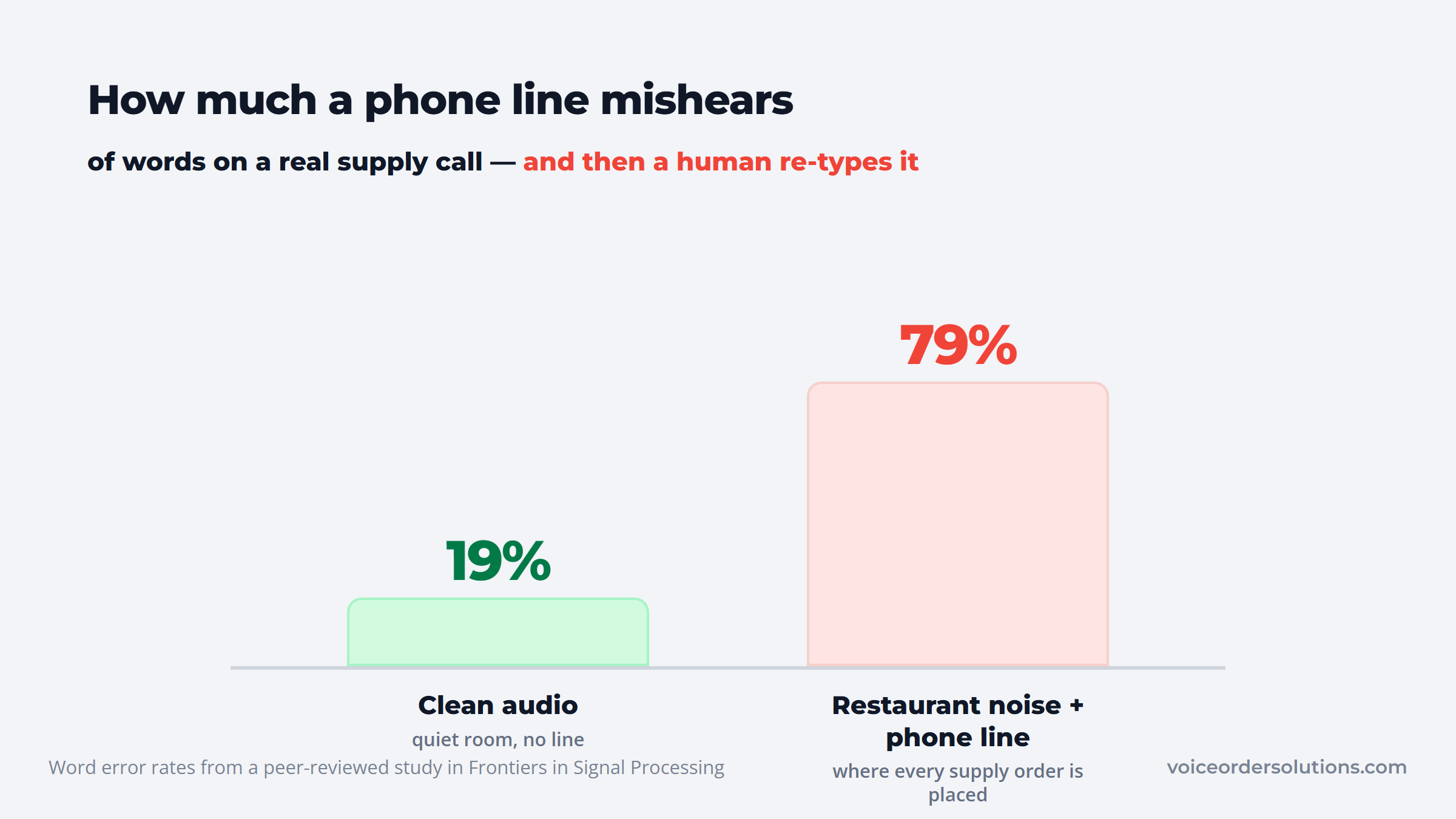
The noise problem is not a figure of speech. A peer-reviewed study in Frontiers in Signal Processing tested speech recognition against realistic conditions and found word error rates climbing from 19% on clean audio to 79% once background noise and normal phone-network distortion were combined. The noise samples the researchers used included restaurant ambience specifically.
That is the environment every supply order gets placed in. Then a human transcribes it.
Strip the marketing off any AI phone ordering system aimed at distributors and the same five steps show up. The order gets captured, matched against a catalog, checked for problems, confirmed, and handed to whatever system the distributor already runs.
Here is the sequence, from the moment someone speaks to the moment the order lands in the system of record.
Step 2 is where the technology earns its keep, because ordering language is genuinely sloppy. Nobody calls their rep and recites SKU numbers. They say "more of the big shrimp" and expect the rep to know.
The verify step is the one to interrogate when a vendor demos. An AI that books every order it hears without pausing is not saving you work; it is producing errors faster than a human could.
What you want is an exception path. The order goes through, but the two lines it could not resolve get held and routed to a person, with the original audio or text attached so they can check it in seconds instead of calling the customer back.
Choco describes running roughly half of orders automatically in its autopilot mode and flagging the rest for review. That is the shape of the thing: most orders clear, the odd ones surface.
Ask any vendor what percentage of orders need a human touch, and what happens to the ones that do. A tool with no answer has not solved the hard part.
For a distributor, AI phone order taking is an order-desk story before it is a technology story. Reps spend their morning transcribing instead of selling. Moving that intake into B2B order taking software hands the morning back to selling.
And the transcription is lossy long before anyone mishears a quantity.
The numbers vendors publish here are self-reported, so treat them as direction rather than fact. Choco says a 40-line order that takes 7 to 8 minutes to type by hand drops under 30 seconds through its review interface, and that distributors save 2 to 3 hours per rep per day. Pepper claims AI-assisted ordering runs about 2.5 times faster than manual entry. Hours per rep is the number that matters, because distributor sales software is meant to move that time from writing reorders to selling.
VoiceOrder Solutions reports 20 to 30 minutes saved per order, with every order carrying a unique number, date, and timestamp, and after-hours orders captured and queued rather than lost to voicemail. For independent distributors, VOS puts setup at 24 to 48 hours, since the work is mostly loading order guides rather than replacing systems.
The common thread is that none of these tools replace the ERP. They feed it. If you are evaluating the system underneath, that is a separate question covered in ERP software for distribution, and the wider intake step is covered in automated order processing.
On the restaurant side, AI phone ordering for restaurants is less about hours saved and more about when and how the order gets placed. Ordering happens in the cooler, not at a desk. That is one slice of a much wider field, and most AI for restaurants sits in the back of house rather than on the phone.
That is the practical appeal of talking an order rather than typing it. VoiceOrder Solutions is built around exactly that motion: staff open the app, call the order out while walking the facility, and the order auto-saves if service interrupts them halfway through, resuming from the same point rather than starting over.
The order guide is personalized per customer, tied to that distributor's pricing and SKUs, so the item names match what the kitchen actually calls things.
The 24/7 piece matters more than it sounds. An order thought of at 11 p.m. after close gets captured then, instead of surviving in someone's memory until morning. For operators comparing approaches, the order management breakdown covers what changes at the intake step.
The procurement side of this category is young, and most of what is written about it comes from the vendors themselves. Every tool below is quote-based, with no public pricing, so cost comparison means demos rather than pricing pages.
| Tool | Approach | Pricing |
|---|---|---|
| VoiceOrder Solutions | Voice-placed orders from an iOS/Android app, digitized and timestamped, delivered by email, EDI, API, or QuickBooks | Available on request |
| Choco | Ingests orders arriving by email, PDF, voicemail, and text, pushes them to the ERP with a review-and-approve step | Available on request |
| Pepper | Distributor ordering platform with AI-assisted order entry and ERP integrations | Available on request |
| Burnt | Ingests orders from email, text, voicemail, WhatsApp, EDI, and portals, routes exceptions to sales, ops, or finance with an audit trail | Available on request |
| Cut+Dry | Distributor ordering and ecommerce platform with an early-stage AI order desk | Available on request |
Read the accuracy claims carefully. Burnt publishes 99.99% order accuracy and Choco cites 97% after training on a customer's order history, but both are self-reported against unpublished test sets, and none of these companies define accuracy the same way.
What is comparable across a demo is narrower: how the tool handles your actual product names, your actual noisy callers, and your actual exception volume. A fuller look at the category sits in wholesale order management software.
Adoption data on this is better than the marketing suggests, and less flattering. IFDA surveyed foodservice distributors for its 2025 technology report and found AI use roughly tripled from 12% in 2023 to about a third of distributors in 2025, with ordering and ecommerce the single most common use case at 56%.
The same report found nearly one in three distributors who adopted AI said it underperformed what they expected.
The full picture has one number the case studies leave out.
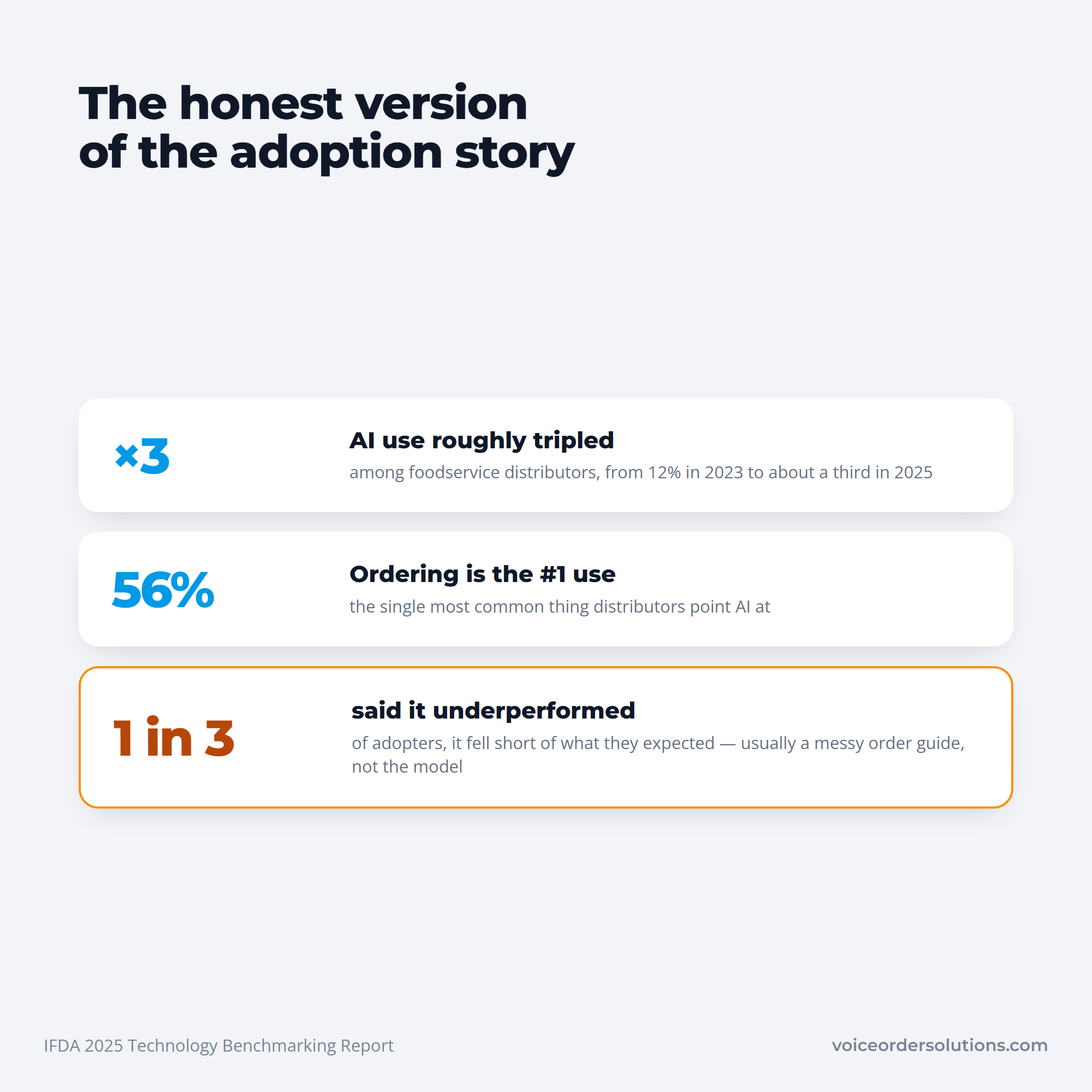
That gap is worth taking seriously, because the failure modes are predictable. A catalog full of inconsistent product names gives the matching step nothing to work with. A customer base that orders through eight channels means automating one channel moves less than you hoped. And a team that does not trust the exception queue will re-check every order by hand, which leaves you with the old process plus a subscription.
None of that argues against the tools. It argues for fixing the order guide first and automating second.
Rollouts fail on data, not technology. The order guide is the thing that decides whether matching works, so it goes first.
Run it in this order, and treat each step as a gate rather than a task to tick off.
Timelines vary with how much history the system needs. Choco describes training on up to 12 months of order data over a 2 to 4 week rollout, while Burnt says most customers go live in 1 to 2 weeks, stretching to 30 to 60 days against legacy ERPs.
VoiceOrder Solutions, which uses a proactively-placed voice order rather than parsing inbound messages, puts independent-distributor setup at 24 to 48 hours because there is less to learn. Ordering guides and their setup are covered further in customizable ordering software.
Pick your baseline before you switch anything on, because the interesting numbers are all comparisons. Most teams discover they never measured order-entry accuracy at all and cannot say whether the AI improved it.
| Metric | What it tells you | Where to start |
|---|---|---|
| Exception rate | Share of orders needing a human; the honest measure of how much work moved | Falls as the order guide improves |
| Time per order | Minutes from received to booked, versus your manual baseline | Compare against a hand-keyed week |
| Order accuracy | Lines delivered matching lines intended | Requires a baseline you probably lack |
| After-hours capture | Orders taken outside business hours that used to wait | Was effectively zero on voicemail |
| Rep time reclaimed | Hours moved off transcription | Only real if the time goes somewhere useful |
The last one is where the business case lives or dies. Hours saved at the order desk only count if reps spend them selling rather than absorbing more admin. Accuracy is worth tracking past the intake step too, since a clean order can still go wrong once it reaches the floor, which is what the warehouse management process covers.
There is a reason this unglamorous corner works while splashier AI projects stall. A developer who automated workflows for a Dallas foodservice wholesaler described it well on Reddit, where a commenter argued these agents succeed because the workflows are already well defined and the failure modes already understood.
Nobody needs the agent to invent how to place an order. The process exists and is documented. What they need is something to run that process without variation at 2 a.m.
That is one developer's opinion, not a study. But it explains why IFDA found ordering the most common AI use case among distributors: order intake is bounded, repetitive, high volume, and has a correct answer you can check against a catalog. Those are the conditions under which this technology is reliable.
Compare that to forecasting demand or pricing dynamically, where the right answer is contested and nobody can tell you the model was wrong until the season ends. Ordering gives you feedback tomorrow, on the truck.
If your reps still spend their mornings replaying voicemails, the phone is not the thing to eliminate. It is the thing to instrument. The call works because it is the one channel every customer already knows how to use, and killing it usually means pushing customers onto a portal they will not adopt.
Start by timing one week of order entry and counting how many orders needed a callback to clarify. That number, more than any vendor claim, tells you whether phone ordering AI is worth a demo. Then fix the order guide, because no system matches what your catalog cannot name.
Distributors and operators weighing voice-based order intake can contact VoiceOrder Solutions for a demo, or read how the ordering flow works end to end.
Phone ordering AI is software that turns a spoken or phoned-in order into a structured, confirmed order without a person re-typing it. The term covers two separate markets: AI that answers guest calls for takeout, and AI that handles the restocking orders restaurants place with their distributors. They share a name and almost nothing else, since the second deals with dozens of lines against negotiated pricing and specific SKUs.
No, and conflating them is the most common mistake in this category. An AI phone ordering system for restaurants usually means a voice agent answering diner calls and sending tickets to the POS. Restaurant phone order AI aimed at the supplier side does the opposite job: it captures a supply order and pushes it into an ERP. The technology overlaps, but the catalogs, error costs, and buyers do not.
Accuracy depends far more on your catalog than on the model. Vendors publish figures from 97% to 99.99%, all self-reported against unpublished tests and defined differently by each company. A peer-reviewed study in Frontiers in Signal Processing found speech recognition word error rates rising from 19% to 79% once realistic background noise and phone-network distortion were combined, which is why the exception path matters more than the headline accuracy number.
No. These tools feed the ERP rather than replace it, delivering a structured order into whatever system you already run through EDI, an API, email, or QuickBooks. VoiceOrder Solutions works the same way, layering on top of existing systems rather than swapping them out. If your ERP is the actual bottleneck, order intake automation will not fix it.
It ranges from days to a couple of months, depending on how much historical data the system needs. Choco describes training on up to 12 months of order history over a 2 to 4 week rollout.
VoiceOrder Solutions puts setup for independent distributors at 24 to 48 hours, because it captures a proactively-spoken order rather than parsing inbound messages. Either way, the variable that actually drives the timeline is how clean your order guide is on day one.