.webp)
Key takeaways:
In 2026, restaurant automation is key to handling rising labor costs, staff shortages, and guests’ growing need for fast, accurate service. If you want to keep up, using smart tools and systems is a must.
This article will show you where automation saves the most time: from front-of-house to the kitchen. We’ll cover practical areas to focus on, helpful software options, and strategies tailored for different restaurant types and sizes.
You’ll get clear insights and decision tips that help you work smarter, not harder. Whether you run a small café or a busy chain, mastering restaurant automation technology can boost efficiency and improve guest satisfaction. Let’s explore how these tools can transform your daily workflows and save you valuable time.
Restaurant automation boosts efficiency in many key areas. It helps speed up ordering and guest interaction, streamlines kitchen production, improves delivery, manages inventory better, and simplifies back-office tasks. These time-saving improvements let your team focus on great food and friendly service without extra hassle.
With restaurant order automation, customers can place orders quickly through kiosks, tablets, or apps. This reduces wait times and cuts down mistakes made by busy staff.
Here’s what automation brings to guest interaction:
Moving to the kitchen, automation technology keeps food preparation steady and precise.
Restaurant kitchen automation and kitchen automation AI keep cooking on track. Machines measure ingredients, control cooking times, and alert staff about progress. This means food prep is consistent and faster. It also cuts down stress during busy hours because the kitchen team gets support instead of extra work.
Now, let’s look at how delivery and inventory management benefit from automation.
Automation in the restaurant industry improves delivery accuracy through smart tracking and routing tools. This ensures orders reach customers on time, every time, boosting satisfaction.
Inventory and supply management gets a makeover with restaurant automation software. It tracks stock in real-time, triggers reorder alerts, and reduces waste. This saves time spent on manual checks and stops costly shortages. And for the reordering side, tools like VoiceOrder Solutions let restaurant buyers place distributor orders by voice while walking the floor, saving 20–30 minutes per order.
Back-office tasks are simplified too. Scheduling, payroll, and sales reports run smoothly with restaurant workflow automation, freeing managers for higher-value work.
Here’s a quick summary of the time-saving benefits across key areas:
| Operational Area | Key Benefits |
|---|---|
| Ordering & Guest Interaction | Faster orders, fewer errors, better service |
| Kitchen Production | Consistent cooking, faster prep, stress reduction |
| Delivery | Improved accuracy, timely orders |
| Inventory & Supply | Real-time tracking, waste reduction, reordering alerts |
| Back Office | Automated reports, easier scheduling, payroll accuracy |
Restaurant automation supports your team. It doesn’t replace the chefs or servers. It helps them be more efficient so your guests get a better experience from start to finish.
Restaurant automation is changing how the dining experience flows. It helps cut down waiting times and frees up staff to focus on guests. Let’s dive into some of the best tools that streamline front-of-house tasks.
Self-service kiosks are a game-changer. Big names like McDonald’s and Panera use kiosks where customers can order and pay on their own. QR code menus, like Menulux or TechRyde Order Taker, let diners browse and order directly from their phones.
Here are key features that make these tools work smoothly:
These benefits add up to shorter lines, faster orders, and fewer mistakes.
Managing bookings and guest questions can take up a lot of staff time. Restaurant automation software like Hostie AI virtual concierge, or platforms integrated with OpenTable and Resy, handle this efficiently. We also use AI phone answering systems, similar to what Papa Johns uses with Google Food Ordering Agent, to talk to guests anytime. Guest-facing tools like these are only half of what AI for restaurants covers, and the back-of-house half usually carries less risk.
Check out what these tools can do:
This means smoother reservation flow and less pressure on your front desk.
Robots like Bear Robotics’ Penny help run food to tables and clear dishes, making life easier for your team. Cleaning robots such as Pudu FlashBot keep the floors spotless without manual work. Although these robots require upfront investment and some staff training, they work best in busy spots where speed and efficiency matter most.
Together, these restaurant automation solutions help your venue run like clockwork in 2026. By using self-service ordering, automated communication, and smart robots, you save time and improve guest satisfaction.
Automation in the restaurant industry is a game-changer for saving time and boosting efficiency in both the kitchen and delivery. Let’s dive into how it works for you.
In the kitchen, smart machines and software help speed up meal prep and keep orders accurate. Think of robots like CaliBurger’s Flippy, which flips burgers perfectly every time, or Chipotle’s Autocado that cuts avocados quickly and safely. There are also robotic fryers, smart combi ovens, and portion dispensers that keep food quality consistent.
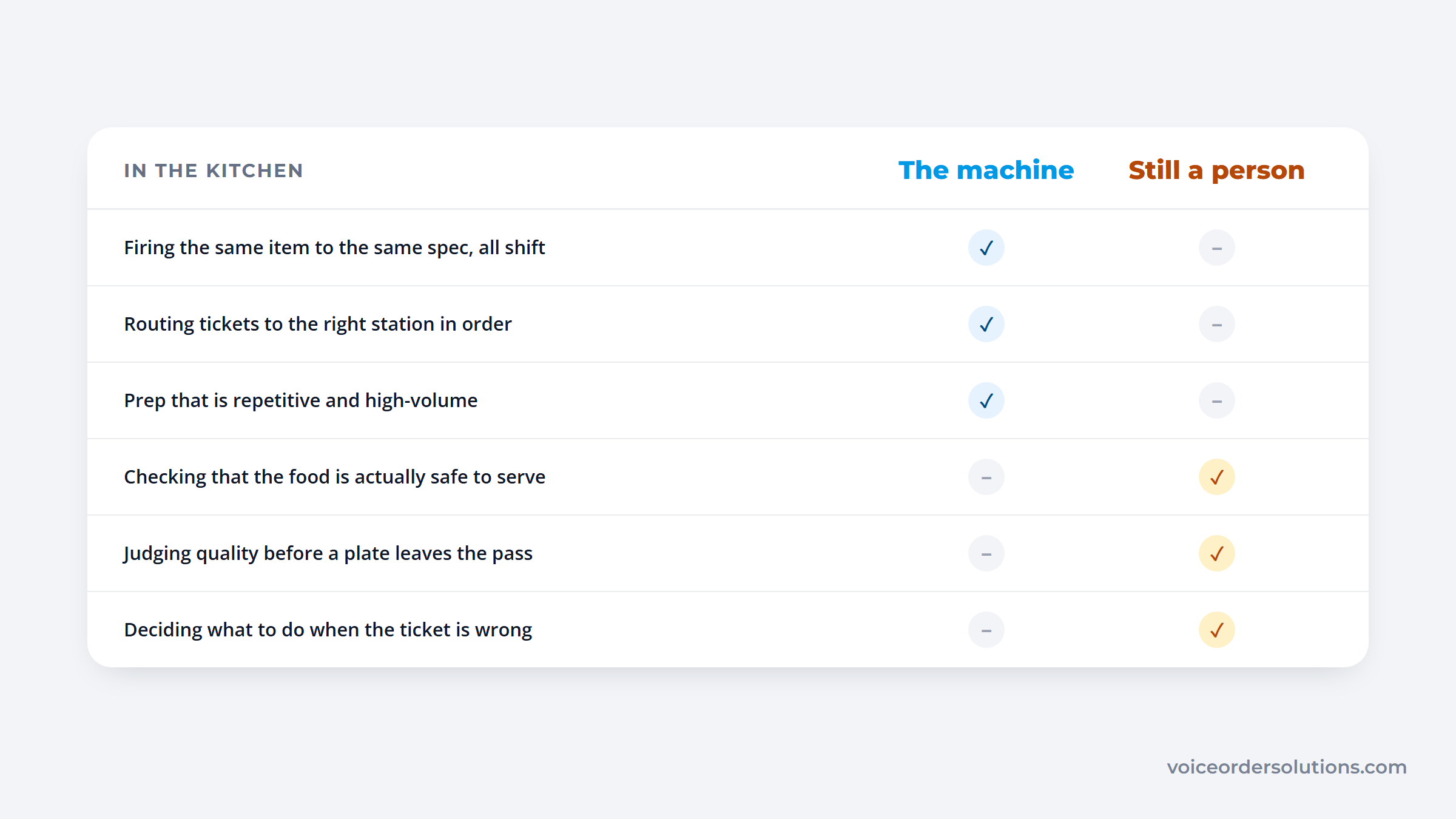
The split is fairly clean once you separate the repeatable jobs from the judgment calls.
Another big help comes from kitchen display systems like Square KDS and TechRyde AI-KDS. These systems organize orders so chefs know exactly what to cook and when. They cut down errors and reduce prep time.
Here’s a quick list of the benefits and some limits:
Delivery is getting faster and smarter thanks to automation too. Companies like Domino’s and Starship Technologies use autonomous delivery robots to bring food right to customers’ doors. This cuts delivery times and keeps food fresh with temperature controls.
Also, AI-driven delivery dispatch platforms optimize routes for drivers. They bundle orders and predict arrival times with 99% accuracy. This means you get your food quicker and restaurants reduce their reliance on human drivers.
Together, these automation solutions boost speed, accuracy, and quality from kitchen to doorstep. If you want to save time and stay ahead in 2026, investing in restaurant workflow automation will give you a big advantage.
Keeping track of inventory and reducing waste is easier with restaurant automation systems. Tools like Square for Restaurants and Apicbase offer real-time inventory management that connects directly with your POS. This means you see stock levels as orders come in, so you can avoid running out or overbuying. Automated reorder alerts pop up when supplies run low, and items automatically hide from digital menus if out of stock. These features lower waste, keep costs under control, and reduce supply chain risks. Simple inventory tracking software does the same job for kitchens that would rather not run their counts through the POS.
VoiceOrder Solutions handles the procurement side of restaurant inventory: ordering stock from your food distributor by voice, hands-free, while walking through the kitchen or storage area. The app captures the order, digitizes it, confirms it, and transmits it directly to the distributor, with no phone call or manual entry.
This removes the two most common procurement problems: transcription errors from phone orders and missed orders placed outside business hours. VoiceOrder Solutions works 24/7, so orders placed after closing are captured and queued automatically.
Each transmitted order updates inventory levels without a separate counting step. For restaurants placing regular distributor orders, this adds up to 20–30 minutes saved per order. The tool integrates via email (PDF, Excel, or Word), EDI, API, or QuickBooks direct, and takes 24–48 hours to set up.
Next, let’s look at how automation improves procurement and vendor management:
This saves time, improves accuracy, and helps control costs. With less manual work, your team can focus on what matters most.
Managing your workforce is just as important. AI-powered scheduling tools predict labor needs based on sales and traffic patterns so you’re never short-staffed or over-scheduled. Plus, automated onboarding and training videos speed up staff ramp-up time. This reduces burnout, improves retention, and frees up time for better guest service.
Using a solid restaurant automation system lets you run your back-office and kitchen more smoothly. It’s a smart way to save time, cut costs, and keep both customers and staff happy.
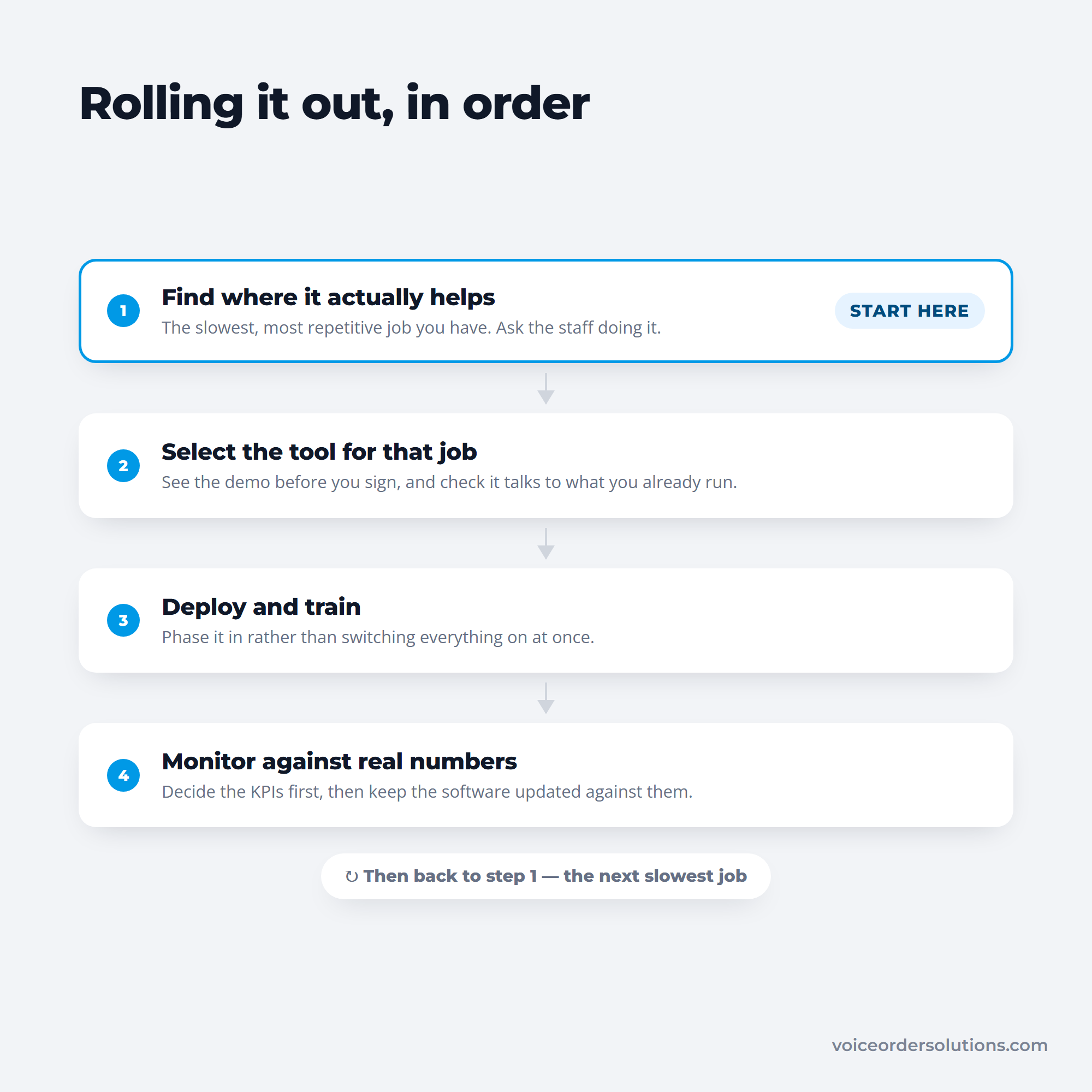
To get the most out of restaurant automation, start by figuring out where it will help the most. A good first step is to track how much time your team spends on repetitive tasks.
The order matters more than the tools, and the first step is the one most operators skip.
You can also survey your staff to learn about their biggest pain points. Knowing what causes slowdowns helps you plan better. Take a close look at your current tech setup to see if it can support new automation tools.
Focus your efforts on areas where automation can have the highest impact. Common spots include order taking, kitchen prep, and delivery logistics. These areas often consume a lot of time and have room for improvement.
Here’s a quick guide to prioritize your automation needs:
By tackling these tasks first, you’ll save time and lower mistakes, which boosts customer satisfaction.
Choosing the right restaurant automation software matters a lot. Look for tools that easily connect with your existing systems, such as POS, inventory, and payment platforms. The system should grow with your business, so scalability is key. The user interface must be simple and clear to keep your team happy and productive. Don’t forget to weigh the cost against the expected return on investment.
Try to see vendor demos before making a final choice. Testing the automation system with real staff helps you understand how it fits into daily work. If procurement is part of your automation scope, it's worth demoing a dedicated voice ordering tool like VoiceOrder Solutions alongside your main stack. It lets restaurant buyers place distributor orders by voice, with orders confirmed and transmitted automatically via email, EDI, or API. No disruption to your existing setup, and no manual re-entry.
Here’s a quick checklist for choosing tools:
| Criteria | Why It Matters |
|---|---|
| Integration capabilities | Keeps all systems working together |
| Scalability | Supports your business growth |
| User interface | Easy to learn and use |
| Cost and ROI | Balances price with benefits |
Finding the right mix of features will make your automation system work well for years to come.
Next, plan how you’ll roll out the technology. Start with simple, quick wins that give a big return, such as self-order kiosks or AI communication bots. This phased approach makes the change less overwhelming and allows your team to adjust gradually.
Training is just as important as the technology itself. Make sure your staff knows how to operate the new system, maintain it, and handle any exceptions that come up. Good training leads to smoother daily operations and less downtime.
Clear goals keep the whole team focused. Set KPIs like:
These numbers will show you how well the restaurant automation is working.
Once your automation system is running, keep a close eye on how it performs. Use analytics dashboards that combine data from POS, kitchen display systems, inventory, and delivery. This way, you get a complete picture of your restaurant operations.
Keep the software and hardware updated regularly. New features and security patches help prevent problems and improve system reliability. Also, stay tuned to industry trends. Automation in the restaurant industry evolves fast, and new AI tools can give you an edge. Keep an eye on laws that affect labor and technology, so you stay compliant.
Consistent monitoring and timely updates keep your restaurant running efficiently and ready for the future.
Restaurant automation brings real benefits you can measure. For example, using restaurant kitchen automation AI and delivery tools can cut labor costs by 30-40%. This means you spend less on staff while keeping up with demand. Orders move faster too, reducing wait times by 20-30%, which guests definitely appreciate. Plus, better tracking and stock management help reduce inventory waste by up to 15-20%. These numbers show how automation in the restaurant industry can save you time and money.
Now, let’s look at some key benefits you can expect:
While these advantages are exciting, some challenges come with automation in restaurants. Staff might resist using new restaurant automation software at first. They’ll need training to use these systems confidently. Not every task fits automation perfectly; for example, quality control still works best in human hands. Resistance drops when the tool removes an obviously tedious job, which is worth weighing as you compare restaurant automation software.
Here’s a quick look at the challenges to keep in mind:
Successful restaurant automation systems combine smart technology with a human touch. We make sure automation helps your team work smarter, not replace the warmth guests expect. Using restaurant workflow automation alongside friendly staff keeps your service smooth and personal.
In short, automation can save you time and costs, improve guest experiences, and still keep your restaurant’s heart intact.
Restaurant automation is changing fast. By 2026, it will be smarter and more connected than ever. One big trend is AI getting into every part of operations: from predicting how much food you’ll need to scheduling the right number of staff. This helps cut waste and keeps things running smoothly.
Robots will also play a bigger role. More kitchens will use robotic food prep to speed up cooking and keep quality consistent. Autonomous delivery robots will become common, helping get orders to customers quickly and without extra labor costs.
Menus won’t be fixed anymore. Dynamic menus will change based on the weather, time of day, and what customers like. This means offering hot drinks on cold days or promoting lunch specials when the restaurant is busiest.
A key shift will be platforms that tie everything together. Imagine one system handling your POS, inventory, marketing, and guest management all at once. Solutions like Bloom Intelligence AI Marketing and Menulux are great examples. These fully integrated platforms make running a restaurant simpler and more efficient.
Here’s what you can do to get ready:
To help you see the practical benefits, here’s a quick table comparing traditional processes with future automation features:
| Operational Area | Key Benefits |
|---|---|
| Ordering & Guest Interaction | Faster orders, fewer errors, better service |
| Kitchen Production | Consistent cooking, faster prep, stress reduction |
| Delivery | Improved accuracy, timely orders |
| Inventory & Supply | Real-time tracking, waste reduction, reordering alerts |
| Back Office | Automated reports, easier scheduling, payroll accuracy |
With restaurant automation software improving every day, getting ahead now means saving time, cutting costs, and delivering better service in the years to come.
Using restaurant automation technology can save you time across every part of your business. From front-of-house ordering to kitchen prep, delivery, inventory tracking, and back-office tasks, automation streamlines workflows and cuts hours of busywork.
Focus on these key areas to get started:
To make the most of these tools, take a strategic and phased approach. Begin with systems that easily integrate into your current setup.
Train your staff thoroughly, so everyone feels confident using the technology. Then, keep improving by gathering feedback and updating tools regularly.
Restaurant automation solutions enhance your team’s work. They don’t replace people. This approach boosts both efficiency and guest experience. For restaurants that still rely on phone calls to restock from their food distributor, it’s also worth adding a dedicated procurement tool to the mix. VoiceOrder Solutions handles those orders by voice, confirms them automatically, and delivers them to your supplier, saving 20–30 minutes per order without any manual entry.
For lasting success, partner with trusted vendors, explore demos, and stay ahead by tracking new automation in the restaurant industry trends. That way, your restaurant keeps growing smarter and faster.
Restaurant automation can speed up ordering and reduce mistakes, helping guests get their food faster and more accurately. It also allows staff to focus more on personal service, making guests feel welcome and cared for without long waits or confusion during ordering.
Smaller restaurants need easy-to-use tools that fit their budget and current setup. Look for automation in restaurant industry systems that can grow with your business without a lot of extra costs or complexity. Training and support are also key to making new tech work well.
Yes, restaurant kitchen automation AI helps monitor inventory and usage better than manual checks. It tracks when items run low and adjusts prep levels to prevent overcooking. This means less waste and lower costs with fewer mistakes in stock management.
Staff might resist new tech at first, and there’s a learning curve. Also, some tasks can’t be fully automated, like quality checks. It’s important to train employees well and keep human oversight to ensure everything runs smoothly and maintains high standards.
Automation in restaurant industry fills gaps by handling repetitive tasks like order taking and inventory tracking. This lets staff focus on guest interaction and cooking. It reduces pressure during busy times and helps keep the restaurant running well even with fewer workers.