.webp)
Key takeaways:
Every restaurant tech vendor now stamps "AI" on the box, and it is hard to tell which tools actually save you time and which just sound modern. The honest answer is that some do a lot and some do very little, and the difference is rarely the guest-facing gimmick that gets the press.
Deloitte's 2025 State of AI in Restaurants survey found 73% of restaurant leaders expect to spend more on AI in the coming year, with more than half already using it daily in inventory management. That sample skews toward big chains, so treat the numbers as where the industry is heading, not where the average independent already is.
This guide sorts AI for restaurants into what it actually does: the guest-facing tools worth a careful look, the back-of-house tools that quietly save real hours, and the one job (getting an order placed without an error) where AI pays off on both sides of the counter. Where a tool's pricing or claims come from a vendor, this guide says so.
"AI for restaurants" is not one thing. It is a label on dozens of tools that do completely different jobs, and lumping them together is why the category feels like noise. The useful first move is to split it in two.
Front-of-house AI faces your guests: phone-answering systems, chatbots on your website, reservation assistants, self-serve kiosks, and drive-thru voice ordering. Back-of-house AI faces your operation: inventory optimization, demand forecasting, staff scheduling, invoice processing, and placing restocking orders to your suppliers.
Both can save time, but they carry different risks. A back-of-house forecasting tool that gets it wrong costs you some over-ordering. A guest-facing bot that gets it wrong costs you a customer, in public. That difference should shape where you experiment first.
| Front-of-house (guest-facing) AI | Back-of-house AI | |
|---|---|---|
| Examples | Phone answering, chatbots, reservations, kiosks, drive-thru voice | Inventory optimization, demand forecasting, scheduling, supplier ordering |
| Main payoff | Catch missed calls and orders, faster service | Cut labor hours, waste, and order errors |
| Main risk | A bad interaction loses a guest publicly | A bad output costs money quietly |
| Where to start | Only with a human fallback | Highest-volume, most repetitive tasks first |
Most of the durable savings live on the right-hand column, in the tasks nobody enjoys and everybody repeats. That includes the one this guide keeps coming back to: getting a supplier order placed correctly, which is where a tool like VoiceOrder Solutions fits on the back-of-house side.
The loudest corner of restaurant AI is the guest-facing phone. An AI phone answering system for restaurants, sometimes sold as an AI receptionist for restaurants or an AI answering service, picks up when staff cannot, takes orders or reservations, answers hours-and-menu questions, and texts a payment link. An AI chatbot for restaurants does the same on your website.
The case for it is real. Missed calls are missed orders, and a host stuck on the phone is not seating tables. Vendors report strong numbers: Popmenu says its answering tool saved one pizzeria from roughly 40 calls a day.
Prices vary by tier. CloudTalk's 2026 roundup lists Slang.ai from about $379 a month and Loman AI from about $199 a month, figures reported in that comparison rather than verified here, so confirm current pricing with each vendor.
Here is the catch most vendor pages skip: guests notice, and some hate it. On Reddit, diners describe walking away from restaurants that made them talk to a bot, with one writing that reaching an AI to order a pizza was "a super turn off" and another saying they stopped ordering from local spots that used it. The anger lands on the restaurant, not the software vendor.
The workable version keeps a human within reach. If you use guest-facing phone or chat AI, make "talk to a person" a one-step option, use it to catch overflow and after-hours calls rather than to replace your host, and listen to how regulars react before you scale it. VoiceOrder Solutions does not play in this guest-facing space at all; its voice AI points the other direction, at your suppliers, which the next section gets into.
"Voice AI for restaurants" and "AI voice agent for restaurants" get searched as if they mean one thing, but they cover two opposite jobs, and confusing them leads to buying the wrong tool.
The first job is guest-side voice: an AI that takes a customer's order at the drive-thru or over the phone. Big chains are piloting it (White Castle with SoundHound, Wendy's with Google Cloud), and vendors like Kea handle phone orders with speech recognition tied to the POS. This is the same guest-facing category as the phone-answering tools above, with the same upside and the same backlash risk.
The second job is staff-side voice: an AI that lets your own team place a restocking order to a distributor by speaking it, instead of phoning it in or writing it down. This is the quieter, lower-risk use, and it maps directly onto a real daily headache. The case for voice ordering in restaurant operations rests on that headache, because the time it gives back lands on the same shift that placed the order.
One restaurant manager described the problem on Reddit: phone calls are still the main way orders get placed, alongside messy handwritten counts, and the process "is prone to mistakes and miscommunication" with no way to confirm what was actually ordered.
The two jobs share a technology and nothing else. One talks to your customers, where a mistake is public and personal. The other talks to your suppliers, where a mistake is a wrong delivery you pay for.
| Dimension | Guest-facing voice AI | Supplier-facing voice ordering |
|---|---|---|
| Who talks to it | Your customers | Your own staff |
| Job | Take a guest's order or booking | Place a restocking order to a distributor |
| Cost of a mistake | A lost, annoyed customer | A wrong or missed delivery |
| Backlash risk | High (guests resent bots) | Low (internal, no guest sees it) |
For most independent operators, the supplier-facing side is the safer place to let AI save real time, because no guest ever touches it.
VoiceOrder Solutions is a voice-powered ordering tool for the supplier side. Staff open the app and speak a restocking order while walking the line, hands free, and the order is digitized, confirmed against the customer's order guide, and timestamped before it goes to the distributor. Because nobody retypes a phone call or a paper note, the transcription errors that come from re-keying disappear.
A few things that matter for saving time and cutting errors:
The payoff is concrete: the roughly 30 minutes a week many operators spend phoning orders shrinks, and the orders that go out are right the first time. It handles the ordering step, not your inventory counts or your guest service, so it sits alongside whatever else you run. You can see the flow on the VoiceOrder Solutions How It Works page.
On the distributor side, tools like Pepper and Choco digitize inbound orders from voicemail, text, and email for the supplier receiving them, solving the same problem from the other end.
Inventory is where back-of-house AI has the longest track record, and Deloitte's survey shows it: more than half of the restaurants surveyed already use AI in inventory management daily. AI-powered inventory optimization for restaurants means software that tracks stock, predicts what you will use, and flags problems before they hit service.
The concrete jobs it does well are worth naming, because "optimization" alone means nothing:
One example of how far this goes: Winnow puts a camera over the bin to log what gets thrown away, then feeds that back into purchasing. The point of all of it is the same, spend less on food you never sell, and it is a core piece of wider restaurant automation.
Optimization only helps if the resulting order actually gets placed correctly, which is the hand-off where a clean ordering step matters. A forecast that says "order 12 cases" is worth nothing if a rushed phone call turns it into 20.
Demand forecasting is the engine under good inventory and labor decisions, and pairing it with a clean restaurant inventory list is one of the clearest AI wins, because the inputs are messy in ways humans handle badly. The question operators ask, how do restaurants use AI for demand forecasting, has a practical answer.
Good forecasting tools pull from four kinds of signal, not just last year's sales.
Vendors like Fourth and Apicbase fold these signals into forecasts that drive both ordering and scheduling. The output is a number you can act on: how much to prep, how much to order, and how many people to put on the floor. Used well, forecasting is what connects a busy Saturday you can see coming to an order and a schedule that are ready for it. Those two are far from the only options, and the wider field of restaurant forecasting software splits fairly cleanly between reporting and prediction.
Labor is the restaurant industry's hardest cost to control, and its worst retention problem. The Bureau of Labor Statistics reports that accommodation and food services had a quits rate of 4.3% in May 2026, more than double the all-industry average and the highest of any major sector. Constant turnover makes scheduling a grind, which is exactly the repetitive work AI is good at.
The churn behind that grind is worse in this industry than almost any other.
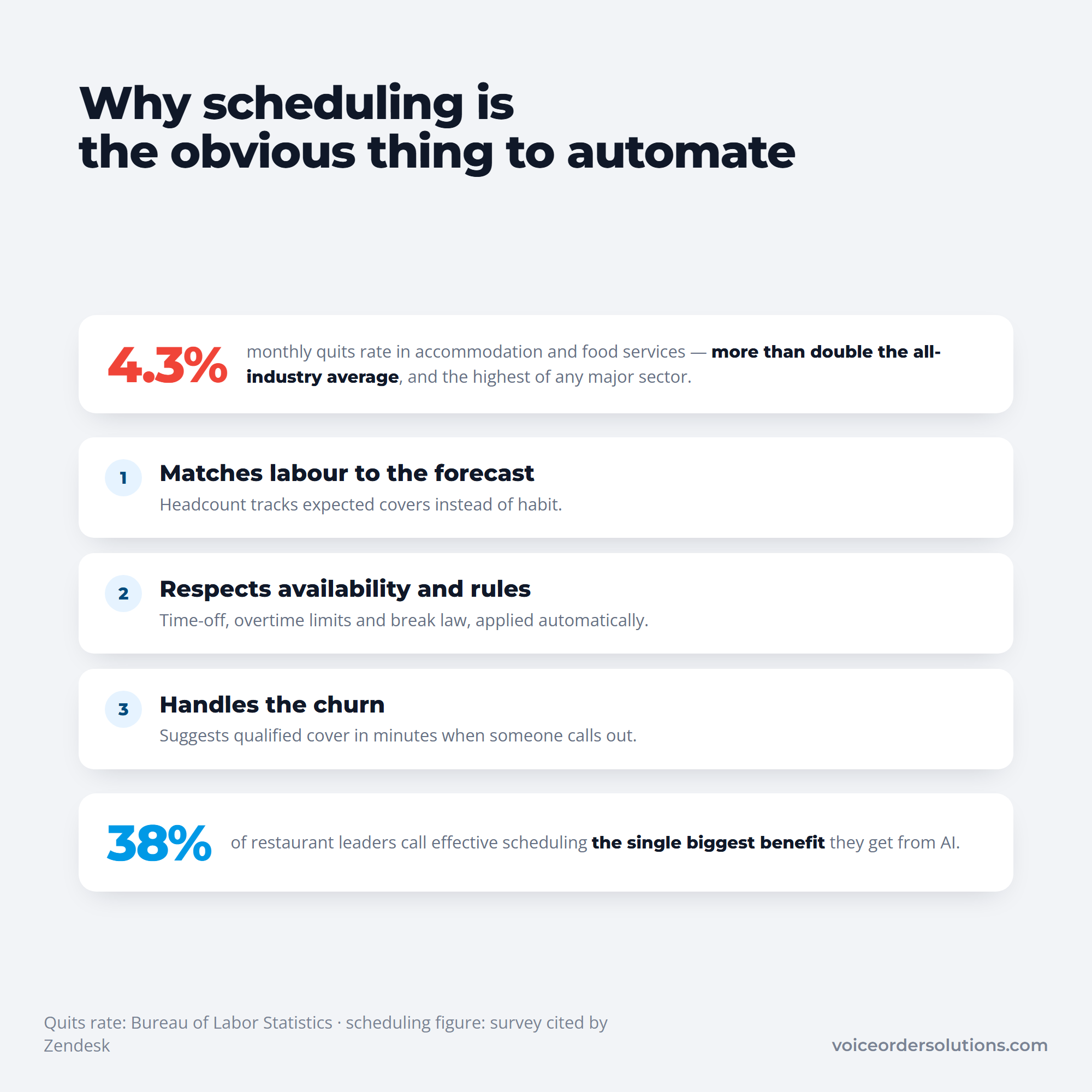
AI employee scheduling software for restaurants builds shift schedules from demand forecasts and staff availability, then adjusts on the fly. Instead of a manager guessing how many servers Saturday needs, the tool sizes each shift to forecasted covers, so you are not overstaffed on a slow lunch or scrambling during a rush.
In practice, the software takes on three jobs a manager would otherwise do by hand.
In a survey cited by Zendesk, 38% of restaurant leaders called effective scheduling the single biggest benefit they get from AI. Tools like Fourth's scheduling suite tie the schedule to the same forecast that drives ordering, so labor and food planning move together instead of in separate spreadsheets. Get scheduling right and you spend less on labor without leaving the floor short.
The fastest way to waste money on restaurant AI is to buy the tool with the best demo instead of the one that fixes your actual bottleneck. The National Restaurant Association's guidance on choosing AI tools lands on a sensible order of operations, and it starts with the problem, not the product.
Work through it before you buy anything:
The operators who get value from AI treat it as a way to remove specific, repetitive work, not as a strategy on its own. Start with the one task that costs you the most time this week, prove the savings, then move to the next.
Strip away the marketing and AI for restaurants comes down to a simple test: does it remove real, repetitive work without creating a new problem? Guest-facing phone and chat tools can, but only with a clean path to a human, because diners will punish a bot that traps them. The safer, steadier savings are in the back: forecasting demand, sizing schedules to it, optimizing inventory, and capturing supplier orders cleanly.
That last one is the least glamorous and one of the most reliable. If phoning and re-keying restocking orders is where your time and accuracy leak, contact VoiceOrder Solutions to see how voice ordering closes that gap. Pick the task that costs you the most, let AI take it, and judge every tool by the hours it actually gives back.
AI for restaurants is a broad label for software that automates restaurant tasks, split into guest-facing tools (phone answering, chatbots, reservations, kiosks, drive-thru voice ordering) and back-of-house tools (inventory optimization, demand forecasting, staff scheduling, invoice processing, and supplier ordering). The guest-facing tools get the attention, but the back-of-house tools usually save more time and money with less risk. Not all of it is AI either, and plenty of the most useful restaurant automation software runs on ordinary rules rather than models.
It can catch missed calls and after-hours orders, but it carries a real risk: diners on Reddit report leaving restaurants that forced them to talk to a bot. If you use an AI phone answering system, an AI receptionist, or an AI answering service for restaurants, keep a one-step option to reach a human, use it for overflow rather than as a full replacement, and watch how regulars react before scaling it.
Restaurants use AI for demand forecasting by feeding it sales history, live weather, local events, and seasonality, then getting back a prediction of how much they will sell by item and by day. That forecast drives how much to prep, how much to order, and how many staff to schedule, so a busy day you can see coming is one you are actually stocked and staffed for.
Yes, on both sides. Guest-facing AI can confirm a customer's order before it is submitted, and supplier-facing voice ordering removes the manual re-typing that causes most restocking errors. Tools like VoiceOrder Solutions let staff speak an order that is digitized, confirmed, and timestamped before it reaches the distributor, so wrong quantities and missed items do not slip through.
Guest voice AI takes a customer's order at the drive-thru or over the phone, where a mistake is public and can cost you the customer. Supplier voice ordering lets your own staff place a restocking order to a distributor by speaking it, where a mistake is an internal delivery issue no guest ever sees. They use similar technology for opposite jobs, and the supplier side is the lower-risk place to start.