.webp)
Key takeaways:
A disambiguation first, because search results for this term are a mess. This article is about Pepper at usepepper.com, the AI platform for independent food distributors run by Pomegranate Technologies. Not PepperHQ, the UK hospitality platform, not Keurig Dr Pepper, and not substitutes for black pepper.
The real Pepper competitors barely surface in a plain search. Pepper's own comparison pages name Cut+Dry, GrubMarket, BlueCart and ZiiZii; the wider set adds AI order-intake tools, B2B ordering platforms and the ERP suites that swallow the function whole.
Wholesale food is a large market to automate: Census Bureau figures put grocery and related product merchant wholesalers at $1,262.9 billion in 2022, up 12.8% on the year before.
This guide covers 12 Pepper alternatives: what each does, published pricing where it exists, and each one's honest limitation. Entries are ordered by fit for the small to mid-size food distributor Pepper itself targets.
Pepper sells to independent food distributors rather than to restaurants. Its central product, Order Agent, takes orders arriving by voice, text, email, photo, PDF or handwriting and turns them into structured orders inside the distributor's order management system, which removes the order desk's retyping.
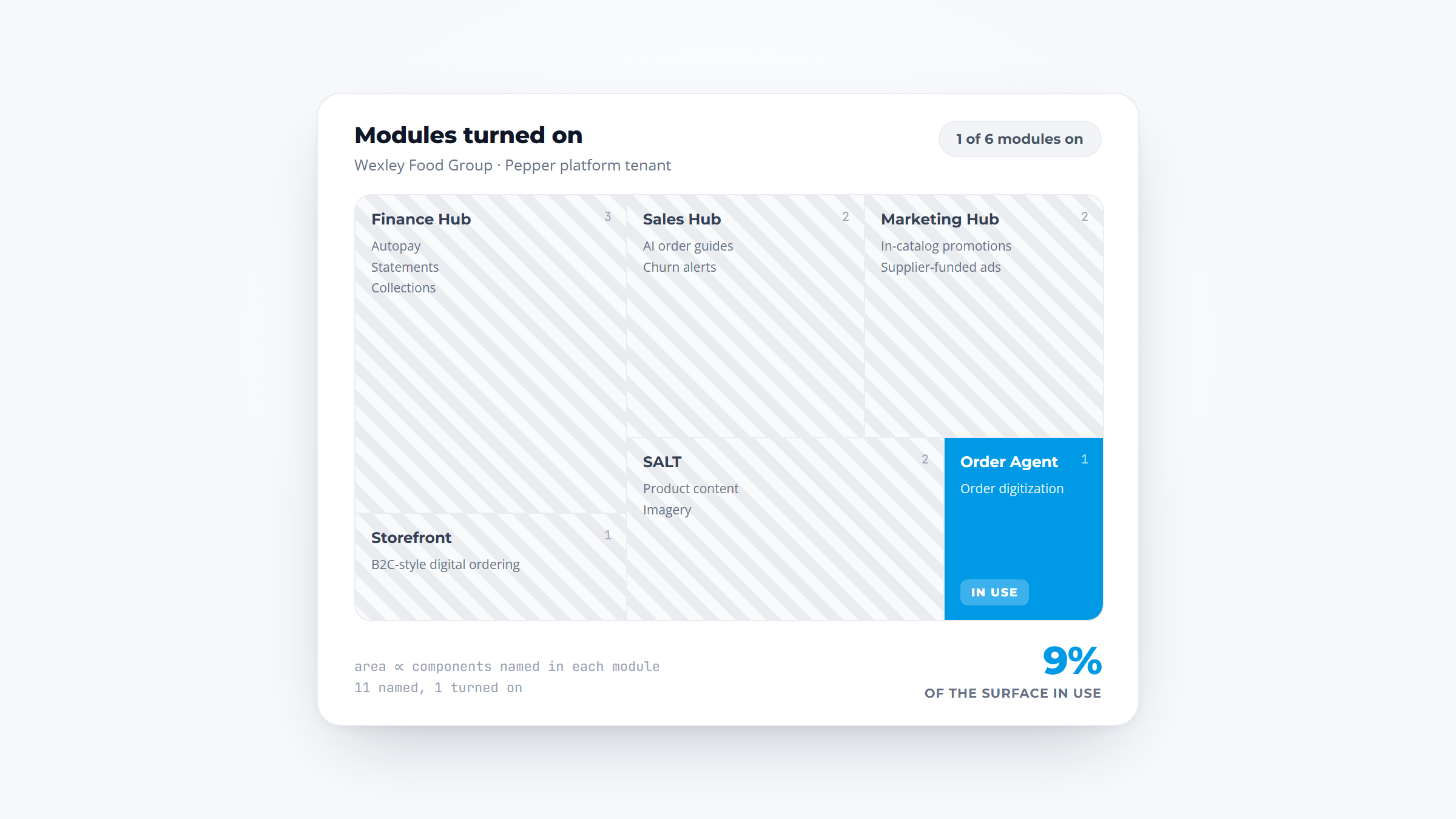
Around it sit four more hubs: Storefront for B2C-style digital ordering, Sales Hub for AI-generated order guides and churn alerts, Marketing Hub for in-catalog promotions and a supplier-funded ad program, and Finance Hub for autopay, statements and collections. Newer modules add Price Management, pitched at capturing more margin, and SALT, which enriches product content and imagery.
The company reports over 500 independent distributors and 100,000 active operators, and says it has integrated with 70 or more ERP systems. Its pricing page claims a 23% or better increase in sales, 10 or more hours saved weekly per rep, and a two-day fall in days sales outstanding. All vendor figures, none audited.
That breadth is the product's strength and the reason people shop around. A distributor buying Pepper is buying a platform, not a feature.
The underlying problem is real enough to justify either. A founder building an order-entry tool relays on Reddit what wholesale food operators told them: one company runs 60 orders a day at about five minutes each to type into Excel, five hours of data entry daily for a team of 12, with accuracy named as its biggest concern.
None of these is a dealbreaker alone. Together they explain most shortlists.
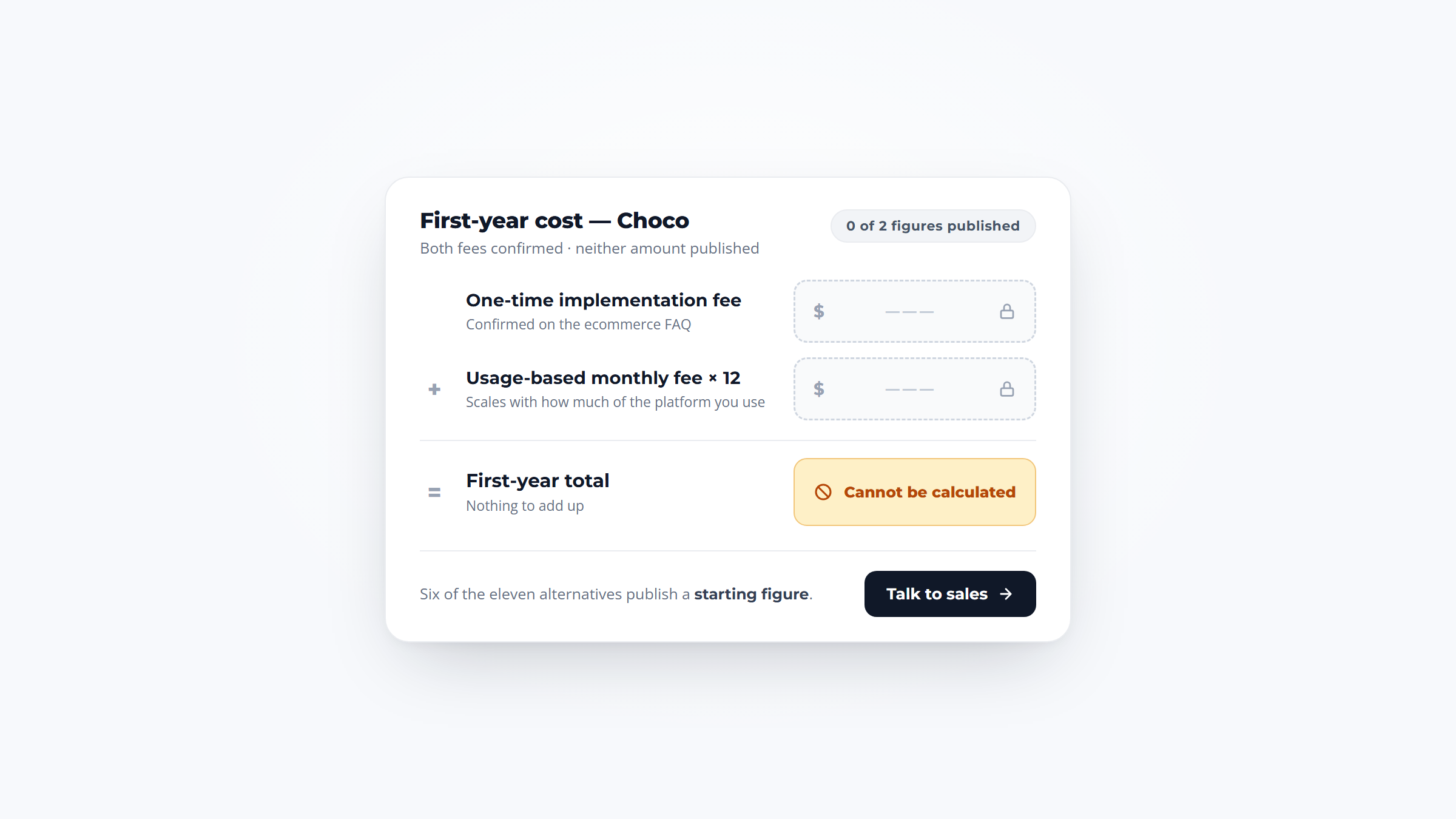
Start with the pricing. Pepper's page carries no tier, no floor and no range, describing a pay-for-performance philosophy and inviting a conversation. That is a common, legitimate model: five of the twelve entries below, VoiceOrder Solutions among them, also quote rather than publish.
If you want to model cost before a first call, Orderwerks, OrderCircle, Unleashed, B2B Wave, SimplyDepo and inSitu Sales all publish numbers.
The suite is also larger than most order-desk problems. If the pain is 40 voicemails a morning, half a dozen modules spanning marketing, pricing and collections is a wide answer to a narrow question. Modular vendors sell the piece that hurts, and narrower AI phone ordering tools attack the same queue for less.
Independent review data is hard to find as well. Pepper has profiles on G2 and Capterra but no user reviews on either, and searching the name also surfaces PepperHQ, an unrelated UK company, so every proof point is vendor-selected. Several competitors to Pepper do better: Orderwerks carries G2 Fall 2026 badges and a self-reported 4.8-plus average.
Implementation is acknowledged as hard by the company itself. Pepper's distributors page says implementations of this kind typically run over time and over budget, positioning itself as the exception. With no independent reviews to check that against, a cautious buyer wants a second opinion.
Pepper's customer evidence is nonetheless unusually specific: its homepage cites a 3x sales increase at Henry's Foods, 20 hours saved weekly at Delco Foods and 35 days to go live at Pride of the Morning. Most Pepper competitors publish less.
The table compares all 12 at a glance. Pricing is shown as published, and vendors that quote only after a demo are marked plainly rather than left blank.
| Tool | Best for | Key features | Main limitation | Pricing (from) |
|---|---|---|---|---|
| VoiceOrder Solutions | Voice ordering issued to customers | Voice ordering, per-account order guides, 24/7 capture | Voice-first intake, food and beverage only | Custom quote |
| Choco | Distributors wanting network scale | OrderAgent digitization, storefront, foodservice CRM | Broad platform commitment | Custom quote |
| Burnt | AI order intake across every channel | Multi-channel parsing, SKU matching, exception routing | Newest of the group | Custom quote |
| Cut+Dry | Storefront-led distributor ecommerce | Branded storefront, structured catalogs, AR tools | Assumes customers will use a portal | Custom quote |
| SimplyDepo | Field sales plus B2B ordering | Order capture with pricing rules, route execution, offline mobile | Priced per rep, rep-focused | $69/rep/month annually |
| inSitu Sales | DSD routes needing ERP sync | Rep app, warehouse picker app, driver dispatch | Setup fee for ERP integration | $200/month |
| Orderwerks | Regulated and complex distribution | Offline sales app, branded B2B portal, compliance modules | QuickBooks-centric, priced in add-ons | $60/user/month |
| OrderCircle | Smaller wholesale brands | Multi-channel orders, order-history CRM, forecasting | Order caps on lower tiers | $199/month |
| Unleashed | Inventory-led distribution | Multi-location stock, automated reorders, B2B portal | Onboarding priced separately | $99/month |
| B2B Wave | Branded wholesale storefronts | Unlimited orders, custom price lists, rep app | Ecommerce-first, not food-specific | $350/month |
| NetSuite | Distributors replacing the whole stack | Multichannel capture, ATP fulfillment, one suite | Cost and implementation length | Custom quote |
| Acumatica | SMB distributors wanting fixed-price ERP | Distribution management, warehouse ops, order management | Mostly sold through partners | Under $1,495/month (APEX) |
Shortlist two or three Pepper alternatives by pricing model and by how your customers order, then read those closely.
Best for: voice ordering issued to customers
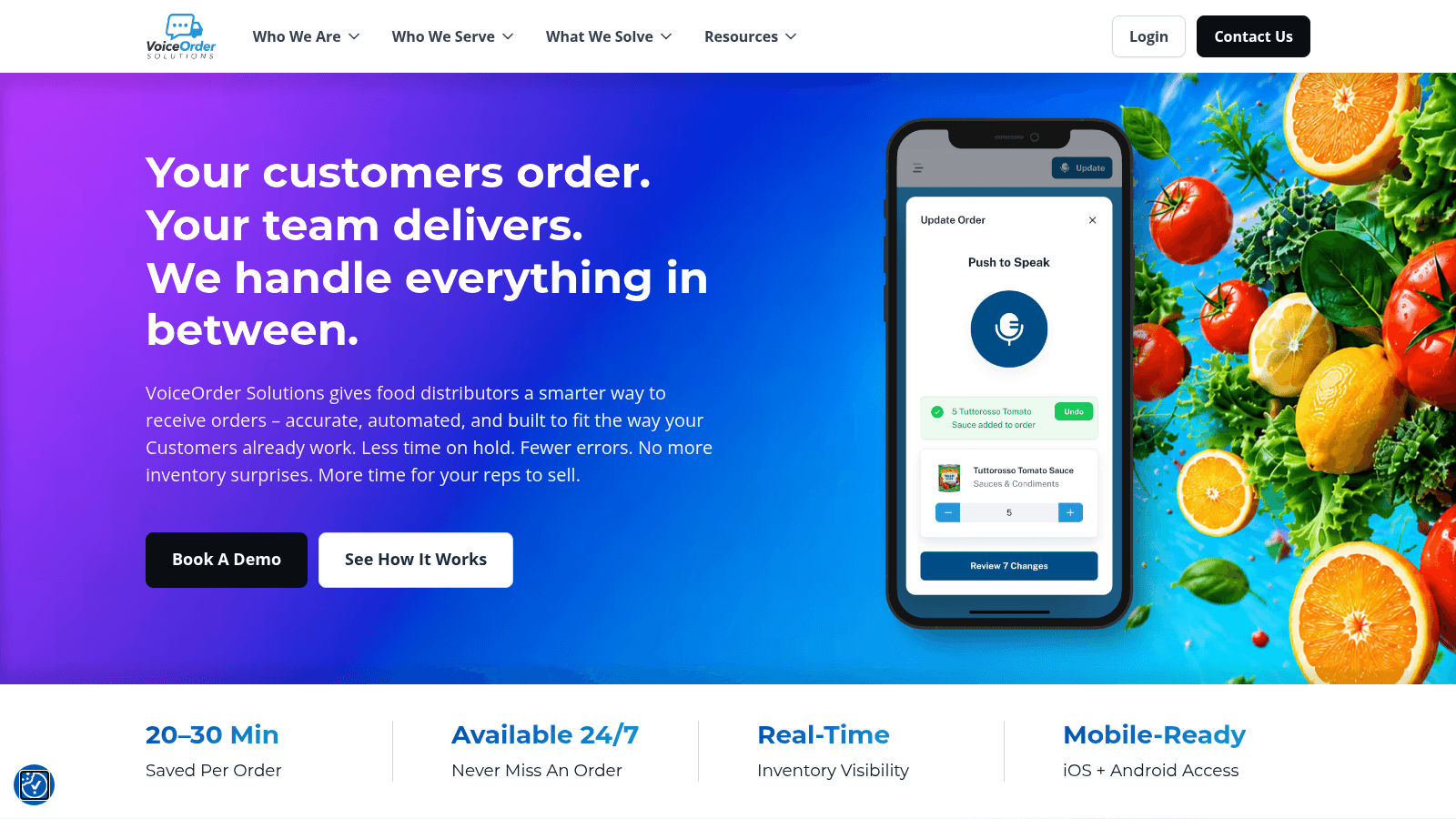
VoiceOrder Solutions inverts Pepper's core assumption. Where Order Agent waits for whatever the customer sent and parses it, VoiceOrder Solutions gives the distributor an ordering channel of its own: accounts order by voice in a dedicated app, and the order desk receives each order structured rather than reconstructed.
The distributor buys it and issues it outward. Each restaurant or store account works from its own order guide at its own agreed prices and pack sizes, controlled from one back end.
Its homepage is direct about the buyer: built for small to mid-size distributors, on the stated grounds that enterprise pricing and complexity are not that segment's problem. That is a narrower target than Pepper's platform play, and the clearest reason to weigh one against the other.
Key features:
Pricing: quote-based, like Pepper. What the company publishes instead is the rollout: most distributors are live within 24 to 48 hours with no IT project, after a 20-minute demo.
Pros: removes retyping at both ends, captures orders around the clock, fast setup, per-account catalogs from one back end, no replacement of existing systems. Cons: voice-first intake rather than a full multi-channel parser, built specifically for food and beverage distribution, and no public rate card.
How to start using it:
Why it's a good Pepper alternative: it targets the same manual order-entry cost without asking a distributor to adopt a marketing hub, an ad network and a collections product alongside it. For a distributor whose problem is genuinely the order desk, the scope matches the problem.
Final verdict: the strongest fit when your accounts will order by voice but never log into a portal, and you want each order structured before it reaches your desk.
The sequence from spoken order to landed record is set out in how it works.
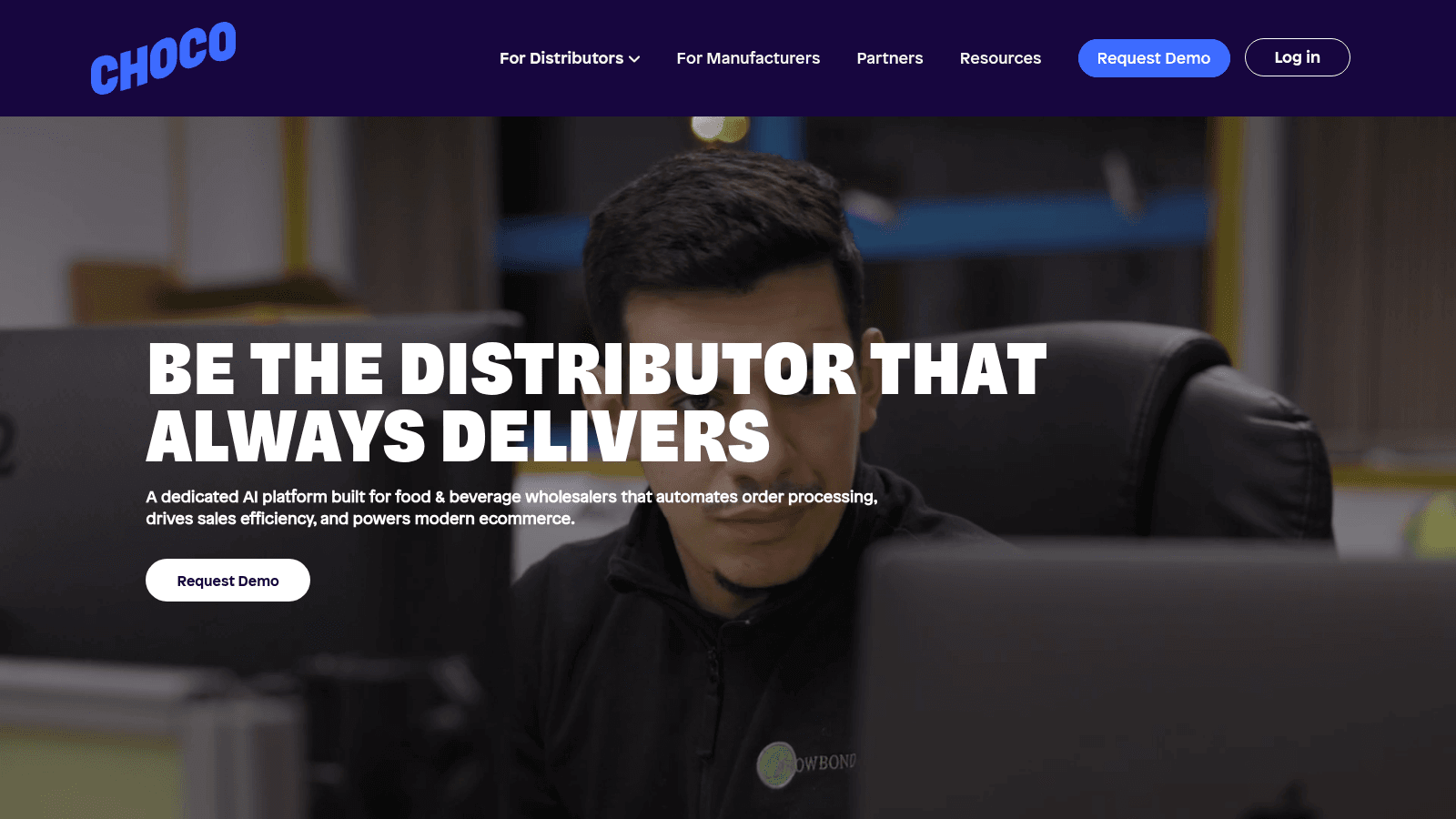
Choco is Pepper's closest structural match: an AI platform for food and beverage wholesalers covering order processing, sales and ecommerce. Its OrderAgent digitizes orders arriving by voicemail, WhatsApp, email, text and photo, the same inbound model Pepper runs.
Around it sit a storefront, SalesHub and CustomerHub, plus a manufacturer-facing ad network and a Dot Foods partnership. Named ERP integrations include NetSuite, QuickBooks, Microsoft Dynamics, Sage, Odoo and NCR.
Key features:
Pricing: quote-based. Choco's pricing page states plainly that it charges a monthly fee depending on usage and directs buyers to its sales team.
Pros: broadest named ERP integration list here, genuine multi-channel intake, established in foodservice. Cons: no published pricing, a platform commitment rather than a point tool, and a manufacturer ad network that adds a second commercial relationship.
Why it's a good Pepper alternative: it solves the same inbound order-digitization problem with a comparable product set, which makes it the natural head-to-head comparison rather than a lateral move.
Final verdict: the shortlist entry if you like Pepper's approach and want a competing quote.

Burnt is the newest entrant here, framed around AI agents for sales and operations, procurement and credit control, though only the sales and operations agent is live and the other two are waitlisted. It ingests orders from email, text, voicemail, WhatsApp, phone calls, EDI, portals and rep free-text into the distributor's ERP.
Its differentiator is SKU matching that resolves informal language, turning a request for large shrimp into a specific count size, plus live inventory checks and substitution suggestions.
Key features:
Pricing: quote-based, with no pricing page on the site. The company states most customers go live in one to two weeks, and 30 to 60 days for legacy ERPs or complex environments.
Pros: one of the widest inbound channel lists here, fast typical implementation, explicit exception handling. Cons: no published pricing, newest and least independently reviewed, and its headline claims differ between its own pages.
Where it fits: distributors whose customers order across five different channels and who want all of them landing in one place without changing customer behavior.
Final verdict: worth a demo for the SKU-matching and exception routing, with its self-reported accuracy figures treated as unaudited.

Cut+Dry approaches the same market from the storefront end. It gives foodservice distributors a branded ecommerce experience with structured catalog data, sales enablement tools and a payments and receivables product, and it also sells to manufacturers and restaurants.
Cut+Dry has since added AI order handling to convert emails, texts and PDFs into digital orders, which narrows the gap between it and the inbound-first tools.
Key features:
Pricing: quote-based; its pricing page outlines flat SaaS plans with no per-user or order fees but no dollar figure. Its customer stories cite Y. Hata and Co. going from contract to launch in 90 days and Harbor Foods reaching 75% customer adoption in under a year, both vendor-reported.
Pros: strongest product-data story here, established named customers, covers ordering and receivables together. Cons: no published pricing, the storefront model depends on customer adoption, and its pricing page says launches typically take 45 to 100 days.
Why buyers shortlist it: Pepper names Cut+Dry directly on its own comparison page, which makes it the competitor Pepper itself expects you to be weighing.
Final verdict: the better choice if your accounts will genuinely log in and browse, and the weaker one if they will not.

SimplyDepo covers B2B order management alongside field sales and route execution, which makes it a different shape from Pepper: it invests in what the rep does on the road rather than in what the order desk receives.
The platform handles order capture with pricing rules, centralized pricing and inventory, and offline mobile capture that syncs when the connection returns.
Key features:
Pricing: published and tiered per rep. Plans start at $69 per rep per month on annual billing or $89 on monthly billing, with annual rates falling to $59 and $49 per rep at higher team sizes, plus a 30-day free trial.
Pros: transparent pricing, genuinely strong field-sales tooling, free onboarding. Cons: priced per rep so it scales with headcount, monthly billing costs $20 more per rep than annual, and its focus sits on the rep rather than on inbound orders.
Its real strength: the price scales with your sales team rather than your order volume, so four reps is a number you can budget exactly.
Final verdict: the pick when order volume comes through reps in the field rather than customers contacting the office.

inSitu Sales runs the direct store delivery workflow end to end with three connected apps: a rep app for orders, a warehouse picker app, and a driver dispatch app with proof of delivery.
The suite names nine ERP and accounting systems outright, among them QuickBooks, NetSuite, Microsoft Dynamics 365 Business Central, SAP Business One, Odoo, Epicor and Xero, rather than gesturing at integration generally.
Key features:
Pricing: published tiers from $200 per month for the starter products to $329 for the Pro bundle and $429 for Enterprise, plus a one-time $500 setup fee for NetSuite or SAP Business One. A 14-day free trial is offered.
Pros: named ERP integrations, covers the whole DSD chain, published pricing. Cons: more moving parts to deploy, a paid ERP integration setup, and app users beyond the three included billed at $34.99 a month each.
Where it beats the alternatives: the warehouse pick gets an app of its own, next to the rep and driver apps, so the order is followed from capture to the customer's door.
Final verdict: the natural choice where the delivery leg matters as much as the order.
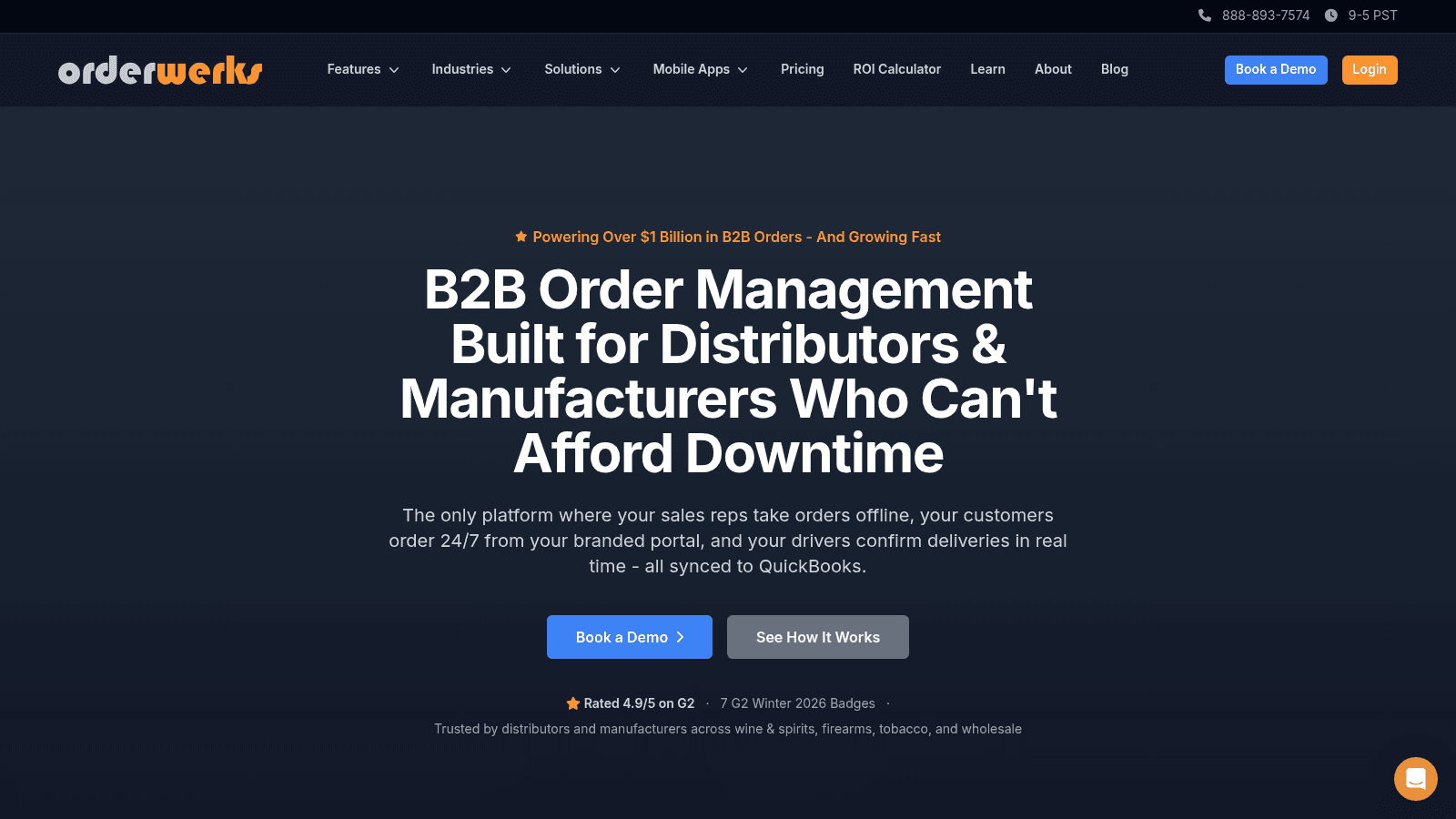
Orderwerks serves the awkward end of distribution, where the category carries obligations: wine and spirits, firearms, tobacco, plus ordinary wholesale. Almost nothing built purely for food handles that paperwork.
Three surfaces run at once: one for the rep, one for the customer buying at any hour and one for the driver, with the accounting sync underneath.
Key features:
Pricing: the base platform is $60 per user per month, with volume discounts from five users. The delivery module adds $150 per month plus $25 per driver, white-glove onboarding for Sales App and Web Portal accounts starts at $2,500 once, and the B2B portal is quoted during a demo.
Pros: clear per-user pricing, real third-party review signals, modular so you buy what you need. Cons: QuickBooks-centric rather than broadly ERP-integrated, priced across several add-ons, and less food-specific than the others.
Why it made this list: it shows its review record openly, with current G2 award badges and an aggregate rating it states as 4.8 or better across review platforms.
Final verdict: a well-evidenced option, and right if you distribute anything with compliance obligations.
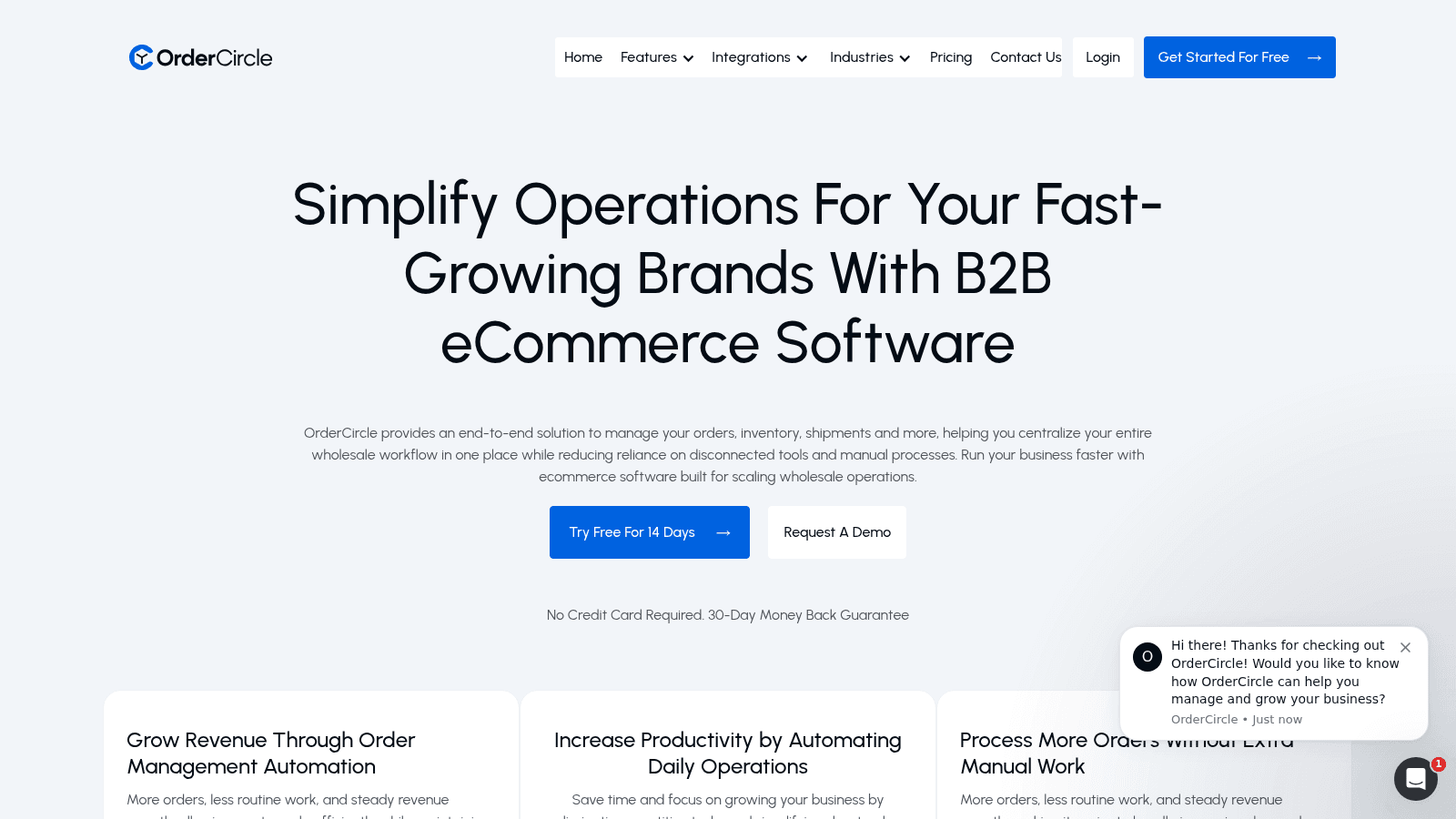
OrderCircle is wholesale ecommerce and order management for growing brands rather than a distributor platform, which makes it a smaller and simpler purchase than Pepper. It tracks orders across channels, keeps order history as a lightweight CRM, and forecasts inventory.
Key features:
Pricing: six public tiers in dollars. The first is $199 a month but stops at 25 orders; $399 removes the ceiling, and the enterprise band runs $599, $799 and $999. A 14-day trial comes first, then a first-month money-back guarantee.
Pros: low entry price, clear order-volume tiers, quick to stand up. Cons: order caps on lower tiers, no staff accounts on the entry tier, and it is built for brands rather than distributors.
What it is genuinely good at: giving a small operation a real ordering system for two hundred dollars a month instead of a platform commitment.
Final verdict: a sensible first system for a distributor too small for the upper half of this list.
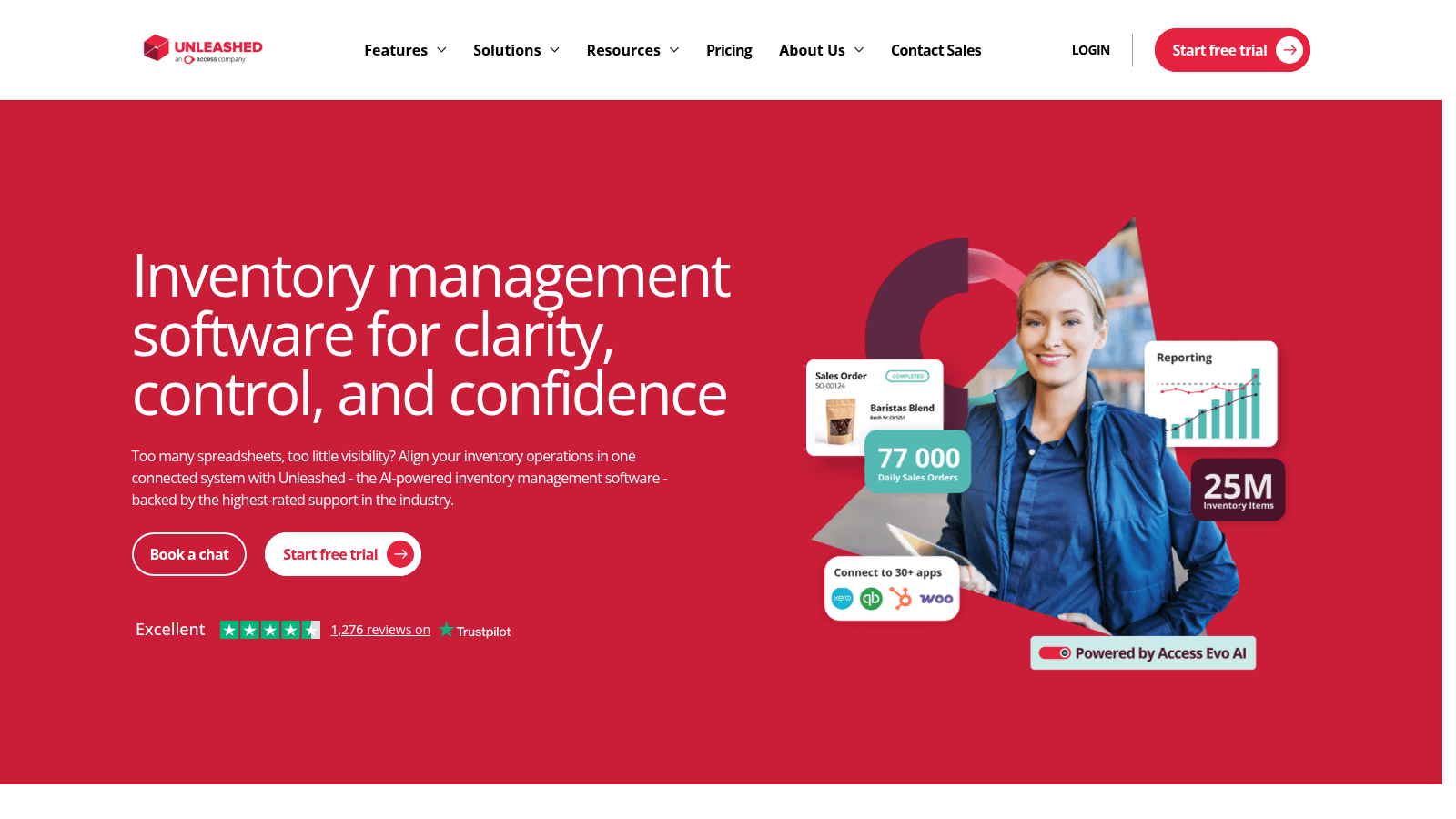
Unleashed comes at distribution from inventory rather than orders, handling multi-location stock, purchasing, B2B ecommerce and forecasting, with order management as one part of a wider platform. That makes it an alternative to Pepper only if your underlying problem is stock accuracy rather than order intake.
Key features:
Pricing: Lite is $99 per month for three users, Core $399 and Pro $729, with additional users at $69 to $89. Onboarding is priced separately at $449, $799 or $5,549 depending on complexity, and support plans run $99 or $239 per month.
Pros: transparent pricing including implementation, strong traceability, mature product. Cons: every plan starts at 100 sales orders a month before paid upgrades, onboarding and support are charged on top, and order capture is not its center of gravity.
Who it suits: distributors whose ordering problems are downstream of not knowing what is actually in stock.
Final verdict: one of the few entries that put a number on implementation, which counts for something here.

B2B Wave is a wholesale ecommerce platform: a branded storefront with custom price lists, invoicing and order automation for distributors, manufacturers and drop-shippers. Like Cut+Dry it assumes buyers will come to a portal, so it competes with Pepper's Storefront module rather than Order Agent.
Key features:
Pricing: Pro lists at $350 a month for US visitors, half price for the first three months, with Enterprise quoted; the currency follows the visitor's location.
Pros: no per-order or transaction fees, generous product and user limits, straightforward pricing. Cons: a single self-serve plan below Enterprise, storefront-first so adoption depends on your customers, and not food-specific.
What it replaces: the customer-facing ordering half of Pepper's platform, at a published price and without the sales, marketing and finance hubs attached.
Final verdict: good value if a portal is all you need, wrong if your customers order by phone.

NetSuite is a full ERP with order management inside it, for distributors who want finance, inventory, procurement and fulfillment in one system rather than a capture layer on top of what they already run. It is an alternative to Pepper only in the sense that replacing everything also replaces the order desk.
Key features:
Pricing: no public figure; NetSuite prices an annual license plus a one-time implementation fee. In one r/Netsuite thread about a $12 million, nine-person distributor, a commenter put a full implementation at $150,000 to $250,000 and several called it too much at that size, though implementers disagreed.
Pros: one system of record, deep functionality, mature ecosystem. Cons: no published pricing, long implementations, and heavy for a distributor whose actual problem is order intake.
Where it earns its place: it belongs on the shortlist when the order desk is one symptom of a stack that no longer holds together.
Final verdict: the answer to a much larger question than Pepper's.

Acumatica is the other cloud ERP worth naming, sold largely through partners and priced on the applications and resources used rather than per user, with a distribution edition covering inventory, procurement, warehouse operations and sales orders. It is the only ERP here that publishes an entry price for smaller distributors.
Key features:
Pricing: the Distribution Edition itself is quoted, through a partner or Acumatica's own pricing review. Its SMB bundle, APEX for Distribution, publishes a starting price under $1,495 per month covering software, implementation and support, with unlimited users at no extra cost.
Pros: unlimited users on the APEX bundle, fixed-price implementation, real distribution depth. Cons: mostly sold through partners, still an ERP-sized change, and the published price applies to one specific bundle rather than the platform generally.
Its real advantage: it is the only ERP in this list where a small distributor can see a number before entering a sales process.
Final verdict: worth a look if you assumed an ERP meant six figures.
The category is usually described as quote-only, and that stopped being true this year. Sorting by what a buyer can actually see before a sales call is more useful than sorting by feature list.
| Pricing posture | Vendors | What it means for you |
|---|---|---|
| Published tiers | Orderwerks, OrderCircle, Unleashed, B2B Wave, SimplyDepo, inSitu Sales | Model the cost yourself, no call needed |
| Published entry bundle only | Acumatica (APEX) | One tier is priced, the rest is quoted |
| Quote-based | Pepper, Choco, Cut+Dry, Burnt, NetSuite, VoiceOrder Solutions | No rate card, so budget fit comes from a demo and a written quote |
The pattern is worth noting: the tools that publish prices are mostly the ones selling a defined product, and the ones that quote are mostly selling platforms or services whose scope varies per customer. Neither is dishonest, and the second group simply takes a demo and a quote to evaluate. The same split runs through the wider category of order management software sold to distributors.
Every genuine choice here reduces to one question: is the problem the order desk, or the whole commercial operation?
If order entry is the pain, a point tool closes it faster and cheaper. Automated order processing removes the retyping and you keep the systems around it.
If reps have no customer data, collections are slow and there is no digital storefront, a platform genuinely does more. Pepper, Choco and Cut+Dry all make that argument and for some distributors it is right.
The failure mode is buying a platform to fix a point problem, then using one module of six. Ask any vendor what its smallest deployed customer runs, and how many modules that customer turned on.
Migration effort is dominated by two things, and neither is the software. The first is your catalog. All of these tools need items, pack sizes and per-account pricing loaded correctly, and a catalog that has drifted for years takes longer to clean than the product takes to configure.
The second is customer behavior. A tool that parses inbound orders needs no change from your accounts, the strongest argument for Pepper, Choco and Burnt. A storefront or app asks customers to do something differently, and adoption is where those projects succeed or fail.
Published implementation windows vary enormously: VoiceOrder Solutions at 24 to 48 hours for independent distributors, Burnt at a fortnight in simple environments and up to two months against a legacy ERP, the ERP suites at several months. Ask for the figure in writing and what it assumes about your data.
Run the old channel in parallel for one full ordering cycle. Distributors that cut over on a Monday find their exceptions on a Friday, and the order management workflow around the tool matters more than the tool.
Buyers here make the same handful of errors, each avoidable with one question during the demo.
The accuracy point deserves emphasis. Every vendor here that publishes an accuracy figure publishes its own, and none of them is independently audited, so treat those numbers as marketing until a reference customer confirms them.
One more applies to route-based businesses. A tool chosen for the order desk may have nothing to say about what happens on a DSD route, and those two problems usually get budgeted together and solved separately.
Start with how orders actually arrive this week. Pull a fortnight of orders and count them by channel.
If most arrive as voicemails, texts and emails and your customers will not change, you want inbound parsing: Pepper, Choco or Burnt. If they will use an app but will not sit at a computer, order taking built around voice is a smaller change than a portal.
If your accounts are already comfortable ordering online, a storefront from Cut+Dry or B2B Wave gives them search, history and self-service. If most of your volume comes through reps on routes, SimplyDepo and inSitu Sales are built for that.
One caution on the channel count. The Census Bureau's own definition treats an order as e-commerce when the buyer placed it over the internet, a mobile device, an EDI network, electronic mail or a comparable online system, so a distributor already taking EDI and email orders is further along than the vendor pitch usually implies.
Only if the order desk is one of several broken systems should an ERP enter the conversation, and Acumatica's APEX bundle is the cheapest honest way to price that question.
Which of these Pepper alternatives fits is decided by your customers, not by a feature grid. Pepper's bet is that customers will never change how they order and the distributor should absorb that. The opposing bet is that customers adopt something better when it is genuinely easier than a phone call.
Both bets are winnable and lead to different products. Count your channels first, pick the vendor whose assumption matches what you found, and get pricing in writing before the second call.
Beyond the Pepper software alternatives here, software for wholesale distributors covers the adjacent systems these tools sit alongside.
If the voice-ordering approach is the one that fits your accounts, contact VoiceOrder Solutions for a demo and a quote.
Pepper, at usepepper.com, is an AI platform for independent food distributors built by Pomegranate Technologies. Its Order Agent turns orders arriving by voice, text, email, photo or PDF into structured orders in the distributor's system, alongside storefront, sales, marketing and finance modules.
It is unrelated to PepperHQ and to Keurig Dr Pepper, both of which dominate search results for the name.
Pepper publishes no pricing at any tier. Its pricing page describes a pay-for-performance philosophy and directs buyers to a conversation, the quote-based approach several vendors here take, VoiceOrder Solutions included.
Six alternatives publish real numbers. Orderwerks starts at $60 per user per month and SimplyDepo at $69 per rep on annual billing; Unleashed, OrderCircle and inSitu Sales start at $99, $199 and $200 a month, and B2B Wave shows US visitors $350.
Pepper publishes comparison pages against Cut+Dry, GrubMarket, BlueCart and ZiiZii. In practice the closest alternatives to Pepper are Choco, which runs the same inbound digitization model with a similar platform around it, and Burnt, which parses a wider set of channels.
VoiceOrder Solutions competes for the same budget from another direction: the distributor rolls out a voice ordering app to its accounts, so orders arrive structured instead of being parsed from whatever those accounts already sent.
Both are AI platforms for food distributors and both digitize inbound orders from messy channels. Choco names more ERP integrations directly, including NetSuite, Microsoft Dynamics, Sage, Odoo and NCR, and runs a manufacturer-facing ad network alongside its distributor product.
Neither publishes pricing, so a real comparison needs quotes from both. Their boundaries overlap enough that the decision comes down to integration fit and commercial terms.
No. Every tool here is a paid B2B system, and the closest thing is SimplyDepo's 30-day trial or Unleashed's 14-day trial.
Free B2B ordering tools exist, but they are storefront builders without catalog, pricing-rule or ERP capability, which is the part a distributor actually needs.