.webp)
Key takeaways:
The brand appears online as Cut+Dry, Cut and Dry, Cut&Dry and CutandDry, so buyers type CutandDry alternatives about as often as the plus-sign version. "Cut and dry" is also an everyday idiom, which is why searching for it returns nail polish, rinse aid and paper cutters alongside the software. This article is about the foodservice platform at cutanddry.com.
Cut+Dry is a good product with a specific bet inside it: that a distributor's restaurant customers will adopt a branded ordering portal, search it, reorder from it and pay through it. Where that bet lands, the results are real. Where it does not, the platform is expensive shelfware.
So the useful comparison is not feature against feature. It is storefront-first against the Cut+Dry alternatives that make a different assumption about how your customers behave.
Cut+Dry describes itself as the only customer-facing ecommerce and sales enablement platform built for foodservice, by foodservice. It sells to three audiences: distributors, who pay, manufacturers, who advertise and syndicate data, and restaurants, who order for free.
The distributor product covers a branded storefront with search and reorder history, structured catalog data intended to clean up messy vendor product files, sales enablement for reps, and a payments and receivables product aimed at collection time. A newer AI layer converts emails, texts and PDFs into digital orders, which narrows the distance between Cut+Dry and the parsing-first vendors it used to sit apart from.
What it does not do is run your stock. Inventory management stays wherever it lives today, and the storefront reads availability from it rather than owning it.
Its named customer results are the strongest part of the pitch and are worth quoting precisely. Y. Hata and Co., described as Hawaii's largest independent foodservice distributor, went from contract to launch in 90 days. Harbor Foods, a multi-location broadline distributor, reached 75% customer adoption in less than a year. Both figures are the company's own.
That second number is the one to sit with. Seventy-five percent adoption inside a year is a genuinely good outcome for a portal rollout, and it is presented as a headline achievement rather than a baseline expectation.
A storefront only pays back if people use it, and the honest answer is that a meaningful share of buyers will not.
The clearest evidence for that is not from foodservice at all. On Reddit, a distributor with hundreds of customers but only a handful sending electronic purchase orders asks how to move the rest across. The most useful reply comes from someone who tried: some customers send part of their orders electronically and the rest by fax, phone and email, and "it's likely a problem with no technological answer. There are customers that actually prefer faxing in orders."
That is the same wall a foodservice portal hits. The distributor gains from the switch, the customer is largely indifferent, and indifference wins. Every channel left running is another transcription step, which is where most order errors are introduced.
Portals do work for plenty of buyers. On Reddit, a produce buyer describes their main vendor's Cut+Dry app as the best one they have used, praising ordering, search and payment in one place. Another in the same thread orders through a main supplier's website in preference to an ordering gun, calls the keying slow, and races a 5 a.m. deadline for next-day delivery.
Both people are real customers of the same category. A distributor's job is to work out how much of its book will take to a portal happily before buying a platform priced on the assumption that everyone will.
Pricing comes by quote. Cut+Dry publishes no dollar figure, which is also how VoiceOrder Solutions and the other platforms here price, and its pricing page describes Standard and Enterprise plans on a flat SaaS model, so budget fit starts with a sales conversation.
Launch takes a while. Cut+Dry's own pricing page puts the average time to launch at 45 to 100 days, varying with the ERP and the complexity of the setup, which is a long runway before the first account orders through the portal.
Adoption is your project rather than theirs. Whatever the vendor does, getting accounts onto a portal is a change-management exercise inside your own customer base, and it runs for months rather than weeks.
Scope has widened too. The AI order desk added recently is genuinely useful, and it also means Cut+Dry now competes with Pepper, Choco and Burnt on their ground, where those vendors have been focused for longer. The same broadening is visible across wholesale inventory management software generally, as point tools grow into platforms.
Some buyers want the opposite trade entirely. Distributors that would rather keep ordering simple, private and phone-free without asking anyone to learn a website have a real alternative now, which was less true three years ago.
The ERP suites are deliberately excluded. Cut+Dry is a storefront and a sales layer that sits alongside your existing systems, so ranking NetSuite or Acumatica against it would compare a feature to a replacement.
| Tool | Best for | Key features | Main limitation | Pricing (from) |
|---|---|---|---|---|
| VoiceOrder Solutions | Ordering without asking anyone to log in | Voice ordering, per-account order guides, 24/7 capture | Voice-first intake, food and beverage only | Custom quote |
| Choco | Distributors wanting network reach | OrderAgent digitization, storefront, foodservice CRM | Ad network in the order flow | Custom quote |
| Pepper | One platform across ordering and sales | Order Agent, storefront, sales and finance hubs | Wide scope | Custom quote |
| B2B Wave | Storefronts without transaction fees | Unlimited orders, custom price lists, rep app | Not food-specific | $350/month |
| OrderCircle | Small wholesalers starting out | Multi-channel orders, order history, forecasting | Order caps below the top tier | $199/month |
| SimplyDepo | Rep-written orders and route execution | Order capture with pricing rules, retail execution, offline app | Priced per rep | $69/rep/month annually |
| Orderwerks | Regulated categories and complex catalogs | Offline sales app, branded portal, compliance modules | QuickBooks-centric | $60/user/month |
| Burnt | Taking orders on every channel at once | Multi-channel intake, SKU matching, exception routing | Newest of the group | Custom quote |
| inSitu Sales | Delivery routes needing ERP sync | Rep app, picker app, driver dispatch | Paid ERP integration setup | $200/month |
| Unleashed | Stock-led wholesale operations | Multi-location inventory, auto reorders, traceability | Onboarding billed separately | $99/month |
Among the CutandDry competitors listed here, pick the Cut+Dry alternatives whose assumption about customer behavior matches your own accounts, then compare only those.
Best for: ordering without asking anyone to log in
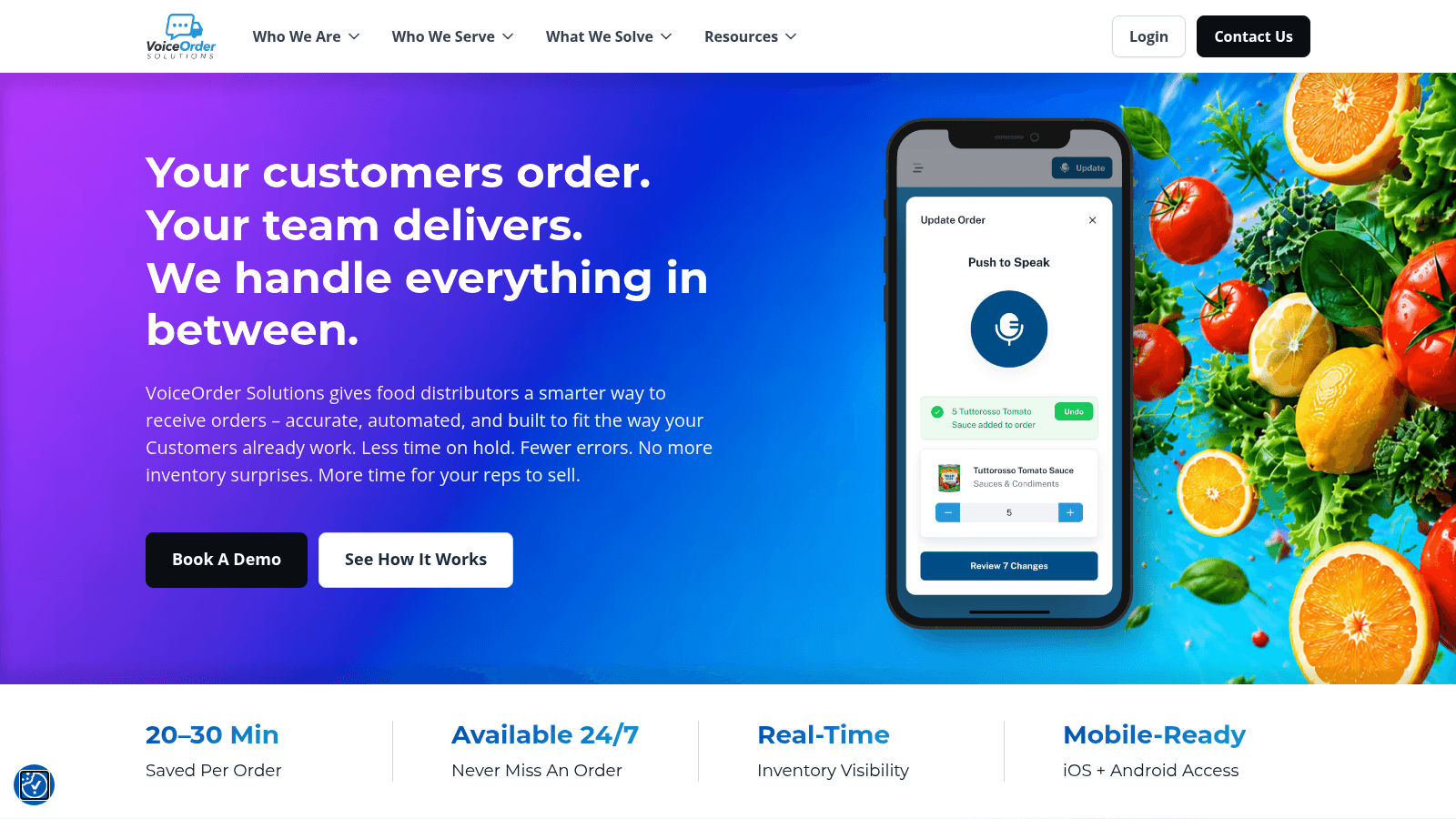
The storefront question disappears here, because there is no storefront. The distributor adds a voice ordering channel for its accounts instead, one that asks customers for a habit change no bigger than leaving a voicemail and gives the order desk an order it does not have to transcribe.
That matters because the alternative to a portal is rarely a better portal. It is usually the phone, and voice is the one interface a kitchen already uses without being trained on it.
The distributor edits every account's guide in one place, so each one lists only what that customer buys, priced and packed to its own agreement. The back office receives a numbered, time-stamped record in whatever file it already opens.
Key features:
Pricing: quote-based, like Cut+Dry's, so there is no rate card to compare. The rollout is the published part: the company says most distributors are up and running in 24 to 48 hours without an IT project.
Pros: the adoption hurdle disappears, after-hours orders still land, one team maintains every account's list, deployment is measured in days, and nothing you already run has to be replaced. Cons: speech is the intake method rather than one of several, the product serves food and beverage only, and the price comes by quote.
How to start using it:
Why it's a good Cut+Dry alternative: it answers the same problem, manual order handling, without betting on the behavior change a storefront requires. For a book of independent accounts that never adopted the portal, that is the whole difference.
Final verdict: the right pick when your least digital customers generate most of your order volume.
Orders moving through it also drive the distributor's order fulfillment queue directly, rather than waiting on a transcription step.
Choco offers both halves at once. There is a branded storefront comparable to Cut+Dry's, and behind it an agent that reads the voicemails, messages, emails and photographs sent by the accounts who never open it.
The company reports 30,000 distributors and more than a million monthly orders, and monetizes manufacturers through advertising placed inside the ordering flow.
Key features:
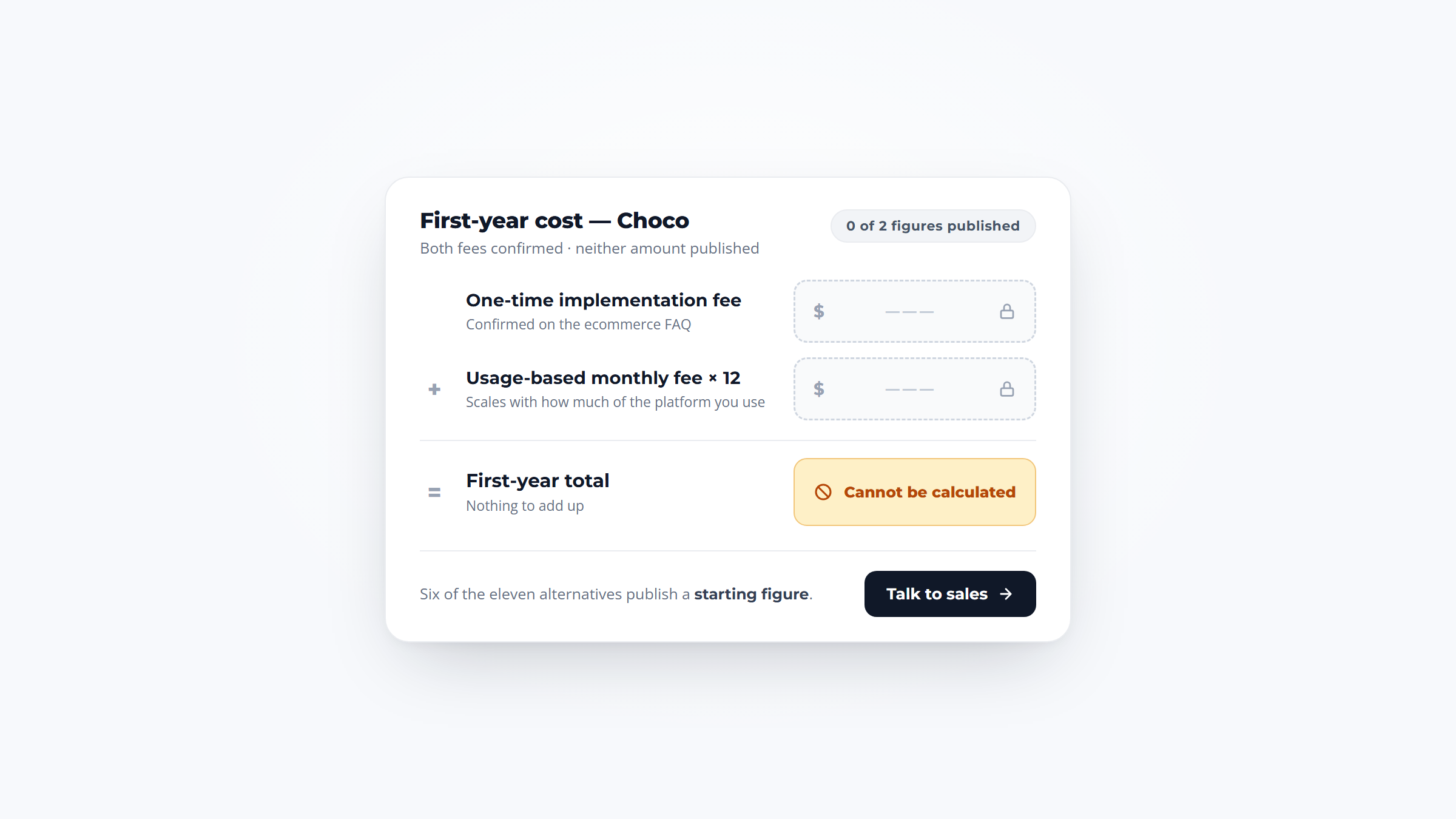
Pricing: quote-based, with no published figure. The company commits only to a fee scaled to usage, with a separate charge to get you live.
Pros: neither adoption path is forced on your accounts, the network is genuinely large, and the integration list is long. Cons: you cannot see a number before a call, the platform is broad if you wanted one thing, and brand-funded promotions appear where your customers order.
What it changes: it removes the all-or-nothing quality of a storefront decision by handling the accounts that never log in.
Final verdict: the most direct like-for-like swap, with a commercial model that needs its own scrutiny.
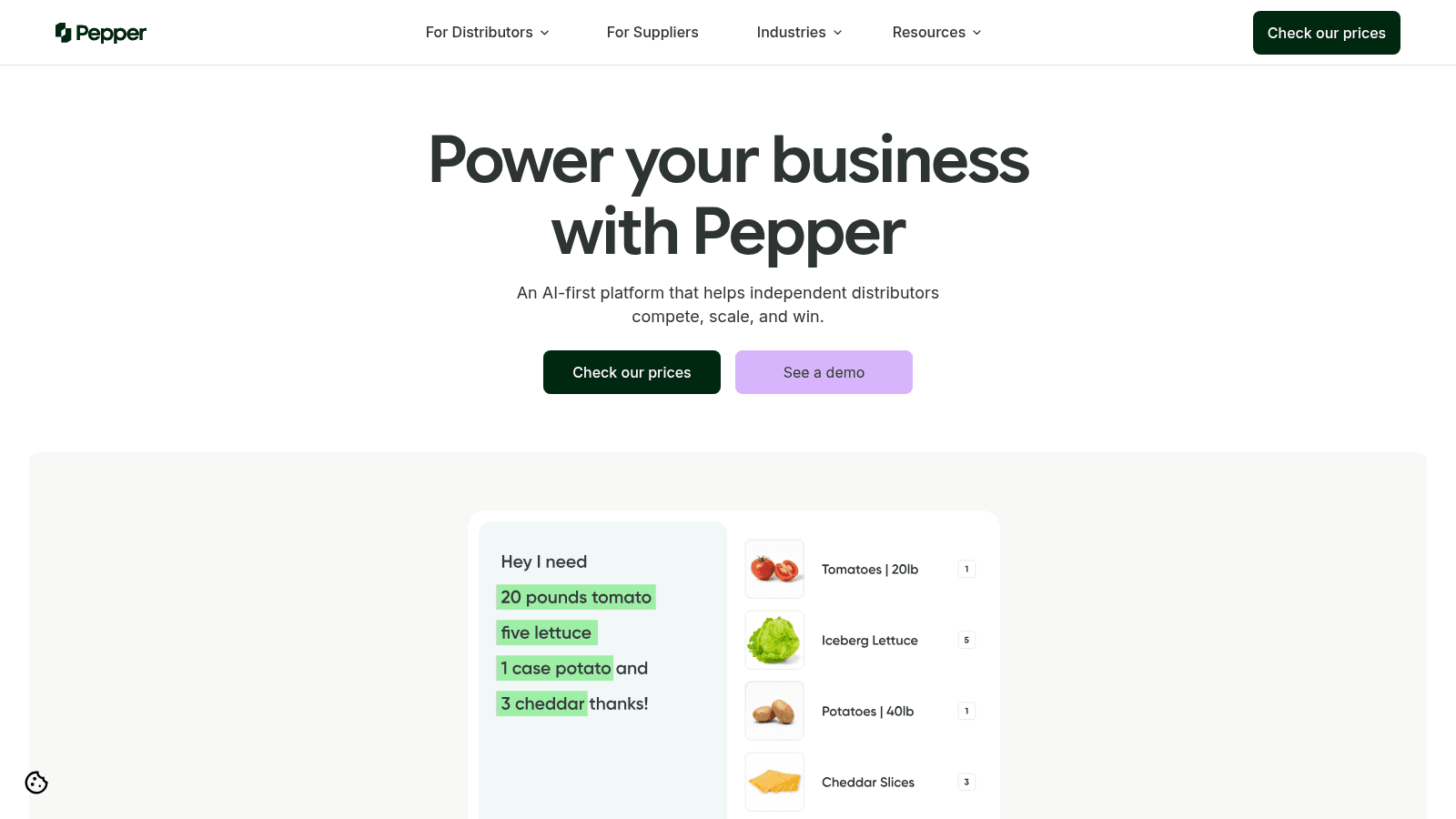
Pepper is built for independent food distributors and names Cut+Dry directly on its own comparison pages, so it expects to meet it in the same evaluations.
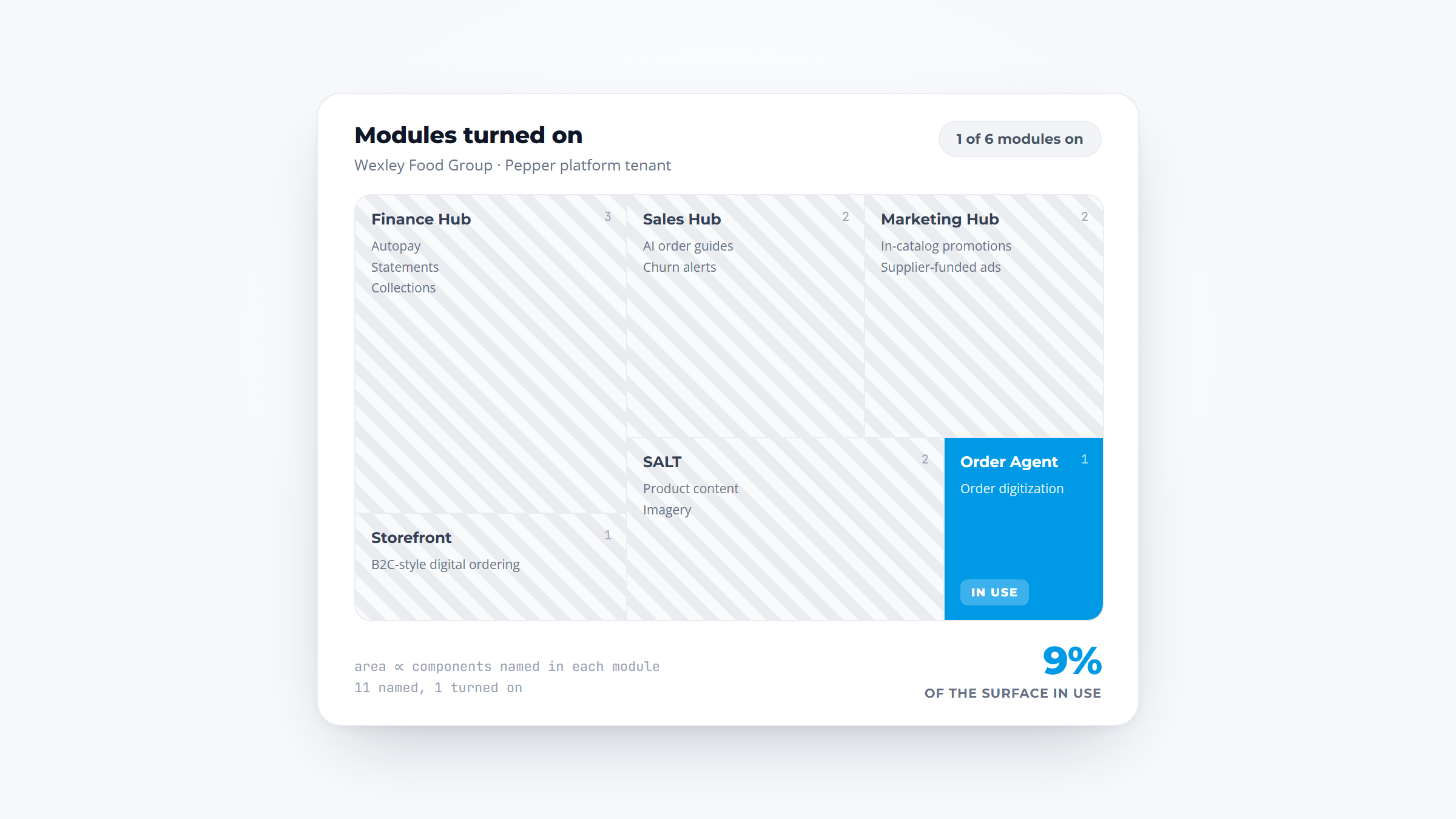
Its Storefront module carries per-customer order guides and par levels, while Order Agent handles the inbound side, alongside sales, marketing and finance hubs.
Key features:
Pricing: quote-based. The company ties its fee to results rather than seats and discusses figures on a call.
Pros: serves the accounts who adopt and the ones who never will, more than 500 distributors reported, wide ERP coverage claimed. Cons: the cost arrives with a quote, the module count exceeds most briefs, and it has no user reviews on G2 or Capterra.
Why it competes here: it makes the same argument Cut+Dry does about modernizing an independent distributor, then adds a fallback for customers who will not modernize with you.
Final verdict: worth quoting alongside Cut+Dry rather than instead of it.
B2B Wave is the closest pure-storefront comparison in this list: a branded wholesale ordering portal with per-customer price lists, invoicing and order automation, sold to distributors, manufacturers and drop-shippers.
The bet is identical to Cut+Dry's, at a price you can see.
Key features:
Pricing: the self-serve Pro plan is shown at $350 a month to US visitors, discounted by half over an introductory quarter, with a quoted enterprise level above it. The page picks its currency from the visitor's location.
Pros: nothing is skimmed off order value, the limits are effectively uncapped, and the rate is on the website. Cons: there is one self-serve plan to choose, nothing in it is specific to food, and it still depends on customers turning up.
Its clearest advantage: you can calculate the cost of the storefront experiment before running it.
Final verdict: the sensible way to test whether your accounts will use a portal at all.

OrderCircle is a smaller wholesale ordering and management system aimed at growing brands. It collects and tracks orders across channels, keeps order history as a light CRM and forecasts inventory.
Key features:
Pricing: six published tiers in US dollars. The entry level runs $199 a month and caps you at 25 orders; removing the cap costs $399, and the largest enterprise tier reaches $999.
Pros: the lowest flat monthly fee on this list, volume bands stated openly, fast to deploy. Cons: the $199 and $299 tiers limit monthly order volume, the entry level leaves out staff accounts, and the product was designed with brands in mind.
Who benefits most: a distributor small enough that Cut+Dry would not seriously pursue it, and large enough to have outgrown a spreadsheet.
Final verdict: the cheapest flat-fee step up from manual order handling here.

SimplyDepo answers the adoption problem differently again: instead of persuading customers to order themselves, it equips the rep standing in front of them.
The product combines B2B order capture with retail execution and route management, and works offline.
Key features:
Pricing: charged by seat. A rep costs $69 a month on an annual agreement and $89 without one, with the annual rate stepping down to $59 and then $49 as the team grows past five and fifteen. A month's trial comes free.
Pros: you can build a budget from your own headcount, onboarding is included, and the field tooling is unusually good. Cons: every new rep adds cost, skipping the annual agreement raises the seat price, and inbound orders are outside its scope.
Where the value sits: it converts the adoption question into a staffing question, which is one you already control.
Final verdict: the right answer where reps, not customers, write most of the orders.
Orderwerks runs a branded customer portal alongside an offline rep app and driver confirmation, with compliance modules for regulated categories such as wine and spirits, firearms and tobacco.
That makes it the closest structural match to Cut+Dry outside foodservice specifically.
Key features:
Pricing: the platform costs $60 a seat each month, with a lower rate once a team reaches five seats. Route management is separate, at $150 a month with $25 for every driver, and getting set up starts at $2,500 as a single charge. Connections to QuickBooks, Xero, ShipStation, Zapier and Slack carry no fee.
Pros: both the seat rate and the setup charge are on the website, outside reviewers rate it, and you buy only the pieces you use. Cons: the total assembles from several lines, the accounting story centers on QuickBooks, and food is one vertical among many.
The reason to shortlist it: it is among the few vendors here that put a number on implementation before you talk to anyone, and the only one that also prices delivery separately.
Final verdict: among the most honestly priced here, and the strongest fit for regulated catalogs.

Burnt takes the opposite position to a storefront entirely. Rather than moving customers to a portal, it accepts orders however they arrive, including phone calls and voicemail, which it transcribes, and turns them into structured records in the ERP.
What sets it apart is turning vague spoken or written descriptions into real line items, checking availability as it goes and proposing a substitute when there is none.
Key features:
Pricing: no page, no figure, quoted after a demo. The company puts a typical go-live at a fortnight, stretching toward two months where an older ERP is in the way.
Pros: its list of accepted channels is among the longest here, deployments are short, and it is explicit about what it cannot decide alone. Cons: budget comes from a quote, outside verification is thin, and its own pages carry different headline numbers.
What you get instead: zero behavior change from your customers, at the cost of trusting a parser with your order accuracy.
Final verdict: the strongest option if your accounts have made clear they are not moving.

inSitu Sales splits the direct store delivery cycle across three applications, one for the rep writing orders, one for the warehouse assembling them and one for the driver handing them over.
The vendor is also unusually specific about what it plugs into, listing QuickBooks, Odoo, Epicor, SAP Business One, NetSuite, Microsoft Dynamics 365 Business Central and Xero among the systems it names.
Key features:
Pricing: the starter products sit at $200 a month each, a bundle of both costs $329, and the full three-app tier is $429. Connecting NetSuite or SAP Business One adds $500 once. Each plan includes three users.
Pros: the ERP list is specific rather than generic, the order is followed all the way to the door, and the tiers are public. Cons: three applications is three rollouts, integration setup is billed, and seats past the included three are charged separately.
Its distinguishing feature: the warehouse pick gets an application of its own rather than being treated as an afterthought.
Final verdict: the pick when the delivery leg breaks as often as the order does.
Unleashed approaches wholesale from stock rather than from ordering, covering multi-location inventory, purchasing, B2B ecommerce and forecasting, with a customer ordering portal available as an add-on.
Key features:
Pricing: three tiers at $99, $399 and $729 a month, carrying three, three and five users respectively, with more seats billed at $69 or $89. Setup is quoted separately in bands of $449, $799 and $5,549; a support plan adds $99 or $239 a month, and the customer-facing store starts at $129.
Pros: almost nothing is hidden, including what implementation costs, traceability is genuinely deep, and the product is mature. Cons: orders are capped at 100 a month unless you pay to upgrade, the final bill assembles from several lines, and ordering is a side of the product rather than its center.
Where it earns attention: it is the option to price when the ordering problem turns out to be a stock-accuracy problem wearing a disguise.
Final verdict: worth considering precisely because it tells you the full cost up front.
Storefront vendors present adoption as a communications problem. The academic record says it is mostly a reliability problem.
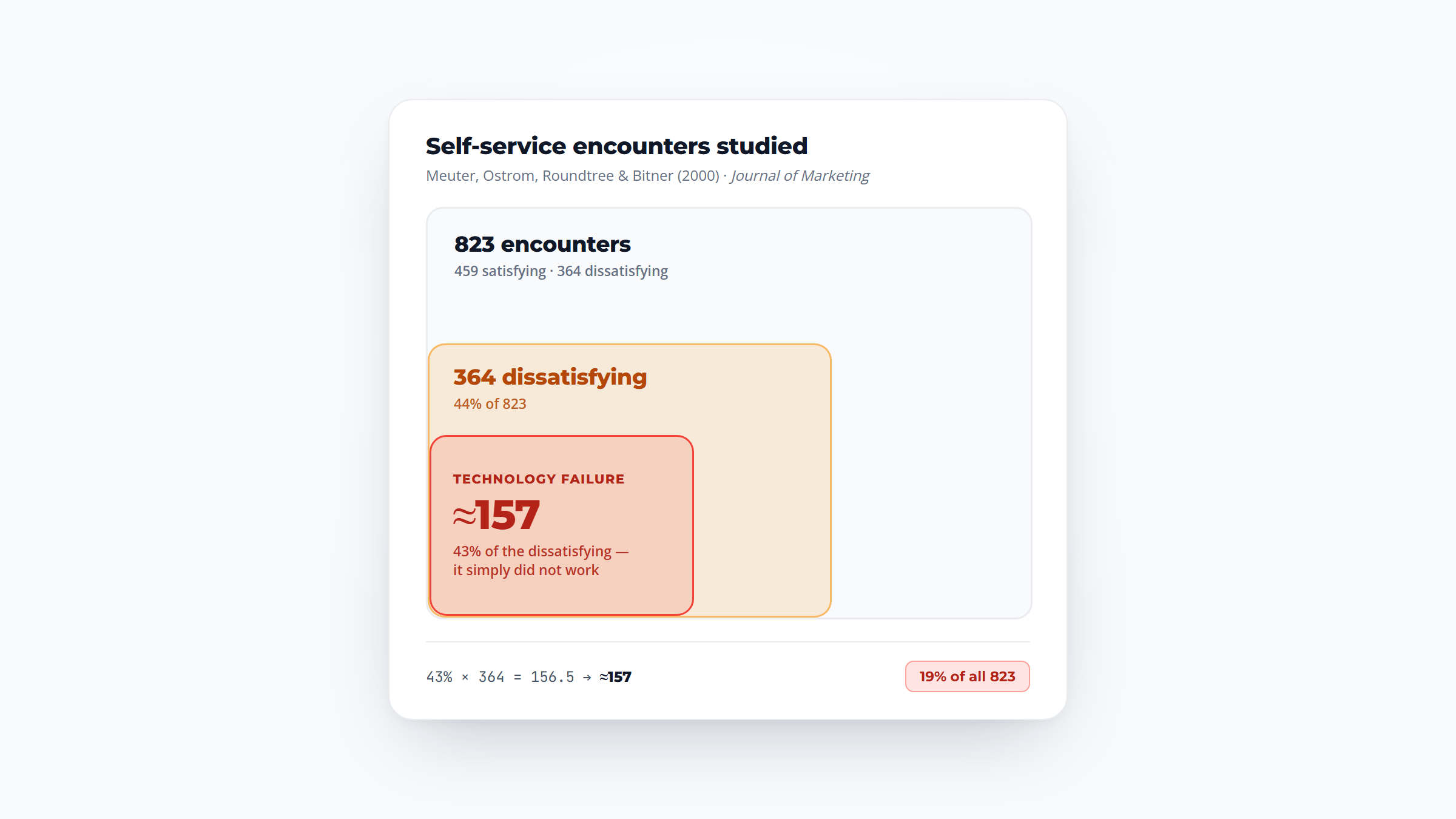
The foundational study is Meuter, Ostrom, Roundtree and Bitner's 2000 paper in the Journal of Marketing, which collected 823 usable accounts of real self-service encounters. It found 459 satisfying and 364 dissatisfying, a 56 to 44 split, which is a sobering baseline for any technology sold on convenience.
The breakdown of the failures is the useful part. Of the dissatisfying encounters, 43% were outright technology failure, the thing simply not working, and 36% were poor design, split between confusing technology and a badly designed service around it. Only 17% were process failures.
Translated into a distributor's terms: your customers will not abandon the portal because they dislike change. They will abandon it the first time a price is wrong, an item they order weekly is missing, or the app fails during a Friday order.
The buyer-side data points the same way. Forrester reported in 2024 that 86% of B2B purchases stall during the buying process and 81% of buyers are dissatisfied with the provider they end up choosing, while noting that buyers who rely heavily on self-service still expect the provider to be responsive and to collaborate.
That is the honest case for a hybrid. Give the accounts that want self-service a good one, and give the rest a channel that does not require them to use it. The same principle governs any restaurant checklist or routine you push out to a customer site: adoption follows reliability, not instruction.
Pricing transparency splits this list cleanly, and it is the fastest way to shorten a shortlist.
| Vendor | Published entry price | What is extra |
|---|---|---|
| Orderwerks | $60 per user monthly | Delivery module, onboarding from $2,500 |
| SimplyDepo | $69 per rep monthly, annual | $89 per rep if billed monthly |
| Unleashed | $99 monthly | Onboarding $449 to $5,549, support, B2B store |
| OrderCircle | $199 monthly | Higher order volumes need higher tiers |
| inSitu Sales | $200 monthly | $500 ERP integration setup |
| B2B Wave | $350 monthly (US) | Half price lasts the first three months |
| Cut+Dry, Choco, Pepper, Burnt, VoiceOrder Solutions | None, quote-based | Covered in the quote, so get setup and add-ons in writing |
Read the right-hand column harder than the left. The distance between the headline and the real total is widest at Unleashed and Orderwerks, and both of them say so on their own websites; for the quote-based vendors, the same detail arrives with the quote. Sound order management is rarely as cheap as the first line of a pricing page.
If you are leaving Cut+Dry, or deciding not to join it, two pieces of work dominate and neither is technical.
The first is your catalog. Structured product data is the thing Cut+Dry does best, so anything you move to has to accept pack sizes, units of measure and account pricing intact, and you may find the platform was carrying more of that quality than you realized. Export everything before you cancel anything.
The second is the customer conversation. Accounts that did adopt the portal have to be told what replaces it, and accounts that never adopted it are the ones your new tool exists for, so they need contacting first rather than last.
Order accuracy will move during a transition regardless of the tool, so track it deliberately through the switch rather than reading the headline volume. Handover points are where the damage happens.
Run both channels through a full ordering cycle. Two weeks of parallel operation surfaces the weekly exceptions a weekend cutover will not, and the warehouse and distribution side needs the same parallel period rather than a single go-live date.
Segment your accounts before you look at another demo. Split them into three groups: those already ordering online somewhere, those who would if it were easy, and those who will phone until they retire.
If the first group dominates, a storefront is the right purchase and B2B Wave or Orderwerks will tell you what it costs. If the second group dominates, the alternatives to Cut+Dry worth pricing are Choco or Pepper, which give you a portal with a fallback attached.
If the third group is where your volume lives, stop evaluating portals. Burnt parses whatever those accounts already send, and voice ordering replaces the channel with something equally easy. Keeping the resulting inventory tracking accurate matters more than the ordering interface at that point.
Where reps write the orders, the question is different again, and SimplyDepo or inSitu Sales answer it.
Cut+Dry's bet is defensible and its case studies show it paying off. The reason to look elsewhere is not that the product is weak, it is that a storefront transfers effort to your customers, and only you know whether they will accept it.
Segment the book first, price the two Cut+Dry alternatives whose assumption matches the largest segment, and ask each one what happens to the accounts that never log in. The answer to that question is the whole comparison, and it is the same logic that should govern wider food and beverage software choices.
If most of your volume comes from accounts that will never use a portal, contact VoiceOrder Solutions for a demo of what replaces one.
Cut+Dry is a foodservice ecommerce and sales enablement platform at cutanddry.com, sold to distributors and used free by their restaurant customers. It provides a branded ordering storefront, structured catalog data, sales tools and a payments product, with an AI order desk added more recently.
The company is also written as Cut and Dry, Cut&Dry and CutandDry across directories and app stores, which is worth knowing when searching for it.
There is no public dollar figure at any tier, the same quote-based approach several vendors here take. The pricing page lists Standard and Enterprise plans on flat subscription terms, without per-user or order-based charges, plus an average launch of 45 to 100 days, and the price itself starts with a sales conversation.
Six of the Cut+Dry software alternatives here do publish a rate, and the cost table above sets them side by side. The cheapest entry points are seat-based rather than platform-based, which suits a distributor with a small team and a lot of accounts.
Choco and Pepper are the closest competitors to Cut+Dry, both offering a distributor storefront alongside inbound order digitization. B2B Wave and Orderwerks compete on the storefront alone at a published price.
VoiceOrder Solutions and Burnt compete from the other direction, removing the portal assumption rather than improving on it. Those are the Cut+Dry competitors to weigh if your accounts have already ignored one portal.
Yes. The distributor pays for the platform and the restaurant orders through it at no charge, which is the standard arrangement across this category.
The cost to a restaurant is fragmentation rather than money, since each supplier tends to arrive with a different app and a different login.
A storefront asks your customer to come to you: log in, browse a catalog, build an order and submit it. An order capture tool goes to them, accepting whatever they already send or giving them a faster way to send it.
The distinction decides everything about adoption. A storefront's value depends on customer behavior changing, while a capture tool's value does not.