.webp)
Key takeaways:
Search for food and beverage industry software and you'll get two completely different product categories on the same results page. One set runs restaurants and bars. The other runs production lines, batch records, and recall procedures for companies that make the products those restaurants serve.
Both are legitimately "F&B software," and shortlisting across the two wastes weeks. A restaurant group does not need catch-weight costing or allergen-controlled batch genealogy, and a beverage manufacturer gets nothing from table-side ordering.
This guide splits 12 platforms into the two groups they actually belong to, with verified pricing where it's published, so you can ignore the half that isn't yours.
Food and beverage industry software is any system built specifically for handling food as a perishable, regulated, traceable product. That specificity is what separates it from generic business software: a standard distribution ERP has no concept of a lot code, a use-by date, or a catch-weight item that's priced by the pound but sold by the case.
On the operator side that means menu and recipe costing, inventory tracking, supplier ordering, and food-cost control. On the manufacturing side it means batch production, quality control, allergen management, lot genealogy, and the food traceability software behind recall readiness.
The two groups converge on exactly one thing: knowing where a given ingredient came from and where it went. Everything else about them differs, including how they're priced, how long they take to implement, and who signs off on the purchase.
The table below covers both groups. The "built for" column is the one that matters most, because a tool from the wrong row will fail you regardless of its feature list.
| Tool | Built for | Core strength | Main limitation | Pricing (from) | Rating |
|---|---|---|---|---|---|
| VoiceOrder Solutions | Operators and distribution | Voice-captured supplier ordering | Ordering only, not production | Quote-based | ★★★★★ |
| Toast | Restaurants and bars | POS with operational add-ons | Ecosystem lock-in | $0-69/month + custom | ★★★★☆ |
| Restaurant365 | Multi-unit operators | Accounting plus inventory | Heavy implementation | Quote-based | ★★★★☆ |
| MarketMan | Operators controlling COGS | Purchasing and food cost | Integrations cost extra | $199/month | ★★★★☆ |
| Craftable | Restaurants with bar programs | Beverage and food margin | No public pricing | Quote-based | ★★★★☆ |
| WISK | Bar and beverage programs | Pour-level beverage control | Food inventory costs extra | $189/month | ★★★★☆ |
| Apicbase | Multi-outlet foodservice groups | Recipe and production data | Priced per outlet | Quote-based | ★★★★☆ |
| Aptean | Food and beverage manufacturers | Purpose-built F&B ERP | Enterprise sales process | Quote-based | ★★★★☆ |
| Sage X3 | Mid-market food producers | Process manufacturing and traceability | Partner-led implementation | Quote-based | ★★★★☆ |
| IFS | Asset-heavy producers | Plant maintenance and uptime | Broad suite, F&B is one vertical | Quote-based | ★★★★☆ |
| FlexiBake | Bakeries and food production | Recipe, labeling, route delivery | Narrow vertical focus | Quote-based | ★★★★☆ |
| Acumatica | Growing manufacturers | Consumption-based licensing | Sold through partners | Quote-based | ★★★★☆ |
Read the group that matches your business and skip the other entirely, because the two halves of this list are not substitutes for each other.
These seven serve businesses that sell food and drink to people: restaurants, bars, hotels, and multi-outlet groups.
Best for: speaking supplier orders hands-free
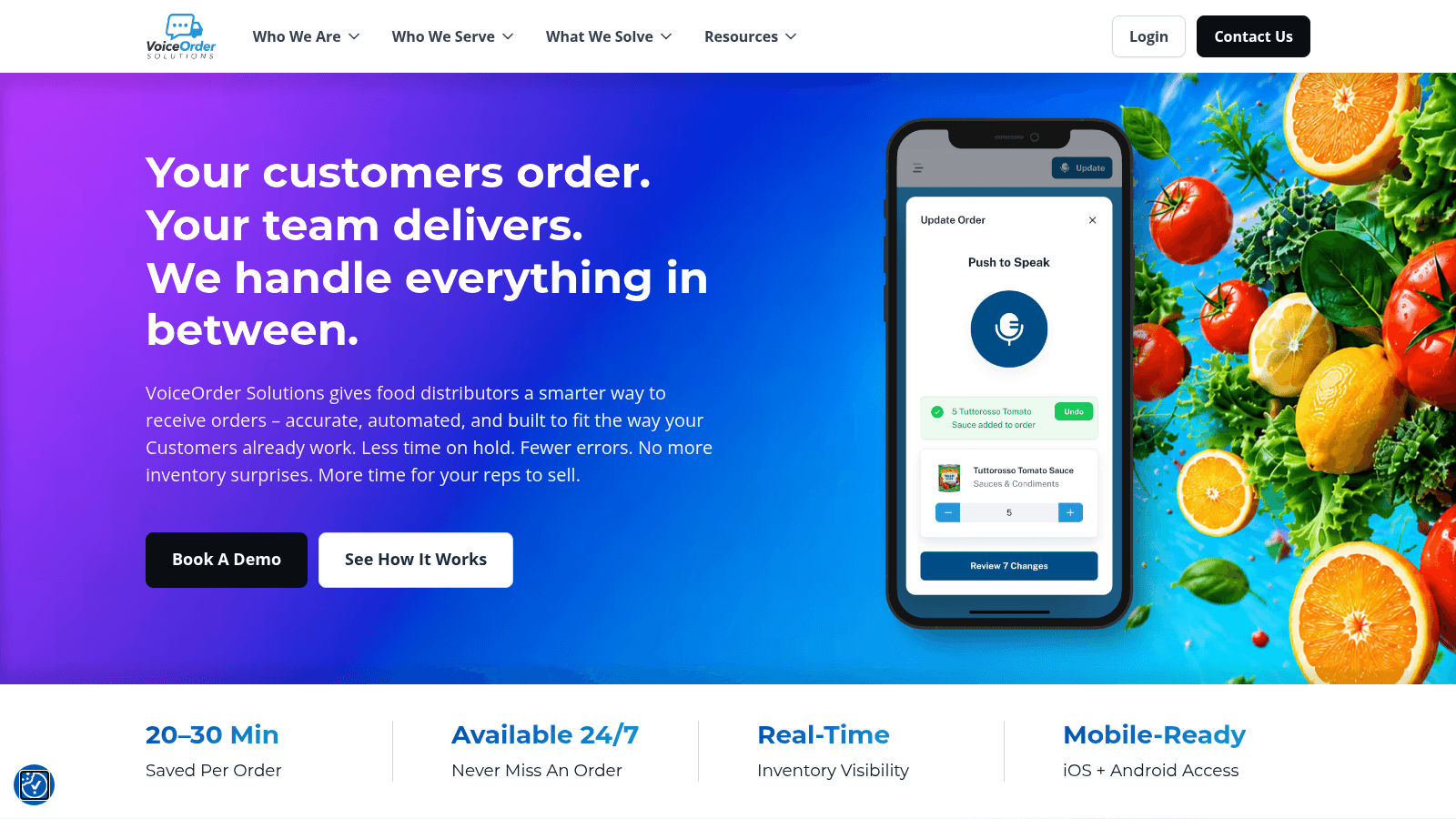
Overview: VoiceOrder Solutions sits at the point where a food business restocks. Staff open an iOS or Android app, speak the order aloud while walking the storeroom or walk-in, and the order is digitized, confirmed, timestamped, and sent to the distributor automatically.
It's deliberately narrow. It doesn't cost your recipes, run your production line, or keep your books, and it doesn't try to.
What it removes is the phone call and the re-keying on both ends of it. That step survives almost every other system a food business installs, which is why an operator with a full inventory platform can still be losing evenings to voicemail and wrong deliveries.
Because capture runs around the clock, an order placed after close is queued rather than lost, and it layers alongside a POS, inventory tool, or ERP without replacing any of them.
Key features:
Pricing: Quote-based, with pricing available on request. Setup for independent distributors typically runs 24 to 48 hours.
Pros: orders are confirmed before transmission so mishearings never reach the supplier, 20 to 30 minutes saved on each order, usable while your hands are full, no lost after-hours orders, and nothing to rip out to adopt it. Cons: everything goes in by voice, which some teams simply won't prefer, and its scope stops well short of production or stock valuation.
How to start using it:
Why it's a good food and beverage industry software: it fixes the ordering step that both restaurants and food businesses still run by phone. Final verdict: the right addition when supplier ordering is your weak link, regardless of what else you run. Contact VoiceOrder Solutions for a demo.
Overview: Toast is a restaurant-specific POS that has grown into a broader operating platform, adding payroll, inventory, and invoice tools around the payment terminal at its center.
Key features:
Pricing: The Starter Kit is $0 monthly for a single location, Point of Sale is $69 monthly, and the complete platform is custom-quoted. Additional suites are bundled add-ons.
Pros: genuinely low entry price, hardware and software from one vendor, large integration marketplace. Cons: value concentrates inside the Toast ecosystem, full multi-location capability requires custom pricing, and switching away later is costly once payments run through it.
Why it's a good food and beverage industry software: it covers the widest span of restaurant operations from a single vendor. Final verdict: the strongest all-round pick for restaurants and bars, provided you're comfortable committing to one ecosystem.
Overview: Restaurant365 unifies restaurant accounting with inventory and workforce management, so food cost, labor, and the general ledger update from the same underlying data rather than reconciling monthly.
Key features:
Pricing: Custom and modular, quoted after a demo. Some older third-party articles still list a $399 monthly plan, but the live pricing page shows only a custom quote, so that figure is stale.
Pros: genuine single source of truth for operations and finance, mature multi-location reporting, strong vendor integration library. Cons: the heaviest rollout on the operator side of this list, more system than a single restaurant needs, and no published pricing.
Why it's a good food and beverage industry software: it treats food cost as an accounting problem rather than a spreadsheet exercise. Final verdict: the pick for multi-unit groups where finance drives the technology decision.
Overview: MarketMan concentrates on the buying and costing loop for food businesses: what you order, what you pay, and how that lands in your cost of goods.
Key features:
Pricing: Starter costs $199 a month, Growth $249, and Enterprise is quoted case by case. Watch two limits: the integrations and AI ordering cost extra, and Starter allows only 50 invoice scans monthly.
Pros: published pricing in a category that mostly hides it, effective price-variance alerting, proven with multi-unit operators. Cons: the most useful integrations are chargeable extras, the entry tier's scan limit is restrictive, and there's no free trial.
Why it's a good food and beverage industry software: it connects purchasing decisions directly to margin. Final verdict: a strong mid-market choice for operators whose main concern is food cost discipline.
Overview: Craftable is a hospitality back-office platform that handles food and beverage programs with equal weight, which is unusual. Recipe costs recalculate on live vendor pricing, and invoices are matched three ways.
Key features:
Pricing: Custom only. No pricing is published and the pricing page does not resolve, so access runs through a demo.
Pros: genuine parity between food and bar programs, strong invoice controls, useful margin reporting. Cons: no published pricing at all, heavier setup than a single-purpose tool, and more capability than a small independent will use.
Why it's a good food and beverage industry software: venues where drinks carry the margin need beverage costing treated as seriously as food. Final verdict: best for hotels, restaurant groups, and venues running substantial bar operations.
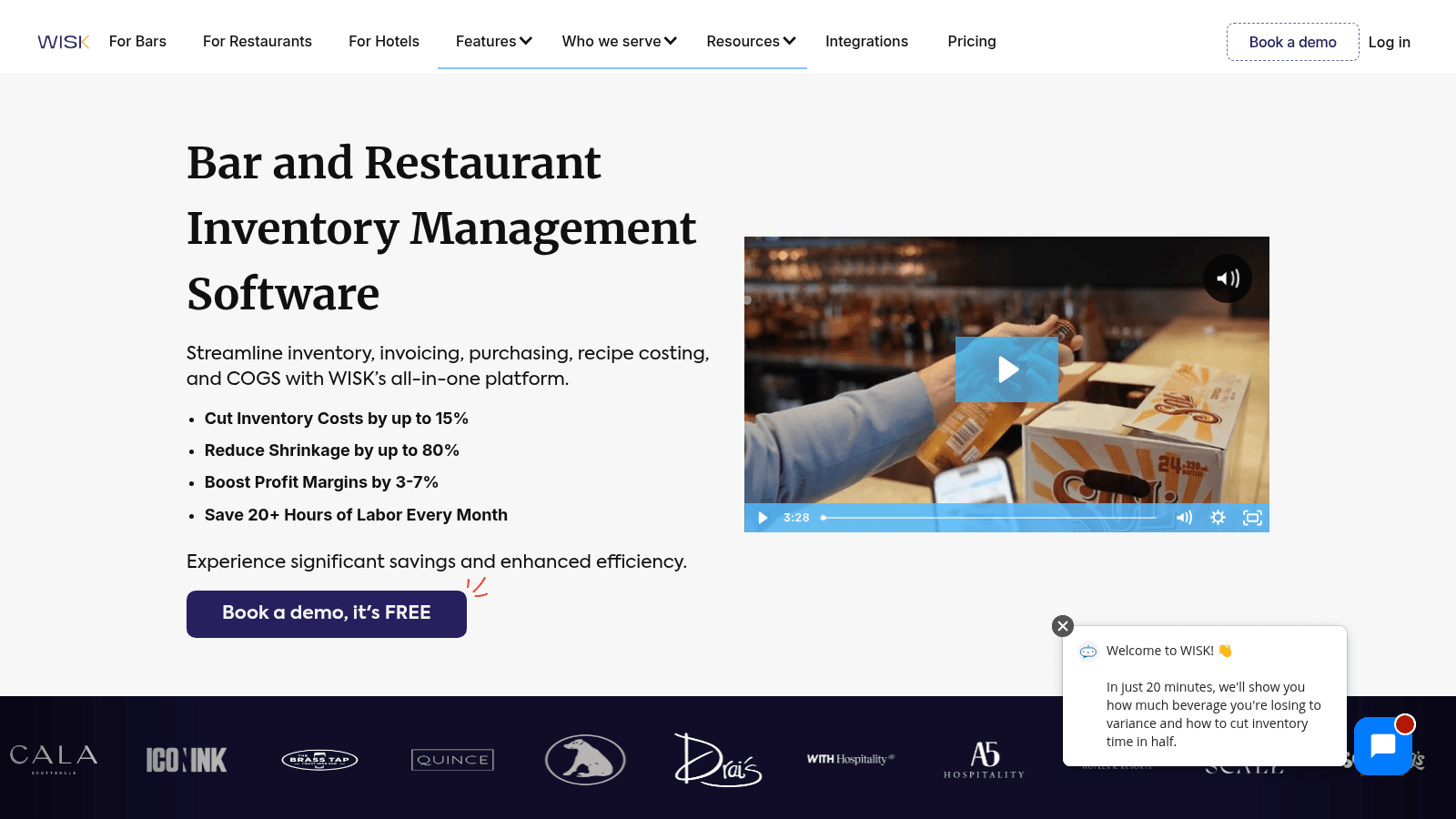
Overview: WISK is beverage inventory taken to pour level, using Bluetooth scales to weigh partial bottles so variance reflects what was actually poured rather than what was counted by eye.
Key features:
Pricing: Essentials is $189 per location monthly on annual billing, up to 300 SKUs, with a $299 setup fee. Professional is $249 and Premium is $499. Food inventory is a $99 to $199 monthly add-on.
Pros: the most precise beverage counting here, genuine pour-level variance detection, over 60 POS integrations. Cons: food inventory costs extra so it isn't a complete solution alone, the setup fee is unusual, and SKU caps apply on the entry tier.
Why it's a good food and beverage industry software: beverage shrinkage hides in partial bottles, which ordinary counting misses entirely. Final verdict: the specialist choice for bars and beverage-led venues, best paired with a food tool.
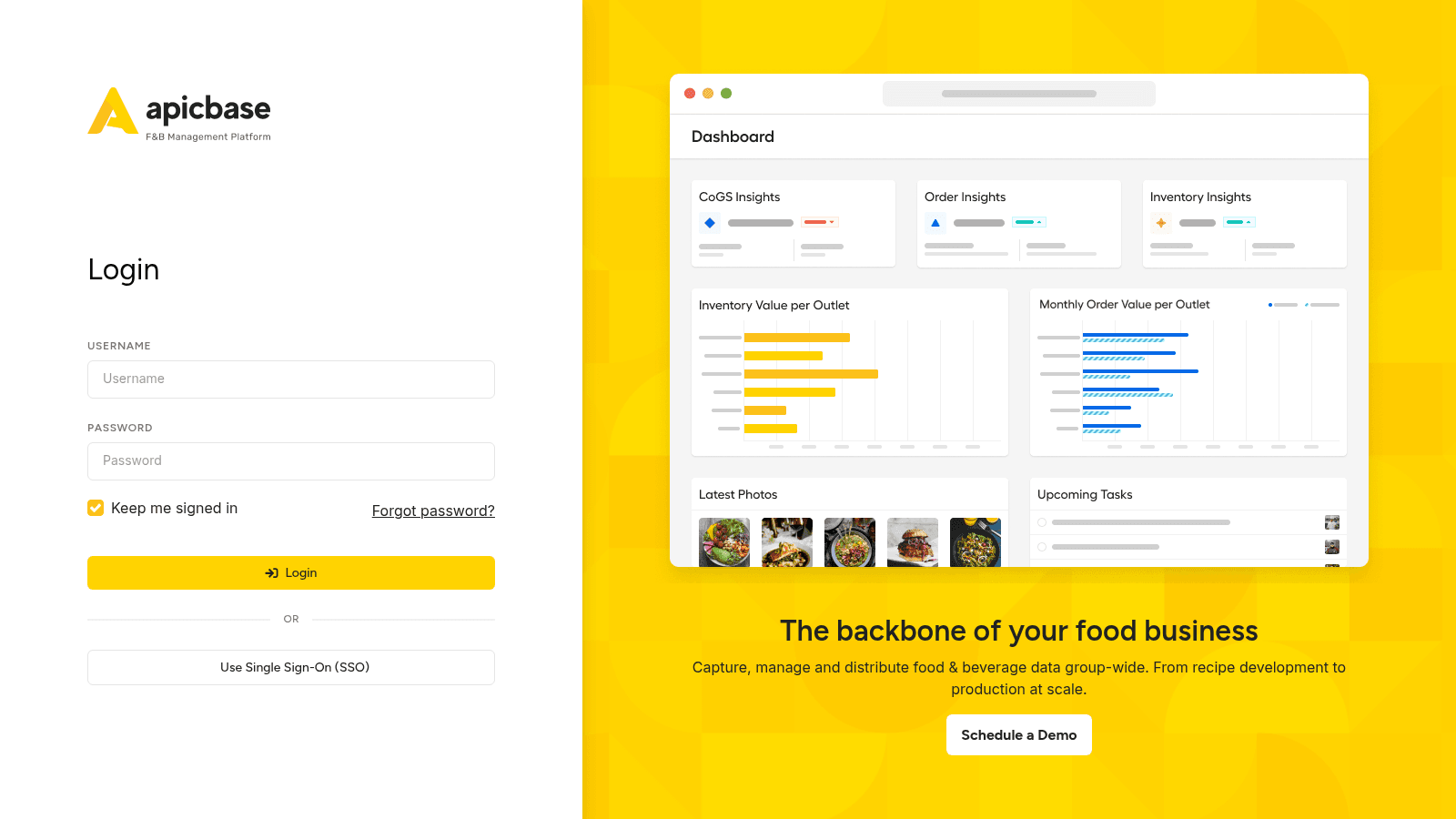
Overview: Apicbase manages the data layer behind multi-outlet foodservice: recipes, nutritional and allergen information, procurement, and production planning, standardized across sites.
Key features:
Pricing: Custom, scaled by outlet count, with Growth starting from five outlets. HACCP, internal ordering, production planning, traceability, and API access are add-ons.
Pros: the strongest recipe and allergen data model on the operator side, genuinely built for multi-outlet groups, useful production planning. Cons: priced per outlet so small operators fit awkwardly, key capabilities sit behind add-ons, and pricing requires a demo.
Why it's a good food and beverage industry software: it bridges operator and producer thinking, handling recipes as production data rather than menu descriptions. Final verdict: the best fit for scaling groups with central production kitchens.
These five serve companies that produce food and drink at scale. Every one is quote-based, sold through a demo or a partner, and implemented over months rather than weeks.
Overview: Aptean sells ERP built specifically for food and beverage manufacturers rather than a general ERP with a food module attached, covering lot traceability, recall management, catch-weight, and allergen control natively.
Key features:
Pricing: Quote-based with no published figures, sold through a demo process.
Pros: purpose-built for F&B rather than adapted, strong recall and traceability tooling, deep industry-specific functionality. Cons: no pricing transparency, an enterprise sales cycle, and considerable implementation effort.
Why it's a good food and beverage industry software: food-specific requirements like catch-weight and allergen genealogy are painful to retrofit into generic ERP. Final verdict: a leading option for established manufacturers who need F&B specifics from day one.
Overview: Sage X3 is a mid-market ERP with a dedicated food and beverage vertical, covering process manufacturing alongside finance and supply chain, with lot, batch, and recall controls in the standard product.
Key features:
Pricing: Quote-based, sold and implemented through Sage partners.
Pros: well-suited to mid-market producers rather than only enterprises, established partner network, traceability included rather than added. Cons: no published pricing, implementation quality depends heavily on the partner you choose, and it's a broad suite rather than a food-only product.
Why it's a good food and beverage industry software: it gives growing producers real process-manufacturing capability without enterprise-scale commitment. Final verdict: a sensible middle option between a food-specific ERP and a full enterprise platform.
Overview: IFS approaches food and beverage manufacturing from the asset side, with strong enterprise asset management for producers whose economics depend on keeping production lines running.
Key features:
Pricing: Quote-based, with no published figures.
Pros: exceptional plant maintenance and uptime capability, genuine enterprise scale, strong across complex multi-site operations. Cons: food and beverage is one vertical among many rather than the sole focus, no pricing transparency, and it's oriented toward larger organizations.
Why it's a good food and beverage industry software: unplanned line downtime is one of the most expensive failures in food production. Final verdict: the pick for asset-intensive producers where equipment uptime drives profitability.
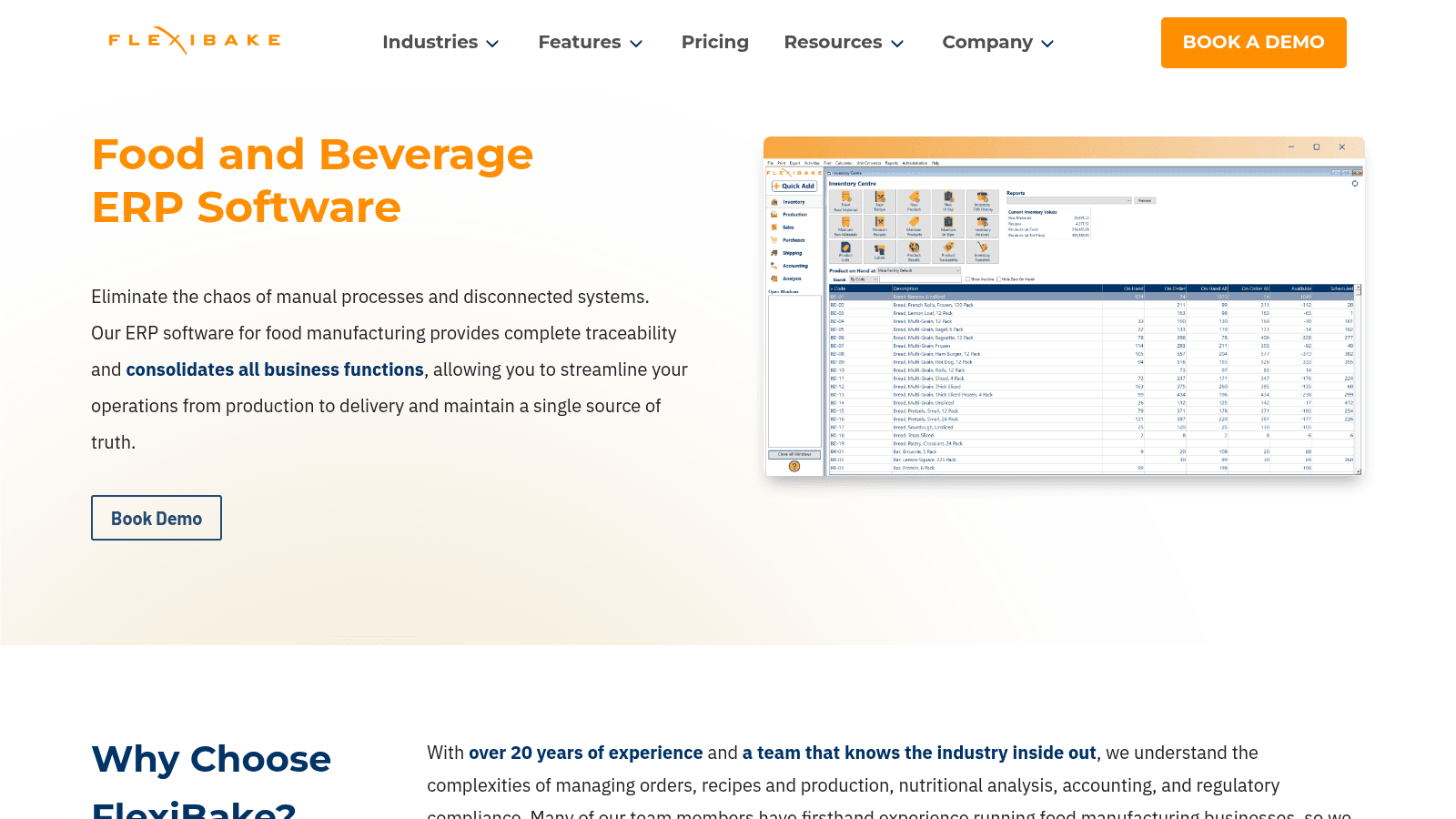
Overview: FlexiBake is ERP for bakeries and food production operations, handling production scheduling, recipe and nutritional labeling, and route delivery in one system aimed at a specific vertical.
Key features:
Pricing: Quote-based. The site describes serving businesses scaling from roughly $1 to $5 million in annual revenue up to $20 to $30 million operations, which describes its target customers rather than its price.
Pros: deep fit for bakery and production workflows, nutritional labeling handled natively, route delivery included. Cons: narrow vertical focus limits it outside bakery-style production, no published pricing, and a smaller vendor than the enterprise options here.
Why it's a good food and beverage industry software: bakery production has scheduling and labeling requirements that generic ERP handles poorly. Final verdict: the specialist choice for bakeries and similar production businesses.
Overview: Acumatica is a cloud ERP with a food and beverage manufacturing edition, notable for licensing on resource consumption rather than per user, which changes the economics for businesses with many occasional users.
Key features:
Pricing: Quote-based, sold through a partner network with consumption-based licensing rather than seat counts.
Pros: unusual licensing model that suits growing teams, genuine cloud architecture, strong distribution alongside manufacturing. Cons: no published pricing, results depend on the implementing partner, and food-specific depth trails a purpose-built F&B ERP.
Why it's a good food and beverage industry software: consumption licensing avoids penalizing you for adding warehouse or production staff. Final verdict: worth shortlisting for growing producers who also distribute.
Every product here was verified live in August 2026, with a reachable page confirming it does what the category claims. One well-known vendor was dropped because its site blocked verification entirely, and we replaced it rather than writing an entry we couldn't check.
We split the list deliberately. Mixing restaurant tools and manufacturing ERP into one ranking produces a list where the top choice is wrong for most readers, so the two groups are ranked separately and labeled clearly.
Pricing is quoted only where a vendor publishes it. For the manufacturing half that meant reporting quote-based across the board, which is accurate rather than evasive, and we resisted the temptation to invent ranges.
We also checked ownership. Several tools in this vertical have changed hands recently, and an entry describing an independent company that was acquired last year is worse than no entry at all.
Requirements diverge sharply between the two groups, but a handful of questions apply to both and are worth asking in any demo.
Ask each of those in a live demo rather than accepting a feature checklist. Traceability in particular tends to look complete on a slide and incomplete in the product.
Start by identifying which half of this list you belong to, because that decision eliminates most of the market immediately.
If you serve food to customers, you're buying operator software, and your sequence usually runs POS first, then inventory and food cost, then ordering. If you produce food for others, you're buying manufacturing ERP, and your requirements are traceability, batch production, and quality control before anything else, often alongside food distribution software for getting it out the door.
Businesses that do both, such as a bakery with retail cafes or a brewery with a taproom, genuinely need one from each column. That's not a failure of shopping; it reflects two different regulatory and operational realities.
Scale then narrows it further. Below roughly five sites, published-price operator tools win on flexibility. Above that, integration overhead starts favoring a suite. On the manufacturing side, the practical question is whether you need food-specific depth from day one or a broader ERP with a food vertical.
The two halves of this category price completely differently, and comparing them directly is meaningless.
| Segment | Typical pricing model | What's published |
|---|---|---|
| Operator POS | Per location, monthly | Toast from $0 to $69, transparent |
| Operator inventory and cost | Per account or location | MarketMan $199, WISK $189 |
| Operator suites | Custom quote | Restaurant365, Craftable, Apicbase |
| Manufacturing ERP | Custom quote plus implementation | Nothing published by any vendor |
Operator software is comparison-shoppable. You can read the tiers, estimate your monthly cost, and often start a trial without speaking to anyone.
Manufacturing ERP is not. Every vendor in that half of the list quotes individually, licensing is only part of the cost, and implementation and consulting frequently exceed the software itself. Budget for a partner relationship measured in months, and ask for implementation costs to be quoted separately from licensing so you can compare offers honestly.
The one requirement genuinely converging across both halves of this list is knowing where food came from and where it went.
The FDA's Food Traceability Rule requires businesses handling foods on the Food Traceability List to keep records of key data elements at critical tracking events, including traceability lot codes and receiving and shipping dates. Its compliance date was extended to July 20, 2028, which sounds distant until you consider how long an ERP implementation takes.
Waste economics point the same direction. ReFED estimates US restaurants and foodservice generated roughly 12.5 million tons of surplus food in 2024, with the sector spending around $162 billion a year on waste-related costs.
Whichever half of this list you buy from, ask how the system would answer a recall question under time pressure. That single question separates software that records traceability data from software that can actually use it.
The most expensive mistake in this category is buying across the divide: a restaurant group implementing manufacturing ERP it will never use, or a producer trying to run batch records through a restaurant inventory tool.
Decide which you are first. If you serve, look at the operator group and start with whichever of POS, food cost, or ordering hurts most. If you produce, look at the ERP group and lead with traceability requirements, then judge vendors on how convincingly they demonstrate a recall.
Then be realistic about the timeline. Operator tools go live in weeks and you can change your mind. Manufacturing ERP is a multi-year commitment where the implementation partner matters as much as the software.
For food businesses whose immediate problem is supplier ordering rather than production or accounting, VoiceOrder Solutions handles that single step without requiring you to replace anything else. Software vendors can also add it through the food service platforms program.
Restaurant software manages selling food: menus, orders, staff, food cost, and payments. Food manufacturing software manages producing it: formulas, batches, quality tests, allergen segregation, and lot genealogy for recalls. They overlap only on traceability. A restaurant asks what a dish costs; a manufacturer asks which finished pallets contain a suspect ingredient lot, which is a fundamentally different question.
Rarely at the beginning. Early-stage food brands typically run on accounting software and spreadsheets until production volume or a retail listing forces the issue. The usual triggers are a customer demanding traceability records, a co-packer relationship, or batch volumes that make spreadsheet tracking genuinely risky. Implementing full ERP before those pressures arrive usually costs more attention than it returns.
On the operator side, partly. Toast offers a $0 Starter Kit for a single location and several scheduling tools have free tiers, though these are entry points rather than complete systems. On the manufacturing side there is effectively nothing free, because the compliance and traceability requirements that make the software necessary are exactly what makes it expensive to build.
Operator tools typically go live in two to eight weeks, with most of that spent cleaning up item lists, recipes, and vendor catalogs rather than configuring software. Manufacturing ERP runs several months to over a year, depending on how many production sites and existing systems are involved. In both cases the constraint is usually your team's availability for data work, not the vendor's timeline.
If you handle foods on the FDA's Food Traceability List, you'll need to record specific key data elements at defined points in the supply chain, including lot codes and shipping and receiving dates. The compliance date is July 20, 2028. Practically, that means asking any vendor to demonstrate a traceability record and a mock recall during evaluation rather than accepting a claim of compliance readiness.