.webp)
Key takeaways:
Unified commerce is one of those terms that means something precise and gets used as though it does not. Read five vendor pages and you will find five definitions that agree in the abstract and contradict each other in the details.
There is a real distinction underneath, and it is worth recovering, because it is the difference between a project that changes how your systems work and one that changes how your website looks.
This guide sets out what unified commerce actually is, how it differs from omnichannel in specific technical terms, what the platform consists of, how to test whether something is genuinely unified, what the research says about which integrations matter, and why the business-to-business version is a different and harder problem.
The term describes an architecture in which every sales channel reads from and writes to one shared, real-time data layer: one inventory position, one customer record, one order book, one price list.
The word doing the work is "one." Not synchronized, not integrated, not reconciled overnight. One. When a store associate, a website and a call center all look at available stock, the model means they are looking at the same number in the same place, rather than at three copies that agree most of the time.
That is a claim about system design rather than about customer experience, and this is where most confusion starts. A customer cannot see your architecture. They see whether the return worked, and a well-run integrated stack can deliver a good return experience without being unified at all.
The reason the architecture matters anyway is failure behavior. Integrated systems agree until something breaks: a sync job fails, two updates collide, a channel goes offline and catches up later. A single data layer has no gap to fall into, because there is no second copy to disagree with.
Omnichannel came first and describes a different goal. It means a customer can move between channels and get a consistent experience, buying online and returning in store, or browsing on a phone and completing on a laptop.
Nothing in that definition requires shared systems. Most omnichannel implementations are separate systems, each owning its own data, connected by integrations that pass information between them. The experience is joined up; the architecture is not.
| Omnichannel | Unified commerce | |
|---|---|---|
| What it optimizes | The experience across channels | The data layer beneath the channels |
| Where data lives | In each channel's own system, synced between them | In one shared system all channels read and write |
| How channels are added | Bolt a new channel on and build integrations to it | The new channel reads the existing data layer |
| When inventory is accurate | After the last successful sync | Continuously, because there is one number |
| What breaks | Integrations, at the seams | The single platform, which is a bigger blast radius |
| Typical stated goal | Short-term conversion | Customer lifetime value |
Manhattan Associates puts the split about as cleanly as anyone: omnichannel emphasizes experience design, while unified commerce emphasizes system connection. Metapack frames the same distinction by goal, arguing that omnichannel drives near-term conversion across siloed channels while unified commerce consolidates the systems and data to raise lifetime value.
Neither is automatically better. Full unification is a larger, more expensive and more disruptive project, and a business with three channels and reliable integrations may have no reason to attempt it. A restaurant juggling delivery apps and its own website has a guest-facing omnichannel order management problem that integrations solve perfectly well.
If the distinction is clear, why does every explanation of it feel slippery?
The honest answer is that almost every page on this topic is published by a company selling a platform, and the definition that sells the platform is broader than the definition that is true.
Manhattan's own frequently asked questions state the cleanest version of the distinction available anywhere, then its body copy describes a unified commerce platform as delivering an omnichannel shopping experience, collapsing the two terms it had just separated.
That is not dishonesty so much as a category problem. The vendor is describing an outcome to a buyer who cares about outcomes, while the architectural claim is aimed at a technical evaluator who may never read the page.
The blur leaves buyers with a practical difficulty: the word on the box does not tell you what is inside. An independent consultancy reviewing the field concluded that most retailers conflate multi-channel, omnichannel and unified commerce entirely, and that a large share of what gets declared unified is aspirational rather than achieved. Its supporting figures are not independently traceable, so treat the sentiment rather than the numbers as the finding.
Manhattan's own commissioned benchmark reports that only 7% of brands reach what it calls unified commerce leadership. That is research paid for by a vendor selling the solution, which is worth stating plainly, though the direction is consistent with the consultancy's less flattering read.
The practical consequence for a buyer is that the category label tells you nothing, so wholesale order management software has to be judged on specific behaviors instead.
Strip the marketing and the component list is stable across every serious source.
| Component | What it holds | What breaks without it |
|---|---|---|
| Commerce engine | Catalog, pricing rules, promotions, the transaction itself | Each channel prices independently and they diverge |
| Order management | Every order from every channel, in one book | Nobody can answer "where is my order" across channels |
| Inventory | One available-to-promise position across all locations | You either oversell or hold buffer stock in every channel |
| Customer record | Identity, history, entitlements, contract terms | The customer is a stranger in each channel they enter |
| Payments | Tokenized methods usable across channels | A card saved online cannot be used in store |
| Point of sale or order entry | The physical or human-assisted capture point | The store or the rep becomes a separate island |
Inventory is the component that usually reveals whether a project was genuinely unified. Holding one available-to-promise number across stores, warehouses and in-transit stock is technically demanding and organizationally contentious, because it means no channel gets its own protected buffer.
Businesses that duck that fight have not unified anything, whatever the platform is called, and this is the point where the order management layer stops being a piece of software and becomes a policy decision.
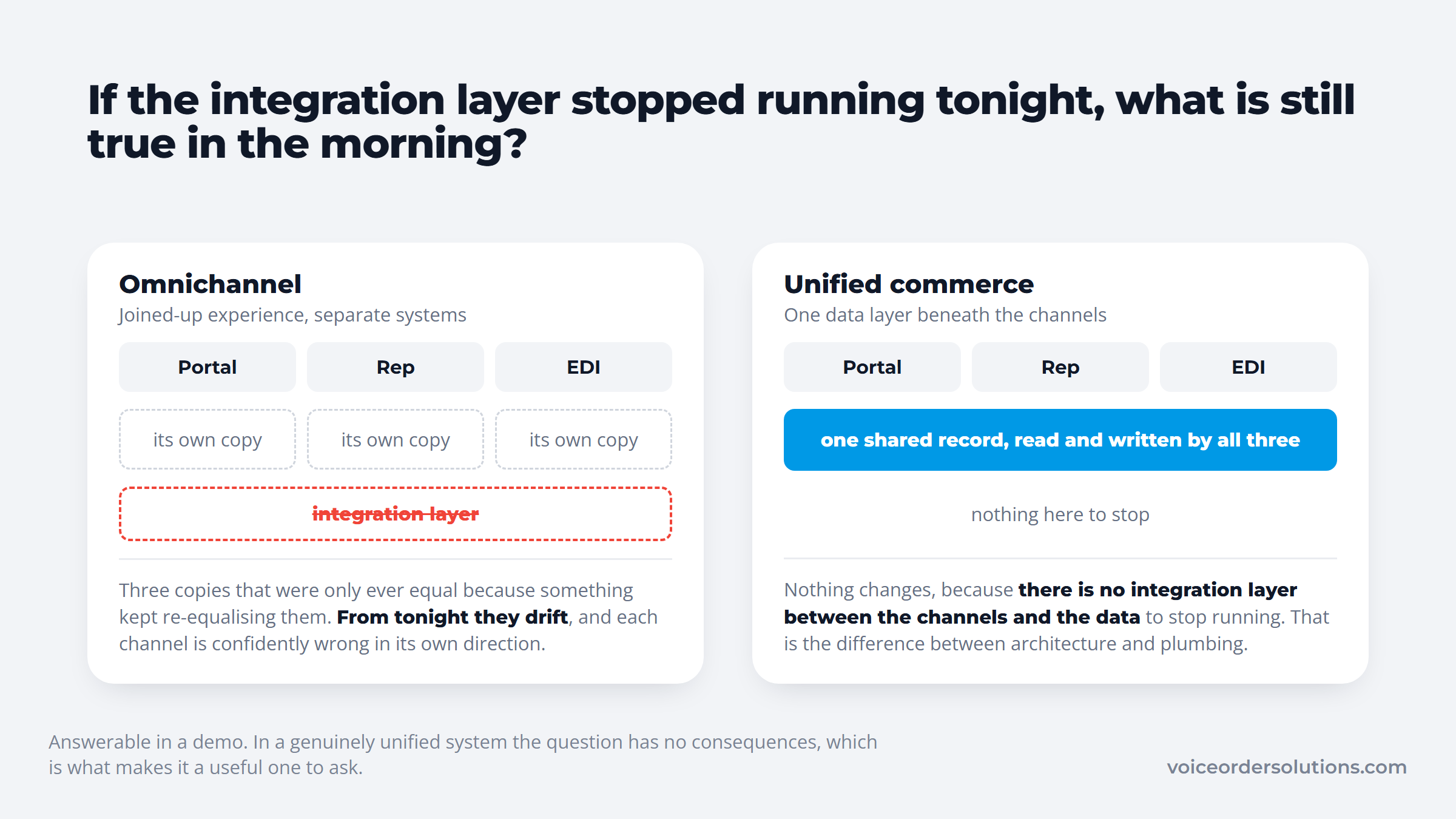
Vendor claims are hard to evaluate from the outside, but a handful of questions get you most of the way, and they are answerable in a demo.
That last question is the sharpest one, because it separates architecture from plumbing. In a genuinely unified system, there is no integration layer between the channels and the data to stop running.
Both architectures look the same on a good day, and only one of them survives the question.
One B2B platform vendor makes the point more bluntly, asking whether customer data, pricing rules and order workflows actually run in one codebase or whether the platform stitches separate modules together behind the scenes. That is a competitor grading its rivals and should be read as such, but the question is a fair one to put to any vendor, including the one asking it.
The answers vary more than the marketing suggests, and products sold as order management software for distributors range from a genuine single record to a reporting layer over three systems that still disagree.
Almost everything written on this subject is vendor material. There is some genuine research, and it is more specific than the marketing.
A peer-reviewed study in Cogent Business and Management surveyed 516 retail buyers and used structural equation modeling to test which specific channel integrations affect customer experience. The finding worth carrying is that the effects are not uniform.
Integrating pricing and product information had the strongest measured effect on both the emotional and the cognitive dimensions of customer experience, with standardized coefficients of 0.519 and 0.487 respectively. Integration of transaction information and of order fulfillment also registered significant effects. Promotion and service integration mattered on different dimensions again.
Two caveats belong with that. The sample was drawn from retail buyers in Peru, so the market context is not the United States, and the study measures retail rather than business-to-business buying.
The transferable result is the shape of the finding rather than the coefficients: consistency of price and product data across channels does more work than the general idea of being joined up, which argues for sequencing a unification project around pricing and catalog first.
Named examples are useful and almost all of them come from the platform vendors involved, so the numbers are self-reported and unaudited.
| Company | What was unified | Source of the claim |
|---|---|---|
| Brooks Brothers | Order management, promotions, store inventory and point of sale onto one platform; shifted from about 35% digital to fulfilling entirely through ship-from-store and store pickup during 2020 closures | Manhattan Associates case study |
| PacSun | Point of sale and order management on one platform, with ship-from-store credited by its co-chief executive for carrying the business through closures | Manhattan Associates case study |
| DiversiTech | Twelve separate ERP systems inherited through acquisitions consolidated behind one self-service customer portal, with orders, shipments, packing slips and invoices syncing automatically | OroCommerce case study, repeated in sponsored trade coverage |
| Lactalis | Twelve regional businesses connected on one commerce platform, with digital orders reported up 230% | OroCommerce case study |
The two B2B examples are the more instructive pair. DiversiTech's problem, twelve ERPs acquired rather than chosen, is the characteristic shape of the challenge in distribution: nobody designed the fragmentation, it accumulated. The fix described is also revealing, since the portal unified what the customer sees while the underlying systems were consolidated behind it over time, which is a more achievable sequence than replacing everything at once.
The scale of business-to-business digital order flow is easy to underestimate. The Census Bureau's E-Stats release put merchant wholesale trade e-commerce at $3,760.2 billion in 2022, against $997.5 billion for retail trade.
Census flags a total quantity response rate of 40.4% on the wholesale estimate and advises caution, so read it as an order of magnitude: B2B digital commerce is several times the size of the consumer version that gets all the coverage.
B2B is also structurally harder, for a reason retail sources never address. A retailer largely chooses its channels. A distributor does not.
Orders arrive from a sales rep's tablet, an EDI feed, an emailed purchase order, a phone call, a customer portal and sometimes a spreadsheet, because the customer decides how they want to order and the supplier accommodates it.
One operator described on Reddit receiving wholesale orders as Excel forms with products in rows and size or color variants across columns, which no system could import, handled with a macro that reformatted the sheet before upload.
The same thread contains the more important lesson. An administrator at a distributor described trying to move customers onto an online ordering portal and getting near-total refusal, seeing perhaps 5% of orders placed online even with an opt-in.
Rather than keep pushing, they rebuilt the intake around the email channel customers were already using, with a triaged shared mailbox and automated workflows, and cut per-order processing from five to ten minutes down to under a minute.
The two attempts sit side by side, and only the second one moved a number.
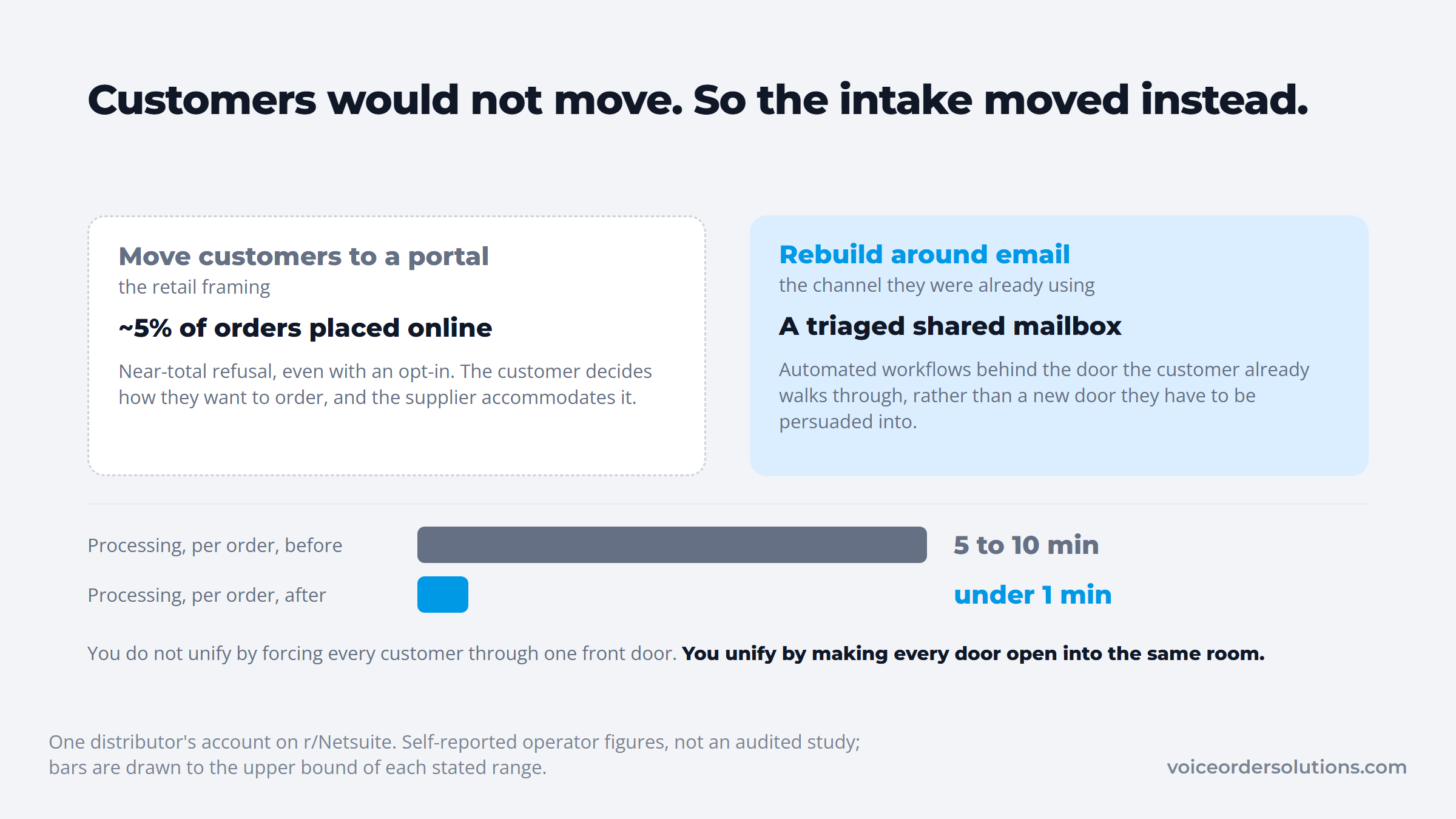
That is the real B2B unified commerce insight and it inverts the retail framing. You do not unify by forcing every customer through one front door. You unify by making every door open into the same room, which is what customizable ordering software is built to do.
Here is the requirement that makes B2B genuinely different, and that no retail-oriented explanation of unified commerce mentions.
In retail, price is a property of the product. In distribution, price is a property of the relationship: each customer has negotiated terms, contract pricing, volume tiers, rebates and often a specific list of items they are allowed to buy. Two restaurants ordering the identical case from the identical distributor on the same morning pay different amounts, correctly.
That turns "one price list" into "one pricing engine capable of resolving a different answer per customer per item, consistently, in every channel." A rep quoting by phone, a portal showing a catalog and an EDI feed accepting a purchase order must all resolve to the same number, or the customer will find the discrepancy and you will spend the afternoon on it.
The same object appears under three different names depending on who is talking. Commerce platforms call it customer-specific pricing, ERP calls it a contract price list, and the distribution business calls it the order guide. They are the same requirement, and treating them as separate systems is exactly how a business ends up with three versions of a customer's price.
Keeping the customer's view of their own orders consistent with that pricing is what order tracking has to reconcile against.
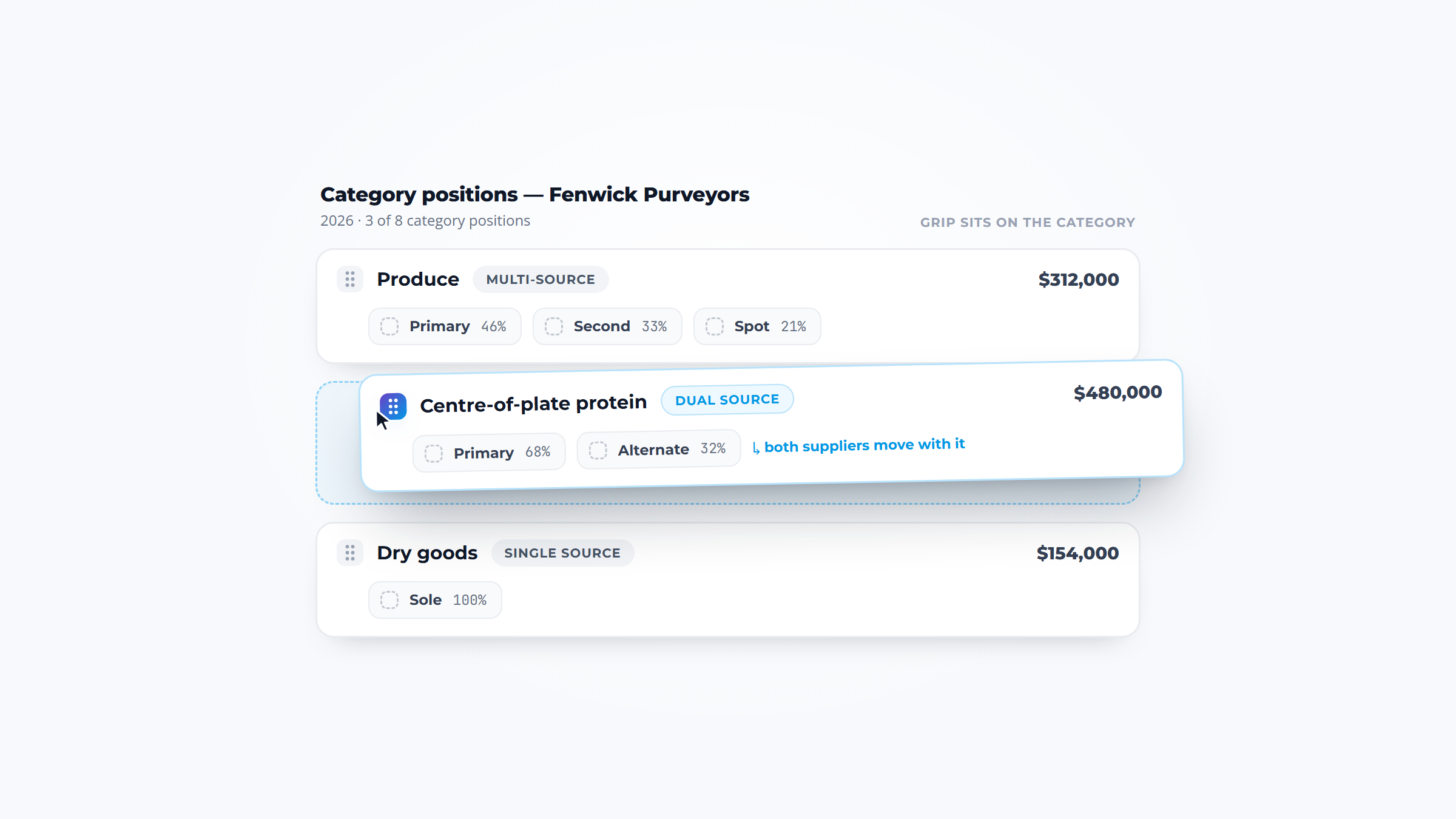
The retail version treats a single inventory pool mainly as a way to sell store stock online. B2B needs the same pool for a harder job: deciding who gets the stock when there is not enough.
When a shipment lands short, someone has to allocate. That decision depends on contract commitments, customer tier, credit status, whether an order is already part-shipped, and what the customer will do if they receive nothing. In retail the equivalent question is usually answered first come, first served.
The same shortage asks a much larger question on the distribution side.
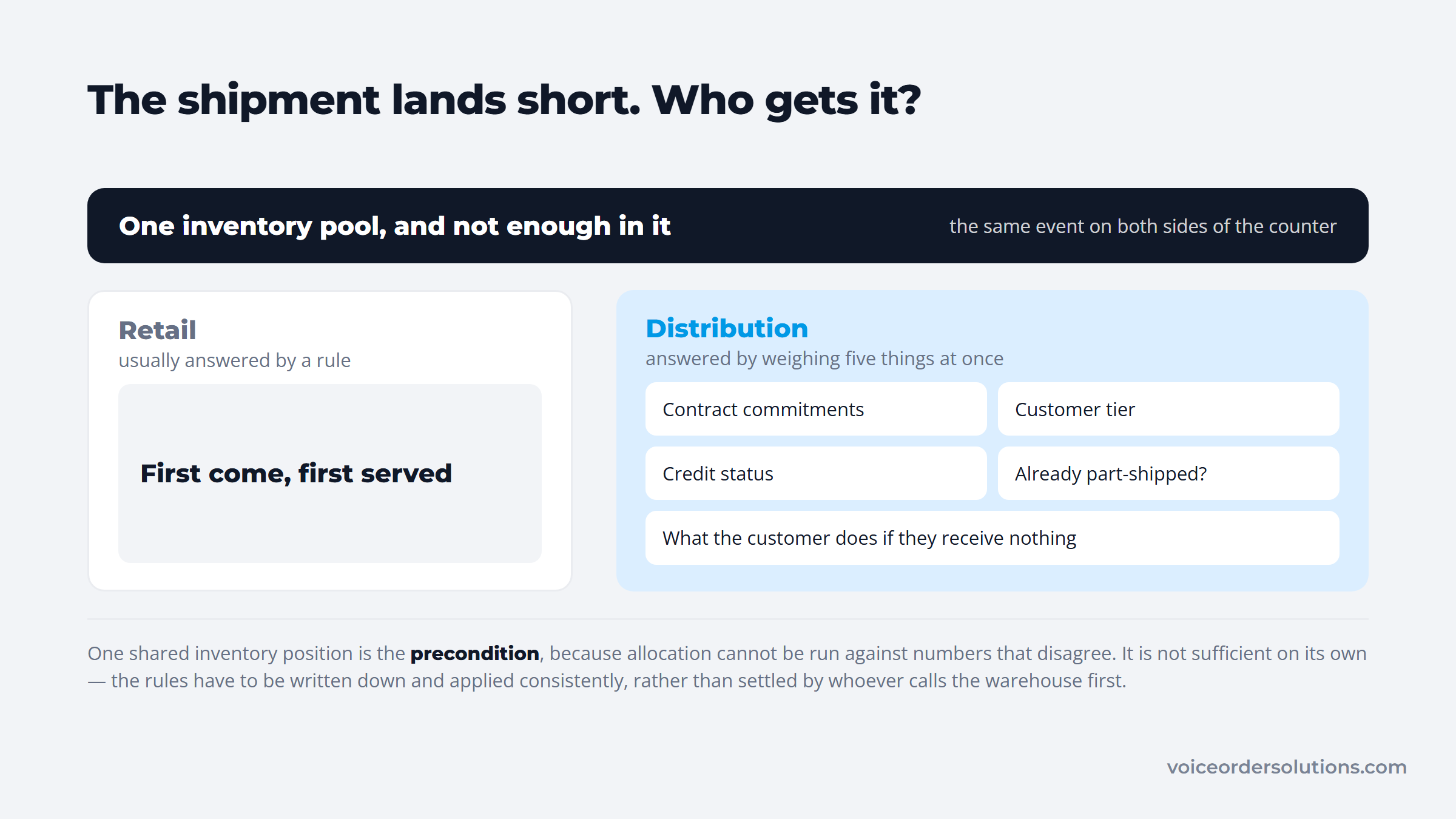
A single inventory position is the precondition for making that decision well, because allocation cannot be run against numbers that disagree. It is not sufficient on its own, since the allocation rules themselves have to be written down and applied consistently rather than settled by whoever calls the warehouse first.
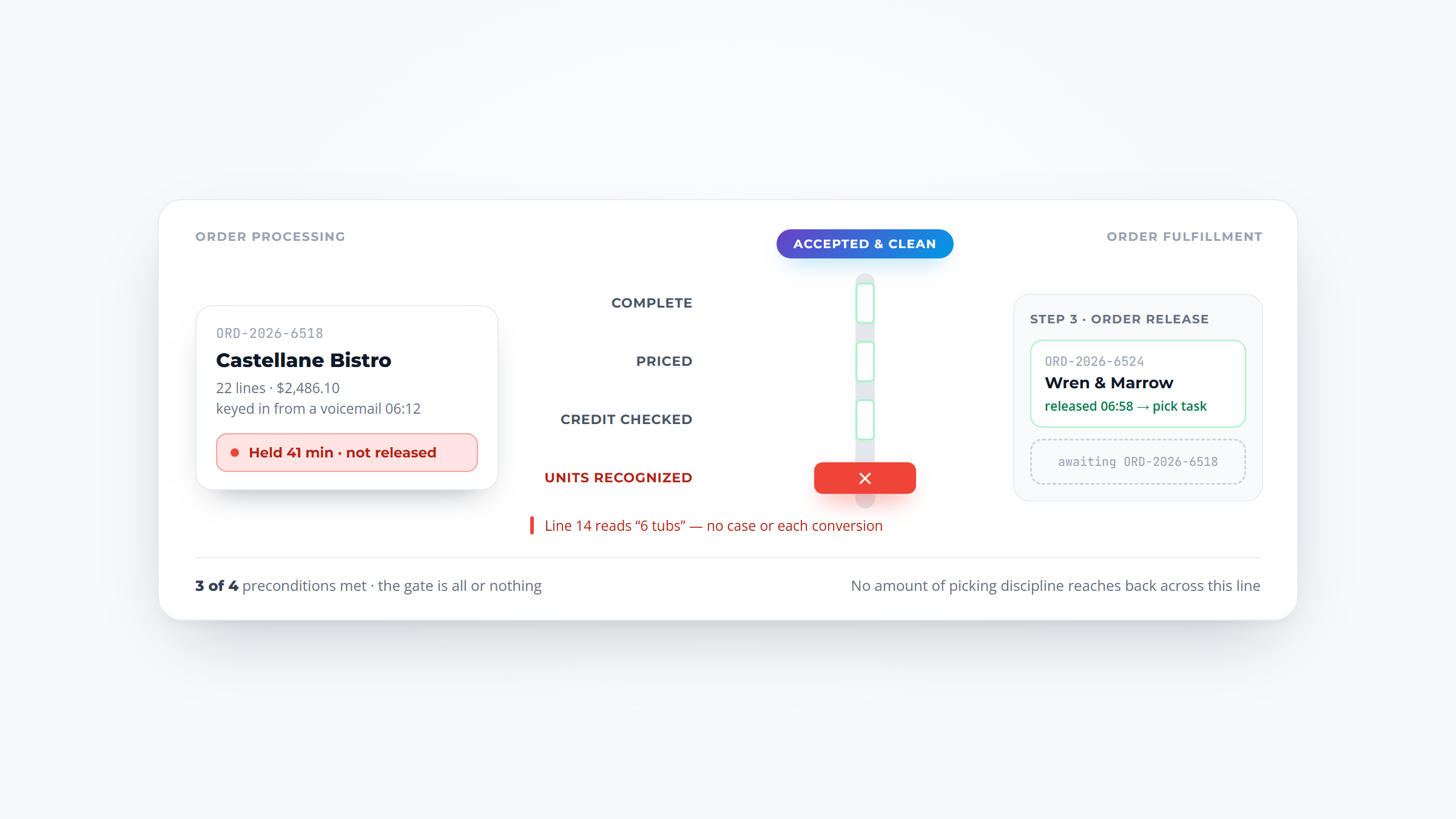
This is also where credit interacts with availability in a way retail rarely encounters. Stock committed to a customer on credit hold is neither available nor allocated, and a system that cannot represent that state will either oversell it or strand it. That third state is the one most inventory management setups quietly lack, which is why held stock tends to vanish from the numbers rather than showing as reserved.
Unification projects fail by trying to happen at once. The sequence below orders the work so each stage is usable before the next begins.
The order matters because each step makes the next cheaper. Consolidating front-ends first, which is the tempting place to start because it is what people can see, means rebuilding them again once the data layer moves underneath.
Note also what is not on that list: replacing everything. DiversiTech's twelve ERPs were consolidated behind a unified customer experience over time rather than in one migration, and that sequence is available to most businesses. Step three is where the visible benefit starts, because a single order book is what finally lets one person answer a customer's question, and it improves the order management process without touching a single channel.
Everything above describes a platform layer. Voice ordering is not one, and it is worth being explicit about that because the vocabulary invites the confusion.
VoiceOrder Solutions is the intake and processing layer on the distributor's side of a voice order. Each account's negotiated catalog is held centrally by the distributor, so an order arriving by voice resolves to exactly the items and rates a rep would quote or an EDI feed would accept for that account.
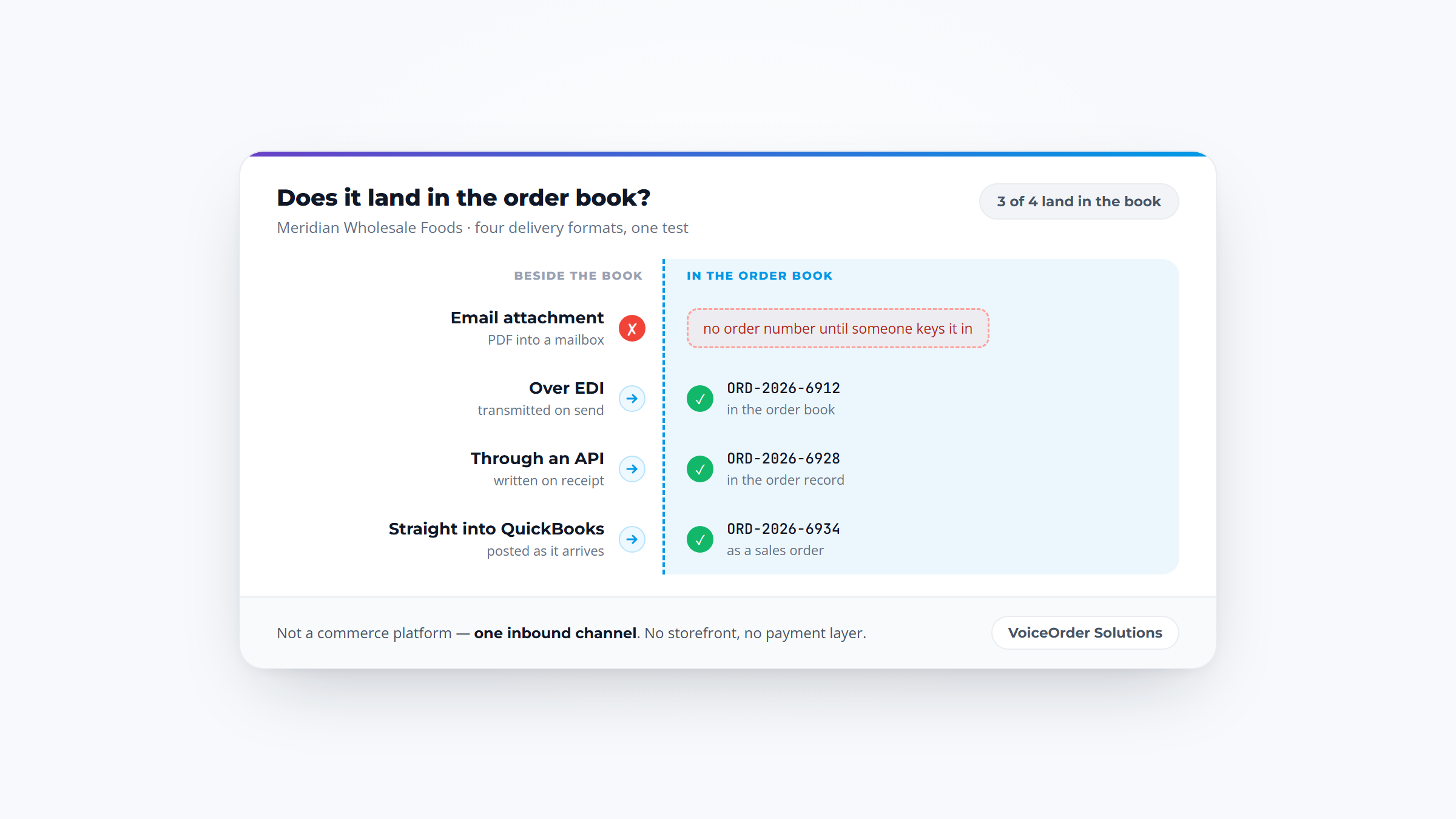
The order reaches the distributor's team digitized, confirmed, numbered and timestamped, and it can land as an email attachment, over EDI, through an API, or straight into QuickBooks. That last list is the part that matters here, because the delivery format decides whether the channel joins the order book or sits beside it.
In the terms of this article, it is one more inbound channel, judged by the only test that matters for a channel: does it land in the same order book as everything else, carrying the same prices. It is not a commerce platform, has no point of sale, no storefront and no payment layer, and it touches nothing guest-facing.
That narrowness is the point. A distributor building toward a single order book does not need every channel to be part of one platform; it needs every channel to resolve to one set of data, and a channel that delivers into the systems already in place is easier to unify than one that brings its own.
Software vendors who want voice as a capability inside their own product can reach it by API, which is how VoiceOrder Solutions works with food service software platforms.
If you are being sold unified commerce, start by asking which of your data domains currently has more than one authoritative copy. That list is the actual project, and it is usually shorter and more specific than the platform pitch implies.
If you are running a distribution business, start with the price list. Getting one answer per customer per item, resolved the same way in every channel, removes more daily friction than any other single change and does not require replacing a system to begin.
And treat channel consolidation as the last step rather than the first. Customers order the way they order, and the winnable version of this project is making every one of those routes end in the same place.
Pricing is available on request, and suppliers adding voice as one more route into the same book can ask VoiceOrder Solutions to trace how an order reaches the systems they already run.
Request a VoiceOrder Solutions demo
It is an architecture in which inventory, customers, orders and pricing live in a single live store that every channel works against directly. The defining feature is one copy of each record, rather than several copies held in step by integrations.
It is a claim about how systems are built rather than about what customers experience, which is why two businesses can offer identical customer journeys while only one of them is unified.
Omnichannel is about experience: a customer can move between channels and things stay consistent. Unified commerce is about architecture: the channels share one underlying data layer instead of syncing separate ones.
You can deliver a good omnichannel experience on separate systems, and many businesses do. The difference shows up when something breaks, because integrated systems disagree at the seams and a single data layer has no seams to disagree at.
Often not, at least not as a platform replacement. A business with a few channels and reliable integrations may get most of the benefit from fixing specific data problems, starting with pricing and product information.
The case strengthens with channel count, SKU count and the cost of being wrong about stock. If overselling or price inconsistency is already causing regular customer problems, the architecture is worth examining.
Customer-specific pricing is the main one. In retail, price belongs to the product; in distribution, it belongs to the relationship, so the pricing engine has to resolve a different correct answer per customer and do it identically across a rep, a portal, an EDI feed and a phone order.
B2B also needs richer allocation logic for short supply, account hierarchies for customers with multiple locations, and credit status as a factor in whether stock is genuinely available.
Partially, and it is often the more realistic route. Consolidating the order book and establishing one authoritative source per data domain can be done while existing systems stay in place, and several published examples describe unifying the customer-facing experience first while back-end consolidation continued over years.
What you cannot do is claim unification while leaving a system outside the arrangement. Any application that keeps its own copy of customer, price or inventory data will eventually disagree with the others.