.webp)
Key takeaways:
Reduce cost, mitigate risk, improve supplier relationships, embrace digital. Most procurement strategy documents open on some version of that list, and there is nothing wrong with a word of it.
The difficulty is that nobody can disagree with it either, and a document nobody can disagree with cannot guide a decision.
A strategy earns its name when it says no to something. It names the categories where you will invest effort and the ones you will leave alone, the suppliers you will consolidate onto and the ones you will keep as insurance, the savings you will chase and the ones that cost more to capture than they return.
This guide covers how to build one for a food business, whether you buy for a restaurant group or run purchasing inside a distributor. It starts with what the document actually is, because that is where most of them go wrong.
The distinction sounds academic until you have watched a leadership team react to each one. A plan is the annual list: initiatives, owners, targets, timelines. A strategy is the reasoning that decides which initiatives belong on the list at all.
A procurement professional put the question to r/procurement after years of presenting planning decks that looked solid until somebody asked how they connected to where the business was going.
The most useful answer in the thread was blunt: if the initiatives do not clearly tie to growth, margin or risk priorities, it is a plan, not a strategy. Another commenter framed strategy as the explicit set of choices about where procurement will create advantage and where it will not. That is anecdotal, and it matches how the two documents behave in practice.
The test is whether removing a line changes anything. Delete "improve supplier relationships" from a document and nothing downstream moves. Delete "we will consolidate produce onto two suppliers and accept a higher unit price for guaranteed Monday delivery" and a dozen decisions change. The second sentence is strategy because it trades one thing away for another.
Splitting spend into direct and indirect is the first structural choice, and it decides who does the work and how they are measured.
| Direct procurement | Indirect procurement | |
|---|---|---|
| What it buys | Goods that become the product you sell | Everything needed to operate |
| Food examples | Proteins, produce, dairy, dry goods, packaging | Cleaning chemicals, uniforms, software, equipment service, freight |
| Volume pattern | High frequency, high volume, tight tolerance | Sporadic, fragmented, many small suppliers |
| What failure looks like | A menu item comes off, or a truck ships short | A bill arrives that nobody recognizes |
| Who usually owns it | A buyer or chef with category knowledge | Whoever raised the requisition |
A direct procurement strategy is about continuity and cost per unit, and it lives or dies on supplier performance and specification discipline. An indirect procurement strategy is mostly about control: getting fragmented spend visible, under contract and through a defined route before you attempt to optimize it.
Food businesses usually run a good direct function and a neglected indirect one, because direct spend is visible and someone is accountable for it every week. The savings in indirect are often larger in percentage terms precisely because nobody has looked.
Distributors carry both halves at once, since the goods they resell are direct spend while the fleet, the warehouse and the software behind them are indirect, a split worth reading against how independent distributors are actually structured.
Strategies written before the spend data is in tend to describe the categories the author already thinks about. Spend analysis is the correction.
The work is less sophisticated than it sounds. Pull twelve months of accounts payable, label each line with a category and a supplier, then sort.
What you are looking for is not the total, which everyone knows, but the shape. How many suppliers sit inside a single category, how much spend sits outside any contract, how many suppliers receive less than a few thousand dollars a year, and where the same item is being bought by two sites at two prices.
Expect the data to be messy. Supplier names appear three ways, one-off vendors clutter the tail, and a single account code hides four categories. Cleaning it is a week of unglamorous work that changes what you argue about for the rest of the year.
The 80% cut is the standard next move: identify the suppliers making up roughly 80% of spend and treat them as the strategy's working set. It is a starting filter rather than a rule, and it deliberately leaves the long tail for a separate decision about consolidation.
Where the same item is being purchased at different prices across sites, the underlying cause is usually catalog discipline, and a shared catalog is where that gets fixed rather than in a negotiation.
Procurement category strategy means treating a group of related spend as one object with its own plan: its own supply market, its own suppliers, its own risks, its own negotiation calendar. Produce is a category. Cleaning chemicals is a category. "Everything we buy" is not.
The public sector has been running this at scale for long enough to produce evidence. Since 2014 the US Office of Management and Budget, supported by the General Services Administration, has led a federal category management initiative intended to help agencies buy like a single enterprise.
The Government Accountability Office reports that federal agencies spent more than $495 billion on common products and services in fiscal year 2024, which is the pool the approach is aimed at.
The more useful finding for a private buyer sits in a separate GAO review of that initiative. Examining how agencies were applying it, GAO recommended more emphasis on how requirements get defined in the first place, and cited Air Force officials who saved money by analyzing what radio capabilities they actually needed rather than by buying replacement radios through an initiative contract.
That is the part most category strategies skip. Consolidating volume onto fewer suppliers is the visible move; questioning the specification is where the larger number usually hides.
Side by side, only one of the two levers produces a number anybody reports.
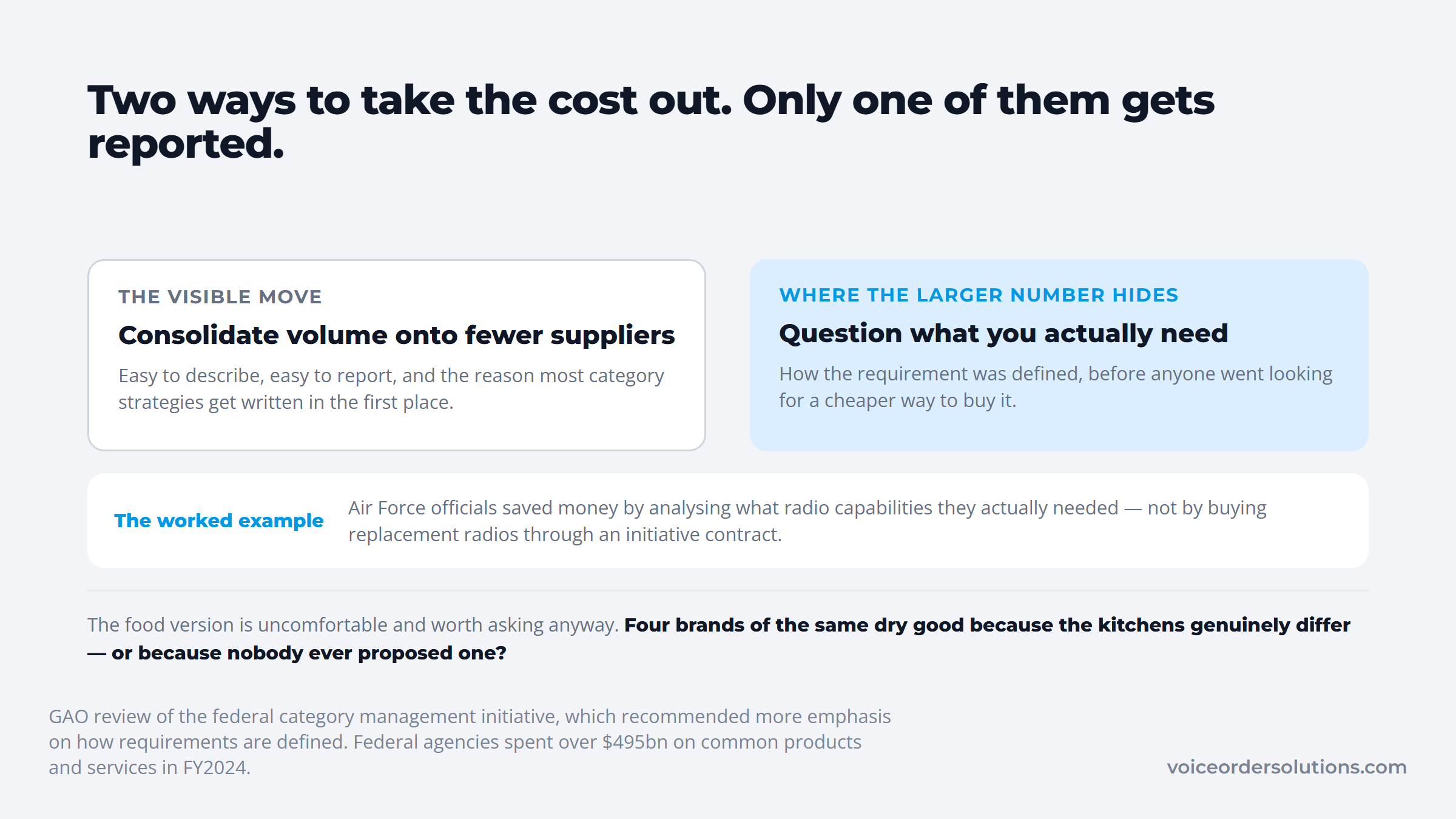
For a food operation, procurement category strategy raises an uncomfortable question worth asking anyway. Do you need four brands of the same dry good because the kitchens genuinely differ, or because nobody has ever proposed one? Does the spec on a cut of protein reflect a dish or a habit?
Holding a category's structure somewhere other than a buyer's memory is what turns those answers into a position you can defend next year, and the systems that do it are compared in procurement software.
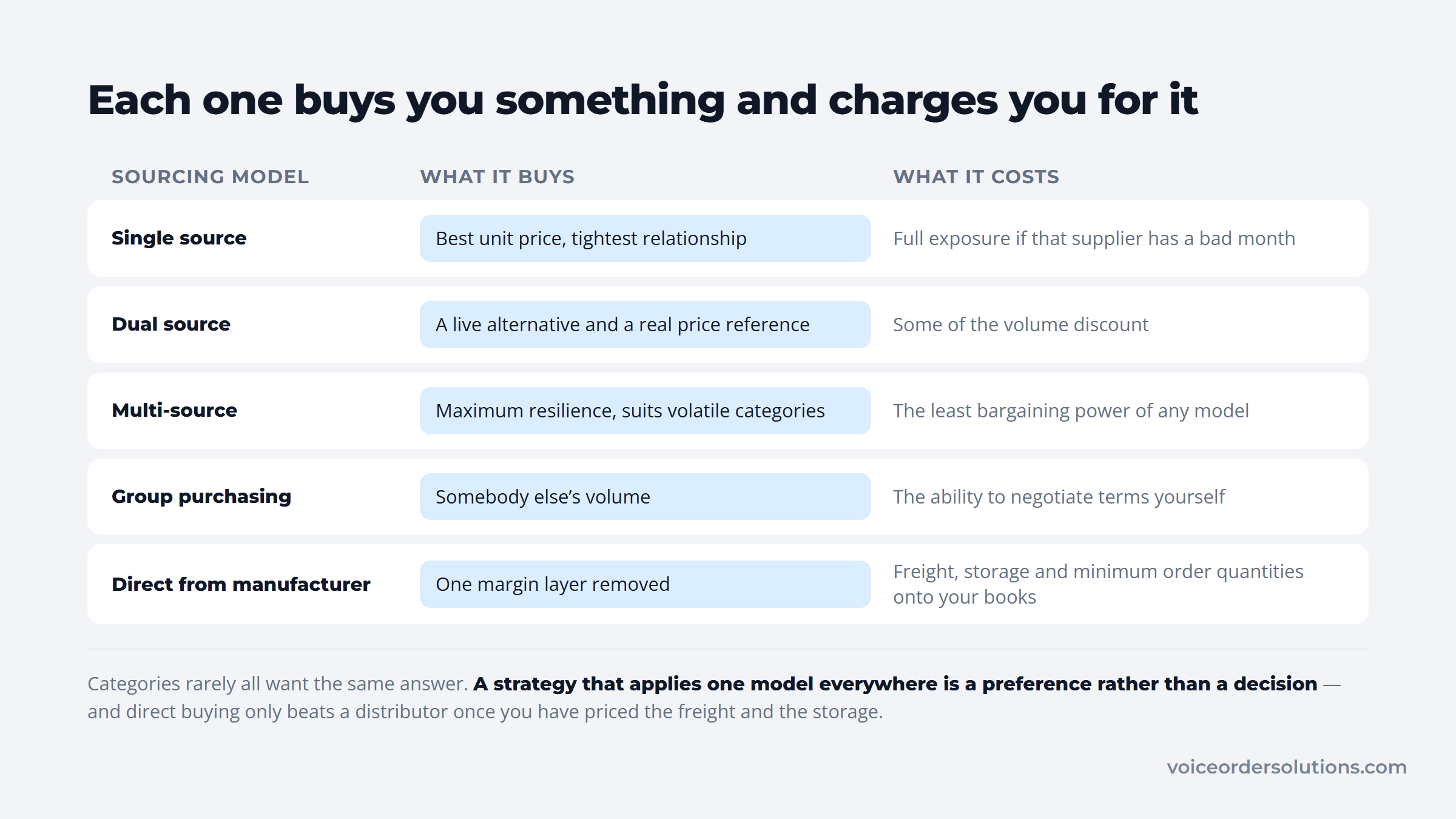
Once a category has a plan, it needs a sourcing model, and this is where a procurement strategy makes its real trade-offs. Each option buys you something and costs you something else.
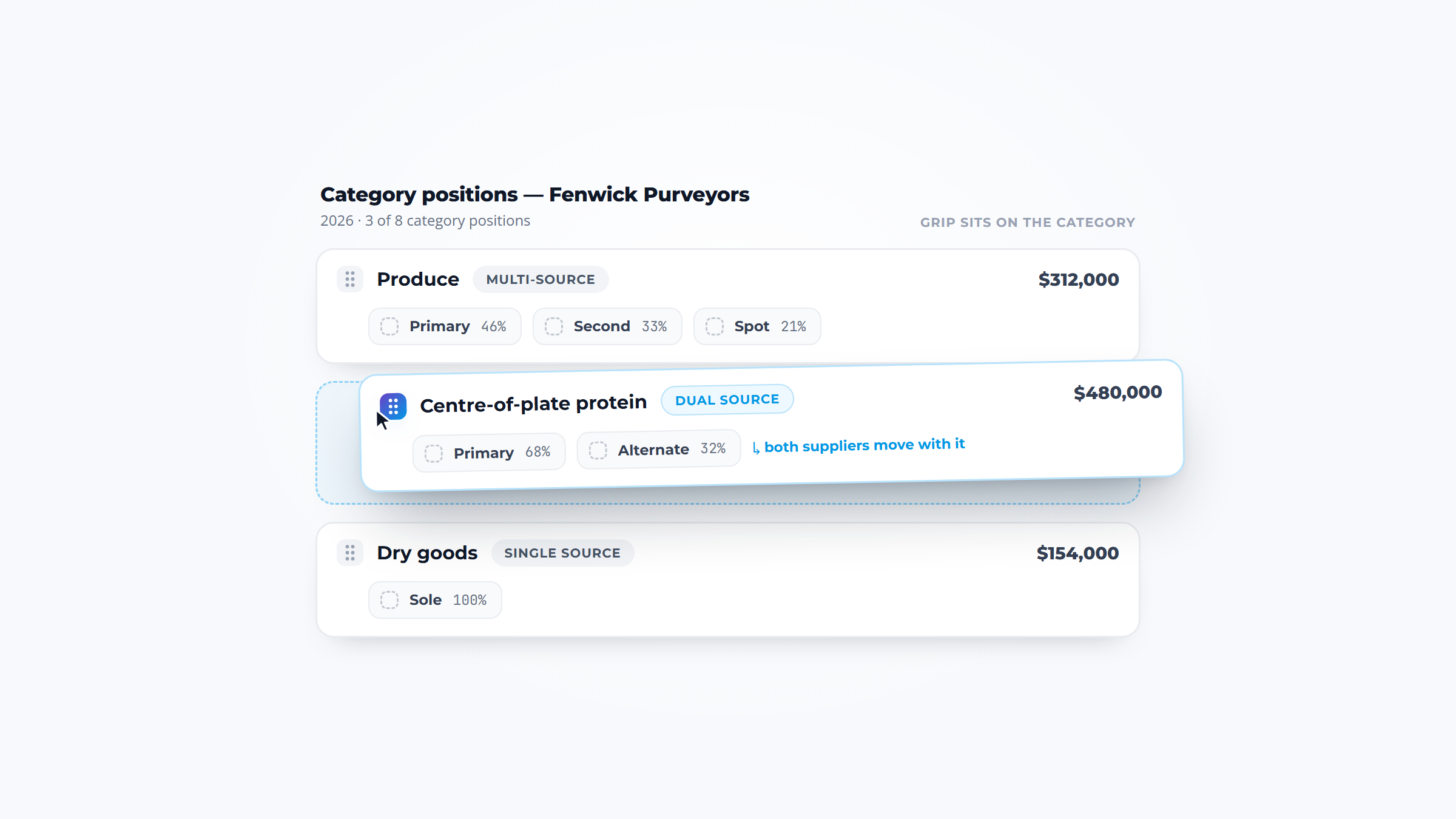
Categories rarely all want the same answer, and a strategy that applies one model everywhere is a preference rather than a decision. The usual pattern in food is single or dual source on stable dry goods, multi-source on anything seasonal, and a hard look at whether direct buying really beats a distributor once you have priced the freight and the storage.
Set against each other, no model is free and none of them is wrong everywhere.
That last comparison depends on which model your supply chain runs, which is worked through in distribution model.
Outsourcing procurement is usually framed as all or nothing, and it almost never is. The realistic question is which of four things you hand over: category strategy, negotiation, transaction processing, or supplier management.
Transaction processing is the easiest to give away and the least strategic, which is why it is where most outsourcing starts. Negotiation can be outsourced successfully in categories where the provider has real buying power you lack, which for a small operator often includes indirect spend such as waste, uniforms and utilities.
Category strategy and supplier management are the two you should be most reluctant to hand over, because they carry the institutional knowledge that makes the next negotiation possible.
The failure mode is predictable. A provider delivers a savings number in year one by consolidating suppliers, and in year three nobody inside the business can explain why a category is structured the way it is or what the alternatives were. Keep the reasoning in-house even when the execution is not, and write the category logic down somewhere your own team owns.
A sustainable procurement strategy fails when it is written as intent. "We will prioritize responsible suppliers" is not auditable, cannot be tested at a tender, and quietly becomes whatever the buyer felt like on the day.
The workable version borrows the structure that federal purchasing uses. The Environmental Protection Agency runs an Environmentally Preferable Purchasing program that does not write its own green rules at all. Instead it points the scale of federal buying, which it puts at over $760 billion, at sustainability standards the private sector already maintains.
The method has three parts. EPA feeds government technical expertise into the voluntary consensus standards that decide what counts as a sustainable product, publishes the specifications, standards and ecolabels it recommends for each purchase category, then helps agencies buy against them.
The published list is a set of recommendations rather than law, which is precisely why a private buyer can copy it. Nothing in the structure depends on being a federal agency.
That is the transferable idea. Name the standard, put it in the specification, and make it a condition of the tender, because a requirement that a supplier hold a particular certification is checkable while a preference for sustainability is not.
Written the first way it cannot be tested; written the second way it can.
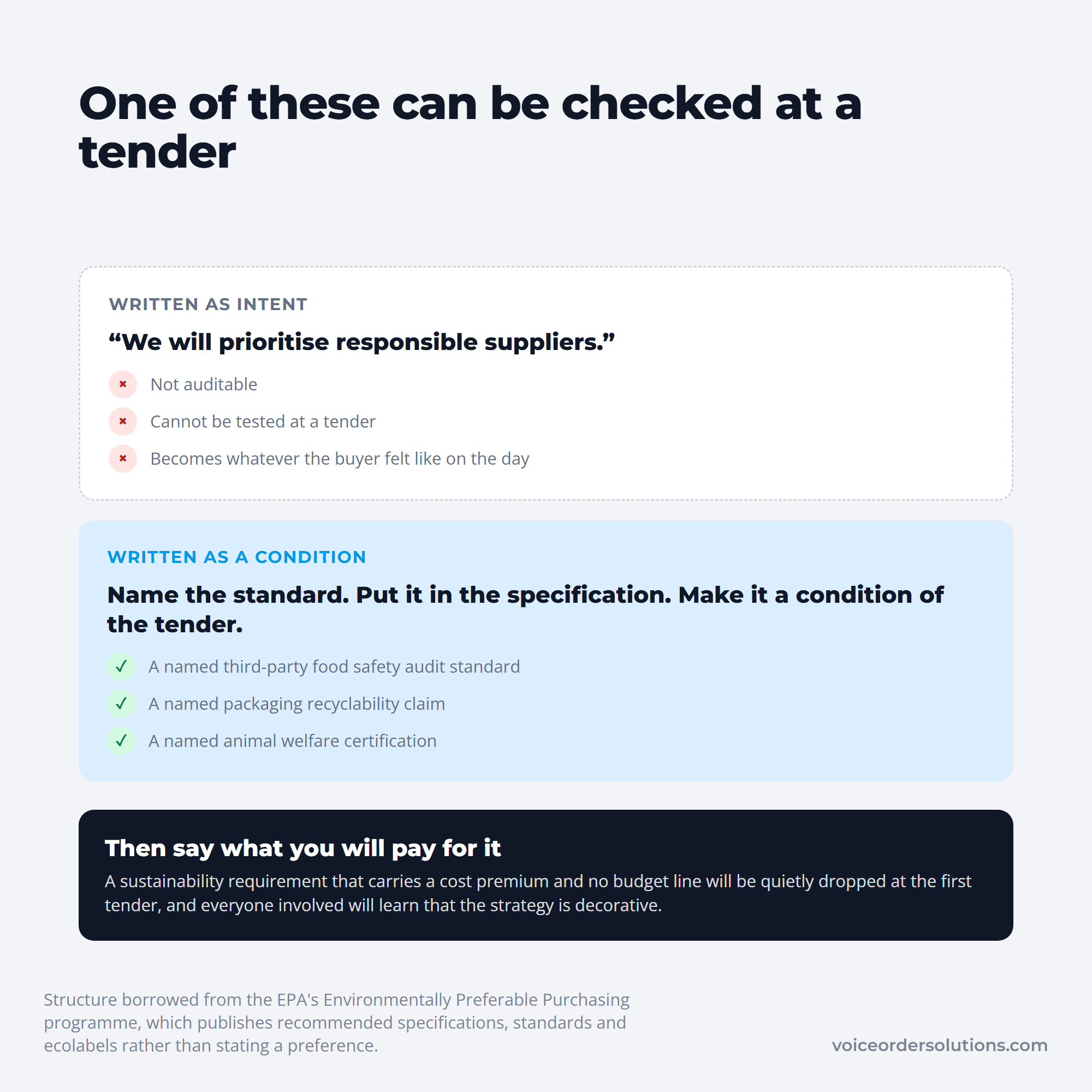
For a food business the same logic applies to third-party food safety audit standards, packaging recyclability claims and animal welfare certifications, all of which have named schemes you can either require or not.
Be honest in the document about what you will pay for it. A sustainability requirement that carries a cost premium and no budget line will be quietly dropped at the first tender, and everyone involved will learn that the strategy is decorative.
Generic procurement advice assumes an item that sits still. Food does not, and four features change the procurement strategy rather than just the execution.
Shelf life caps how much a large order can buy you. A price break on a quantity you cannot store before it expires is not a saving, and any category strategy for fresh product has to be written against delivery frequency rather than order size.
Price volatility makes fixed annual contracts risky in both directions. Categories exposed to weather, disease or fuel tend to be handled with market-linked pricing or shorter terms, and the strategy should say which categories are allowed to float.
Food safety and traceability requirements move supplier qualification from a nice-to-have to a gate. A supplier who cannot produce audit results or lot-level records is not a cheaper option, it is a different risk category.
Substitution changes what a stockout costs. A missing cleaning chemical is an inconvenience; a missing protein takes a dish off the menu. Rank categories by what failure does to service, not by what they cost, and the priority order usually rearranges itself.
None of that removes the weekly buying cycle underneath, which runs on par levels, supplier choice and receiving discipline rather than on category positions, and is worked through in restaurant procurement.
Most published frameworks run to eight or ten steps and blur together. The sequence below is ordered by dependency, so each stage produces the input the next one needs.
The opening half is analysis, and it produces the inputs every later choice depends on.
Only now is it worth writing anything that looks like a strategy. Convert each of the five category positions into a stated choice, with the trade-off named out loud, then set the governance around it: who approves a new supplier, what spend threshold requires a tender, who can override a contracted price.
Finish with the measures, and pick fewer than you want to. A strategy with fifteen KPIs has no priorities. Three or four that leadership will actually look at monthly will shape behavior more than a scorecard nobody opens. Where the current process is failing at the transaction end rather than the strategy end, the diagnosis in reducing order errors is usually the faster read.
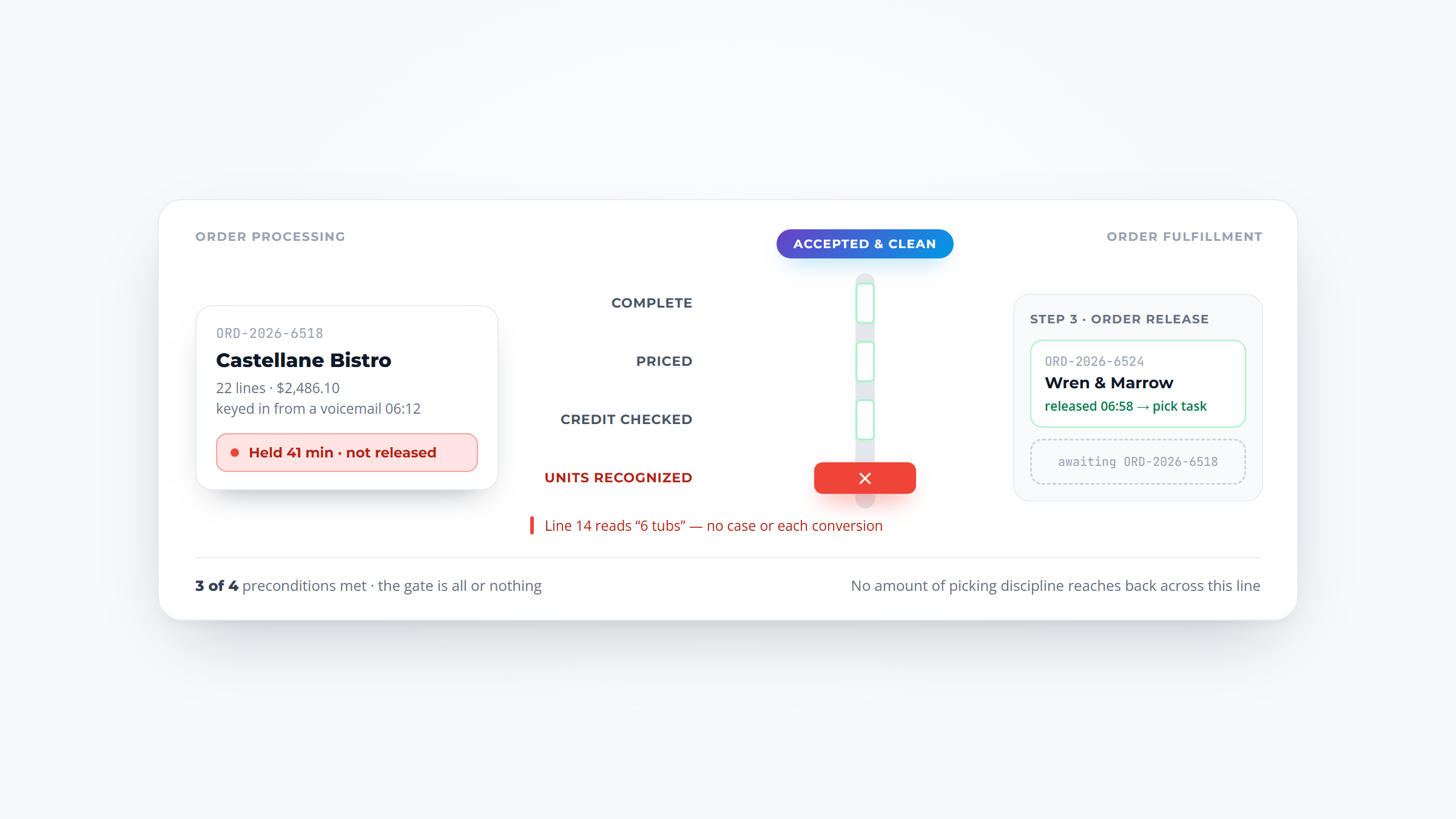
There is a gap between a strategy and its execution that no framework diagram shows. A category decision made in a quarterly review is carried out every morning by someone placing an order against a list, and if that step is loose, the contracted structure above it does not survive contact.
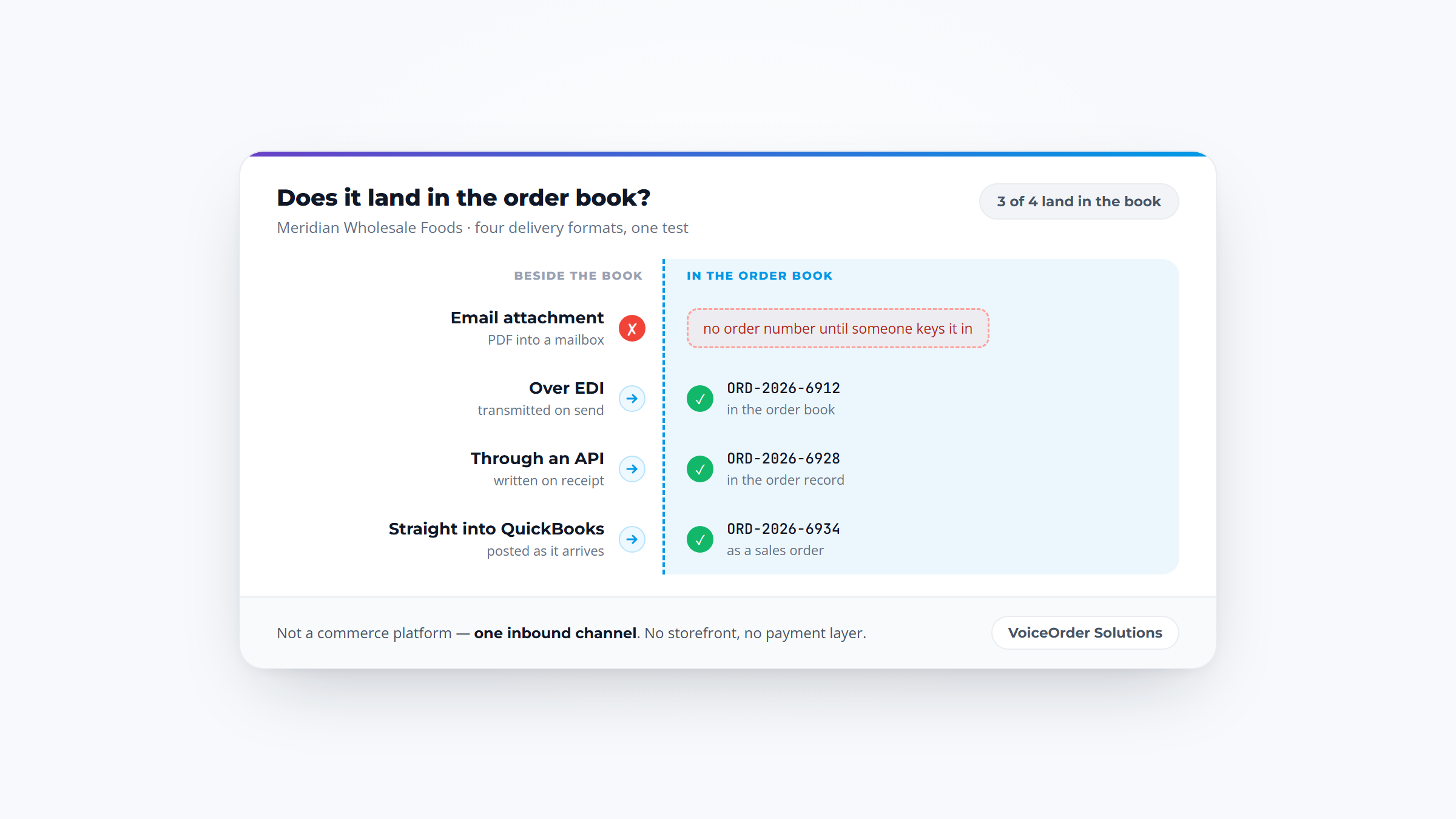
That step is what VoiceOrder Solutions addresses, and the customer for it is the distributor rather than the operator. A food distributor licenses the software and loads each account's order guide into the admin platform, so every order that comes in is already scoped to the products and the rates that account has been quoted.
Its order desk receives those orders digitized, confirmed and delivered into the distributor's system without anyone retyping them. Every order placed in the app carries a unique number and timestamp.
For a distributor that matters strategically rather than just operationally, because it removes the transcription step where an agreed price and an ordered item can diverge.
What it is not is a procurement platform. VoiceOrder Solutions does not run tenders, hold contracts, analyze spend, manage supplier qualification or produce category reporting, and it is not an alternative to the buying tools discussed elsewhere in this guide.
The product handles the ordering step and leaves the strategy layer to systems built for it, a scope the company sets out across the four operation types under solutions.
Strategies collapse at the approval boundary far more often than at the analysis stage. Writing the decision rights down is dull and it prevents most of the drift.
| Decision | Typical owner | What goes wrong without it |
|---|---|---|
| Add a new supplier | Procurement lead, with finance sign-off | Sites onboard their own vendors and the category fragments |
| Approve a specification change | Category owner plus the operational user | Specs drift toward whatever is cheapest that week |
| Override a contracted price | Named individual, logged every time | The contract becomes a suggestion |
| Commit above a spend threshold | Finance, with a tender requirement above a set figure | Large commitments arrive as fait accompli |
| Exit a supplier | Procurement lead, with notice period checked | Terminations trigger penalty clauses nobody read |
Publish the table, keep it to one page, and review it annually. The version that lives in a policy document nobody has opened is worth less than a printed sheet on the wall of the buying office. Where these approvals need to be enforced in software rather than remembered, that capability sits in purchasing systems such as restaurant purchasing software.
Savings is the headline measure of a procurement strategy and the least reliable one, because it depends entirely on the baseline you choose. A negotiated reduction against last year's price is real. A reduction against a quote you were never going to accept is arithmetic.
Better measures answer whether the structure changed. Spend under contract tells you how much buying now runs through a deliberate route. Supplier count per category tells you whether consolidation actually happened or was only agreed. Price variance for the same item across sites tells you whether the catalog is being respected. On-time in-full performance tells you whether the continuity you traded price for materialized.
Pick three or four, publish them monthly, and resist adding more. Procurement strategy planning fails at the review stage more often than at the writing stage, and a short scorecard that gets read beats a long one that does not. Where reporting has to draw from several systems at once, that integration question is covered in ERP software for distribution.
Take one category next week, ideally your second-largest rather than your largest, since the largest usually carries too much political weight for a first attempt. Write down its current supply structure, what you would have to give up to change it, and what you would gain. One page.
Show that page to the person who places the orders in that category and ask what it gets wrong. Their answer is the difference between a strategy that survives and one that gets quietly ignored, and it costs an afternoon to find out.
If that conversation keeps landing on the order itself, on rekeyed items, wrong pack sizes and prices that do not match what was agreed, that is a different problem from sourcing. It is also not one a buyer can finish alone, because the same errors are being created on the supplier's side of the same order, which is where the fix tends to start.
Distributors who recognize that pattern on their own inbound orders can ask VoiceOrder Solutions to run it against a live order guide, with pricing available on request.
It is a written set of choices about how your organization will buy: which categories get attention, what supply structure each one runs, what you will trade away to get continuity or price, and who decides what. The test of whether you have one is whether deleting a line from the document would change a decision. If nothing downstream moves, you have a statement of intent rather than a strategy.
A plan lists initiatives, owners, targets and dates for the coming year. A strategy explains why those initiatives and not others, by naming which categories are worth effort and which are being left alone on purpose. Plans change annually; strategies should survive several planning cycles. The practical signal is whether each initiative ties clearly to growth, margin or risk, which is a test some practitioners use.
Direct procurement buys what becomes the product you sell, so its strategy is about supply continuity, specification discipline and cost per unit, and it is measured weekly. Indirect procurement covers everything needed to operate, and its strategy is usually about getting fragmented spend visible and under contract before optimizing it. Most food businesses run direct well and indirect informally, which is where the larger percentage savings tend to sit.
Name the standard rather than the aspiration. The Environmental Protection Agency's purchasing program points buyers at specific voluntary consensus standards and ecolabels instead of a general preference, and that structure transfers directly to a private buyer. Write the named certification into the specification, require it at bid stage, and fund whatever premium it carries, or it will quietly disappear at the first competitive round.
Twelve weeks is a realistic first pass for a mid-sized food business: roughly six weeks on spend analysis and category assessment, then six on writing the positions, governance and measures. The analysis half consistently takes longer than expected because supplier data has to be cleaned before it can be sorted. Trying to compress it usually produces a document that describes the categories the author already knew about.