.webp)
Key takeaways:
Food prices keep climbing faster than almost anything else a restaurant buys, and the way you procure that food decides how much of each dollar survives as profit. The Bureau of Labor Statistics reports food-away-from-home prices rose 3.5% over the year ending May 2026, outpacing grocery inflation, which means every sloppy order and every unspotted price hike costs more this year than last.
Procurement is also one of the few big cost centers you fully control. You cannot set the market price of beef, but you can control how tightly you order, how accurately the order gets placed, and how quickly you catch a supplier overcharge.
This guide walks through how to improve restaurant procurement in 2026: what it actually covers, how to set par levels and choose suppliers, how voice ordering closes the error-prone gap where orders get placed, and how to make sense of procurement services, partners, fees, and software without overpaying for any of them.
The simplest restaurant procurement software definition to work from is this: procurement is the full process of sourcing, purchasing, receiving, and managing everything your operation needs to run, from produce and protein to packaging, cleaning supplies, and equipment service. It is not a single act of "ordering food." It is a chain, and each link is a place to save or lose money.
It helps to separate two terms people mix up. Procurement is the sourcing-and-ordering process; procurement cost is the total you spend running it. You improve the process to control the cost.
Restaurant procurement is also genuinely different from ordering in most other businesses, for three reasons worth naming:
Every stage of that chain hands off to the next, and an error early on flows downstream, which is why it pays to see procurement as one connected process rather than a pile of separate tasks.
| Procurement stage | What happens | Where money leaks |
|---|---|---|
| Define needs | Set what to buy from par levels and the menu | Guessing quantities, over- or under-ordering |
| Select suppliers | Choose and vet vendors per category | Buying on price alone, no backup |
| Place the order | Send the order to the distributor | Wrong quantities, missed items, no record |
| Receive and inspect | Check the delivery against the order | Accepting shorts, spoilage, substitutions |
| Match and pay | Reconcile invoice to order and receipt | Overcharges, lost credits, price creep |
Fix the process stage by stage and the cost takes care of itself. The rest of this guide follows that chain.
Procurement sits on top of your single largest controllable cost, and 2026 is a punishing year to get it wrong. The National Restaurant Association projects $1.55 trillion in industry sales, yet more than nine in ten operators name food and supply costs as a serious challenge, and 42% said they were not profitable last year.
When food costs run high, a few points of procurement waste is the whole margin. Over-ordering that spoils, a case quietly billed at a higher price, a missed delivery that forces a last-minute buy at retail prices: each is small, and together they are the difference between a profitable quarter and a break-even one.
There is a labor cost hiding in procurement too. The half hour a manager spends on the phone placing orders, the time spent chasing a wrong delivery, the back-and-forth over a disputed invoice, all of it is paid labor spent on a process that should mostly run itself.
Some of it, like the phone time, is exactly what voice ordering tools such as VoiceOrder Solutions are built to remove. Tightening procurement gives you back both food cost and hours.
Good procurement starts with knowing how much you actually need, and the tool for that is the par level: the amount of an item you want on hand to get through to the next delivery, plus a small buffer. Order to your pars and you stop guessing.
Plotted over a week, a par level is just a line your stock is not allowed to cross.
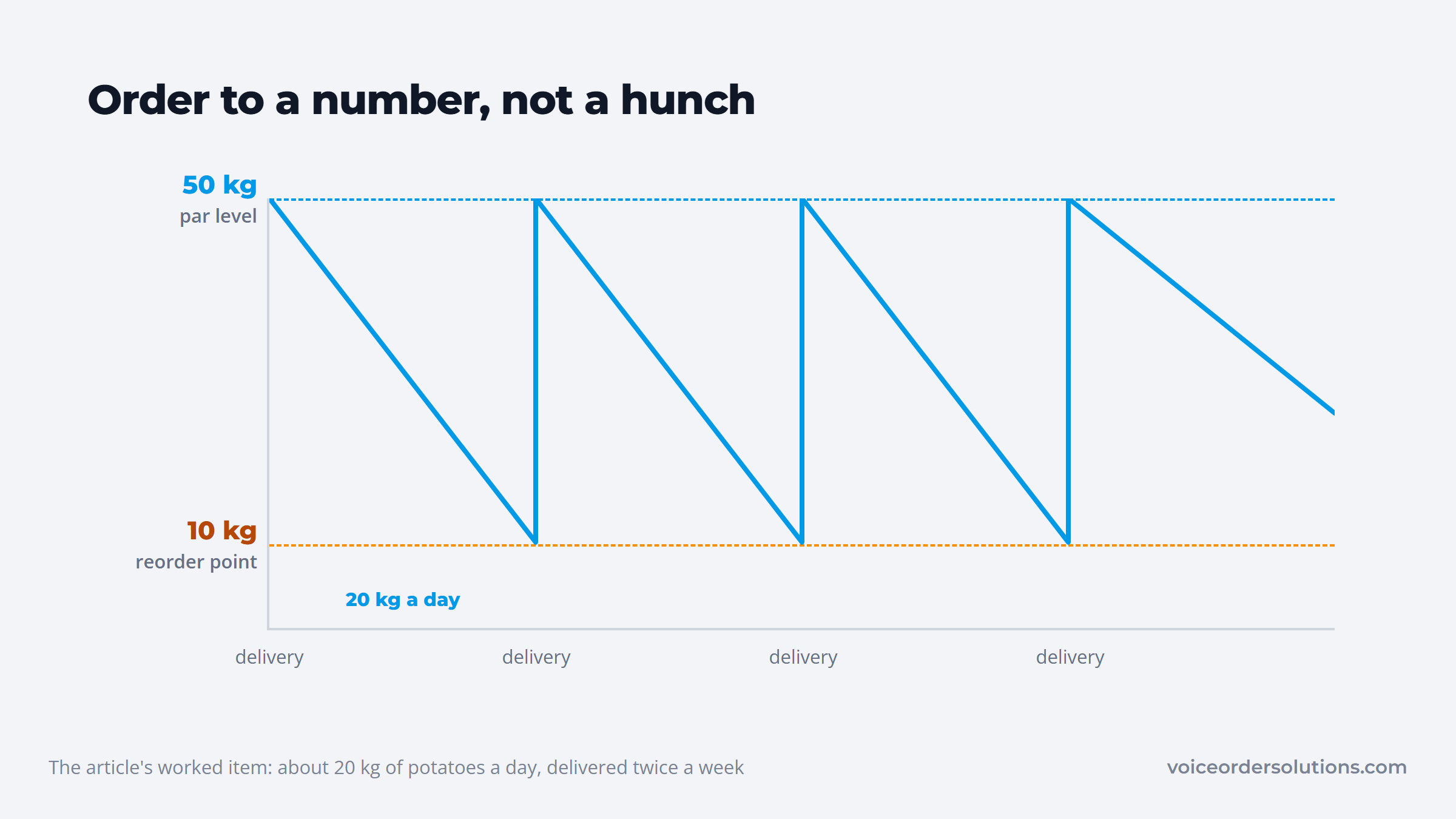
The math is simple and worth doing per item. Track how much you use on a normal day, decide how many days a par has to cover, and set a reorder point that triggers before you run out.
Take a kitchen that uses about 20 kg of potatoes a day and gets deliveries twice a week. A par of 50 kg covers the gap with a cushion, and a reorder point of 10 kg means you order again while there is still a day's supply on the shelf, not after you have run dry.
| Item | Daily use | Par level | Reorder point |
|---|---|---|---|
| Potatoes | 20 kg | 50 kg | 10 kg |
| Chicken breast | 12 kg | 30 kg | 8 kg |
| Romaine | 8 cases | 18 cases | 4 cases |
Par levels turn ordering from a memory game into a number you can hand to anyone on the team. They also make every later step easier, because a specific order ("30 kg chicken breast") is one you can check a delivery and an invoice against, where a vague one ("some chicken") is not.
With pars set, the next decisions are who you buy from and how the order gets placed. Both Fourth and Apicbase land on the same supplier rule: for primary categories like meat, dairy, and produce, keep two to three vendors each rather than putting everything on one truck. Running two or three vendors per category is far easier when restaurant purchasing software puts them all in one ordering flow.
Two to three vendors per category gives you a live price check, a backup when one is out of an item, and negotiating leverage. For a specialty item with only one good source, one vendor is fine, as long as you know it is a single point of failure and keep a small buffer. Deciding how many to keep per category is a vendor management question rather than a purchasing one, and it is worth revisiting each season.
Then write down how ordering works, so it does not live only in the head of whoever usually does it:
Procedures like these are what keep procurement steady when the usual manager is off. The weakest link in most of them is step four, confirming the order, which is exactly where the next section focuses.
One clarification first, because the phrase causes confusion. Voice ordering in procurement means your own staff placing a restocking order to your distributor by speaking it, not an AI taking orders from your guests. The two get searched the same way and are opposite jobs; this section is about the supplier-facing one.
The two point in opposite directions, which is the fastest way to tell them apart.
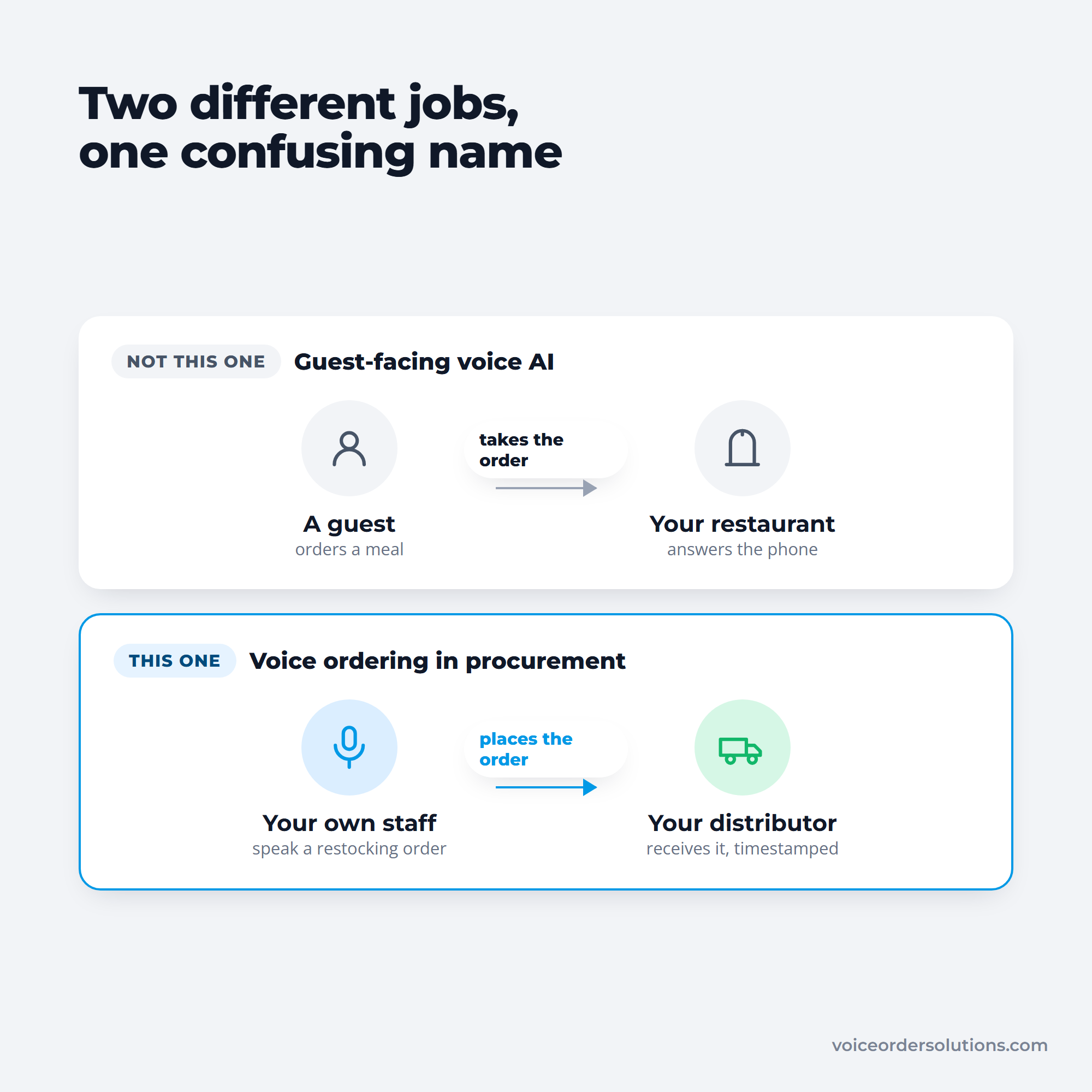
Order placement is where most procurement errors are born. An item gets forgotten, a quantity gets fat-fingered into a portal, a phone order gets misheard over kitchen noise. The vendor then delivers exactly what was ordered, and the order was simply wrong.
Phone and handwritten ordering is still the default at many independent restaurants, and it is the leakiest step in the chain. When an order lives in a voicemail or on a scrap of paper, there is no clean record, so a dispute becomes your word against the vendor's, and you usually eat the difference.
The fix is to capture the order once, cleanly, and confirm it before it goes. No retyping a paper note into a system later, no relying on a voicemail nobody can replay.
VoiceOrder Solutions is built for exactly this step. Staff speak a restocking order into the app while walking the line, hands free, and the order is digitized, confirmed against the customer's own order guide, and timestamped before it reaches the distributor.
Why that matters for procurement specifically:
The result is time and accuracy: the roughly 30 minutes a week many operators spend phoning orders shrinks, and the orders that go out are right the first time. VoiceOrder Solutions handles the placing-the-order step and layers on top of your existing setup, with independent distributors typically live in 24 to 48 hours. You can see the ordering flow on the VoiceOrder Solutions How It Works page.
Placing the order right is half the job; the other half is making sure what arrives and what you pay for both match it. This is where a specific, recorded order pays off.
Supplier confirmation is the first checkpoint, and skipping it burns kitchens. Picture a chef prepping a Friday salmon special who discovers at service that the salmon never came, because nobody confirmed the order landed. A confirmed, timestamped order kills that surprise before it happens.
At delivery, inspect against the order, not just the invoice. Check quantities, weights, and quality item by item, and log every short, substitution, and spoiled case on the spot, before the truck leaves. That record is what turns an owed credit into an actual credit.
Then reconcile the money with a three-way match:
Do this consistently and you close the back-end leaks where restaurants quietly overpay, and invoice capture software that reads line items automatically makes the match faster. A clean, confirmed order at the start makes every one of these checks faster, because there is a single reference point everything gets measured against.
Shorts, substitutions and spoiled cases all land in the same place, the margin on the case you actually sell, so it helps to price one out with freight, handling and shrink included and see what is left.
Price a case the right way. Add freight, handling and shrink, set your markup, and see the margin you actually keep.
What the case costs you
How you price it
Shrink is the line that does the quiet damage. A case priced on cost plus markup can look fine and still land a few points under what you assumed, once freight, handling and the portion you never sell come out of it. Price your top ten movers this way and the leak usually turns out to sit in two or three items, not spread evenly across the order guide.
Sooner or later a restaurant procurement service or group-buying "partner" will pitch you, promising to cut your food costs. Some are worth it; understanding how they charge is how you tell.
These restaurant procurement partners pool the buying volume of many operators to negotiate lower distributor pricing, then take a cut. Buyers Edge Platform, for example, runs a large foodservice procurement network on this model. The key question is always the fee.
A procurement fee is what you pay a service to source or buy on your behalf. It usually takes one of two shapes, and the difference matters for whether it pays off:
| Fee model | How you pay | Best for |
|---|---|---|
| Percentage of savings | The service keeps a share (often around 25%) of what it saves you | Operators with enough volume to generate real savings |
| Fixed service fee | A set monthly amount to source and manage buying | Predictable, recurring needs at smaller scale |
The volume threshold is real. One operator on Reddit described a procurement service that took 25% of the savings it found, pitching 4% to 8% savings, while another noted these programs often want $2 million or more in annual food spend before the numbers work. Below that, your own distributor rep negotiating on your behalf may get you most of the way for free.
One more clarification, since "procurement fee at a restaurant" also gets searched by diners: that phrase sometimes refers to a service charge on a guest's bill, which is a different thing entirely from the supplier-side fee covered here. For operators, the fee that matters is the one a procurement partner charges you, so read the model before signing, and run the math against your actual spend.
A restaurant procurement system is the software layer that runs ordering, from purchase orders to price tracking to invoice matching. The category is crowded, and the tools split into a few jobs worth knowing before you buy.
Most procurement and inventory platforms (MarketMan, MarginEdge, Apicbase, and others) handle purchasing alongside inventory: suggested order quantities from par levels, invoice scanning, and price alerts. This is the order management software layer that sits between your menu and your suppliers. Square's Order Guide, built from its acquisition of Zitti, focuses on comparing vendor prices from your ingredient list. Each solves a real piece, and they overlap.
Plenty of operators still run procurement on a spreadsheet, and they are not wrong to weigh the cost. On Reddit, restaurant owners describe building color-coded sheets that flag the cheapest vendor per item, updating them from invoices every few weeks, and judging paid tools "pricey" against that free workaround. A spreadsheet genuinely covers price comparison; where it breaks down is placing and confirming the order itself.
That is the gap a voice ordering tool fills, and it is why VoiceOrder Solutions sits alongside these systems rather than replacing them. Your inventory or spreadsheet tells you what to buy; VoiceOrder Solutions is how that order gets placed and confirmed to the distributor without a re-typing error. Pick the system that fixes your actual bottleneck, whether that is price visibility, inventory, or the order-placement step, and skip the modules you will not use.
Better procurement is not one project, it is a chain you tighten link by link: set pars so you order to a number, keep two to three vendors per category, place and confirm orders cleanly, reconcile every invoice against the order, and check any service fee against your real volume before you sign.
Start with the two steps that pay back fastest. Put par levels on your top-spend items so you stop guessing quantities, and fix the order-placement step so orders go out right the first time.
If phoning and re-keying orders is where your procurement leaks time and accuracy, contact VoiceOrder Solutions to see how voice ordering to your distributor closes that gap. Market prices will keep rising, but how well you procure against them is yours to control, starting with your next order.
Restaurant procurement is the full process of sourcing, purchasing, receiving, and managing everything a kitchen needs to operate, from ingredients and beverages to packaging, cleaning supplies, and equipment service. It is a connected chain, not a single ordering task, and improving each step (par levels, supplier choice, order placement, receiving, and invoice matching) is how you control food cost.
On the supplier side, a procurement fee is what a restaurant pays a procurement service to source or buy on its behalf, usually either a percentage of the savings the service finds (often around 25%) or a fixed monthly fee. Separately, diners sometimes see a "procurement fee" as a surcharge on a bill, which is an unrelated guest-facing charge, not the supplier-side fee operators deal with.
Restaurant procurement services and partners pool the buying volume of many operators to negotiate lower prices from distributors, then charge for it, typically taking a share of the savings. They mainly pay off for higher-volume operators, often those spending $2 million or more a year on food. Below that, a good distributor rep negotiating directly can capture much of the same benefit at no extra cost.
A restaurant procurement system is the software that runs ordering, including purchase orders, par-based reorder suggestions, price tracking, and invoice matching. Some tools bundle procurement with full inventory management, others focus on price comparison or on placing and confirming the order itself. Choose based on the step that costs you the most time, and avoid paying for features you will not use.
Yes. Most procurement errors come from manually re-keying an order that arrived by phone, voicemail, or paper. Voice ordering to your distributor captures the order once and confirms it before it sends. Tools like VoiceOrder Solutions digitize, confirm, and timestamp a spoken order against the order guide, so wrong quantities and missed items are caught before the order leaves.