.webp)
Key takeaways:
If you searched this term and got Chocolatey the Windows package manager, cocoa substitutes and a chocolate brand, you are not alone. This article is about Choco at choco.com, the platform for food and beverage wholesalers, and the software you would realistically weigh against it.
Choco is one of the better-funded companies in this category, reporting more than $328 million raised, and it has the network to prove it. That is exactly why the Choco competitors matter: the question is not whether Choco works, but whether a platform of that shape is what your distribution business needs.
The eleven Choco alternatives below cover AI order intake, customer-facing ordering apps, B2B storefronts, field-sales systems and one full ERP, ordered by fit for an independent or regional food distributor.
Choco's page title still calls it the complete growth platform for food distributors, and the structure follows from that. OrderAgent digitizes orders arriving as voicemail, WhatsApp message, email, text or photo. An ecommerce module gives the distributor a branded storefront. SalesHub handles prospecting and pipeline, and CustomerHub is a foodservice CRM covering churn signals and account ownership.
Its homepage reports 30,000 distributors on the platform, more than a million orders processed monthly, round-the-clock AI order processing, and average order sizes 20% larger. Those are the company's own figures, not audited results.
The part worth understanding before you shortlist it is the fourth revenue stream. Choco sells advertising to manufacturers, placed inside the ordering experience that the distributor's own customers use. A distributor adopting the platform is also opting its customer-facing storefront into promotions funded by brands and served by Choco.
That is not hidden and it is not unusual in marketplace software. It is a materially different commercial relationship from a flat SaaS fee, and it belongs on the evaluation sheet next to the price.
Choco names NetSuite, QuickBooks, Microsoft Dynamics, Sage, Odoo and NCR among its ERP integrations, and its US operation runs a partnership with Dot Foods. The operator-side equivalent of all this sits in restaurant procurement software, which is a different buyer with a different budget.
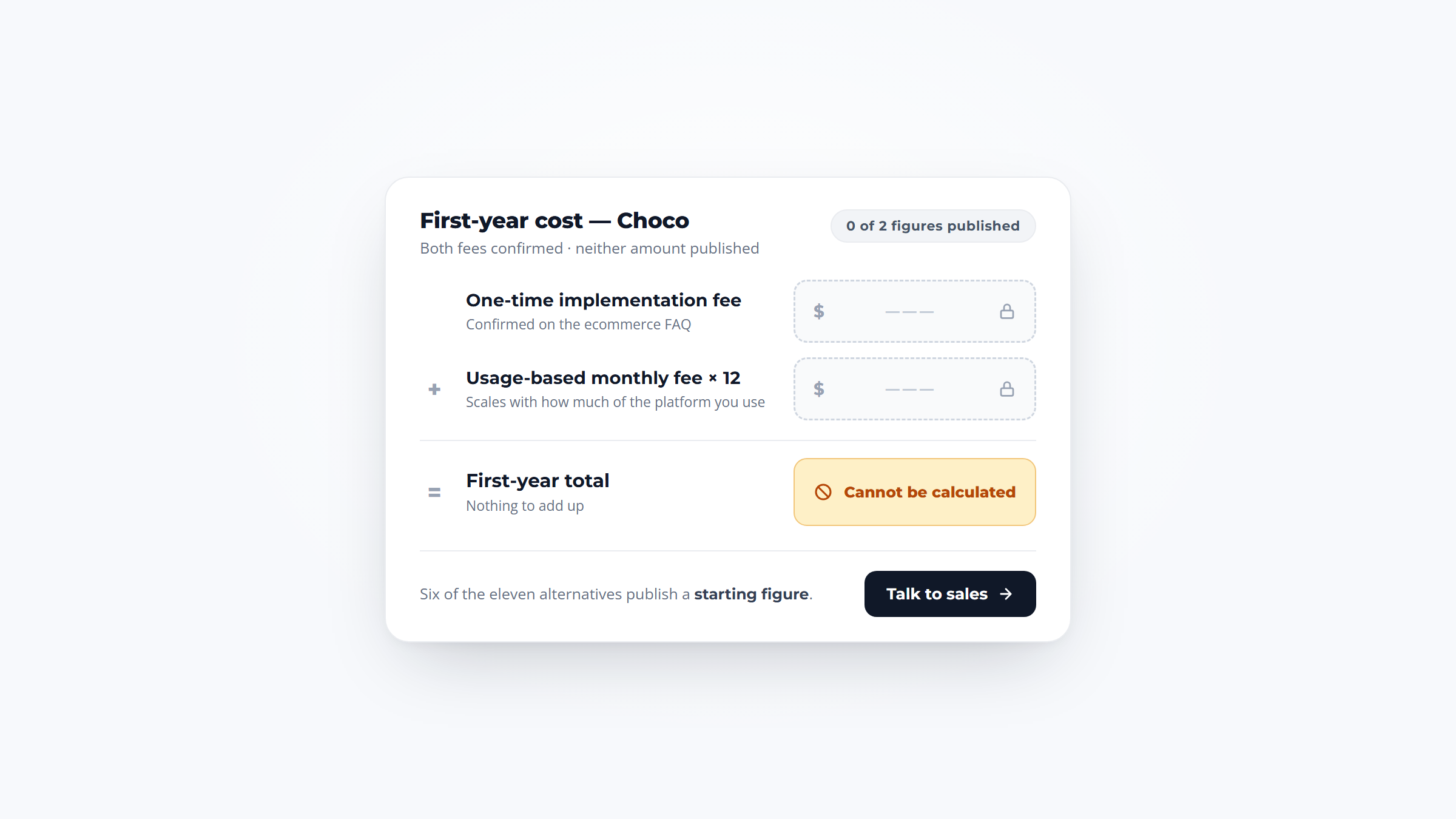
Choco quotes rather than publishing a price, which is common among the platforms here. The pricing page commits to a monthly figure scaled to how much of the platform you use and routes you to sales, and its ecommerce FAQ adds an implementation charge on top. Neither part can be estimated from a competitor's per-seat rate, because the shape of the pricing is not the same.
The platform is also wide. A distributor whose problem is 40 voicemails every morning is being sold order capture plus a storefront plus a CRM plus prospecting plus an ad network. Several alternatives here are narrower, cheaper and faster to deploy.
Preferred pricing exists for some buyers and not others. Dot Foods customers are offered discounted rates against the rest of the market plus free ERP integration. That is good news if you buy from Dot Foods and a reason to ask hard questions about your own quote if you do not.
Adoption is not free either. Even where the vendor does the heavy lifting, a storefront rollout needs ERP access from your IT side, a digitized catalog and a brand-asset review. Budget weeks, not days, and remember your accounts have their own restaurant purchasing habits that a new portal has to displace.
Its customers also do not all fit the model. On Reddit, a chef being pushed by suppliers to adopt Choco explains the hesitation: their menu changes daily, so a preloaded catalog does not match how they buy.
The replies split. One user says it turned an hour-long chore into fifteen minutes, while noting that many suppliers now ship their own apps to download. Another says it looks like a solution to a problem most independent restaurants do not have, and the original poster agrees.
The table lines up all eleven on fit, features and limits. Published pricing is shown wherever the vendor publishes any, and quote-based vendors are marked as such.
| Tool | Best for | Key features | Main limitation | Pricing (from) |
|---|---|---|---|---|
| VoiceOrder Solutions | Distributors issuing an ordering app outward | Voice ordering, per-account order guides, 24/7 capture | Voice-first intake, food and beverage only | Custom quote |
| Pepper | Independent distributors wanting one platform | Order Agent, storefront, sales and finance hubs | Wide scope | Custom quote |
| Burnt | Parsing every inbound channel at once | Multi-channel intake, SKU matching, exception routing | Newest of the group | Custom quote |
| Cut+Dry | Distributors committing to a storefront | Branded ecommerce, structured catalogs, payments | Depends on customer portal adoption | Custom quote |
| SimplyDepo | Rep-led ordering and route execution | Order capture with pricing rules, retail execution, offline app | Priced per rep | $69/rep/month annually |
| OrderCircle | Small wholesalers wanting a cheap start | Multi-channel orders, order history, forecasting | Order caps below the top tier | $199/month |
| Orderwerks | Compliance-heavy distribution | Offline sales app, branded portal, vertical modules | QuickBooks-centric | $60/user/month |
| inSitu Sales | Route businesses needing ERP sync | Rep app, picker app, driver dispatch | Paid ERP integration setup | $200/month |
| B2B Wave | Storefronts without transaction fees | Unlimited orders, custom price lists, rep app | One self-serve plan | $350/month |
| Unleashed | Stock-driven distribution | Multi-location inventory, auto reorders, traceability | Onboarding billed separately | $99/month |
| NetSuite | Replacing the whole stack at once | Multichannel capture, ATP fulfillment, full suite | Cost and implementation length | Custom quote |
Read the two or three Choco alternatives whose pricing model and customer-behavior assumption match yours, and skip the rest.
Best for: distributors issuing an ordering app outward
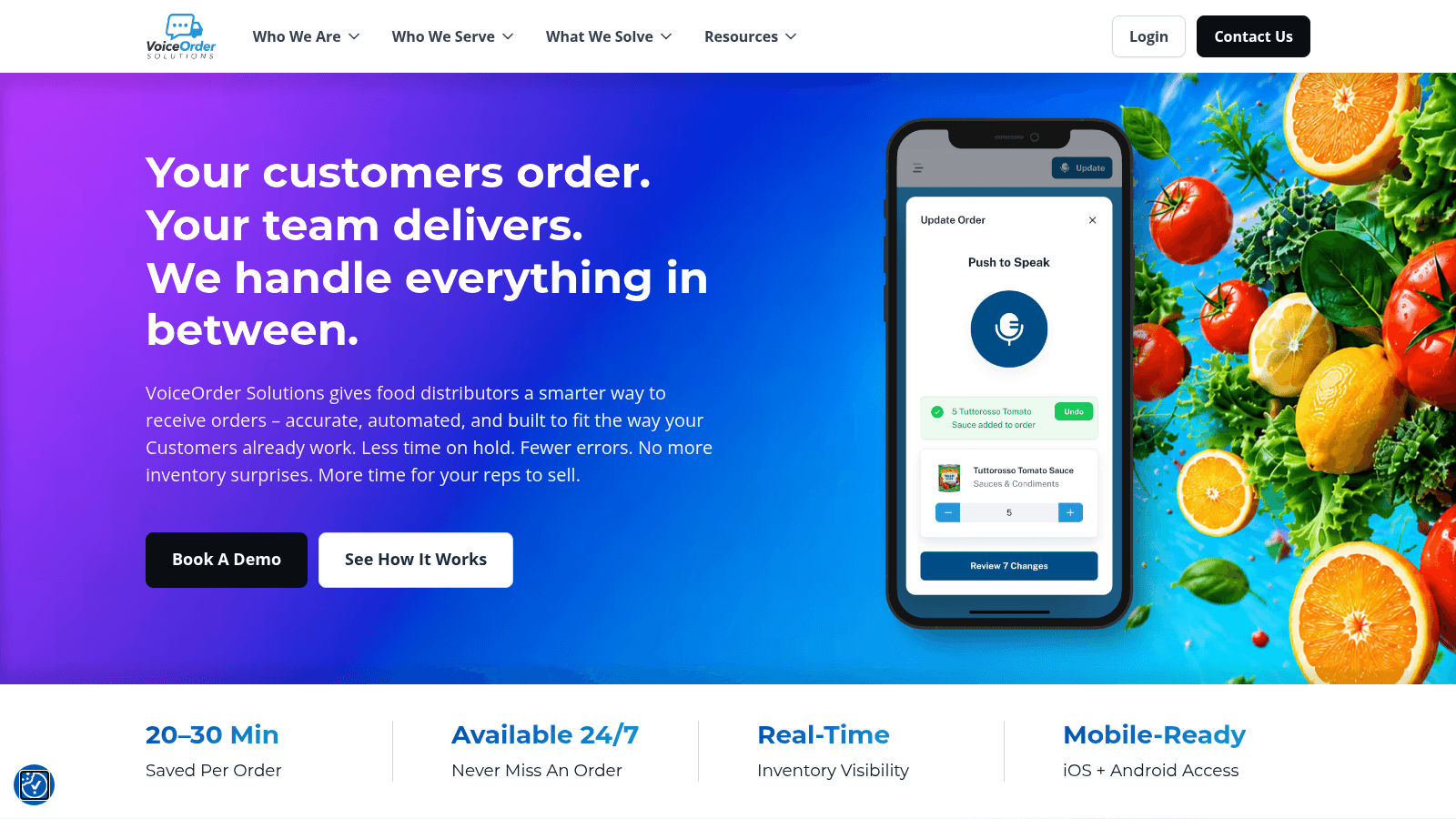
Choco's model absorbs whatever channel the customer already used. VoiceOrder Solutions gives the distributor a channel of its own instead: each account gets a voice ordering app built on its own order guide, and orders come to the distributor's team through that app rather than the voicemail box.
The consequence is a shorter chain. Nothing has to be interpreted, because nothing arrived as a voicemail in the first place, and the record reaching the distributor is already structured, numbered and timestamped.
The distributor manages every account from one admin platform, setting the items each restaurant buys, the rates it was quoted and the packs it takes. The company aims squarely below the enterprise tier, arguing that a regional distributor should not have to absorb enterprise cost or enterprise complexity to fix order entry.
Key features:
Pricing: by quote, the same position Choco is in. The company is specific about the rollout instead: most distributors are running within 24 to 48 hours, and it is not an IT project.
Pros: nothing has to be read and interpreted, late orders survive, one team edits every account list, the rollout is short, and your current systems stay where they are. Cons: speech is the only intake route, the product covers food and drink alone, and a price arrives only with a quote.
How to start using it:
Why it's a good Choco alternative: it takes on the same manual-entry cost without a storefront, a CRM, a prospecting tool or an ad network attached, and without putting third-party promotions in front of your customers.
Final verdict: the better fit when your accounts will speak an order but will never log in, and when you want to keep the ordering relationship entirely between you and them.
Orders processing through the platform also drive its inventory visibility view, which is what the distributor sees rather than a warehouse count.
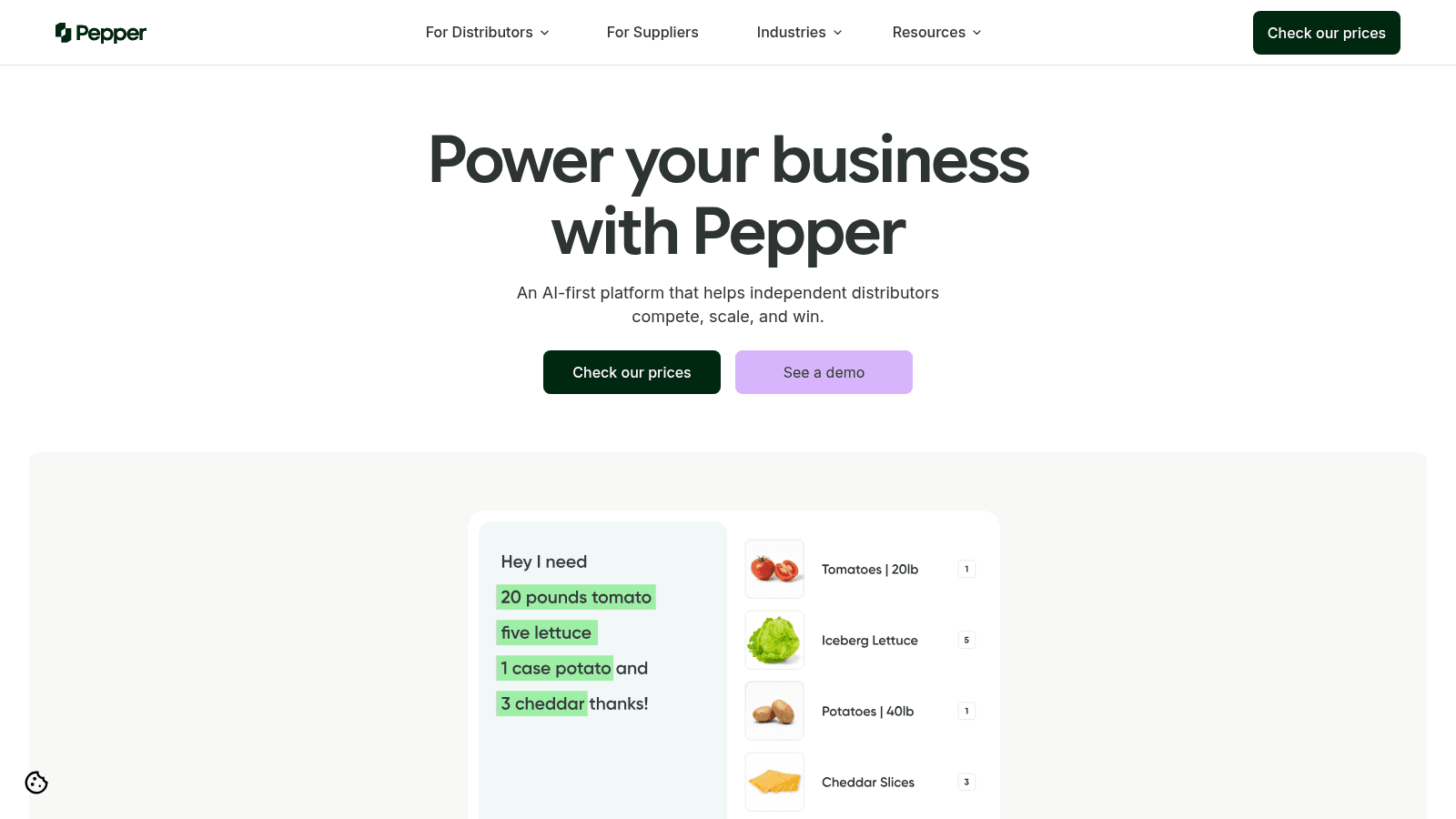
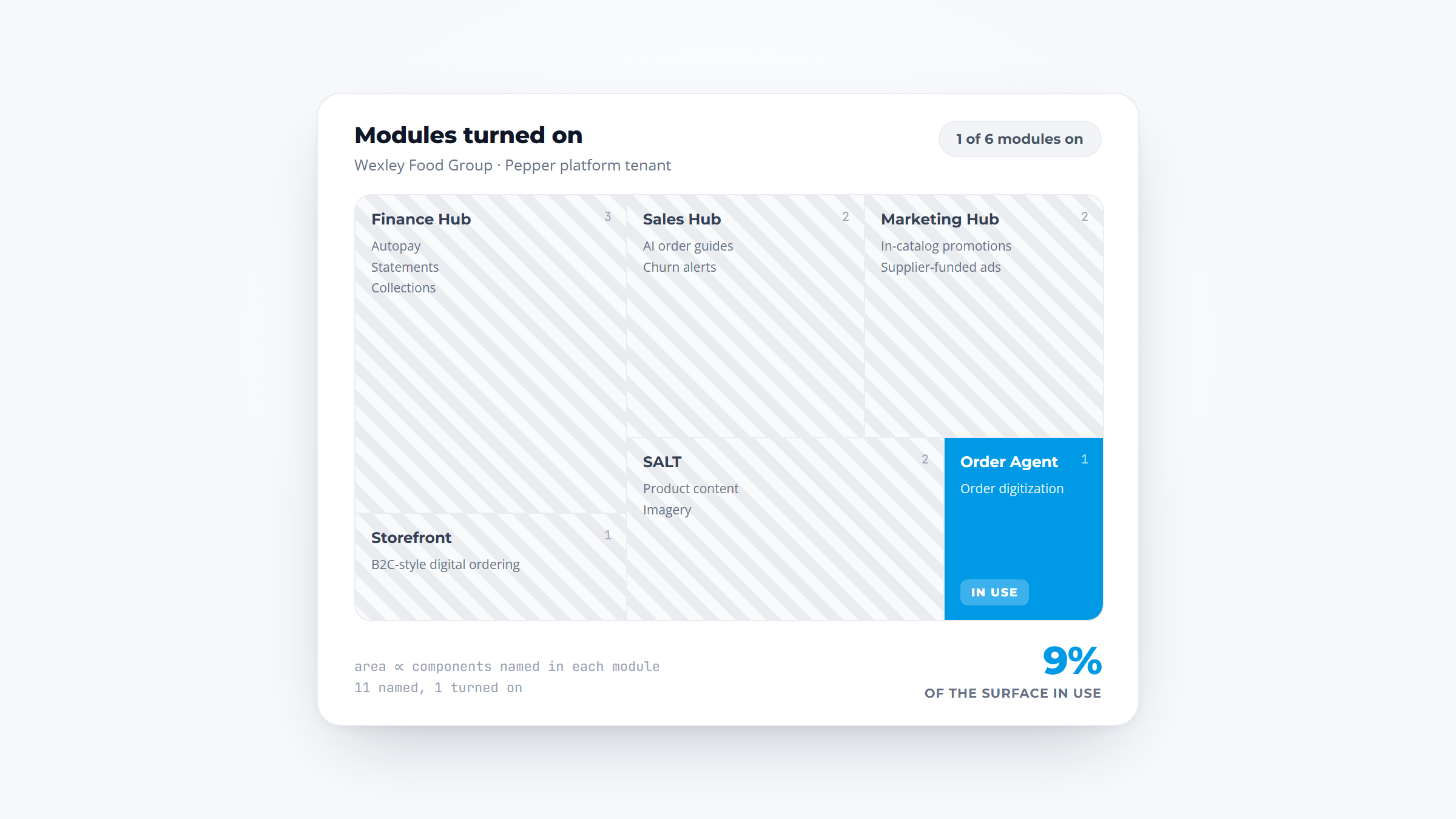
Pepper is Choco's closest structural rival and sells to the same buyer, the independent food distributor. Its Order Agent performs the same job as OrderAgent, converting voice, text, email, photo, PDF and handwriting into structured orders.
The surrounding hubs also mirror Choco's: storefront, sales, marketing and finance, with a newer product-content module.
Key features:
Pricing: by quote. The vendor ties fees to outcomes and discusses numbers on a call.
Pros: the cleanest head-to-head with Choco, a reported base above 500 distributors, and integration claims running to 70 or more ERPs. Cons: no public price, the surface area matches Choco's rather than reducing it, and no outside reviewer has rated it.
The case for it: if Choco's shape is right and only the commercial terms are in question, Pepper is the quote that tells you whether Choco's number is competitive.
Final verdict: the obvious second quote rather than a genuine change of direction.

Burnt's intake list is broad, taking orders from email, SMS, WhatsApp, phone calls and voicemail (transcribed), EDI, customer portals, spreadsheets and reps' free-text notes, and routing them into the ERP.
Its sharpest feature is language resolution: a request for large shrimp becomes a specific count size against your catalog, with live stock checks and substitution suggestions behind it.
Key features:
Pricing: nothing published. Deployment is described as a fortnight for most, and closer to two months when an older ERP has to be worked around.
Pros: one of the broadest named channel lists here, quick to stand up, and honest about handing edge cases back to people. Cons: the figure only arrives after a demo, third-party verification is scarce, and its own pages quote different headline results.
Where it wins: channel breadth. If your accounts order five different ways and none of them will change, this is the tool built for that reality.
Final verdict: a genuine alternative on capability, with vendor-reported accuracy figures that need a reference call to stand up.

Cut+Dry sells the storefront half of Choco's proposition and sells it harder. Distributors get branded ecommerce with structured catalog data, sales enablement and a payments product, and it also serves manufacturers and restaurants.
The company has since layered AI order handling on top, which narrows the distance between it and the parsing-first vendors.
Key features:
Pricing: a flat subscription without seat or per-order charges, and no dollar amount on the page. The vendor points instead to named results: a Hawaii distributor live within three months of signing, and a broadline operator with three quarters of its customers using the platform inside twelve months. Both are its own figures.
Pros: the clearest answer to bad product data anywhere here, references you can look up, and receivables handled alongside orders. Cons: no dollar figure to budget against, the whole return rests on customers logging in, and launch averages 45 to 100 days by the company's own figure.
Its strongest suit: catalog structure. If your product data is the reason ordering goes wrong, this is the vendor that treats that as the product.
Final verdict: a real alternative if your accounts will browse, and the wrong bet if they will not.

SimplyDepo puts its weight behind the rep rather than the order desk, combining B2B ordering with retail execution and route management.
Where Choco assumes orders arrive at your office, SimplyDepo assumes somebody is standing in the customer's stockroom writing them.
Key features:
Pricing: per seat and public. An annual agreement puts a rep at $69 monthly, month-to-month at $89, with larger teams on annual terms paying $59 and then $49. The first month is free.
Pros: costs can be worked out from headcount alone, setup is included in the price, and the road-facing tools are strong. Cons: the bill grows with the team, going month-to-month adds $20 to each seat, and nothing here addresses orders that arrive on their own.
Who should look at it: distributors whose volume is written by reps on routes rather than phoned into an office.
Final verdict: the clearest-priced option here, and only relevant if field sales is genuinely how you sell.
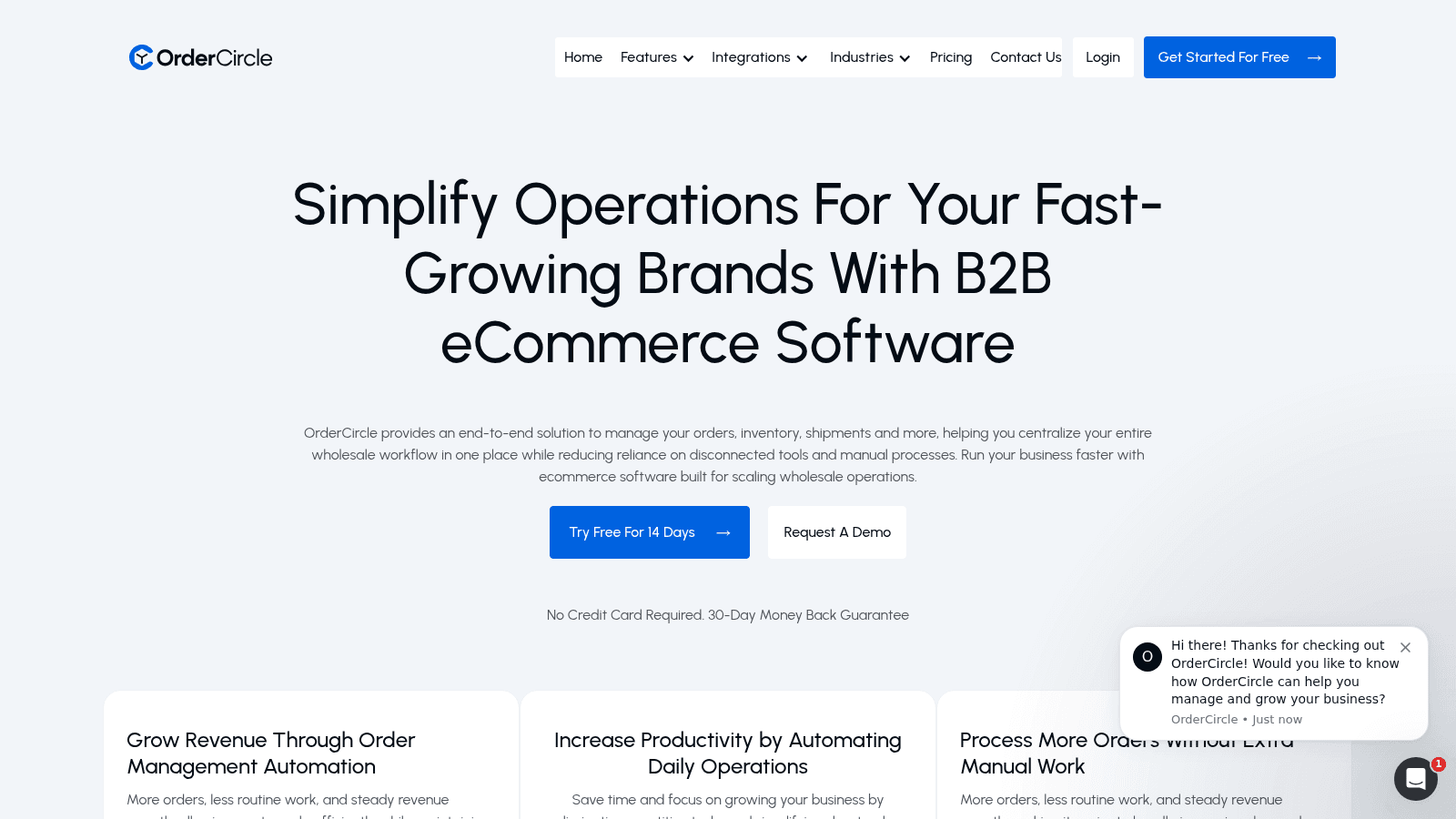
OrderCircle is the smallest flat-fee starting point on this list, which matters if you would rather not price by seat at all. It handles multi-channel order collection, keeps order history as a light CRM and forecasts inventory, without any of the platform ambition Choco carries.
Key features:
Pricing: six tiers, all in dollars and all public. Entry is $199 monthly against a 25-order ceiling, $399 lifts the ceiling entirely, and the top enterprise band reaches $999.
Pros: the cheapest option here that does not charge by seat, bands you can read before buying, and a short setup. Cons: the two cheapest tiers cap monthly orders, the entry tier has no staff accounts, and the product was shaped for brands.
What it does better: it lets a small operation stop running on spreadsheets for two hundred dollars a month rather than a platform contract.
Final verdict: the right first system for a distributor Choco would not seriously pursue anyway.
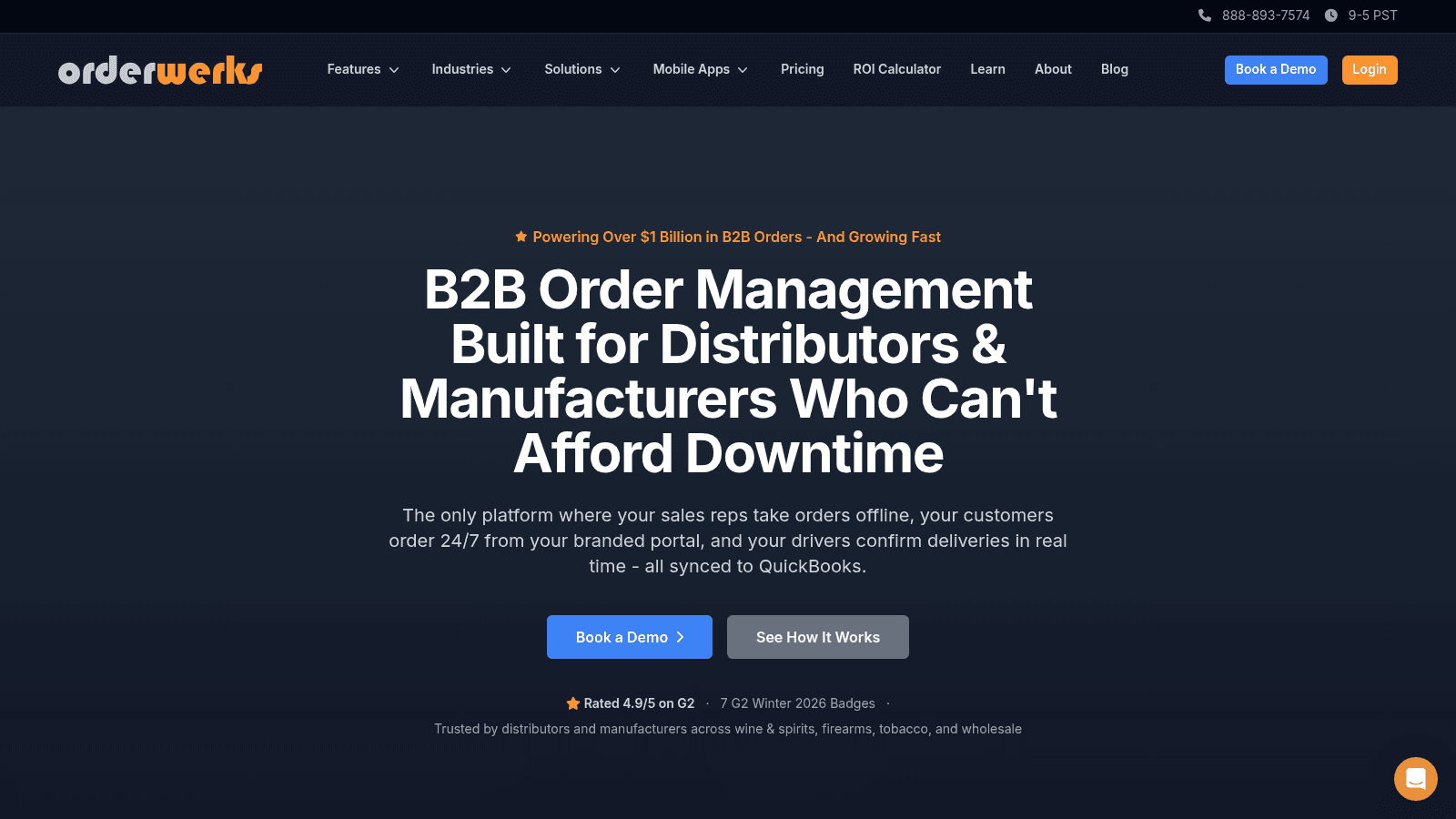
Orderwerks was built for categories where the paperwork is part of the product: wine and spirits, firearms, tobacco, alongside ordinary wholesale. Nothing food-specific on this list carries that compliance layer.
Three groups use it at once. The rep writes orders whether or not there is signal, the customer can buy from a branded site at two in the morning, and the driver closes the loop at the door, with QuickBooks updated behind all of it.
Key features:
Pricing: seats cost $60 monthly, with volume pricing from five seats up. Adding the delivery module means $150 monthly and a further $25 per driver, while implementation is quoted from $2,500 as a one-off.
Pros: you can total the cost yourself, implementation is priced openly, and connections to QuickBooks, Xero, ShipStation and Zapier cost nothing extra. Cons: the final number comes from several separate lines, accounting revolves around QuickBooks, and food is not its specialism.
Why it belongs here: it is the only vendor whose seat rate, delivery module and setup fee are each published as separate figures, so the total can be assembled without a call.
Final verdict: among the most transparent here, and the natural pick if any of your categories carry compliance obligations.

inSitu Sales runs the direct store delivery cycle as three linked apps covering rep ordering, warehouse picking and driver dispatch with proof of delivery.
The integration list is unusually concrete for this category, naming Xero, NetSuite, Microsoft Dynamics 365 Business Central, Epicor, SAP Business One, Odoo and QuickBooks among others rather than gesturing at ERPs in general.
Key features:
Pricing: each starter product is $200 monthly, the combined Pro tier $329, and Enterprise $429. Wiring in NetSuite or SAP Business One is a single $500 charge. Extra app users are $34.99 a month each.
Pros: the ERP list names actual systems, the order is tracked past dispatch, and the tiers are visible. Cons: deploying three applications is three projects, integration carries its own fee, and only three users come with each plan.
The trade-off it offers: more moving parts in exchange for following the order past the order desk and onto the truck.
Final verdict: the strongest choice where delivery execution matters as much as order capture.
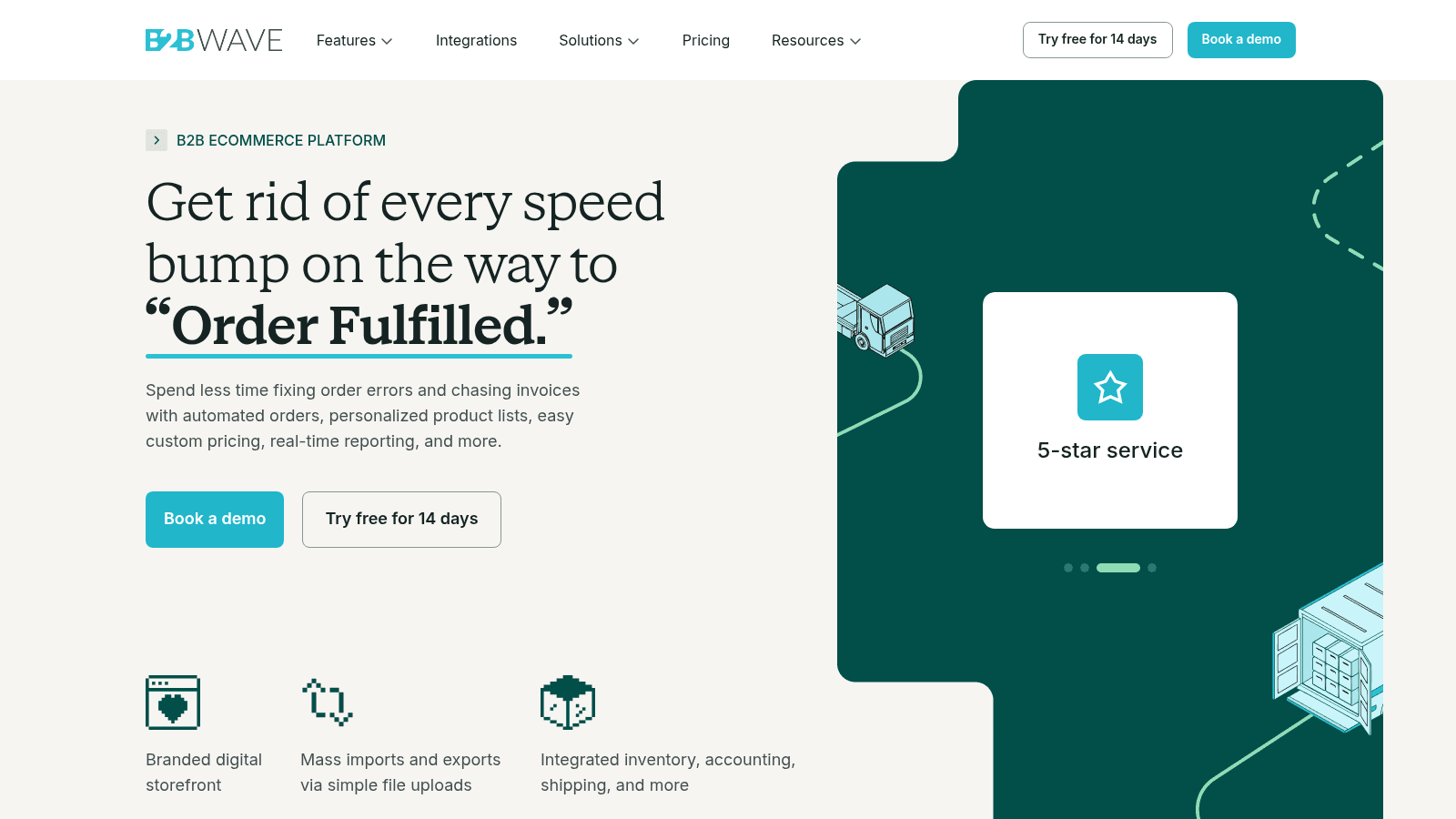
B2B Wave gives distributors, manufacturers and drop-shippers a branded wholesale storefront with per-customer price lists, invoicing and order automation.
That competes with Choco's ecommerce module and nothing else, which is either the point or a dealbreaker depending on what you need.
Key features:
Pricing: US visitors see the Pro plan at $350 a month, cut to half that for an opening quarter, with an enterprise tier quoted on request and local currency elsewhere.
Pros: order value is never taxed, the ceilings are effectively absent, and the plans are plainly stated. Cons: only one self-serve plan sits below Enterprise, the value depends on portal use, and it was not designed around food.
Why it's a good Choco alternative: it delivers the storefront at a published price, without the CRM, the prospecting tools or the manufacturer advertising.
Final verdict: solid value for a portal, and irrelevant if your customers order by phone.
Unleashed treats distribution as an inventory problem first. It covers multi-location stock, purchasing, B2B ecommerce and demand forecasting, with ordering as one component rather than the center of the product.
Key features:
Pricing: the three plans cost $99, $399 and $729 monthly, with further seats at $69 or $89. Implementation is billed apart, in bands of $449, $799 and $5,549, and ongoing support at either $99 or $239 monthly.
Pros: the implementation and support costs are stated rather than hinted at, traceability runs deep, and the product is well established. Cons: each plan includes 100 sales orders a month and charges for more, several charges stack up, and capturing orders is not what it was built for.
Best angle: it is the option to consider when what looks like an ordering problem is really nobody knowing what is in stock.
Final verdict: worth pricing precisely because it tells you what the whole thing will cost.

NetSuite is the full ERP option, with order management as one module inside finance, inventory, procurement and fulfillment. It is an alternative to Choco only if you were already contemplating replacing the stack.
Key features:
Pricing: none disclosed beyond an annual license and a one-time implementation fee. When a $12 million distributor with nine staff asked on Reddit whether it fit, one reply estimated $150,000 to $250,000 to implement and several thought the business too small, while implementers there disagreed.
Pros: everything reconciles to one place, the functional depth is real, and the partner ecosystem is mature. Cons: no number without a sales process, a rollout measured in quarters, and far more system than an order desk needs.
Where it lands: on the shortlist only when the order desk is one of several systems that no longer hold together.
Final verdict: the answer to a much bigger question, and an expensive answer to a small one.
Every option here asks you to move something valuable inside a vendor's system: your catalog, your account-level pricing, and eventually your order history. That is worth doing, and it is worth understanding what it costs later.
Economists have a precise name for this. The 2009 Nobel Prize in economic sciences went partly to Oliver Williamson for explaining why parties end up locked into hierarchical arrangements rather than trading freely. The most typical case of the mutual dependence he describes is parties holding assets, either physical assets or knowledge, that are only valuable inside the relationship.
A distributor's order guides, negotiated price files and two years of buying patterns are exactly that kind of asset. Once they live in a platform, and once your customers have learned that platform's app, the cost of leaving is paid by both of you.
The mirror image runs on the buying side too, where vendor management is largely the discipline of not letting any one supplier relationship become impossible to unwind.
Three questions cut through it at the demo stage. Can you export your catalog, your pricing and your full order history in a usable format, on demand, without asking? Who owns the relationship with your customer inside the app? And if the vendor changes its commercial model, what can it change unilaterally?
Choco's ad network makes the second question sharper than usual, because the ordering surface your customers see carries content sold by someone else. That may be a fair trade for the network's reach, and it should be a decision rather than a discovery.
Independent distributors are shopping for this software because the top of their market is extremely concentrated, and technology is one of the few levers they control.
The scale of that concentration is a matter of public record. When Sysco proposed buying US Foods, the Federal Trade Commission alleged the combined company would hold 75% of the national market for broadline distribution and would reduce competition in 32 local markets. A court granted the FTC's request for a preliminary injunction in June 2015, and the merger was abandoned.
That is the competitive backdrop for every tool in this list. An independent distributor cannot out-buy a national broadliner, but it can be easier to order from, and the distribution management decisions behind that are where software actually helps.
Concentration also explains the platform pitch. Choco, Pepper and Cut+Dry all argue that independents need to look like a national operator to their customers, which is true of the storefront and much less true of the order desk.
Pricing posture is the most decision-relevant difference in this list, so it is worth laying out plainly rather than burying it in the entries.
| Vendor | Published entry price | What is not included |
|---|---|---|
| Orderwerks | $60 per user monthly | Delivery module, onboarding from $2,500 |
| SimplyDepo | $69 per rep monthly, annual | Monthly billing costs $89 per rep |
| Unleashed | $99 monthly | Onboarding $449 to $5,549, support plans |
| OrderCircle | $199 monthly | Higher order volumes need higher tiers |
| inSitu Sales | $200 monthly | $500 ERP integration setup |
| B2B Wave | $350 monthly (US) | The half-price offer covers three months only |
| Choco, Pepper, Burnt, Cut+Dry, NetSuite, VoiceOrder Solutions | None, quote-based | Set out in the quote, so ask for setup and add-ons in writing |
Two things follow. The published prices are entry points rather than totals, and the vendors that publish are mostly selling a defined product rather than a variable-scope platform. Neither posture is dishonest: a published rate lets you build a budget before the first call, and a quote is written around your own operation.
Which posture suits you depends partly on your own distribution model, since a business with predictable routes and stable accounts can forecast a per-seat cost that a fast-growing one cannot.
The work is not in the software. It is in the catalog and in your customers, in that order.
Pack sizes, units of measure and account-level pricing all have to survive the move intact. Where those fields have gone unmaintained for a few years, cleaning them will outlast the configuration work by a wide margin. Audit them before signing, because the audit also tells you how much of the current problem is really a data problem.
The customer side comes next. A parsing tool asks nothing of your accounts, which is the strongest argument for staying with a Choco-shaped product. Anything customer-facing asks them to change a habit, and the wholesale order management systems that succeed are the ones whose adoption plan is as detailed as their feature list.
Export before you switch, not during. Ask for your catalog, pricing, customer records and order history as files you hold, and confirm you can get them again later without a support ticket.
Run both channels through at least one complete ordering cycle. The exceptions that break a migration are weekly rather than daily, so a fortnight of parallel running finds what a weekend cutover will not.
Count your inbound channels for two weeks before you look at another demo. That count decides most of this.
Heavy voicemail, text and email volume from accounts who will never change points to parsing: Pepper or Burnt. Accounts who would happily use an app but never a computer point toward voice ordering, and keeping order tracking inside your own systems rather than a marketplace.
Accounts already ordering online point to a storefront from Cut+Dry or B2B Wave. Volume written by reps on routes points to SimplyDepo or inSitu Sales.
Reach for NetSuite only when ordering is one symptom of a stack that stopped holding together. Most Choco software alternatives solve a narrower problem than that, which is usually the point.
Choco's argument is scale: a large network, a manufacturer ecosystem and a product suite that covers most of what a distributor does commercially. That is a real advantage and it is worth paying for if you will use it. The calculation changes again if you are a software vendor rather than a distributor, since food service software platforms are buying an integration rather than a product.
The counter-argument is ownership. A narrower tool leaves the customer relationship, the ordering surface and the commercial terms entirely yours, at the cost of the network.
Get two quotes from platform vendors and one from a point tool, then compare what each asks you to give up rather than what each promises. The Choco alternatives worth your time are the ones whose assumption about your customers is already true. Most Choco software alternatives will tell you their price in the first email, while the quote-based vendors, VoiceOrder Solutions among them, scope it on a call first.
If keeping the ordering relationship in your own hands is the priority, contact VoiceOrder Solutions for a demo.
Choco, at choco.com, is a platform for food and beverage wholesalers. Its OrderAgent converts orders arriving by voicemail, WhatsApp, email, text or photo into structured data, alongside an ecommerce storefront, a sales module and a foodservice CRM.
It is unrelated to Chocolatey, the Windows package manager that dominates search results for the abbreviation.
Choco does not publish a price; like several vendors here, VoiceOrder Solutions included, it quotes. Its pricing page commits only to a usage-based monthly fee, and its ecommerce FAQ adds a one-time implementation charge on top of that.
Six alternatives here do publish: Orderwerks from $60 per user monthly, SimplyDepo from $69 per rep, Unleashed from $99, OrderCircle from $199, inSitu Sales from $200 and B2B Wave from $350.
Pepper is the closest of the Choco competitors, running the same inbound digitization model with a comparable set of surrounding modules. Burnt covers more inbound channels, and Cut+Dry competes primarily on the storefront and catalog side.
Among narrower alternatives to Choco, the published-price vendors are the fastest to evaluate, because you can rule them in or out before booking anything.
VoiceOrder Solutions approaches the same problem from the opposite end: the distributor adds a dedicated voice ordering channel for its accounts rather than interpreting whatever they already sent.
Both are AI platforms sold to food distributors, both digitize inbound orders, and neither publishes pricing. The practical differences are commercial rather than functional.
Choco reports a larger network and runs a manufacturer advertising business inside the ordering flow. Pepper reports over 500 distributors and pairs ordering with finance and price-management modules. Getting quotes from both is the only reliable way to separate them.
Choco says it is free for restaurants, with distributors paying for the platform. That is the standard model across this category, including Cut+Dry.
For a restaurant, the real cost is not money but fragmentation, since each supplier tends to arrive with a different app to install and learn.