.webp)
Key takeaways:
Restaurants inherit their distribution model rather than choosing it. You pick suppliers, and each one arrives with a delivery structure already decided, along with the cutoffs and minimums that come with it.
Understanding those structures is worth an hour because it explains rules that otherwise look arbitrary. The reason one supplier needs 48 hours' notice and another takes an order at 6pm for tomorrow is a difference in model, not a difference in attitude.
This guide covers the models you will actually encounter, what each means for how you order, and how to build one ordering routine that works across all of them.
A distribution business model is the structure a company uses to move product from where it is made to where it is sold. It defines how many stops the product makes, who owns it at each stage, and who physically delivers it.
Three questions define any sales and distribution model. Where is inventory held, who transports it, and how many intermediaries sit between producer and buyer.
The answers determine cost, speed, and freshness, and those three trade against each other. A model optimized for freshness carries more delivery cost; one optimized for cost delivers less often.
The scale involved is large. The National Association of Wholesaler-Distributors puts the wholesale distribution industry at $8.6 trillion, supporting more than 6 million jobs and powering nearly a third of the US economy.
Four structures cover almost everything a restaurant will meet.
| Model | How product moves | Deliveries you receive | Best for |
|---|---|---|---|
| Hub and spoke | Producer to central warehouse, then out to customers | Fewer, larger, consolidated | Broadline grocery and dry goods |
| Direct store delivery | Producer or distributor delivers straight to the site | Many, smaller, frequent | Bread, dairy, produce, beverages |
| Third-party logistics | An outside carrier warehouses and delivers on the supplier's behalf | Varies by carrier schedule | Specialty and lower-volume suppliers |
| Direct from producer | You buy straight from the farm or maker | Irregular, often self-collected | Local produce and specialty items |
Most restaurants use three of these simultaneously without labeling any of them. The broadline distributor is hub and spoke, the bread and dairy suppliers are direct store delivery, and the specialty importer is likely using a third-party logistics provider.
Each brings a different cutoff, a different minimum, and a different delivery day, which is why a single ordering routine so rarely fits all of them.
Hub and spoke is the dominant model in foodservice distribution. Product from many producers flows into a central distribution center, is consolidated, and goes out on routes serving many customers.
It is the structure most wholesale food distribution software is built around. Its advantage is consolidation. One order covers thousands of items from hundreds of producers, arriving on one truck with one invoice, which is why broadline distributors can serve a restaurant's dry goods, frozen, and packaging needs together.
The warehouse layer itself runs on warehouse and distribution software. The trade-off is time and rigidity. Product passes through an extra handling stage, so the model suits items with reasonable shelf life better than highly perishable ones.
For ordering, hub and spoke means firm cutoffs. The warehouse builds routes overnight, so an order arriving after the cutoff genuinely cannot make tomorrow's truck rather than merely being inconvenient.
It also means minimum order values, because a small drop on a long route loses the distributor money. Understanding that explains why consolidating your order into fewer, larger deliveries usually improves your pricing. Consolidation is the first lever in supply chain network optimization, and it pays twice by cutting both the delivery fee and the labor to receive.
Direct store delivery skips the central warehouse. The producer or a dedicated distributor delivers straight to your site, often with the driver also handling merchandising, rotation, and returns.
You encounter it most with bread, dairy, soft drinks, beer, snacks, and often produce. The reason is shelf life: for a product measured in days, an extra warehouse stop costs more than the delivery efficiency it buys.
DSD gives the freshest product and the most responsive service, since the person delivering usually knows your account directly. It also produces the most deliveries to receive, each with its own paperwork.
The ordering implications differ sharply from hub and spoke. Cutoffs are often later and more flexible, because the route is shorter and built closer to delivery time, and reps frequently work from customizable order guides rather than a fixed catalog. Order sizes are smaller and more frequent, and the rep may adjust quantities based on what they see in your storeroom.
That informality is the model's strength and its weakness. Orders agreed verbally with a driver at the back door are fast, and they leave no record when a delivery turns out short. Distributors running DSD operations face the same problem from the other side.
The FMCG distribution model describes how fast-moving consumer goods reach retail, and restaurants buy inside it whenever they order branded packaged products. An FMCG distribution business model is defined mainly by how many layers sit between the manufacturer and the shelf.
Its defining feature is layers. A manufacturer sells to a national distributor, who sells to regional wholesalers, who serve individual outlets, and each layer takes margin and adds lead time. Each layer's cut is a markup on what it paid, and a wholesale markup calculator shows what margin a given markup really leaves.
Stacked up, the cost of the extra links is easier to see than to describe.
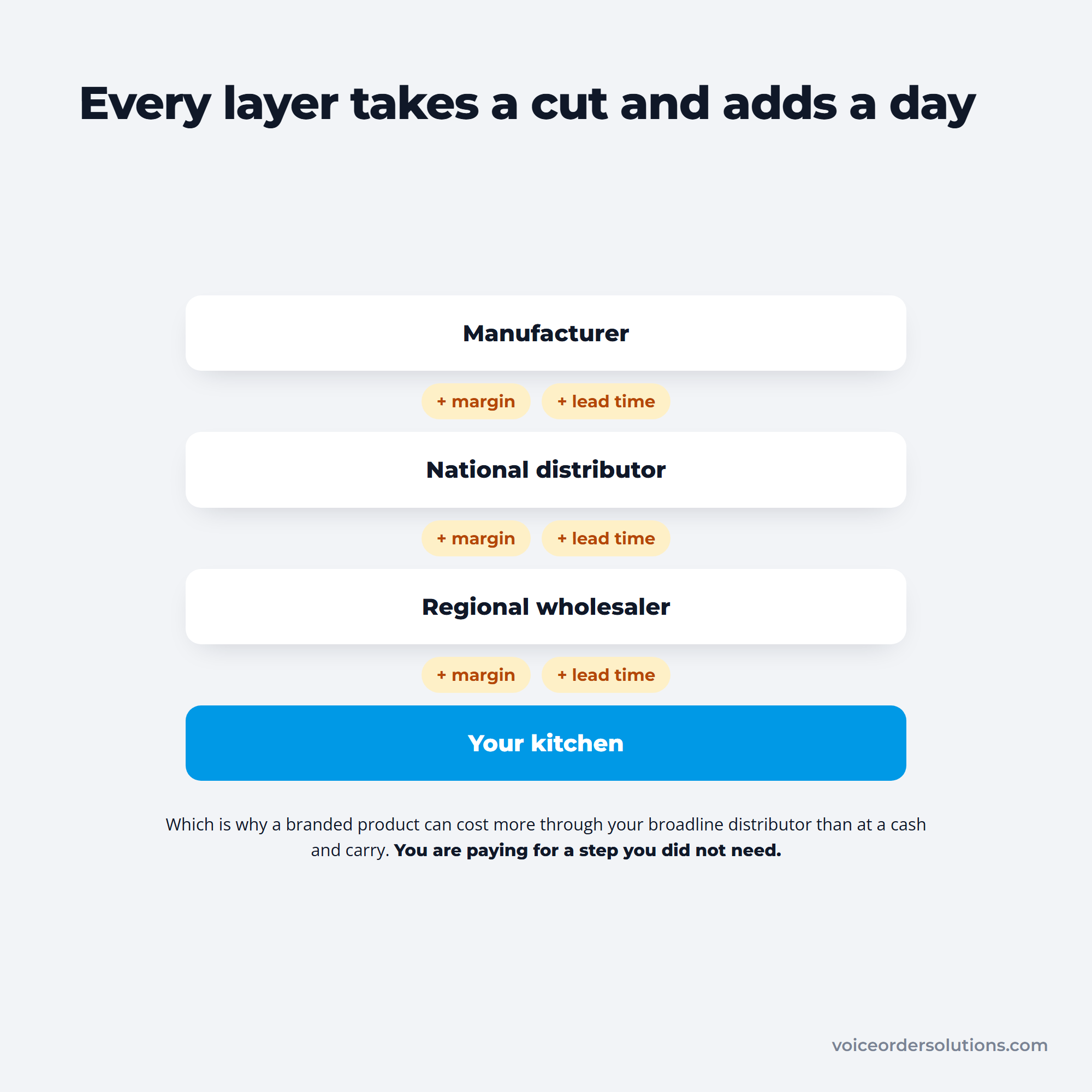
That layering explains why a branded product sometimes costs more through your broadline distributor than at a cash and carry. You are paying for a step in the chain you did not need.
Third-party logistics works differently. A 3PL warehouses and ships on the supplier's behalf without ever owning the product, which lets small producers reach customers without building their own distribution.
For a restaurant, buying from a supplier who uses a 3PL usually means longer lead times and less flexibility on delivery dates, because your supplier does not control the warehouse or the truck.
Each of those layers is a markup applied to the one below it, and the arithmetic is easier to read as a chain than as a description, so price one case through it.
Follow a case from your cost to the shelf, and check that your wholesale price still leaves the retailer the margin they need to stock you.
Your side of the case
The shelf price is the part that surprises people. A case costing $22.00 leaves the distributor at $28.60, and once the retailer takes a 40% margin the same product sells at $3.97 a unit, or $47.64 for the case you started with. Every layer you can skip comes out of that spread, which is why a branded item can cost less at a cash and carry.
Suppliers rarely state their model anywhere on a website, but three questions settle it in a single phone call.
Ask where the product is picked. A named distribution center serving several states points to hub and spoke; a local depot with its own vans points to direct store delivery.
Ask who employs the driver. If the answer is a logistics company rather than the supplier, a 3PL sits in the middle, and your delivery date is being set by a business you hold no account with.
Ask what happens if you miss the cutoff by an hour. A hub-and-spoke operation will say the next scheduled day, because the truck is already loaded against a route built the night before. A DSD supplier will more often say they can work something out, because the route is shorter and assembled closer to delivery. Some DSD suppliers now collect those orders the night before through DSD sales software, so the van leaves loaded to what each account asked for.
Write the three answers beside each supplier on your order sheet. That page will tell you more about your real ordering constraints than any category label does.
The practical value of understanding models is that it turns arbitrary-seeming rules into predictable ones.
| If your supplier uses | Expect | Plan your ordering to |
|---|---|---|
| Hub and spoke | Firm early cutoffs, minimum order values, set delivery days | Order in fewer, larger batches against a fixed schedule |
| Direct store delivery | Later cutoffs, frequent small drops, rep involvement | Keep par levels tight and expect more receiving |
| Third-party logistics | Longer lead times, less date flexibility | Order further ahead and hold more buffer |
| Direct from producer | Seasonal availability, informal scheduling | Confirm in writing and build in substitution options |
Running one ordering routine across all four is the mistake most operators make. A single Monday order works for the broadline distributor and fails for the produce supplier whose availability changes midweek.
The workable approach is one ordering method with per-supplier timing. Same process, same person, same record, but the cutoff and frequency set to match each supplier's model rather than your calendar.
Whatever model your suppliers use, your side of the transaction is the same act: deciding what you need and communicating it accurately before the cutoff.
That step is usually the weakest link. A restaurant with three suppliers on three models typically has three ordering habits, one of which involves a phone call and none of which produces a record.
The gap only matters on the day a delivery turns out short, and then it matters a lot.

VoiceOrder Solutions gives that step one method regardless of the model behind it, and the supplier is the one who sets it up. Whether the truck comes off a consolidated route or a local DSD run, the buying customer talks the order into an app holding their agreed catalog, and it reaches that supplier structured, timestamped, and in a format their systems read.
Two things follow. Orders reach hub-and-spoke suppliers inside their cutoff, because nothing waits in a voicemail box to be typed up. And DSD orders agreed at the back door gain the record they normally lack, since each carries a unique order number and timestamp.
It covers the ordering step rather than the distribution model itself, and it layers alongside the existing distributor software stack rather than replacing any of it.
Distribution models do not just determine when product arrives. They determine the structure of your bill, and comparing suppliers on case price alone misses most of it. A landed cost calculator puts freight and pack count back into the comparison, so the cheapest case is not mistaken for the cheapest unit.
Hub and spoke pricing bundles the warehouse and the route into the case price, then adds minimum order values to protect route economics. Order below the minimum and you either pay a fee or absorb a worse price per case.
Direct store delivery usually shows a higher unit price with fewer explicit fees, because the delivery cost is built into the product. What it costs you instead is receiving labor, since more frequent drops mean more time checking deliveries in.
Third-party logistics arrangements often carry the least flexible terms, because your supplier is passing through a carrier's schedule and minimums rather than setting their own.
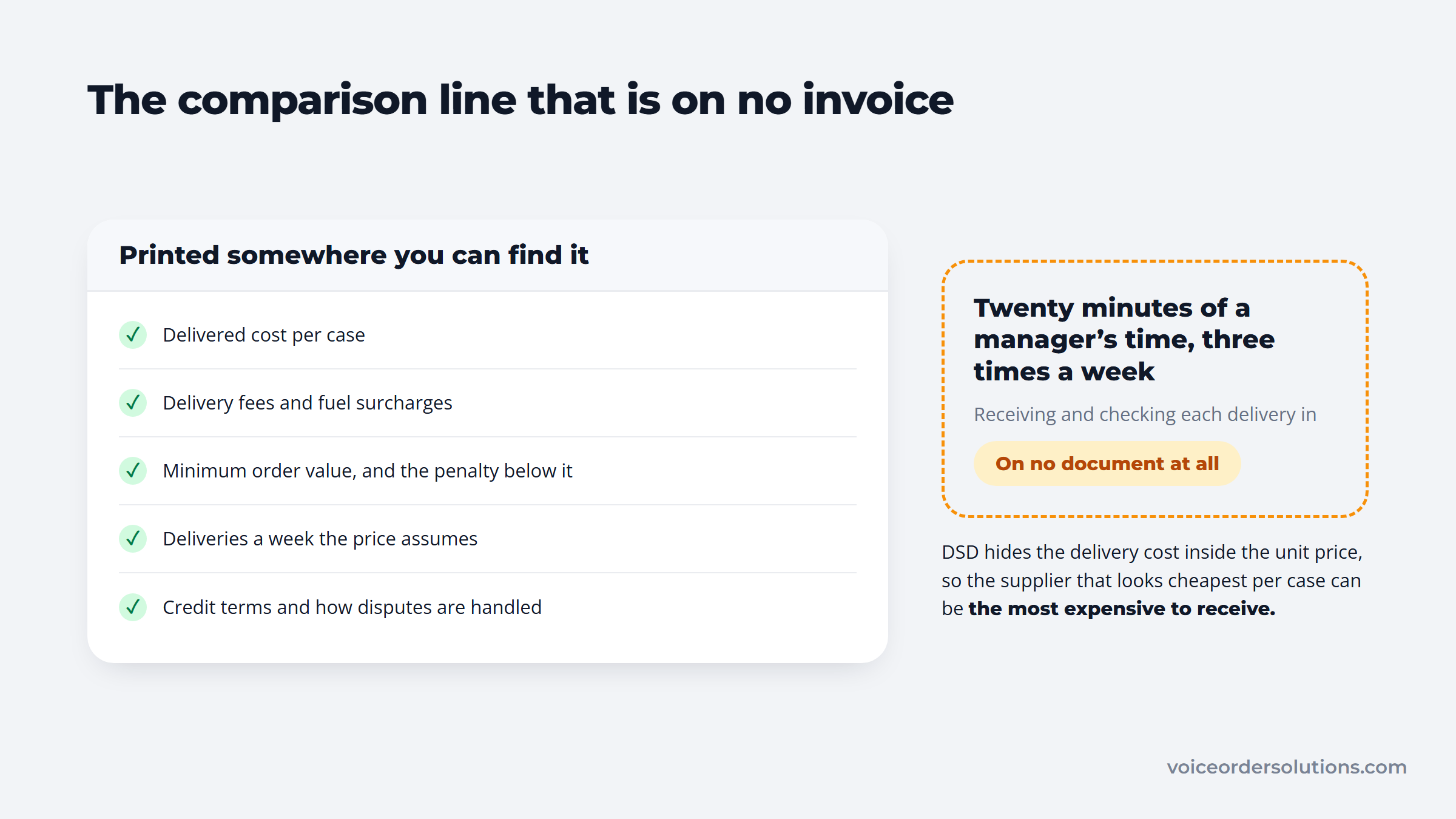
Compare suppliers on these before switching:
The fourth line is the one operators consistently leave out. Twenty minutes of a manager's time per delivery, three times a week, is a real cost that never appears on an invoice.
Four of those five comparison lines are printed somewhere, and the fifth is not.
Run that comparison annually rather than only when a rep calls. Terms drift, and the arrangement that suited you two years ago may now be sized for a volume you have outgrown.
The models themselves are stable. What is changing is how orders move through them.
The IFDA found AI use among foodservice distributors roughly tripled between 2023 and 2025, with ecommerce and ordering the single most common application at 56% of adopters. Labor savings rose sharply as a technology decision driver over the same period.
The honest counterpoint sits in the same report: nearly a third of AI adopters said the technology underperformed their expectations.
For restaurants the visible effect is more distributors offering online ordering portals and firmer, automated cutoffs. The informal phone relationship is narrowing, particularly on the hub-and-spoke side. On the distributor side of that shift, the operational work of distribution management is what decides whether the tighter cutoffs hold.
That shift rewards operators who already order in a structured way, typically through a wholesale order management portal, and penalizes those relying on a rep's goodwill to accept a late order.
Getting this right is mostly an audit followed by a small number of scheduling decisions.
Step four fixes more problems than the rest combined. Restaurants routinely count stock on a schedule that suits the kitchen and then discover the cutoff passed two hours earlier.
Step six is the one people skip because verbal ordering feels efficient. It is efficient right up to the delivery that arrives short. Ask each supplier what their order management system can send back as confirmation, since a record they generate is worth more in a dispute than one you wrote down.
The audit itself rarely takes more than an hour. Most of the information sits in delivery notes and invoices you already have, and the gaps it exposes are usually obvious once written side by side.
Repeat it whenever you add a supplier or open a site. Ordering routines that worked for three suppliers tend to break quietly at five, because the schedule that accommodated all of them no longer exists.
Write down your suppliers and their cutoffs this week. Most operators have never had that list in one place, and assembling it usually explains two or three recurring problems immediately.
Then align your counting routine to those cutoffs rather than to habit. That single change removes a large share of late orders without any new tooling, and it costs nothing beyond moving a recurring task an hour earlier in the day.
Once the timing is right, ask your suppliers what they offer for placing the order, because the record you want is theirs to provide. Independent food distributors run VoiceOrder Solutions for exactly that, giving their accounts one order taking method across every model they buy on. Distributors can contact the team to try it against a real order guide.
Hub and spoke moves product from many producers into a central distribution center, where it is consolidated and sent out on routes serving many customers. It is the dominant structure in broadline foodservice distribution because it lets one order and one delivery cover thousands of items. The trade-offs are firm cutoff times, minimum order values, and an extra handling stage that suits shelf-stable goods better than highly perishable ones.
DSD stands for direct store delivery, where a producer or dedicated distributor delivers straight to your location without routing through a central warehouse. It is standard for bread, dairy, beverages, snacks, and often produce, because those products cannot afford the extra time a warehouse stop adds. DSD gives fresher product and more responsive service, at the cost of more frequent deliveries to receive and check.
A distributor buys product, owns it, and resells it to you, taking margin on the goods. A third-party logistics provider never owns the product; it warehouses and ships on the supplier's behalf for a fee. Practically, buying from a supplier who uses a 3PL usually means longer lead times and less flexibility on delivery dates, because your supplier does not control the warehouse or the vehicle.
None is best in isolation, and most restaurants use several at once by necessity. Hub and spoke suits dry goods, frozen items, and packaging where consolidation saves money. Direct store delivery suits short-shelf-life categories where freshness matters more than delivery efficiency. The useful decision is not picking a model but aligning your ordering schedule to the cutoffs each of your suppliers' models imposes.
Usually yes, and in a predictable direction. Hub-and-spoke suppliers set higher minimums, because a stop on a long consolidated route has to earn its place, so expect a case count or a dollar threshold before delivery is free.
DSD suppliers set lower minimums or none at all, since the truck is passing your door anyway on a short local route. Where a 3PL is involved, the minimum is frequently written into the logistics contract rather than set by the supplier, which is why it can feel non-negotiable.