For Independent Food Distributors

Wholesale Markup Calculator

Turn a landed cost into a wholesale price, see the margin that markup really gives you, and watch how staples drag your blended margin down.
VoiceOrder app ordering screen

Wholesale Markup Calculator

Turn a landed cost into a wholesale price, see the margin that markup really gives you, and watch how staples drag your blended margin down.

Your case and how you price it

$
Everything a case costs you before markup: supplier, freight, handling.
%
Markup is added on top of cost. It is not the same as margin.

Your line is not one markup

% of $
Commodity items you have to price sharp to win the order.
%
The thinner markup the market lets you hold on the basics.
Wholesale price per case
$29.70
Landed cost of $22.00 plus 35% markup
Gross profit per case
$7.70
What you keep on each case sold
Implied markup
35%
Measured against cost
Real gross margin
25.9%
Measured against the price you bill
Margin on your staples
15.3%
At 18% staple markup
Blended margin across the line
19.5%
With staples at 60% of sales
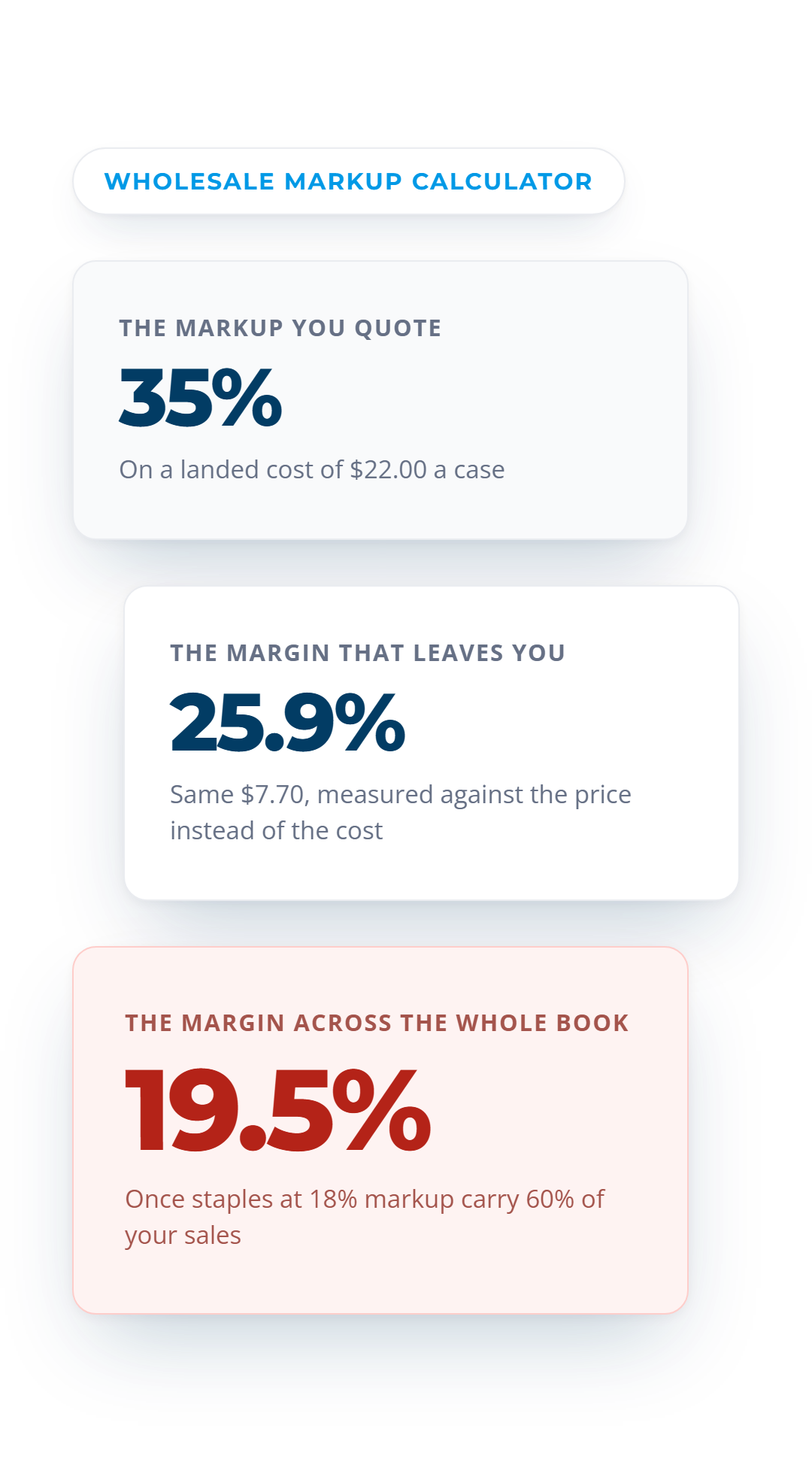
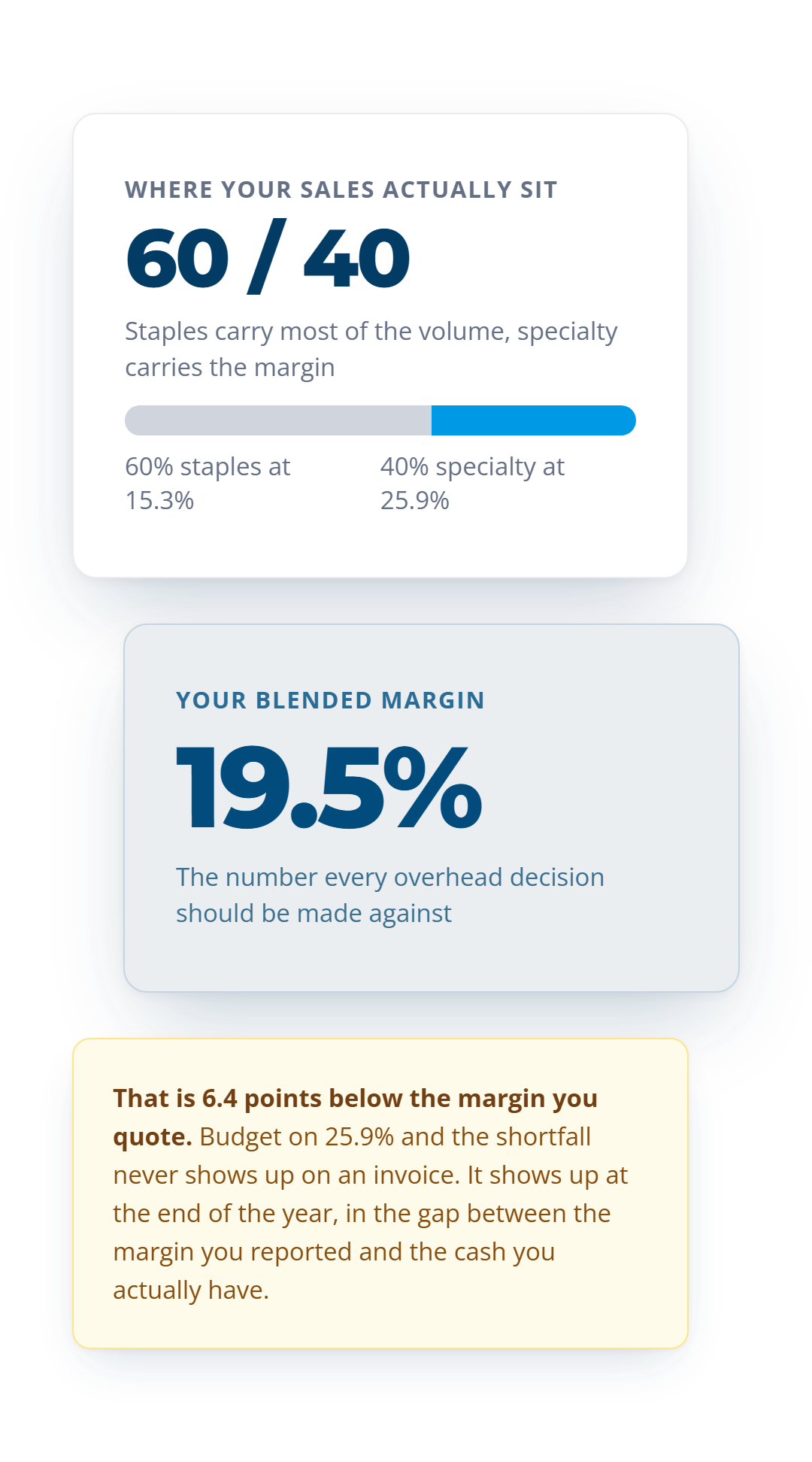
A 35% markup is a 25.9% margin, not 35%. Your staples marked up 18% hold only a 15.3% margin, and with staples at 60% of sales your blended margin is 19.5%. The price on your best items is not what you take home.
Thin margins punish every ordering mistake. VoiceOrder Solutions confirms each order against your price list before it ships, so a mispriced or wrong case does not eat the little margin the line has.
Book A Demo →
Estimates only. Markup and margin move fast, so check them against your own order guide before repricing.
$29.70

Wholesale price on a $22.00 case

25.9%

The margin that 35% markup leaves

19.5%

What you keep once staples are in the mix

Sound Familiar?

Your best line is not the margin you take home

Every distributor quotes the margin on the items they are proud of. The blend is the number that pays the overhead.
Checkmark icon for verifying the margin a markup really leaves

We hold 35 points across the book.

You hold 35% on top of cost, which is a 25.9% margin. Those are nine points apart, and only one of them is what you bank.
Stacked pallets icon for the staple volume that carries thin margins

Staples are thin, but they bring the volume.

They do, and at 18% markup they hold a 15.3% margin. At 60% of sales they are not a side line, they are most of your book.
Cycle icon for a sales mix averaging out across the year

The mix evens out across the year.

It evens out at 19.5%, which is six points below your specialty margin. That is the number to plan against, not the one on your best case.
How It Works

How to use the wholesale markup calculator

Price one case, then widen it to the whole book. The second step is the one that changes decisions.
1

Start from landed cost

Freight and handling are already in the case by the time you price it. Marking up the supplier invoice leaves that money on the table.
2

Set the markup, read the margin

35% on a $22.00 case prices it at $29.70 and leaves 25.9%. The two numbers use different denominators, so they never match.
3

Add your staple mix

Put in what share of sales runs on staples and what markup they carry. At 60% and 18%, the blended margin lands at 19.5%.
Built For Distributors

What the calculator shows you

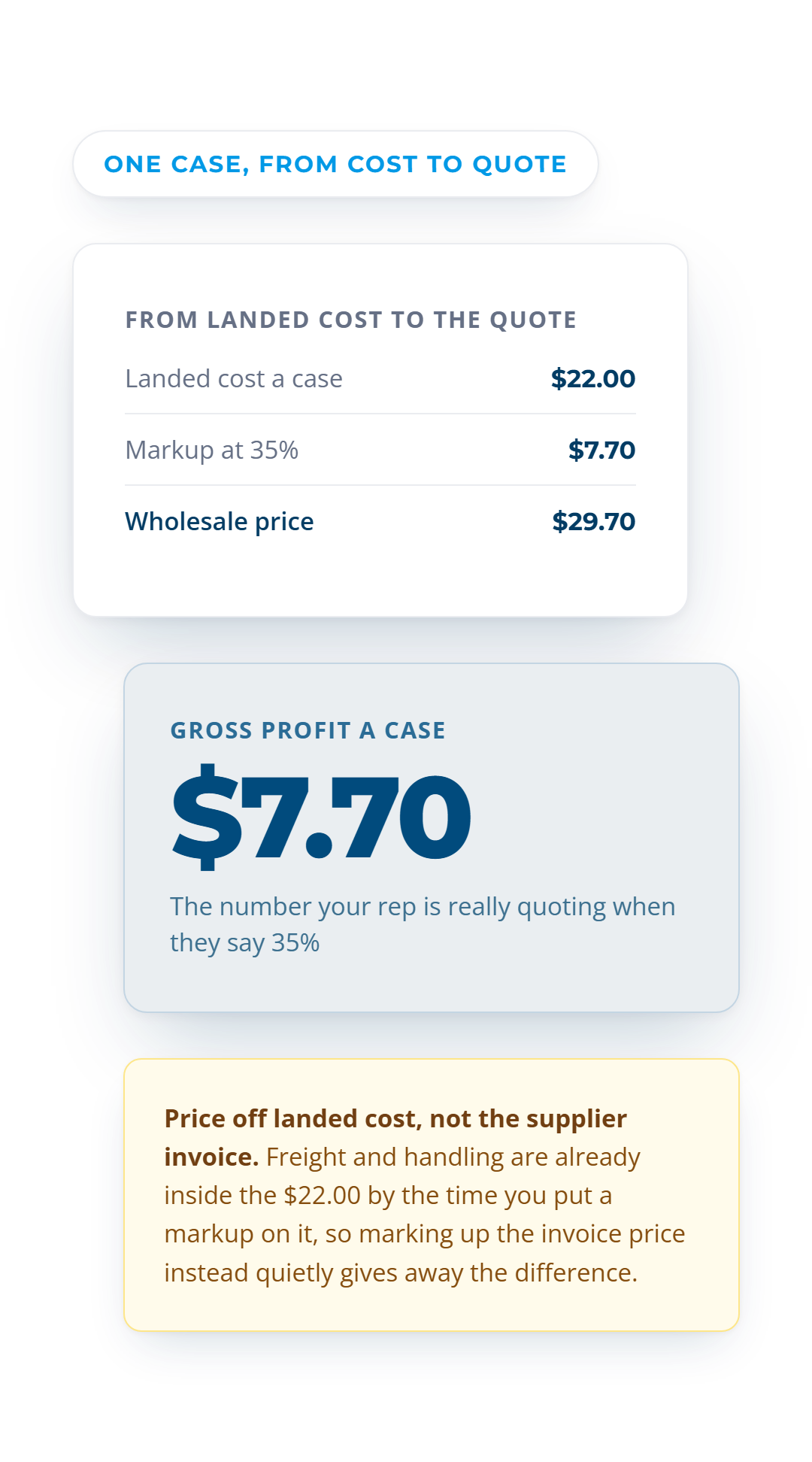
Calculator cards showing a $22.00 landed case marked up 35% to a $29.70 wholesale price, leaving $7.70 of gross profit
Wholesale price

The price your markup actually produces

A 35% markup on a $22.00 landed cost gives $29.70 and $7.70 of gross profit a case. That is the number your rep quotes.
Prices from landed cost, not the invoice
Shows gross profit in dollars a case
Works at any markup you set
Updates the moment a cost moves
Markup to margin

The nine points between the two numbers

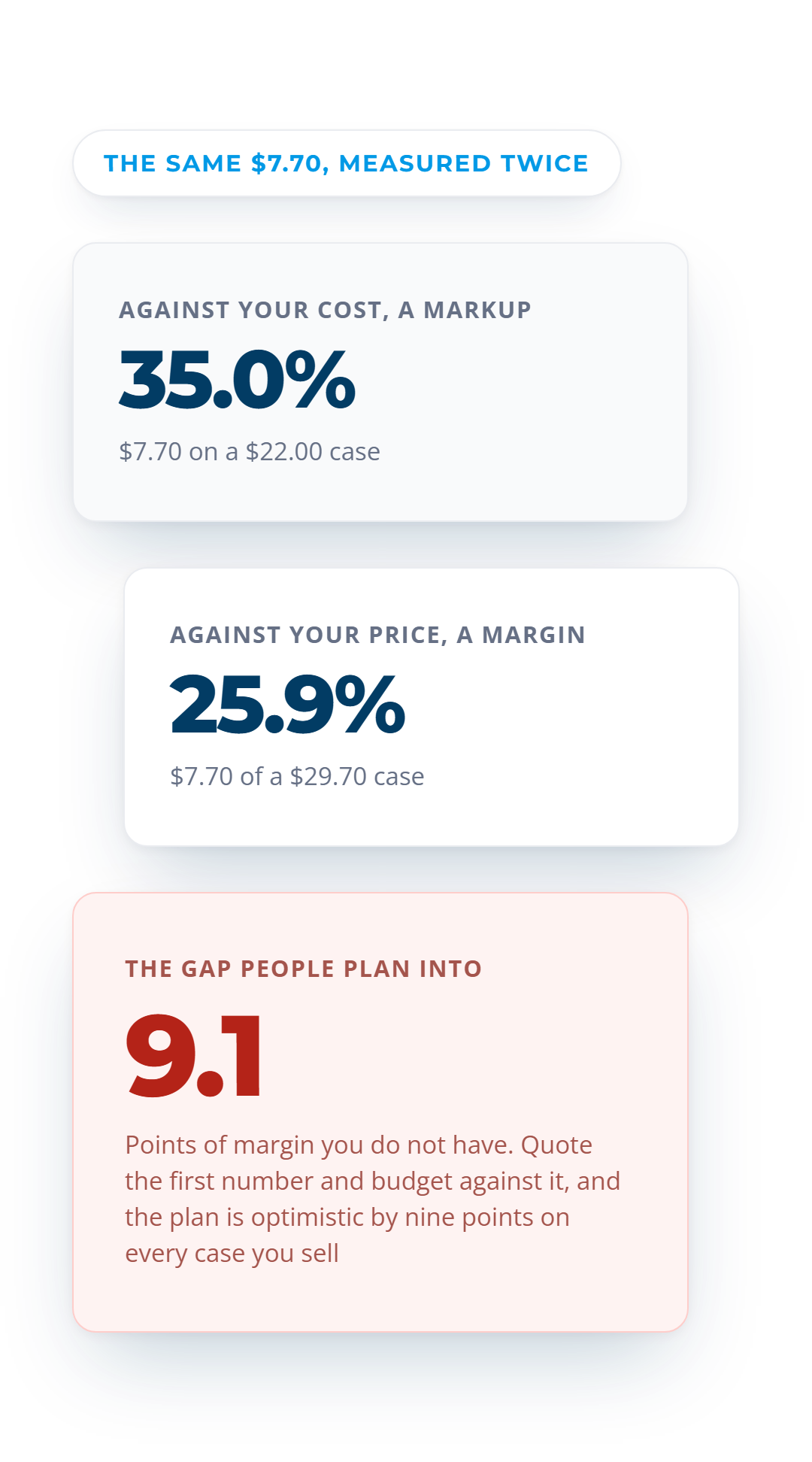
The same $7.70 is 35% of your cost and 25.9% of your price. Quote the first and plan on the second, and the plan is nine points optimistic.
Converts your markup into a real margin
Shows both numbers side by side
Ends the markup against margin argument
Gives you one figure to write down
The same $7.70 shown as a 35.0% markup on cost and a 25.9% margin on price, 9.1 points apart
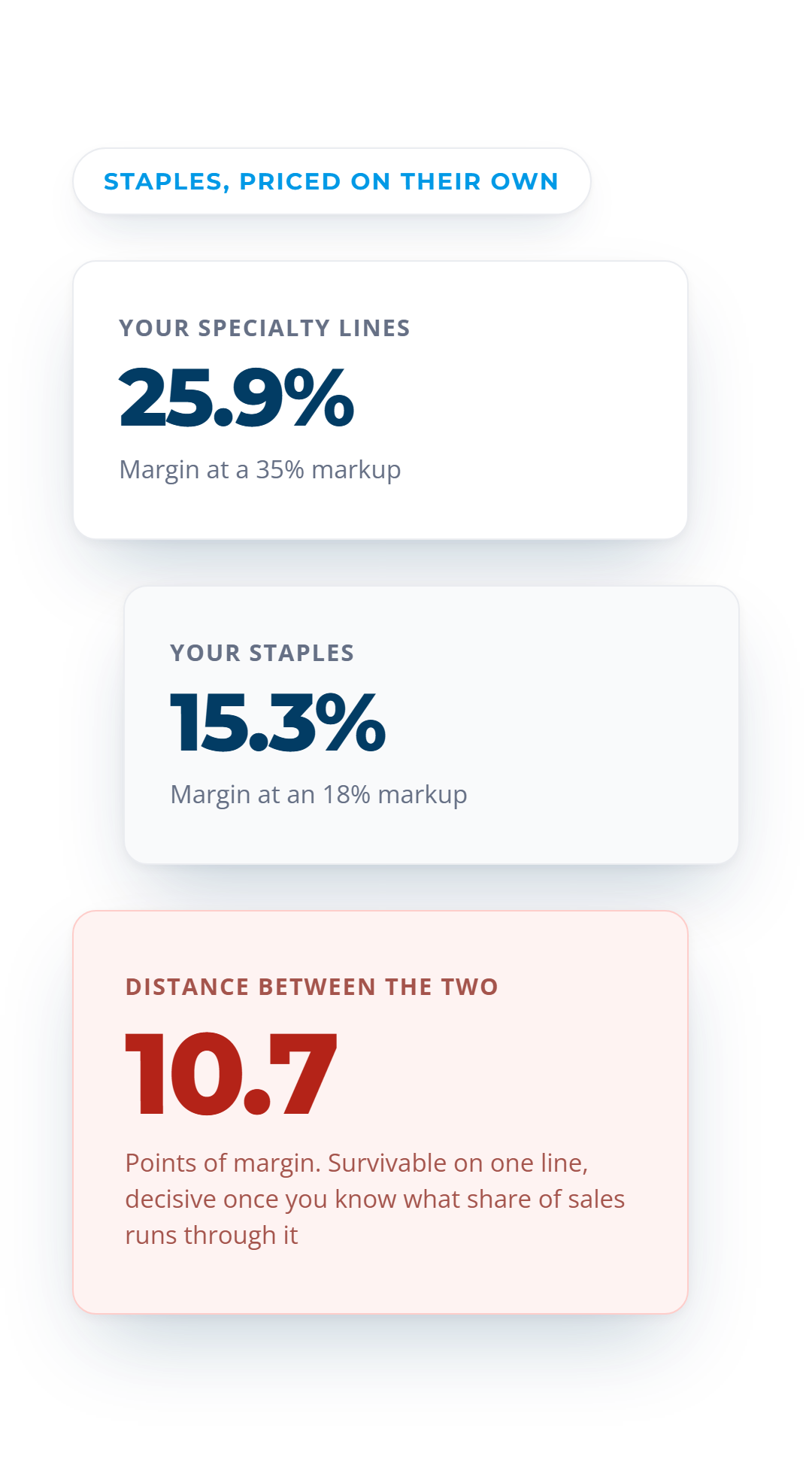
Specialty lines at a 25.9% margin against staples at 15.3%, a gap of 10.7 points
Staples

What the thin end of the book really holds

Staples marked up 18% carry a 15.3% margin. On their own that looks survivable. The question is how much of your sales run through them.
Prices your staple markup as a margin
Takes the share of sales they carry
Separates the line from the book
Works for any two-tier mix
The blend

The one margin number worth planning against

With staples at 60% of sales, your 25.9% specialty margin and their 15.3% blend to 19.5%. Every overhead decision should be made against that.
Weights each tier by its share of sales
Shows the gap against your best line
Moves as the mix shifts
Gives finance a number they can use
A 60/40 sales mix bar blending 15.3% staple and 25.9% specialty margins into a 19.5% blended margin
After The Numbers

What to do once you know your blended margin

A blended margin is only useful if it changes what you push and what you price. Start here.
Percent symbol icon for planning against your blended margin

Plan against the blend

Delivery truck icon for the freight that sits inside landed cost

Price off landed cost

Side by side bar chart icon for the share of sales staples carry

Know your staple share

Rising trend line icon for pushing the wider specialty lines

Push the wider lines

Price tag icon for repricing staples when costs move

Reprice staples on cost moves

Target icon for setting sales targets as margins

Set targets as margins

Calendar icon for reviewing your sales mix each month

Watch the mix each month

Falling trend line icon for reviewing your thinnest accounts

Review your thinnest accounts

Balance scale icon for holding one pricing rule across reps

Hold one rule across reps

Six Levers

What actually moves your blended margin

Raising the markup on your best line is the smallest of these. The mix does most of the work.
Rising chart icon for the share of sales staples make up

Staple share of sales

The single biggest lever. Every point of sales that moves from staples to specialty lifts the blend.
Dollar sign icon for the markup your staple items carry

Staple markup

Thin lines are thin for a reason, but 18% is a choice, not a law of nature. Test a point.
Cash icon for the landed cost of a case

Landed cost

Freight and handling sit inside the $22.00. Cutting either lifts the margin at the same price.
Invoice icon for the margin mix across your accounts

Account mix

Two accounts of the same size can carry very different blends. Rank them and you will see it.
Order guide list icon for the number of lines you carry

Line count

A wider specialty range gives reps something to sell besides the item everyone discounts.
Product case icon for what an account actually orders

Order composition

What an account actually orders is decided by the guide in front of them, not by the catalog.

See how VOS puts your whole range in front of every account

VoiceOrder Solutions builds each customer a personalized order guide from your own SKUs and pricing, so the mix they order from is the mix you chose.
The Comparison

Three margin numbers, and which one to run the business on

Same $22.00 case, same 35% markup, same book with staples at 60% of sales. These are the three figures people quote.

What you need from a margin number

Blended margin, 19.5%

Specialty margin, 25.9%

Headline markup, 35%

Describes the whole book
No, only the 40% that is not staples
No
Safe to budget overhead against
No, it is 6.4 points too high
No, it is 15.5 points too high
Measured against the price you bill
Yes
No, it is measured against cost
Moves when your mix moves
No, it is blind to the mix
No
Comparable to another distributor
Only line for line
No, nobody marks up the same way
Tells a rep what to quote
Yes, on those lines
Yes, that is all it does
Survives a cost increase
Yes, if you reprice
Yes, mechanically
Means the same to you and your bank
Yes
No, your bank reads margins
Where it falls down
It hides which lines are carrying it
It is the margin on your best third
It is not a margin at all, and gets used as one
Best used for
Every decision above the line item
Pricing one line, not planning
Setting a price, and nothing after that
FAQ

Common questions about wholesale margin

What is a good margin for a wholesaler?
Judge the blend, not the best line. Food distribution runs thin, and a book holding 19.5% across staples and specialty is doing better than one quoting 25.9% on a third of its sales.
What is the average markup from wholesale to retail?
It varies by category and by what the retailer needs to clear. Work it from their end: take the margin they require on the shelf and check the wholesale price that leaves them.
What is a blended margin?
Each tier's margin weighted by its share of sales. Staples at 15.3% across 60% of sales and specialty at 25.9% across the rest come to 19.5%.
Why is a 35% markup only a 25.9% margin?
The $7.70 of profit is the same either way. Markup divides it by the $22.00 you paid; margin divides it by the $29.70 you charged, and the bigger denominator gives the smaller number.
Should staples carry the same markup as specialty?
Rarely. They are price-checked constantly, so they carry less. What matters is knowing the share of sales running through them, because that is what sets the blend.
How do you lift a blended margin?
Move sales mix before you move price. A point of sales shifting from staples to specialty does more for the blend than a point on the staple markup.
Should a markup go on the supplier price or the landed cost?
Landed cost, always. Freight and handling are in the case before you price it, so marking up the invoice leaves that money uncollected on every case you sell.

Know the margin on every line, not just the good ones

VoiceOrder Solutions gives each customer an order guide tied to your own pricing and SKUs, so the mix they order from is the mix you chose to sell.