Compare three supplier quotes on landed cost per unit, freight in. The price comparison tool below ranks all three and names the winner, because the dearest case on the sheet is often the cheapest unit.
A cost comparison calculator for three supplier offers at once. Case price, pack count and freight in, landed cost per unit out, because the cheapest case on the quote sheet is rarely the cheapest unit.
Option A
$
What this supplier quotes for the case, before freight.
units
Sellable pieces in the case. This is where two quotes stop being comparable.
$
Delivery, fuel or drop charge split down to the case. Zero if it is included.
Option B
$
A bigger case is not a better price until you divide it out.
units
Read it off the spec sheet, not the order guide line, when a pack count changes.
$
Heavier cases usually carry more freight, so it rarely matches Option A.
Option C
$
The lowest case price on the sheet is the one worth checking hardest.
units
A short pack is how a cheap case stays cheap on paper.
$
Include any minimum drop fee you pay to get this one delivered.
Volume
units
Units, not cases, so the gap between the offers lands in dollars a month.
Best landed cost per unit
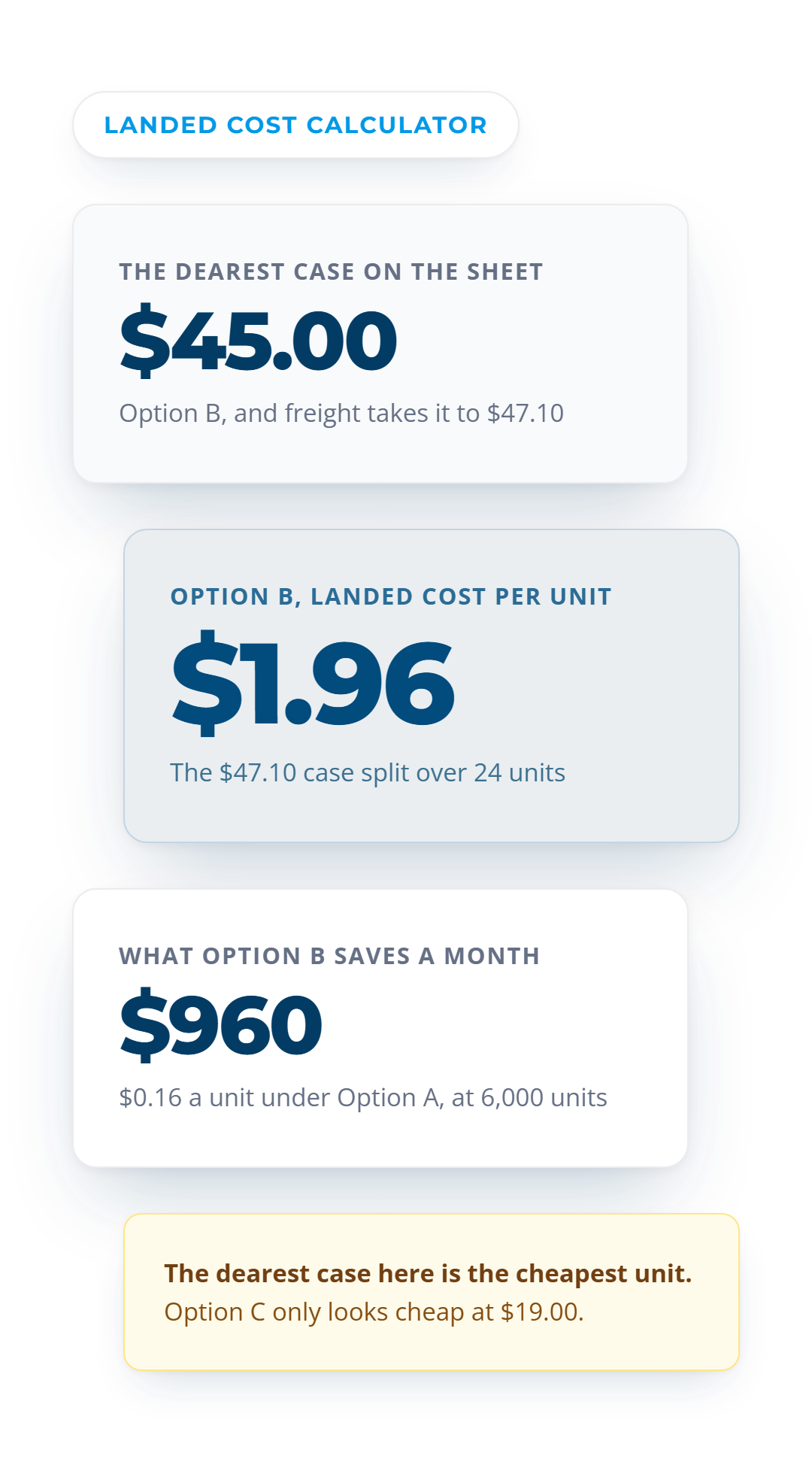
Option B, $1.96
$47.10 landed over 24 units a case
Saving against the dearest offer
$960 a month
$0.16 a unit under Option A, at 6,000 units a month
Option A landed per unit
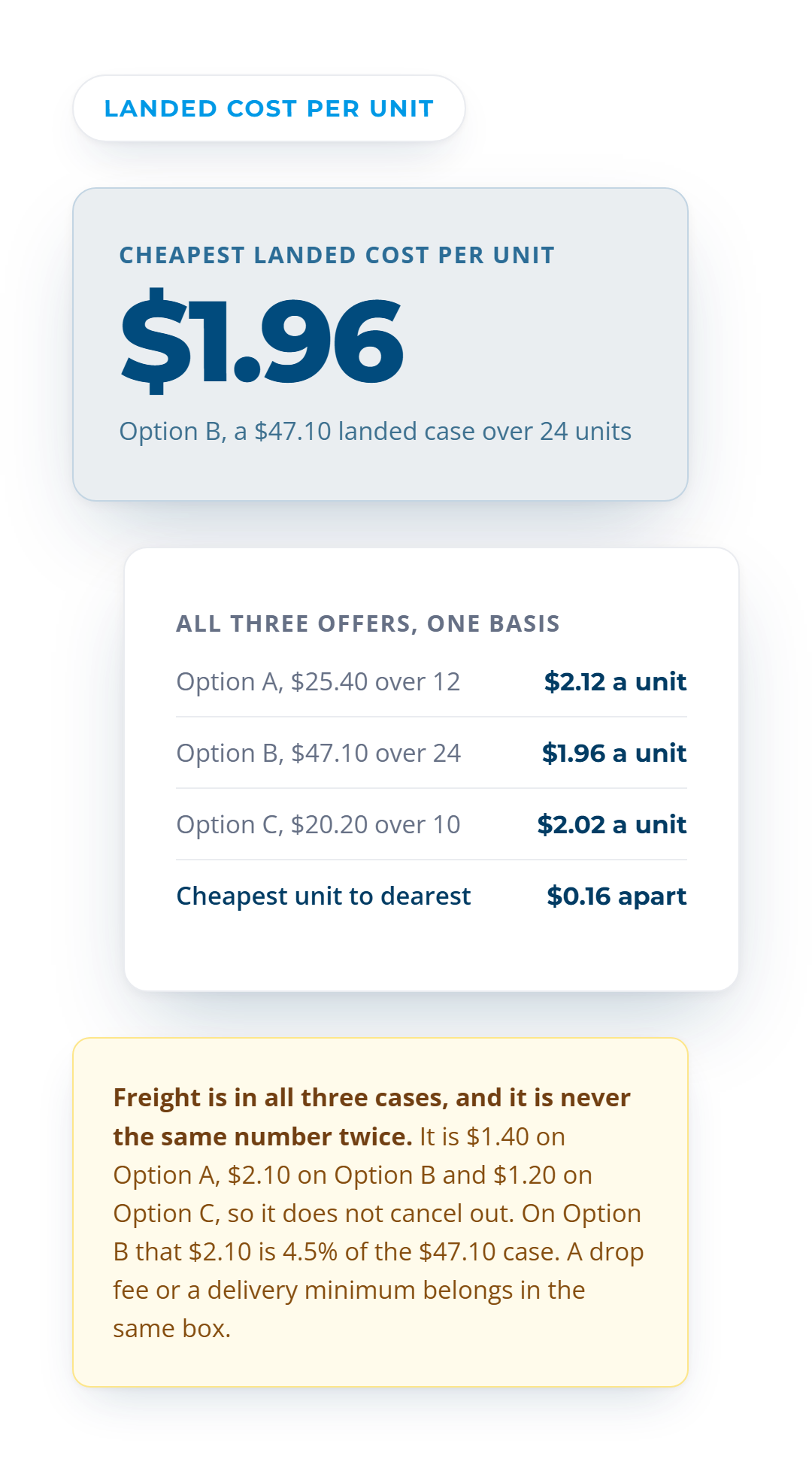
$2.12
$25.40 landed over 12 units
Option B landed per unit
$1.96
$47.10 landed over 24 units
Option C landed per unit
$2.02
$20.20 landed over 10 units
Gap to the runner up
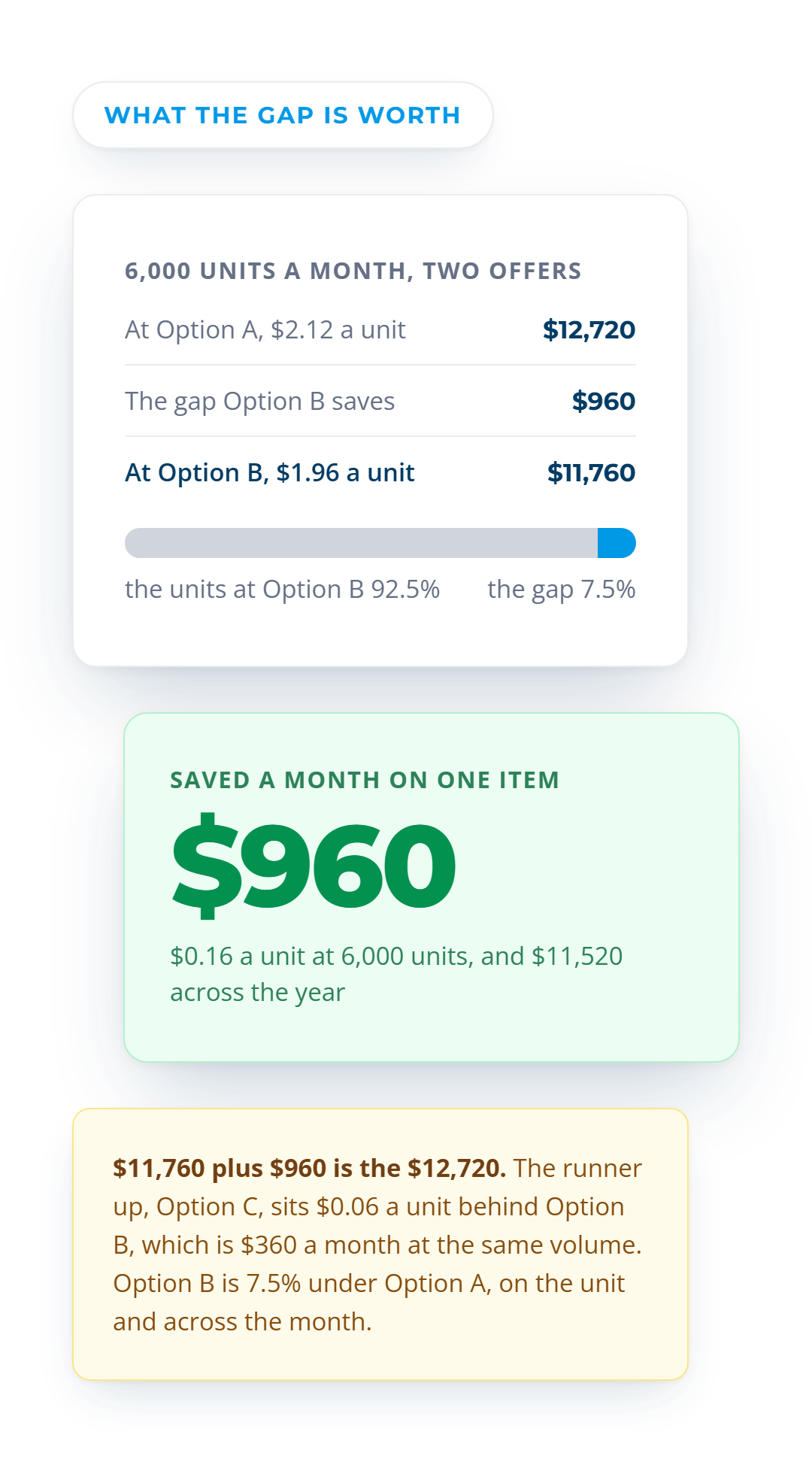
$360 a month
Option C is $0.06 a unit more than Option B
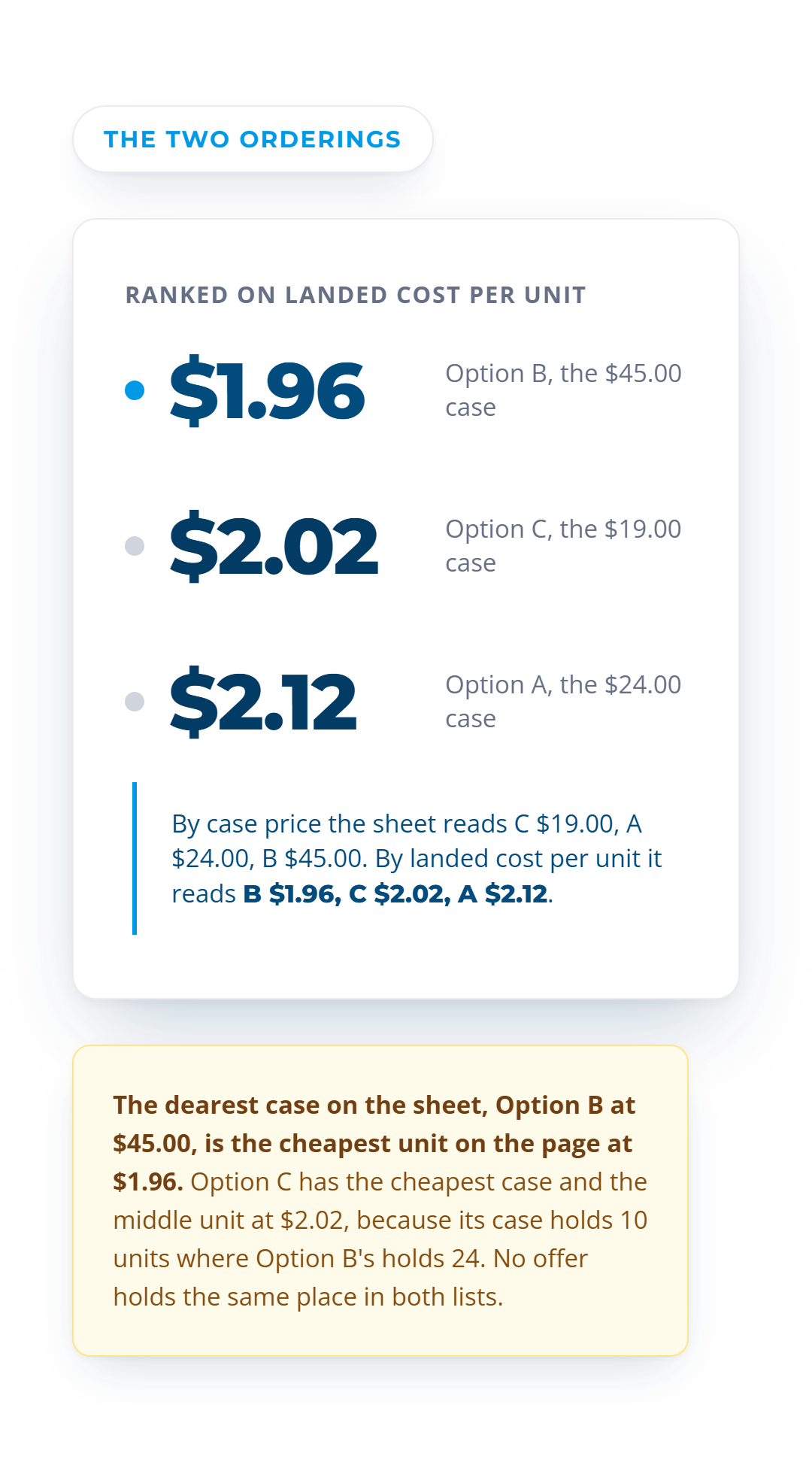
By case price the order is C $19.00, A $24.00, B $45.00. By landed cost per unit it comes out B, C, A. The dearest case on the sheet, Option B at $45.00, is the cheapest unit at $1.96, and Option C only looks cheap because its case holds 10 units. Rank the quote on landed cost per unit or the case price picks for you.
Pack counts and freight terms move more often than price lists do.
VoiceOrder Solutions keeps order guides, pack counts and prices current across suppliers, so the number you compared is the number you pay.
Estimates only. Use this price comparison tool one item at a time, and confirm pack counts, net weights and freight terms on the quote before you move volume.
$1.96
Lowest landed cost per unit of the three offers
$960
A month between the winner and the dearest offer
$45.00
The dearest case on the sheet, and the cheapest unit
Sound Familiar?
The quote sheet ranks the offers for you, and it ranks them wrong
Three quotes arrive in three different shapes. Whichever one your eye lands on first is the one that gets ordered.
Option C is the cheapest, it is $19.00 a case.
By case price C is first. On landed cost per unit it is second at $2.02, because that case holds 10 units. Cheapest case, middle unit.
We are not paying $45.00 for a case of anything.
That is the one you want. Option B lands at $47.10 with freight and splits over 24 units, which is $1.96, the cheapest unit on the page.
Freight is a rounding error, leave it out.
It is $1.20 on one of these offers and $2.10 on another, and it never cancels out. Leave it out and you are ranking quotes instead of costs.
How It Works
How to use the landed cost calculator
Three quotes in, one ranking out. This compares domestic supplier offers with freight per case added, and it does not calculate duties, tariffs or customs brokerage.
1
Enter the three offers as they arrived
Case price, pack count and freight for each one. The defaults are $24.00 over 12 units, $45.00 over 24, and $19.00 over 10.
2
Put freight on the case, per offer
Freight takes those cases to $25.40, $47.10 and $20.20. A drop fee or a delivery minimum belongs in the same box, split down to the case.
3
Read the ranking, not the sheet
Landed cost per unit comes out B $1.96, C $2.02, A $2.12. Add the units you buy a month and the gap turns into dollars.
What You See
What the calculator shows you
Landed cost per unit
All three offers on one comparable number
Option A lands at $2.12 a unit, Option B at $1.96, Option C at $2.02. Same basis, same freight treatment, three quotes that arrived in three different shapes.
Which offer wins, and which one only looks like it
By case price the order is C $19.00, A $24.00, B $45.00. By landed cost per unit it is B $1.96, C $2.02, A $2.12. The dearest case is the cheapest unit.
$0.16 a unit under the dearest offer is $960 a month at 6,000 units a month, and $11,520 a year. The runner up sits $0.06 behind, which is $360 a month.
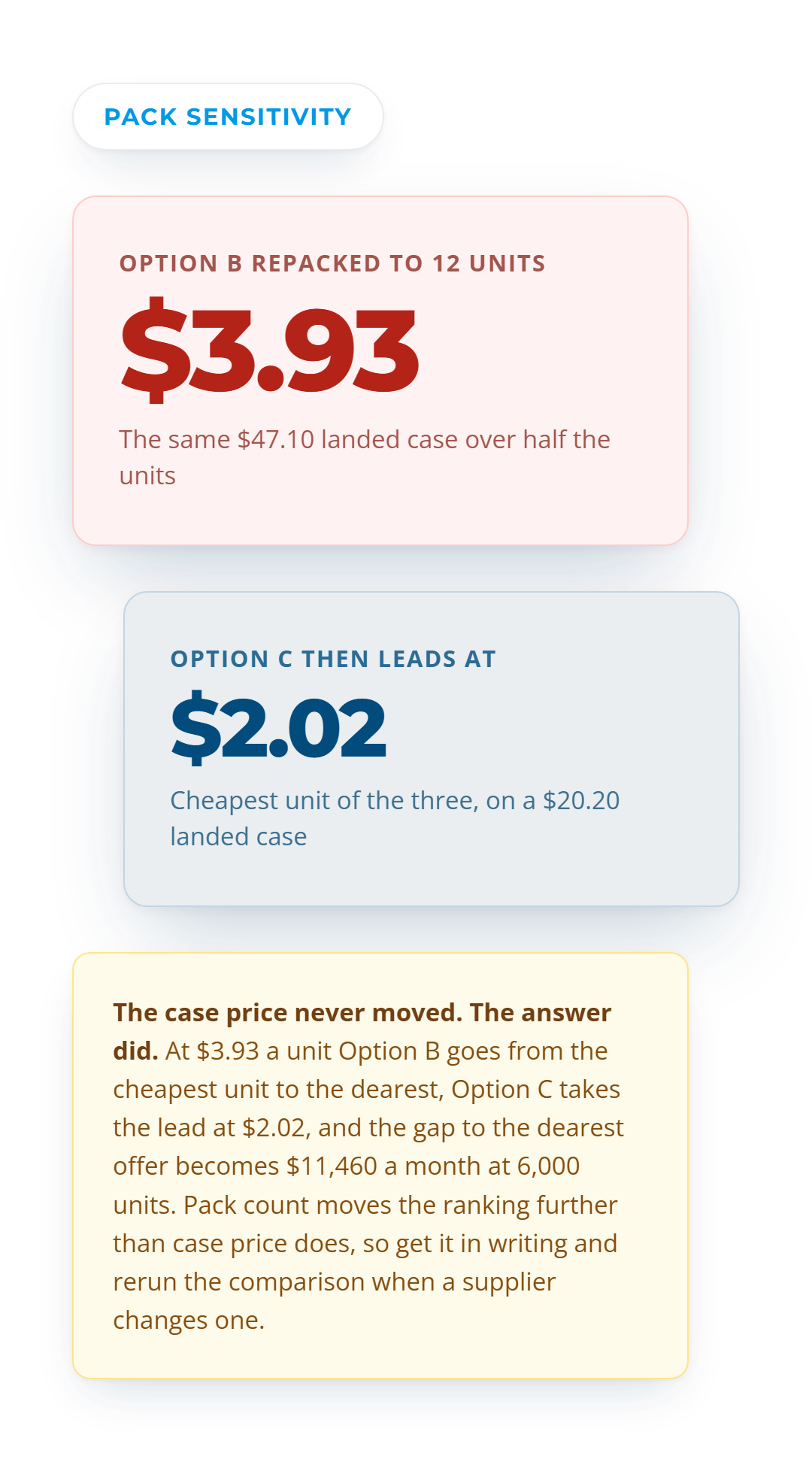
Repack Option B to 12 units and its unit cost goes from $1.96 to $3.93, and Option C takes the lead at $2.02. Pack count moves the answer more than case price does.
A ranking is only worth something if it changes which offer you order and which pack your own book lists.
Rank on landed cost per unit
Confirm the pack count in writing
Get the freight terms quoted
Add the drop minimum in
Compare one item at a time
Recheck when a pack changes
Watch shelf life on bigger cases
Reprice the item you switched
Keep the offers you turned down
Six Things That Move It
What decides which offer is actually cheaper
Case price is the number everyone reads and the one that decides least. The first two here decide most of it.
Units per case
One of these cases holds 10 units and another holds 24. That alone is why a $19.00 case loses to a $45.00 one.
Freight per case
$2.10 on one offer, $1.20 on another. Heavier cases carry more freight, so it never cancels out between two suppliers.
Drop minimums
A supplier you take two cases from charges to deliver them. Put that fee in the freight box or the offer reads cheaper than it bills.
A quiet pack change
A pack count can change while the price holds. The ranking moves, the quote sheet does not, and nobody reruns the comparison.
Units you can actually sell
A bigger case is only cheaper if the last of it leaves the building. Count sellable units, and check shelf life before you move up a pack.
Where the pack is listed
The winning offer only pays off if your own order guides and prices carry the new pack, on every account, from the day you switch.
See how VoiceOrder Solutions keeps inventory current as orders come in
VoiceOrder Solutions gives visibility across your full catalog, updated as stock levels change. You get fewer stockout surprises when a switch to a 24 unit case changes how fast a line moves.
Three ways to pick between supplier offers, and which one answers the question
Same three quotes each time: $24.00 over 12 units, $45.00 over 24, $19.00 over 10, freight in. These are the three things a buyer looks at before switching.
What you need before you switch an offer
Landed cost per unit, all three offers
The case price on the quote sheet
The biggest discount off list
Ranks the offers on one basis
No, it ranks C first and B last
No
Counts freight per case
No
No, a list price rarely carries freight
Divides by the pack count
No
No
Says what the gap is worth a month
No, not without a pack count
No
Moves when a pack count moves
No, the number sits still
No, the discount holds while the pack shrinks
Catches a cheap case with a short pack
No, that is how one hides
No
Handles three quotes at once
Yes, it just ranks them wrong
Only against one shared list
Gives a buyer one number to quote
Yes, it is already on the sheet
Yes, and it sounds better than it is
Where it falls down
It holds only while the pack counts and freight terms hold
It is the number you can rank two offers on: the case with freight on it, divided by the units in the case. Option B quotes $45.00, lands at $47.10 and splits over 24 units, which is $1.96 a unit. That $1.96 is the figure to compare, and the $45.00 is the one that misleads.
What is an example of landed cost?
Three quotes for one item. By case price the sheet reads C $19.00, A $24.00, B $45.00. With freight added and the pack count divided out it reads B $1.96, C $2.02, A $2.12. The dearest case is the cheapest unit, and the cheapest case lands in the middle.
What should be included in landed costs?
A full landed cost can carry freight, handling, storage, insurance and, on an import, duties and brokerage. This calculator covers the one that decides most domestic supplier comparisons, freight per case, and it does not calculate duties, tariffs or customs. Put any drop fee or delivery minimum in the freight box and the three offers stay comparable.
Is landed cost the same as COGS?
No. Landed cost is per case and per unit, which is why you can rank offers with it. Buying 6,000 units a month at $1.96 is $11,760 of goods, and the cost of goods sold counts what left the building over a period. Pick the supplier on the unit cost, report on the period total.
What is FOB versus landed cost on a domestic quote?
FOB tells you where the freight stops being the supplier's problem. FOB destination means delivery is already in the case price, and FOB origin means you are paying it on top. Read that line first, because it decides whether an offer needs $1.20 or $2.10 added before you compare it.
What is the difference between standard cost and landed cost?
Standard cost is the price you planned against and budget off. Landed cost is what the case really costs you delivered, which can drift the moment freight or a pack count changes. Compare offers on landed cost, then check the winner against your standard so the variance does not surprise you later.
Should landed cost be included in inventory?
Freight into your warehouse belongs in what the goods are worth, so your accountant will want it there rather than in overhead. The practical reason to track it is the choice in front of you: at $0.16 a unit, the gap between the best and dearest offer here is $960 a month and $11,520 a year.
Make the pack you chose the pack your accounts order
VoiceOrder Solutions gives each account a personalized order guide built from your own SKUs and pricing, so a pack change or a price change reaches every order instead of sitting in an email.
.webp)