For Independent Food Distributors

Material Markup Calculator

Price a case the right way. Add freight, handling and shrink, set your markup, and see the margin you actually keep.
VoiceOrder app ordering screen

Material Markup Calculator

Price a case the right way. Add freight, handling and shrink, set your markup, and see the margin you actually keep.

What the case costs you

$
What you pay before anything else touches it.
$
Inbound delivery, split across the cases on the truck.
$
Receiving, cooler space, pick and pack, outbound delivery.
% of cases
Cases you buy but never sell: spoiled, damaged, expired, miscounted.

How you price it

%
Markup is added on top of cost. It is not the same as margin.
cases
So we can show what this pricing is worth across the month.
Price per case
$29.43
Landed cost of $20.30 plus 45% markup
Gross profit per case
$8.50
After freight, handling and shrink
True cost per case
$20.93
Landed cost, grossed up for 3% shrink
Real gross margin
28.9%
What you keep out of every dollar billed
Monthly gross profit
$51,013
Across 6,000 cases
Shrink cost per month
$3,767
Product you paid for and never sold
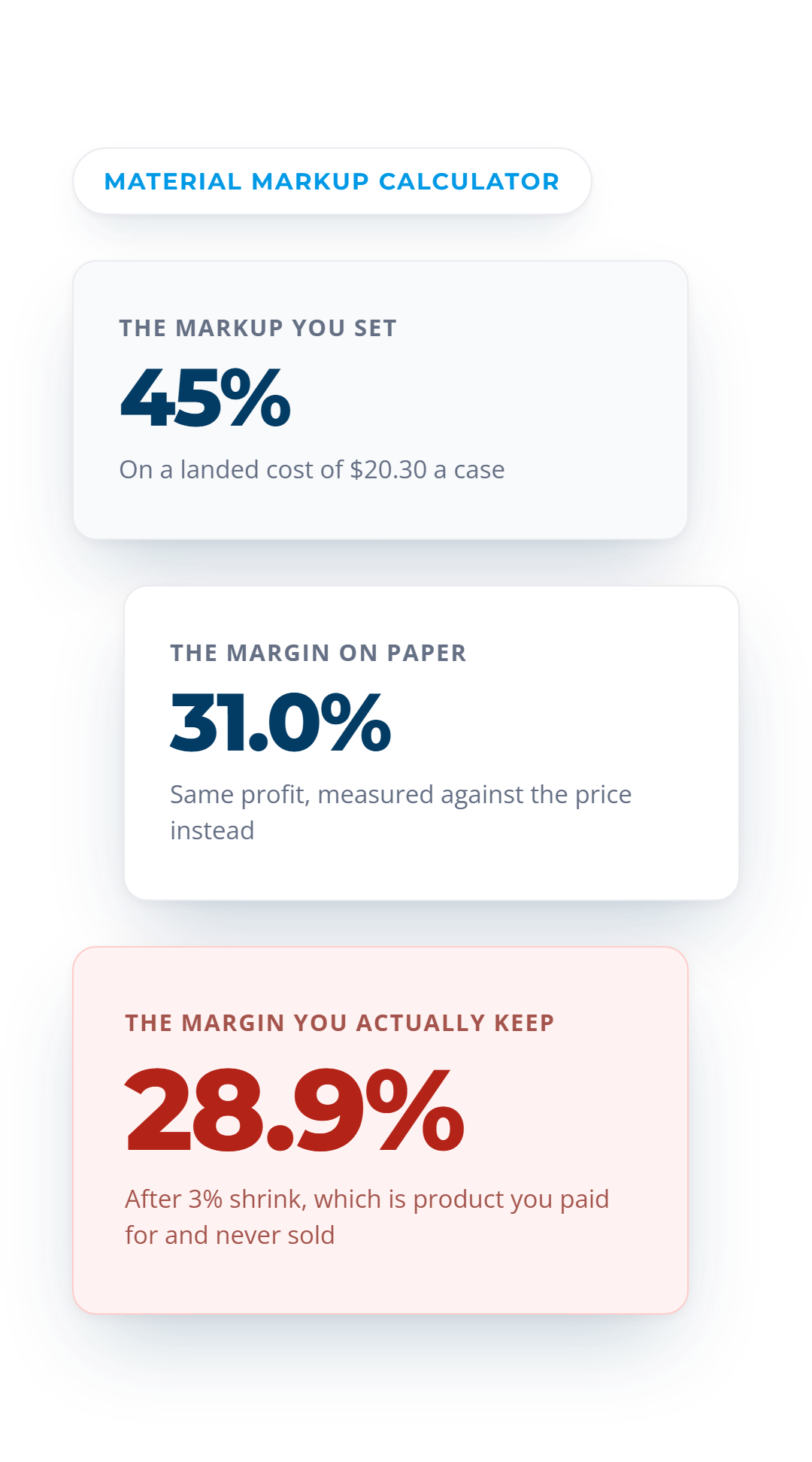
A 45% markup feels like a 45% margin. It is not. Marking up gives you a 31.0% margin on paper, and 3% shrink pulls it down to 28.9%. That gap is $3,767 a month.
Shrink usually starts as a bad order. VoiceOrder Solutions confirms every order before it ships and keeps inventory live, so you stop buying product nobody asked for.
Book A Demo →
Estimates only. Confirm your landed costs and shrink rate before you reprice an order guide.
45%

The markup you think you are taking

28.9%

The margin you actually keep

$3,767

A month lost to shrink alone

Sound Familiar?

A 45% markup is not a 45% margin, and it is not close

Markup is measured against your cost. Margin is measured against your price. Confusing them is the most expensive arithmetic error in distribution.
Order guide list for one flat 45 point markup run on every line

We run 45 points on everything.

You run 45% on top of cost, which is a 31.0% margin before shrink. Those are two different numbers and only one of them pays the overhead.
Dollar sign for freight dollars booked as a separate P and L line

Freight is a separate line, it comes out of the P and L.

It comes out of the margin either way. $1.40 of freight and $0.90 of handling turn an $18.00 case into $20.30 before you price it.
Clock face for product that ages out and becomes three percent shrink

Three percent shrink is a rounding error.

It is $3,767 a month at this volume, and it is what drags a 31.0% paper margin down to the 28.9% you bank.
How It Works

How to use the material markup calculator

Build the cost up first, then apply the markup. Doing it the other way round is where the margin goes missing.
1

Build the landed cost

Supplier price, plus freight in, plus handling. $18.00 becomes $20.30 before a markup is applied to anything.
2

Add the shrink you really see

Product you paid for and never sold has to be carried by the product you did sell. At 3%, your true cost per case is $20.93, not $20.30.
3

Read the margin, not the markup

A 45% markup prices the case at $29.43. That is a 31.0% margin on paper and 28.9% once shrink is counted.
Built For Distributors

What the calculator shows you

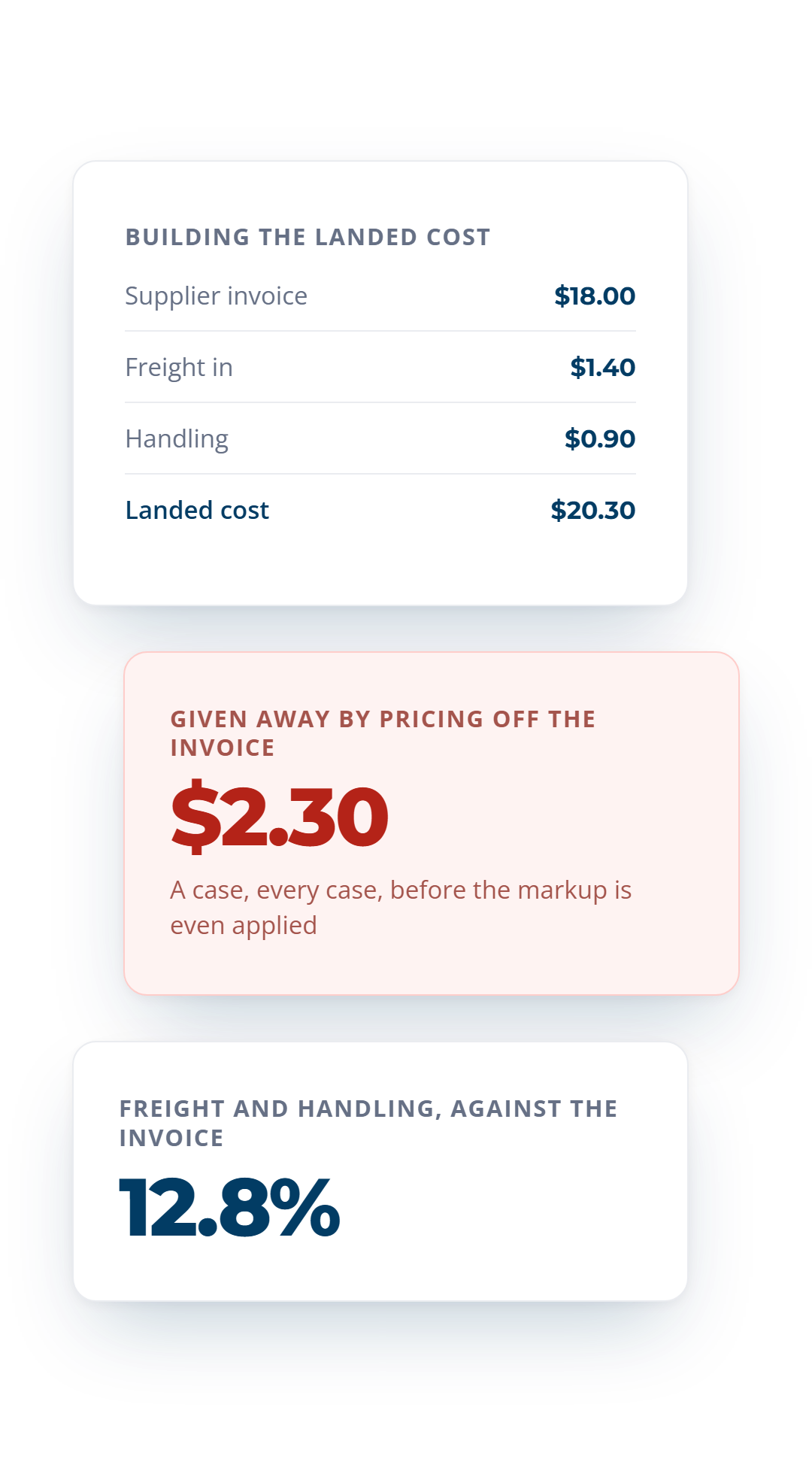
Landed cost built up: an $18.00 supplier invoice plus $1.40 freight and $0.90 handling comes to $20.30 a case.
Landed cost

What the case really costs before you price it

An $18.00 supplier price plus $1.40 of freight and $0.90 of handling is $20.30 on your dock. Price off the $18.00 and you have given away $2.30 a case.
Adds freight in to the case cost
Adds your handling per case
Gives one landed figure to price from
Updates as any input moves
Markup to margin

What your markup leaves as a margin

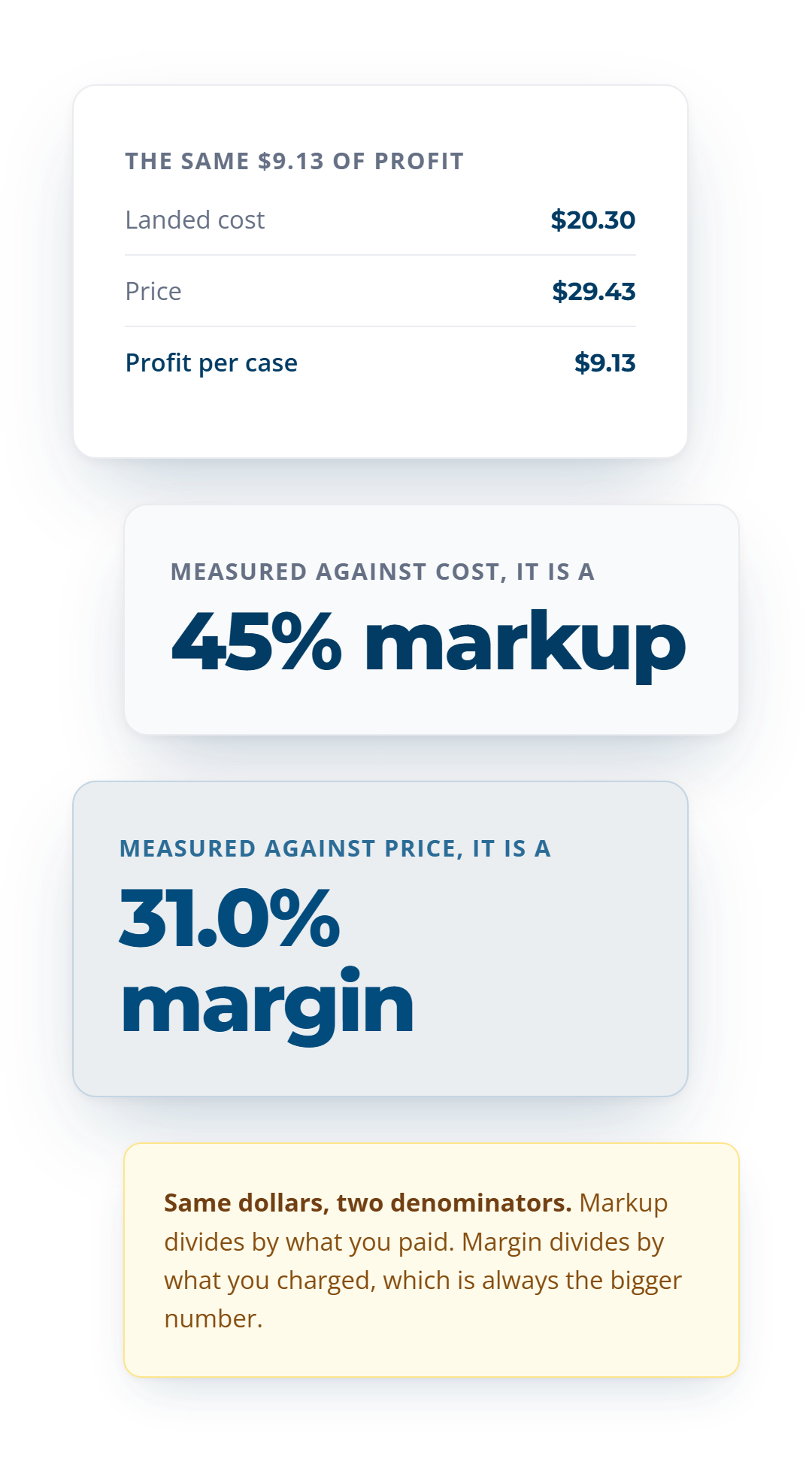
45% on a $20.30 landed cost prices the case at $29.43. As a share of that price the profit is 31.0%, not 45%, because markup and margin use different denominators.
Converts markup into a real margin
Shows the price the markup produces
Settles the markup against margin argument
Works at any markup you set
The same $9.13 of profit is a 45% markup measured against cost and a 31.0% margin measured against the $29.43 price.
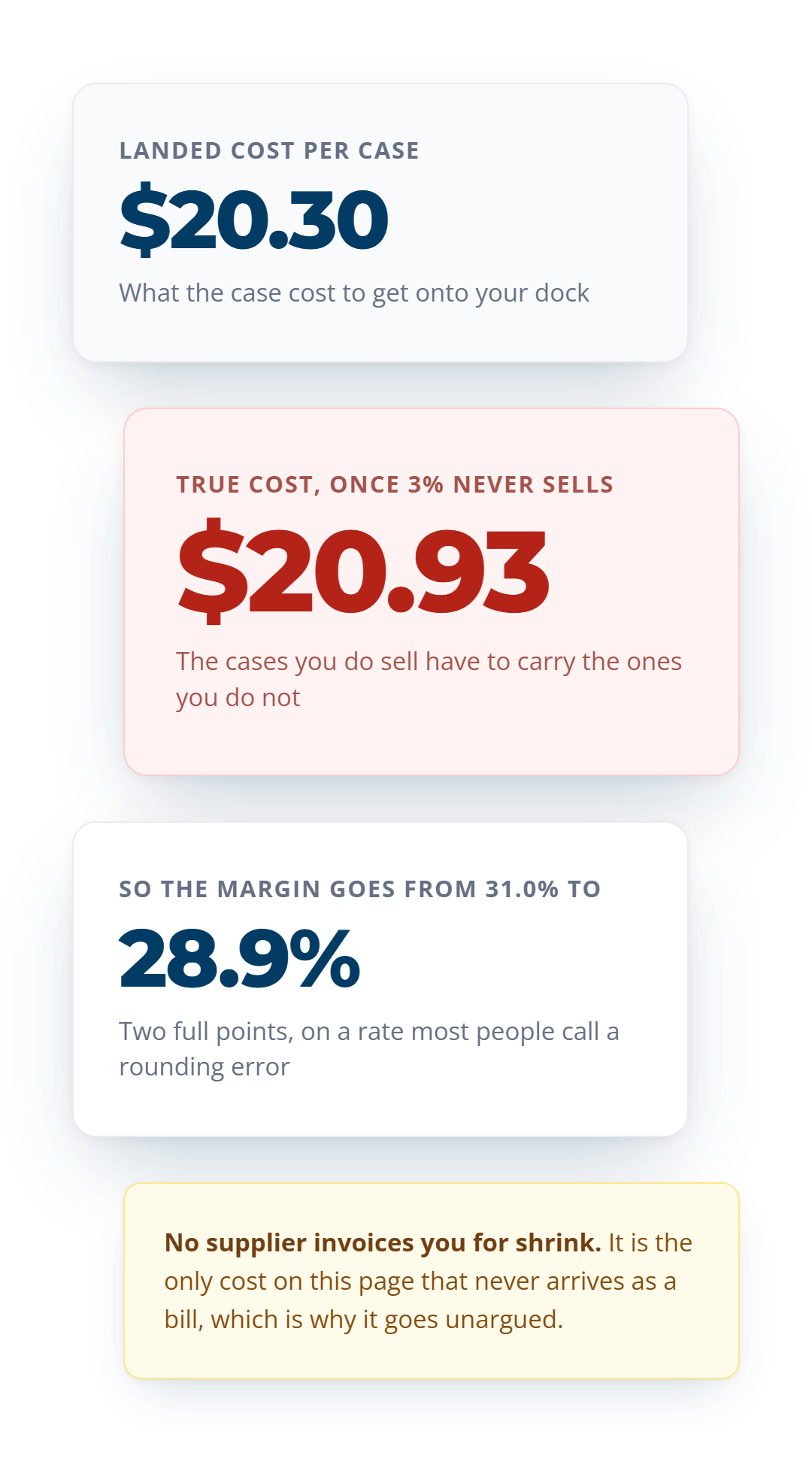
At 3% shrink the true cost per case rises from $20.30 to $20.93, pulling the margin from 31.0% down to 28.9%.
Shrink

What spoilage takes off the top

At 3% shrink your real cost per case is $20.93, not $20.30. That is what pulls the paper margin of 31.0% down to the 28.9% you actually keep.
Grosses the cost up for shrink
Separates paper margin from real margin
Prices shrink per case and per month
Uses your own shrink rate
At your volume

The same case, across a month of orders

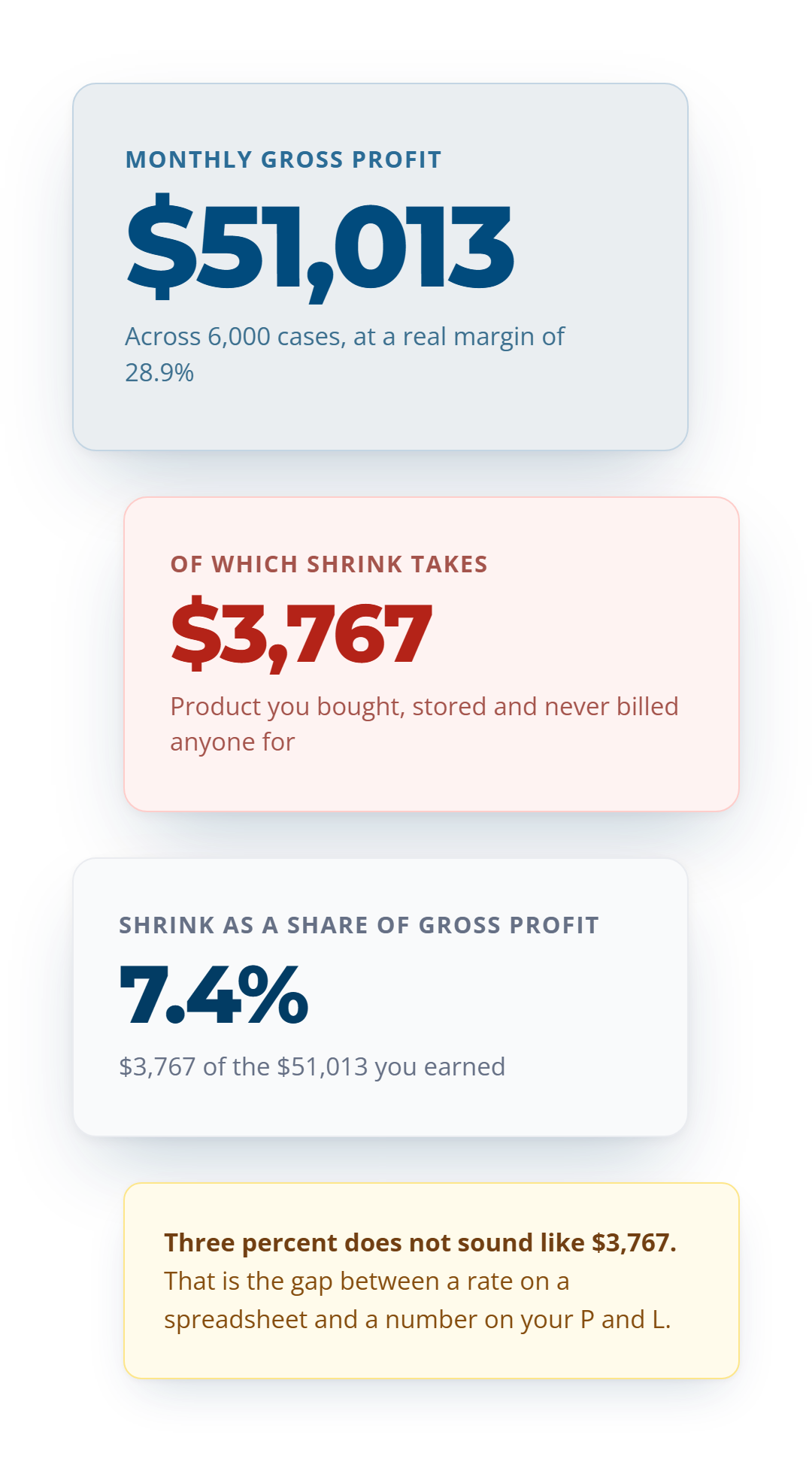
Gross profit comes to $51,013 across 6,000 cases. Shrink alone takes $3,767 of it, which is product you bought, stored and never billed anyone for.
Scales the per-case figures to a month
Shows shrink as a monthly cost
Makes a small percentage visible
Moves with your real case volume
Monthly gross profit of $51,013 across 6,000 cases, of which shrink takes $3,767, or 7.4%.
After The Numbers

What to do once you know the real margin

The number is only worth having if it changes the markup your reps apply. Start here.
Invoice icon for pricing off landed cost, not the supplier invoice

Price off landed, not invoice

Percent sign icon for setting targets as a margin instead of a markup

Set targets in margin, not markup

Buffer stock icon for building shrink into the cost of each case

Put shrink in the cost

Bar comparison icon for measuring shrink category by category

Measure shrink by category

Calendar icon for rechecking freight costs each quarter

Recheck freight each quarter

Downward trend icon for reviewing your thinnest margin SKUs

Review your thinnest SKUs

Cycle icon for repricing whenever landed cost moves

Reprice when landed cost moves

Balance scale icon for holding one pricing rule across every rep

Hold one rule across reps

Rising chart icon for tracking margin rather than revenue

Track margin, not revenue

Six Levers

What actually moves the margin on a case

Only one of these is the markup. The other five decide what that markup is worth.
Delivery truck icon for freight in, added to the cost of each case

Freight in

$1.40 a case is 7.8% on top of the supplier price. It lands on the margin whether you price for it or not.
Stacked case icon for handling labor charged per case

Handling per case

Labor to receive, put away and pick. It is real cost per case even though no supplier invoices you for it.
Shrinking box icon for the shrink rate on product you never sell

Shrink rate

Three points of shrink costs more than three points of markup earns. Cut it first.
Target icon for the markup rule written as a margin target

The markup rule itself

Write it as a margin target and convert, so nobody has to remember which denominator applies.
Cash icon for buying terms and the supplier price per case

Buying terms

The supplier price is the biggest single input. Volume and timing move it further than any rule.
Verified check icon for order accuracy preventing credits off margin

Order accuracy

A short or a swap becomes a credit, and a credit comes straight off the margin on that case.

See how VOS keeps the order right before it reaches your margin

VoiceOrder Solutions sends every order through digitized, numbered and timestamped, so the case you picked is the case you priced.
The Comparison

Three ways to price a case, measured the same way

Same $18.00 supplier price, same $1.40 freight, same $0.90 handling, same 3% shrink. Only one method gets you the margin you intended.

What you need from a pricing rule

Markup on landed cost

Markup on supplier price

A target margin by eye

Covers freight and handling
No, it prices off $18.00
Only if the rep remembers to
Accounts for shrink
No
Almost never
Gives the margin you aimed at
No, it lands $2.30 a case short
Sometimes, by luck
Holds when freight rises
No, freight is outside the rule
No, nobody recalculates
Works across every category
Only where freight is flat
No, it drifts category by category
Same answer from any rep
Yes
No, that is the whole problem
Scales to a monthly figure
Yes, to the wrong figure
No, there is nothing to scale
Easy to audit afterwards
Yes
No, the working is in someone's head
Where it falls down
Only as good as your shrink estimate
The freight and handling never get recovered
Two reps price the same case differently
Best used for
Every case you buy, store and deliver
Nothing you deliver yourself
A one-off quote you will review anyway
FAQ

Common questions about markup and margin

Is a 30% markup the same as a 30% margin?
No. Markup is a share of your cost, margin is a share of your price. A 30% markup leaves a 23.1% margin, because the profit is divided by the larger number.
What is a 20% markup on $100?
$120. The $20 of profit is 20% of the $100 cost but only 16.7% of the $120 price, which is the margin you would report.
How do you convert a margin into a markup?
Flip the toggle from markup to margin and type the target. Ask for 33% here and it prints a $31.24 price, a 54% markup on your $20.30 landed cost. The textbook conversion says 49.3%, and the gap is the 3% shrink sitting between cost and price.
What should a markup be applied to?
Landed cost, not the supplier invoice. An $18.00 case with $1.40 freight and $0.90 handling costs you $20.30, and marking up the $18.00 leaves $2.30 a case unrecovered.
How does shrink change the margin?
It raises the cost of everything you do sell. At 3%, a $20.30 landed cost behaves like $20.93, which turns a 31.0% paper margin into 28.9%.
Why does a 45% markup leave under 29%?
Two reasons compound. Markup measured on price is always smaller, which takes 45% to 31.0%, and then 3% shrink takes it to 28.9%.
Should targets be set in markup or margin?
Margin. It is the number that appears in your accounts, and it cannot be misread. Convert to a markup once, write it down, and have every rep use the same one.

Keep the margin you priced for

VoiceOrder Solutions gives every customer an order guide tied to your own pricing and SKUs, and sends each order through digitized and confirmed before it reaches your system.