For Independent Food Distributors

Unit Price Calculator

Compare two pack sizes on the same footing. See the real cost per unit and per pound, so the pack that looks cheaper is not just the bigger box.
VoiceOrder app ordering screen

Unit Price Calculator

Compare two pack sizes on the same footing. See the real cost per unit and per pound, so the pack that looks cheaper is not just the bigger box.

Option A

$
What you pay for the whole pack.
units
Sellable pieces: cans, bags, each.
lb
So we can compare per pound, not just per unit.

Option B

$
What you pay for the whole pack.
units
Sellable pieces: cans, bags, each.
lb
So we can compare per pound, not just per unit.
Better buy per pound
Option A
$1.00 per lb vs $1.11
You save per pound
10.0%
$0.11 per lb versus the other pack
Option A per unit
$2.00
Pack price divided by units
Option A per lb
$1.00
The number that actually compares
Option B per unit
$1.67
Pack price divided by units
Option B per lb
$1.11
The number that actually compares
Option B is cheaper per unit at $1.67 versus $2.00, but its units are smaller. Per pound, Option A costs $1.00 and Option B costs $1.11, so A is the better buy by 10.0%. The pack that looks cheaper per unit is not always cheaper per pound.
Pack sizes change faster than order guides. VoiceOrder Solutions keeps units, pack counts and prices straight across your catalog, so you always compare like for like.
Book A Demo →
Estimates only. Confirm net weights and pack counts on the spec sheet before you switch a SKU.
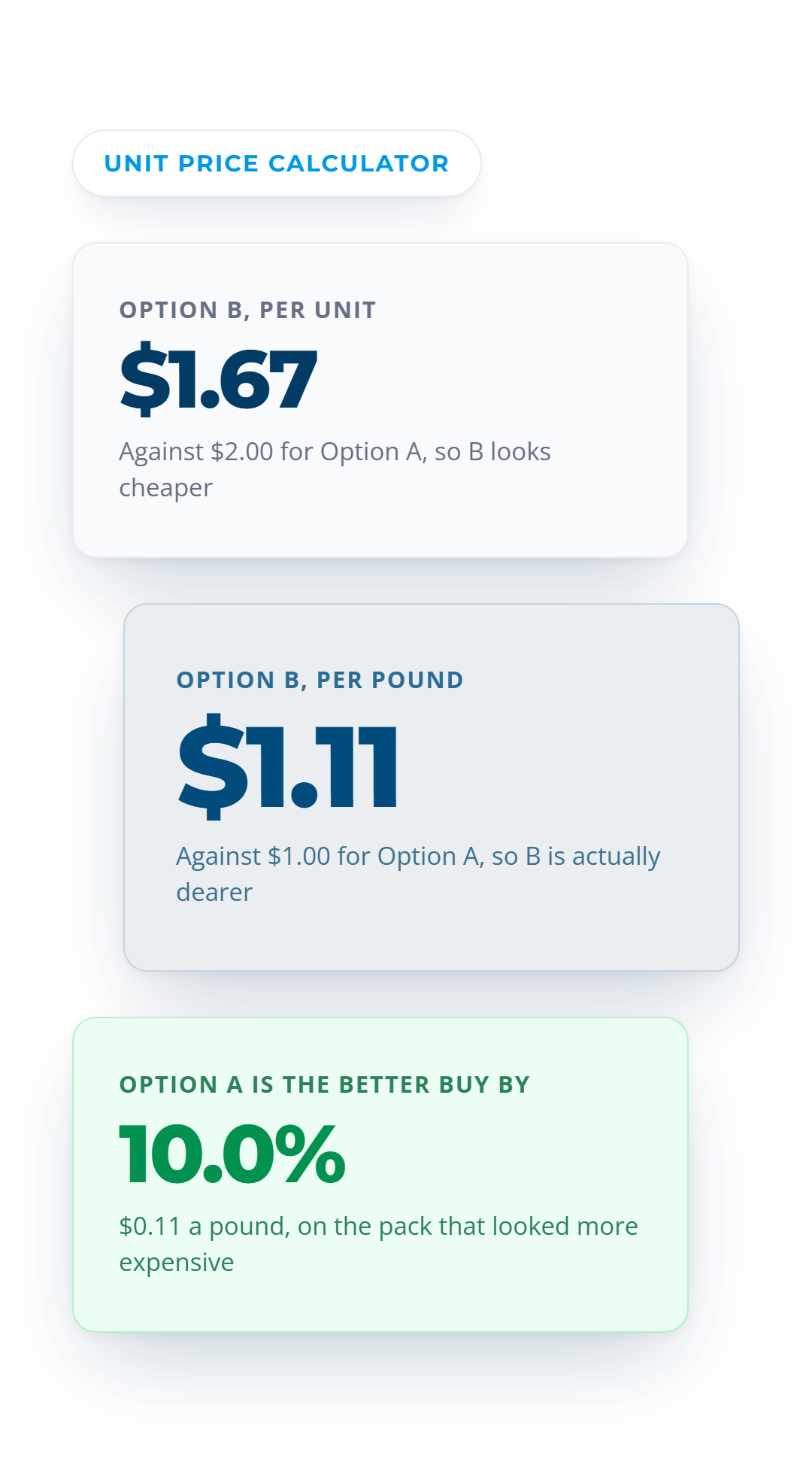
$1.67

The pack that looks cheaper per unit

$1.11

What that same pack costs per pound

10.0%

More than the pack you nearly skipped

Sound Familiar?

The cheaper pack is not always the cheaper buy

Two packs, two prices, two different unit counts and two different unit weights. The comparison only works once you put them on one base.
Cash bills for a per unit price that looks like the cheaper deal

B is cheaper, it is $1.67 a unit.

It is, against $2.00 for A. But B's units are smaller. Per pound B costs $1.11 and A costs $1.00, so the cheaper-looking pack is 10.0% dearer.
Stacked cases for the belief that a bigger pack is always better value

The bigger case is always better value.

B is the bigger case at 24 units and $40.00. It still loses. Case size tells you about handling and storage, not about price.
Clock face for the time a rep burns doing pack math in their head

The rep can work it out in their head.

Per unit, maybe. Per pound needs the net weight too, and that is the step that gets skipped in front of a customer.
How It Works

How to use the unit price calculator

Three numbers per pack. The calculator does both comparisons and tells you which one to trust.
1

Enter the pack price and the unit count

Use the price you actually pay, landed if you have it. Dividing by the units gives you a per-unit figure straight away.
2

Add the net weight per unit

This is the step that decides the answer. Without it you are comparing a 2 lb unit against a 1.5 lb unit as though they were the same thing.
3

Read the per-pound line, not the per-unit one

Per unit says B wins at $1.67. Per pound says A wins at $1.00. Only one of those comparisons is between like and like.
Built For Distributors

What the calculator shows you

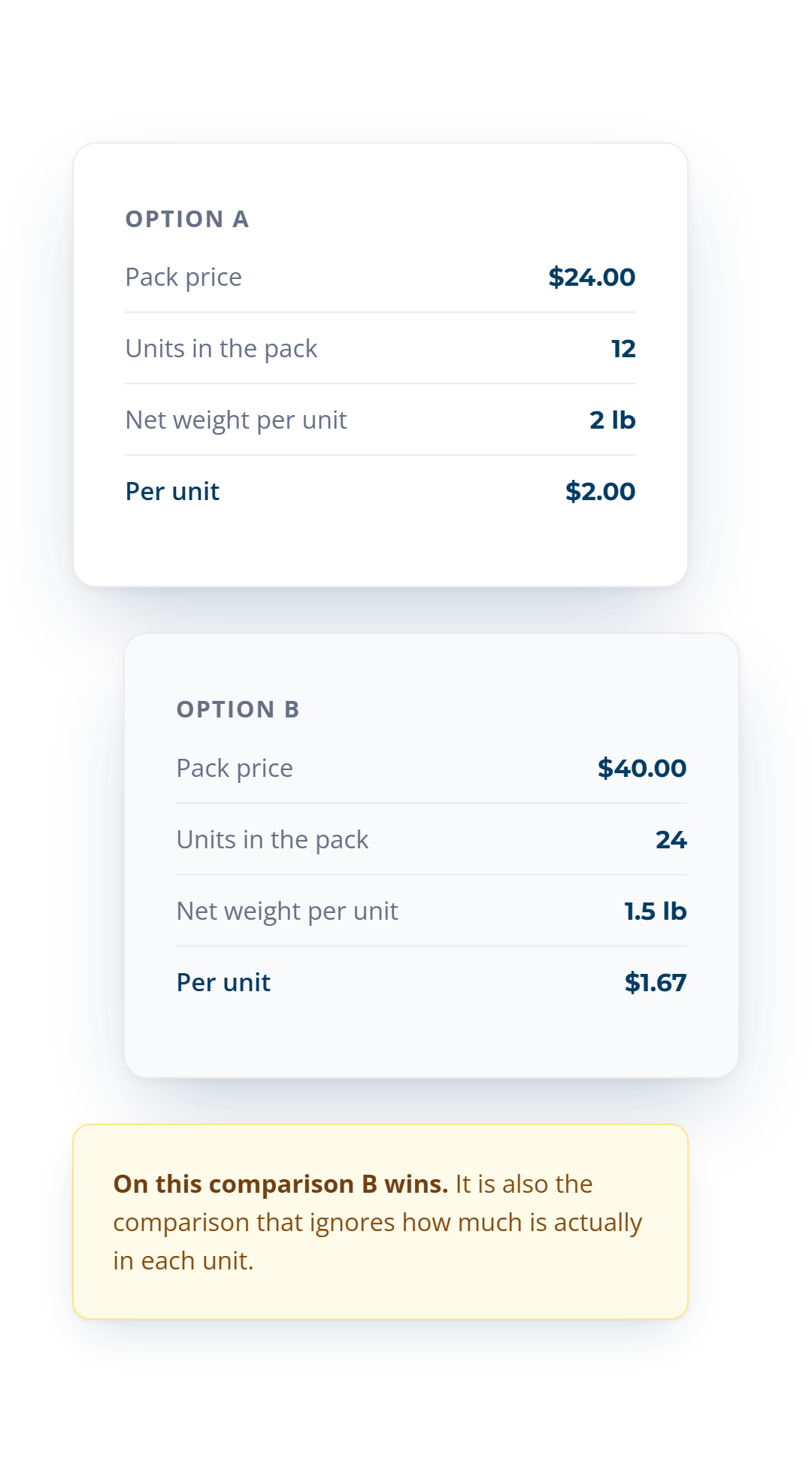
Per unit: Option A is $24.00 over 12 units at $2.00 each, Option B is $40.00 over 24 units at $1.67 each, so B looks cheaper.
Per unit

What each pack costs you per unit

Pack price divided by unit count. $24.00 over 12 units is $2.00, and $40.00 over 24 units is $1.67. This is the comparison most people stop at.
Works off the price you actually pay
Handles any unit count per pack
Gives both packs in one view
Shows the figure a customer will quote at you
Per pound

What each pack costs you per pound

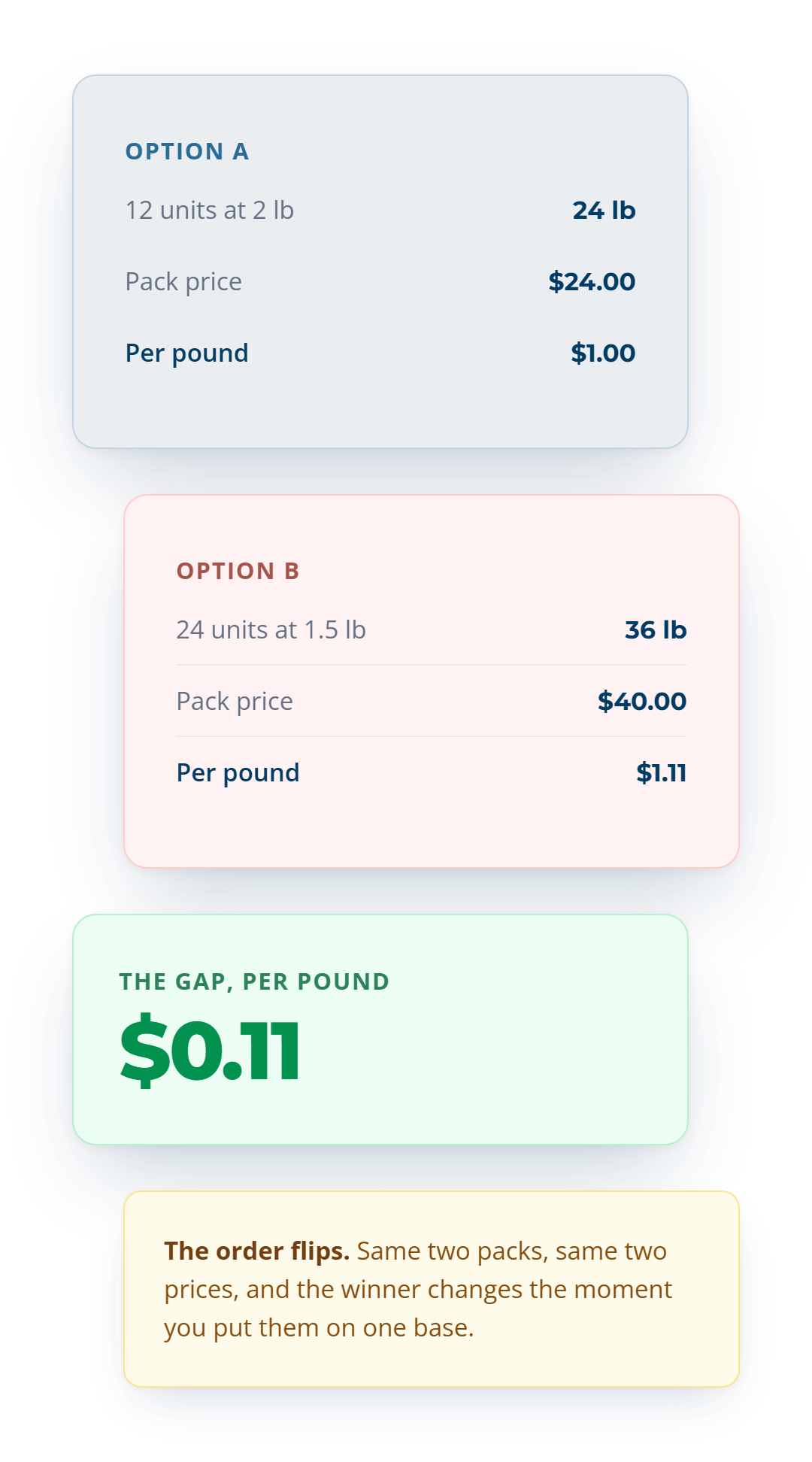
A's 12 units at 2 lb is 24 lb for $24.00, so $1.00 a pound. B's 24 units at 1.5 lb is 36 lb for $40.00, so $1.11. The order flips.
Puts both packs on one base
Uses net weight, not pack weight
Catches the smaller-unit trick
Falls back to per unit if weights are missing
Per pound: Option A is 24 lb for $24.00 at $1.00 a pound, Option B is 36 lb for $40.00 at $1.11, so the order flips.
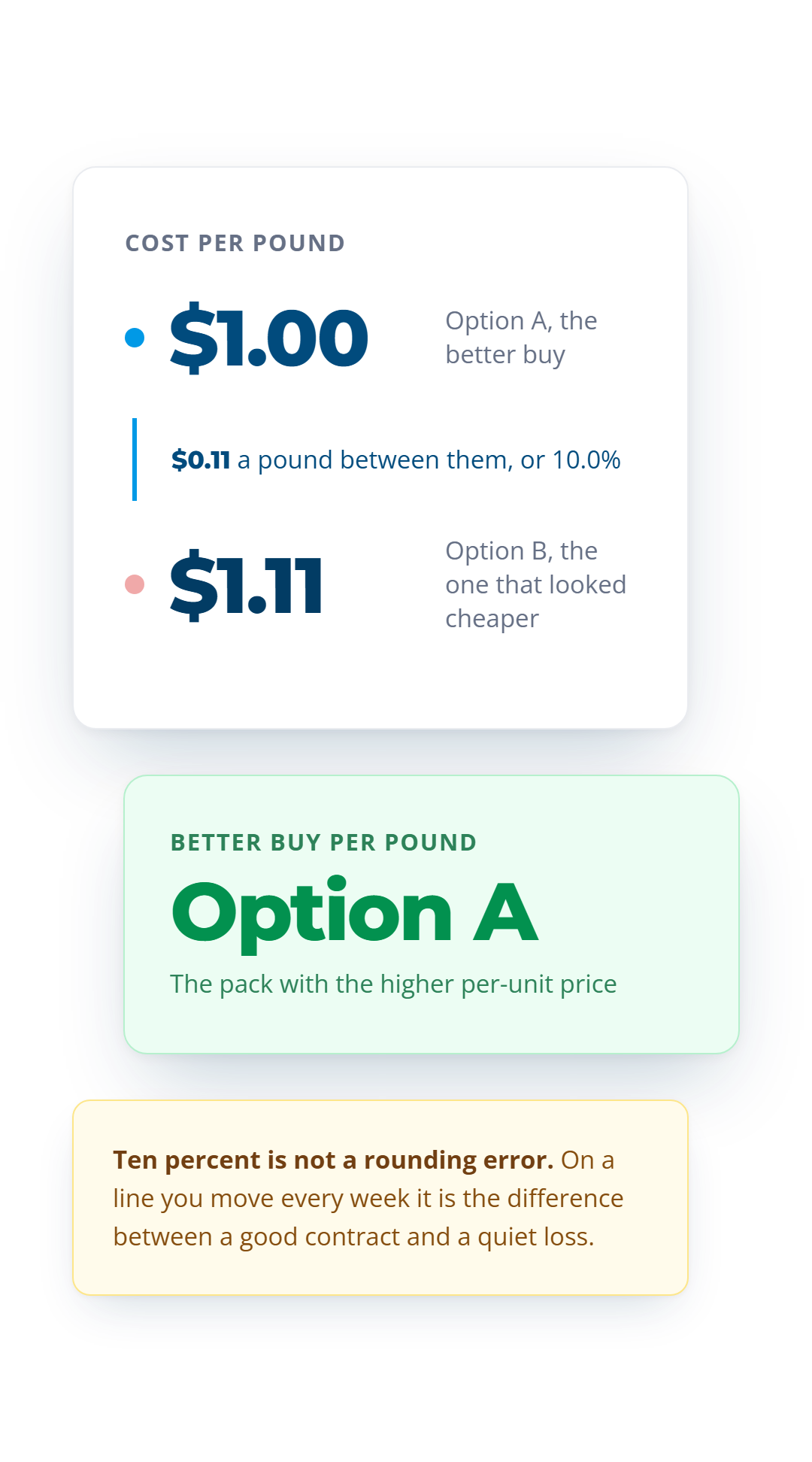
A price scale from $1.00 to $1.11 a pound, showing Option A is the better buy by $0.11 a pound, or 10.0%.
The verdict

Which pack is actually the better buy

Option A, at $1.00 a pound against $1.11. That is $0.11 a pound, or 10.0%, on the pack that looked more expensive on the shelf label.
Names the winner, not just the numbers
Shows the gap in cents and percent
Flips the moment the inputs change
Works the same for any two packs
In the field

The number to quote and the number to check

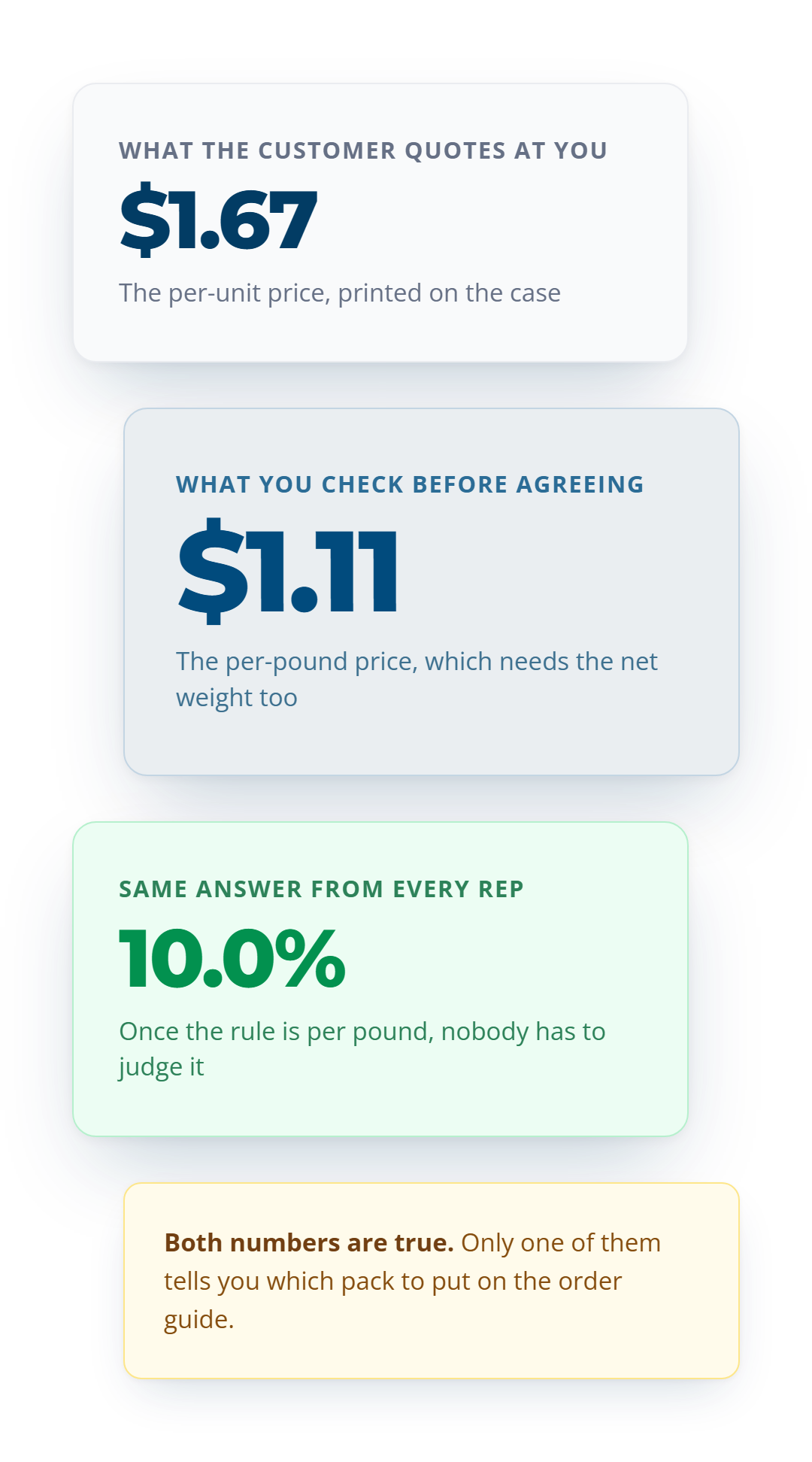
Customers compare on the per-unit price because it is printed on the case. You need the per-pound figure before you agree it is the better deal.
Separates the quoted figure from the real one
Settles a pack-size argument in seconds
Works on a phone in front of the customer
Same answer from every rep
The $1.67 per-unit price a customer quotes against the $1.11 per-pound price you check before agreeing.
After The Numbers

What to do once you know the real unit cost

The comparison is only worth running if it changes which pack you stock and quote. Start here.
Bar chart icon for comparing two packs on the same base

Compare on one base

Order guide icon for listing net weight on every line

Put net weight in the guide

Cycle arrows icon for rechecking a pack after it changes

Recheck when a pack changes

Price tag icon for quoting the pack that wins per pound

Quote the pack that wins

Shrinking box icon for units trimmed to a lighter weight

Watch for shrinking units

Calendar icon for a quarterly check of both pack options

Check both packs each quarter

Falling trend icon for dropping a pack that never wins

Drop the pack that never wins

Target icon for matching the right pack to each account

Match pack to the account

Rising chart icon for training reps on the per pound line

Train reps on the per-lb line

Six Levers

What actually changes the cost of a unit

The pack price is only one of them, and it is the one you control least.
Balance scale icon for the net weight of a single unit

Net weight per unit

Half a pound off a unit moves the per-pound cost more than most price changes do.
Case icon for the number of units inside a pack

Units per pack

More units spread the pack price further, which is why the per-unit figure flatters a big case.
Dollar icon for the price you pay for the whole pack

Pack price

The number everyone negotiates, and the one that tells you least on its own.
Truck icon for freight and handling in landed cost

Landed cost

Freight and handling land on the pack, so a bulky pack can lose a comparison it won at the supplier.
Percent icon for a supplier spec change on unit weight

Spec changes

A supplier trimming a unit from 2 lb to 1.5 lb is a price rise that never appears on the invoice.
Verified check icon for keeping order guide pack sizes accurate

Guide accuracy

If the pack size on the order guide is stale, every comparison run off it is wrong.

See how VOS keeps pack sizes current on every order guide

VoiceOrder Solutions builds each customer a personalized order guide from your own SKUs and pack sizes, and your team updates it from one admin platform.
The Comparison

Three ways to compare two packs

Same two packs, $24.00 for 12 units at 2 lb against $40.00 for 24 units at 1.5 lb. Only one method gets the answer right.

What you need from a comparison

Cost per pound

Cost per unit

Pack price

Right answer on these two packs
No, it picks B at $1.67
No, it picks A for the wrong reason
Works when unit weights differ
No, that is exactly what it misses
No
Works when unit counts differ
Yes
No
Survives a supplier spec change
No, a lighter unit looks like a win
No, nothing in it changes
Compares across two suppliers
Only if their units match yours
No
Gives one number per option
Yes
Yes, and it means nothing
Safe to quote to a customer
Only alongside the weight
No
Hard for a rep to get wrong
Yes, and wrong
Yes, and always wrong
Where it falls down
It needs a net weight you can trust
It ignores how much is in the unit
It compares two different quantities
Best used for
Any two packs of the same product
Packs whose units are identical
Checking a budget, never a value call
FAQ

Common questions about unit price

How do you calculate the unit price?
Divide the pack price by the number of units in the pack. A $24.00 case of 12 works out at $2.00 a unit.
How do you calculate cost per pound?
Multiply the units by the net weight of each, then divide the pack price by that total. $24.00 over 12 units of 2 lb is 24 lb, so $1.00 a pound.
Which one should you compare on?
Per pound, whenever the two packs hold different unit sizes. Per unit is only a fair comparison when a unit of one is the same thing as a unit of the other.
Can the cheaper pack per unit be the more expensive buy?
Yes, and it is the usual case. Option B is $1.67 a unit against A's $2.00, but B's units are lighter, so per pound B costs $1.11 and A costs $1.00.
What if you do not know the net weight?
The calculator falls back to a per-unit comparison. Treat that as a rough answer and get the weight off the spec sheet before you move an account onto the pack.
Should landed cost go in instead of the supplier price?
Yes, if you have it. Freight and handling attach to the pack, so a bulky case can lose a comparison it won on the supplier invoice.
How do you spot a supplier shrinking a pack?
Watch cost per pound, not pack price. A unit going from 2 lb to 1.5 lb at the same price is a price rise that never shows on the invoice.

Put the right pack in front of every account

VoiceOrder Solutions gives every customer a personalized order guide built from your own SKUs and pack sizes, so they order the pack you meant to sell them.