Calculate food cost on the pounds you can sell, not the pounds you bought. Yield comes off the case first, then the markup goes on what is left.
The case as it arrives
$
Landed cost of the case, with freight and handling already in it.
lb
What the scale says at the dock, before anything is trimmed off.
Yield and target margin
%
Share of the case weight you can still sell after trim, bone and drip loss. Weigh a few cases, do not assume it.
%
Margin is measured on your selling price, so a 32% target leaves 68% of it for cost.
Monthly movement
cases
How many cases of this item you cut, portion and sell on in a month.
Price per usable lb
$2.08
Hits a 32% margin on the 34 lb you can sell
Cost per usable lb
$1.41
The $48.00 case spread over 34 usable lb
Usable weight per case
34 lb
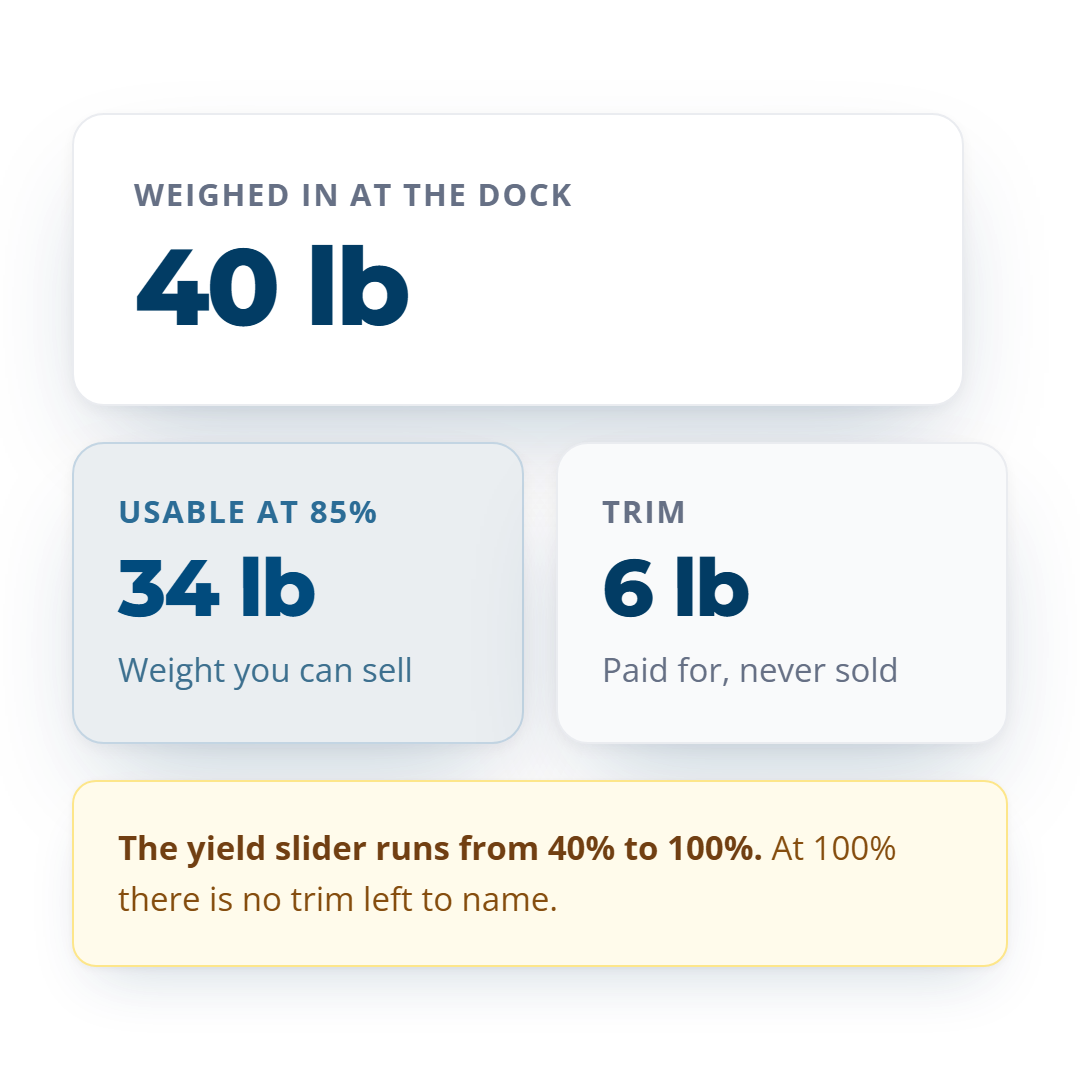
40 lb bought at 85% yield, so 6 lb of trim
Price off the weight you bought
$1.76
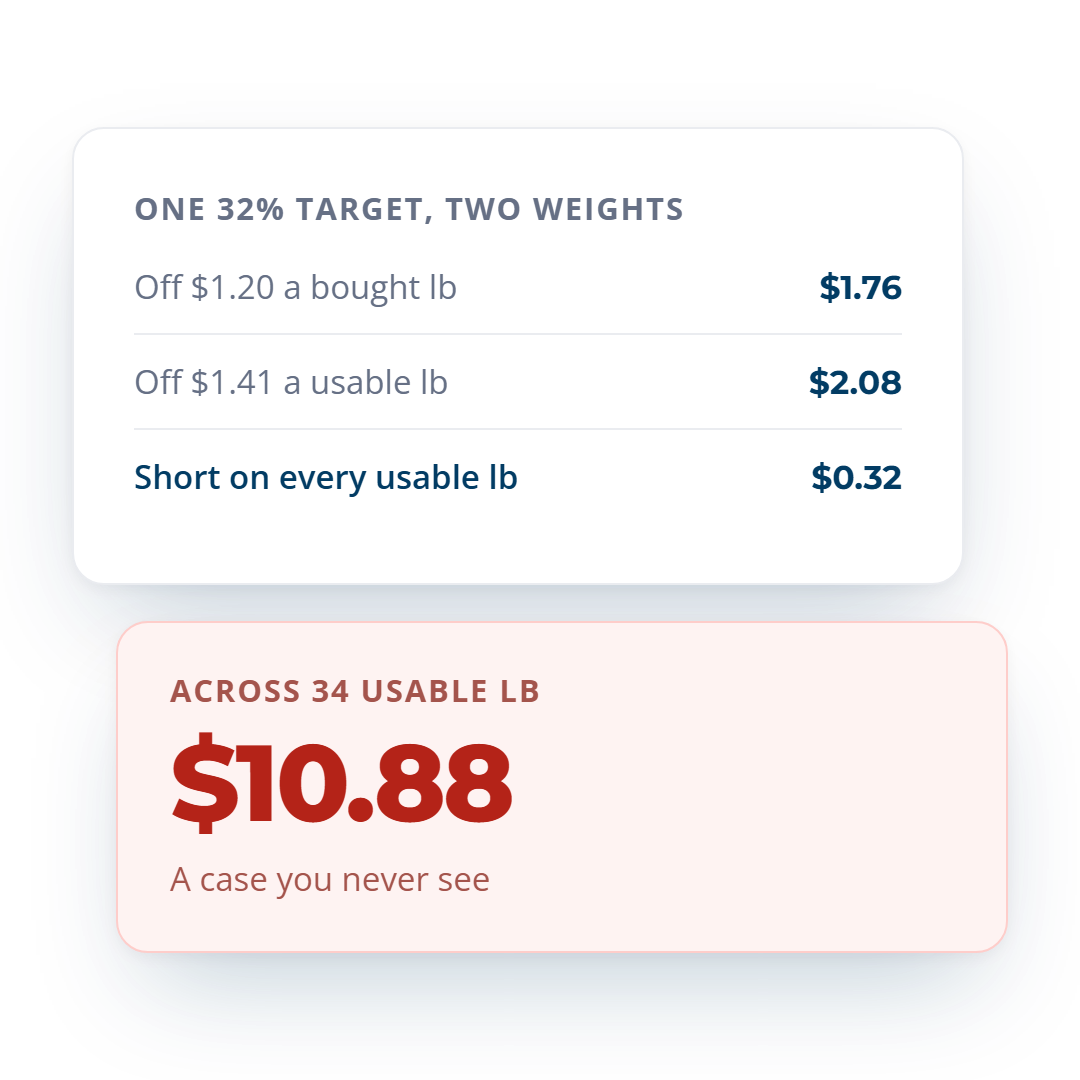
$1.20 a bought lb at the same margin, $0.32 a lb short
Revenue per case
$70.72
$2.08 across 34 usable lb
Gross profit per case
$22.72
$70.72 less the $48.00 case, a 32.1% margin
Food cost percentage
67.9%
$48.00 of the $70.72 the case sells for
Monthly gross profit
$9,088
At 400 cases a month
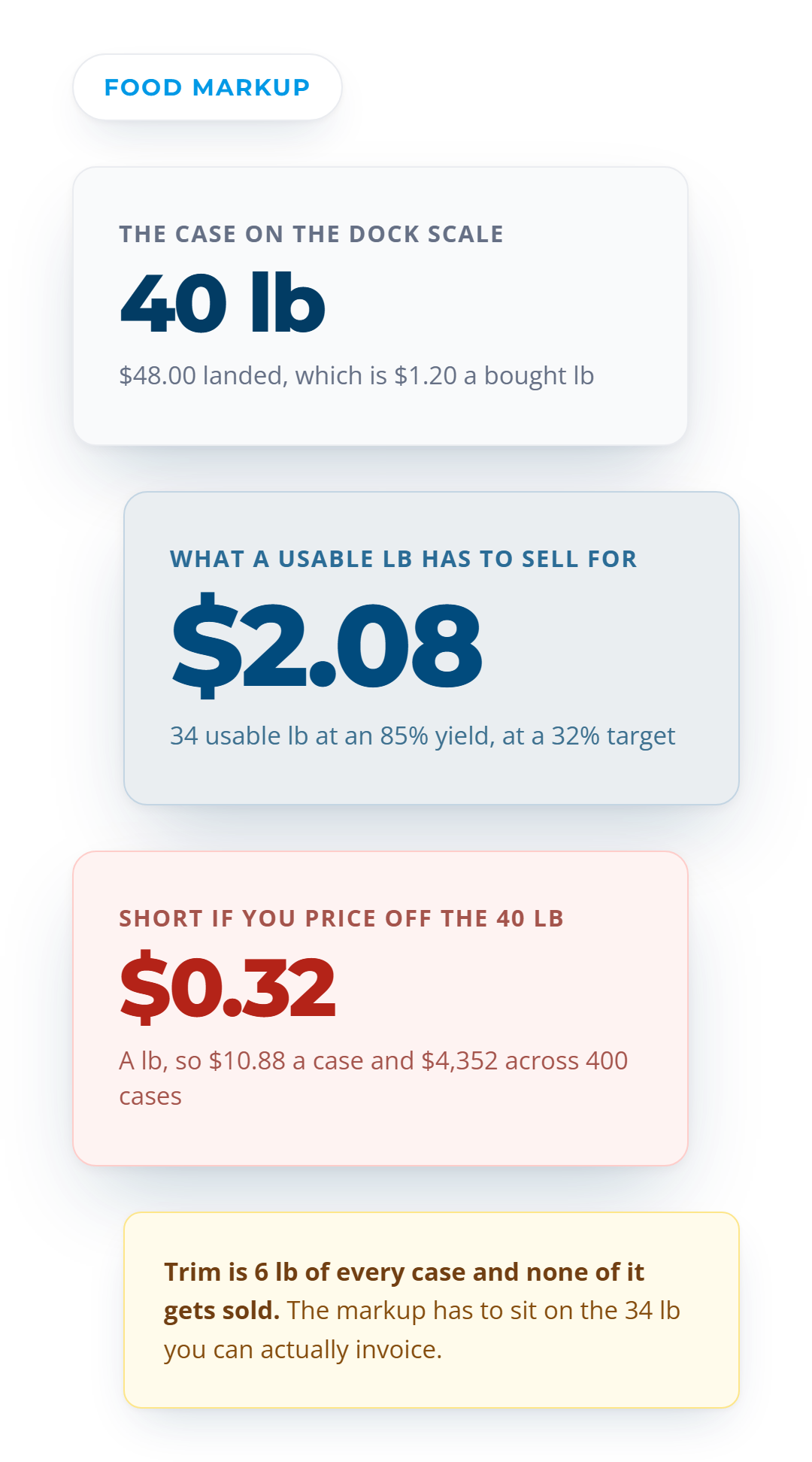
Trim is 6 lb of every case. Price off the 40 lb you bought and you are $0.32 a lb short, which is $10.88 a case you never see.
Estimates only. Yield moves with the cut, the grade and whoever is on the band saw, so weigh your own cases before you price off these numbers.
You trim it. So what does a usable pound cost?
Six quick questions. At the end you get the price per usable pound, and what pricing off the weight you bought is quietly costing you.
Step 1 of 7
The situation
What are you pricing?
Pick the closest one.
Pick one to carry on.
The case
What does the case cost, and what does it weigh?
The weight you buy, before anything comes off it.
$
Landed, with freight in.
lb
As bought, on the invoice.
Enter a cost and a weight above zero.
What survives the block
And how much of it can you actually sell?
Yield is the whole point. Everything that does not survive the trim still got paid for.
%
The share of the case that ends up as sellable product, after trim and loss.
%
A percentage of the price you bill.
Enter a yield above zero.
The volume
How many cases a month?
Turns cents a pound into the number that shows up in a month.
cases
Of this item.
That cannot be negative.
How it gets ordered
How do customers order cut and portioned product?
Weight, pieces and cases are three different conversations, and they often happen on the same phone call.
Pick one to carry on.
Who knows the yield
Who records the yield after a case is broken down?
Last one before your numbers.
Pick one to carry on.
Your breakdown is ready
Price per usable lb
--
The headline number. The rest are below.
Want to see your results?
You have given us enough to work this out. Fill this in and the full breakdown opens up.
Loading the form.
The form did not load.Your browser or your network is most likely blocking it. That should not cost you the numbers you just worked out.
Your details go straight to our team, who will follow up about these numbers.
Your result
Working it out.
Here is your breakdown.
Price per usable lb
--
Price off the weight you bought
--
Cost per usable lb
--
Usable weight per case
--
Gross profit per case
--
Monthly gross profit
--
A yield price only holds if the customer orders off the same price list.
VoiceOrder Solutions keeps personalized order guides tied to your current pricing, so the cut that ships is the cut you priced.
Estimates only. Confirm your yield off a real cut test before repricing.
$2.08
What a usable lb has to sell for to hit 32%
6 lb
Trim coming off every 40 lb case
$0.32
Short a lb if you price off the weight you bought
The Basics
What is food markup?
Food markup is what you add to the cost of food product to set its selling price. For a distributor that cuts, trims or portions product, that cost has to sit on the pounds that sell. Trim is paid for but does not sell at the cut's price.
Only the pounds you can bill
The pounds that leave on an invoice. A 40 lb case at an 85% yield gives 34 lb, and the full $48.00 has to come back from those 34.
Saw hours and packaging stay outside
Cutting labor and packaging. The $48.00 landed cost covers freight and handling in, not the hours on the saw, so the margin has to pay for them.
Catch-weight cases
Catch-weight items are billed by the pound, so a light case also costs less. The price per usable lb holds whatever a case weighs, as long as the yield holds.
Who It's For
Who uses a food markup calculator
Distributors with a cut room of their own need it: the ones that cut, trim or portion product before it ships. Anyone who prices a cut item, sets a yield standard or manages cutters should run it.
Owners pricing cut lines
Cut room leads weighing yields
Managers adding portioned products
Dock teams checking case weights
Controllers costing trim
Teams repricing on grade changes
Reps quoting by the pound
Supervisors tracking cutter yields
Buyers comparing supplier yields
How It Works
How to use the food markup calculator
Two numbers describe the case, two set the price, and the last one turns a per pound figure into a monthly one.
1
Enter the case as it arrives
A $48.00 landed case at 40 lb is $1.20 a bought lb. Use the landed cost, with freight and handling already counted in it.
2
Put in the yield you actually get
85% of 40 lb is 34 usable lb, so 6 lb is trim. Weigh a few cases over a week instead of taking the number off a spec sheet.
3
Set the margin the line has to carry
A 32% target on 34 usable lb gives $2.08 a lb, $70.72 a case and $22.72 of gross profit. At 400 cases a month that is $9,088.
What You See
What the calculator shows you
The usable price
What a pound has to sell for once trim is out
$48.00 across 34 usable lb is $1.41, and a 32% target takes that to $2.08 a lb. The case sells for $70.72 and earns $22.72.
Yield moves this price the most, and it is the input most often guessed. Pin down these three before a rep quotes the cut.
1
The case weight that arrives
If the supplier bills by the case, weigh what comes off the truck. A 40 lb case that weighs in light costs more per pound than the label says.
2
Weight lost before it ships
Product gives up liquid in the cooler and on the saw. Measure usable weight as it leaves, not right after cutting, or the yield reads high.
3
Trim you sell, taken off the cost
If trim goes out as ground product or to a renderer, take what it earns off the $48.00. Skip that and the cut carries a cost the trim already pays back.
Sound Familiar?
A case of food does not weigh what you get to sell
The scale at the dock says 40 lb. The band saw decides how many of those pounds ever leave on an invoice.
We price off the case weight.
40 lb at $48.00 is $1.20 a bought lb. The 34 lb you can sell cost $1.41 each, and pricing off the wrong one leaves you $0.32 a lb short.
Trim is a rounding error.
Trim is 6 lb of every case here. At the same 32% target that gap is $10.88 a case, which is $4,352 a month across 400 cases.
Our yield is about 85%.
About is expensive. Assume 85%, really get 75%, and the case gives 30 usable lb at a price built for 34 lb. It earns $62.40 instead of $70.72, so profit is $14.40 and the margin is 23.1%, not 32.1%.
The Comparison
Three ways to price a cut case, and which one survives the trim
Same $48.00 case, same 40 lb on the dock scale, same 32% target. These are the three ways the price actually gets set.
What you need before you quote a cut item
Pricing on usable pounds, after yield
Pricing on the weight on the invoice
A flat markup on the case cost
Prices the pounds you can sell
No, it spreads the cost over 40 lb
No, it never looks at a pound
Treats trim as a cost you carry
No, the 6 lb of trim is invisible
No
Names the gap in cents a pound
No, the gap never gets named
No
Moves when the yield moves
No, the price is the same at any yield
No, the rate is fixed whatever the yield
Lands the margin you asked for
No, a 32% target lands at 19.8%
Only on the one cut it was set for
Shows the food cost behind the price
No, it reports a food cost off 40 lb
No, it reports neither figure
Works per cut, not per category
Only if every cut yields the same
No, one rate across the whole guide
Gives a case revenue and a profit
Yes, but off pounds you cannot sell
Yes, per case, never per pound
Where it falls down
It trusts the yield you type, and a spec sheet yield runs high, so the price comes out low
It prices the trim as though it sold
One rate across cuts that yield differently
Best used for
Any cut, portioned or trimmed item you sell by the pound
Three of these six show up in the markup math. The other three happen in the cut room, where nobody is looking at a price.
The yield you really get
85% here. At a 75% yield the case gives 30 usable lb and needs $2.35 a lb, which is $0.27 more than $2.08.
The landed case cost
$48.00 with freight and handling in it. Leave freight out and every pound downstream is priced off a cost you do not actually pay.
The margin you are measuring
A 32% margin leaves 68% of the price for cost. Move the target to 40% and the same case needs $2.35 a usable lb.
Who is on the band saw
Two cutters on the same case can be 10 points of yield apart. 85% against 75% is $0.27 a lb on every pound that leaves.
The cut specification
A closer trim spec sells fewer pounds at a higher price. Price the spec your cut room actually works to, not the one on the sheet.
What happens to the trim
6 lb a case is $7.20 of cost at $1.20 a bought lb. Grind it, render it or sell it on and it stops being a straight loss.
See how VOS confirms the order before your cut room reads it
VoiceOrder Solutions digitizes, confirms and timestamps every order it takes before transmitting it. The item and the quantity an account asked for are then what your cut room reads.
VOS does not price cut product or calculate yield. It works on the order: customers order by voice in the VOS app, review each line, and the order reaches you confirmed and timestamped.
Orders captured 24/7, overnight ones included
Each app order carries a number, so who ordered what is on record
Delivered by email, EDI or API, in the format you use
Put the cost on the pounds you can sell, then mark that up. A $48.00 case at 40 lb and an 85% yield gives 34 usable lb, so cost is $1.41 a lb, and a 32% target margin prices it at $2.08. Mark up the $1.20 you paid per bought pound instead and you get $1.76, which leaves the trim unpaid for.
How much mark up should you charge on food?
Enough to cover the trim, not a round number off a chart. On this case $22.72 of gross profit against a $48.00 cost is a 47.3% markup, and the same $22.72 against $70.72 of revenue is a 32.1% margin. Decide the margin the line has to carry, then read off the markup it needs.
Does trim belong in the cost or in the markup?
In the cost, not the markup. Spread the $48.00 case over the 34 lb you can sell and cost is $1.41 a usable lb. Mark that up to $2.08. Price off the 40 lb you bought and the same target gives $1.76, which is $0.32 a lb short.
How do you calculate food cost on product you cut yourself?
Divide the case cost by the usable pounds, not the pounds on the invoice. $48.00 over 34 usable lb is $1.41, against $1.20 over the 40 lb you bought. The food cost percentage then comes off what the case really earns, so $48.00 of $70.72 is 67.9%.
Is trim the same as shrink?
No, and they belong in different places. Shrink is product you lose to spoilage, damage or a short count, and it goes into your landed cost. Trim is weight you never intended to sell, 6 lb of every 40 lb case here, and it belongs in the price per pound. Budgeting for one does not cover the other.
How does yield change the price you need?
Every point of yield you lose is carried by the pounds that are left. At an 85% yield this case needs $2.08 a lb. At 75% it needs $2.35, and at 90% it needs $1.96, a $0.39 spread on the same $48.00 case. Yield moves the price more than the case cost usually does.
What yield should you use on a cut item?
Your own, measured. Weigh the case in, weigh the saleable product out, and do it across a few cases and a few cutters. Assume 85% and really get 75% and you sell 30 lb at a price built for 34, so the case earns $62.40 instead of $70.72 and the margin goes with it.
Price the cut, then make sure that price is what ships
VoiceOrder Solutions keeps personalized order guides tied to your current pricing and SKUs, so the $2.08 a usable lb you worked out is the price an account orders against.