Price one case three ways at once, cost-plus, a target profit, or matching a competitor, and see the margin each approach actually leaves you.
The product
$
Landed cost, everything in before markup.
cases
So we can show what the pricing is worth monthly.
Three ways to price it
%
Set the margin you want, we solve the price.
$
Price to a flat dollar profit on each case.
$
The price you would have to meet to win the line.
Cost-plus price
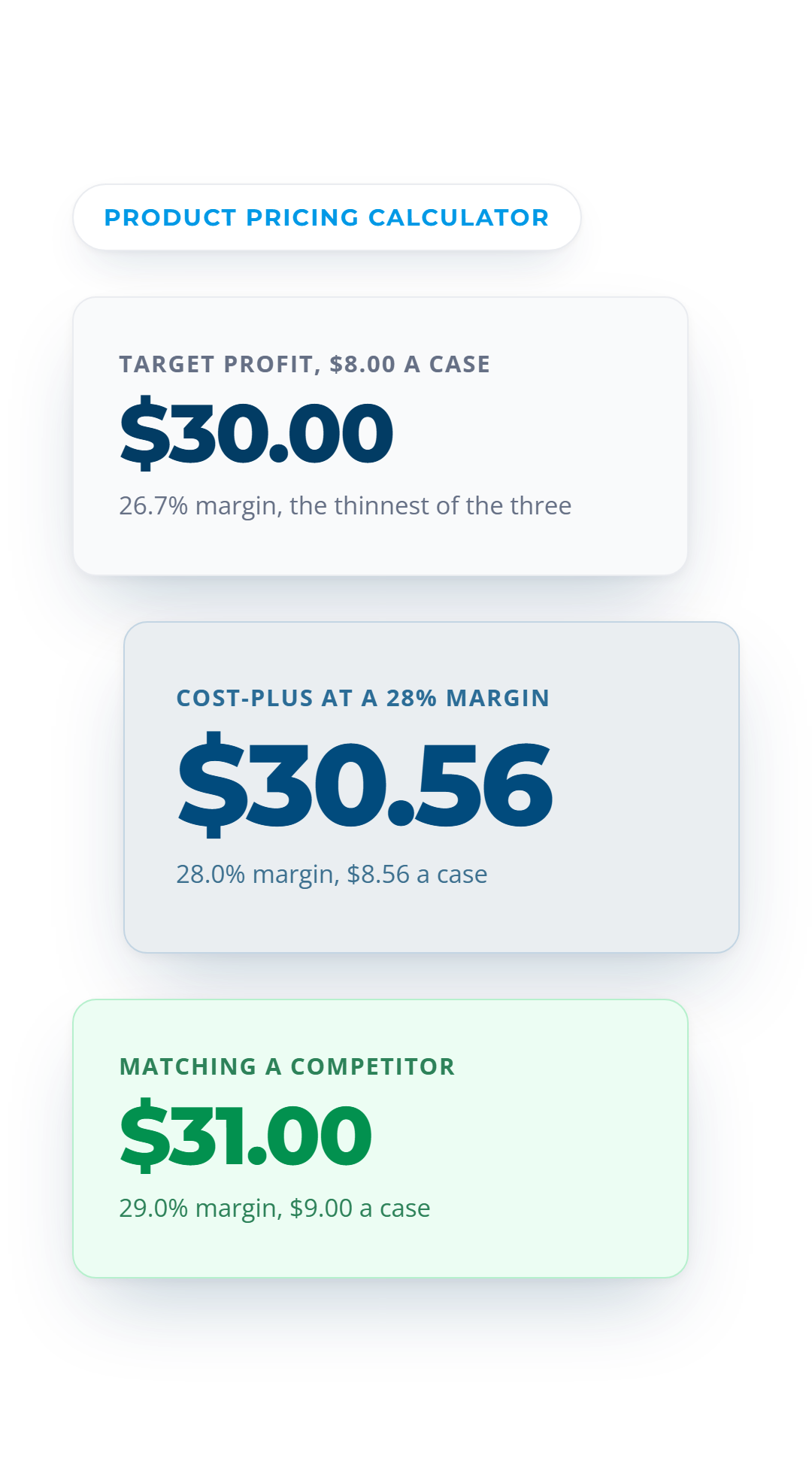
$30.56
28.0% margin, $8.56 profit per case
Target-profit price
$30.00
26.7% margin, $8.00 profit per case
Match-competitor price
$31.00
29.0% margin, $9.00 profit per case
Thinnest margin of the three
26.7%
From the target-profit price
Price spread
$1.00
$30.00 to $31.00 across methods
Monthly profit, cost-plus
$51,360
Across 6,000 cases
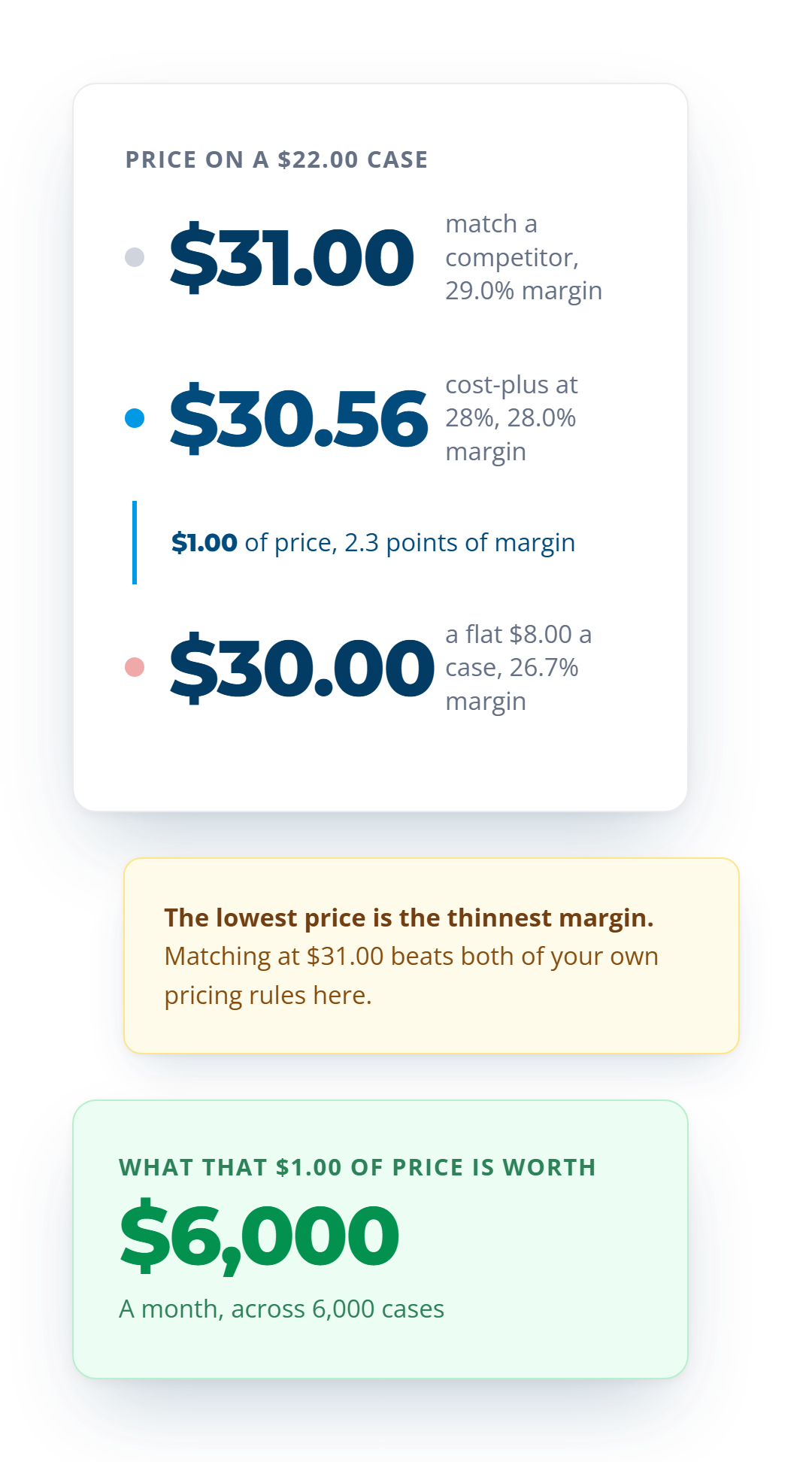
Three ways to price the same $22.00 case give three answers: $30.56 for a 28% margin, $30.00 to make $8.00 a case, and $31.00 to match a competitor. The lowest-margin method is the target-profit price at 26.7%, so the cheapest-looking price is rarely the most profitable.
A price is only right if it holds across the catalog.
VoiceOrder Solutions keeps your price lists and order guides consistent, so the margin you set is the margin you bill.
Estimates only. Check your landed cost and the competitor quote before you commit to a price.
$30.56
Cost-plus price on a $22.00 case
26.7%
Margin a flat $8.00 a case leaves
$51,360
Monthly profit across 6,000 cases
Sound Familiar?
Three ways to price the same case, three different answers
Every distributor has a pricing rule. The trouble is the rules disagree, and the one that sounds safest is usually the thinnest.
We add our margin and move on.
A target margin is the one rule that holds across the catalog. On a $22.00 case, 28% prices at $30.56 and leaves $8.56. The number is right. Nobody checks it against the other two.
Just make eight bucks a case.
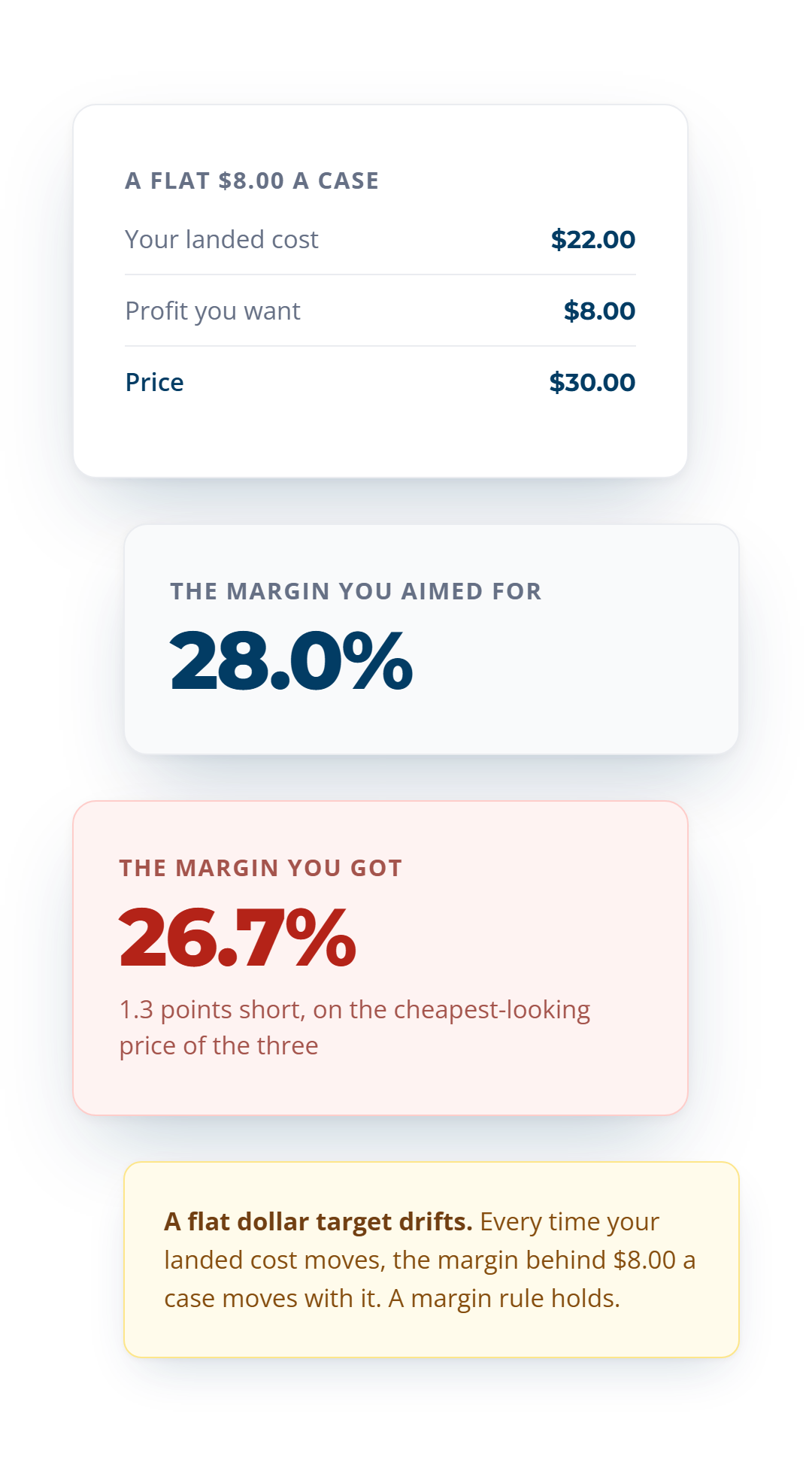
A flat profit is easy to remember and easy to lose on. $8.00 on a $22.00 case prices at $30.00, which works out at 26.7%, the thinnest margin of the three.
Match them and make it up on volume.
Matching a competitor at $31.00 is the best of the three here, at 29.0% and $9.00 a case. You only know that because you ran it. Most matches are guesses.
How It Works
How to use the product pricing calculator
Three rules, three prices, and the margin behind each one. It takes about a minute.
1
Start with landed cost
Use what the case costs you on the dock, not the supplier invoice. Freight, handling and shrink all belong in it, or every price you get back is optimistic.
2
Set all three rules at once
A target margin, a target profit per case, and whatever a competitor charges. Fill in all three, because the comparison is the whole point.
3
Read the margins, not the prices
The three prices land within $1.00 of each other. The margins behind them run from 26.7% to 29.0%, and that gap is where the money is.
Built For Distributors
What the calculator shows you
Cost-plus
The price your target margin actually needs
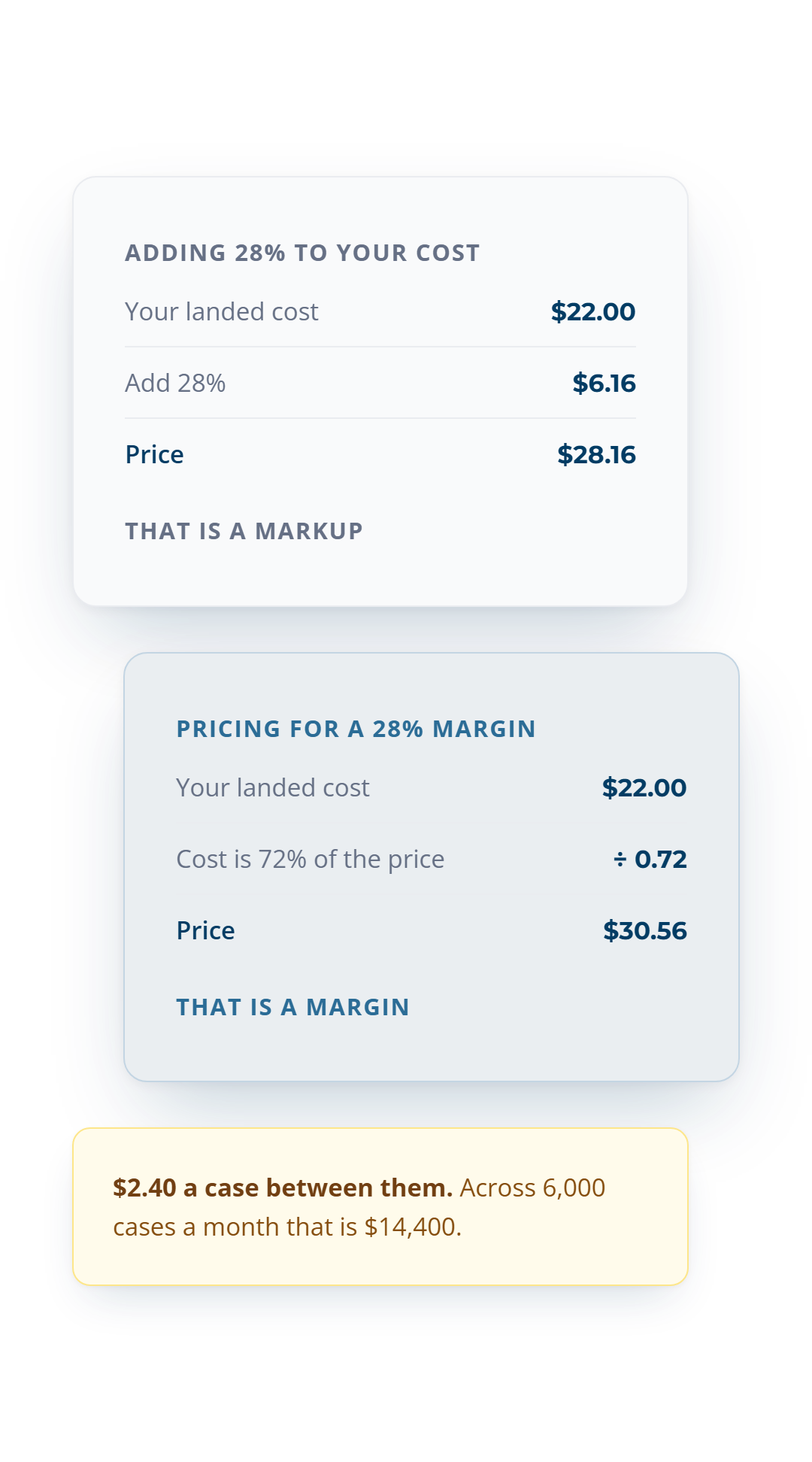
A margin is not a markup. To clear 28% on a $22.00 case you have to price at $30.56, not $28.16. That is $2.40 a case most rules quietly give away.
A competitor at $31.00 leaves you $9.00 and 29.0% on a $22.00 case. Matching only costs you when their price sits near your cost, and here it does not.
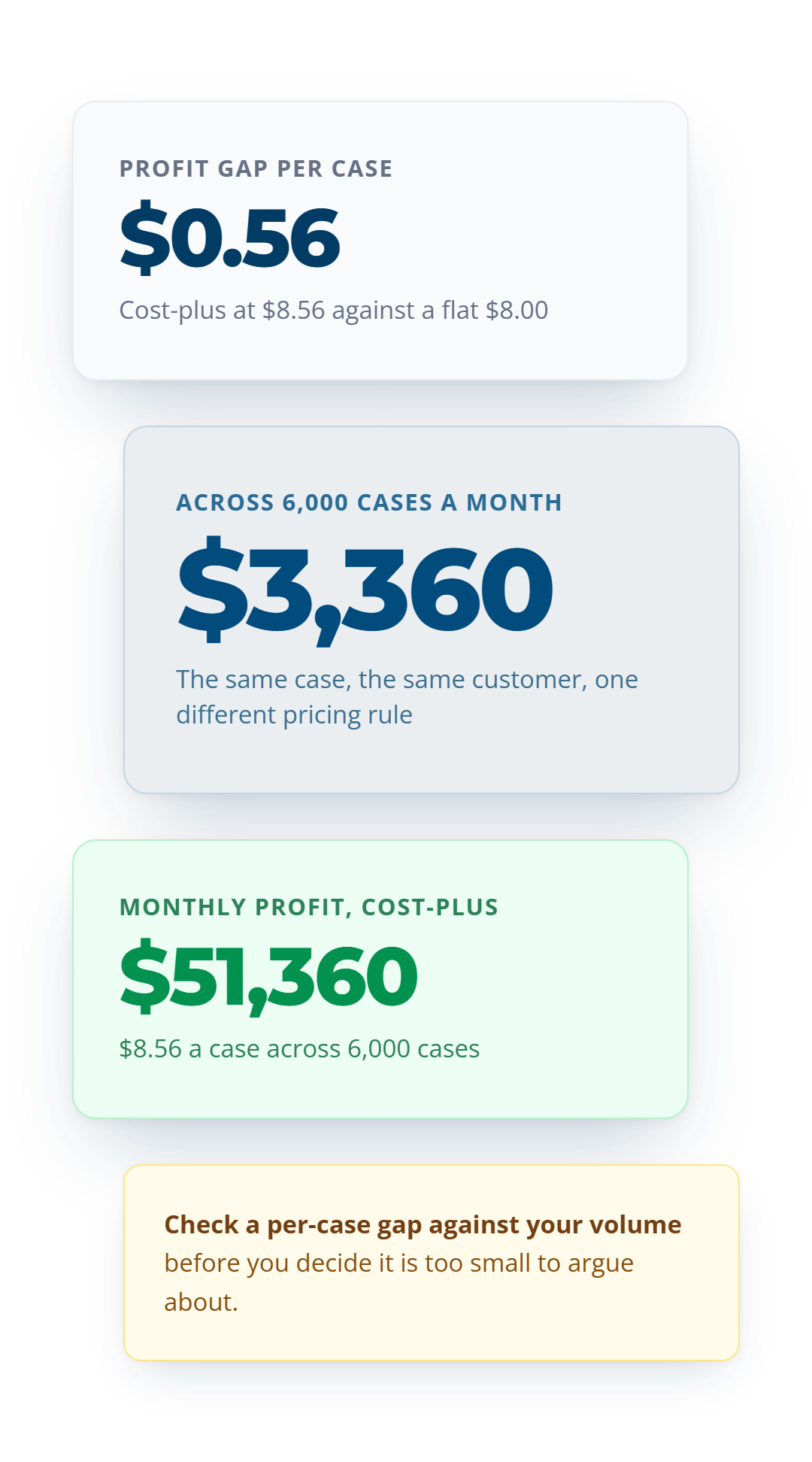
A $0.56 difference per case is easy to wave off. Across 6,000 cases a month it is $3,360, which is the gap between the thinnest rule and the cost-plus one.
The comparison only helps if it changes the number a rep quotes. Start here.
Price off margin, not markup
Put landed cost in the rule
Find your thinnest method
Set a floor per category
Quote one price per account
Recheck when cost moves
Compare before you match
Review your flattest margins
Hold the price across the guide
Six Levers
What actually moves the margin on a case
The price is one half of the margin. These are the parts of the other half you can change.
Landed cost
Freight, handling and shrink all sit inside the $22.00. Cut any of them and all three prices improve at once.
Markup against margin
A 28% markup and a 28% margin are $2.40 apart on this case. Pick one, write it down, and make every rep use it.
Case pack
Pack size moves your cost per case and the per-unit price your customer compares you on.
Buying terms
Product cost is the biggest part of the case. Volume and timing move it further than any pricing rule.
Shrink
Product that never ships still costs you, and it raises the real cost of everything that does.
Price consistency
A price that holds on every order guide is worth more than a clever one that does not.
See how VOS keeps your pricing consistent across every account
VoiceOrder Solutions builds each customer a personalized order guide tied to your pricing and SKUs, so the price you set is the price they order against.
Start from landed cost, then apply one rule. For a target margin, divide the cost by one minus the margin: a $22.00 case at 28% prices at $30.56.
What is the difference between markup and margin?
Markup is a percentage of your cost, margin is a percentage of the price. A 28% markup on a $22.00 case gives $28.16, while a 28% margin needs $30.56, a $2.40 gap.
What is a good margin on a case of food?
It varies by category, so compare against your own blend rather than a benchmark. Staples run thin and specialty runs wide, and the mix is what pays the overhead.
Should you price off a flat profit per case?
Only on a narrow catalog. A flat $8.00 gives 26.7% on a $22.00 case, but the same $8.00 on a cheaper case is a much fatter margin and on a dearer one it is far too thin.
Is it worth matching a competitor's price?
Check the margin before you match. At $31.00 against a $22.00 case the match leaves 29.0%, which beats both other rules here. That will not hold if your cost is higher than theirs.
What costs belong in the price of a case?
Product cost, inbound freight, handling, and the shrink you expect on that item. Leave any of them out and the margin on screen is not the margin you bank.
How often should you reprice?
Whenever landed cost moves enough to matter. A $0.56 change per case looks small until you multiply it: across 6,000 cases a month it is $3,360.
Set the price once, bill it everywhere
VoiceOrder Solutions gives every customer a personalized order guide tied to your pricing and SKUs, and most distributors are live in 24 to 48 hours.
.webp)