For Independent Food Distributors

Purchase Price Variance Calculator

A purchase price variance calculation in three numbers: the price you budgeted, the price the invoice charged, and what the gap costs you this month and across a year.
VoiceOrder app ordering screen

Price Variance Calculator

What is price variance? The gap between the price you planned to pay and the price the invoice actually charged. Put both prices in to see what it cost you this month and over a year.

Standard and actual

$
The price you budgeted, quoted or last agreed. Accounting calls the gap against it the material price variance.
$
What the invoice really charged for the same case, same pack, same grade.

Volume on the invoice

cases
Cases of this item received in the month. To calculate price variance you hold the quantity still, so the price variance formula measures both prices on this same volume.
Unfavorable price variance
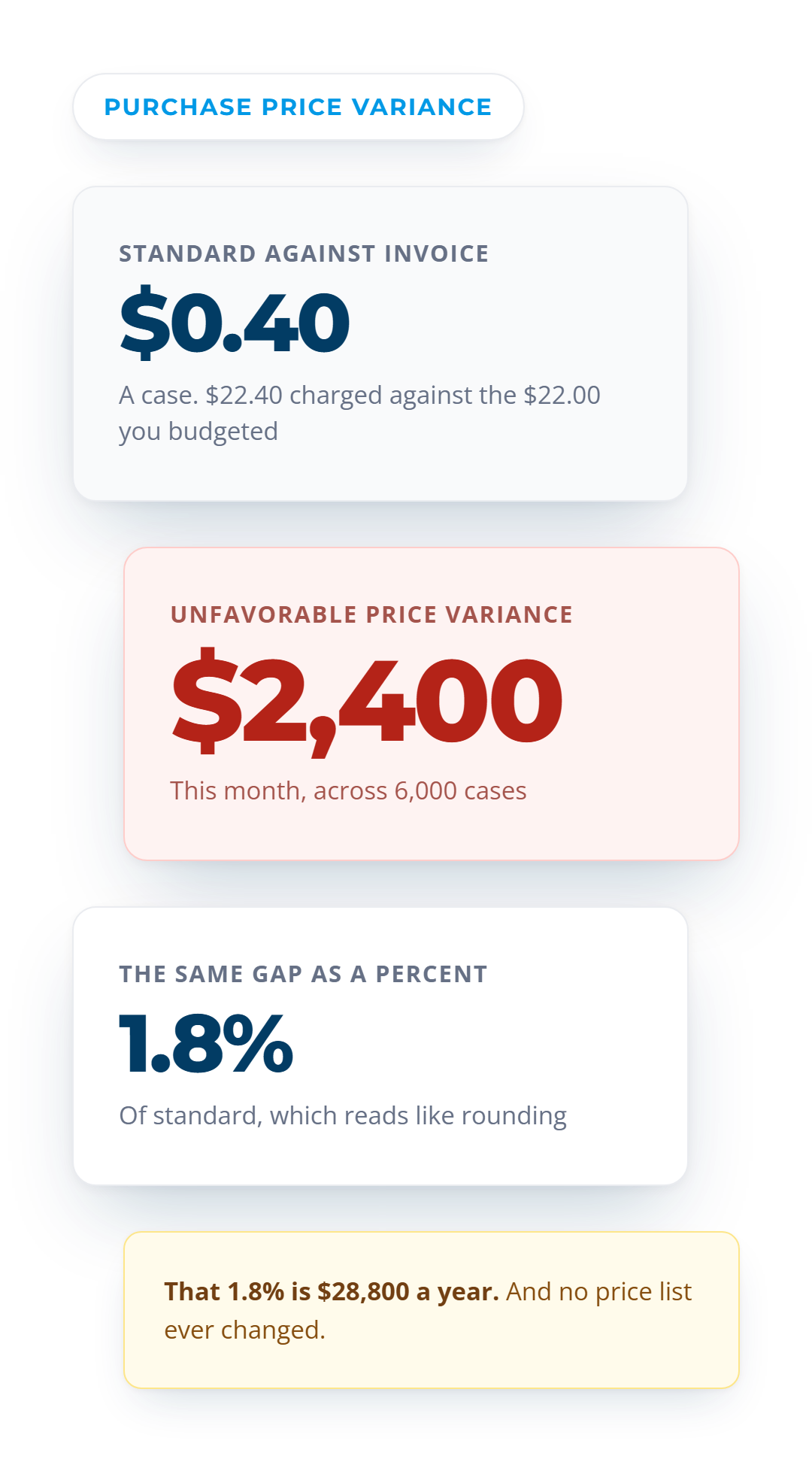
$2,400
$0.40 a case across 6,000 cases
Variance per case
$0.40
$22.40 actual against the $22.00 standard
Variance as a percent
1.8%
$0.40 on a $22.00 standard price
Spend at the standard price
$132,000
6,000 cases at $22.00
What you actually spent
$134,400
$132,000 plus the $2,400 variance
A year at this variance
$28,800
12 months of $2,400
1.8% reads like rounding. It is $2,400 this month and $28,800 a year, and it never appears on a price list because the list price never changed.
A cost increase costs you twice if your own price list never catches up. VoiceOrder Solutions keeps personalized order guides per customer tied to current pricing, so a cost change reaches every account instead of waiting on a spreadsheet.
Book A Demo →
Estimates only. This is a pure price variance, so it holds the quantity still. A full cost variance calculation also carries the usage and mix you bought, not just the price you paid for it.
$2,400

Unfavorable price variance on one item in one month

1.8%

How small the same gap looks as a percentage

$28,800

What that 1.8% is worth across a year

Sound Familiar?

A price variance hides in the percentage, not in the dollars

What is price variance? The gap between the price you planned to pay and the price you were charged. It is small on one case and large on a year.
Percent sign for a variance that hides in the rate

The invoice looked about right.

$22.40 against a $22.00 standard is 40 cents, which nobody queries. Across 6,000 cases it is $2,400 this month and $28,800 a year.
Rising line for a cost that crept up off the price list

Nothing changed on the price list.

It never does. A standard price is the one you budgeted, so a 1.8% drift lands on invoices and never on the list you compare against.
Falling line for an invoice that came in under standard

We came in under standard, so we are fine.

A favorable $2,400 is worth the same look. Paying $21.60 instead of $22.00 is a saving only if the pack, grade and count are the same.
How It Works

How to run a purchase price variance calculation

Three numbers, one item, one month. Hold the quantity still and the answer is price and nothing else.
1

Enter the standard price you budgeted

$22.00 a case is the price you quoted, agreed or last paid. Write the date next to it, because an old standard reads as a variance.
2

Enter the price the invoice charged

$22.40 for the same case, same pack, same grade. The 40 cents between them is your price variance per case.
3

Enter the cases you bought this month

6,000 cases turns 40 cents into $2,400, and the panel carries it out to $28,800 a year.
What You See

What the calculator shows you

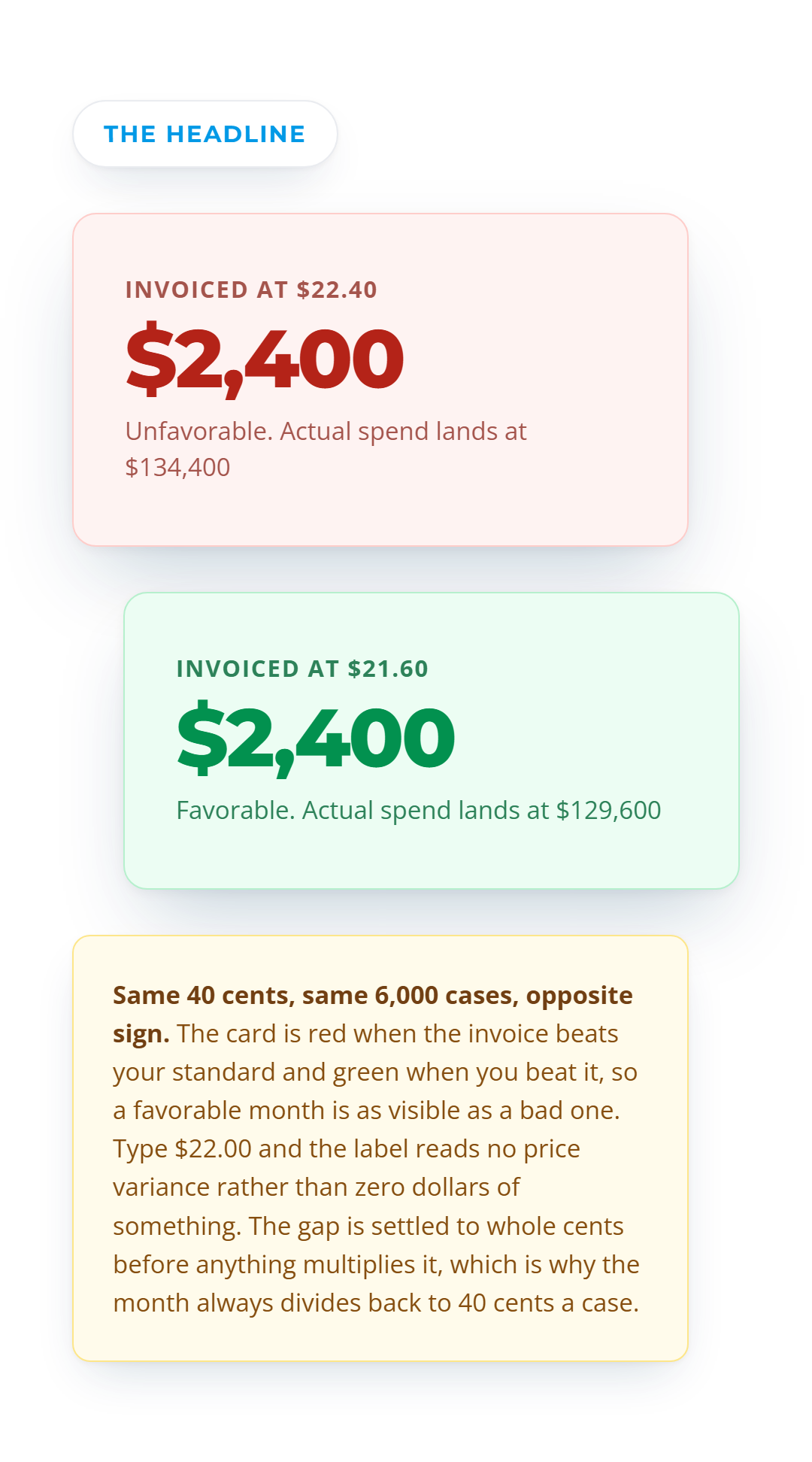
Two variance cards against a $22.00 standard, $2,400 unfavorable on a $22.40 invoice and $2,400 favorable on a $21.60 invoice.
The headline

The total variance, with its sign

$0.40 a case across 6,000 cases is $2,400 unfavorable and the card is red. Pay $21.60 instead and the same $2,400 is favorable and the card turns green.
Red when unfavorable, green when favorable
Names the gap per case and the volume
Settles to whole cents before multiplying
Reads $0 when the invoice matches standard
Percent and dollars

The same gap in both units

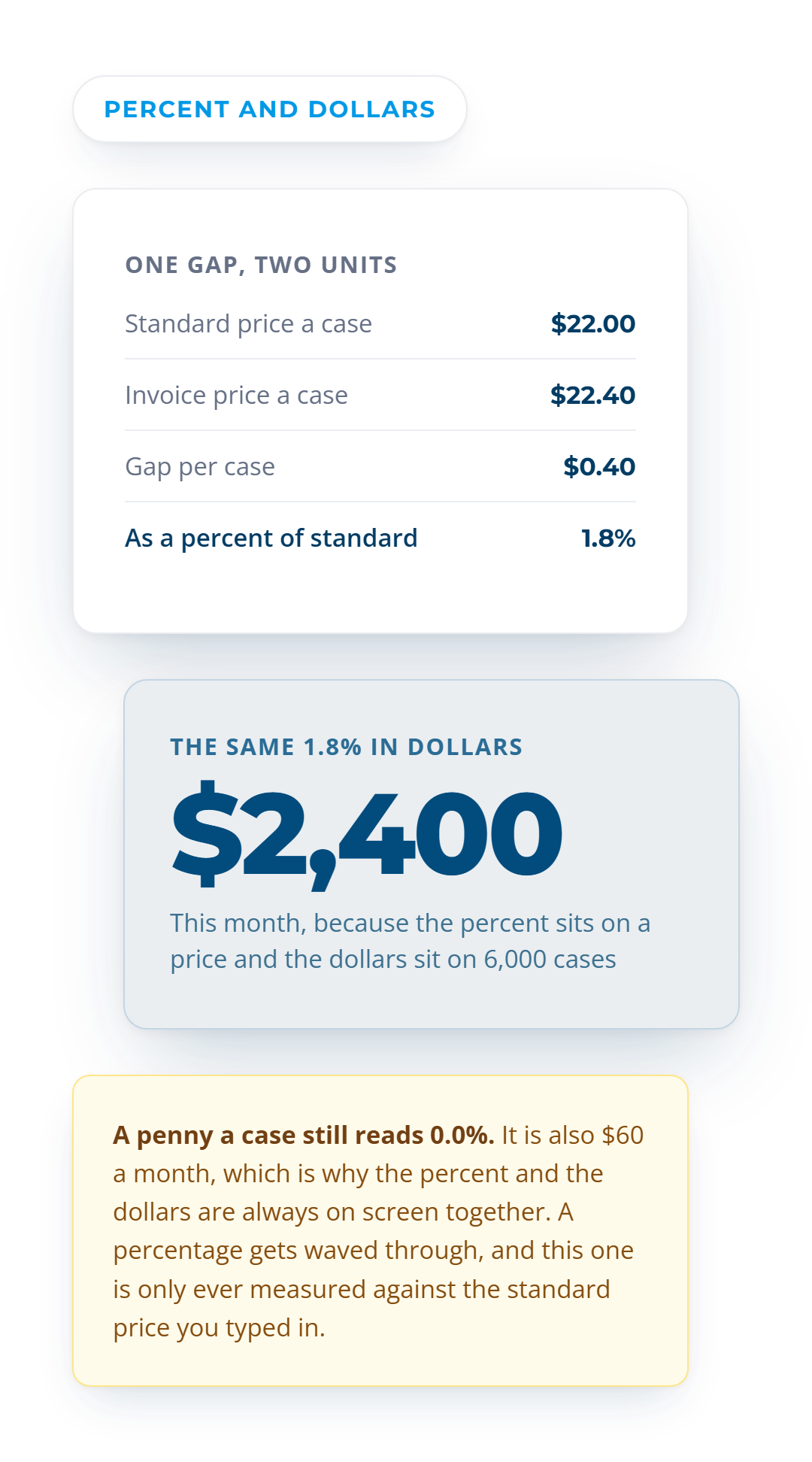
40 cents on a $22.00 standard is 1.8%, which reads like rounding. The dollar cards sit beside it so you see the $2,400 at the same time.
Percent measured against the standard price
Dollars on the month's real volume
A penny a case still reads 0.0%
Holds the quantity still, so this is price only
A 40 cent gap per case shown both as 1.8% of the $22.00 standard price and as $2,400 across 6,000 cases.
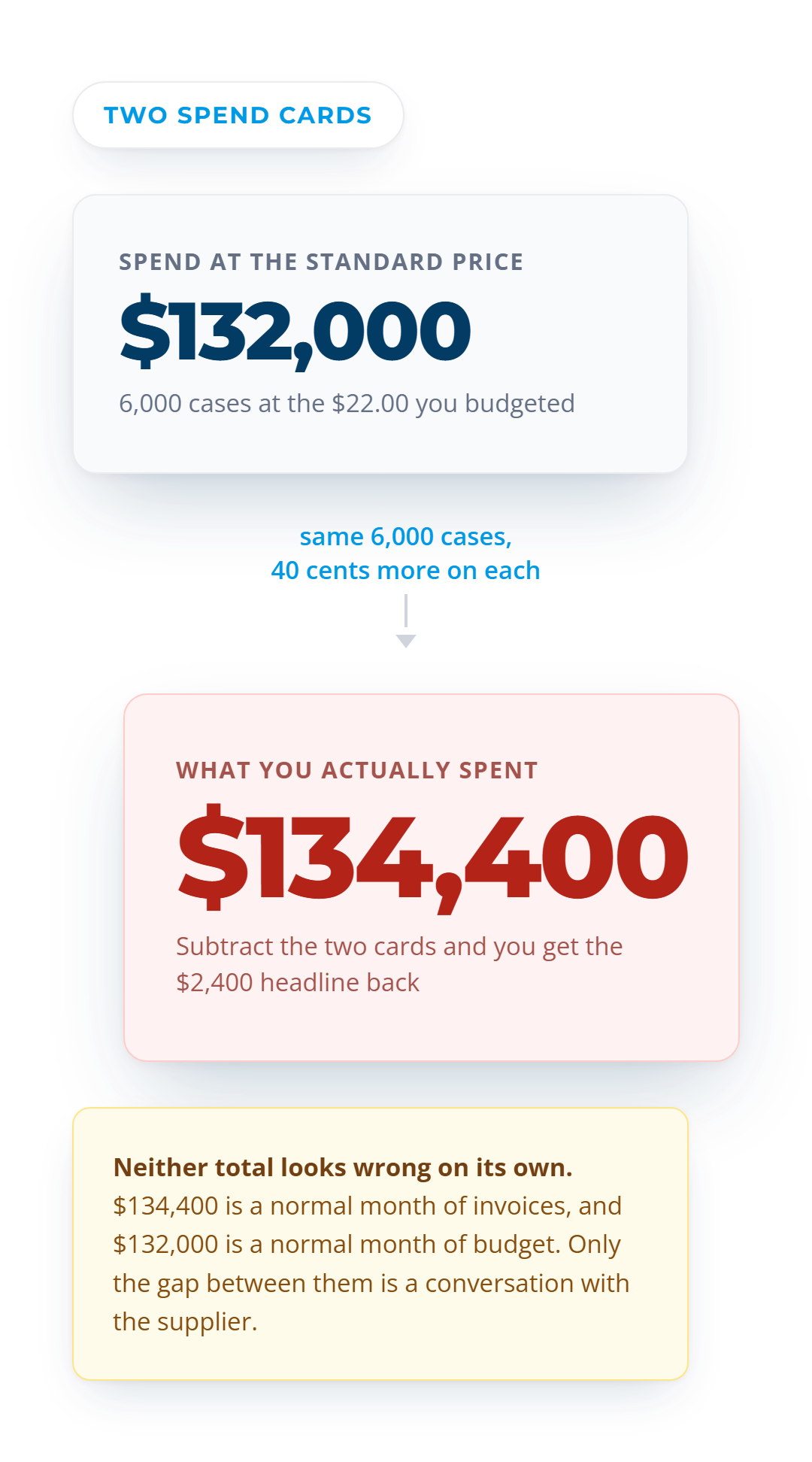
Two spend cards on the same 6,000 cases, $132,000 budgeted at the standard price and $134,400 actually invoiced.
Two spend cards

Budget against what you actually paid

6,000 cases at $22.00 is $132,000 budgeted. The invoices came to $134,400, and the two cards differ by exactly the $2,400 headline.
Spend at standard and spend actual
The two always differ by the headline
Subtracts instead of adding when you beat standard
Works on one item at a time, which is the point.
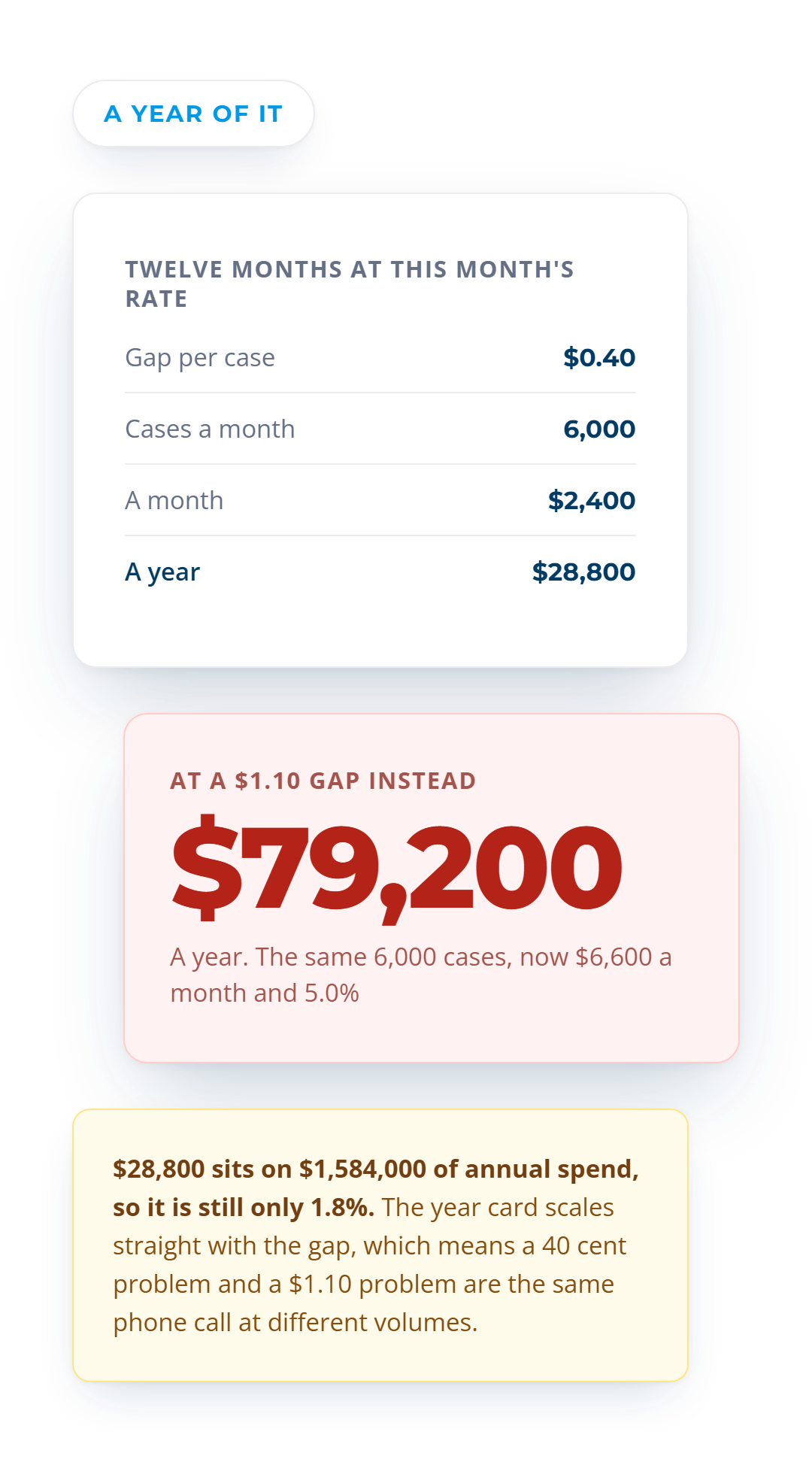
A year of it

What the gap is worth if nothing changes

$2,400 a month is $28,800 a year. Widen the gap to $1.10 and the same 6,000 cases is $6,600 a month and $79,200 a year.
Twelve months at this month's rate
Scales straight with the price gap
Red while the variance runs against you
No cases yet means no cost, not a red card
The 40 cent gap carried out to $2,400 a month and $28,800 a year, with a wider $1.10 gap reaching $79,200.
After The Numbers

What to do once you know the variance

A variance only pays off if somebody owns it. These nine habits turn the number into a conversation with the supplier.
Price tag marking a standard price per item

Set a standard price per item

Calendar for dating each standard price you set

Date every standard you set

Invoice being checked against the standard price

Check invoices against it weekly

Bar comparison of invoice price against standard price

Query the gap while the invoice is open

Stacked cases showing a pack or grade change

Ask what changed, pack or grade

Delivery truck for separating a short ship from a price gap

Keep a price gap apart from a short ship

Price list being updated the same week a cost moves

Move your own price list the same week

Balance scale weighing favorable against unfavorable variance

Report favorable and unfavorable apart

Cycle arrows for repricing every standard each quarter

Reprice every standard quarterly

Six Levers

What actually moves a purchase price variance

One of these six is the standard you compare against. The other five are why the invoice stops matching it.
Target marking the standard price you set

The standard you set

A standard from last year is not a standard. $22.00 has to be a price somebody agreed to, with the date it was agreed on beside it.
A single case standing in for a pack or grade substitution

Pack and grade substitutions

A favorable $2,400 can be a cheaper grade in the same case. Compare like for like or the variance measures the swap instead of the price.
Route map for freight charged on the invoice

Freight sitting on the invoice

A 40 cent gap can be freight rather than product. Decide once whether freight belongs in the $22.00 standard, then keep it there.
Rising bars for a volume tier you did not hit

A volume tier you did not hit

Tier pricing is still a price, so a tier you missed lands here. Run the tool per tier rather than blending two prices into one standard.
Clock for when an off-contract buy was placed

When you bought, not just what

An off-contract buy to cover a hole prices at the spot number. A $0.40 gap often starts as a shortage somebody solved in a hurry.
Dollar sign for the price your own accounts pay

Rebates and off-invoice allowances

An off-invoice allowance never touches the $22.40 you were charged, so the $2,400 is real this month. Decide once whether the standard is gross or net of rebates.

See how VOS turns every order it takes into a dated record

VoiceOrder Solutions numbers, dates and timestamps every order placed in it. The volume your accounts ordered is then a dated record, which is where a 6,000 case month should start.
The Comparison

Three ways to watch what you pay, and which one holds up

Same $22.00 standard, same $22.40 invoice, same 6,000 cases. These are the three ways a 40 cent gap gets caught or missed.

What you need before you approve the next invoice

Actual price against a standard price

Eyeballing the invoice total

Watching your gross margin instead

Names the gap in dollars per case
No, a total hides 40 cents a case
No, it reports the result and not the cause
Puts the gap on the month's real volume
Only if last month's invoice is in front of you
Yes, but blended with every other item
Shows the percent and the dollars together
No, neither one
Percent only, and a month late
Separates price from quantity
No, a bigger total can just be more cases
No, mix and volume move it as well
Carries the gap out to a year
No
No, it reads backward and not forward
Catches a favorable gap too
Rarely, a lower total reads as good news
No, a favorable buy just looks like a better month
Works one item at a time
No, the invoice covers the whole truck
No, one item disappears in the blend
Needs nothing you do not already have
Yes
Yes
Where it falls down
It is only as good as the standard you typed, so an old standard reads as a variance
It only catches a jump big enough to see
By the time margin moves, the quarter is already priced
Best used for
Holding a supplier to the price you agreed, item by item
A quick sanity check, not a measurement
Seeing that something slipped, not what
FAQ

Common questions about purchase price variance

What is PPV and how is it calculated?
PPV is purchase price variance, the gap between the price you budgeted for an item and the price you were charged for it. Subtract the standard price from the actual price, then multiply by the cases you bought. $22.40 against a $22.00 standard across 6,000 cases is $2,400 unfavorable for the month.
How do you calculate the purchase price variance (PPV)?
Per item, per month, straight off the invoices. Pull every receipt line for that item, take the price each one charged, and set it against the $22.00 standard. Multiply the gap by the cases you received, not the cases you ordered. Hold the quantity still on both sides, because this answers price and nothing else.
What is a good PPV value?
There is no published benchmark, so judge it in dollars and by direction. A 1.8% gap reads like rounding and is $28,800 a year, which is worth a phone call. A good PPV is small, explained and shrinking, and a favorable one still needs a reason.
What is the formula for price variance?
Price variance is actual price less standard price, times the quantity you bought, which accounting also calls the material price variance. $0.40 times 6,000 cases is $2,400. This is the cost accounting kind of variance, not the statistical kind, so nothing here gets averaged or squared.
What is the formula for PPV?
PPV equals actual unit price less standard unit price, times units purchased. A positive answer is unfavorable, because you paid more than you planned. Pay $21.60 against the same $22.00 standard and the figure is $2,400 favorable, with actual spend at $129,600 rather than $134,400.
What is a PPV calculation?
It is a monthly check that your invoices match the prices you planned, run item by item. Here it holds $132,000 of spend at standard against the $134,400 you really spent. It is not a full cost variance calculation, because the quantity and the mix you bought are held still.
How is MUV calculated?
Material usage variance takes the quantity side: actual quantity less standard quantity, times the standard price. Price variance and usage variance split the same total gap between them, so run both before you blame the supplier. This tool does the price half, with the 6,000 cases held constant.

Catch a cost increase before your own price list misses it

VoiceOrder Solutions keeps personalized order guides tied to your current pricing, so a $0.40 cost increase reaches every account's guide instead of waiting on a spreadsheet.