For Independent Food Distributors

Procurement Savings Calculator

Separate the savings that reach your P&L from the increases you kept off the table, and see both measured against what you actually spend.
VoiceOrder app ordering screen

Procurement Savings Calculator

Procurement cost savings and cost avoidance are two different numbers. This one splits them, because reporting a single total is how a procurement claim stops being believed.

The contract you signed

cases
Cases a year of this item or this category. Calculating cost savings needs the volume, not just the price.
$
What you paid before the negotiation, on the same freight terms.
$
The price on the new agreement. Old less new is the hard saving, and that over baseline spend is how you calculate cost savings percentage.

The increase you kept off the table

%
The increase the supplier asked for and did not get. Set it to 0 if nothing was on the table.
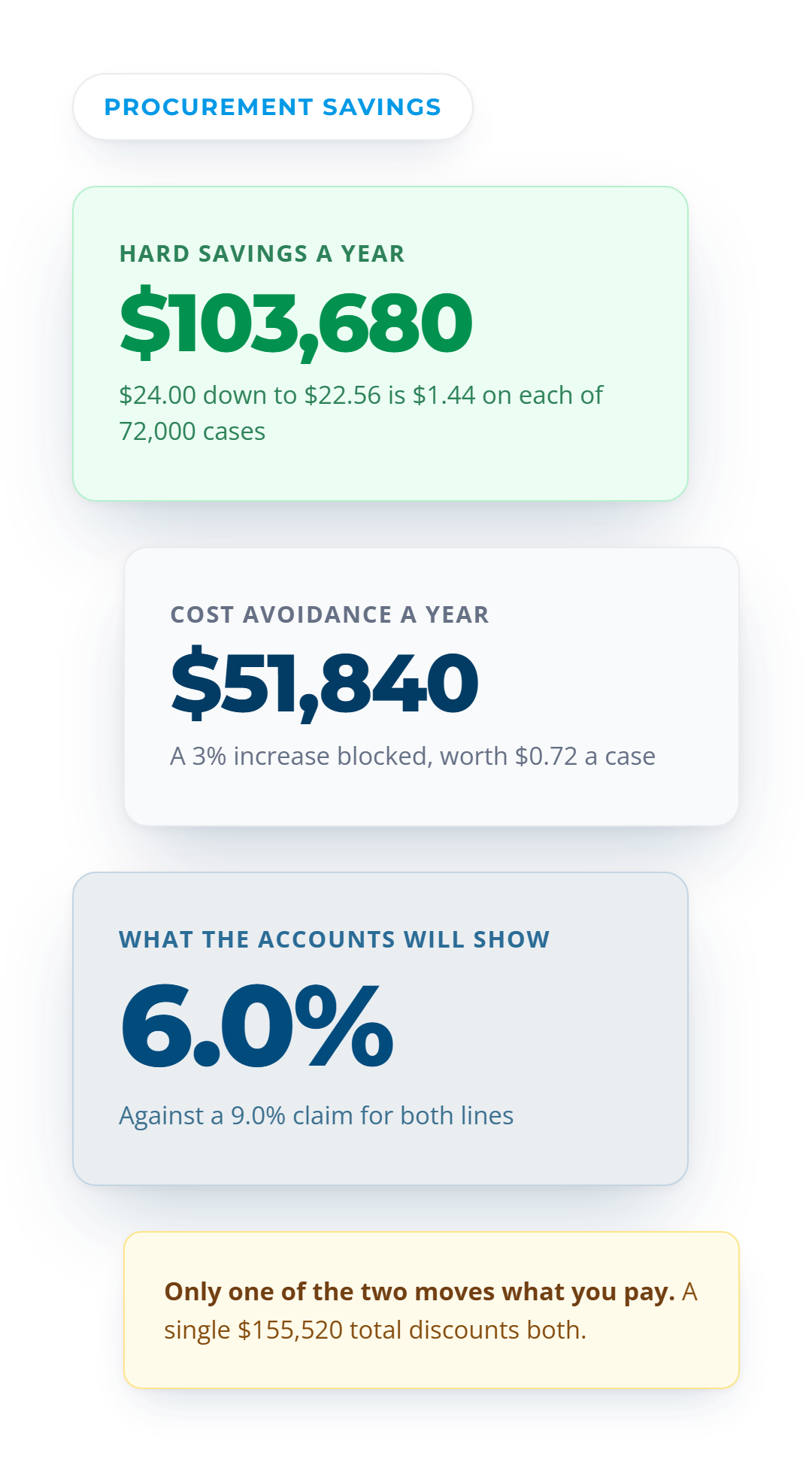
Hard savings a year
$103,680
$1.44 a case across 72,000 cases
Cost avoidance a year
$51,840
$0.72 a case, the 3% increase that never reached an invoice
Total benefit claimed
$155,520
$103,680 hard plus $51,840 avoided
Hard savings as a share of spend
6.0%
Of $1,728,000 of baseline spend
Total benefit as a share of spend
9.0%
What a deck claims, against 6.0% the accounts will show
Baseline annual spend
$1,728,000
72,000 cases at $24.00
New annual spend
$1,624,320
$1,728,000 less the $103,680 you took out
Hard savings a month
$8,640
$103,680 a year across 12 months
Only the $103,680 of hard savings reaches the P&L, where spend drops from $1,728,000 to $1,624,320. The $51,840 of cost avoidance is real, and invisible, because the increase never reached an invoice. Report them on separate lines or finance stops believing either one.
You cannot negotiate on volume you cannot see. VoiceOrder Solutions keeps inventory visibility live as orders are processed, so the volume you take to a supplier is the volume you actually move.
Book A Demo →
Estimates only. Procurement cost savings vs cost avoidance is a reporting distinction, not an accounting one: hard savings change what you pay, cost avoidance changes what you would have paid.
$103,680

Hard savings a year on one negotiated line

$51,840

Cost avoidance, real and invisible

6.0%

What the accounts will show, against a 9.0% claim

Sound Familiar?

Two kinds of savings, and only one of them reaches the P&L

A single savings total is the fastest way to lose the argument. Split it in two and both halves survive the question.
Cash icon for a savings total claimed for the year

We took $155,520 out this year.

Only $103,680 of that reaches the P&L. The other $51,840 is an increase you kept off the table, and no account will ever show it.
Falling trend line for baseline spend dropping to new spend

Finance cannot find the number we reported.

Baseline spend is $1,728,000 and new spend is $1,624,320. The $103,680 between them is findable in the ledger. Cost avoidance never will be.
Rising chart for a savings percentage quoted in a deck

The deck says we are running 9%.

9.0% is hard savings plus avoidance. The accounts will show 6.0%, so name both lines or the next claim gets discounted before anyone reads it.
How It Works

How to use the procurement savings calculator

Three numbers build the baseline. A fourth separates the savings you can prove from the ones you cannot.
1

Enter the volume and the price you were paying

72,000 cases a year at $24.00 is $1,728,000 of baseline spend. Use the price you actually paid, not the one the supplier first asked for.
2

Add the price you negotiated

$24.00 down to $22.56 is $1.44 a case, which is $103,680 a year and 6.0% of baseline spend. That part is hard savings.
3

Enter the increase you kept off the table

A 3% increase blocked is $0.72 a case and $51,840 a year. Set it to 0% and the total benefit falls back to $103,680.
What You See

What the calculator shows you

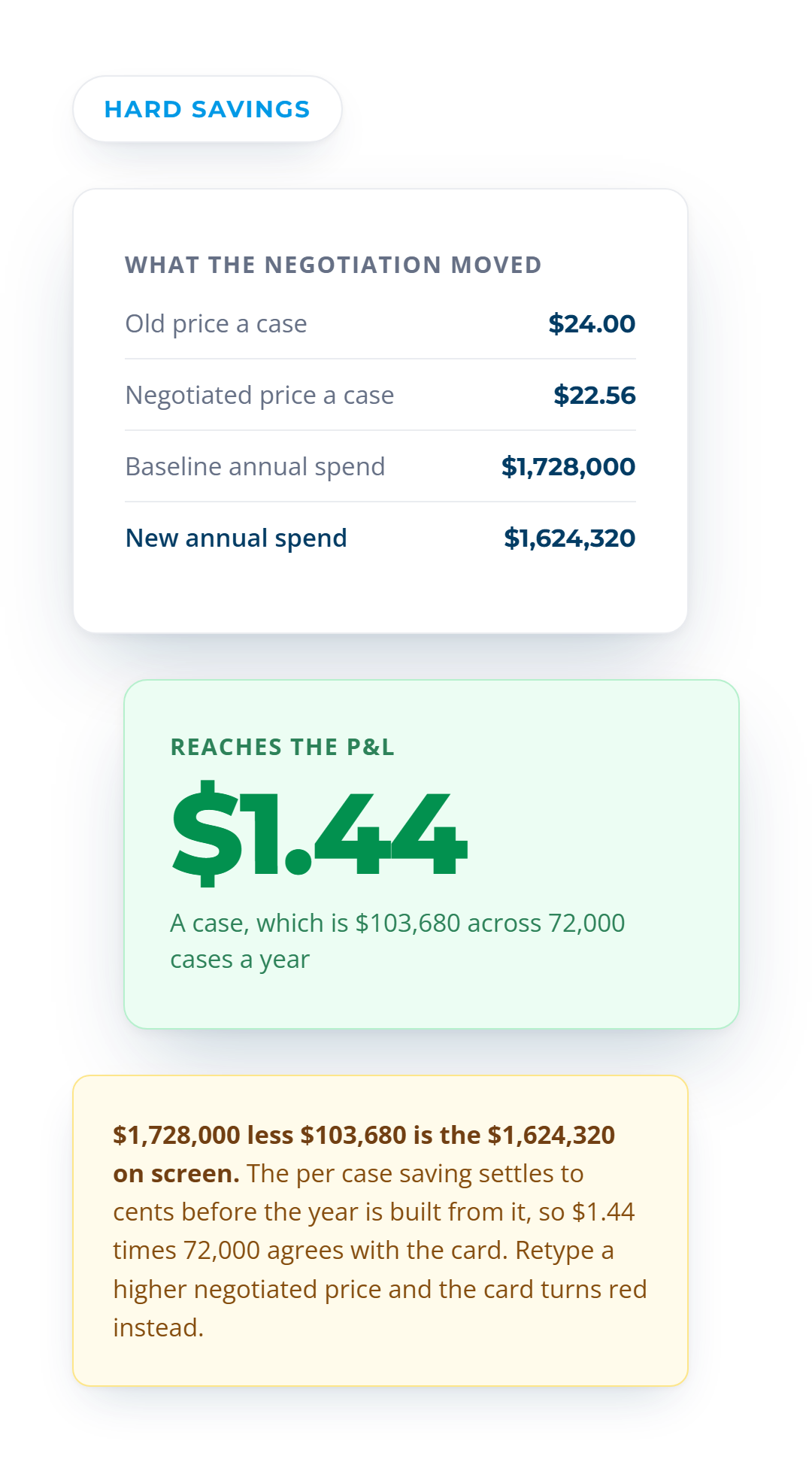
What a negotiation moved: a case price cut from $24.00 to $22.56 takes baseline annual spend of $1,728,000 down to $1,624,320, a $1.44 saving a case worth $103,680 across 72,000 cases.
Hard savings

The savings that reach the P&L

$24.00 less $22.56 is $1.44 a case, which is $103,680 across 72,000 cases. Baseline spend of $1,728,000 really does become $1,624,320.
Settles the per-case saving to cents first
Prints the saving per case and per year
Shows the spend before and after
Turns red when the new price is higher
Cost avoidance

The increase that never reached an invoice

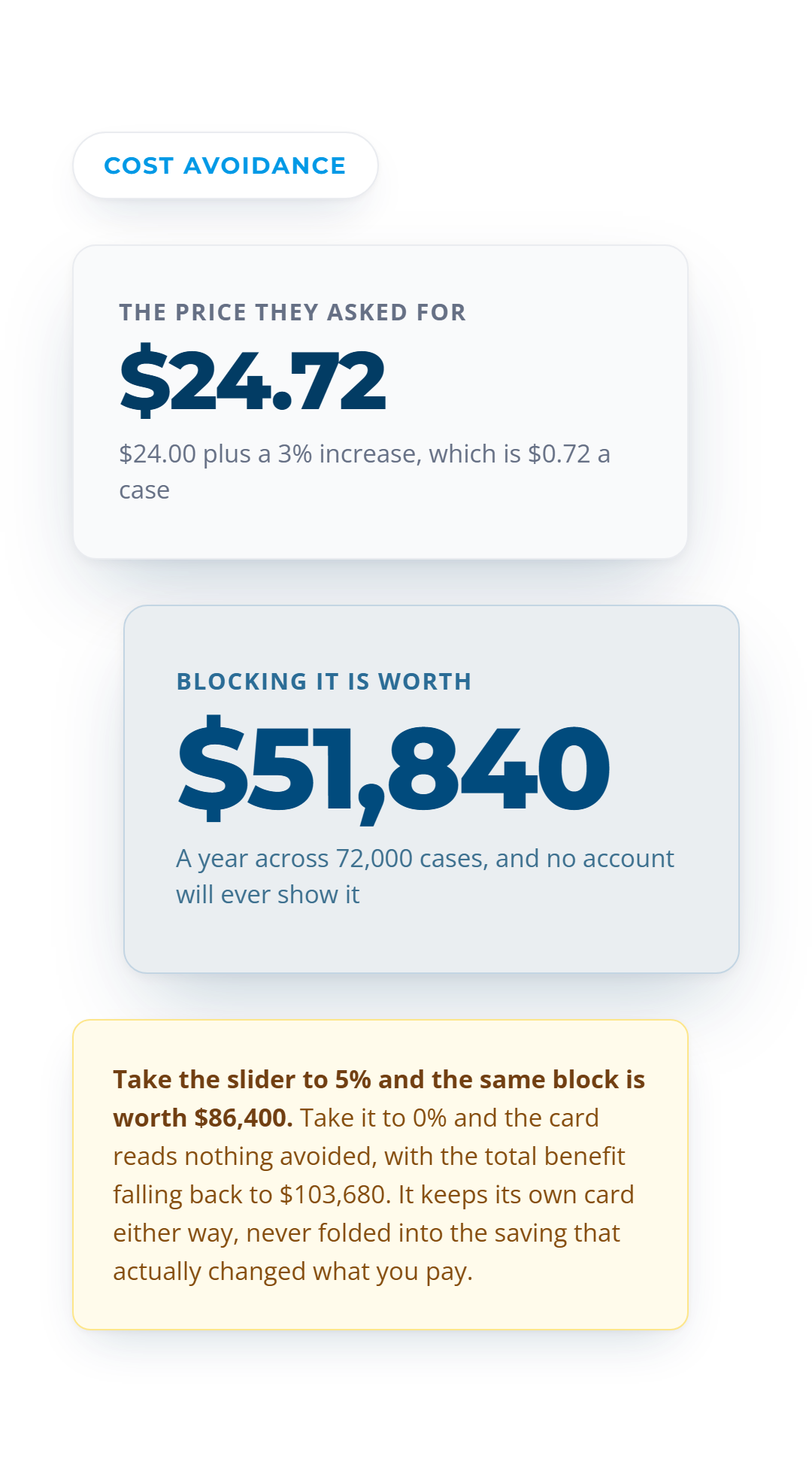
A 3% increase you kept off the table would have put the case at $24.72. Blocking it is worth $0.72 a case and $51,840 a year, and nothing in the accounts will show it.
Its own card, never folded into the saving
Slider from 0% to 20%
Prints the price you avoided per case
Reads zero when nothing was asked for
A cost avoidance card: a 3% increase would have put the case at $24.72, so blocking it is worth $0.72 a case, or $51,840 a year across 72,000 cases, and no account will ever show it.
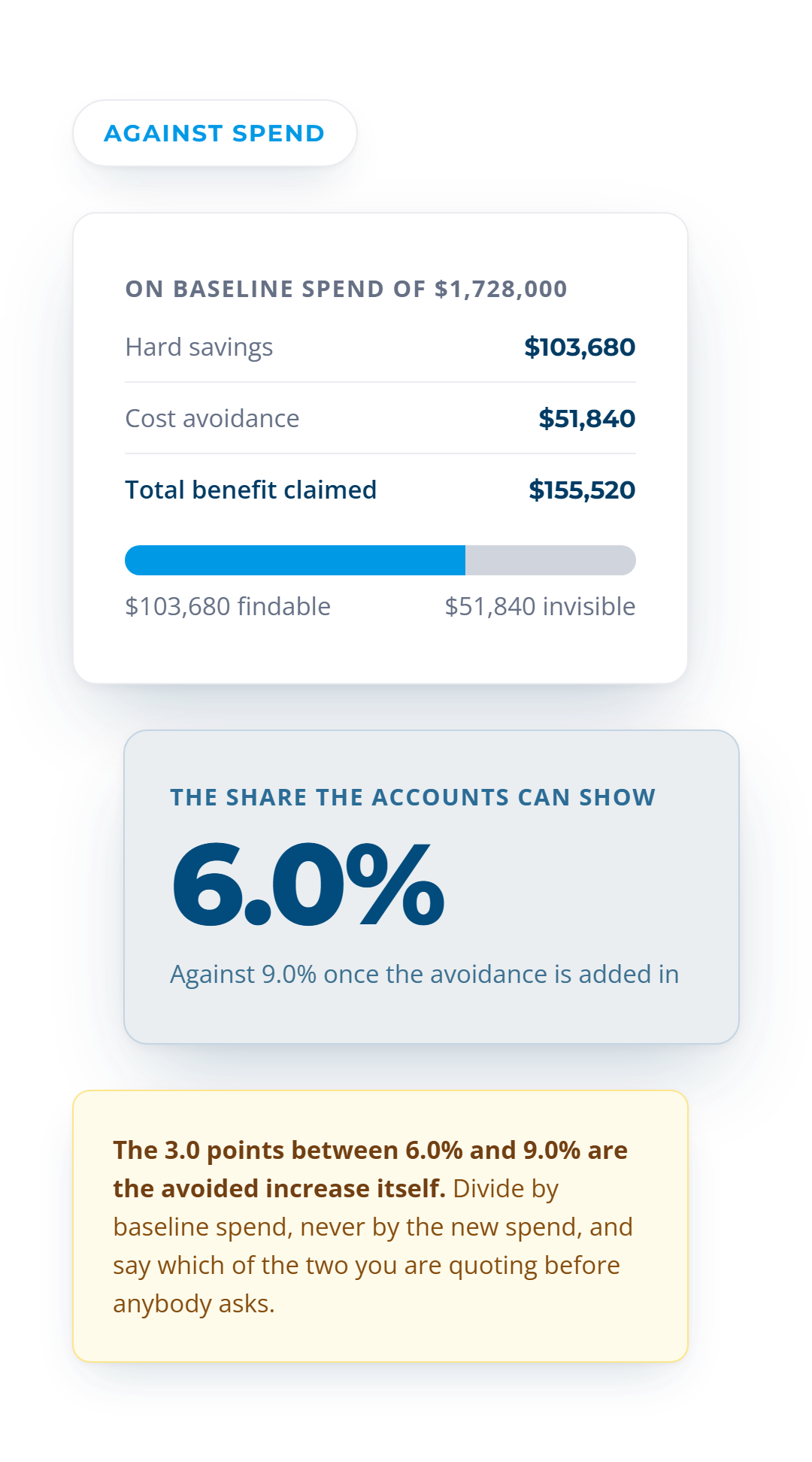
Both savings measured on baseline spend of $1,728,000: a split bar shows $103,680 of hard savings as findable at 6.0% and $51,840 of cost avoidance as invisible, with a $155,520 total reading 9.0%.
Against spend

The percentage finance will check

$103,680 against $1,728,000 of baseline spend is 6.0%. Add the avoidance and the same line reads 9.0%, which is the number that gets challenged.
Both percentages, side by side
Measured on baseline spend, not new spend
Names the spend behind each one
Both move when the volume moves
Per month

What the deal is worth each month

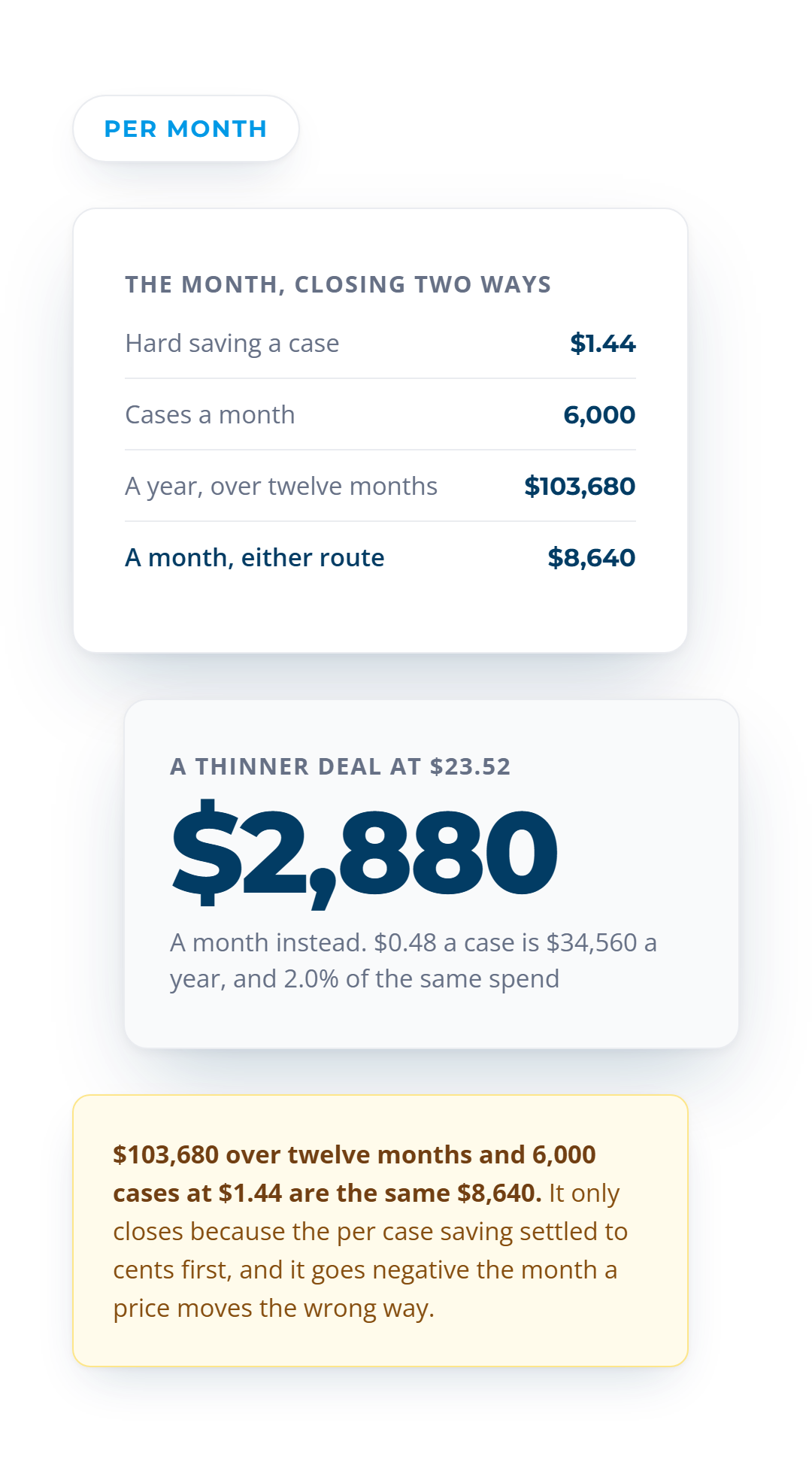
$103,680 a year is $8,640 a month, which is 6,000 cases at $1.44. A thinner deal at $23.52 is $0.48 a case and $2,880 a month instead.
Divides the year across 12 months
Agrees with the per-case saving times volume
Rounds to whole dollars
Goes negative if the price went up
The month closing two ways: $1.44 a case across 6,000 cases is $8,640, the same as $103,680 a year split over twelve months, falling to $2,880 a month on a thinner $23.52 price.
After The Numbers

What to do once the two numbers are apart

A savings claim lives or dies on its baseline. These nine habits are what keep yours standing.
Price tag for naming the baseline price

Name the baseline price

Delivery truck for keeping freight terms identical

Keep freight terms identical

Order guide list for reporting hard savings on their own line

Report hard savings on their own line

Calendar for dating the price you measured from

Date the price you measured from

Case of product for counting the cases rather than estimating

Count the cases, do not estimate

Check mark for confirming the invoice matches the deal

Check the invoice matches the deal

Dollar sign for measuring a saving against baseline spend

Measure against baseline spend

Rising trend line for the increase you kept off the table

Say what was avoided, separately

Cycle arrows for re-baselining once a year

Re-baseline once a year

Six Levers

What actually decides whether a savings claim survives

Only two of these six are the prices. The other four are why a $103,680 claim gets argued down to nothing.
Target for the baseline a saving is measured from

The baseline you measured from

$24.00 is what you were paying, not what the supplier opened at. A generous baseline is how a $103,680 claim gets reversed in a review.
Stacked pallets for the case volume behind a price

The volume behind the price

$1.44 a case is only $103,680 if 72,000 cases actually move. Half the volume is half the saving, and the price never changed.
Balance scale for comparing two prices on identical freight terms

Freight terms on both prices

A $22.56 price that moved freight onto you is not a $1.44 saving. Compare the two prices on identical terms or the gap is not real.
Invoice for checking the negotiated price was actually billed

Whether the invoice agrees

The saving lives on the agreement until an invoice shows $22.56. Check a month of invoices before $103,680 goes into anybody's deck.
Comparison bars for hard savings set against cost avoidance

Hard savings against avoidance

$103,680 changes what you pay and $51,840 changes what you would have paid. One is auditable, the other is a judgment call.
Percent sign for the savings percentage you quote

The percentage you quote

6.0% stands up against $1,728,000 of spend. 9.0% needs the avoidance explained first, every single time it is shown.

See how VOS makes your accounts' order volume countable

VoiceOrder Solutions captures orders 24/7 and queues the ones that arrive after hours. Each account orders from its own order guide, so a year of orders is a record rather than an estimate.
The Comparison

Three ways to report a saving, and which one survives finance

Same 72,000 cases, same $24.00 baseline, same $22.56 on the new agreement. These are the three ways the number gets reported.

What you need before a savings number goes in a deck

Hard savings and avoidance on separate lines

One total benefit number

A percentage off the supplier's first ask

Names the savings that reach the P&L
No, the two get added together
No, the ask was never a price you paid
Keeps cost avoidance on its own line
No, and that is the whole problem
No
Ties the saving to a price you paid
Sometimes, and nobody writes it down
No, the baseline is whatever was asked for
Measures against baseline spend
Yes, usually as one percentage
No, it is measured on a number nobody paid
Shows the saving on one case
No
No, there is no case price behind it
Shows what lands each month
No
No
Stands up to a question from finance
No, 9.0% cannot be found in the accounts
No, a first ask is not auditable
Moves when the volume moves
Only if somebody updates the volume
No, it is a percentage with no cases under it
Where it falls down
It trusts the baseline you type, so a generous old price inflates everything after it
The first time $51,840 cannot be traced, the $103,680 stops counting too
A 3% ask becomes a 3% saving and the spend never moved
Best used for
Taking a negotiated line to finance with both numbers named
Nothing. It costs you the claim you had already earned
Nothing, though it still turns up in quarterly decks
FAQ

Common questions about procurement savings

What are the different types of savings in procurement?
Two of them matter. Hard savings change what you pay, so $24.00 down to $22.56 takes $103,680 a year out of spend. Cost avoidance changes what you would have paid, so a 3% increase you blocked is worth $51,840 and never reaches an account. Report them on separate lines.
What are procurement savings?
The money a negotiation takes out of what you actually pay. On 72,000 cases, $1.44 a case is $103,680 a year, which is 6.0% of $1,728,000 of baseline spend. If spend does not fall, it was avoidance rather than a saving.
What is cost avoidance in procurement?
An increase that was asked for and did not happen. A 3% rise would have put the case at $24.72 and cost you $51,840 a year across 72,000 cases. Blocking it is worth exactly that, and no line on the P&L will ever show it.
How do you calculate savings as a percentage of spend?
Divide the saving by baseline spend, never by the new spend. $103,680 against $1,728,000 is 6.0%. Add the $51,840 of avoidance and the same line reads 9.0%, so say which percentage you are quoting before you are asked.
How do you save cost in procurement?
Start with the cases you buy most of, because the volume does the work. Moving one price from $24.00 to $22.56 across 72,000 cases is $103,680, which beats a bigger percentage on a line nobody orders. Blocking an increase counts too, and a 3% rise avoided is worth $51,840.
What baseline should you measure a saving against?
The price you were paying before the negotiation, on the same freight terms. $24.00 a case gives $1,728,000 of baseline spend and a defensible 6.0%. Use the supplier's opening ask instead and the saving is measured on a price nobody paid.
Why can finance not find the savings procurement reported?
Because only hard savings move the accounts. Baseline spend of $1,728,000 becomes $1,624,320, so the $103,680 is findable. The $51,840 of avoidance never reached an invoice, which is why one combined $155,520 total looks wrong the moment anyone checks it.

Negotiate on volume you can actually see

VoiceOrder Solutions keeps inventory visibility updating automatically as orders are processed, so the 72,000 cases you take into a supplier meeting is the volume that really moved.