.webp)
Key takeaways:
Food and labor already eat most of a restaurant's revenue, and the vendors behind that food decide how much of it you keep.
The National Restaurant Association projects industry sales of $1.55 trillion in 2026, yet 42% of operators said their restaurant was not profitable last year, with more than nine in ten citing food and supply costs as a serious pressure. When margins are that thin, sloppy vendor management is not a back-office annoyance. It is the difference between a good month and a loss.
This guide walks through how to run restaurant vendor management in 2026: how to choose and rank suppliers, build relationships that hold up under pressure, score performance on numbers instead of gut feel, negotiate past the unit price, and close the gaps where orders and invoices quietly go wrong. Most of it is process and a few well-placed checks, not new software you have to rip in.
Vendor management is everything you do to source, order, receive, and pay the suppliers that keep your kitchen running: produce, protein, dry goods, paper, cleaning supplies, equipment service, and the distributors that carry them. It is the operational discipline of getting the right products, at the right price, on time, without errors creeping into the order or the invoice.
Restaurant vendor relations management is a narrower, more strategic slice of that work. JPMorgan draws the line cleanly: vendor management is the "run the business" side, day-to-day delivery, quality, and cost, while supplier relationship management is the "grow the business" side, the strategic partnerships that get you first call on short supply, better terms, and early warning when a product is about to spike.
You need both, and you should not treat every vendor the same. Your broadline distributor and your one specialty cheese importer deserve different levels of attention.
| Vendor management | Vendor relations management | |
|---|---|---|
| Focus | Run the business | Grow the business |
| Timeframe | Daily and weekly | Quarterly and yearly |
| Measures | On-time delivery, fill rate, price, invoice accuracy | Reliability in a shortage, terms, joint problem-solving |
| Applies to | Every supplier | Your handful of strategic suppliers |
Get the day-to-day management right across all vendors, then invest the relationship work in the two or three that genuinely move your menu and your margin.
The cost side is where vendors hit your P&L first. Food-away-from-home prices keep climbing faster than grocery prices, so the same order costs more this quarter than last, and a vendor who overcharges by a few percent or slips wrong quantities into deliveries is skimming your margin without you noticing.
The 2026 James Beard and Deloitte survey of independent operators found something worth sitting with: better business performance correlated more with operations-focused technology, like inventory and supplier tools, than with marketing tools.
Over 80% of operators plan to spend more on AI in the next year, and supply-chain and inventory management is the number-one target for that spend, part of a broader move toward restaurant automation. The operators pulling ahead are the ones tightening how they buy, not the ones buying more ads.
There is a service side too. When a vendor forgets an item or delivers the wrong cut, the cost is not just the credit you chase. It is the dish you 86 during service, the prep cook standing idle, and the table that orders something less profitable instead.
Vendor problems show up as lost sales long before they show up on an invoice, which is why the operators who manage suppliers tightly protect both their food cost and their guest experience at once.
Good vendor management starts before the first order, at selection. The mistake almost every guide warns against, and almost every operator makes anyway, is choosing a vendor on the lowest bid alone. The cheapest produce supplier is worthless if a third of the case is wilted or the truck shows up after your lunch prep is done.
Start by ranking what you buy. List your ingredients and supplies by how much they matter to the menu and how much you spend on them, then match each to a vendor that can actually deliver on quality, consistency, and timing, not just price. A tomato that anchors your signature dish deserves a more careful vendor choice than the paper napkins. That ranking is the part worth settling before you shop for restaurant purchasing software, because a system that treats every line identically will hide exactly the categories where a vendor choice costs you money.
For your primary categories, meat, dairy, and produce, keep two to three vendors each rather than putting everything on one supplier. The logic is simple: it gives you a live price check, a backup when one vendor is out of an item, and negotiating leverage.
For specialty items where only one good source exists, one vendor is fine, but know that you have a single point of failure there.
When you do place those orders across several vendors, the way the order gets from your head to the distributor matters as much as which vendor you picked.
Speaking an order into a tool like VoiceOrder Solutions, which digitizes and confirms it before it sends, removes the retyping step where wrong quantities and missed items usually creep in. More on that below; for now, the point is that vendor choice and order accuracy are two halves of the same job.
Every vendor relationship gets tested eventually: a missed delivery on your busiest Friday, a price hike with no warning, a product suddenly out of stock. What decides how that week goes is the relationship you built before it.
The single most practical habit here is to know exactly who to call at each vendor, a real person who can actually fix things, not a general customer-service line. When a delivery is wrong at 6 a.m., the operators who recover fastest are the ones who text a named rep, not the ones filing a ticket.
Pay your vendors on time, and they will prioritize you when supply is tight. A reputation as a reliable payer is leverage, and JPMorgan's supplier team makes the same point from the buyer side: an unhealthy supplier eventually becomes your problem, so a relationship where both sides stay solvent is worth protecting.
Communicate early and often. If your volume is about to jump for a catering push or drop for a slow season, tell your vendors before it happens, not after they have already loaded the truck. The best vendor relationships run on the same thing every good working relationship does: clear expectations, honest heads-ups, and no surprises on either side.
You cannot manage what you do not measure, and "I feel like they've been late lately" is not measurement. A vendor scorecard turns vague frustration into numbers you can act on and negotiate with. A scorecard is the point where vendor management stops being a relationship and starts being a program you can hand to someone else.
What makes a scorecard work is the routine around it, not the metrics on it.
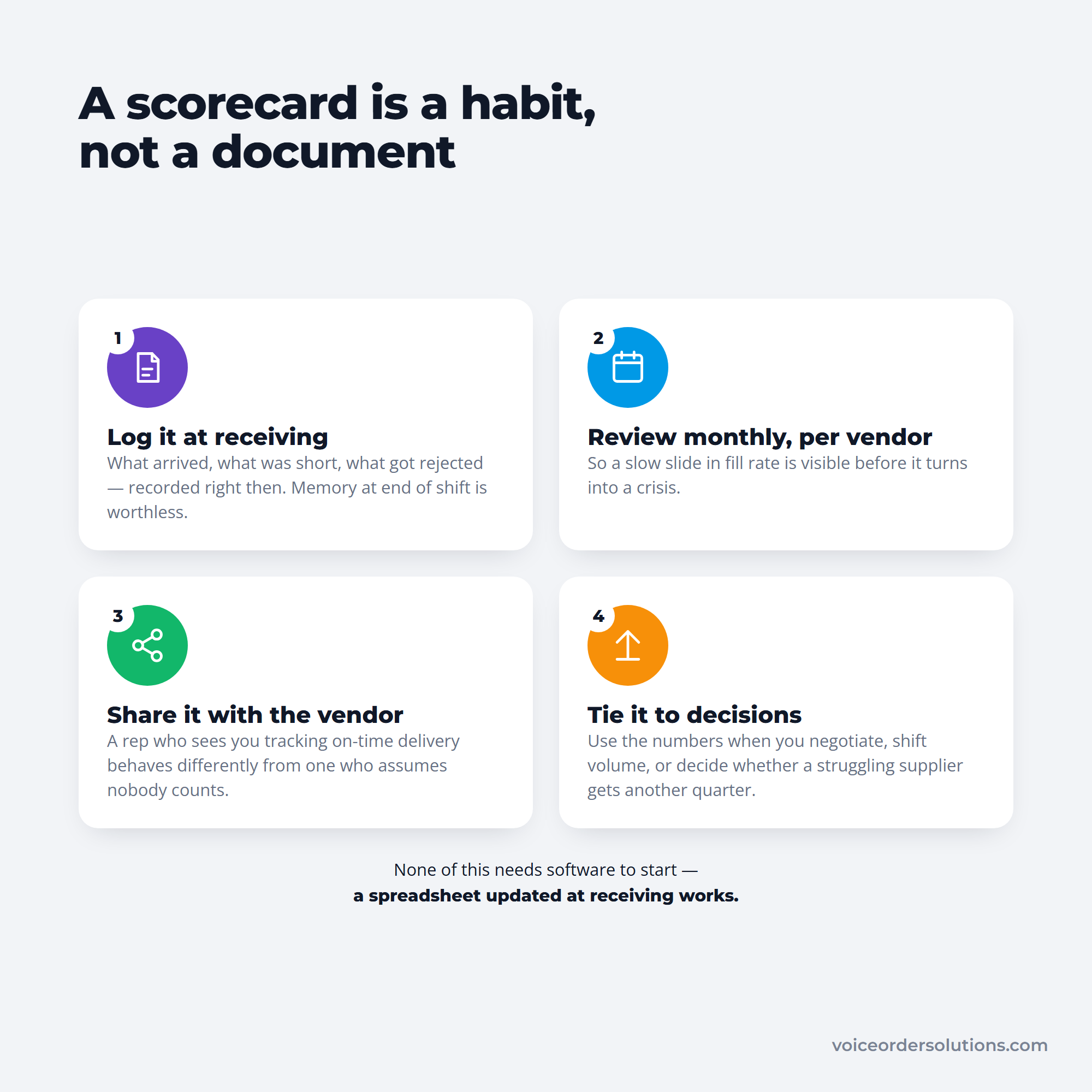
Pick a handful of metrics that map to what actually hurts when a vendor fails, then log them every delivery. You do not need a fancy system to start; a spreadsheet updated at receiving works. What matters is that you are tracking trends, not reacting to the last bad drop. Whether that log lives in a spreadsheet or in restaurant vendor management software, the numbers that decide which vendors stay on the list are usually order accuracy and price.
| Metric | How to measure it | What good looks like |
|---|---|---|
| On-time delivery | Deliveries on the agreed window ÷ total deliveries | 95%+ |
| Fill rate | Items delivered complete ÷ items ordered | 98%+ |
| Quality / rejection rate | Items rejected on receiving ÷ items delivered | Under 2% |
| Invoice accuracy | Invoices matching the order and price ÷ total invoices | 98%+ |
| Responsiveness | Time to resolve a credit or issue | Same day |
Turning those metrics into a habit takes four steps, none of which need software to start.
A scorecard is only useful if it changes what you do. Reviewed and shared, it quietly raises the performance of every vendor on your list because they know the numbers are being kept.
Most operators negotiate one number, the price per case, and leave real money on the table. The terms around the price often matter more than the price itself.
A case has more riding on it than the number on the order guide, so price one out with freight, handling and shrink included and see the margin you actually keep.
Price a case the right way. Add freight, handling and shrink, set your markup, and see the margin you actually keep.
What the case costs you
How you price it
The figure worth negotiating over is the margin after shrink, not the markup you quoted. A markup that looks healthy on the order guide gives back several points once freight, handling and the cases you throw away are in the math. Take that number into the conversation, because it is the one that shows which concessions actually pay.
Negotiate delivery windows that fit your prep schedule, payment terms that ease your cash flow, and the right to audit the contract so you catch price creep. A vendor who holds the line on unit price might happily give you net-30 terms or a standing Tuesday delivery that saves you a scramble. A window is only worth negotiating if the truck keeps it, so ask how the distributor measures estimated time of arrival accuracy before you sign.
Three things shift the balance in your favor before you ever talk price.
Come to every negotiation with your own data: your scorecard numbers, your volume, and the prices you are getting elsewhere. A vendor discussion backed by "here is your fill rate and here is your competitor's quote" goes differently than one built on a vague sense that you are paying too much.
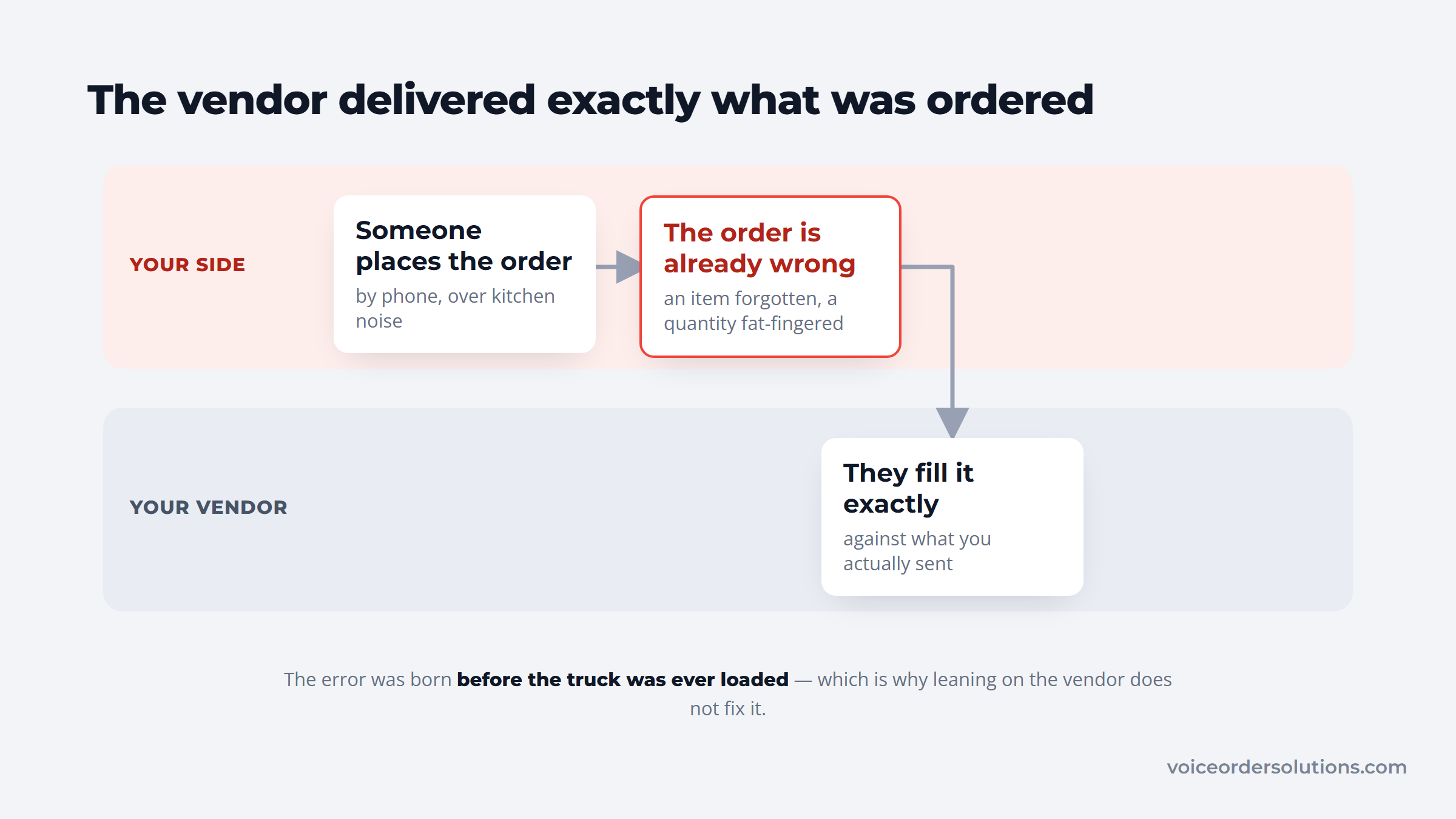
Ask operators where vendor problems come from and they will point at the supplier. Look closer and most errors are born on your side, at the moment an order gets placed: an item forgotten, a quantity fat-fingered, a phone order the rep hears wrong over kitchen noise. The vendor delivered exactly what was ordered; the order was just wrong.
Follow one bad order back and it rarely started on the supplier's side.
Phone and handwritten ordering is still the norm at a lot of independent restaurants, and it is where the mistakes hide. One restaurant manager described the problem on Reddit: phone calls remain the main way orders get placed, alongside messy handwritten stock counts, and "this process is prone to mistakes and miscommunication," with neither the restaurant nor the supplier able to confirm what was actually ordered.
When there is no clean record, a dispute becomes your word against theirs, and you usually eat the difference.
The fix is to capture the order once, cleanly, and confirm it before it sends. That means no retyping a paper note into a portal later, and no relying on a voicemail nobody can play back.
VoiceOrder Solutions is a voice-powered ordering tool built for exactly this gap. Staff speak a restocking order into the app while walking the line, hands free, and the order is digitized, confirmed, and timestamped before it goes to the distributor. Because it captures the order at the source and confirms it against the customer's own order guide, the transcription errors that come from re-keying a phone order disappear.
A few specifics that matter for vendor management:
For a restaurant, the payoff is time and accuracy: the roughly 30 minutes a week many operators spend phoning orders shrinks, and the orders that go out are right the first time. It handles the placing-the-order step, not your inventory counts or accounting, so it sits alongside whatever inventory system you already run. You can see the full ordering flow on the VoiceOrder Solutions How It Works page.
The order going out clean is half the job. The money coming back, credits owed, prices charged, invoices matched, is where vendors quietly overcharge restaurants that are not watching.
Vendor prices move constantly, and distributors do not make them easy to compare. One operator built a whole system for it on Reddit, a spreadsheet that auto-imports invoices and flags any price that jumps beyond a normal range, because vendors intentionally vary pack sizes and descriptions to make apples-to-apples comparison hard.
Their blunt takeaway: at a minimum you had better be tracking prices in a spreadsheet somewhere, "or you absolutely will be paying too much." You do not need to build what they built, but you do need a running record of what each item should cost.
Credits are the other leak. Short deliveries, spoiled product, and wrong substitutions all create credits you are owed, and they get scribbled on a paper invoice and forgotten. Record every credit at receiving, the moment you reject the item, and reconcile it against the vendor's statement so nothing slips. Invoice capture software that reads line items at receipt is one way to stop credits and price hikes from getting past you.
A few standing checks stop most overcharges before you ever pay them.
Accurate, confirmed orders make all of this easier, because a timestamped order is the reference point every invoice and credit gets checked against. Manage the orders well and the invoice work gets shorter, not longer.
Even good vendors fail sometimes: a truck breaks down, a product goes out of stock nationally, a supplier goes under. Vendor management is not just running the relationship well, it is having a plan for the day it breaks.
Keep a backup vendor identified for each primary category, ideally one of the two-to-three you already buy from, so shifting volume is a phone call, not a scramble. For your most critical items, hold a small buffer of shelf-stable or frozen stock so a single missed delivery does not empty the station mid-service.
Build a little flexibility into the menu too. A kitchen that can swap one green for another, or run a special around whatever protein actually arrived, rides out a supply gap that would sink a rigid menu. The operators who stay calm when a vendor fails are the ones who decided, in advance, exactly what they would do.
Restaurant vendor management is not one big project. It is a set of habits: choosing vendors on more than price, keeping two to three per category, building a real relationship with a named rep, scoring performance on hard numbers, negotiating the terms and not just the price, and closing the order and invoice gaps where money leaks out.
Start with the two that pay back fastest. Put a simple scorecard in place this week so you are measuring instead of guessing, and tighten how orders get placed so they go out right the first time.
If phoning and re-keying orders is where your errors and lost time cluster, contact VoiceOrder Solutions for a demo of how voice ordering closes that gap. The vendors will not change on their own, but the way you manage them can, starting with your next delivery.
Restaurant vendor management is the work of sourcing, ordering, receiving, and paying the suppliers that keep a kitchen running, from produce and protein to paper goods and equipment service. Done well, it means the right products arrive on time, at the agreed price, with errors caught before they reach an invoice. It covers vendor selection, performance tracking, negotiation, order accuracy, and payment control.
Vendor management is the day-to-day operational side: delivery, quality, cost, and invoice accuracy across every supplier. Restaurant vendor relations management is the strategic side, the longer-term partnership work you invest in your two or three most important suppliers so you get priority in a shortage, better terms, and early warning on price moves. You manage all vendors; you build relationships with the few that matter most.
For primary categories like meat, dairy, and produce, two to three vendors each is the common recommendation. That gives you a live price comparison, a backup when one supplier is out of an item, and real negotiating leverage. For specialty items with only one good source, a single vendor is fine, but recognize it as a single point of failure and keep a little buffer stock.
Track on-time delivery rate, fill rate (items delivered complete versus ordered), quality or rejection rate at receiving, invoice accuracy, and how fast a vendor resolves a credit or issue. Log these at delivery, review them monthly per vendor, and share the scorecard with your reps. The numbers turn vague complaints into leverage you can negotiate with.
Most ordering errors come from manual re-entry: retyping a phone or paper order, or relying on a voicemail nobody can replay. Capture each order once and confirm it before it sends. VoiceOrder Solutions lets staff speak an order that is digitized, timestamped, and confirmed against the order guide before it reaches the distributor, which removes the transcription step where wrong quantities and missed items usually appear.