.webp)
Key takeaways:
An estimated time of arrival is the most-quoted number in logistics and one of the least examined. Everyone publishes one, customers plan around it, and very few operations can say how often theirs is right.
The gap matters because an ETA is a commitment in everything but name. A restaurant receiving a produce delivery schedules labor around it. A retailer books dock time. When the estimate slips by two hours, the cost lands on someone else's shift.
This guide covers what the term actually means, why estimates drift, and the concrete steps that tighten them, including the ordering-side fixes that most ETA advice skips entirely.
The estimated time of arrival meaning is the same wherever you meet it: the predicted time at which a vehicle, shipment, or person will reach a specified destination. ETA (estimated time of arrival) is used identically across trucking, shipping, aviation, and last-mile delivery, and it always describes a forecast, calculated from current position, remaining distance, expected speed, and known delays.
The word doing the work is "estimated." An ETA is a probabilistic statement, not a guarantee, which is why mature operations quote it with a window rather than a single minute.
A concrete estimated time of arrival example makes the meaning clearer. A truck leaves a distribution center at 6:00 AM with 180 miles to cover. At an assumed average of 55 mph the driving time is about 3 hours 16 minutes, so the planner rounds to an ETA of 9:20 AM.
If the driver hits 40 minutes of congestion outside the city, actual arrival becomes 10:00 AM, and the ETA was wrong by 40 minutes even though nothing went wrong with the plan.
ETA rarely appears alone. Three related abbreviations sit alongside it, and mixing them up is a common source of confusion between shippers and receivers.
| Term | Stands for | What it describes | Estimated or actual |
|---|---|---|---|
| ETA | Estimated time of arrival | Predicted arrival at the destination | Estimated |
| ETD | Estimated time of departure | Predicted departure from origin | Estimated |
| ATA | Actual time of arrival | Recorded arrival, after the fact | Actual |
| ATD | Actual time of departure | Recorded departure, after the fact | Actual |
The pair that matters most for accuracy is ETD and ATD. An ETA is built on an assumed departure, so a truck that leaves 45 minutes late arrives 45 minutes late before traffic is considered at all. Operations that track ATD against ETD usually find their ETA problem started in the yard.
ETA error is rarely one big failure. It accumulates from several small, predictable sources, and each one is measurable if someone chooses to measure it.
Congestion is the largest external factor and it is getting worse rather than better. The American Transportation Research Institute calculated that highway congestion added $108.8 billion in costs to the US trucking industry in 2022, a 15% year-over-year increase, equivalent to more than 430,000 drivers sitting idle for a full work year.
Congestion is also highly concentrated, so a route through a known corridor carries far more risk than mileage alone suggests.
Driver hours are the second hard constraint, and they are legal rather than negotiable. FMCSA rules limit property-carrying drivers to 11 hours of driving within a 14-hour on-duty window, with a required 30-minute break after eight cumulative hours of driving. An ETA that implies a driver will push past those limits is not optimistic, it is invalid.
Dwell time at the loading dock is the factor most often left out of the model entirely. Time spent waiting to be unloaded at a previous stop pushes every downstream ETA on that route, and many operations never record it, so it never enters the calculation. Distributors running warehouse and distribution software can capture dock times automatically, which is usually the fastest way to get the number.
The basic calculation is simple arithmetic, and the accuracy comes from what you include rather than from the formula.
Start with distance divided by realistic average speed, then add everything that isn't driving:
Working through the earlier example with those steps changes the answer. The same 180-mile run at a realistic 48 mph average takes 3 hours 45 minutes.
The two answers come from the same trip, and everything separating them is time nobody was driving.
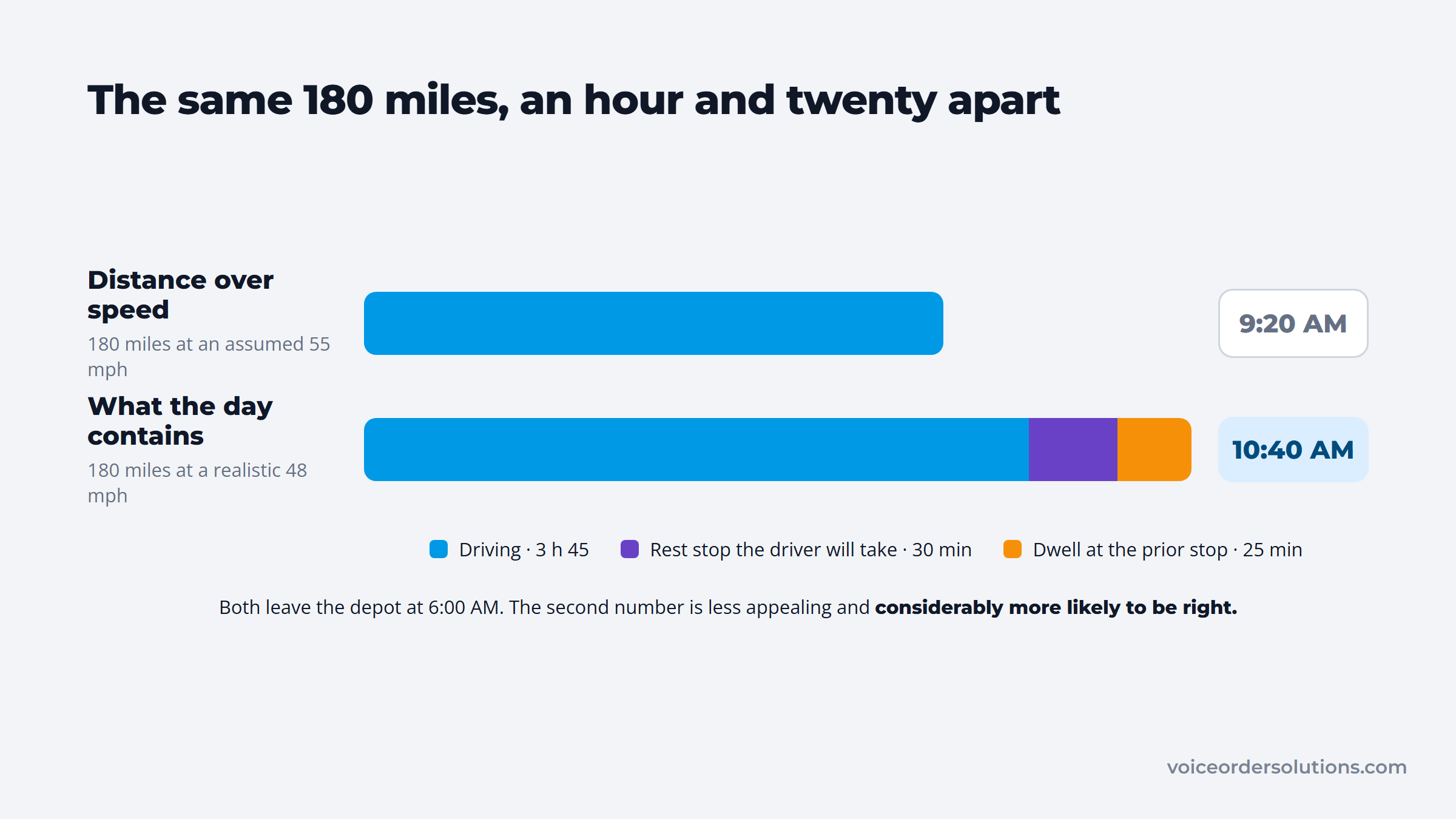
Add a 30-minute rest stop the driver will actually take and 25 minutes of expected dwell at the prior stop, and you get 4 hours 40 minutes, or an ETA of 10:40 AM rather than 9:20 AM. The second number is less appealing and considerably more likely to be right.
The definition holds across modes, but the accuracy you can reasonably expect does not, and applying road-freight assumptions to ocean freight causes a lot of misplaced confidence.
Road freight is the most predictable over short distances and the most volatile in urban delivery, where a single congested corridor can absorb an hour. Estimates are usually good to within an hour on regional runs and degrade sharply on multi-stop city routes.
Ocean freight works on a completely different scale. An ETA quoted three weeks out is genuinely a range, and port congestion at the destination frequently adds days rather than hours, which is why importers plan around a week rather than a day. Air freight sits between the two, reliable in transit and unpredictable in customs clearance.
Last-mile delivery is the mode where customers expect the most precision and operators have the least control, because the estimate depends on how many stops precede theirs and how long each takes. This is why last-mile ETAs are almost always dynamic and quoted as a window.
Match your promised precision to the mode. Quoting an ocean shipment to the hour, or a city delivery to the minute, sets up a failure the operation was never able to avoid.
A static ETA is calculated once, at dispatch, and communicated as fixed. A dynamic ETA recalculates continuously from live position and traffic data, updating as conditions change.
Static estimates are cheap and they work acceptably on short, predictable routes with few stops. They fail badly on long multi-stop routes, because error compounds at every stop and nobody downstream learns about it until the truck fails to appear.
Dynamic ETAs solve the compounding problem but introduce a communication one. An estimate that shifts every few minutes is accurate and unusable, because a receiver cannot schedule labor against a number that keeps moving. The practical answer most operations land on is recalculating continuously but only notifying the customer when the estimate moves past a meaningful threshold, such as 30 minutes.
Almost every guide to estimated time of arrival begins at dispatch, which skips the step where a surprising share of error is created. An ETA cannot be accurate if the order it is built on arrived late, incomplete, or wrong.
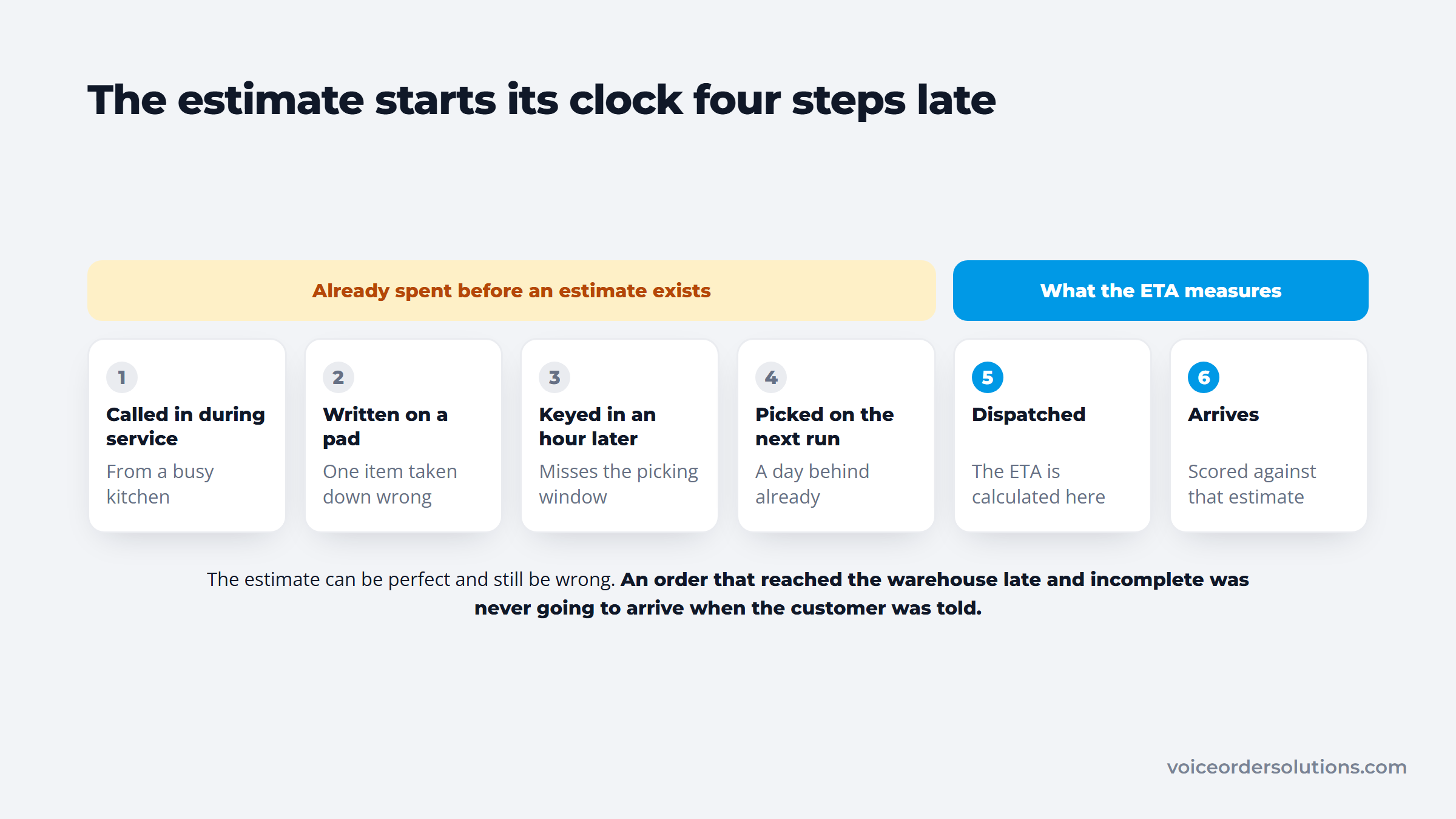
Consider the ordinary path a food distribution order takes. A restaurant manager calls it in during service through the restaurant phone system, a rep writes it on a pad, it gets entered into the system an hour later, and one item is transcribed incorrectly. That order now misses its picking window, ships on the next run, and the delivery ETA the customer was given was never achievable.
Laid out end to end, the estimate only ever covers the last two steps of six.
This is the gap VoiceOrder Solutions addresses, from the supplier's end of it. Store and restaurant buyers talk their order into an app the distributor has issued them. The moment they finish, the order exists as a dated, numbered record inside the distributor's system rather than as a message waiting to be heard.
Two parts of that matter for arrival estimates specifically. The timestamp gives the distributor a hard record of when the order genuinely entered the queue, rather than when someone got round to keying it in. Because capture runs around the clock, an order placed after close is queued rather than discovered the following afternoon, which keeps it inside its normal fulfillment window instead of pushing it a day late. Both properties come from capturing the order once at the source, which is the same test that decides whether order entry software helps or simply moves the typing somewhere else.
VoiceOrder Solutions does not track vehicles, plan routes, or calculate ETAs, and it is not a fleet system. It improves the input that arrival estimates depend on, which is a different and largely unaddressed problem.
The other order-side fix is a cutoff time that both sides genuinely treat as real. A published cutoff that is routinely stretched teaches customers it is negotiable, and every late order accepted pushes the picking schedule that tomorrow's ETAs are built on.
Pick a cutoff that reflects the time your warehouse actually needs, show it to the customer at the moment they order, and route anything arriving after it to the next run rather than squeezing it in. Distributors running customizable ordering software can enforce this automatically instead of leaving it to a rep's judgment during a phone call.
Operations that tighten their cutoff usually see delivery-window performance improve without touching routing at all, because the schedule stops being rebuilt every morning.
Fleet operations have the most levers here, because they control both the data and the vehicle. The improvements that move the number most are unglamorous.
You cannot improve an estimate you never score. Capture actual time of arrival and actual time of departure at every stop, automatically through telematics where possible, and store them against the original estimate. Within a month you will have enough data to see which lanes, drivers, and customers are systematically slower than the model assumes.
Dwell time is not a fleet-wide constant. A receiver with two docks and a forklift unloads in twenty minutes; one with a single door and no equipment can take ninety. Once you have recorded actuals, calculate a per-customer dwell average and feed it into the routing calculation instead of using a single default. Long dwell also raises what each stop costs, which a delivery cost calculator splits out per drop, per case and per mile.
A flat 15-minute buffer on every route is wrong twice: too generous on stable short runs and nowhere near enough on volatile urban ones. Calculate the spread of historical arrival times per lane and set the buffer from that spread, so predictable routes get tight windows and difficult ones get honest ones.
Decide what change is worth a notification and automate it. Most receivers want to know when an ETA moves by more than half an hour, and want nothing at all for a five-minute drift.
Together those four changes typically do more than buying better traffic data, because they fix assumptions the traffic feed never touches. Pair them with order tracking software so the stop-level record and the order record can be read against each other rather than separately.
Most operations measure ETA accuracy as an average error, which is the least useful summary available. An average hides the tail, and the tail is where the complaints come from.
| Metric | What it tells you | A workable target |
|---|---|---|
| On-time within window | Share of arrivals inside the promised window | 90% or better |
| Mean absolute error | Average size of the miss, in minutes | Under 20 minutes |
| Late tail (P90) | The miss size your worst 10% experience | Under 60 minutes |
| Early arrivals | Share arriving before the window opens | Under 10% |
| ETD accuracy | Share departing within 15 minutes of plan | 85% or better |
Early arrivals deserve their own line because they are treated as a success and are frequently not one. A truck that shows up two hours early at a receiver with no dock space waits, blocks a bay, and delays its own next stop.
The scorecard and the yard disagree about that delivery, and only one of them is right.

Track these per lane and per customer rather than as a single company number. A fleet-wide 92% on-time figure can comfortably conceal one metropolitan area running at 60%.
The way an estimate is expressed changes how much accuracy you need. A single-minute ETA is a promise you will break; a window is a forecast you can hold.
Quote a window sized to your actual measured variability for that lane, and widen it honestly where the data says you should. Customers plan better around a reliable two-hour window than an unreliable fifteen-minute one, and they escalate far less often.
When an ETA slips past your notification threshold, send the update immediately rather than waiting for confirmation. A receiver told at 9:00 that a 10:00 delivery is now arriving at 11:30 can move labor; the same receiver told at 10:15 has already paid for the crew.
The threshold is only as good as the order behind it, which is why order fulfillment software that knows when the order was actually placed gives a more honest window than one starting the clock at dispatch.
A few errors show up repeatedly across operations of every size, and all of them are cheaper to fix than to live with.
The last one is the most commonly missed, because it sits upstream of everything a fleet team controls and usually belongs to a different department.
Improving estimated time of arrival accuracy is mostly a measurement problem wearing a technology costume. Start by recording actual arrivals and departures against your estimates for four weeks, then look at which lanes and customers account for the misses.
You will usually find the error concentrated rather than spread evenly, and it is often traceable to dwell time nobody logged or orders that reached the warehouse later than anyone assumed. Distributors reviewing their stack will find most wholesale order management platforms record order timestamps already, and the data is simply never pulled.
Fix the concentrated causes before evaluating a routing platform, because better software applied to unrecorded assumptions produces confident estimates that are wrong in exactly the same way.
For food distributors whose arrival estimates keep slipping because orders arrive by voicemail and get keyed in hours later, VoiceOrder Solutions timestamps and transmits the order at the moment it is spoken. It is built for independent food distributors and the wider software-for-distributors stack they already run. Contact VoiceOrder Solutions to see how the order record fits your fulfillment window.
ETA stands for estimated time of arrival. It is the predicted time a vehicle, shipment, or person will reach a destination, calculated from current position, remaining distance, expected speed, and known delays. The estimated time of arrival definition holds across trucking, shipping, aviation, and last-mile delivery, and in every one of them it describes a forecast rather than a guaranteed arrival time.
ETA is the estimated time of arrival at the destination, while ETD is the estimated time of departure from the origin. They are two ends of the same trip. ETD matters more than most operations realize, because an arrival estimate assumes a departure time; if a vehicle leaves 45 minutes late, the ETA is already 45 minutes wrong before any traffic is encountered.
Judge accuracy against a window rather than a minute. A realistic target for most road operations is arriving within a 30-minute window at least 90% of the time, with the worst 10% of arrivals missing by under an hour. What matters more than the specific figure is measuring the late tail rather than the average, since averages conceal exactly the misses customers notice.
Usually because the model omits something rather than because traffic data is poor. The three most common omissions are dwell time at previous stops, which is frequently never recorded; realistic average speeds, where planners use posted limits instead of achieved speeds; and order-entry delay, where the shipment entered the system later than anyone assumed. Legally mandated driver hour limits also cap what any route can achieve.
No, and any vendor claiming otherwise is overselling. Routing and telematics platforms improve estimates significantly by using live position and traffic data, but they still depend on inputs the software does not control: when the order arrived, how long the previous receiver took to unload, and whether the driver has hours available. Software applied to unmeasured assumptions produces confident predictions that repeat the same errors.