The cost per delivery formula is route cost divided by drops. Put in one day on one of your own routes and it splits that cost out per drop, per case and per mile.
The driver
$
Wage plus payroll taxes and benefits, not the rate on the offer letter.
hours
Clock in to clock out, including the pre-trip check and the load.
The truck
miles
Dock back to dock, so the empty miles at both ends are counted.
mpg
A loaded straight truck on close city stops lands near 8.
$
What you pay at the pump or on a fuel contract.
$
Lease or depreciation, insurance, maintenance and plates, divided by route days.
What the route delivers
drops
Stops the driver makes in the day. Cost per drop doubles as a delivery price calculator: it is the floor any delivery charge has to clear.
cases
Total cases loaded for the day. This is how to calculate freight cost per unit: route cost over the cases that route carries.
days
A weekday route usually runs 21 or 22 days a month.
Cost per drop
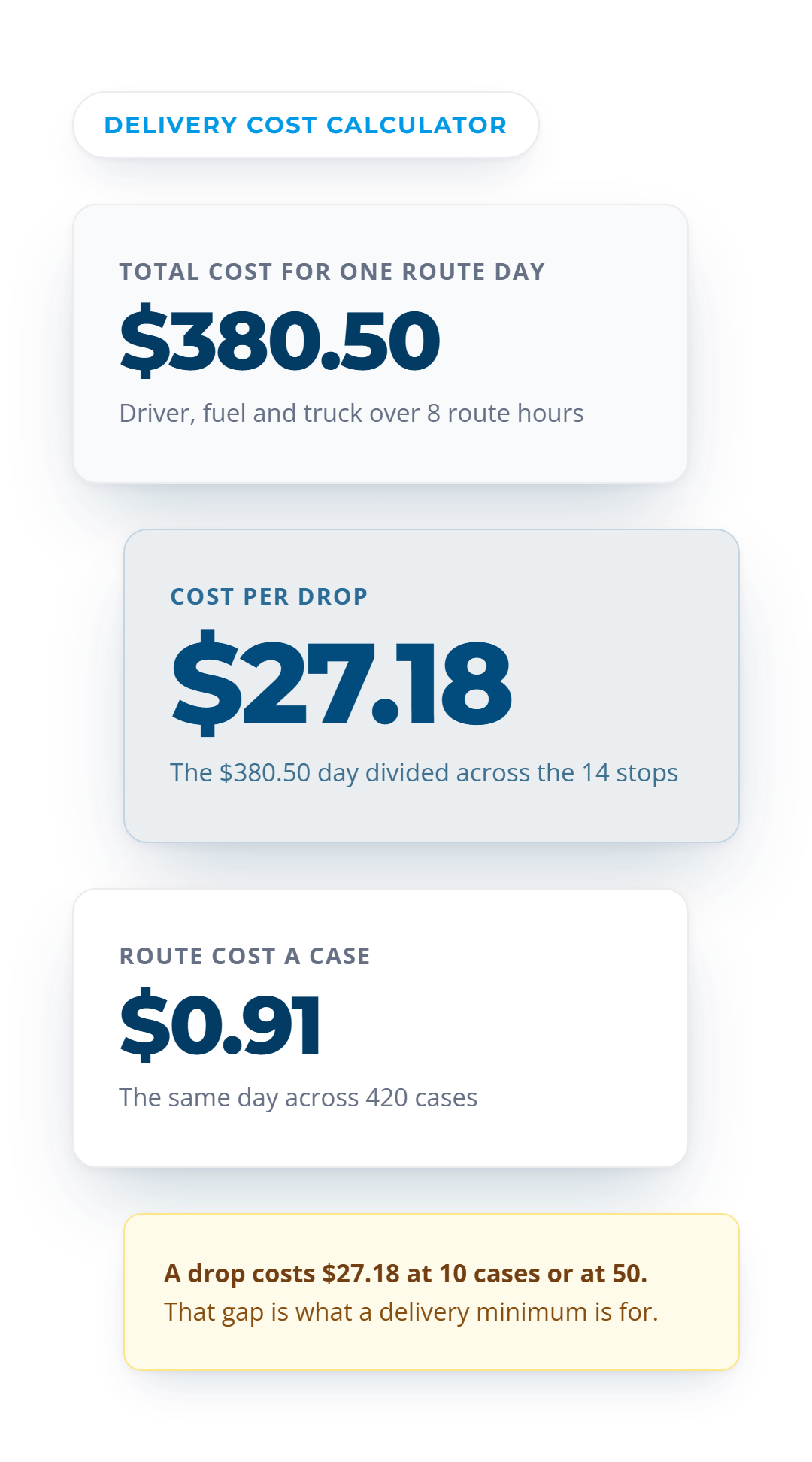
$27.18
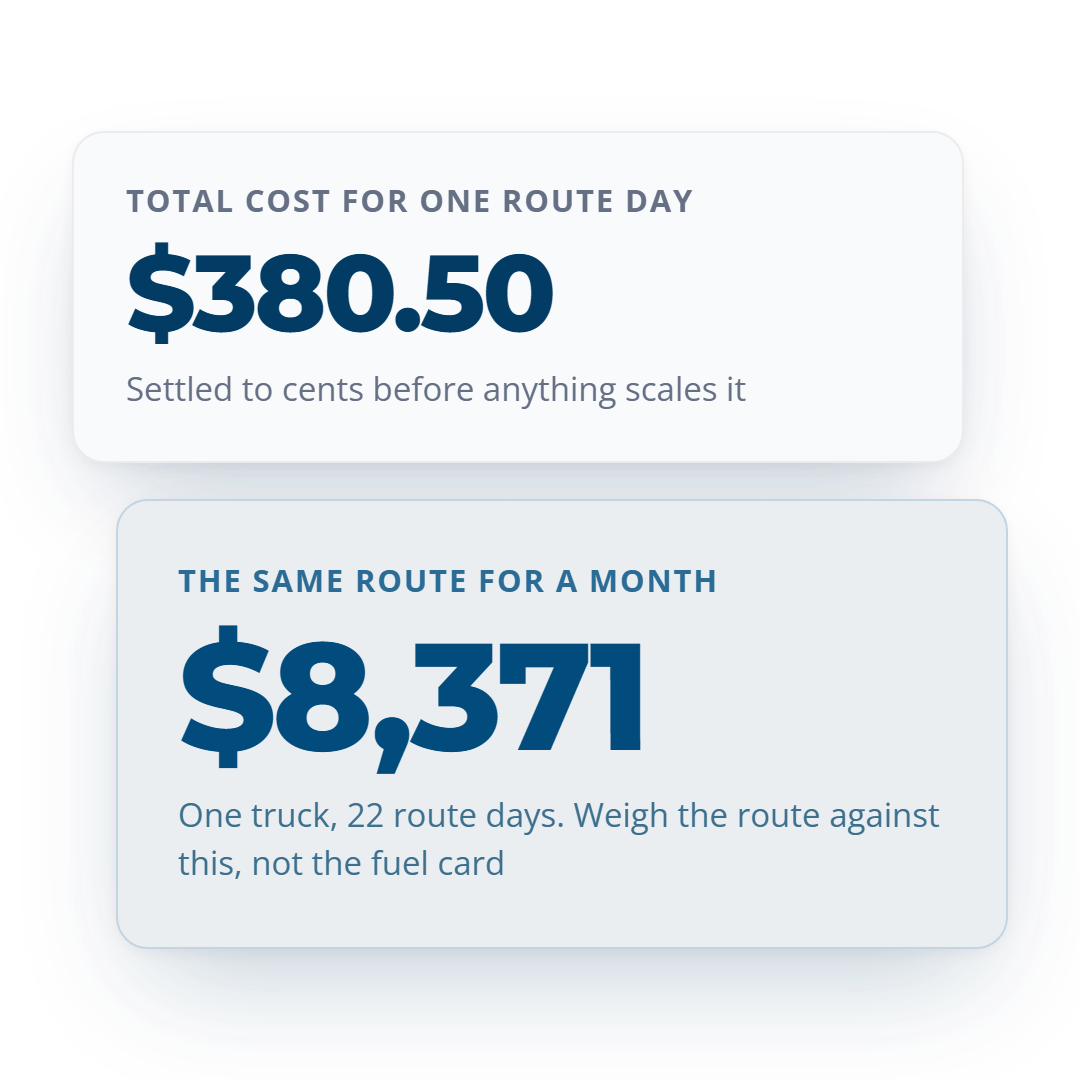
$380.50 of route cost across 14 drops
Total cost for the day
$380.50
$224.00 driver, $61.50 fuel, $95.00 vehicle
Cost per case
$0.91
$380.50 across 420 cases, about 30 a drop
Cost per mile
$3.17
Across 120 route miles
Fuel for the route
$61.50
15 gallons at $4.10 a gallon
Monthly cost of the route
$8,371
At 22 route days a month
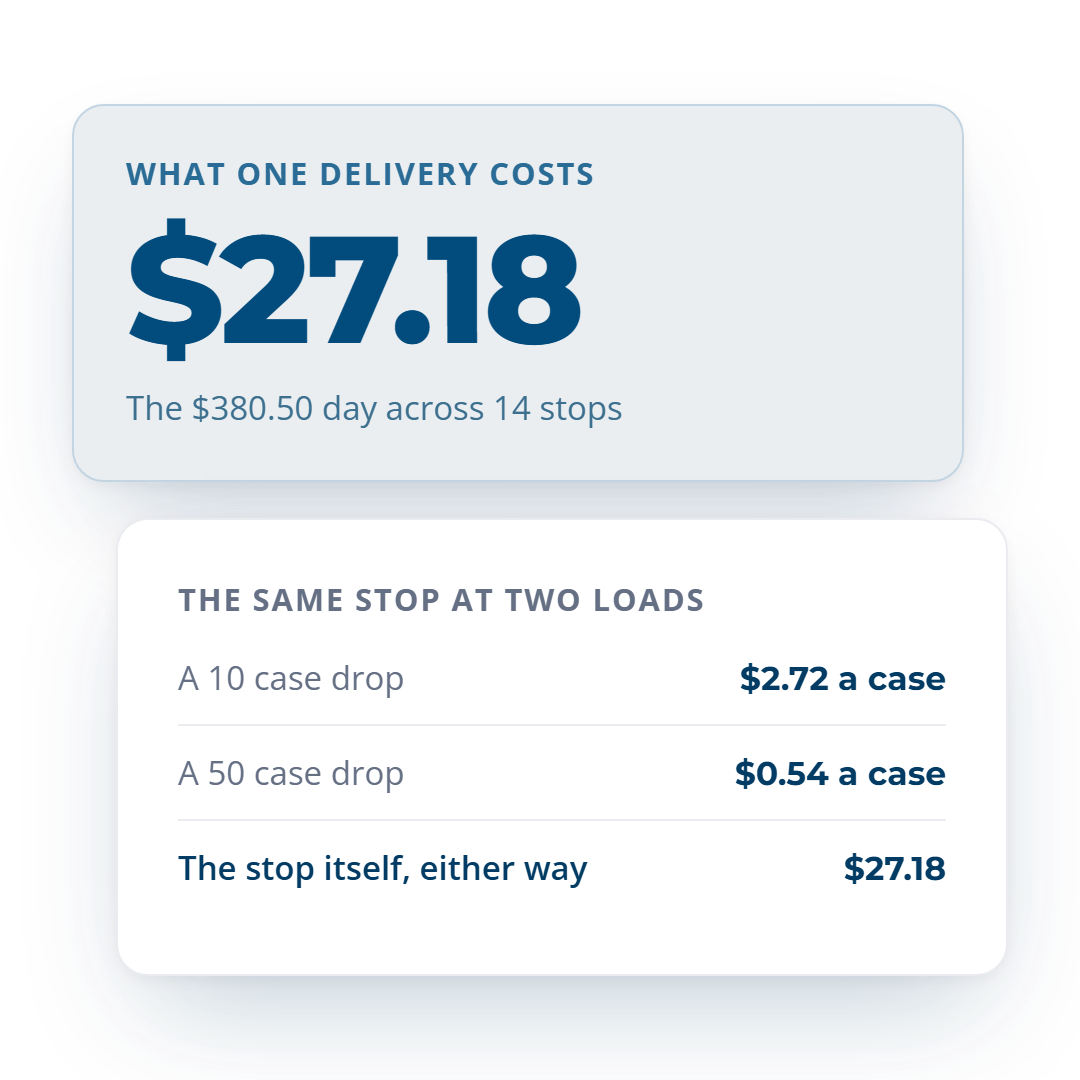
The drop costs $27.18 whether it is 10 cases or 50. At 10 cases that is $2.72 a case against a $0.91 average, which is what a delivery minimum is actually for.
Estimates only. A route level distribution cost calculation, so it does not carry warehouse overhead, admin, or the cost of a redelivery.
What does one drop actually cost you?
Seven quick questions about one route. At the end you get the cost of a drop, a case and a mile, which is the whole argument for a delivery minimum.
Step 1 of 7
The situation
What put the route under the microscope?
Pick the closest one.
Pick one to carry on.
The driver
What does the driver cost, and how long is the run?
Fully loaded cost, with payroll taxes and benefits in it.
$
Loaded, not the hourly rate on the payslip.
hours
Door to door, including loading and returns.
Enter a wage and route hours above zero.
The truck
And what does the truck cost to run?
The vehicle cost per day is the part that does not care how many drops you make.
miles
Round trip.
mpg
Loaded, in traffic. Be honest.
$
What you are paying this week.
$
Lease or depreciation, insurance, maintenance, spread across a working day.
Those cannot be negative.
What the run carries
How many stops and how much product?
This is where a cost per drop turns into an argument about minimums.
drops
Stops where something comes off the truck.
cases
Total across the whole run.
days
How often this run goes out.
Enter a drop count above zero.
How the run gets built
When do most orders for tomorrow's truck land?
A route built on half the orders gets rebuilt, and that is a cost nobody books.
Pick one to carry on.
The ones that arrive late
How does a late add-on reach you after the route is built?
Last one before your numbers.
Pick one to carry on.
Your breakdown is ready
Cost per drop
--
The headline number. The rest are below.
Want to see your results?
You have given us enough to work this out. Fill this in and the full breakdown opens up.
Loading the form.
The form did not load.Your browser or your network is most likely blocking it. That should not cost you the numbers you just worked out.
Your details go straight to our team, who will follow up about these numbers.
Your result
Working it out.
Here is your breakdown.
Cost per drop
--
Cost per case
--
Total cost for the day
--
Cost per mile
--
Fuel for the route
--
Monthly cost of the route
--
A wrong case on the truck is a second trip at full route cost.
VoiceOrder Solutions gives every account an order guide tied to your own pricing and SKUs, and confirms the order before it reaches the pick list.
Estimates only. Confirm your fully loaded driver cost and vehicle cost per day.
$27.18
What one drop costs on a 14 stop route
$2.72
Route cost a case when a drop is only 10 cases
$0.91
Route cost a case across all 420 cases on the truck
The Basics
What is cost per delivery?
Cost per delivery is the share of a route day that one stop uses up, whatever it carries. It comes from the day's driver, fuel and truck costs, split evenly across every drop. It is the cost a delivery minimum has to clear.
Only the route day is counted
The route day and nothing before it. Picking in the warehouse and the time spent taking the order sit outside the $27.18, so serving a stop costs more.
Every stop priced the same
The calculator splits the day evenly, but a long unload or a detour uses more of the 8 hours than a quick drop.
The order that misses the route
An order that arrives after the route is built waits a day or gets a trip of its own. A trip of its own puts driver time, fuel and the truck behind one drop.
Who It's For
Who uses a delivery cost calculator
Any distributor running its own trucks can use it, from a single route to a full fleet. Whoever sets the delivery minimum, quotes a new stop or cuts a route should have that figure.
Owners setting a delivery minimum
Sales managers weighing small accounts
Reps adding a new stop
Transport managers costing a route
Controllers budgeting the fleet
DSD teams setting visit frequency
Owners pricing delivery fees
Ops reviewing light drops
Teams comparing two routes
How It Works
How to use the delivery cost calculator
Three groups of inputs and one real day. The day total is the number everything else divides.
1
Cost the driver and the truck
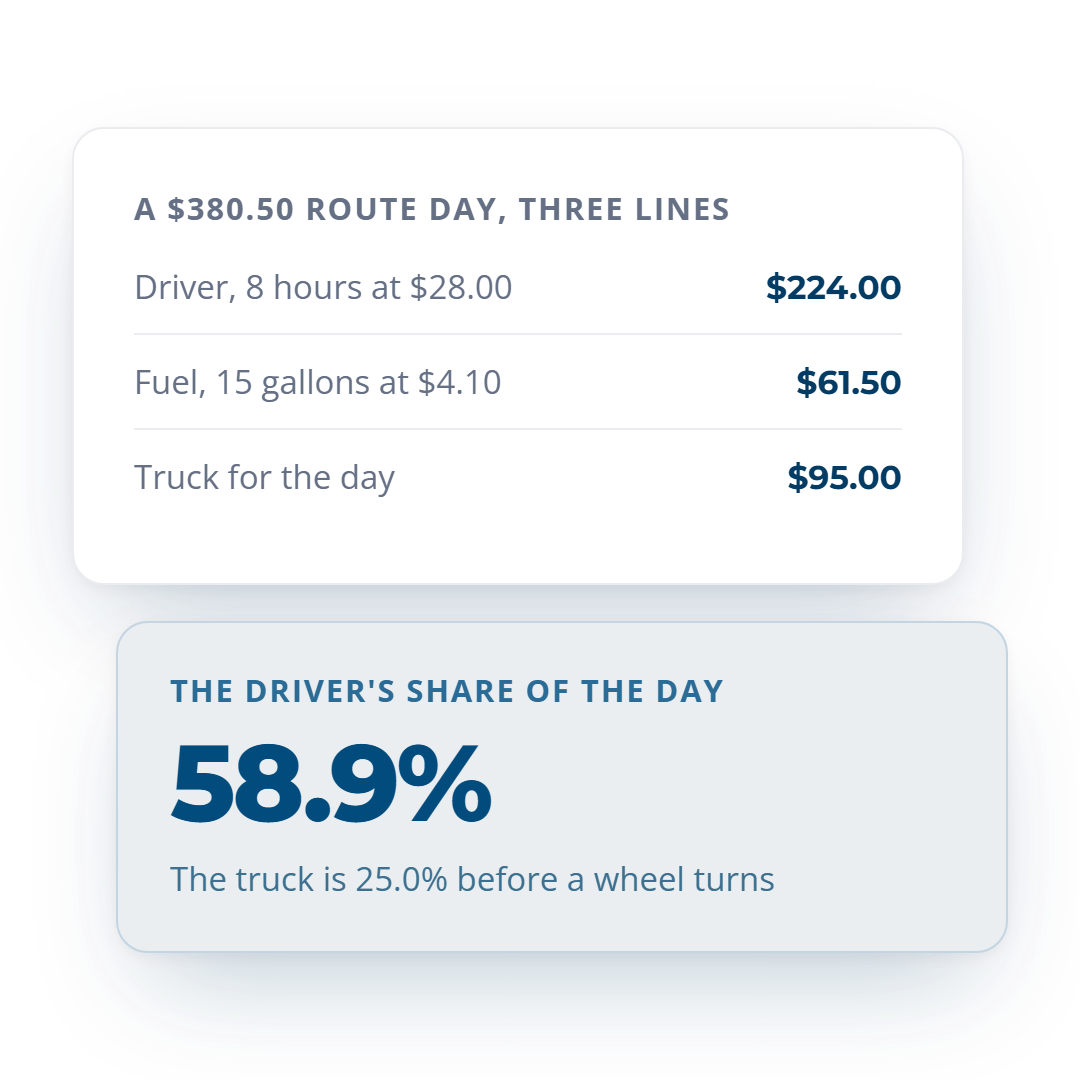
$28.00 an hour over 8 hours is $224.00 of driver. Add $95.00 for the truck day, lease, insurance, maintenance and plates included.
2
Add the miles and the fuel
120 miles at 8 mpg burns 15 gallons, so $4.10 a gallon is $61.50. The day lands at $380.50.
3
Split the day by drops, cases and miles
14 drops makes it $27.18 a delivery, 420 cases makes it $0.91 a case, and 120 miles makes it $3.17 a mile.
What You See
What the calculator shows you
Cost per drop
What one delivery costs before a case comes off
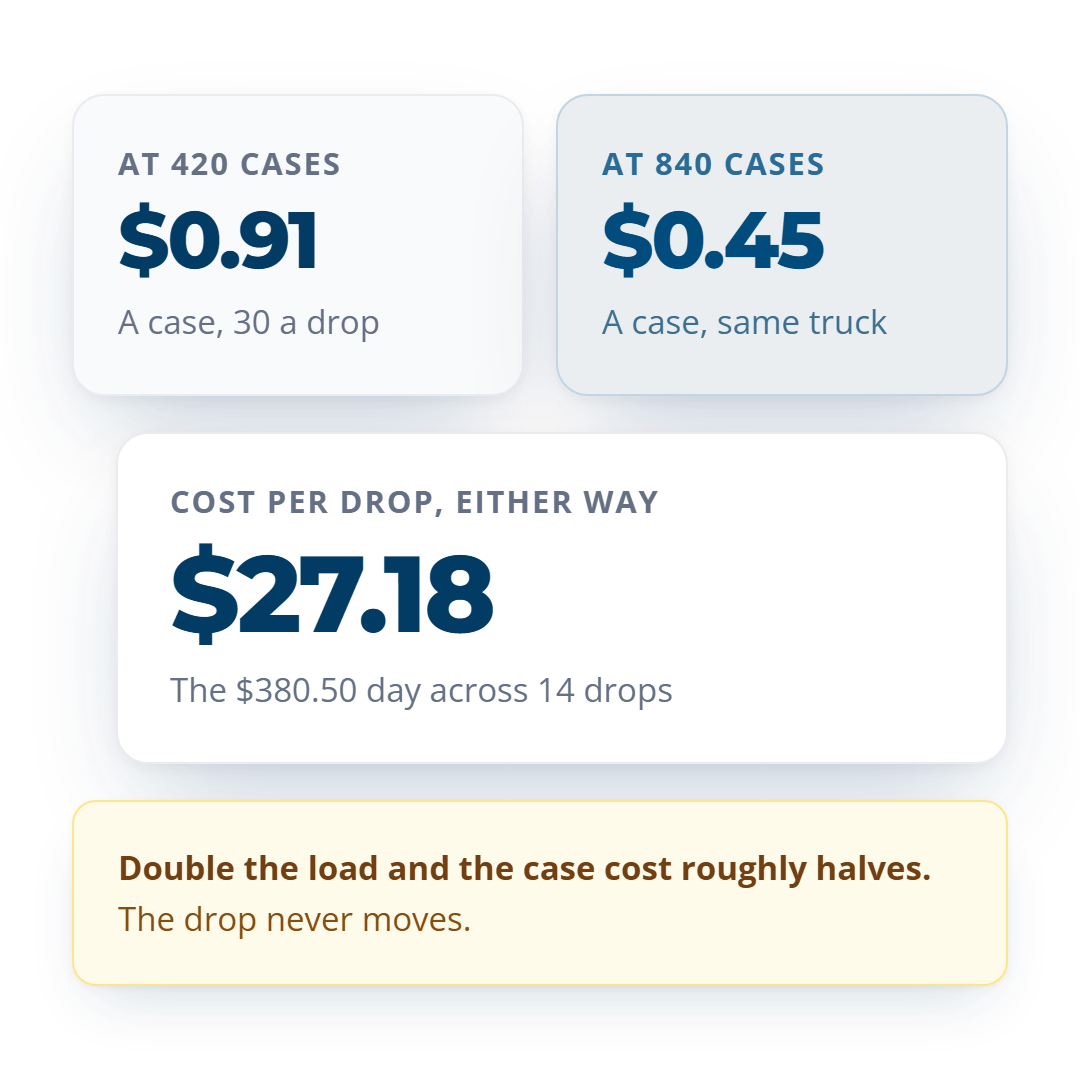
A $380.50 day across 14 drops is $27.18 a stop. That figure holds whether the drop is 10 cases or 50, which is why it is the floor a delivery charge has to clear.
Three of these set the cost of the day. The other three decide how far that day has to stretch.
Driver hours
$28.00 an hour over 8 hours is 58.9% of the day. A $45.00 driver takes the same route to $516.50 and the drop to $36.89.
The truck day
$95.00 of lease, insurance, maintenance and plates is 25.0% of the day, and it is spent whether the truck runs 60 miles or 120.
Fuel and mpg
120 miles at 8 mpg is 15 gallons, so $61.50 at $4.10. That is 16.2% of the day, so fuel is rarely where the answer is.
Drops in the day
The same $380.50 over 14 stops is $27.18 each. Fewer stops in the day means a dearer stop, with nothing else changing.
Cases per drop
420 cases averages 30 a drop. A drop of 10 cases costs $2.72 a case, three times the route average, and 50 cases costs $0.54.
Order accuracy
A wrong case is a second trip, and a second trip costs the full $27.18 again. Order accuracy is a route cost, not an office cost.
See how VOS gives every account its own order guide
VoiceOrder Solutions builds each customer an order guide tied to your own SKUs and pricing, and captures orders 24/7, so an after-hours order is waiting when the pick list is built instead of sitting in voicemail.
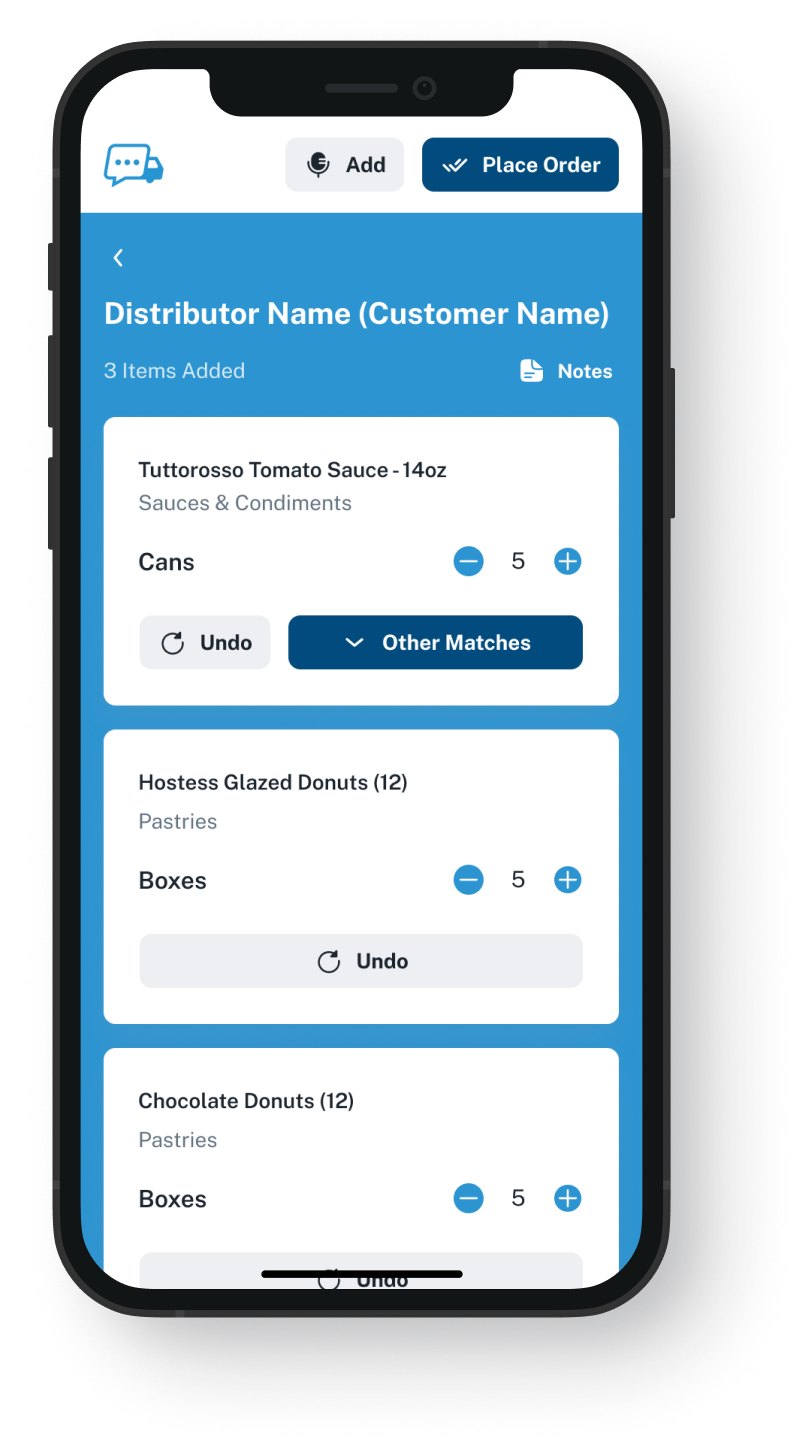
VOS does not plan routes, dispatch trucks or track deliveries. It works a step earlier. Customers order by voice in the VOS app, 24/7, and after-hours orders are in before the truck is loaded.
Customers order 24/7, after hours included
Each line reviewed by the customer before it is sent
For DSD, drivers show up with the right product
20-30 minutes saved per order compared with a phone order
Add the driver, the fuel and the truck for one day, then divide by the stops. A $28.00 driver over 8 hours is $224.00, 120 miles at 8 mpg is $61.50 of fuel at $4.10, and the truck day is $95.00. That $380.50 across 14 drops is $27.18 a delivery.
Where should a delivery minimum be set?
Above the margin a stop has to earn, not at a round number. At $27.18 a drop, an account buying at a 20% margin has to order $135.90 of product before the stop pays for itself. Set the minimum so the smallest order on the truck still clears that.
Should you charge customers for delivery?
Either charge for it or price it in, but do it knowing the number. At $0.54 a case, a 50 case drop absorbs the stop without anyone noticing. At $2.72 a case, a 10 case drop does not, so that is where a delivery charge or a minimum belongs.
What does a light drop do to your margin?
It takes it a case at a time. The same $27.18 stop spread over 10 cases is $2.72 a case against a $0.91 route average. If the gross margin on those cases is under $2.72, the delivery costs more than the order earns.
Should you drop an account that orders too little?
Change the frequency or the minimum before you drop it. An account taking a stop every week at 10 cases can take one every other week at 20 cases, and the route cost falls from $2.72 a case to $1.36 with the same volume sold.
How do you count the truck's fixed cost in a delivery cost?
As a cost per route day, not a cost per mile. Take the lease or depreciation, insurance, maintenance and plates for the year, then divide by the days the truck actually runs. At $95.00 a day that is 25.0% of a $380.50 route before the truck leaves the yard.
What is the cost per case on a delivery route?
Route cost over the cases that route carries. $380.50 across 420 cases is $0.91 a case, and $3.17 a mile across 120 miles. Load 840 cases on the same day and the case cost falls to $0.45, while the cost per drop stays at $27.18.
Get the order right before the truck is loaded
VoiceOrder Solutions digitizes and confirms every order before it reaches the pick list, so a wrong quantity does not come back as a second trip to the same stop.