For Independent Food Distributors

Warehouse Size Calculator

See how many cases a building you already have can actually hold, and how many weeks of flow that is at your throughput.
VoiceOrder app ordering screen

Warehouse Size Calculator

See how many cases a building you already have can actually hold, and how many weeks of flow that is at your throughput.

The building you have

sq ft
Total floor area under roof.
% of floor
What is left after aisles, dock, staging and office.
sq ft
A standard 48 by 40 inch pallet is 13.3 square feet.
high
Floor stacked or rack levels. Food crushes, so most go 2 or 3.

What you move through it

cases
A rough average across your order guide.
cases
So we can turn capacity into weeks of stock.
Cases it holds
12,400 cases
At 50 cases per pallet
Pallet positions
248
124 floor spots, 2 high
Storage footprint
1,650 sq ft
55% of the building
Floor positions
124
Before stacking
Weeks of stock at full
9.0 weeks
At 6,000 cases a month
Space that is not storage
1,350 sq ft
Aisles, dock, staging, office
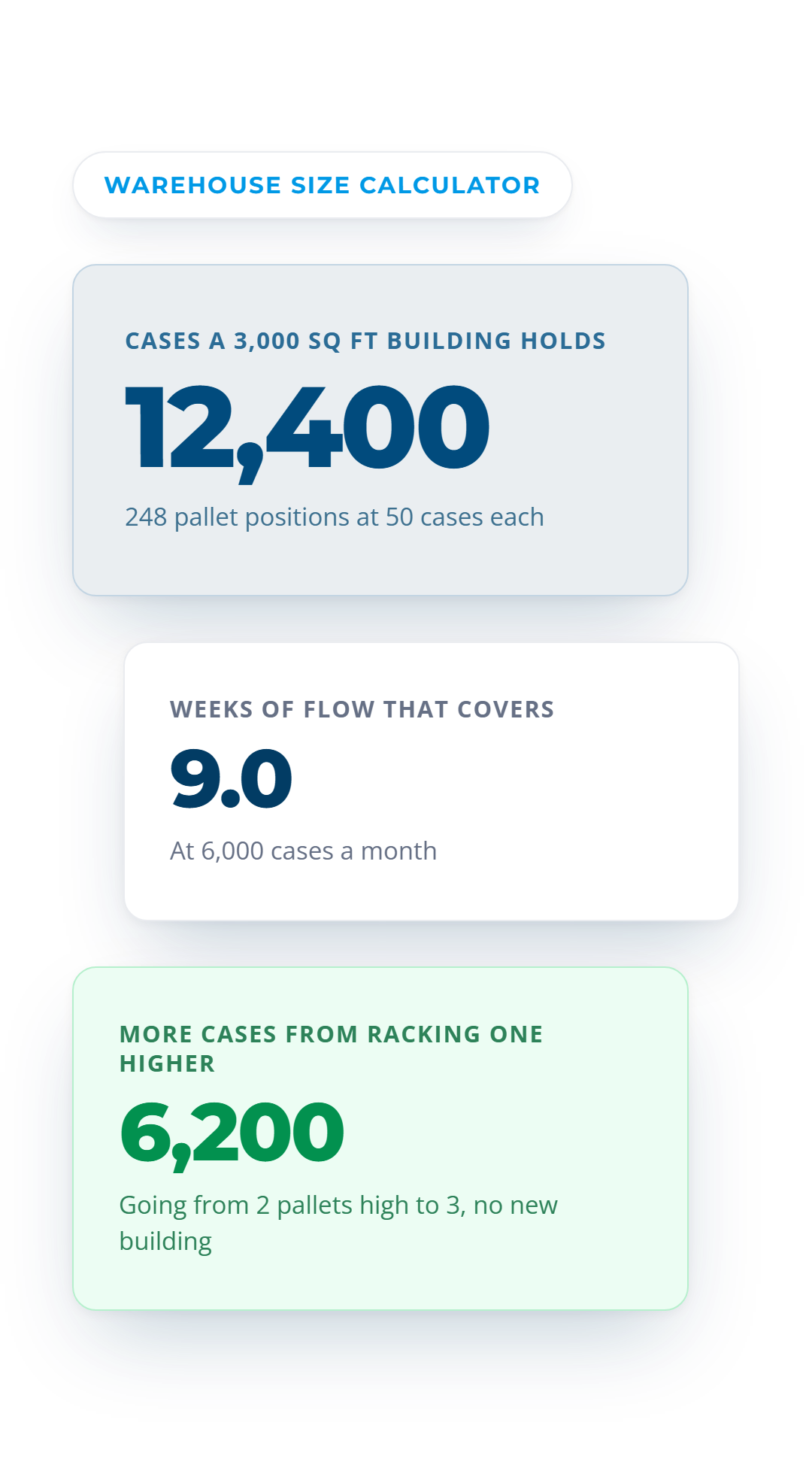
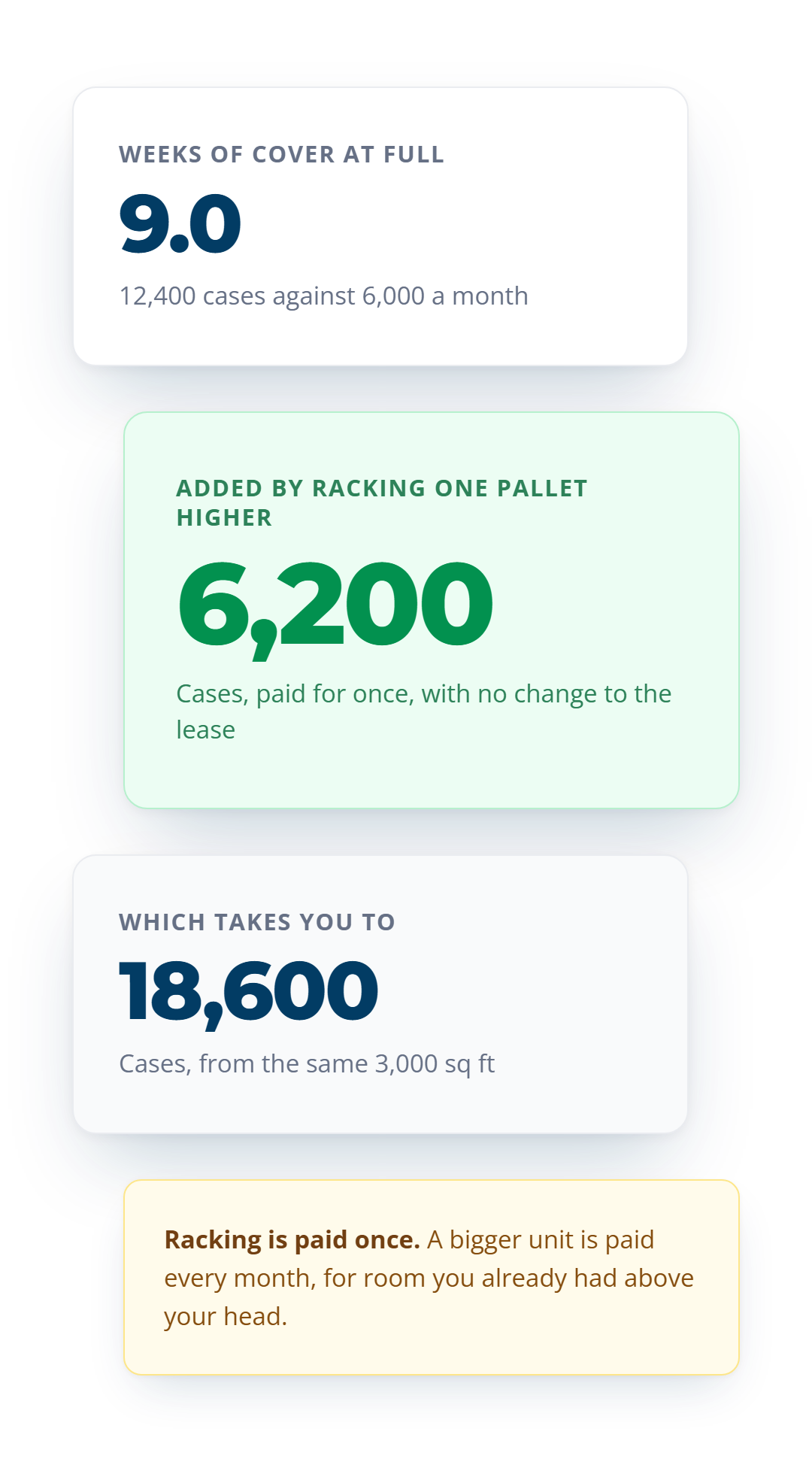
Your 3,000 sq ft holds about 12,400 cases, roughly 9.0 weeks of flow at 6,000 a month. Racking one pallet higher, from 2 to 3, would add about 6,200 cases without adding a square foot.
You run out of room before you run out of demand. VoiceOrder Solutions keeps inventory live and orders confirmed, so you fill the space with product that turns instead of stock that sits.
Book A Demo →
A planning estimate. Confirm rack layout, clear height and fire code with your building before you commit.
12,400

Cases a 3,000 sq ft building holds

9.0

Weeks of flow that covers

6,200

More cases from racking one higher

Sound Familiar?

We are out of space, so we need a bigger building

Usually you are out of racking, not out of building. The two cost very different amounts to fix.
Balance scale for judging a building by floor area alone, not height

We have 3,000 square feet.

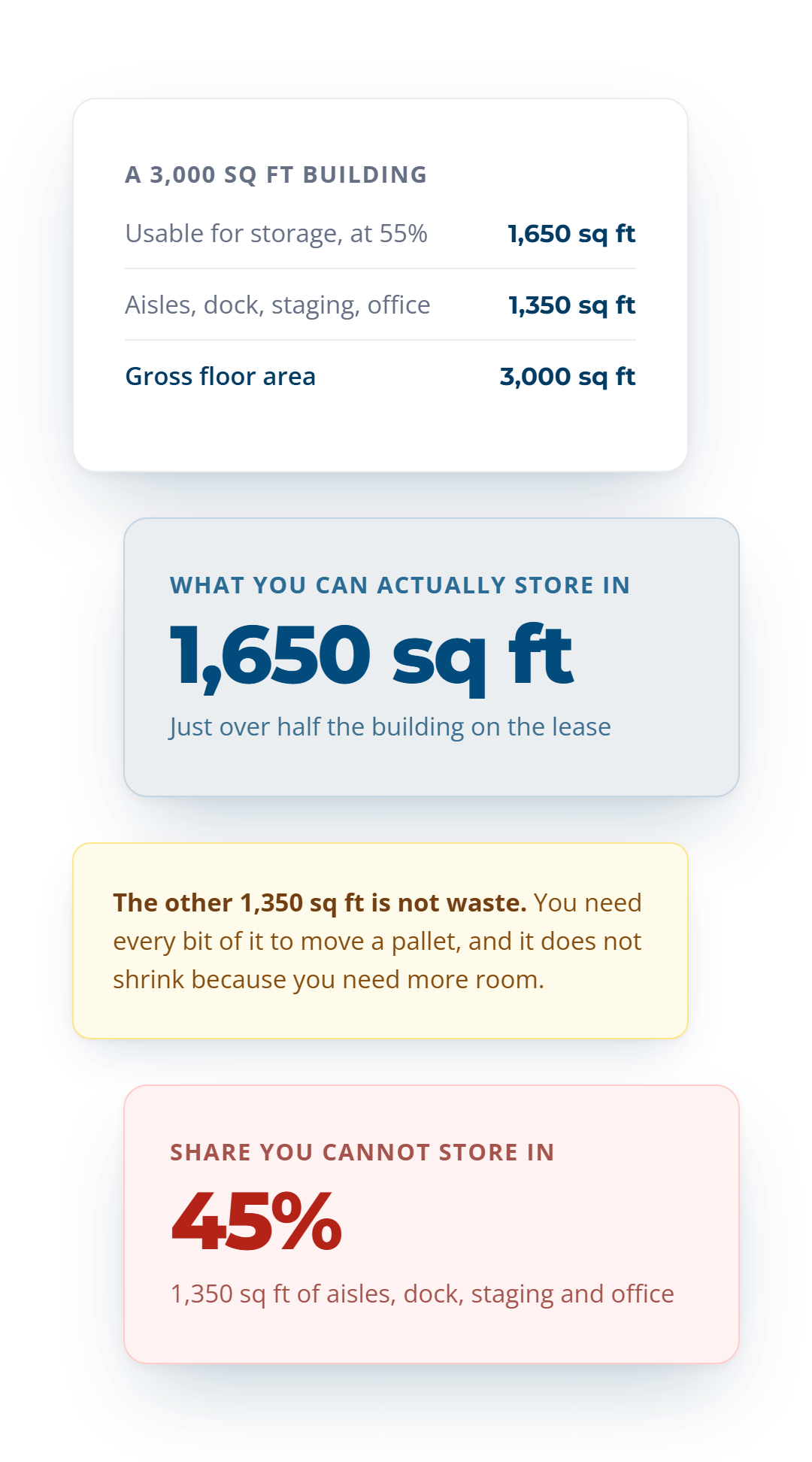
You have 1,650 you can store in. The other 1,350 is aisles, dock, staging and office, and it does not shrink just because you need more room.
Cash bills for the rent on a bigger unit once you feel full

We are full, time to look at a bigger unit.

Racking one pallet higher, from 2 to 3, adds about 6,200 cases without a square foot of new building or a line on the lease.
Bar comparison for case capacity nobody in the building has measured

Nobody knows how many cases we can actually hold.

It is 12,400 here, which is 9.0 weeks of flow at 6,000 cases a month. Without that number, buying decisions are guesses with a lease attached.
How It Works

How to use the warehouse size calculator

Measure the building, take out what you cannot store in, then count pallets rather than square feet.
1

Enter the building, then the usable share

Aisles, dock, staging and office come out first. At 55% usable, a 3,000 sq ft building gives you 1,650 sq ft to store in.
2

Set the pallet footprint and stack height

A standard GMA pallet is 48 by 40 inches, so 13.3 sq ft. Stack height is the lever most distributors have not pulled.
3

Read capacity in weeks, not just cases

12,400 cases means nothing on its own. At 6,000 cases a month it is 9.0 weeks of cover, which is the number to judge against your lead times.
Built For Distributors

What the calculator shows you

A 3,000 sq ft building gives 1,650 sq ft of storage, with the other 1,350 sq ft, 45%, as aisles, dock and staging.
Usable floor

How much of the building you can actually store in

3,000 sq ft at 55% usable leaves 1,650 for storage. The other 1,350 sq ft is aisles, dock, staging and office, and you need every bit of it.
Separates storage from everything else
Uses your own usable percentage
Shows both halves in square feet
Stops you planning off the gross area
Pallet positions

How many pallets fit, on the floor and in the air

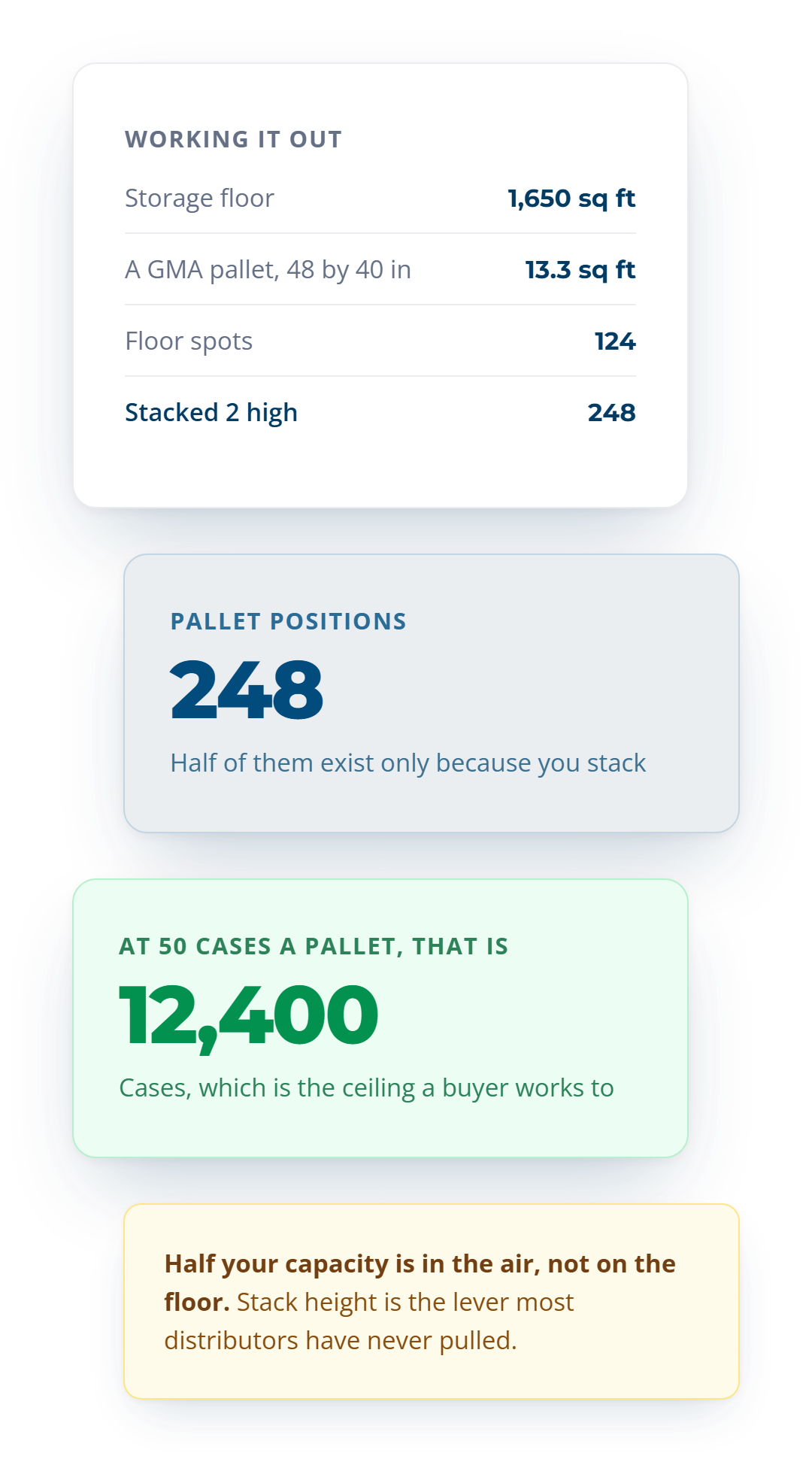
1,650 sq ft at 13.3 sq ft a pallet is 124 floor spots. Stacked 2 high that is 248 positions, which is where the real capacity comes from.
Counts floor spots before stacking
Multiplies by your stack height
Uses a real pallet footprint
Rounds down, so it does not flatter you
1,650 sq ft at 13.3 sq ft a pallet gives 124 floor spots, which stacked 2 high is 248 pallet positions.
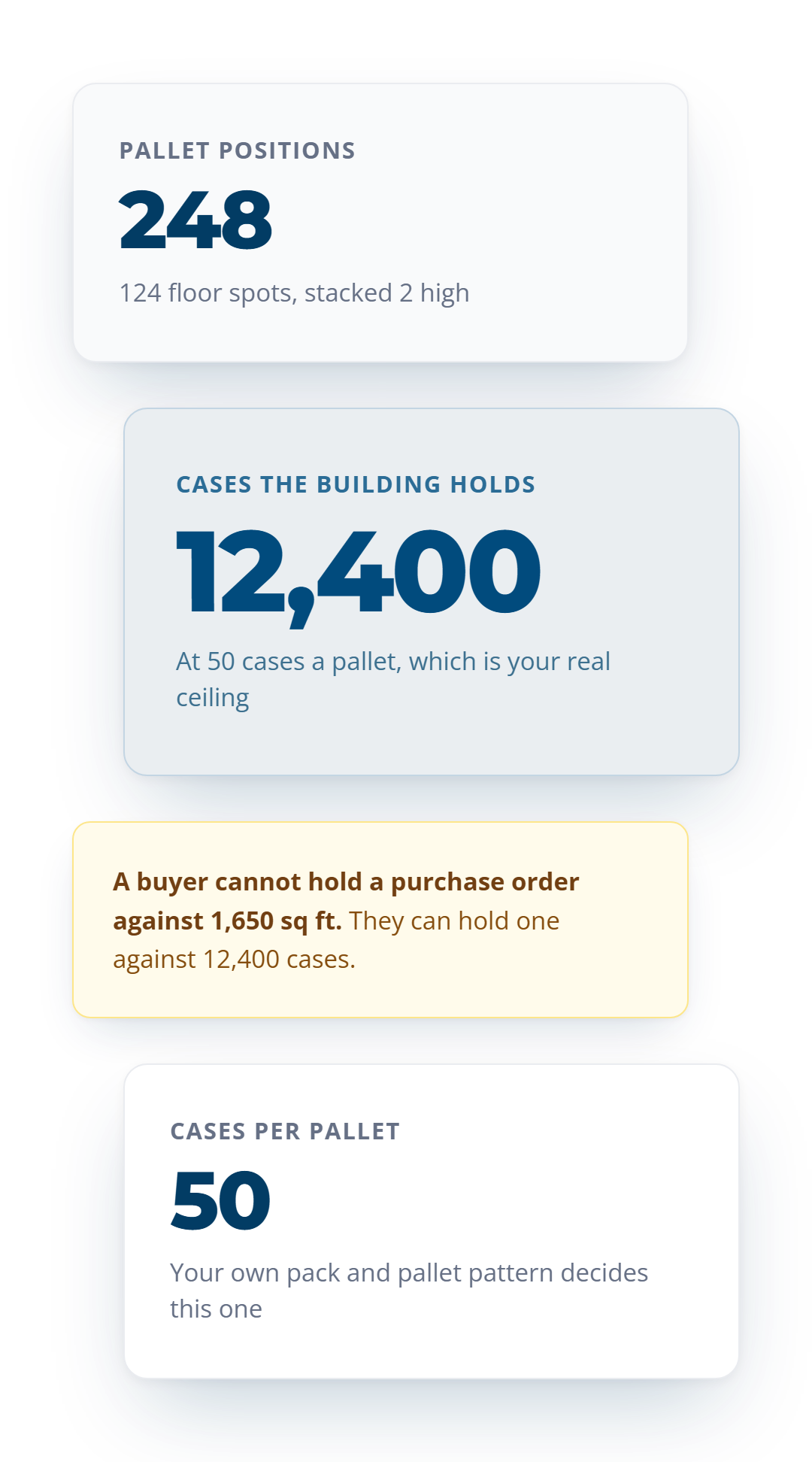
248 pallet positions at 50 cases each is a ceiling of 12,400 cases, the unit a buyer actually works in.
Capacity in cases

What that is in the unit you buy in

248 positions at 50 cases a pallet is 12,400 cases. That is the number to hold a purchase order against, not the square footage on the lease.
Converts positions into cases
Uses your own cases per pallet
Gives buyers a hard ceiling
Updates as any input changes
Weeks of cover

How long the building holds you for

12,400 cases against 6,000 a month is 9.0 weeks at full. Racking one pallet higher adds about 6,200 cases, which is most of another month.
Turns capacity into weeks of flow
Uses your real monthly throughput
Prices a stack height change in cases
Shows the cheap fix before the costly one
12,400 cases is 9.0 weeks of cover at 6,000 a month, and racking one pallet higher adds 6,200 cases to reach 18,600.
After The Numbers

What to do once you know your real capacity

A capacity number earns its keep by stopping a lease you did not need. Start here.
Pallet racking stacked an extra level high

Rack higher before leasing

Warehouse floor plan with the storage area marked off

Measure your usable share

Warehouse building with racking aisles running through it

Narrow the aisles you can

A product case, the unit buyers order in

Give buyers a case ceiling

A clock, for supplier lead times

Check cover against lead times

A verified check mark for a recounted capacity figure

Recount after a layout change

A downward trend line for slow moving pallets

Clear the slowest pallets first

A stack of cases waiting in staging

Keep staging off the racks

A calendar for a quarterly capacity review

Review capacity every quarter

Six Levers

What actually changes how much the building holds

Only one of these needs a bigger building. The other five are inside the one you have.
An upward chart for capacity gained by stacking higher

Stack height

The biggest lever by a distance. One more pallet high is about 6,200 cases here, for the cost of racking.
A percent sign for the usable share of the floor

Usable percentage

Aisles, dock and staging take 1,350 sq ft of 3,000. Narrower aisles need the right truck, so cost it properly.
Cases buffered on a pallet

Cases per pallet

Pack and pallet patterns decide this. A better pattern adds capacity with no building work at all.
An order guide listing the SKUs you carry

SKU count

Every SKU needs a position even when only a few cases sit in it. Slow lines cost whole pallet spots.
A delivery truck arriving at the dock

Inbound timing

Two deliveries landing the same morning need floor space neither of them keeps. Spread them out.
A turnover cycle arrow for stock turning faster

Turns

Faster turns mean fewer cases resident at once, which is the same as a bigger building and far cheaper.

See how VOS keeps what you stock in line with what accounts order

VoiceOrder Solutions shows live inventory against the catalog your customers order from, so the racks carry the lines that actually move.
The Comparison

Three ways to get more room

Same 3,000 sq ft building, same 6,000 cases a month. These are the three answers people reach for, in the order they should try them.

What you need from more capacity

Rack higher

Turn stock faster

Lease more space

Adds capacity this quarter
Slowly, it takes a buying change
Only once a unit is available
Costs nothing per month after
Yes, and it gives money back
No, it is rent every month
Uses the building you already pay for
Yes
No, that is the point of it
Works without changing how you buy
No, changing how you buy is the method
Yes
Reversible if you get it wrong
Yes
Not inside a lease term
Measurable in cases, not square feet
Yes, in cases resident
Yes, but only in square feet
Helps your cash position too
Yes, it frees cash directly
No, it ties cash up monthly
Scales again next year
Yes, to a point
Yes, and so does the rent
Where it falls down
Limited by clear height and your truck
Needs demand you can see in advance
You pay monthly for capacity racking gives once
Best used for
The first thing to try, every time
The lever to pull alongside racking
Real growth, after the other two are done
FAQ

Common questions about warehouse capacity

How many square feet is one pallet?
A standard GMA pallet is 48 by 40 inches, which is 13.3 sq ft of floor. That is the footprint, before any aisle space around it.
How do you calculate warehouse capacity?
Take the usable floor, divide by the pallet footprint, multiply by stack height, then by cases per pallet. Here that is 1,650 sq ft, 124 spots, 248 positions, 12,400 cases.
How much of a warehouse is actually usable for storage?
Often around half to two thirds. At 55%, a 3,000 sq ft building leaves 1,650 sq ft of storage and 1,350 sq ft of aisles, dock, staging and office.
How much space does a food distributor need?
Work back from weeks of cover rather than a square footage. 12,400 cases is 9.0 weeks at 6,000 a month, so the question is how many weeks your lead times force you to hold.
Is it cheaper to rack higher or to lease more space?
Racking, nearly always. Going from 2 pallets high to 3 adds about 6,200 cases here, paid once, against rent every month for the same room.
What limits how high you can stack?
Clear height, the reach of your truck, product weight and what the pallet below can carry. Check all four before you buy racking.
Why count cases instead of square feet?
Because you buy in cases. A buyer cannot hold a purchase order against 1,650 sq ft, but they can hold it against a ceiling of 12,400 cases.

Fill the building you already pay for

VoiceOrder Solutions keeps inventory visible against live order activity, so what sits on your racks is what your accounts are actually ordering.