.webp)
Key takeaways:
Every business that takes orders eventually ships the wrong thing. A case of the wrong mulch, a size 10 instead of a size 8, an invoice with last quarter's pricing. The item is cheap to replace. The trust is not. PwC found that 32% of customers will walk away from a brand they love after a single bad experience, and in B2B, one botched order can put a whole account at risk.
The good news is that order errors are systematic, which means they are fixable. They creep in at predictable points: when someone keys an order by hand, when two systems fail to talk, when a picker rushes to hit a target. This guide walks through how to reduce order errors across retail, warehouse, and B2B operations, from the moment an order is placed to the second it leaves your dock. None of it requires a moonshot. Most of it is process, a few well-placed checks, and measuring the right numbers.
An order error is any gap between what the customer asked for and what they got. That covers the obvious cases, wrong item, wrong quantity, wrong price, wrong shipping address, missing items, and the quieter ones, duplicate orders and stale pricing that surfaces later as an invoice dispute.
What trips up most teams is assuming errors live in one place, usually the warehouse. They do not. An order passes through a long chain, and each handoff is a fresh chance to get it wrong. This table maps each stage to the mistake it tends to produce and the section of this guide that fixes it:
| Stage | Typical error here | Where to stop it |
|---|---|---|
| Order entry | Phoned or emailed order mistyped: wrong SKU, quantity, or price | Capture and validate at entry |
| Order processing | Wrong pricing, terms, or stock confirmed | Order management as a quality gate |
| Picking and packing | Wrong item or quantity pulled | Scan every pick and pack |
| Shipping | Wrong label or address applied | Pre-dispatch verification |
| Invoicing | Order billed wrong, usually inheriting an upstream mistake | Connected systems and three-way matching |
A mistake at the front of that chain, a mistyped SKU during entry, does not stay small. It flows downstream, gets picked correctly against the wrong data, ships fast, and lands as a return. That is why the errors that cost the least are the ones you stop at the start. The sections below follow this chain, so you can find the stage where your own errors cluster and fix it there.
The sticker price of a wrong order hides the real damage. Add up the labor to field the complaint, the return shipping, the restocking, the replacement pick, and the reship, and estimates of the true cost cluster around $25 to $50 per error. OrderEase puts it higher for bigger-ticket goods, estimating that correcting an order error can cost 50% to 125% of the product's own value.
Volume makes it worse. Warehouse pick error rates typically run 2% to 4%. At a few thousand orders a month, a 3% error rate is a lot of returns, and each one carries that full seven-step cost of unwinding it. Returns are where the damage becomes visible: the National Retail Federation reported that U.S. shoppers sent back $743 billion of merchandise in 2023, a 14.5% return rate, and every wrong order feeds that pile.
Then there is the money that never shows up on an invoice. Consider a mid-sized garden center that phoned its supplier for two pallets of two-cubic-foot mulch bags and received three-cubic-foot bags instead. The supplier had no record of the call, so it absorbed the difference, but the buyer still lost selling time during peak season and ate more than $600 in knock-on costs. Scale that up and the numbers get serious: in 2021 a manual slip at Citibank sent $900 million to the wrong recipients, as reported by the New York Times.
Errors also cost you downstream in ways finance feels later. As finance leader Jack Conaway notes, one bad invoice creates four problems at once: a delayed payment, hours of rework to catch and reissue it, a dented customer relationship, and a higher DSO while the invoice sits in dispute. The wrong order does not end when the replacement ships. It follows you into the next quarter.
It is tempting to write up the person who packed the wrong box and move on. That rarely fixes anything. As pharma quality leader Gaurav Raj Sharma puts it, human error is not a root cause, it is a signal. When people make the same mistake repeatedly, the real cause is usually unclear procedures, poor tools, thin training, or a culture that rewards speed over accuracy.
Look under most order errors and you find a few repeat offenders:
A useful diagnostic, borrowed from logistics leader Phelisters George, is to ask of any recurring error: is this a people problem, a process problem, or a system problem? The answer points at the fix. And one root cause shows up again and again across order-heavy businesses: manually re-keying orders that arrived by phone, voicemail, or email. That single habit is where a large share of order entry errors are born, which is where the next section starts.
The cheapest error to fix is the one you never key twice. Most order entry errors are born the moment a human retypes an order that arrived on paper, in a notes app, or over the phone. To reduce order entry errors for good, you remove that retype, and a whole category of mistakes disappears with it. That is the whole premise of web based order entry software: the order is captured once, in structured form, and never typed again.
One team measured exactly what removing that retype was worth.
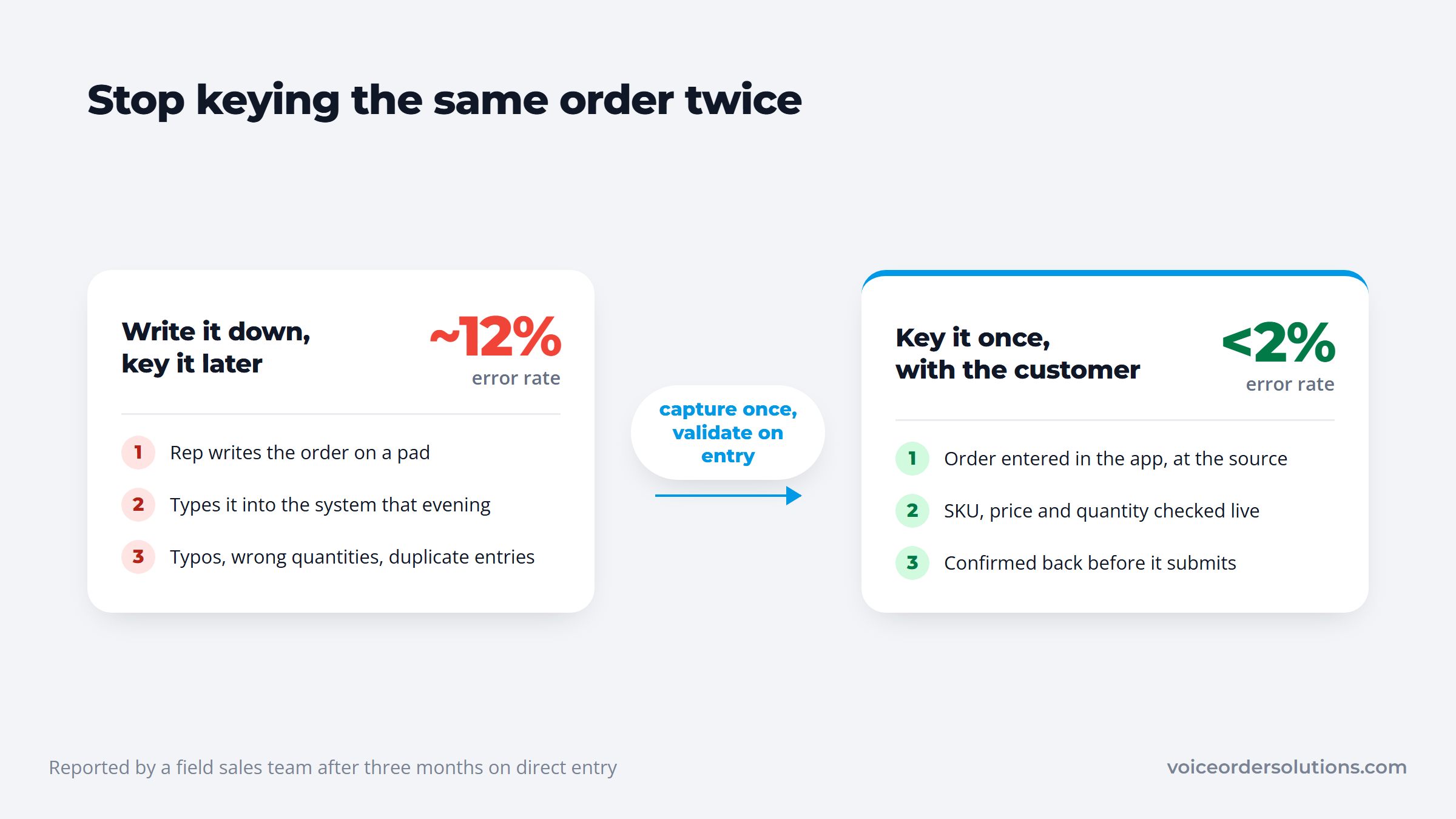
A field sales team laid out the before and after on Reddit. Reps used to jot orders down and enter them into the system later, which produced a steady stream of typos, wrong quantities, and duplicate entries. Moving to direct entry, where the rep keys the order in an app while standing with the customer and the system validates product codes, pricing, and quantities before it submits, dropped their error rate from around 12% to under 2% in three months. Two things did the work: capturing the order once, at the source, and validating it against real data before it could go through.
The mechanics matter more than the tool. Set it up in this order:
You can push this further with automation. Conexiom, an order-automation vendor, reports that AI document capture can pull order data from PDFs and emails at 95% extraction accuracy with 87% touchless processing, checking each order against ERP records before accepting it, and cutting order errors by roughly half. The principle holds whether the tool is AI or a validated web form: capture the order in a structured way, check it at entry, and never transcribe it again.
For teams that still take orders by voice, the same logic applies to the spoken order. VoiceOrder Solutions, for example, lets staff place a procurement order by speaking it into an app, then digitizes, confirms, and timestamps that order before it transmits, assigning it a unique order number and auto-saving it if the call is interrupted. The order is captured clean the first time instead of being written down and keyed in later. Whatever the channel, the goal is the same: structure and check the order at the point of entry, not after it has already gone wrong.
B2B order processing carries a specific risk that retail rarely faces: orders arrive in a dozen formats, phone calls, faxes, emails, PDFs, EDI files, and a human on the supplier side keys most of them by hand. The larger the order, the more a single fat-fingered quantity costs.
There are proven ways to reduce errors in B2B order processing, and several travel well across teams:
The payoff compounds. When suppliers integrate ordering with their back-end systems instead of re-keying everything, orders move faster and errors drop, because the data is entered once and validated on the way in rather than retyped at each step.
Food distribution is a sharp example of the B2B problem, where after-hours calls and rushed voicemails get transcribed wrong and turn into failed deliveries. VoiceOrder Solutions is built for exactly this step: it captures a restaurant or store's procurement order by voice, digitizes and timestamps it, and routes it to the distributor in the format they already use. Because orders are captured 24/7 and confirmed before they transmit, they do not sit in a voicemail box waiting to be mis-keyed. It works as a companion to the distributor's existing tools, not a replacement for them, and it is aimed squarely at the independent distributors who live and die by order accuracy.
Once an order is correct on paper, the warehouse has to pick and pack it correctly. This is where speed and accuracy openly compete, and where a counterintuitive truth shows up.
Plotted against each other, the trade-off puts the fastest pickers somewhere uncomfortable.
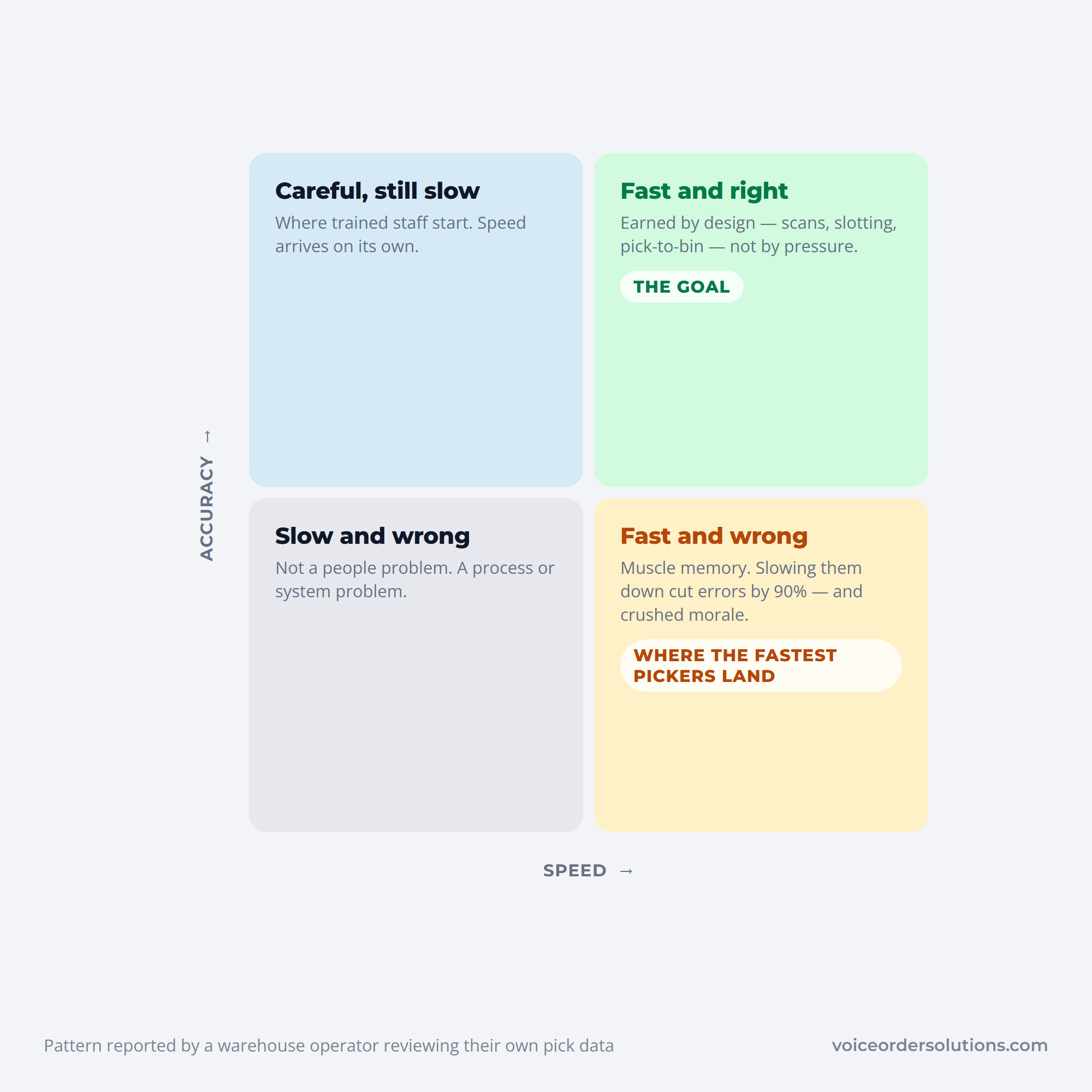
A warehouse operator shared pick-accuracy data on Reddit with a surprising pattern: the fastest, most experienced pickers made the most mistakes, running on muscle memory. Forcing them to slow down cut errors by 90%, but it crushed morale. The lesson other operators echoed in the thread is that accuracy has to come first and speed follows, not the other way around. "Slow is smooth, smooth is fast."
The structural fixes that reduce order errors in the warehouse are well established:
Peak season tests all of this: AutoStore notes pick accuracy can fall to 50% when warehouses onboard temporary staff in a rush, so the systems that enforce accuracy matter most when volume spikes.
Knowing how to reduce order errors in retail starts with one fact: the order is often spoken, and every relay adds risk. The fix is to shorten the chain between what the customer wants and what the system records.
Digital ordering does most of the heavy lifting. When customers enter their own orders through a QR menu, kiosk, or online store, no one transcribes them, and about 66% of restaurants now use QR ordering for that reason. A point-of-sale system with standardized, forced modifiers removes the "no pickle" versus "NP" versus "plain" ambiguity that turns into remakes. The stakes are real: in Toast's 2023 research, 68% of restaurants said a POS outage costs them more than $500 an hour, so the ordering system's reliability is itself an accuracy issue. Running several of those channels at once adds a failure mode of its own, which is why omnichannel order management treats them as one queue rather than three.
A few practices keep retail order errors down:
Each of these shortens the distance between what the customer says and what the system records, and that shorter path is where most retail order errors quietly disappear.
Prevention reduces errors. Verification catches the ones that slip through. The best operations do both, and treat the moment before dispatch as a hard gate.
The single highest-return check is a pre-dispatch review. Phelisters George reports that a five-minute readiness check of documents, packaging, quantity, and labels catches 70% to 90% of mistakes before the truck loads. It costs almost nothing and stops the most expensive errors, the ones that reach the customer.
Give one person per shift the job and a fixed sequence to run before an order leaves:
Design the checkpoints so they are hard to skip:
None of these checks are expensive, and each one converts a hope that someone looked into a step the order cannot skip.
Many order errors are not really human mistakes, they are the seams between systems that do not talk. When your storefront, inventory, order management, and accounting tools each hold a slightly different version of the truth, someone reconciles them by hand, and hands make typos.
Integration removes the seams. Connecting your sales channels to inventory and your ERP means stock levels, pricing, and customer data flow in real time instead of being copied between spreadsheets. Real-time inventory in particular prevents the classic error of selling something you cannot ship. The Calderys example is the case for automation in one story: after mapping and automating its order workflow, starting with order intake, the manufacturer cut audit prep from two weeks to two hours and eliminated the manual errors that came from 200-plus touchpoints. Mapping first and automating second is the order that makes order process automation pay, and it is the step most teams skip.
The right order management tools reduce fulfillment errors most when they do a few specific things well, so weigh these before a long feature list:
The tools do not have to replace what you have. VoiceOrder Solutions, for instance, delivers digitized orders in the formats distributors already use, email, EDI, API, or straight into QuickBooks, and layers alongside existing systems rather than swapping them out, adding real-time inventory visibility and low-stock alerts on top. The aim of any integration is the same: let data move once, cleanly, so no one has to retype it.
Systems catch errors. Culture decides how many reach the system in the first place. The operations with the lowest error rates train for accuracy first and treat it as a shared standard, not a personal failing.
Start with how you onboard. Spindl's training benchmarks are a useful bar: have new staff hit 100% accuracy on three consecutive orders and 95% across ten simulated ones, including the tricky cases, before they work live volume. Accuracy is a skill you build deliberately, and as the warehouse data showed, speed follows accuracy, not the reverse.
Then align the incentives. If reviews and bonuses reward throughput alone, people optimize for throughput. Tie accuracy to performance reviews or a monthly bonus so getting it right is worth as much as getting it fast, which is how many warehouse teams keep their quickest pickers careful. Reduce the conditions that create errors too: fewer interruptions during order entry, manageable workloads, and clear standard procedures, since fatigue and distraction drive more mistakes than ignorance does.
For teams that want a framework, Lean methods give a shared language. The 5 Whys, tracing a problem back by asking why five times, and root-cause tools like Fishbone diagrams turn "someone messed up" into a fixable process gap. A short weekly sync across the people who touch orders, sales, operations, and finance, keeps small patterns from hardening into habits.
You cannot reduce order errors you are not counting. A single metric anchors the whole effort: the order accuracy rate, calculated as accurate orders divided by total orders, times 100. Ship 1,000 orders with 980 correct and you are running at 98%. That number is your baseline and your scoreboard, and a handful of others tell you where and what the errors are costing:
| Metric | How to calculate | What good looks like |
|---|---|---|
| Order accuracy rate | Accurate orders ÷ total orders × 100 | 99% or higher; investigate below 98% |
| On-time dispatch | Orders shipped by their deadline ÷ total × 100 | 98% or higher |
| Damage rate | Damaged units ÷ units shipped × 100 | Under 1% |
| Return rate | Returned orders ÷ total orders × 100 | At or below your category norm |
| Days sales outstanding | Accounts receivable ÷ revenue × days in period | Trending down over time |
Make the measurement specific and honest:
Run the recurring errors through a real root-cause pass instead of patching symptoms. Anomaly detection, whether it is a flag in your software or a person reviewing the weekly log, catches the order that is ten times the customer's usual quantity before it ships, not after.
The list above can read like a lot. It is not meant to be done at once. Order errors are systemic, so knowing how to reduce order errors comes down to a few high-impact moves: stop re-keying orders at the point of capture, put one hard verification check before anything ships, and start measuring your accuracy rate this week. Calderys did not automate everything on day one, it started with order intake and built from there.
Pick the stage where your own errors cluster, the diagnostic in this guide will point at it, and fix that one first. For food distributors and the restaurants they serve, capturing the procurement order cleanly is often that first stage, which is the problem VoiceOrder Solutions was built to solve. If order accuracy is where you are losing time and trust, book a demo and start with the order itself.
Manual data entry. Most order errors start when someone retypes an order that came in by phone, email, or on paper, which introduces typos, wrong quantities, and duplicates. The fix is to capture the order once, in a structured form, and validate it before it submits.
To reduce order entry errors, remove the second time an order gets keyed. Capture it directly at the source, pull from dropdowns, barcodes, or saved order guides instead of free text, validate the SKU, price, and quantity against live data, and confirm the order back before it sends.
The order management tools that reduce fulfillment errors best share four traits: validation of SKUs, pricing, and quantities at entry, real-time inventory across channels, clean integration with your existing systems, and error logging so you can see why mistakes happen. The category matters less than those four capabilities.
Reduce order errors in the warehouse by scanning every pick and every pack, picking to bins so shortcuts are impossible, and fixing slotting so fast movers are easy to find. Train for accuracy before speed, and when products cannot be barcoded, put the barcode on the location instead.
Track the order accuracy rate: accurate orders divided by total orders, times 100. Measure it as a rate rather than a raw count, log every error with a timestamp and cause, and investigate whenever accuracy dips below 98%. Pair it with on-time dispatch, damage rate, and return rate.