.webp)
Key takeaways:
The tablet shelf is the clearest symptom. A restaurant takes orders from its own site, two delivery marketplaces, the phone, and the counter, and each one arrives on a different device with its own alert sound.
Someone then retypes each of those into the POS. That person is doing integration work by hand, all night, and every retype is a chance to get a modifier wrong.
Omnichannel order management is the fix for that specific problem. This guide covers what it genuinely means, the two channel problems restaurants actually have, and how to consolidate without buying a platform you do not need.
Omnichannel order management is a single system that receives, tracks, and fulfills orders from every channel a business sells through, presenting them as one queue with one source of truth for stock and status.
The word that distinguishes it is "single." Multichannel means selling through several channels. Omnichannel means those channels resolve into one operational view.
A restaurant taking orders from four sources is multichannel by default. It becomes omnichannel only when those four arrive in one place, decrement one stock count, and appear on one screen for the kitchen.
The definition matters commercially because vendors use the terms interchangeably. Asking whether orders arrive in one queue or several separates the two quickly.
Listing them makes the scale of the problem visible, and most operators are surprised by the count.
| Channel | Direction | Typical failure |
|---|---|---|
| Dine-in and counter | Guest to restaurant | Modifier errors under pressure |
| Own website or app | Guest to restaurant | Menu drift between site and POS |
| Delivery marketplaces | Guest to restaurant | Separate tablet, manual re-entry |
| Phone orders | Guest to restaurant | Misheard details, no record |
| Catering and group orders | Guest to restaurant | Handled by email, invisible to the system |
| Supplier ordering | Restaurant to distributor | Phoned or texted, unrecorded |
The first five are guest-facing and are what "omnichannel" normally refers to. The sixth runs the opposite direction and is almost always left out of the conversation entirely.
That omission is odd, because supplier ordering has exactly the same problem: multiple channels, no single record, and a person retyping. It is worth treating as part of the same project.
Restaurants conflate these two, and the tools that solve them are not the same.
Guest-facing omnichannel is about consolidating demand. Orders arrive from many places and need to reach one kitchen without a human relay, with menus and availability consistent everywhere.
Supplier-facing ordering is about consolidating supply. Orders leave for several distributors through different channels, and need to arrive accurately with a record you can point at when a delivery is short. Where the distributors support it, supplier management software built around ordering puts every one of them in a single app with a dated record of each order.
The first is solved by a POS with integrations or a middleware layer, usually alongside the kitchen management tooling that routes tickets once orders land. The second is solved by tooling on the purchasing side, and buying a guest-ordering platform does nothing for it.
Diagnose which one is costing you more before shopping. A restaurant losing thirty minutes a night to tablet re-entry has the first problem; one losing a Saturday to a short delivery has the second.
The cost of disconnected channels is rarely a single big loss. It accumulates in small increments that never appear as a line item.
Every manual re-entry takes a minute and carries an error risk. Every menu change has to be made in four places, and the one you forget produces a guest ordering something you no longer serve.
Stock is where it gets expensive, because every channel is drawing against the same inventory count. Selling the same finite item across channels that each hold their own count means overselling is a matter of timing rather than possibility.
IHL Group estimates the global retail industry loses about $1.73 trillion a year to inventory distortion, meaning out-of-stocks and overstocks together, roughly 6.5% of global retail sales. Restaurants running channels against separate stock figures are exposed to the same mechanism at a smaller scale.
The time cost compounds too. Staff attention split across several screens is the reason a ticket sits unnoticed for six minutes during a rush.
A strategy here is mostly a sequence of consolidations rather than a purchase.
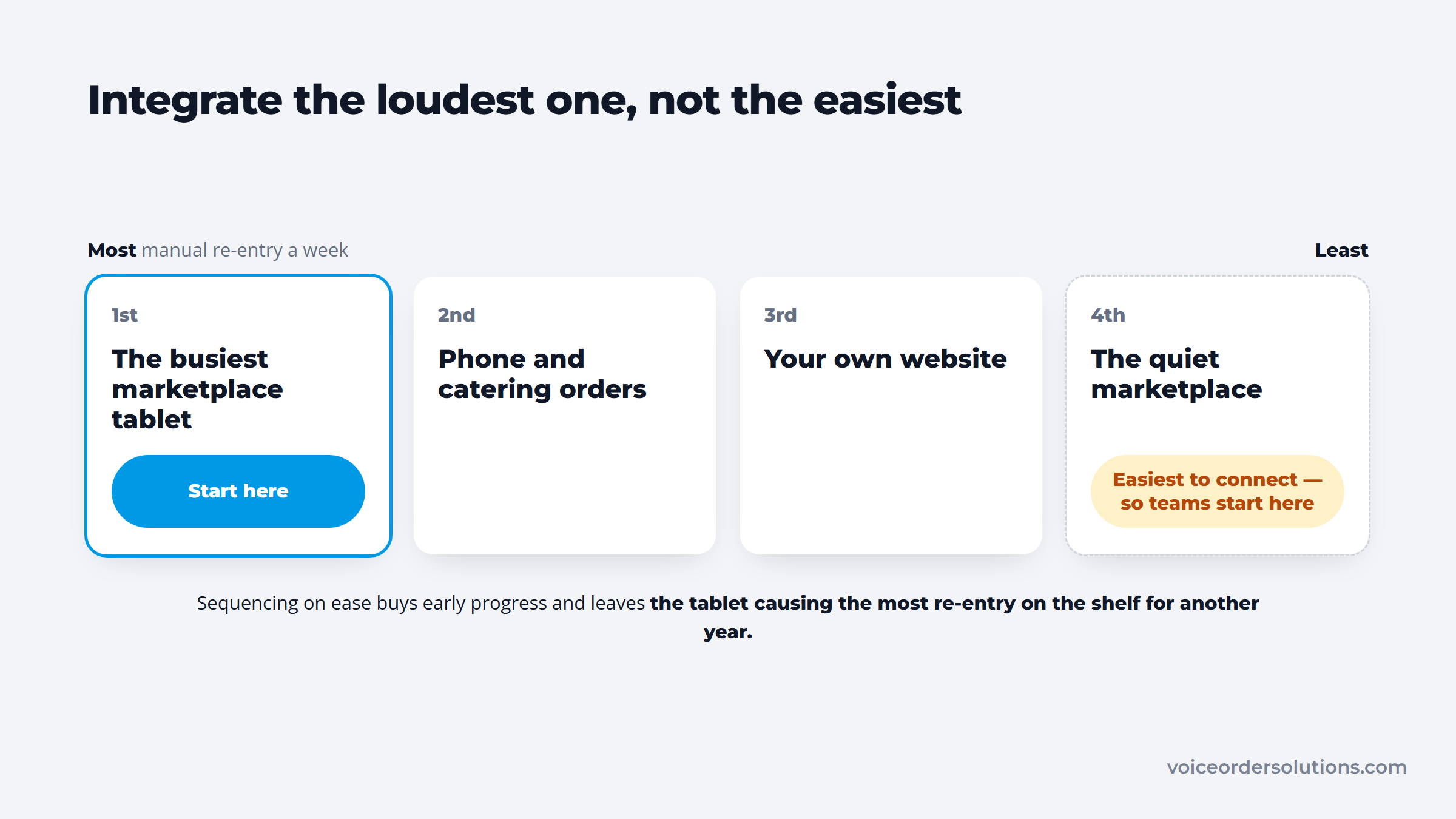
The third point is where most projects go wrong. Teams integrate the simplest channel to show early progress, and the tablet causing the most re-entry stays on the shelf for another year.
Ordering the channels by the work they create puts the starting point somewhere else entirely.
Retiring a channel is a legitimate outcome. A marketplace producing four orders a week may not justify the operational drag of an unintegrated tablet.
Once guest channels are consolidated, the remaining manual re-entry in most restaurants is the order going out to distributors.
That order typically leaves through whichever channel is convenient at the time: a phone call to one supplier, a text to a rep, an email with a photo of a handwritten list to a third. None of it is recorded anywhere the restaurant controls.
VoiceOrder Solutions applies the same consolidation principle to that direction, from the supplier's side of it. The distributor issues the app, the buyer talks the order into it, and the distributor receives the result in whichever format their back office already reads: email, EDI, API, or QuickBooks.
The practical effect is one capture method feeding several suppliers, which is what omnichannel means applied to purchasing. Every order carries a unique number and timestamp, so a short delivery becomes a documented discrepancy rather than a disagreement.
It is worth being explicit about scope. VoiceOrder Solutions is sold to distributors, not to restaurants, and it is not a guest-ordering system: it has nothing to do with kiosks, QR menus, delivery marketplaces, or answering the phone to diners. It handles the supplier ordering direction only, alongside whatever POS the restaurant runs.
The ecommerce version of this problem is more mature, and restaurants are drifting toward the same expectations.
Online retail is now a substantial share of commerce rather than an adjunct. U.S. Census Bureau data put retail e-commerce sales at $326.7 billion in Q1 2026, up 9.8% year over year and 16.9% of total retail sales.
At that scale, manual reconciliation between channels stopped being viable years ago, which is why ecommerce omnichannel systems lead on real-time inventory sync and unified order status. Distributors face the B2B version of the same problem, usually under the name unified commerce.
Restaurants adopting delivery marketplaces inherited a version of the same architecture without the integration discipline that came with it. The lesson worth borrowing is that stock and status must live in one place, not that you need retail-scale software.
Menu drift is the quiet failure of multichannel restaurants and the problem omnichannel systems exist to solve.
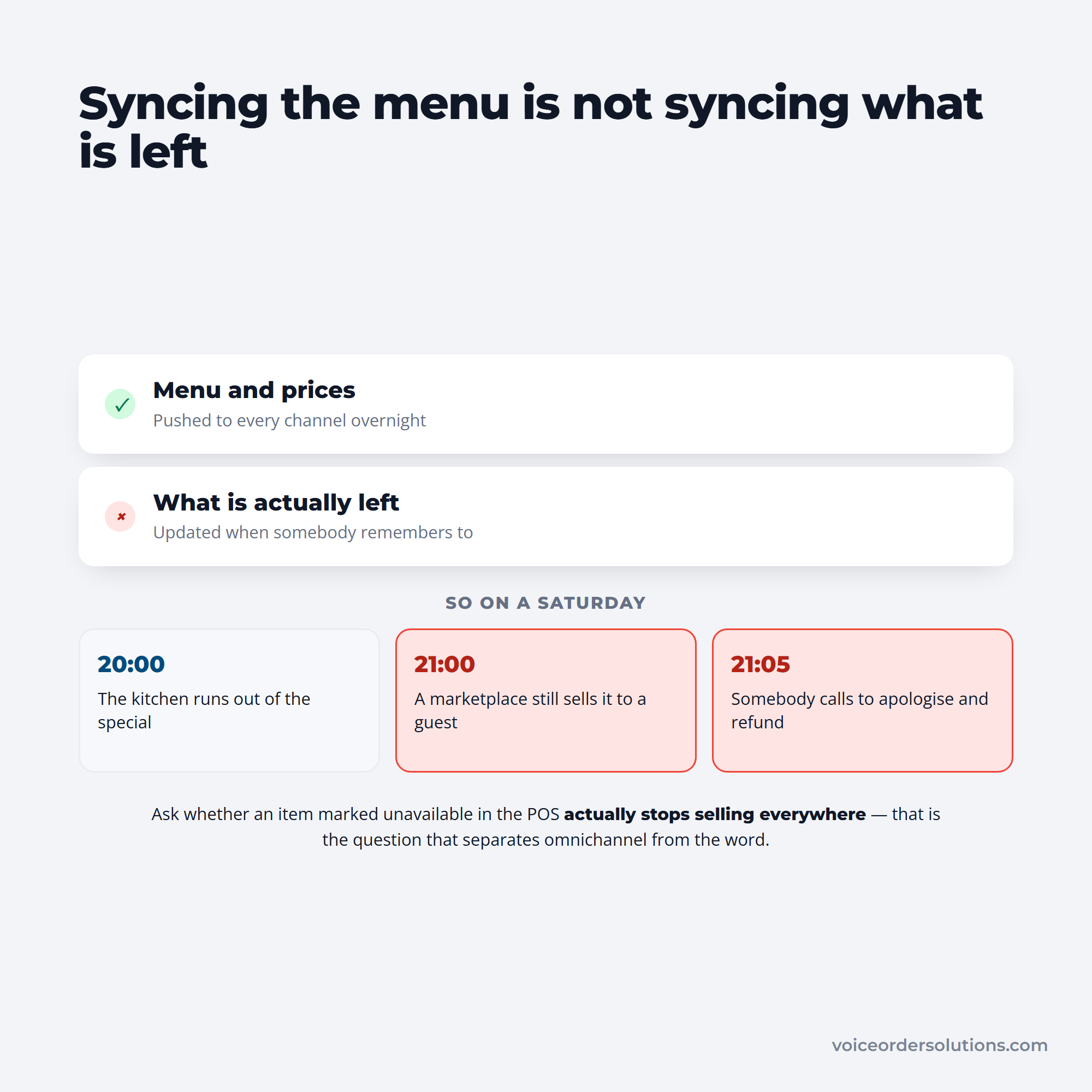
Every channel holds its own copy of your menu. Change a price, retire a dish, or run out of an item, and each copy needs updating separately. The one you forget keeps selling something you cannot make.
The cost lands on staff and guests at the same time. Somebody calls the customer to apologize, the order is refunded or substituted, and the review mentions it.
Real-time availability is harder than pricing and matters more during service. When the kitchen runs out of a special at eight, that needs to reach every channel within minutes, not at the next manual update.
Work through these before assuming a platform handles it:
The third question is the one that separates genuine omnichannel from marketing language. A system that syncs menus nightly but not availability will still sell you out of a special at nine o'clock on a Saturday.
The two syncs are different problems, and only one of them is usually solved.
Test it during a real service before rolling it out everywhere. Availability sync behaves differently under load than it does in a demo.
Multi-market order management adds a dimension for groups operating across several sites or regions: the same order type behaves differently by location.
Menus differ, suppliers differ, delivery marketplaces differ by city, and pricing may vary by market. A system that assumes one menu and one supplier set will fight you at every site.
The requirement to test for is whether the platform supports per-site configuration under a single reporting layer. Many products handle one or the other, presenting either uniform sites or disconnected ones.
Reporting is the usual casualty. Groups frequently end up unable to compare channel performance across sites because item names drift, which is why the standardization step earlier is worth the effort it costs.
Supplier ordering has the same problem in reverse. A distributor running order tracking software across all your sites can show you which location is ordering late, which no single-site view will surface.
The market splits into three approaches, and the right one depends mostly on your channel count and site count.
| Approach | How it works | Best for |
|---|---|---|
| POS with native integrations | Marketplaces connect directly into the POS | Single sites on a mainstream POS |
| Middleware aggregator | A layer consolidates channels, then feeds the POS | Operators with marketplaces the POS does not support |
| Full order management platform | Independent system owning orders and stock across channels | Multi-site groups with complex requirements |
Start by asking which of your existing channels a candidate supports natively, by name. Integration claims are usually stated generally and the marketplace you actually use is frequently the exception.
Then ask what happens when an integration fails mid-service, because it will. A system that silently drops orders during an outage is worse than the tablet it replaced.
None of the three approaches covers the supplier direction, which is bought separately and usually from the distributor: their order management tooling is what decides how the outbound order gets captured.
Omnichannel projects are easy to justify and hard to prove, so record a baseline before changing anything.
Track manual re-entries per shift, which is the metric the project exists to reduce. Track ticket time by channel, since an unintegrated channel is usually slower and nobody has quantified it. Track menu discrepancies found per month, and overselling incidents per month.
On the supplier side, track wrong or short lines per delivery. Most operators have never counted this and are surprised by the number.
Give it a full month before and after. A single busy week will not separate the effect of the change from normal variation, and restaurant automation projects are particularly prone to being judged on a good Friday.
Omnichannel consolidation is usually justified on labor, and the arithmetic is simple enough to do before any demo.
Count the orders arriving through unintegrated channels in a week. Multiply by the time it takes to retype one. No published benchmark exists for that figure, so time it yourself; our own working estimate is forty seconds to a minute once you include reading the tablet and checking modifiers. That is the recurring labor the project removes.
On that estimate, a site handling sixty marketplace orders a week spends roughly an hour of staff time weekly, or about fifty hours a year, before counting errors. Substitute your own timing before taking the annual figure to anyone.
Errors are the larger and less visible half. A mistyped modifier produces a remake, a refund, or a bad review, and any one of those costs more than the minute that caused it.
Against that, the costs are integration fees, a possible per-order charge from marketplace connectors, and the internal time to standardize menus before switching on. The last one is consistently underestimated and is the reason projects slip.
Run the numbers for your own volume rather than accepting a vendor's model. Below roughly thirty unintegrated orders a week, the labor saving alone rarely justifies a dedicated platform, and native POS integrations are the better answer.
Count your channels this week, including the ones nobody thinks of as channels: catering emails, the phone, the supplier text thread. Most restaurants find seven or eight.
Then watch a busy service and count manual re-entries. That number, multiplied by a minute and by your shifts per week, is the time budget the project has to beat.
Consolidate the highest-volume unintegrated channel first, measure again, and only then look at the next one. Sequencing by volume rather than by ease of integration is what separates projects that finish from projects that stall with three channels left. Projects that attempt every channel simultaneously tend to stall halfway with staff running both the old and new process.
When the guest side is consolidated, apply the same logic to supplier ordering, and expect the tooling to come from the supplier. The tool doing that job is VoiceOrder Solutions, bought by independent food distributors to consolidate how their food service accounts order, and distributors can contact the team to see it against a live order guide.
The omnichannel order management definition most vendors use is a single system that takes in orders from every channel a business sells through and presents them as one queue, with one authoritative stock count and one order status. The distinguishing feature is consolidation rather than channel count. Selling through five channels that each keep their own records is multichannel; those five resolving into one operational view is omnichannel.
Multichannel means you sell through several channels, each operating independently with its own screen, stock figure, and reporting. Omnichannel means those channels feed one system, so stock decrements once and staff work from a single queue. Most restaurants running delivery marketplace tablets alongside a POS are multichannel, even when the vendors involved describe themselves as omnichannel.
Often not a dedicated platform, but usually some consolidation. A single site taking orders from its own website, two marketplaces, and the counter benefits enormously from having those arrive in the POS rather than on separate tablets, and most mainstream POS products now offer that through native integrations. A separate order management platform generally earns its cost at multi-site scale.
Almost entirely by removing manual re-entry and screen-switching. Every order retyped from a marketplace tablet into the POS costs about a minute and carries an error risk, and staff attention split across several devices is why tickets go unnoticed during a rush. Consolidation also removes the duplicated work of updating menus and availability in four places whenever something changes.
Usually not, and that gap is worth noticing.
Omnichannel platforms are built for orders coming in from customers, so the orders going out to distributors stay manual even after a full consolidation project.
The supplier side has the same underlying problem of scattered channels and no single record, and it needs tooling aimed at purchasing rather than at guest demand. If you are scoping an omnichannel project, decide early whether supplier ordering is in or out of it, because assuming a guest-facing platform will cover both is the most common source of disappointment at the end of a rollout.