.webp)
Key takeaways:
A customer calls to say the delivery was short. Somewhere between the order they placed and the pallet that arrived, four cases stopped existing. The order was correct. The pick sheet was correct. The truck left on time.
Working out where it went wrong is hard because "fulfillment" gets used for two different things. Sometimes it means the whole journey from an order arriving to a customer being satisfied. Sometimes it means only the physical work of getting goods from a shelf onto a truck. Those two definitions put the failure in different departments, which is how the same problem stays unfixed for years.
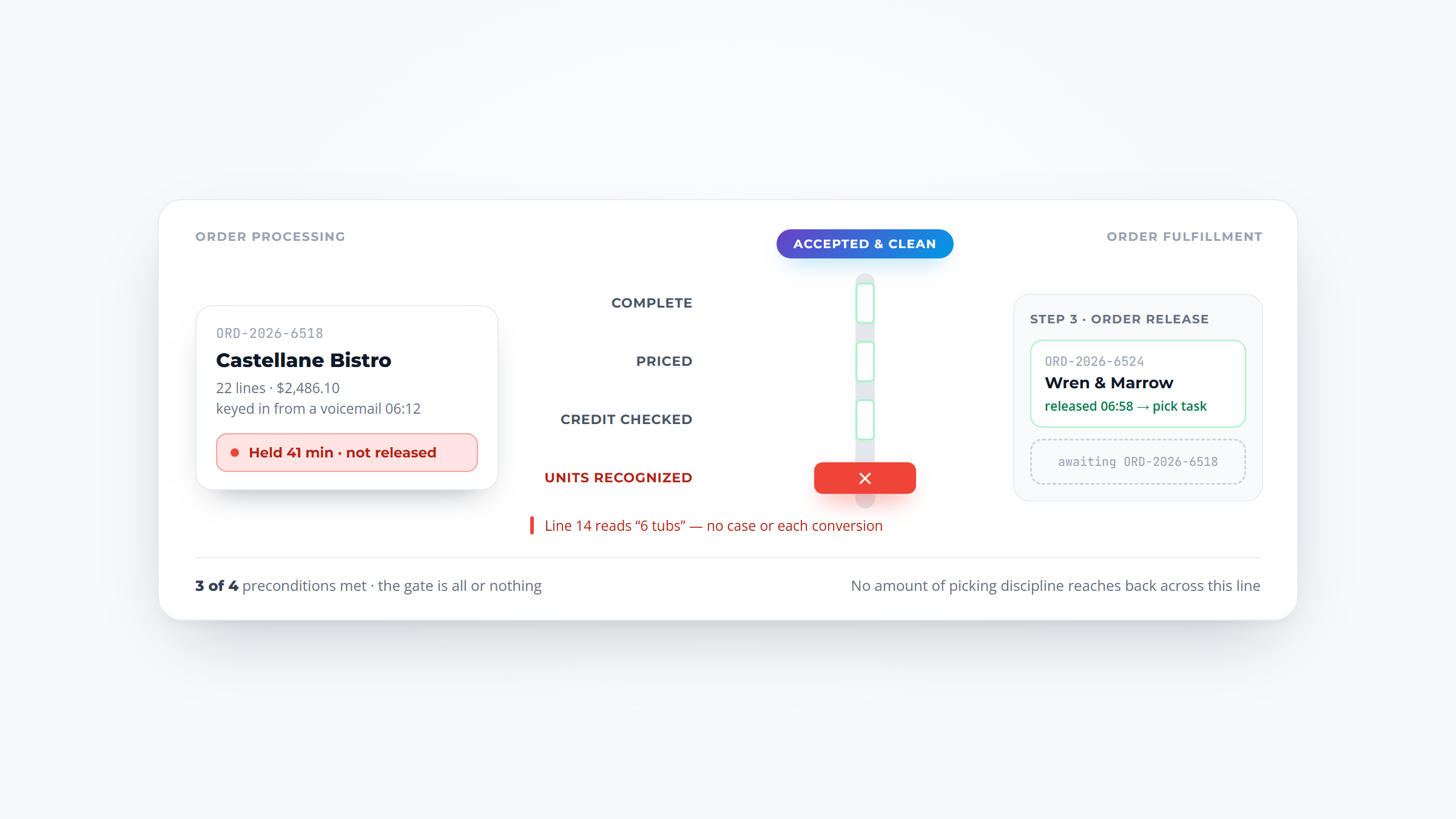
This guide uses the narrower and more useful boundary. The order fulfillment process starts once an order has been accepted, priced and confirmed, and ends once the customer has the goods and the paperwork agrees. What happens before that is order processing, and it is a separate discipline with separate failure modes, described in automated order processing.
The clean way to draw the line is by asking what the warehouse needs before it can act. It needs an order that is complete, priced, credit-checked, and expressed in units it recognizes. Producing that is order processing. Acting on it is fulfillment.
The reason to separate them is diagnostic. If your shorts are caused by an order that arrived as a voicemail and got typed in wrong, no amount of picking discipline will fix it. That first failure is what voice ordering tools such as VoiceOrder Solutions are aimed at.
If the shorts instead come from stock that could not be found in the bay, no amount of order-entry automation will help. Working out which of the two you have is worth doing before spending anything in the warehouse.
Most operations attack whichever end has a vendor pitching at them, rather than the end producing the errors.
The wider frame, order fulfillment process supply chain management, extends the boundary further out to include supplier inbound and demand planning. That view is useful when you are designing a network. It is unhelpful when you are trying to find out why Tuesday's route ran three cases short, because it makes almost everything in the company part of the answer.
Published guides split the order fulfillment process into five, six or seven steps, and the differences are mostly about where returns and delivery get grouped. Seven is the most useful count because it separates the two stages where most food distributors actually lose money.
| Step | What happens | Common failure |
|---|---|---|
| 1. Receiving | Inbound goods checked against the purchase order, counted and recorded | Received at nominal weight rather than actual, or posted at end of shift |
| 2. Putaway and storage | Product assigned a location under the right conditions | Stored without a location record, creating phantom stock |
| 3. Order release | Accepted order becomes a pick task, allocated to stock | Released before stock is genuinely available |
| 4. Picking | Items pulled from locations against the pick list | Right item, wrong pack size, or a substitution nobody logged |
| 5. Packing and staging | Order assembled, checked, labeled, staged by route | No independent check, so the pick error ships |
| 6. Shipping and delivery | Loaded, transported, delivered, proof of delivery captured | Temperature excursion, or delivery outside the agreed window |
| 7. Returns and credits | Rejections, shorts and damages processed back | Credit issued from a driver's note rather than a record |
Anyone building an order fulfillment process flow chart can use those seven boxes directly, with two decision diamonds worth drawing explicitly: one after step 3 asking whether the full quantity is available, and one after step 6 asking whether the delivery was accepted in full. Those two branches are where the exceptions live, and a flow chart that hides them describes a day when nothing goes wrong.
Draw the exceptions on the same page as the happy path. A flow chart that only shows the clean route trains people to treat exceptions as unusual, when in a food operation they are routine.
The sales order fulfillment process is the same seven steps viewed from the commercial side. It cares about the promise: what was quoted, what was committed, when it was said to arrive, and whether the invoice matches.
That framing matters because the two views disagree about what "done" means. A warehouse considers an order done when it is loaded. Sales considers it done when the customer has accepted it and has not disputed the invoice. The gap between those two definitions is exactly where credits are generated, and measuring only the warehouse view makes the operation look better than the customer experiences it.
Practically, this means the order fulfillment process needs one owner across both views, not a warehouse manager measured on dispatch and an account manager measured on complaints. Where the two are separately incentivized, shorts get handled by whoever is cheapest to blame. The workflow mechanics that connect them are set out in order management workflow.
The seven steps of the order fulfillment process do not change. Who performs them, and where the fixed costs sit, is the decision that shapes everything else.
| Model | Best when | Trade-off |
|---|---|---|
| In-house | Volume is steady, delivery is a differentiator, product needs handling knowledge | Fixed cost in building, fleet and labor regardless of volume |
| Third-party logistics | Volume is seasonal, geography is new, or capital is better spent elsewhere | Variable cost per order, less control over the customer's delivery experience |
| Direct ship from supplier | Item is bulky, slow-moving, or the supplier already delivers to that area | You own the promise but not the execution, and visibility is thin |
| Hybrid | Core range in-house, long tail or overflow outsourced | Two processes to run, and a routing rule that has to be maintained |
Most established food distributors are hybrid whether or not they call it that, because a handful of categories already ship direct from the manufacturer. The question worth asking is whether that arrangement was designed or simply accumulated.
Direct store delivery adds its own variant, where the fulfillment process ends inside the customer's premises rather than at a dock, with the driver merchandising, rotating and collecting returns. That changes the labor model and the proof-of-delivery requirement, which is covered under direct store delivery.
Picking method is usually chosen once and never revisited. Discrete picking takes one order at a time and is simple and slow. Batch picking gathers the same item across several orders in one trip and cuts travel. Zone picking assigns pickers to areas and passes the order between them. Wave picking releases groups of orders timed to a dispatch window.
Travel time is the dominant cost in most picking operations, so the first optimization is almost always slotting rather than method: fast-moving items closest to the packing station, heavy items positioned so they land at the bottom of the pallet. The deeper mechanics of that layout work sit in warehouse management process.
Packing is where a pick error either gets caught or ships. The cheapest control is separation of duties, and a small business operator on r/smallbusiness described it plainly: have one person pick the order and a different person pack it, so the packer double-checks the picker's work as they build the carton. Two sets of eyes on every order, with no technology required.
That is one operator's experience rather than a study, and it is cheap enough to test in a week.
A related idea travels less well and is worth translating rather than copying. Parcel sellers can settle a "half the order never arrived" claim by pulling the weight the carrier logged at dispatch, because every package gets weighed. A pallet leaving on your own route truck gets no weigh-in at all.
The equivalent has to be built into staging instead: the case count signed off at the dispatch check, plus the actual weight of every catchweight item, captured on the device that will later capture proof of delivery. That costs nothing beyond deciding to do it, and it turns a short-ship argument into a comparison of two records.
For most industries the delivery leg is a logistics problem. For food it is also a regulated one, and the rules are specific enough to shape how the process is designed.
The Food and Drug Administration's sanitary transportation rule, made under the Food Safety Modernization Act on the back of a 2005 transportation statute, spreads the duty across four roles instead of resting it on the driver: whoever ships the food, whoever loads it, whoever hauls it by truck or rail, and whoever receives it at the other end.
What it asks for is unglamorous. Equipment has to be fit for the job and clean, the operation has to be run so food does not warm up or get contaminated on the way, the training has to have happened, and all of it has to be documented.
The three failures it was written against are a load that is not kept cold, a trailer that is not cleaned between loads, and food left unprotected.
A distributor moving its own product is usually more than one of those four roles at once.

The edges of the scope are worth knowing before you design around it. Road and rail are covered; ship and air are not, because the statute underneath does not reach them.
Farms sit outside the rule, and so do operations with less than $500,000 in average annual revenue. So does food shipped completely enclosed in a container, unless that food needs temperature control for safety, which is the carve-out that takes most genuinely shelf-stable freight out of scope.
The operational consequences are concrete. Somebody has to specify the temperature the load must be held at, somebody has to verify the vehicle can hold it, and the records have to exist afterwards. A fulfillment process that treats the truck as a black box between dispatch and delivery is missing a compliance step, not just a visibility one.
Delivery windows deserve the same treatment. In foodservice they are often contractual, tied to a receiving window when the customer has staff on site, and a delivery that arrives outside it can be refused even though the goods are perfect. Build the window into the promise rather than into the driver's judgment, and give customers a way to see status without phoning, which is what order tracking is for.
Three food-specific complications break generic fulfillment logic, and each needs a rule decided in advance rather than on the dock.
Substitution is the first. When an item is unavailable, somebody decides whether to send an alternative, and the worst version of that decision is a picker making it silently. The rule needs three parts: which items have approved substitutes, who is allowed to authorize one, and how the customer is told before the truck arrives rather than after.
Shorts are the second. A short-ship is a promise already broken, so the only remaining variable is how early the customer learns about it. Notifying at pick time gives a kitchen a chance to adjust a menu; notifying at delivery gives them a problem. This is cheap to fix and rarely done, because the information exists hours before anyone acts on it.
The same shortage, told at two different hours, is two different conversations.

Catchweight is the third and the most technical. Products sold by weight but ordered by piece have to be picked, weighed and invoiced on the actual weight, and any step that treats the nominal weight as final produces an invoice dispute.
If your system cannot carry both the ordered quantity and the shipped weight through to the invoice, catchweight items will generate credits forever regardless of how well the warehouse performs.
Reverse flow gets a paragraph in most fulfillment guides and a filing cabinet in most operations. In foodservice distribution it is usually driver-collected: a rejected case comes back on the same truck, with a note.
That note is the problem. A credit raised from a handwritten driver note carries no evidence about what came back, in what condition, or why, so it cannot be analyzed later and cannot be disputed at the time.
The fix is to make the return a transaction at the point of collection, with a reason code from a short fixed list, captured on the same device that captures proof of delivery.
Reason codes only work if the list is short enough that drivers use it honestly. Damaged, wrong item, short-dated, over-delivered, customer refused, quality complaint: six options is workable, and twenty is a list nobody reads.
Once you have three months of coded returns you can see whether credits come from picking, from receiving, from a single supplier or from one customer's expectations. Each of those points at a different fix.
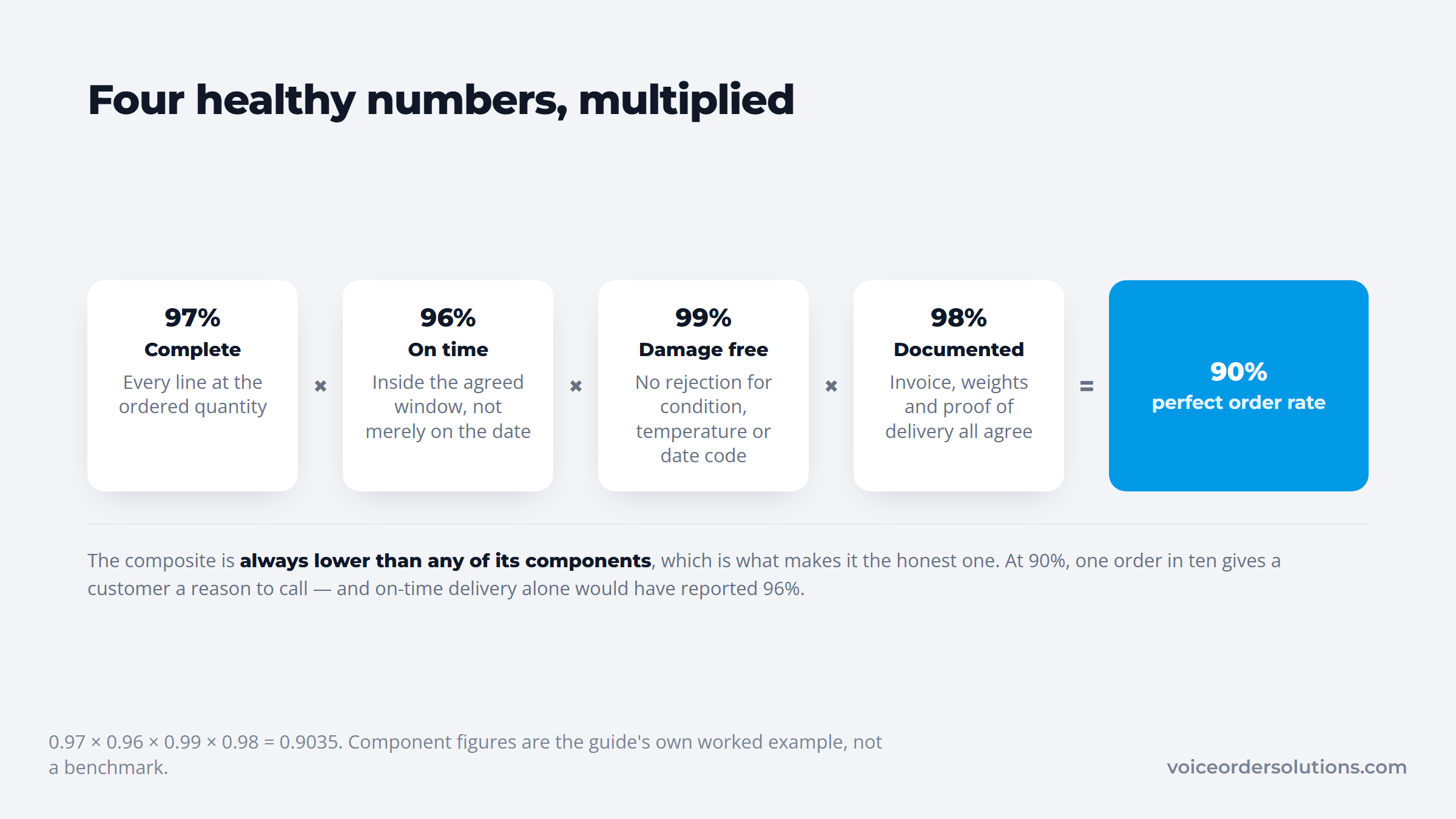
Single metrics flatter the order fulfillment process. On-time delivery can be excellent while orders arrive incomplete. Fill rate can be high while a quarter of invoices get disputed. The perfect order rate is the multiplication of the things a customer actually cares about, which is why it is always lower than any of its components and always more honest.
| Component | What it asks |
|---|---|
| Complete | Every line shipped at the ordered quantity |
| On time | Delivered inside the agreed window, not merely on the date |
| Damage free | Accepted without rejection for condition, temperature or date code |
| Documented correctly | Invoice, weights and proof of delivery agree with what was received |
Multiply the four and a set of components at 97%, 96%, 99% and 98% produces a perfect order rate near 90%, meaning one order in ten gives a customer a reason to call. That arithmetic is why the composite measure is worth the effort of assembling.
Laid out as a multiplication, none of the four numbers looks like the problem.
On-time in-full is the common shorthand for the first two components, and it has known limits. A 2024 study in Mathematics, modeling spare-part distribution in the automotive sector, argued that existing approaches to measuring distribution efficiency suffer from partial observation of the problem, and proposed a fuller model for assessing OTIF compliance.
That industry is not food and the model should not be transplanted as a benchmark. The underlying caution does transfer: a single compliance percentage tells you less than it appears to, which is the argument for the composite view above. Systems that assemble these figures across order, warehouse and invoice data are compared in order management software.
Run a month of credits through their root causes and the same handful of points in the order fulfillment process account for most of the value, in roughly this order.
Stock that was not really available at release, so the order was picked short before anyone touched it. Unit-of-measure mismatches, where a case and an each get confused between the order and the pick. Silent substitutions, and catchweight items invoiced at nominal weight.
Deliveries refused for arriving outside a receiving window come next, followed by orders that were wrong before the warehouse ever saw them. That last category gets blamed on the warehouse most often and belongs to it least.
The diagnostic is simple and few operations run it: tag every credit with the step that caused it, not the department that absorbed it, and look at the distribution after a month. Most managers are surprised by which step wins, and the surprise is the point of the exercise. The broader process framing that surrounds this sits in order management process.
Order fulfillment process optimization strategies usually arrive as a list of technologies. The sequence below is ordered by what has to be true before the next thing works.
Five of these cost nothing beyond the decision to do them, and each removes a class of credit rather than a single instance.
Re-slot the pick face against the last quarter's movement rather than the layout you inherited, since fast movers migrate. Separate picking from packing so every order gets a second look. Batch or zone the picking only after slotting is right, because a faster route through a bad layout is still a bad layout.
Automation belongs last in this sequence, not first. Every operation that has automated a broken process has discovered that it now produces the same errors faster and with less opportunity to notice. Systems worth looking at once the process is stable are surveyed under order fulfillment software.
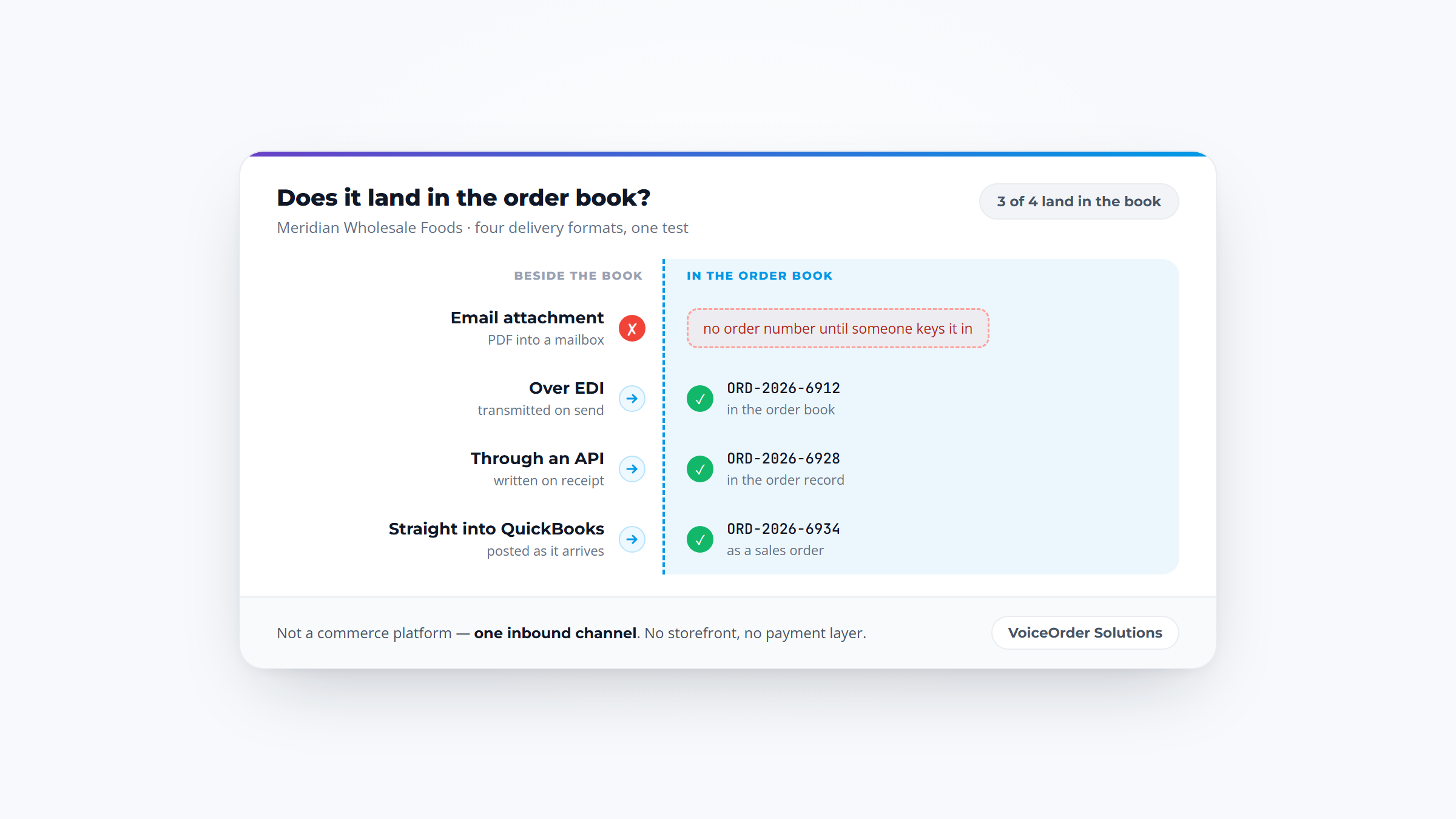
One step that decides how much of the rest is achievable is not among the seven at all. It sits upstream of step three, where an accepted order becomes a pick task.
If the order arriving at release is a transcription of a voicemail, every downstream control is protecting a document that may already be wrong, and the most disciplined picking operation in the region will still ship the wrong thing accurately.
This is the narrow problem VoiceOrder Solutions works on, and the buyer is the distributor rather than the operator receiving the delivery. A food distributor deploys the app to the restaurants and stores on its account list, with each account's own product list and agreed prices loaded into the admin platform.
Orders from those accounts reach the distributor's system already digitized, confirmed and timestamped, with a unique order number attached. The customer confirms each line before sending, so the order desk is not correcting somebody else's transcription.
An interrupted order resumes where it stopped, and orders placed after hours are captured and queued instead of sitting in a mailbox until morning.
The boundary is worth stating plainly. VoiceOrder Solutions does not pick, pack, slot, route, schedule a fleet, print a label or process a return, and it has nothing to do with steps four through seven above.
What it affects is step three, by making the order that gets released a cleaner one, and it does not claim more than that. Distributors can see where it sits relative to the rest of their stack under order management.
Take last month's credits, tag each one with the step in the seven that caused it, and total the value by step. Most operations have never done this and most are wrong about the answer.
Fix the single largest bucket before touching anything else. Release against unavailable stock is an allocation setting rather than a warehouse project. Catchweight invoicing is a data flow. Silent substitutions are a rule and a conversation, and that one can be settled this week for nothing.
If the tagging keeps pointing upstream of step three, to orders that were already wrong before anything was released against them, that is worth testing directly rather than arguing about. Pricing is available on request, and distributors can put a week of their own inbound orders through VoiceOrder Solutions and compare the result.
Request a VoiceOrder Solutions demo
Receiving inbound stock, putaway and storage, order release, picking, packing and staging, shipping and delivery, then returns and credits. Some guides compress this to five or six by merging delivery into shipping or leaving returns out, but keeping them separate is more useful for a distributor because those two stages generate most of the credits.
Order fulfillment begins once an order is accepted, priced, credit-checked and expressed in units the warehouse recognizes. Everything before that, including capture, validation and pricing, is order processing. The line matters diagnostically: errors that originate before it cannot be fixed by better picking, and errors after it cannot be fixed by better order entry.
There is no universal figure, and the number is only comparable against your own history because it depends on how strictly you define each component. What matters is measuring it as the product of complete, on time, damage free and correctly documented rather than as any one of those.
Components in the mid to high nineties multiply out to roughly 90%, so treat a composite in that region as normal rather than poor.
Three changes cost nothing and move the number. Separate picking from packing so a second person checks every order. Record the case count and the catchweights at the dispatch check so a short-ship claim is settled against a record. Write down the substitution rule so nobody is making that decision alone on the dock. Re-slotting the pick face against recent movement is the fourth, and it costs a weekend.
Four things: temperature control in transit is regulated under the FDA's sanitary transportation rule rather than optional, catchweight items must be invoiced on actual shipped weight rather than nominal, substitutions carry menu consequences that generic replacements do not, and delivery windows are often contractual because the customer only has staff to receive at certain hours. Each one needs a rule decided in advance.