.webp)
Key takeaways:
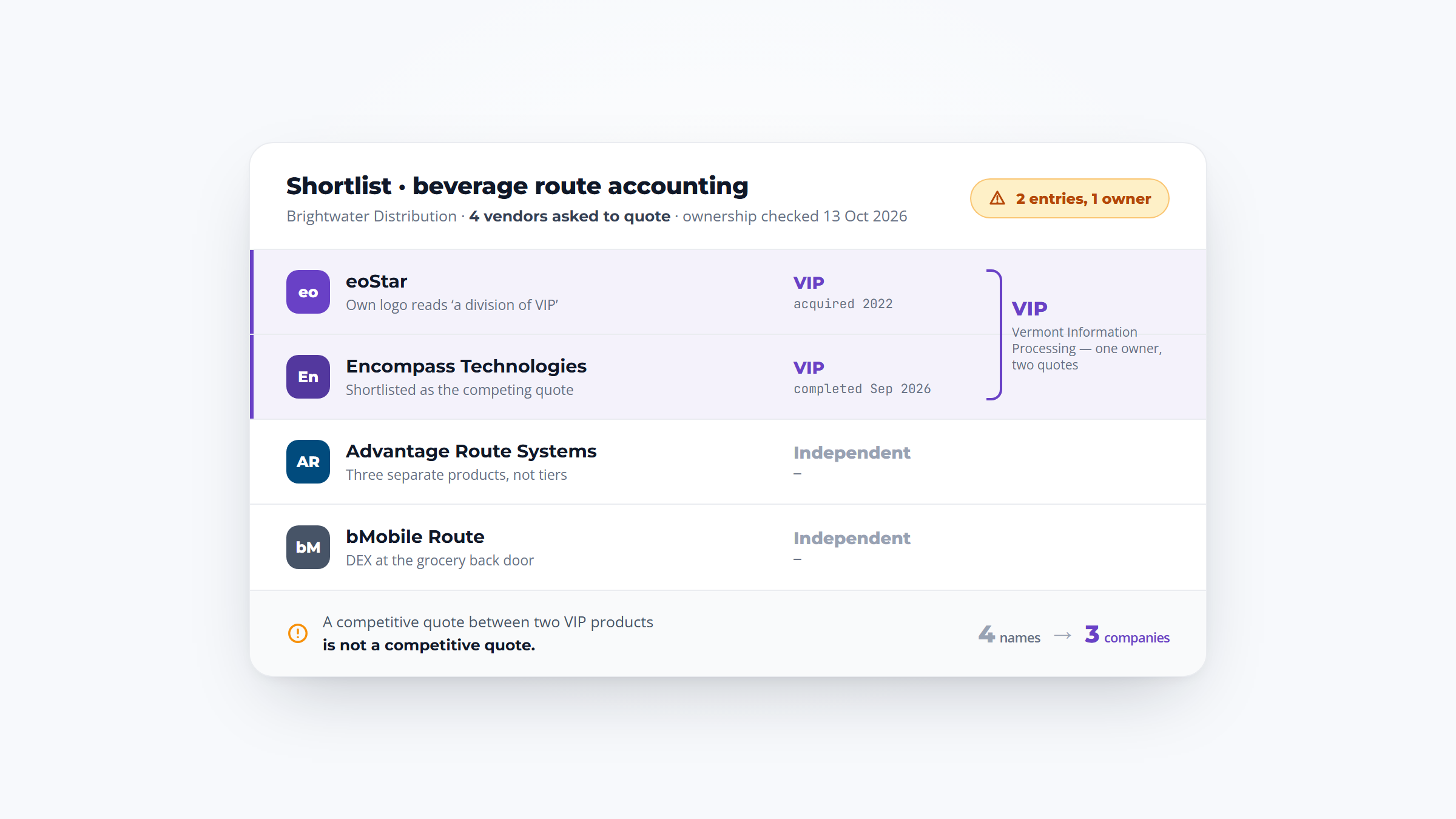
Walk into any warehouse with an accuracy problem and you will hear the same theory: the pickers need to slow down. Almost never true. Pick errors are usually the last visible symptom of something that went wrong hours or weeks earlier, at a receiving dock or on the order desk.
The warehouse management process is the sequence that moves goods from a supplier's truck to a customer's door. This guide walks each step, but through one specific lens: what each one does to the accuracy of the orders you ship, and where that accuracy is actually won or lost.
The warehouse management process covers everything that happens to physical goods inside the four walls of a facility, from the moment a truck backs into a dock to the moment product leaves on another one.
That is narrower than it sounds, and the distinction trips people up constantly. The Association for Supply Chain Management separates three things that get used interchangeably: warehouse management is what happens inside the building, inventory management tracks stock across the whole supply chain, and stock management handles replenishment against demand.
You need all three. They are not the same discipline, and a tool that does one well often does the others badly. If your problem is knowing what you own rather than moving it, that is wholesale inventory management software territory, not a warehouse process problem.
Search the process of warehouse management and you will get a different step count from every result. This is not sloppiness. It is a genuine disagreement about whether returns, quality control, and cycle counting are their own stages or parts of adjacent ones.
| Source | Steps | What it adds or folds in |
|---|---|---|
| ASCM | 6 | The bare spine; returns and counting excluded |
| NetSuite | 6 | Same six, framed around KPIs per stage |
| Canon Business Process Services | 7 | Adds returns and cycle counting as numbered steps |
| Cerexio | 8 | Adds inventory control and returns |
| SimplyDepo | 9 | Splits inspection and QC out of receiving |
| Inbound Logistics | 11 | Adds kitting, dispatch, and value-added services |
Pick whichever taxonomy matches your facility. For accuracy specifically, the six-step spine plus two additions is the useful frame, because inventory control and returns are the two stages where records and reality drift apart most quietly.
Here is the warehouse management process flow that every source agrees on, with what each step contributes to order accuracy and how each one fails.
| Step | What happens | The accuracy risk |
|---|---|---|
| 1. Receiving | Goods arrive, get checked against the purchase order and shipping notice, and are logged | Product hits the rack before it is scanned in |
| 2. Put-away | Stock moves from the dock to its assigned location | Item stored in the wrong bin; location never recorded |
| 3. Storage | Goods sit in a known location until needed | Slot drift as items get moved for convenience |
| 4. Picking | Items are pulled to fill an order | Wrong item, wrong quantity, similar SKUs confused |
| 5. Packing | Picked items verified, protected, labeled | Pick errors sail through without a scan gate |
| 6. Shipping | Order loaded, documented, dispatched | Wrong carrier, wrong address, wrong pallet |
Read them in order and one thing stands out. Each step inherits whatever the previous step got wrong, and the cost of fixing an error roughly multiplies every time it survives another handoff. That compounding is why the wider order management workflow is worth drawing out on paper before any single step gets optimized.
If you fix one step, fix this one. A warehouse operator on Reddit made the case better than most vendor content does, arguing in a thread on barcode software that scanning alone fixes transcription errors but not accuracy, because the real damage comes from product landing on the rack before it is scanned in.
The fix that worked was structural: a gate, not a warning.
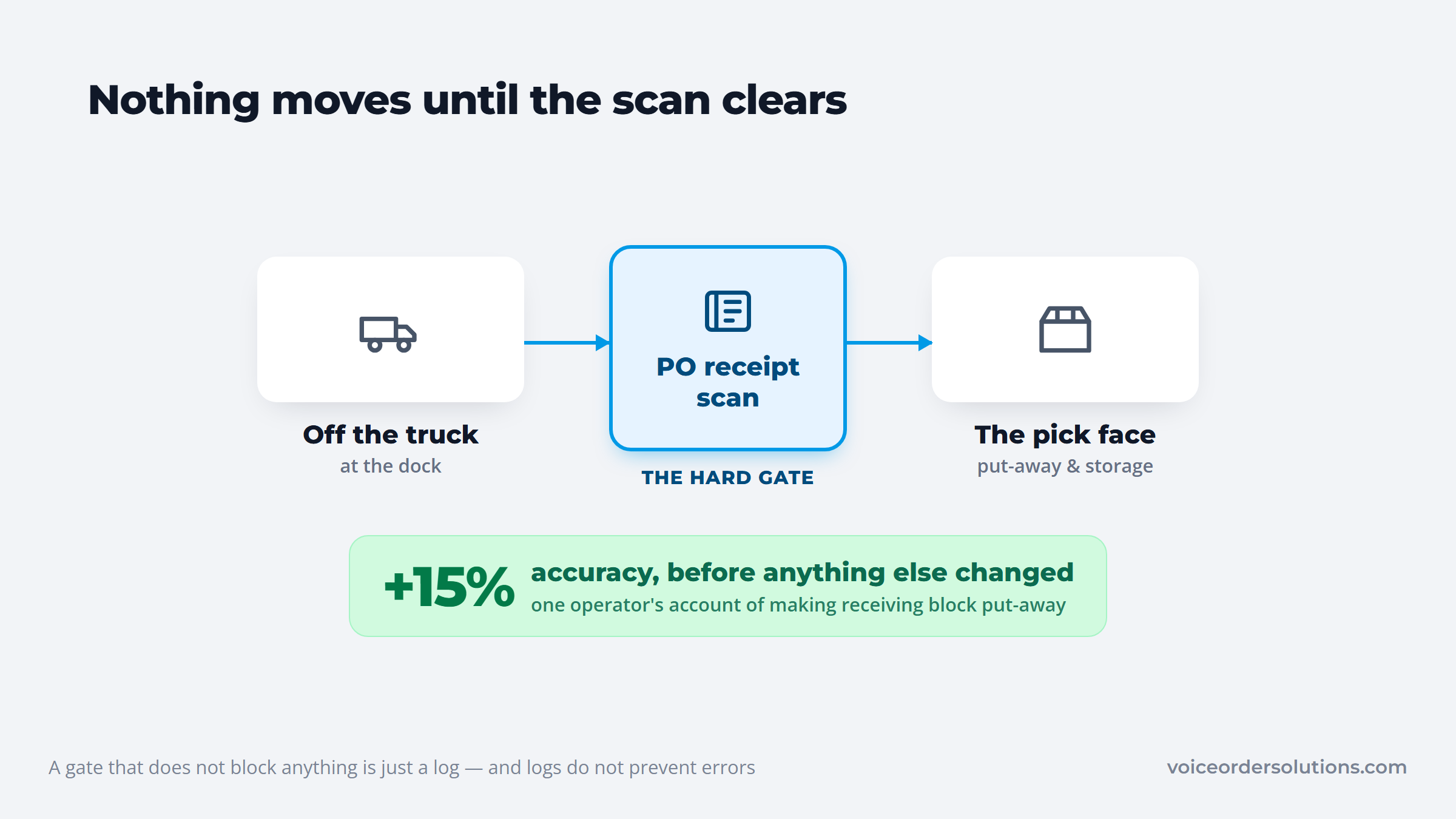
The reply that stuck: they made receiving a hard gate, so nothing physically moved to a pick face until the purchase order receipt scan cleared. Accuracy jumped 15% before they changed anything else. That is one operator's account rather than a study, but the mechanism is sound and it explains why so many barcode rollouts disappoint.
The point is sequence, not paperwork. Each step has to block the next one.
Skip step 5 and the other four become decoration. That is the whole insight: a gate that does not block anything is a log, and logs do not prevent errors.
Every step above assumes the pick list is right. Receiving, put-away, and slotting all work to make sure the correct product is in the correct place, and none of them can tell you the order itself is wrong.
That is a real gap in a distribution warehouse, because the order did not come from your system. A customer phoned it in, left it on a rep's voicemail, or texted it, and somebody at the order desk typed it up before it ever reached the floor. Every one of those hops is a chance to book a case pack as an each or hear "sixteen" as "sixty."
The unnerving part is what the floor looks like when it does.
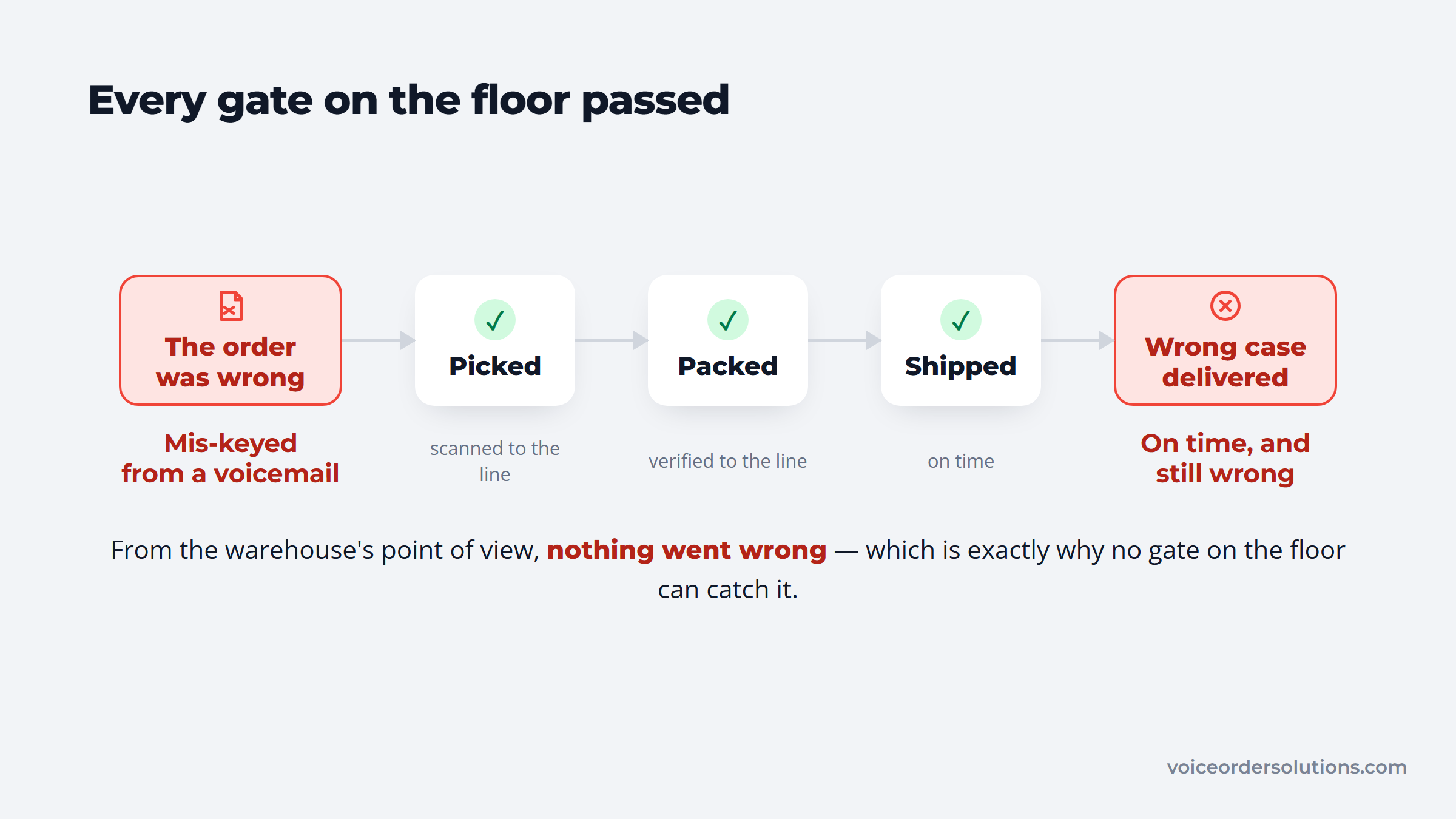
When that happens, your process works flawlessly against the wrong instructions. The picker scans to the line, the packer verifies against the line, the line ships on time, and the customer still gets the wrong thing. No gate on the floor catches it, because from the warehouse's point of view nothing went wrong.
This is why order intake belongs in a conversation about warehouse accuracy at all. It has its own playbook, covered in phone ordering AI and automated order processing.
VoiceOrder Solutions works on that step alone. It is not a warehouse management system and does not pretend to be one; it will not tell you what is on your racks or route a picker. It handles how the customer's order reaches you.
The model is worth understanding because it is the opposite of transcription. Rather than a rep taking a call and re-keying it, the customer's own staff speak the order into an app while walking their cooler, matched against an order guide built from your catalog and your pricing. The order lands already structured, carrying a unique number and a timestamp. That match only holds if the catalog behind it is current, which is the job B2B catalog software does.
That timestamp is what an order desk actually argues about. When a customer says they asked for six and the pick list says two, a confirmed record answers it in seconds instead of a phone call and a guess.
Orders placed after close are captured and queued rather than sitting in a voicemail box until morning, and they arrive in whatever format your team already works from, a workflow covered in wholesale food distribution software.
None of that moves a pallet. It just means the pick list your floor executes against says what the customer meant. VOS is aimed at independent food distributors in particular, where the order desk is often one or two people.
Picking deserves disproportionate attention because it consumes disproportionate money. A peer-reviewed review of 269 journal papers published in Production & Manufacturing Research found that order picking usually contributes more than 55% of total warehouse cost, and that layout alone can swing total picking travel distance by more than 60%.
That is also who your workforce is. The Bureau of Labor Statistics counts about 1.84 million people in warehousing and storage, including 457,740 stock clerks and order fillers at a median $21.49 an hour. The warehouse management system picking process is not an abstraction; it is most of your labor bill, doing the step that costs the most when it goes wrong.
Which picking method you choose drives most of your accuracy and speed.
| Method | How it runs | Best when |
|---|---|---|
| Discrete | One picker takes one order, start to finish | Low volume, high-value or complex orders |
| Batch | One picker pulls the same SKU across several orders at once | Many orders sharing few SKUs |
| Zone | Each picker owns an area; orders pass between zones | Large facilities, wide SKU range |
| Wave | Orders released in scheduled groups, often by carrier cutoff | Shipping deadlines drive the schedule |
Batch and zone both raise throughput and both introduce a sorting step where orders can cross. That is the trade: the faster methods move the error risk from the pick face to the consolidation point, so whichever you choose, the verification has to move with it.
Put-away looks trivial and quietly wrecks counts. The failure is rarely losing a pallet; it is putting it somewhere real and never recording where.
Slotting is the discipline that decides where things live, usually with ABC analysis: fast movers near the pack stations, slow movers further out. Done well it cuts travel distance, which is the single biggest lever on picking cost.
Then it drifts. Warehouse workers describe hot items getting moved closer for convenience during a rush and never returning to their home slot, so the system says one location and the product lives in another. Nobody logged anything wrong. The record and the building simply stopped agreeing. Slot discipline is one of the recurring costs in warehouse operations, and it is usually a scheduling problem rather than a system one.
The fix is unglamorous: make location changes a scanned transaction rather than a decision, and re-slot on a schedule instead of by instinct. Perishable facilities feel this fastest, since a mis-slotted item is also an aging one, which is why restaurant inventory management treats location and date as the same problem.
Slotting only works inside the floor you actually have, and the space a given amount of stock needs is usually larger than the racking footprint suggests once aisles, dock and staging are counted.
See how many square feet you need to hold your inventory once aisles, dock and staging are counted, and how much stacking higher saves.
What you need to store
Room for the work
Watch what the stack height does. Going from two high to three takes the same stock from 725 square feet to 484, which is often the difference between re-slotting and renting a second unit. The aisles and overhead figure is the one to keep in view, because it stays near 45% of the building whatever you do with the racks.
Packing is the last cheap place to catch a pick error. After this, the error rides a truck and becomes a return, a credit, and an angry phone call.
A scan-to-confirm step at the pack station is the standard control, and it works because it is independent: the packer scans what is physically in the tote and the system compares it to what the order says should be there. A mismatch stops the pack rather than trusting the picker to notice their own mistake. The comparison is only as good as the record it checks against, which is why order fulfillment software and clean capture belong to the same conversation.
Shipping adds documentation risk on top. Right product, wrong pallet, wrong carrier, wrong address, and traceability matters here too, since a lot number that was never captured cannot be recalled later. That is a real cost in food distribution specifically, covered in food traceability software.
The inventory and warehouse management process only stays honest if someone keeps checking the record against the shelf. Cycle counting is that habit: counting a slice of the facility continuously rather than shutting down twice a year for a full physical count.
What most guides skip is the resolution protocol, which is where counts actually get fixed or quietly corrupted. A warehouse worker laid out a workable version in a cycle counts thread, and it maps to what the discrepancy usually is: a mispick, where someone pulled an extra piece to complete an order.
Notice what makes it work: every physical move gets recorded, including the informal ones. Counts drift when people fix problems helpfully and silently, pulling a replacement piece to save an order and telling nobody. Catch that habit and most of your mystery variance disappears.
Returns run the process backwards, and backwards is where accuracy goes to die. A returned item has to be received again, judged, and sent somewhere, usually with less information than it had on the way out.
The control is a disposition decision made once, by rule, and recorded: restock it if it is saleable, refurbish it if it can be, quarantine it if its condition is unclear, scrap it if it is done. The failure mode is an item sitting on a returns bench for a week in a state the system cannot describe, counted by nobody and available to everybody.
Give returns the same gate receiving gets. Nothing rejoins sellable stock without a scan that says it did.
Most teams do not need a new system; they need to see the one they have. Building a warehouse management process flow chart is the cheapest diagnostic available, and it usually takes an afternoon.
Step 4 is the one that changes minds. Teams discover their errors cluster at one or two handoffs, and that the expensive automation they were considering sits nowhere near either.
The warehouse management process rewards attention at the front. Receiving and put-away are cheap to fix and decide what every later step is working with, while picking optimization is expensive and only pays off on a foundation of counts you can trust.
So start upstream of where the pain shows up. Count your last ten shipping errors and trace each back to the step that created it, not the step that revealed it. If more than a couple trace to an order that was already wrong when it hit the floor, the fix is not on the floor.
If the trace keeps ending at a phoned-in order rather than a picker, that is an intake problem, and VoiceOrder Solutions runs demos of that step. For the systems that run the floor itself, warehouse distribution software covers the category, and inventory management covers visibility across it.
The six steps nearly every source agrees on are receiving, put-away, storage, picking, packing, and shipping. Guides that list seven to eleven steps are usually breaking out inventory control, quality inspection, returns, or kitting as their own stages rather than folding them into adjacent ones.
For accuracy work, treat the six-step spine as the core and add inventory control and returns, since those two are where records and reality drift apart.
A warehouse management system process flow is the same six-step sequence expressed as what the software does at each stage: pre-receiving against an advance shipping notice, scan-verified receipt, directed put-away, location tracking, directed picking, pack verification, and shipping documentation. The value is not the diagram but the gates in it. A flow where product can move without a scan will drift no matter how detailed the chart looks.
Receiving causes the most, because everything downstream trusts its record. If stock can reach a pick face before its receipt scan clears, later steps inherit a count that was never true. Picking produces the most visible errors and consumes more than 55% of warehouse cost per a peer-reviewed review of 269 studies, but many of those errors originate in a receiving or put-away record that was already wrong.
Warehouse management is what happens to goods inside the building: receiving, moving, picking, and shipping them. The warehouse inventory management process is the record-keeping layer over it, knowing what you own, where it sits, and whether the system agrees with the shelf. ASCM draws this line explicitly and adds a third, stock management, which handles replenishment against demand. A facility can move product well and still have records nobody trusts.
No, and expecting it to is the common mistake. A WMS enforces gates and removes transcription errors inside the building, but it can only execute the order it was given.
If a customer's order was misheard on a phone call or mistyped from a voicemail, your pickers will pull the wrong line perfectly and your packers will verify it against the same wrong line. Accuracy needs the order to be right before it reaches the floor, and the process gated once it does.