.webp)
Key takeaways:
Ask four people in a business to describe the order management process and you will get four answers. Sales describes quotes becoming orders, while operations describes picking and shipping. Finance talks about invoicing and collections, and purchasing means buying stock in.
All four are correct, and the disagreement is the problem. Orders fall through the gaps between those definitions, and each team believes the failure belongs to somebody else.
This guide separates the four processes, shows where they hand off, and covers the specific improvements that make orders faster without adding headcount.
The order management process is the full sequence from an order being placed to it being fulfilled and paid for. In its broadest form it runs from a customer's decision through picking, shipping, invoicing, and cash collection.
Most organizations do not run it as one process. They run three or four connected processes, each owned by a different function, joined by handoffs that nobody is formally responsible for.
That structure is why order management improvements so often disappoint. Optimizing the warehouse does nothing if orders arrive late from sales, and speeding up invoicing does nothing if the order data was wrong at capture.
The useful mental model is a chain where every link inherits the errors of the one before it.
Separating the four makes it obvious which one you actually need to fix.
| Process | Starts with | Ends with | Usually owned by |
|---|---|---|---|
| Customer order management | A customer placing an order | The customer receiving it | Customer service or ops |
| Sales order management | A quote or agreed deal | An order entered and confirmed | Sales |
| Purchase order management | An internal need for stock | Goods received and matched | Purchasing |
| Order to cash | An order being placed | Payment collected and reconciled | Finance |
The four overlap rather than running in sequence. Order to cash spans almost the whole chain, while purchase order management runs alongside it on the buying side.
Confusion between the customer order and purchase order processes causes the most wasted effort. A restaurant ordering produce from a distributor is running a purchase order process, even though it feels like placing an order, and the software that helps is different.
This is the process most people picture. A customer orders, the order is validated, stock is allocated, it is picked and shipped, and the customer is updated along the way.
Its defining constraint is that the customer is watching. Every delay is visible, so the process is judged on communication as much as on speed.
The failure modes are concentrated at the start and end. Orders captured incorrectly cause downstream chaos, and orders fulfilled correctly but communicated poorly still generate complaints and support cost.
Improving it usually means removing manual re-entry at capture and automating status updates, rather than accelerating the warehouse. Most operations discover their warehouse was never the bottleneck.
The sales order management process converts an agreed deal into a structured order the rest of the business can act on. It covers pricing, terms, credit checks, and getting the order into the system correctly.
It is the least automated of the four in most organizations, because it involves negotiated terms that resist standardization. Reps hold pricing in spreadsheets, apply it manually, and the resulting orders need correction later.
The fix is usually structural rather than technological. Pricing that lives in the system as customer-specific price lists removes the interpretation step, and the order enters correctly the first time. Setting those prices in the first place is a separate job, and a product pricing calculator compares a cost-plus, a target-profit and a competitor-matched price on the same case.
Where deals genuinely are bespoke, the answer is an approval step rather than free-text entry, so exceptions are visible instead of invisible.
This is the buying side, and for restaurants and distributors it is where the real money leaks. It covers identifying a need, raising a purchase order, sending it to a supplier, receiving goods, and matching the invoice.
The cost is larger than most operators assume. APQC benchmarking data shows organizations spend anywhere from about $14 to more than $54 to process a single purchase order, and attributes that spread largely to how the work is structured rather than which system is installed.
At $54 an order, a business placing 40 orders a week is spending over $100,000 a year on the administration of buying. That is the number worth putting in front of anyone who thinks this process is too small to optimize.
Distributors selling into this process meet it from the other side, through wholesale order management systems built to receive it. The step that generates most of that cost is capture. Orders assembled by walking a storeroom and then relayed by phone or voicemail get re-keyed by someone else, and every re-keying is both labor and risk.
VoiceOrder Solutions removes that relay from the distributor's end. Instead of a rep transcribing a call, the buying customer speaks into an app holding the catalog and prices already agreed between them, and the finished record arrives with a reference number and a time attached. The re-keying step, and the cost that sits inside it, is gone.
The confirmation step matters more than the speed. Because the order is presented back before sending, a misheard item is caught by the person who placed it rather than discovered when the truck arrives.
The order to cash management process is the finance view of the same chain, running from order placement through fulfillment, invoicing, collections, and reconciliation. It is the widest of the four definitions.
Its distinguishing feature is that errors surface late. A pricing mistake made at order entry appears as a disputed invoice weeks later, by which point the fix requires a credit note and a phone call.
The same mistake is two very different jobs depending on when it surfaces.
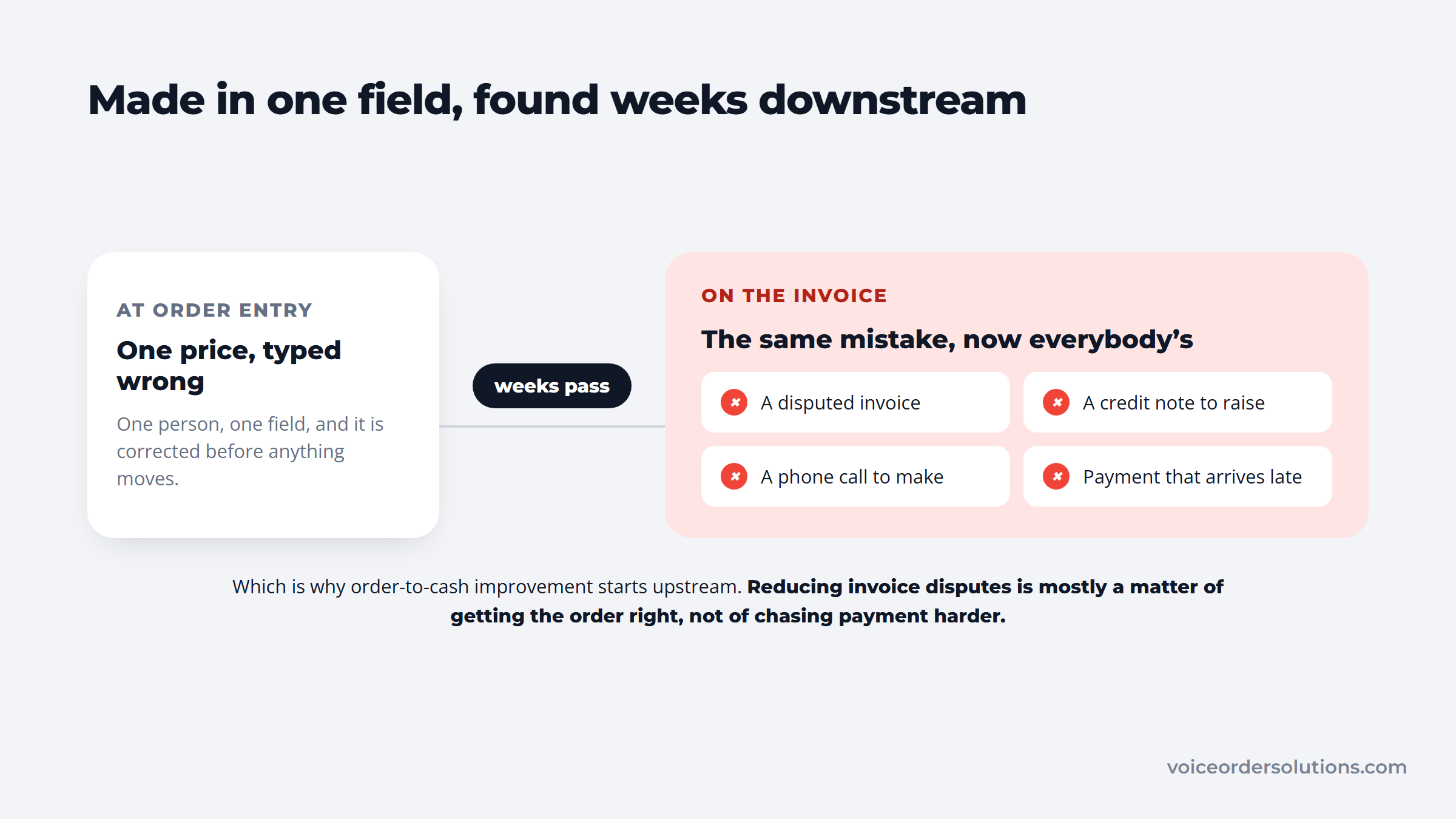
That delay is why order to cash improvements usually start upstream. Reducing invoice disputes is mostly a matter of getting the order and the delivery right, not of chasing payment harder. To see what the current delay is costing you, an AR turnover calculator turns credit sales and receivables into days sales outstanding.
Returns complicate the end of the process considerably. NRF and Happy Returns put US retail returns at $890 billion in 2024, up from $743 billion the prior year, with retailers estimating 16.9% of sales would be returned.
For food distribution the equivalent is credits for short or wrong deliveries, and the same principle holds: the cheapest credit is the one you never have to issue.
The ecommerce order management process flow follows the same shape with three differences that change how it is built.
Volume is higher and order value is lower, so per-order manual handling is not viable at any stage. Orders arrive continuously rather than in batches, which removes the natural checkpoints a daily order cycle provides. And customers expect real-time status, so the process has to publish its own state outward.
The practical consequence is that ecommerce order management lives or dies on integration quality. Stock levels, order status, and shipping data have to move between systems without a person copying anything.
B2B food ordering is drifting toward the same expectations. Restaurants increasingly want to see stock availability and order status the way they would on a consumer site, which is why distributors have invested in customer-facing ordering software.
The order fulfillment process supply chain management teams own is the execution half of order management, sitting alongside procurement, inventory, and logistics.
The distinction that matters operationally is between promising and delivering. Order management promises: it confirms what a customer will get and when. Fulfillment delivers against that promise using the stock and capacity actually available.
Most broken promises trace to the two being disconnected. An order confirmed against stock that was already allocated elsewhere becomes a short shipment, and no amount of warehouse efficiency prevents it.
The two figures come off the same shelf and only one of them is safe to promise against.

Available-to-promise logic, where the system checks genuinely uncommitted stock before confirming, is the standard fix, and it is a core reason distributors invest in ERP for distribution. It requires inventory accuracy good enough to trust, which is the harder half.
Across all four processes, the failures cluster in predictable places.
The first item causes more downstream cost than the rest combined, because it corrupts the data every later step depends on. It is also the cheapest to fix.
Notice that only one of those six is a warehouse problem. Order management improvement programs that begin in the warehouse usually begin in the wrong place.
Improving the end to end order management process works best in a fixed sequence, because each step depends on the one before it being right.
Step one is the one most often skipped, and it is the one that tells you whether the other six apply to you. Mapping usually reveals two or three re-entries nobody knew existed.
Step two carries most of the arithmetic. Handing the customer a way to place the order themselves removes the re-entry rather than accelerating it, which is the difference between order management that gets faster and order management that gets cheaper.
Step seven is organizational rather than technical, and it is frequently what makes the rest stick.
Two categories of software claim this process, and knowing which you are being shown prevents a lot of wasted evaluation time.
An order management system specializes in the order lifecycle: capture across channels, allocation, orchestration, and status. It is generally faster to deploy and better at handling many channels, but it needs to connect to whatever holds your financial records.
An ERP owns the financial system of record and treats orders as one module among purchasing, inventory, and accounting. It gives you one ledger and one dataset, at the cost of a longer implementation and less depth on multi-channel orchestration.
The practical rule is that channel complexity favors an order management system, while financial complexity favors an ERP. A distributor selling through three channels with straightforward accounting has a different problem from one selling through a single channel across four legal entities.
Plotted against the two things that actually decide it, the choice stops being a feature comparison.
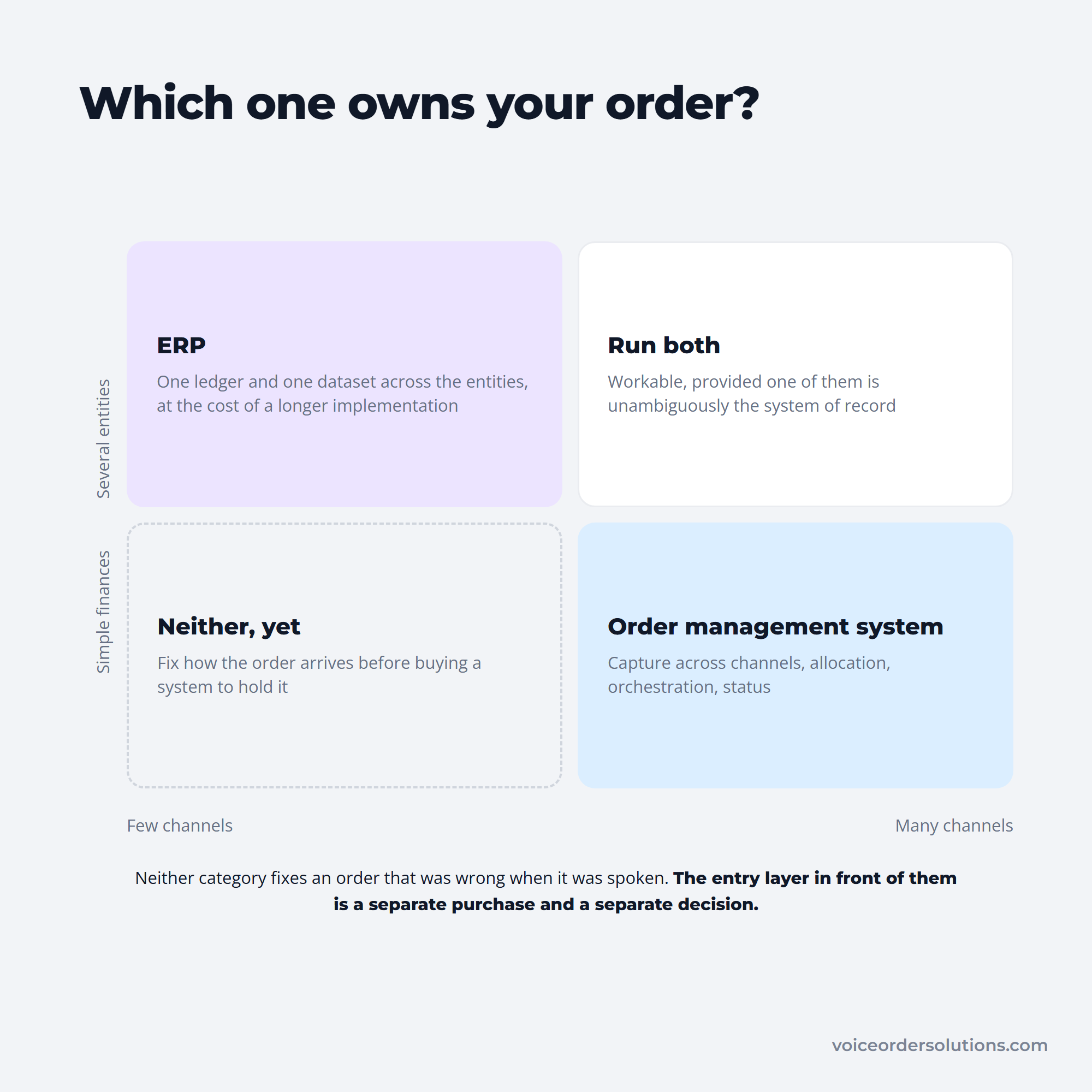
Many operations end up running both, which is fine provided one of them is unambiguously the system of record. The failure mode is two systems that each believe they hold the authoritative order, which produces reconciliation work nobody budgeted for.
Neither category fixes an order that was wrong when it was spoken, which is why the order entry layer in front of them is a separate purchase and a separate decision.
Measuring the process as a single cycle time hides where the delay lives. Measure the handoffs instead.
| Handoff | Metric | Why it matters |
|---|---|---|
| Customer to system | Order-to-confirmation time | Exposes capture and re-entry delay |
| System to warehouse | Confirmation-to-pick time | Shows whether release is batching badly |
| Warehouse to customer | Pick-to-delivery time | The part most operations already track |
| Delivery to invoice | Delivery-to-invoice time | Drives how fast cash arrives |
| Invoice to cash | Days sales outstanding | The finance view of everything upstream |
Order-to-confirmation is the metric most businesses do not track and should. It is where manual capture hides, and it is usually measured in hours when everyone assumes minutes.
Measuring it is straightforward and uncomfortable. Take fifty recent orders, record when the customer actually sent them and when they appeared confirmed in your system, and look at the spread rather than the average.
The spread is where the story is. A median of twenty minutes with a tail running to six hours means most orders are fine and a specific channel or shift is failing, which is a far more actionable finding than an average of ninety minutes.
Track order accuracy alongside speed, as a percentage of lines rather than orders. A single wrong line in a fifty-line order still triggers a credit and a phone call.
Time one order end to end this week. Note every point where a person retypes something that already existed in writing, and how long the order waited between steps.
That single exercise usually locates the problem within an hour, and it is almost always at capture rather than in fulfillment. Time a second order on a different day before drawing conclusions, since one quiet Tuesday can flatter a process badly. Businesses that start with the warehouse spend money accelerating a step that was never the constraint.
Once capture is clean, the downstream improvements get easier, because the data flowing into them is finally reliable.
Distributors whose inbound purchase orders still arrive by phone call and voicemail can move that capture step to their customers directly. VoiceOrder Solutions is sold to independent food distributors and captures the order at the point it is spoken; see how it works, or contact the team to try it against a live order guide.
In its broadest form: order capture, validation, stock allocation, picking and packing, shipping, delivery confirmation, invoicing, and payment reconciliation. Different functions draw the boundaries differently, which is why the same process gets described with anywhere from five to eight stages. What matters more than the count is knowing which stages your business actually owns and where the handoffs between teams sit.
Sales order management handles orders coming in from customers, covering pricing, terms, and getting the order into your system correctly. Purchase order management handles orders going out to suppliers, covering raising the order, receiving goods, and matching invoices. A restaurant buying produce is running a purchase order process; the distributor filling it is running a sales order process. The same transaction, two different processes.
Order to cash is the finance term for the whole chain from an order being placed through to payment being collected and reconciled. It spans sales, operations, and finance, which is why it is usually the widest definition anyone in the business uses. Improving it generally means fixing errors upstream at order entry rather than chasing payments harder at the end.
Start by removing manual re-entry at capture, since errors introduced there propagate through every later stage and cannot be corrected cheaply. Then confirm orders against genuinely uncommitted stock rather than on-hand totals, and automate status updates so customers are not calling to ask. Warehouse speed is rarely the constraint, though it is usually where improvement projects begin.
APQC benchmarking data puts it at anywhere from about $14 to more than $54 per purchase order, with the spread driven mainly by how the process is structured rather than which software is used.
Multiply that upper figure by your annual order count before deciding the process is too small to improve. For many mid-sized operations the total runs well into six figures. Worth noting that the benchmark covers the administrative act of processing the order alone, not the value of the goods, so it is pure overhead rather than cost of sale.