For Independent Food Distributors

Accounts Receivable Turnover Calculator

See how fast you collect, how many days past terms your customers really pay, and what that delay costs you.
VoiceOrder app ordering screen

Accounts Receivable Turnover Calculator

See how fast you collect, how many days past terms your customers really pay, and what that delay costs you.

Your numbers

$
Sales billed on terms. Leave out cash and card sales that settle the same day.
days
What the invoice says. Net 30, net 21, net 14.
$
$
% / yr
Your line of credit rate, or what that cash would earn if you had it.
days
AR turnover ratio
9.4x
You collect your book 9.4 times a year
Days sales outstanding
38.8 days
Average time from invoice to cash
Days past your terms
8.8 days
How far customers run past net 30
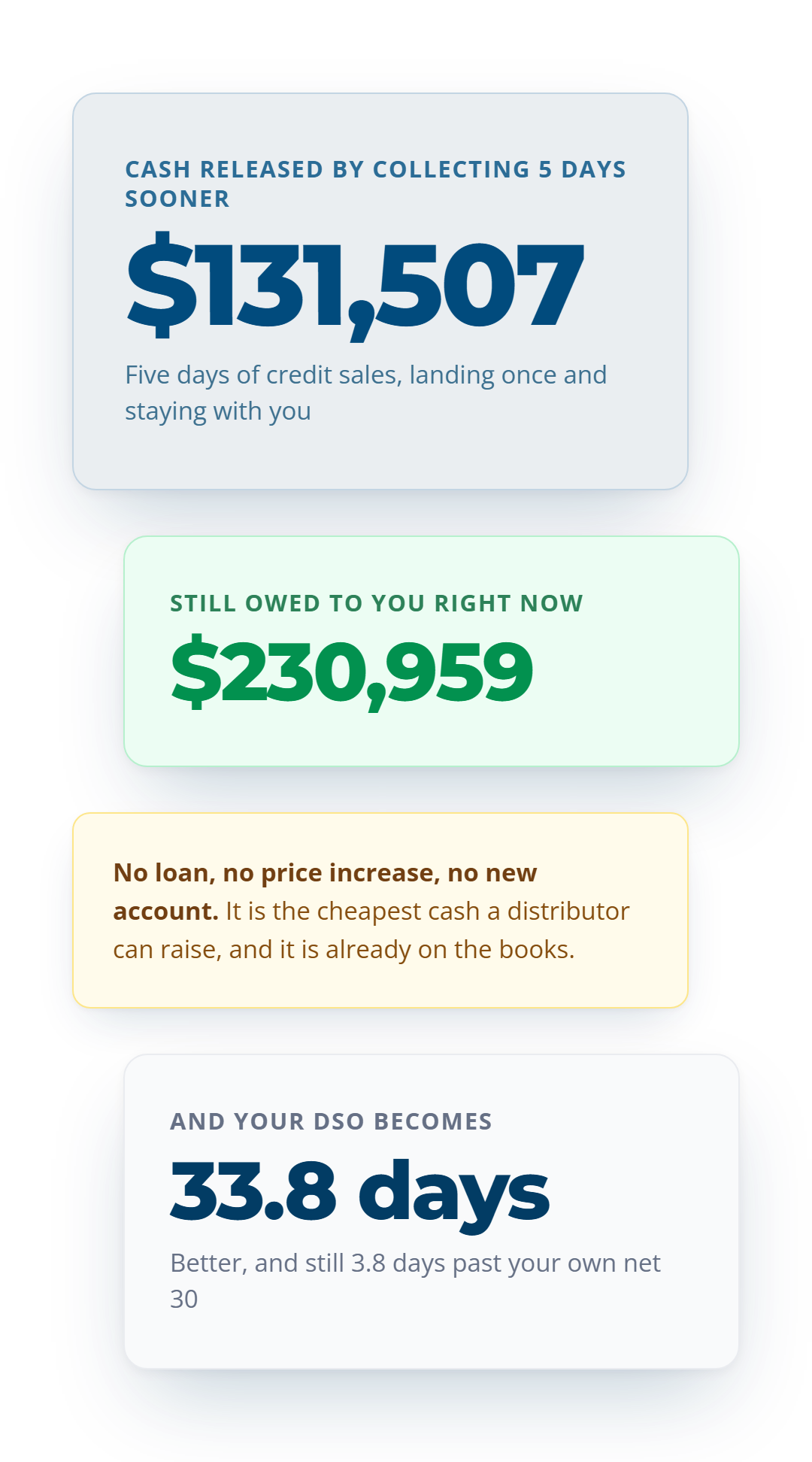
Cash stuck past terms
$230,959
Your money sitting in other people's accounts
Yearly cost of that delay
$20,786
At 9% cost of money
Cash freed by collecting 5 days sooner
$131,507
One-time cash release, yours to keep
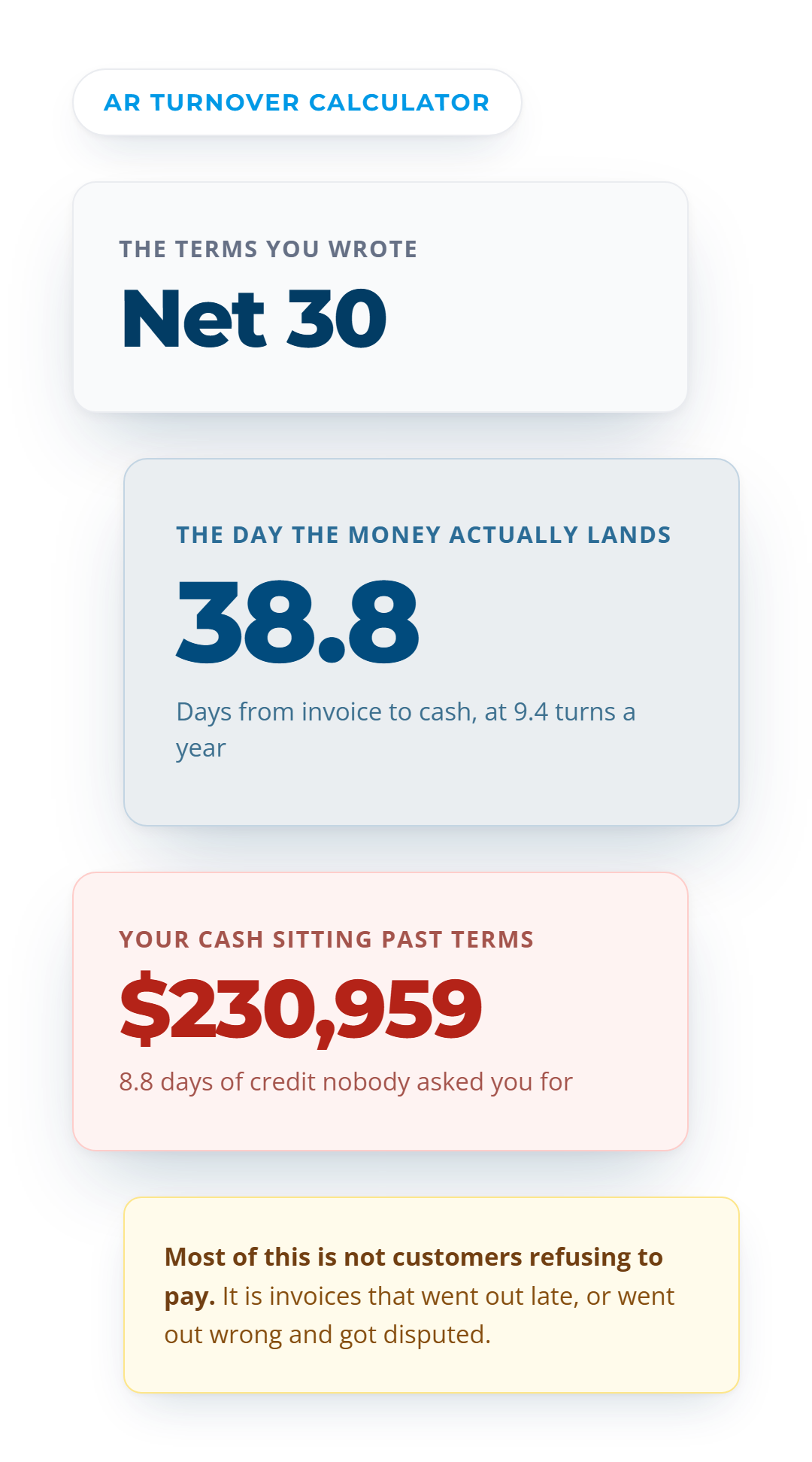
You write net 30 but collect in 38.8 days. That gap leaves $230,959 of your cash on someone else's balance sheet and costs you $20,786 a year to finance. Most of it is not customers refusing to pay, it is invoices that went out late or wrong.
You cannot collect on an order you keyed in wrong. VoiceOrder Solutions digitizes and confirms every order before it ships, so invoices go out clean the first time and disputes stop aging your book.
Book A Demo →
Estimates only. Uses a simple average of your start and end AR balances. Talk to your accountant before acting on the numbers.
38.8

Days you actually take to collect

$230,959

Of your cash sitting past terms

$20,786

A year to finance the gap

Sound Familiar?

You wrote net 30, and the money shows up on day 39

The terms on the invoice are not the terms you are operating on. The difference is a loan you never agreed to make.
Buffer band for the extra days past terms that you quietly finance

Our customers pay fine, just a bit late.

A bit late is 8.8 days past net 30. On $9,600,000 of credit sales that is $230,959 of your money funding their operation instead of yours.
Stacked pile for invoices left waiting until the month end chase

We will chase it at month end.

Chasing is the expensive fix. Most of the gap starts earlier, with an invoice that went out a day late or carried a quantity the customer disputes.
Rising line for the cash collecting five days sooner would release

Five days would not change much.

Five days is $131,507 released in one go, and it is cash you already earned. No new account, no price increase, no loan.
How It Works

How to use the accounts receivable turnover calculator

Four numbers off your year end, then a slider to price the gap. It takes about a minute.
1

Use credit sales, not total sales

Cash and card sales never become receivables, so including them understates how slowly your credit book actually turns.
2

Enter AR at both ends of the year

The calculator averages them, which smooths out a seasonal peak. A single year-end figure taken after a slow December will flatter you.
3

Compare DSO against your written terms

38.8 days against net 30 is 8.8 days of unofficial credit. That gap, not the ratio, is the number worth managing.
Built For Distributors

What the calculator shows you

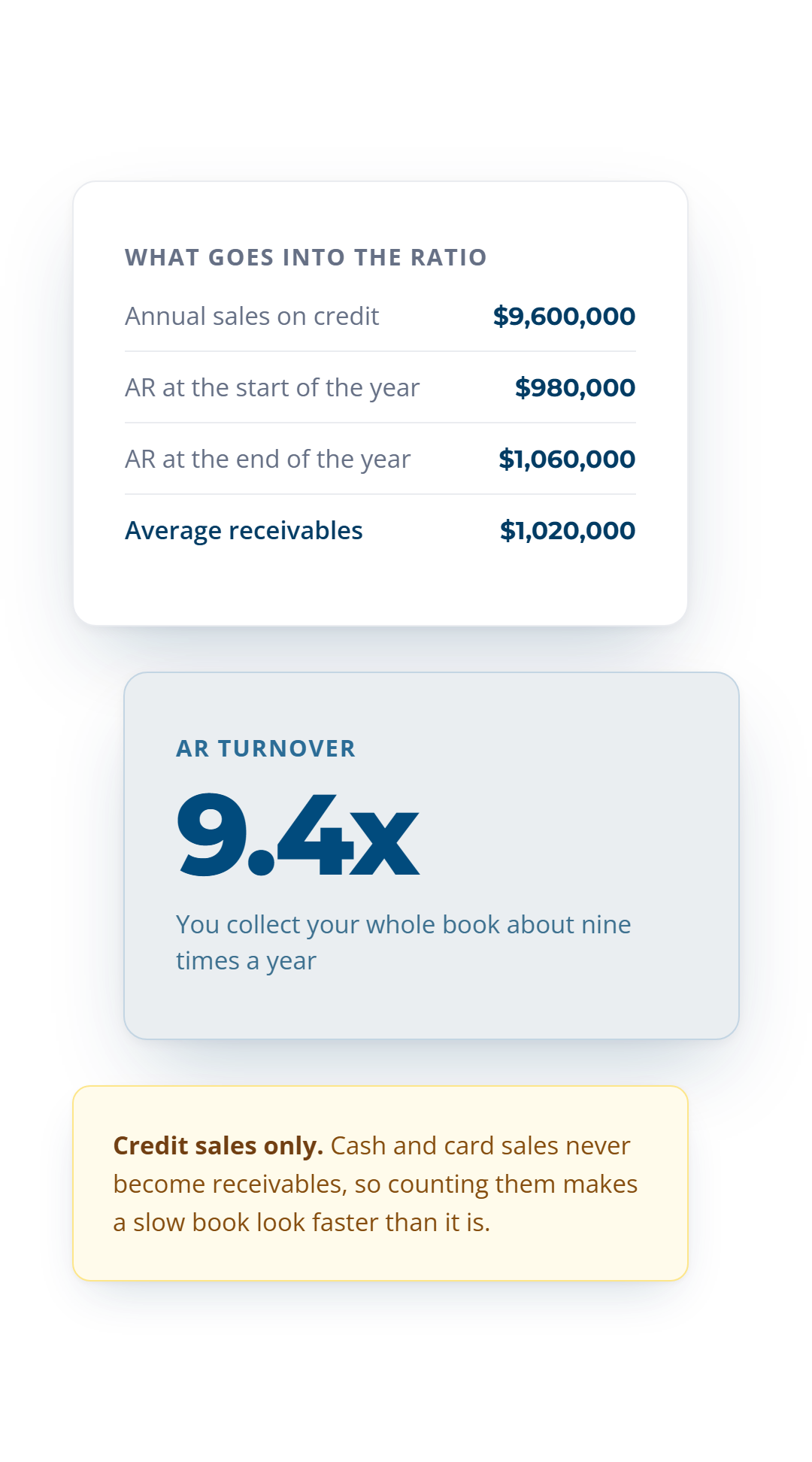
AR turnover worked out: $9,600,000 of credit sales against an average book of $1,020,000 gives 9.4 turns a year.
Turnover

How many times a year you collect your book

Credit sales divided by average receivables. $9,600,000 against an average book of $1,020,000 is 9.4 turns, which is the ratio a lender will ask for.
Uses credit sales, not total sales
Averages AR across the year
Gives one ratio you can track
Compares cleanly year on year
Days past terms

The gap between what you wrote and what you get

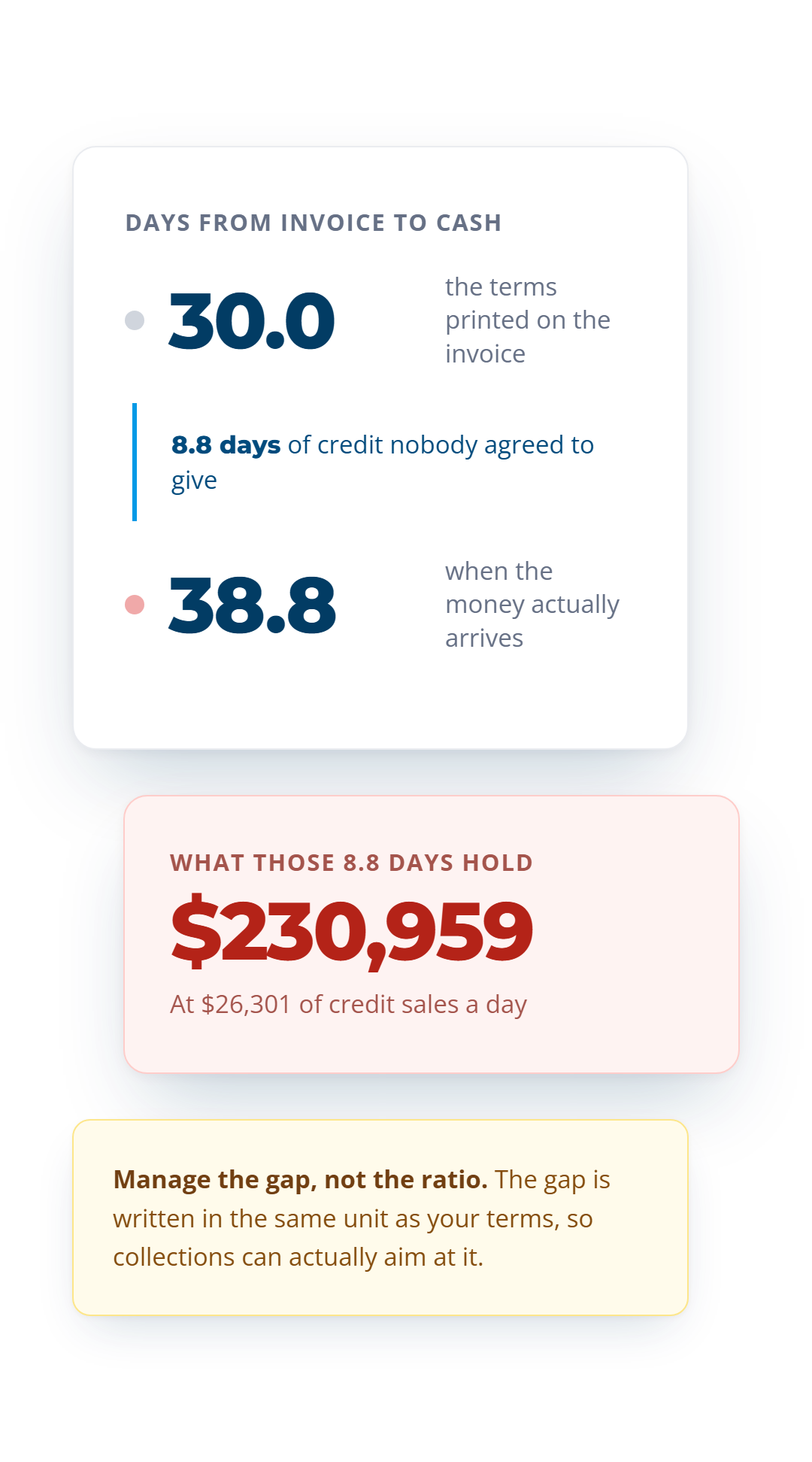
9.4 turns is 38.8 days from invoice to cash. You wrote net 30, so 8.8 days of credit are being taken without anyone asking.
Converts the ratio into real days
Measures the gap against your own terms
Shows the number collections should target
Works for any terms, not just net 30
Net 30 terms against 38.8 days to collect, a gap of 8.8 days holding $230,959 of your cash.
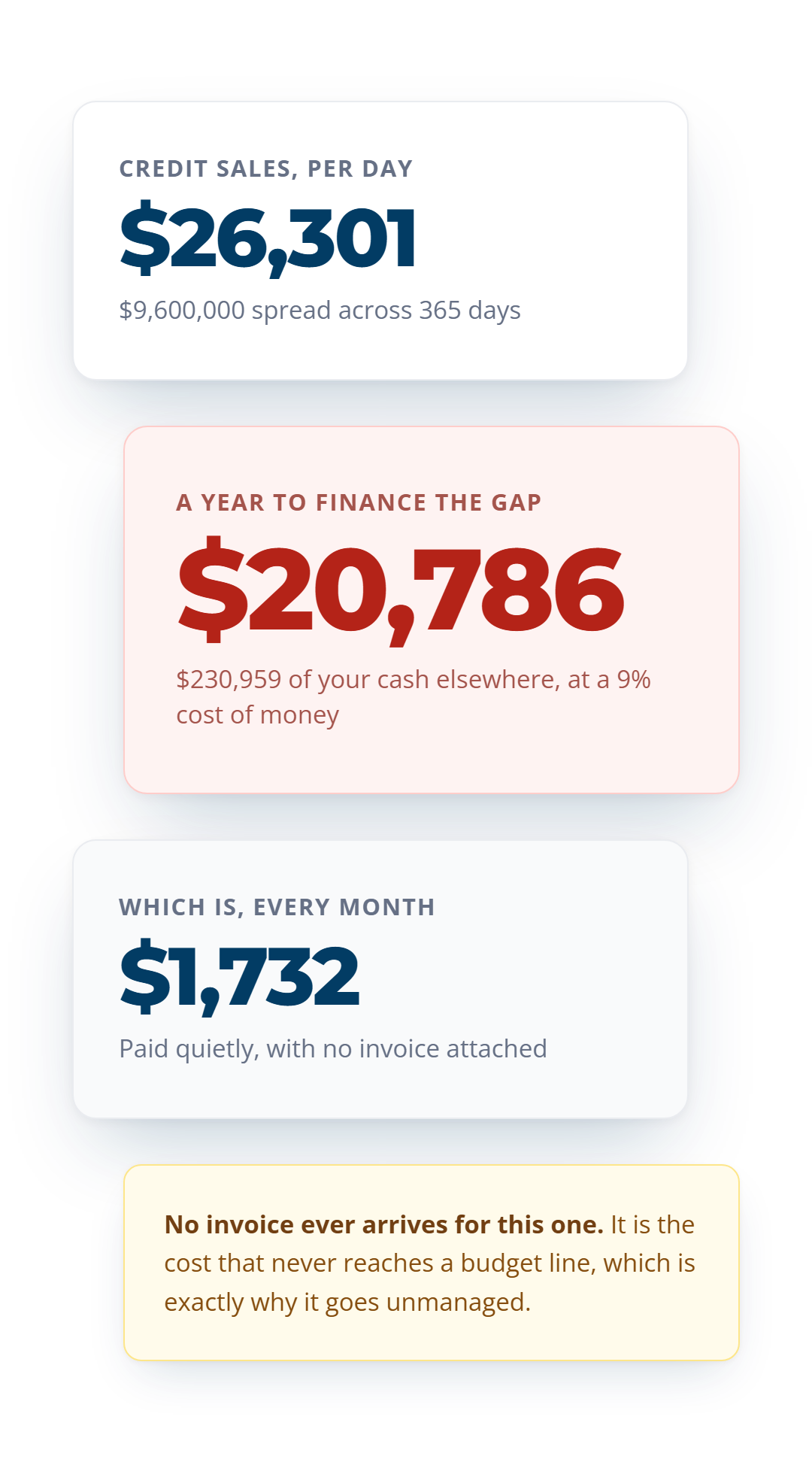
At $26,301 of credit sales a day, financing $230,959 past terms costs $20,786 a year, or $1,732 a month.
Cash and cost

What the delay is costing you to finance

At $26,301 of credit sales a day, 8.8 days past terms is $230,959 parked elsewhere. Financing it at 9% costs $20,786 a year.
Prices the gap in dollars, not days
Applies your own cost of money
Turns a ratio into a budget line
Updates as the book moves
The prize

What collecting five days sooner releases

Five days of credit sales is $131,507. Collect that much sooner and it lands once, in cash, and stays with you.
Turns a days target into a cash figure
Slides from one day to a month
Separates one-time cash from annual saving
Gives collections a target worth hitting
Collecting five days sooner releases $131,507 once, and brings days sales outstanding from 38.8 to 33.8.
After The Numbers

What to do once you know your DSO

A DSO number only pays off if it changes how invoices go out. Start here.
Invoice document icon for invoicing the day you deliver

Invoice the day you deliver

Verified checkmark icon for fixing invoice disputes early

Fix disputes before they age

Bar comparison icon for ranking accounts by days past terms

Rank accounts by days past terms

Calendar icon for chasing payment at day 31

Chase at day 31, not day 60

Balance scale icon for matching credit terms to the account

Match terms to the account

Turnover arrows icon for tracking DSO every month

Track DSO every month

Price tag icon for pricing slow paying accounts

Price slow payers accordingly

Target icon for quarterly credit limit reviews

Review credit limits quarterly

Cash banknotes icon for putting released cash to work

Put the released cash to work

Six Levers

What actually moves your days sales outstanding

DSO is an output. Most of it is decided before anyone picks up the phone to chase.
Clock icon for invoice timing

Invoice timing

An invoice sent two days late is two days added to every account it touches.
Dollar sign icon for invoice accuracy

Invoice accuracy

A disputed line stops the whole invoice, not just the line. Those are the ones that age past 60.
Order guide list icon for order accuracy

Order accuracy

A wrong quantity on delivery becomes a credit note, and a credit note becomes a late payment.
Percent icon for setting terms by account

Terms by account

One set of terms for every customer means your best payers subsidize your slowest.
Downward trend icon for chase timing

Chase timing

A reminder on day 31 costs a phone call. The same debt at day 90 costs a relationship.
Delivery truck icon for proof of delivery

Proof of delivery

An order you can show, numbered and timestamped, ends most disputes before they start.

See how VOS gets the order right before it becomes an invoice

VoiceOrder Solutions sends every order through digitized and confirmed, with its own order number, date and timestamp, so the invoice behind it is not the one that gets disputed.
The Comparison

Three ways to deal with slow payment
Not the office keying it in.

Same $9,600,000 of credit sales, same 8.8 days past terms. This is what each approach actually fixes.

What you need from a collections fix

Bill clean and early

Chase harder

Tighten terms

Shortens DSO without a phone call
No, the phone call is the method
Only if they are honored
Stops the dispute before it ages
No, it starts after the dispute
No, a disputed invoice ignores terms
Costs you nothing per account
No, it is staff time per account
Yes, on paper
Keeps the customer relationship intact
Not past day 60 it does not
Not with the accounts you want to keep
Works on accounts you cannot pressure
No, pressure is the whole tool
No, they are the ones who ignore terms
Scales as you add accounts
No, it needs a person per account
Yes, it is just a policy
Fixes the cause, not the symptom
No, it treats the symptom
No, it renames the symptom
Shows up in next month's DSO
Yes, briefly
Rarely, and not on its own
Where it falls down
It cannot rescue debt that already aged
The same accounts age again next month
You already write net 30 and collect in 38.8
Best used for
Everything invoiced from here on
Debt that is already past 60 days
New accounts, before a habit forms
FAQ

Common questions about accounts receivable turnover

What is the formula for accounts receivable turnover?
Annual credit sales divided by average accounts receivable. $9,600,000 of credit sales against an average book of $1,020,000 gives 9.4 turns a year.
What is the turnover of accounts receivable?
It is how many times a year you collect your whole receivables book. Nine point four turns means the average invoice is paid and replaced about every 39 days.
What is a good AR turnover ratio?
Judge it against your own terms rather than a benchmark. On net 30 a ratio near 12 means you collect on time; 9.4 means you are running 8.8 days behind what you wrote.
What is days sales outstanding?
The average days from invoice to cash, which is 365 divided by your turnover. It is the same measure as the ratio, in the unit your terms are written in.
Why use credit sales instead of total sales?
Cash and card sales never become receivables. Counting them inflates the numerator and makes a slow book look faster than it is.
What does slow collection actually cost?
The cash sits elsewhere and you finance the gap. At 8.8 days past terms that is $230,959 of your money, costing $20,786 a year at a 9% cost of money.
How is this different from inventory turnover?
Receivables turnover measures how fast customers pay you. Inventory turnover measures how fast stock leaves the warehouse. Both park cash, in different places.

Bill it right the first time

VoiceOrder Solutions delivers every order digitized, numbered and timestamped before it reaches your system, so the invoice behind it goes out clean and on time.