Key takeaways:
An institutional kitchen is not a restaurant that happens to be inside a building. A hospital kitchen produces meals against diet orders written by clinicians, and getting one wrong is a patient safety event.
A school district kitchen produces meals that have to meet federal nutrition standards and be counted correctly, because the count is what the district gets reimbursed on. A senior living community does both, for residents who live there and will eat the same cycle menu for years.
Restaurant software does none of this, which is why foodservice software solutions for institutions grew up separately. It assumes a guest chooses from a menu, pays, and leaves. The software below assumes a population with dietary requirements, a budget set a year ahead, a production schedule that runs whether or not anyone is hungry, and a regulator somewhere downstream.
The ten platforms below were reviewed in October 2026 using only what their vendors publish. They are grouped by the setting they are built for, because that is the only sorting that helps: the gap between a K-12 platform and a hospital platform is far wider than the marketing suggests.
Strip away the differences and a foodservice management system does five things: plan a menu cycle, analyze its nutrition, forecast and produce against it, record what was served, and account for the money.
Menu cycle planning is where a foodservice management system starts. A restaurant menu changes seasonally. A cycle menu repeats on a four-week or six-week rotation, has to hit nutrient targets across the whole cycle rather than per dish, and has to work for people who have no alternative.
Nutrient analysis is the part most restaurant tools cannot do at all. It calculates against a standard, not against a label, and in K-12 that standard is federal.
Foodservice operations software forecasts from census or enrollment rather than from last week's covers. A hospital forecasts from admissions, a school from attendance, a senior community from its resident roll.
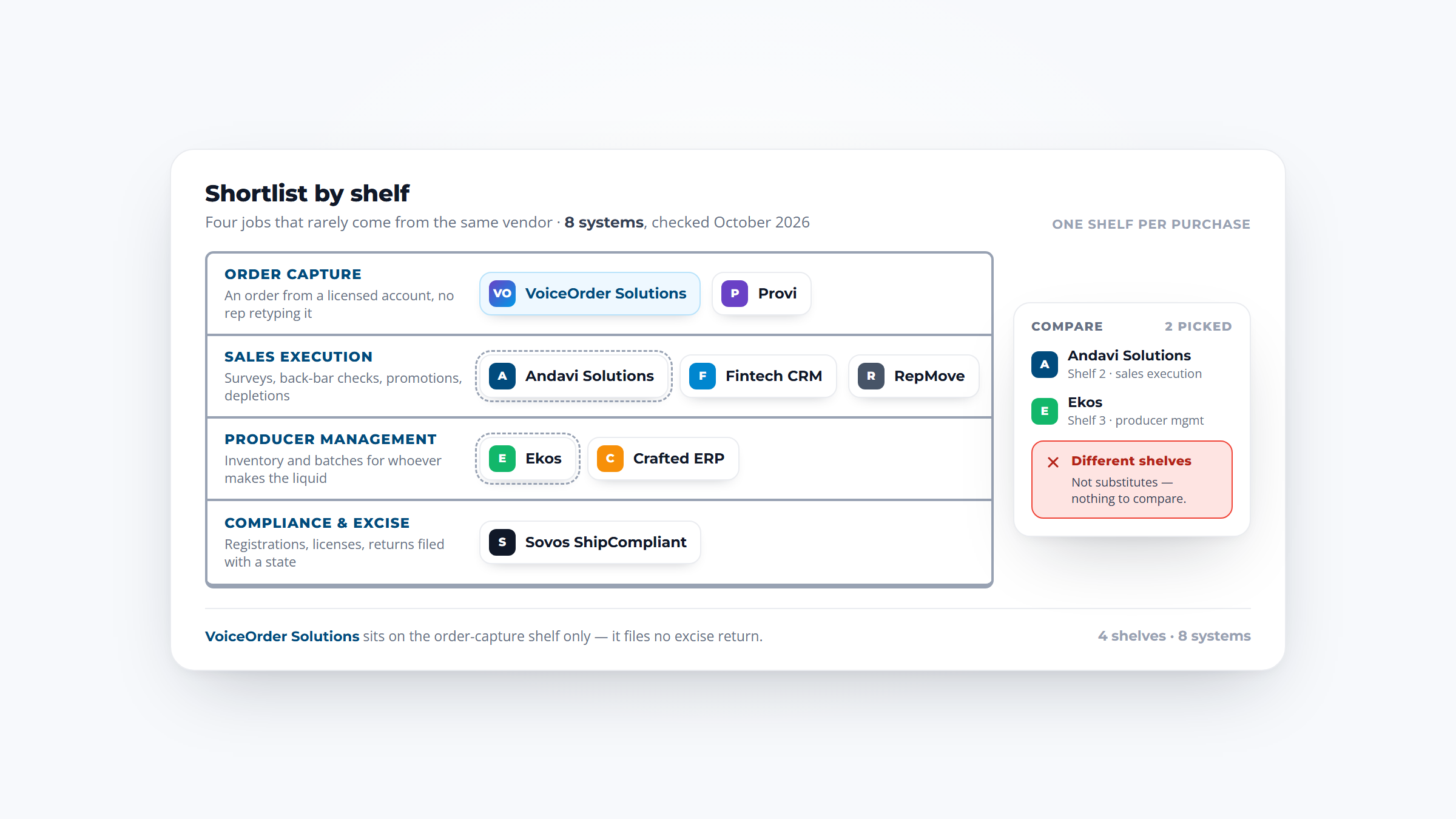
Counting and accounting is the fifth job foodservice operations software has to carry, and it is where these platforms diverge most: reimbursable meal counting in K-12, charge capture in healthcare retail, and a defensible cost per meal everywhere. None of them cover the step after that: getting the order to a distributor takes a separate class of tool, which includes VoiceOrder Solutions. Set against restaurant operations platforms, the overlap usually stops at inventory.
Two federal data sources give the scale, and they explain why this software exists as its own category.
The National School Lunch Program served an average of 29,988,048 children on a school day in fiscal year 2025, according to the National School Lunch Program participation table in USDA's child nutrition tables, current as of September 11, 2026. That is a nine-month average that excludes June through August, calculated from average daily meals. It is up from 29,862,644 in FY 2024 and 28,620,765 in FY 2023.
On the care side, the CDC's National Center for Health Statistics found in its 2020 long-term care study that about 68,150 post-acute and long-term care providers served roughly 7.3 million people in the United States, with about half of those providers being residential care communities and about a quarter nursing homes.
Both populations eat every day, on a budget, under rules. That is a different procurement problem from a restaurant's, and it is why these platforms spend as much engineering on compliance records as on kitchens. The buying side has more in common with restaurant procurement platforms than with restaurant POS, though the approval chains are longer.
The table compares the setting each platform serves, the job it is built around, and who owns it. The owner column is there deliberately: two of these ten belong to acquisitive software holding companies, and a buyer running a competitive bid should know that before the quotes arrive.
| Platform | Best for | Settings served | Core job | Owner | Price |
|---|---|---|---|---|---|
| Illumia | Multi-setting institutions | Higher ed, healthcare, senior living, K-12 | Dining, nutrition and payments on one platform | Roper Technologies | Not published |
| Computrition | Hospitals and health systems | Healthcare | Clinical nutrition and patient meal production | Not stated on its site | Not published |
| MealSuite | Senior living operators | Senior living, healthcare | Menu, nutrition and supply from truck to table | Independent | Not published |
| Nutrislice | Operators needing digital menus | K-12, higher ed, healthcare, corporate | Menu publishing, signage and mobile ordering | Accel-KKR backed | Not published |
| PrimeroEdge | Districts and state agencies | K-12 | Meal applications, claims and state reporting | Cybersoft Technologies | Not published |
| TITAN by LINQ | Districts wanting one vendor | K-12 | Nutrition inside a district ERP suite | LINQ | Not published |
| Heartland School Solutions | Districts led by payments | K-12 | Meal payments and nutrition together | Global Payments | Not published |
| Jamix | Multi-unit kitchen operators | Institutional and multi-unit dining | Recipes, menus, purchasing and production | Independent | Not published |
| Galley Solutions | High-volume contract dining | Onsite foodservice, multi-unit groups | Recipe and cost data across many kitchens | Independent | Not published |
| CaterTrax | Catering inside institutions | Healthcare, education, corporate | Catering and event ordering | Volaris Group, a Constellation company | Not published |
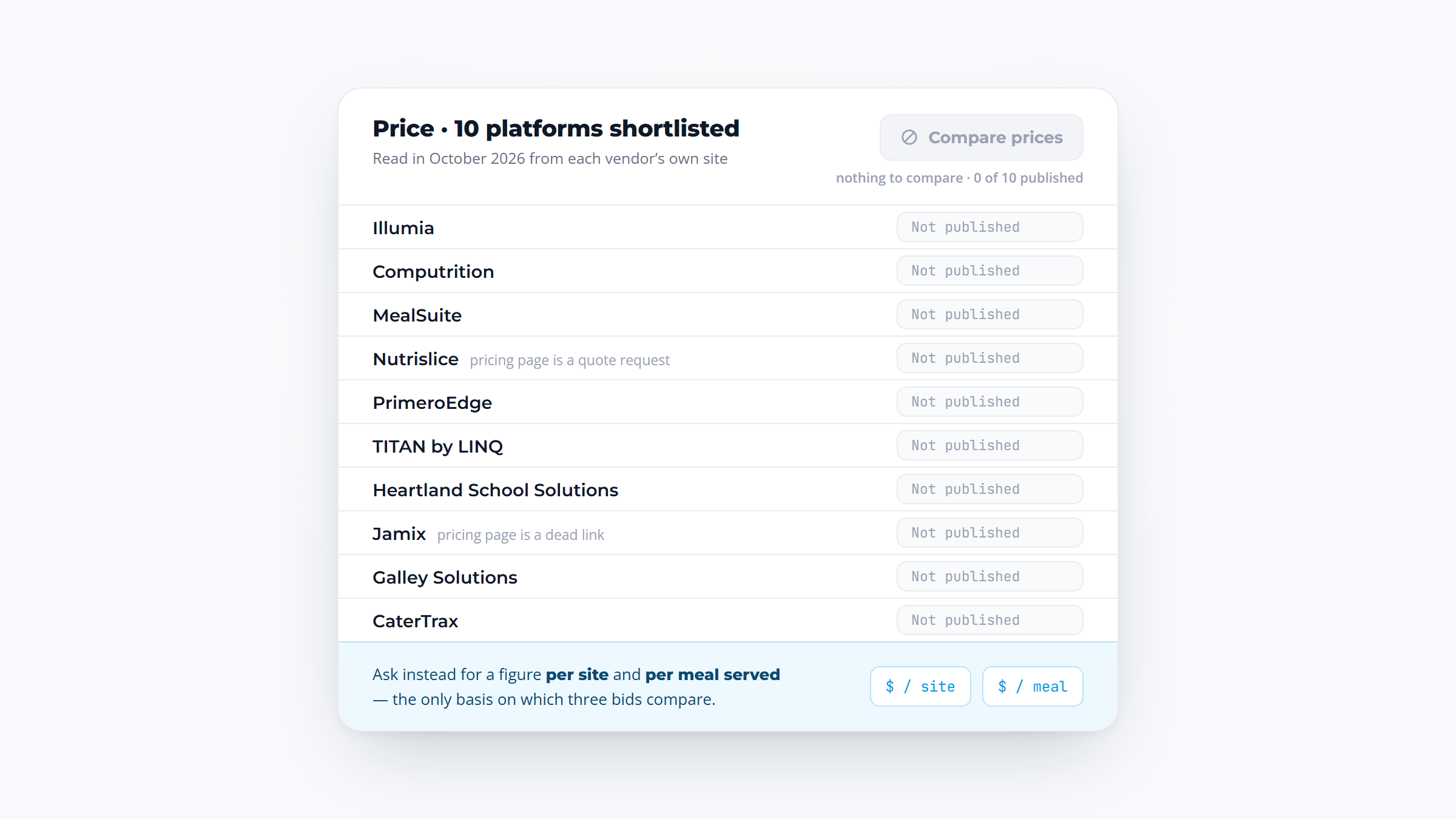
Not one of the ten publishes a price. In a category bought through procurement processes and public bids, that is the expected posture rather than evasion. What the entries below give you instead is a clear read on which setting each one actually serves.

Overview: Illumia is the platform formerly known as Transact + CBORD, and the name is new enough that most search results still use the old one. It covers food, nutrition and dining services alongside campus access, ID and integrated payments.
Its breadth is the point: one vendor across dining, payments and access for an institution that would otherwise buy three.
Key features:
Pricing: Not published. Illumia sells through institutional procurement.
Pros: Covers four settings plus payments and campus access under one contract, deep installed base in higher education and healthcare, backed by a large parent.
Cons: No published price, the rebrand makes research harder for another year, broad platforms configure slowly, more than a single-site operator needs.
Why buyers shortlist it: An institution running dining, retail, access and payments can consolidate four contracts into one.
Final verdict: The strongest fit for a large campus or health system that wants a single vendor across dining and payments.

Overview: Computrition is healthcare foodservice software with clinical nutrition at its center. It separates foodservice operations, nutrition care, retail and integration into distinct modules, which suits a hospital where those functions report to different people.
Its patient-facing ordering is more developed than most here.
Key features:
Pricing: Not published.
Pros: Deep clinical nutrition functionality, genuine room service capability, retail and POS included, long presence in hospitals.
Cons: No published price, healthcare-specific so of little use elsewhere, and ownership is not stated on its own website.
Where it fits: Acute care, where diet order accuracy is a patient safety requirement rather than a preference.
Final verdict: A specialist choice that earns its place in hospitals and is wasted anywhere else.

Overview: MealSuite is built for senior living and healthcare operators and describes its scope as truck to table, meaning it reaches from supplier ordering through to what reaches the resident. Its newer platform, MealSuite NXT, adds AI-assisted menu planning.
Supplier integration is the part that distinguishes it commercially.
Key features:
Pricing: Not published.
Pros: Strong senior living focus, live supplier pricing is rare in this category, census-driven forecasting, kiosks reduce dining room labor.
Cons: No published price, less suited to K-12, its published outcome figures are customer case studies rather than independent results.
Its real strength: Tying menu cost to live distributor pricing, which is where most senior living budgets actually leak.
Final verdict: The default shortlist entry for senior living, and a credible one for post-acute care.

Overview: Nutrislice sits beside a management platform rather than replacing one. Founded in 2011, it publishes menus, runs digital signage and handles mobile ordering across K-12, higher education, healthcare and corporate dining.
Nutrislice is the most visible layer in this list, because it is the part diners actually see.
Key features:
Pricing: Not published. Its pricing page is a quote request rather than a rate card.
Pros: Modular so you buy only what you need, works across every setting here, strong allergen and menu transparency, visible value to families and diners.
Cons: No published price, not a production or inventory system, several products means several line items, signage needs hardware.
Where it beats the alternatives: Communicating what is being served, which every management platform does badly and this one does as its whole job.
Final verdict: A complement to the platforms above rather than a competitor to them.

Overview: PrimeroEdge serves school districts and state agencies, which is an unusual combination and a meaningful one: the same vendor sits on both sides of the claims process. It is owned by Cybersoft Technologies, which also publishes SchoolCafé.
Its coverage of the administrative side is the deepest here.
Key features:
Pricing: Not published.
Pros: Strongest eligibility and claims functionality, used by state agencies as well as districts, covers warehouse distribution, mature product.
Cons: No published price, K-12 only, and the parent also sells SchoolCafé, which can confuse a bid.
Why it made this list: Reimbursement is where K-12 foodservice money comes from, and this handles that end better than the platforms that start in the kitchen.
Final verdict: The right choice for a district whose pain is paperwork rather than production.

Overview: TITAN is LINQ's K-12 nutrition platform, acquired by LINQ and now sold inside a district software suite that also covers finance, HR, payroll and payments. For a district already running LINQ elsewhere, that is the whole argument.
Its inventory handling across sites is better than most K-12 tools.
Key features:
Pricing: Not published.
Pros: Fits inside a district ERP so data moves without integration work, strong multi-site inventory, family portal for payments and applications, automated purchase forecasting.
Cons: No published price, the value depends on buying more LINQ, K-12 only, less compelling as a standalone purchase.
What it is genuinely good at: Removing the integration project between nutrition and the rest of the district's systems.
Final verdict: Compelling for a LINQ district and an ordinary option for anyone else.

Overview: Heartland approaches school nutrition from the payments side. It is a Global Payments company, and its MySchoolBucks payment platform is often what gets a district in the door before the nutrition modules follow.
That makes it a different kind of purchase from the nutrition-first platforms.
Key features:
Pricing: Not published.
Pros: Payments and nutrition from one vendor, strong family-facing experience, useful participation analytics, backed by a listed parent.
Cons: No published price, production and inventory are lighter than PrimeroEdge's, payments-led pricing can complicate a nutrition-only comparison, K-12 only.
Where it fits: Districts where meal payment adoption and participation are the problem, not production.
Final verdict: Buy it for participation and payments, and check the production modules carefully against your actual kitchens.

Overview: Jamix sells a cloud kitchen management system covering recipes, menus, purchasing, inventory and production in one place. It works across institutional and multi-unit dining rather than specializing in a single setting, and the company is Finnish.
Its purchasing module is unusually electronic for a kitchen tool.
Key features:
Pricing: Not published.
Pros: Genuine commissary and requisition handling, electronic supplier ordering, works across settings, straightforward cloud deployment.
Cons: No published price, no payments or eligibility functionality, no US-specific reimbursement features, its usage figures are vendor-stated.
Why buyers shortlist it: Commissary production is common in institutional dining and badly served by platforms built around a single kitchen.
Final verdict: A strong fit for a central production kitchen feeding satellite sites.

Overview: Galley calls its category culinary resource planning, and the product is a single live source of recipe, cost and menu data across every kitchen an operator runs. It targets onsite foodservice operators and multi-unit restaurant groups rather than a specific institutional setting.
Data consistency is the problem it is built to solve.
Key features:
Pricing: Not published.
Pros: Excellent for standardizing recipes across many kitchens, strong costing, modern interface, useful for contract caterers.
Cons: No published price, no eligibility, claims or clinical nutrition functionality, not a standalone system for a regulated setting, published savings figures are customer-reported.
Where it fits: Contract dining and large multi-site operators whose problem is that fifty kitchens cost the same dish differently.
Final verdict: A specialist layer that pays off at scale and is unnecessary below it.

Overview: CaterTrax handles catering and hospitality ordering inside non-commercial foodservice, which is the revenue stream most management platforms treat as an afterthought. It is sold in two shapes, one for a single site or a handful, and one for multi-location operations.
Ownership sits with Volaris Group, part of Constellation Software, and the company is based in Rochester, New York.
Key features:
Pricing: Not published.
Pros: Purpose-built for a revenue stream others ignore, two genuinely different product shapes, serves the US, Canada and the UK, integrates with finance.
Cons: No published price, catering only so it never replaces a management platform, approval workflows need configuration, less useful where catering volume is low.
Where it beats the alternatives: Internal catering, which is often the only part of an institutional operation that generates margin.
Final verdict: A companion purchase, and a strong one wherever catering is more than an occasional tray of sandwiches.
Each platform was assessed in October 2026 from what the vendor and its parent put in writing. Nothing here rests on a software directory, which in this category still lists at least one of these companies under a brand name it stopped using in March 2026.
Three tests decided the list.
The first was institutional fit. A platform had to serve schools, healthcare, senior living or onsite dining specifically, which removed the large field of restaurant tools that rank for this keyword. Restaurant software does not do nutrient analysis against a federal standard or meal counting for reimbursement, and no amount of feature overlap changes that.
The second was that the platform had to be a distinct company, which turned out to matter more here than expected. One of the ten shares a parent with a platform that would otherwise have been on this list, another belongs to a different software holding group, and one strong candidate was dropped outright.
The third was that a US buyer has to be able to evaluate the platform from the vendor's own website. A vendor that lists no figure is recorded here as listing no figure, never as a guessed band, and a product sold into other countries as well says so in its entry.
Two of the ten belong to serial software acquirers, and nothing on the product pages makes that obvious.
Illumia has been part of the Roper Technologies companies since 2024, which it states in its own name-change FAQ. Horizon Software, a K-12 and healthcare foodservice platform that would otherwise have appeared on this list, says on its own about page that it operates as a unit of Roper Technologies "with sister food service technology companies such as CBORD and iTradeNetwork".
CBORD is now Illumia. So two of the best-known names in institutional foodservice software, plus a major food procurement network, answer to the same parent.
CaterTrax is part of Volaris Group, a Constellation Software company, which lists it in its hospitality portfolio.
This is not a reason to rule any of them out. Serial acquirers tend to keep products alive longer than venture-backed vendors do. It is a reason to ask two questions in a bid: who owns the roadmap for each product, and what the support model looks like once the integration period ends. A procurement team shortlisting Illumia and Horizon Software is putting those questions to the same parent, which is worth knowing while you read the answers.
The feature lists converge and the requirements do not. Work from your setting.
The binding constraints are eligibility, claims and the administrative review. Production matters, but reimbursement is what funds the program, and a platform that handles menus beautifully while making claims painful will cost more than it saves.
Ask any K-12 vendor to demonstrate an administrative review: pulling production records, meal counts and eligibility documentation for a date range, as an auditor would request them. PrimeroEdge and TITAN by LINQ both handle this directly; lighter tools reconstruct it.
Diet order accuracy is the requirement everything else serves. The system has to receive diet orders, check meals against them and against documented allergies, and keep that record. Retail dining and catering sit alongside but never ahead of it.
Test it with a diet order change mid-service: a patient moves from a regular to a renal diet after a tray has been assembled, and you want to see what the system stops.
The constraint is that residents eat every meal here for years, so cycle menus, preference management and food cost per resident day dominate. Census-driven forecasting matters more than in any other setting because occupancy moves.
The purchasing side also matters more, since a single distributor usually supplies most of the food. Set beside general kitchen management software, the care-specific functions are exactly what is missing.
Not one of these vendors lists a figure, so any range here would be guesswork. What you can establish before a call is the shape of the number.
| What drives the price | How it is usually counted | What to ask for |
|---|---|---|
| Scale of operation | Sites, beds, students enrolled or meals served | A figure quoted per site and per meal, so you can compare bids |
| Modules | Nutrition, production, POS, payments, catering priced separately | A line-itemized quote rather than a bundle |
| Implementation | Fixed-fee project, sized by data and sites | Who migrates recipes, menus and resident or student records |
| Ongoing services | Support tier, dietitian data services, menu content | What is included and what renews annually |
Two things are worth insisting on. Ask for the price per site and per meal served, because that is the only basis on which three differently structured bids can be set side by side. And ask what happens in year two, since implementation discounts in this category frequently make the first year misleading.
Budget separately for data migration. Recipes, cycle menus, resident or student records and historic production data all have to move, and that work is the reason implementation is quoted rather than listed. Operators who have already tidied their purchasing records spend noticeably less of it.
Every platform above ends at the purchase order. What happens next is a separate problem: the order has to reach the distributor, and in institutional foodservice a large share of it still arrives by phone, voicemail or email to a sales rep who keys it in at the other end.
That gap belongs to foodservice distribution software rather than to the kitchen platform, and it is where VoiceOrder Solutions sits. It is a voice ordering app bought by food distributors, including the independent and specialty houses that supply schools, hospitals and senior living communities, and the distributor deploys it for its own accounts rather than the kitchen buying it directly.
What the distributor gets is an order that arrives in a usable format. Accounts order by voice against the guide their distributor maintains for them, and the result reaches the back office as an email carrying a PDF, Excel or Word file, or straight into EDI, an API or QuickBooks, which means the rep is not retyping a voicemail into the order system and the account is not waiting on a callback to confirm.
For an institutional operator the practical consequence is a shorter loop between the production plan and the confirmed order, which is the same reason kitchens tighten their procurement process at the same time. Operators can put the question to their distributor; distributors can watch the setup run against guides they already maintain.
Book a VoiceOrder Solutions demo
Setting first, then the specific constraint, then the vendor count.
For K-12, start with PrimeroEdge if claims and reviews are the pain and TITAN by LINQ if you already run LINQ, with Heartland School Solutions if payments and participation lead. For hospitals, Computrition, with Illumia if dining sits alongside payments and access. For senior living, MealSuite. For central production feeding satellites, Jamix. For recipe and cost consistency across many kitchens, Galley Solutions. For menus and signage your diners actually see, Nutrislice. For internal catering, CaterTrax.
Most operators end up buying two: a management platform for the setting, and one of the layers above it. That is a reasonable outcome rather than a failure to consolidate, provided you know which of the two owns the inventory record. Getting that wrong is how a kitchen ends up counting stock twice, which is the same failure mode behind most stock management problems in multi-site operations.
For catering inside an institution, CaterTrax is the specialist, covering order capture, standardized menus and pricing across sites, and centralized approvals. It is sold in a single-site shape and a multi-location shape. For contract caterers whose problem is recipe and cost consistency across many kitchens rather than order taking, Galley Solutions is the better fit. Neither replaces a nutrition or production platform.
It depends on who owns the inventory record. TITAN by LINQ gives K-12 districts real-time inventory across every site with transfers handled centrally, Computrition holds par levels by cost center in hospitals, and Jamix covers requisitions to a commissary kitchen for central production. If you run both a management platform and a layer on top, decide which one is authoritative before go-live, and keep a single inventory list rather than two that drift.
No vendor in this list lists a figure, which is normal for software bought through institutional procurement. Expect the quote to be driven by sites, beds or enrollment, by which modules you take, and by a separately priced implementation. Ask for a per-site and per-meal figure so bids built on different units can be compared, and ask what year two looks like.
Yes, and the differences are structural rather than cosmetic. Institutional platforms plan cycle menus against nutrient standards, check meals against diet orders, forecast from census or enrollment, and count meals for reimbursement. Restaurant software assumes a guest ordering from a menu and paying. Some inventory and recipe costing functionality overlaps, which is why restaurant tools rank for these searches, but the compliance functions do not exist in them.
Illumia comes closest among the management platforms, covering higher education, healthcare, senior living and K-12, and that breadth is its main argument for a multi-setting organization. In practice most operators find the specialist platforms stronger within a single setting, so an organization running all three often buys two or three and integrates them. Decide whether one contract or the best fit per setting matters more before the bids come in.
Operators and distributors leave this with different questions. An operator's is what their delivery partner can accept besides a call. A distributor's is whether its own accounts would use something better.