Key takeaways:
Search for beverage sales software and the results will hand you a liquor-store point-of-sale system, a brewery production tool and a beverage sales tracking software pitch on the same page, as though they were competing for the same budget.
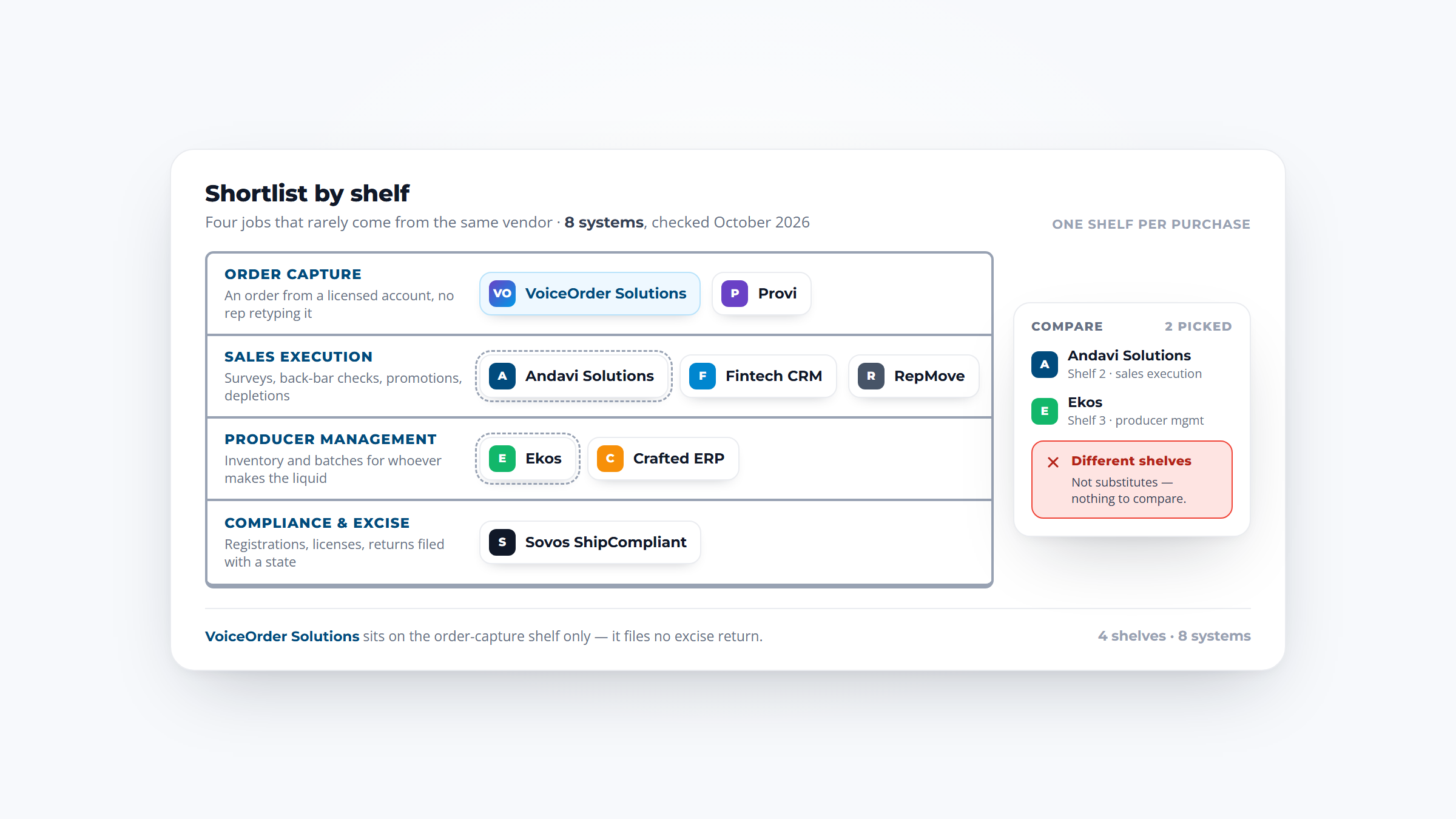
The four are not interchangeable. A beverage distributor buys from four distinct shelves, and the one you need depends on whether you take orders, work accounts, make the product, or file with a state.
Most of those orders still arrive by phone, which is why voice ordering has become a live question for distributors whose desks are still transcribing them.
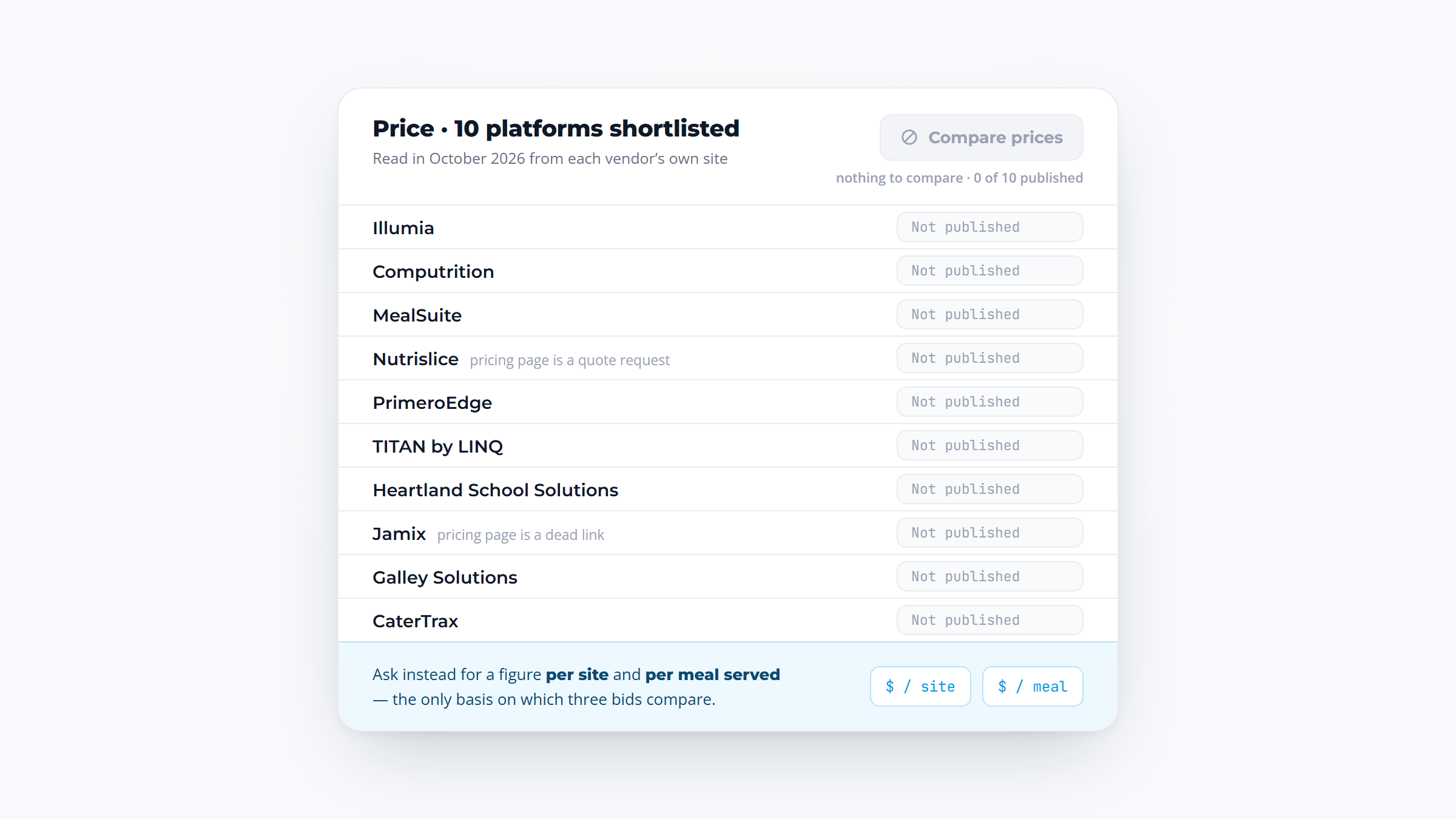
The eight systems below were checked against their vendors' own pages in October 2026. A vendor that publishes no price is recorded as having the normal posture for this market rather than marked down for it, and each published figure carries the basis it bills on.
Four jobs hide under the one phrase, and they rarely come from the same vendor.
Order capture is how an order gets from a licensed account into your system without a rep retyping it. Provi does this as a marketplace across distributors, and VoiceOrder Solutions does it as a channel a single distributor runs for its own accounts. The food-ordering networks that serve the same job outside alcohol, Pepper and its rivals, are a separate shortlist again.
Sales execution is what a field team does between orders: surveys, shelf and back-bar checks, promotions, depletion tracking. This is the beverage sales rep software end of the market, where Andavi Solutions and RepMove live, with Fintech CRM covering it alongside invoice collection.
Producer management is inventory, batches and compliance for the people who actually make the liquid. Ekos and Crafted ERP sit on this shelf, and a distributor buys from it only if it also produces.
Compliance is registrations, licenses and excise filing. Sovos ShipCompliant is the specialist, and nothing else on this list files a return for you.
Most beverage distribution software shortlists mix all four without noticing. A distributor that already runs route accounting is usually shopping on the first two shelves. One that is losing time to misread phone orders is shopping on the first alone.
The table sorts the eight by what they actually do, then by whether they touch compliance, because that is the question that separates an alcohol distributor's shortlist from everyone else's.
| Platform | What it does | Best for | Compliance and excise | ERP or accounting link | Price (and the basis it bills on) |
|---|---|---|---|---|---|
| VoiceOrder Solutions | Order capture | Taking orders from bars and restaurants | None, it produces the order record | Email, EDI, API, QuickBooks | Pricing available on request |
| Provi | Marketplace order capture | Reaching licensed accounts you do not cover | Three-tier compliant marketplace, no filing | ERP integrations for distributor partners | Free for buyers, on request for distributors |
| Andavi Solutions | Sales execution CRM | Field teams working on and off premise | Pricing gateway, no filing | Salesforce platform heritage | Pricing available on request |
| Fintech | Invoice payment and CRM | Collecting on COD and on terms | Payment compliance, not excise | Over 200 system types | $65 per user a month, 5-user minimum |
| Ekos | Producer management | Breweries, cideries, distilleries, wineries | Pre-populated TTB reports | Accounting integration | Pricing available on request |
| Sovos ShipCompliant | Compliance platform | Registrations and excise returns | Automated excise and gallonage reports | Over 60 partner integrations | Pricing available on request |
| Crafted ERP | Beverage manufacturing ERP | Multi-category, multi-entity producers | Regulatory tasks inside the ERP | Built in Oracle NetSuite | Pricing available on request |
| RepMove | Field sales CRM and routes | Small teams that want a published price | None | One-way, or two-way on the top tier | From $16.67 per user a month, billed annually |
Six of the eight publish nothing on price, VoiceOrder Solutions included, which is ordinary wherever the product arrives with an implementation attached. Work down the entries by shelf first, because comparing a $65 seat against a quote-based platform tells you nothing until you know they do different jobs.

Best for: Clean order records from licensed accounts
Overview: In beverage alcohol the order is not just a commercial document. It is the record a distributor may later have to stand behind, because what was ordered, by whom and at what time is what protects you in a credit or delivery dispute.
VoiceOrder Solutions opens this list for that reason. It is a voice ordering app a distributor deploys for its accounts, who order by voice against the guide the distributor maintains for them, and what reaches the order desk is a dated, numbered, line-confirmed record. It is not compliance software and not route accounting, and it does not file anything with a state.
An independent food distributor or a DSD operation supplies the guides it maintains per account, and those become the catalog each buyer works from. The buyer then signs off each line before anything is transmitted, so nobody is reconstructing a voicemail later.
That confirmation step is the part that matters here. An order a customer reviewed and sent is a different artifact from a message a rep transcribed, and the difference shows up in credits, redeliveries and disputes about what was actually agreed.
Key features:
Pricing: Priced on request rather than listed, which is how six of the eight here sell. VoiceOrder Solutions publishes a setup window instead of a rate: most distributors are running inside 24 to 48 hours, after a 20-minute demo.
Pros: Leaves a confirmed record rather than a transcription, suits accounts that will never use a portal, runs off guides the distributor already maintains, arrives in a format the back office already reads, keeps every account's history in one place.
Cons: No public rate card, and it covers order capture alone, so it files no excise return, runs no route and tracks no depletions.
How to start using it:
Where it fits: Upstream of everything else here. It gives the compliance, route and analytics systems a clean record to work from, and it replaces none of them.
Final verdict: Not a compliance platform and not a CRM, and it leads because an accurate order is the input every other system on this list assumes you already have. Distributors who want a confirmed order record in hand before the rest of the stack reads it start here.

Overview: Provi is a marketplace for beverage alcohol, where licensed retailers and operators search across distributor catalogs in one place and send order requests through to the right rep.
Its reach is the product. Provi states 1,400 distributor portfolios across 49 states, which is coverage no single distributor's own portal can offer.
Key features:
Pricing: No published rate card. Search is free for buyers, and the distributor side is sold through a demo.
Pros: Genuine market reach, structured orders rather than texts, rep notified immediately.
Cons: No route accounting, no settlement and no excise reporting, and it places your catalog on a shared network rather than your own.
Why buyers shortlist it: Nothing else here puts your portfolio in front of accounts no rep of yours currently visits.
Final verdict: Worth it for reach, and worth being clear-eyed that reach on a marketplace is rented rather than owned.

Overview: Andavi Solutions sells the sales-execution suite formerly called GreatVines, and buyers searching the old name will land on the new one. It is built specifically for the three-tier trade rather than adapted to it.
Its most distinctive capability is image recognition. A rep photographs a back bar, a shelf or a menu, and the system reads the listings, fills in the survey and validates placement and pricing against what should be there.
Key features:
Pricing: No published rate card and no pricing page.
Pros: Purpose-built for three-tier selling, strong survey and placement validation, a sister pricing product aimed at posted-price states.
Cons: No inventory, no route accounting and no excise filing, and it is shaped for enterprise field teams rather than small ones.
Its real strength: Turning a rep visit into structured data without the rep typing it, which is the difference between depletion reporting that happens and depletion reporting that is promised.
Final verdict: The strongest field-execution option here for a supplier or distributor running a real territory team, and overweight for anyone running three reps.

Overview: Fintech has worked the alcohol trade since 1991 and sells two things: PaymentSource, which automates invoice payment between distributors and retailers, and Fintech CRM, the field-sales product formerly sold as Lilypad.
The payment half is the one that matters for a distributor, because alcohol payment terms are set by state law rather than by negotiation, and missing them has consequences beyond cash flow.
Key features:
Pricing: Fintech CRM is $65 per user per month with a five-user minimum, and onboarding fees apply. PaymentSource is quoted rather than published.
Pros: Publishes a real seat price, long track record in the trade, handles the payment-compliance problem directly.
Cons: Two products rather than one platform, a five-seat floor plus onboarding, and no excise filing or route work.
Where it beats the alternatives: Nothing else here automates collection against the statutory due dates that alcohol credit law imposes.
Final verdict: The practical pick where the pain is getting paid on time and on terms, rather than knowing what is on the shelf.

Overview: Ekos is management software for craft producers, covering inventory, production, sales and accounting for breweries, distilleries, cideries and wineries in one system.
The reason it belongs on a distribution list is the Ekos Order Hub, a portal where distributors and direct accounts see a producer's real-time available inventory and order against rules the producer sets.
Key features:
Pricing: No published price. Three tiers, Essentials, Plus and Professional, each quoted on request.
Pros: Federal reporting pre-filled rather than exported, a genuine distributor-facing ordering portal, lot tracking on every tier.
Cons: Producer-side only with no route accounting, point-of-sale and distillery features are paid add-ons above the entry tier, and the entry tiers cover one production facility.
Why it made this list: It is the clearest example of a producer system that hands distributors a clean ordering surface, which is the same job from the other end of the tier.
Final verdict: The right system if you make the product as well as move it, and irrelevant if you only move it.

Overview: Sovos ShipCompliant is the compliance specialist in this category, in market since 2006 and covering both direct-to-consumer shipping and three-tier distribution compliance.
Its three-tier product does the work nothing else here touches: product and label registrations filed directly into state systems, license renewals tracked to deadline, and excise returns generated already populated.
Key features:
Pricing: No published rate card, and no pricing page at all.
Pros: The deepest compliance coverage here, filings produced rather than exported, long operating history.
Cons: Compliance only, so no order capture, no CRM and no inventory, and the product is weighted toward producers and shippers rather than wholesalers.
Where it fits: Alongside whatever captures your orders, not instead of it.
Final verdict: The obvious answer when registrations and returns are the bottleneck, and no answer at all to how orders reach you in the first place.

Overview: Crafted ERP is a beverage manufacturing ERP sold in editions by category, covering beer, wine, spirits, ready-to-drink and non-alcoholic lines, with a multi-category edition for producers running several at once.
The product is built inside Oracle NetSuite rather than on its own platform, which is the single most important thing to know before pricing it.
Key features:
Pricing: Not published, but the basis is, which is unusual and useful. Crafted states that pricing follows the NetSuite platform cost, the number of users and the modules chosen, rather than your production volume, plus a one-time implementation fee.
Pros: Publishes how it prices even without a number, proper multi-entity support, built on a mature platform.
Cons: You are buying NetSuite underneath, so the floor is an ERP budget plus implementation, and it offers no route accounting.
Why it earns a place here: Pricing on users and modules rather than on volume is genuinely different from the percentage-of-revenue models common elsewhere, and it suits a producer whose volume is growing faster than its headcount.
Final verdict: A serious system for a producer with more than one category or entity, and far more than a distributor-only operation needs.

Overview: RepMove is a field-sales CRM with route planning and a dedicated food and beverage product page. It is the most accessible option here and the least specialized.
RepMove publishes a full tier table, which almost nothing else in this category does.
Key features:
Pricing: Every tier is priced per user. Flex is $16.67 per user per month billed annually, or $19.99 billed monthly. Sales Pro is $54 and $59.99 on the same two bases for teams of up to 10 users, and Accelerate is $80 and $87.99 for 11 or more.
Pros: Fully published pricing with the billing basis stated, a free trial, workable for a two-person team.
Cons: Not beverage-native, with no excise reporting, no three-tier features and no depletion tracking, and two-way integration costs the top tier.
Where it fits: A small distributor or self-distributing producer that wants route and account discipline without a six-figure implementation.
Final verdict: Honest value for a small field team, and not a substitute for a trade-specific system once compliance enters the picture.
Each figure below comes from the company that charges it, checked in October 2026 and labeled with how it bills.
Route accounting systems were deliberately excluded from this beverage distribution software list. They are a separate purchase with a separate article, because a truck settlement platform answers a different question from a sales system.
Candidates also had to serve the distributor's side of the relationship rather than the operator's.
Each was then checked for ownership against its own newsroom, which turned out to matter more than expected. Four of the names on an initial shortlist had changed hands or changed names, and in two cases the old brand and the new one would have appeared as separate entries in the same list.
This is the fork that decides your software. A non-alcoholic beverage distributor needs none of what follows; an alcohol wholesaler cannot operate without it.
Most states require alcohol to move producer to distributor to retailer, with no business in one tier holding a significant interest in another. Treasury's 2022 report on competition in beer, wine and spirits sets out the consequences, and two of them are software requirements rather than legal footnotes.
The first is posted pricing. Numerous states require distributors to file their prices with a state authority and then hold them for a period, during which they generally cannot compete on price. A system that lets a rep discount at the account is actively unhelpful in those states.
The second is that the regime varies by state and by commodity inside the same state. Treasury's own example is Virginia, which is a franchise state for beer and wine and a control state for spirits. Any vendor claiming to handle compliance should be asked which states and which commodities.
The federal layer is lighter than most buyers expect, and the distinction is worth getting right.
| Requirement | Who it binds | What your system has to produce |
|---|---|---|
| Daily receipt and disposition records | Every wholesale liquor dealer, federally | A daily record kept three years, with no routine filing |
| Monthly state excise report | Distributors and wholesalers, state by state | A filing on a fixed date, due even in a month with no sales |
| Posted and held prices | Distributors in post-and-hold states | Prices filed with the state and frozen for a period |
| Statutory payment terms (Texas) | Beer on delivery, wine and spirits on set dates | Payment status tracked per invoice against a legal clock |
| Delinquency lists | Distributors in states that publish them | Orders blocked to named accounts from a published time |
Federally, the TTB requires every wholesale liquor dealer to keep daily records of receipt and disposition and hold them three years, and states plainly that no report is submitted unless it asks for one. The recurring filing burden sits at state level.
Texas shows what that looks like in practice. Its Alcoholic Beverage Commission requires distributors and wholesalers to file a monthly excise report by the 15th covering the prior month, and says a report must be filed even if no business was done. Beer must be paid for on or before delivery; wine and spirits run on statutory due dates tied to the delivery window.
Texas then publishes a delinquent list of retailers who missed those dates, effective at 12:01 a.m. on a published day, after which no sales or deliveries may be made to anyone on it. An order already invoiced before that moment can still be delivered, but only until 1 p.m.
Texas rules are not national ones, and that is exactly the point. Twice a month, on a date set by a regulator, your order desk has to stop selling to named customers, and the system that takes orders has to know. This is also where vendor onboarding earns its keep, because license and credit status collected at setup is what makes those checks possible later.
Two of the eight publish a price, which makes a cost comparison across the list impossible and a cost comparison within a shelf straightforward.
On the field-sales shelf, the published range runs from $16.67 per user per month at RepMove billed annually to $65 per user per month at Fintech CRM, which also imposes a five-user minimum and onboarding fees. A five-rep team on RepMove's entry tier is therefore looking at about $83 a month billed annually, or $100 billed monthly, against $325 at Fintech CRM, and the gap buys trade-specific functionality rather than more seats.
The quote-based group behaves differently. Compliance platforms, producer ERPs and order-capture systems are sold by scope, so the only comparison worth making is between two quotes written against an identical requirement. Crafted ERP is unusually clear about what drives its number, naming platform cost, users and modules rather than production volume.
One cost sits outside the software entirely. A sales system is only as good as the stock position behind it, so inventory visibility gaps show up as orders taken for product that cannot ship, at a cost no license fee reflects.
Implementation is the line most buyers underestimate. An ERP built on NetSuite carries a one-time implementation fee on top of licensing, and compliance platforms that file into state systems are priced against the states and commodities you actually operate in.
The orders themselves have not modernized at the same rate as the software around them. A large share still arrive as a call to a rep, a text message, or a note taken at the end of a delivery, and somebody at the order desk types them in.
That matters more in alcohol than in dry goods, for a reason that has nothing to do with efficiency. An order the account confirmed itself carries something a transcription cannot, so when a delivery is disputed, short-paid or questioned against a credit deadline, the distributor has a dated record to point at.
Three fixes are available, and they are not equivalent. A marketplace brings orders in structured but routes them through a shared network. A rep-entry screen keeps the relationship and keeps the typing. An order entry channel the distributor runs for its own accounts keeps both the relationship and the record.
Whichever route you take, the test is the same: can you show what the account ordered, at what price, and at what time, without asking the rep who took the call? That question tends to answer itself the first time a delinquency date is disputed.
Work out which of the four jobs you are buying before you compare anything, because a feature grid across shelves is noise.
If orders arrive badly, start at order capture and fix the record before you buy analytics that will sit on top of it. If you have the orders and cannot see the market, sales execution is the shelf, and Andavi Solutions is the deepest option on it. If getting paid on statutory terms is the recurring problem, Fintech is built for that specific clock.
If you file in several states, treat compliance as its own purchase rather than a checkbox on something else, because only Sovos ShipCompliant here actually produces the returns. A direct store delivery operation will want the route layer kept separate again. If you make the liquid too, Ekos or Crafted ERP depending on scale.
One question separates serious vendors from the rest across all four shelves. Ask them to show a single order from a licensed account in a post-and-hold state, with a frozen price, a credit status and a delivery date near a delinquency cutoff. The answers will not be close, and the demo takes twenty minutes.
That test belongs to the compliance and sales-execution systems on this list. VoiceOrder Solutions sits earlier in the chain, on the order record those systems inherit, and that part can be seen running against guides a distributor already maintains.
Book a VoiceOrder Solutions demo
Ekos is craft beverage management software for breweries, distilleries, cideries and wineries. Producers use it for raw-material and finished-goods inventory with barcode scanning, production and batch records with lot tracking, sales and customer management through the Ekos Order Hub, and accounting with TTB compliance, where it pre-populates the Brewer's Report of Operations and the excise tax report. It also tracks kegs by location, customer and freshness. It is not route accounting and does not run a delivery fleet.
Food and beverage sales software is not one category, and the answer depends which side of the handoff you sit on, because producers, distributors and operators buy different systems. A producer wants Ekos or Crafted ERP, a distributor wants order capture plus whichever of sales execution or compliance is the bottleneck, and an operator wants back-of-house and inventory tools. We cover the operator and manufacturer side separately in our roundup of food and beverage industry software.
It is the field-sales category: an app a rep carries into accounts to log visits, run surveys, check shelf and back-bar placement, record depletions and take orders. Andavi Solutions is the trade-specific version, with image recognition that reads listings off a shelf photograph. RepMove is the generalist version at $16.67 per user per month billed annually. The distinction that matters is whether the tool knows what a depletion is.
Alcohol distributors generally do, and non-alcoholic distributors generally do not. Federal rules require a wholesale liquor dealer to keep daily receipt and disposition records for three years but not to file routinely, while states set their own recurring filings, with Texas requiring a monthly report by the 15th even in a month with no sales. Of the systems here, only Sovos ShipCompliant produces returns; Ekos pre-populates federal reports for producers.
Rarely, and the ones that try tend to be strong at one and thin at the other. Route accounting is its own category, covering van sales, invoicing at the stop and end-of-day settlement, and it is a separate purchase from the sales and compliance tools here. Most distributors end up with a route system, something that captures orders cleanly, and a compliance tool, connected rather than combined.
The order record is the piece every one of those systems inherits, and it is the cheapest part of the stack to get right first.