.webp)
Key takeaways:
A salesperson promises 40 cases on Thursday. The warehouse has 12. Both of them were looking at a screen when they said it.
That is not usually a counting failure. The count may have been perfect at 6 a.m. What went wrong is that one system knew about an order placed at 9:15 and the other did not, or that 28 of those cases were committed to a customer nobody had told the sales team about. The number was accurate and useless at the same time.
Inventory visibility is the discipline that closes that gap. It covers which stock states exist, who is allowed to see them, how many systems have to agree, and how quickly a change in one place shows up everywhere else.
For a food distributor it decides whether you can commit a delivery with confidence. It also starts earlier than most people expect, at the moment a customer's order first enters the building.
Three terms get used as if they were the same thing, and separating them is the fastest way to work out which problem you have.
Tracking is the act of recording movement: a case is received, a case is picked, a case is scanned into a bay. Accuracy is whether the resulting record matches what a person would find if they walked to the location and counted. Visibility is whether the people who need that record can reach it, in a form they can act on, before the moment when acting on it matters.
You can have all three, or any two. A warehouse running disciplined cycle counts can be highly accurate and still have terrible visibility, because the only place the number lives is a terminal in the building. A retailer with a live network view can have excellent visibility of a number that is wrong.
Improving one does not improve the others, which is why "we bought a system" so rarely settles the argument.
The practical test is a question you can ask out loud. If a customer service rep in a different building needs to know whether 40 cases of an item can ship Thursday, how many people do they have to interrupt to find out? Zero is visibility, and two is a reporting problem wearing a technology costume.
Where the underlying number itself is suspect, the fix belongs to inventory accuracy instead, and no amount of dashboard work will substitute for it.
Ask three departments how much of an item you have and you will get three answers, all defensible. They are reading different states of the same product.
| State | What it counts | Who usually reads it |
|---|---|---|
| On hand | Physically in the building, including stock already promised | Warehouse, finance |
| Allocated | On hand but committed to a specific open order | Customer service |
| Available to promise | On hand minus allocated, plus inbound arriving inside the promise window | Sales, order entry |
| On order | Raised on a purchase order, not yet shipped by the supplier | Buyers |
| In transit | Shipped by the supplier, not yet received | Buyers, receiving |
| On hold | Physically present but not sellable: damage, quality hold, expired date code | Quality, finance |
Available to promise is the number a salesperson actually needs and the one most systems display least prominently. It is also the only number that changes when someone else places an order, which is why it drifts fastest and why a screenshot of it is worthless ten minutes later.
The on-hold row is the one that quietly causes the worst surprises in food. A pallet sitting in a quality hold is on hand, is not allocated, and is not sellable, and if your system has no state for it, the stock will read as available right up until somebody walks over to pick it.
Getting these six labeled consistently across every system that touches them is unglamorous work and it removes more disputes than any dashboard. Start by writing down which field in which system carries each state, and you will usually find at least one that nobody owns.
The phrase real-time inventory visibility does a lot of hiding. Almost every inventory number is a snapshot with an age, and the useful question is not whether the system is real time but how old the number is allowed to get before the decision it feeds goes wrong.
Some vendors market the same capability as dynamic inventory management visibility, which describes a stock figure that updates as transactions occur rather than on a clock. The label is worth translating into a number: ask how many seconds or hours old the figure on the screen actually is.
A nightly batch sync is fine for a slow-moving dry good ordered once a month. It is dangerous for a high-turn perishable where four customers can order the same lot before breakfast. The tolerance is set by the item's velocity and by how expensive a broken promise is, not by what the software brochure claims.
This is why an "as of" timestamp belongs next to every stock figure a person is expected to act on. A number with a time attached invites the right question. A number without one invites a promise.
Two mechanisms move the freshness dial. Event-driven updates push a change the moment a transaction happens, so a receipt or a pick is reflected immediately. Scheduled synchronization moves everything on a clock, which is cheaper to run and builds a known lag into every figure.
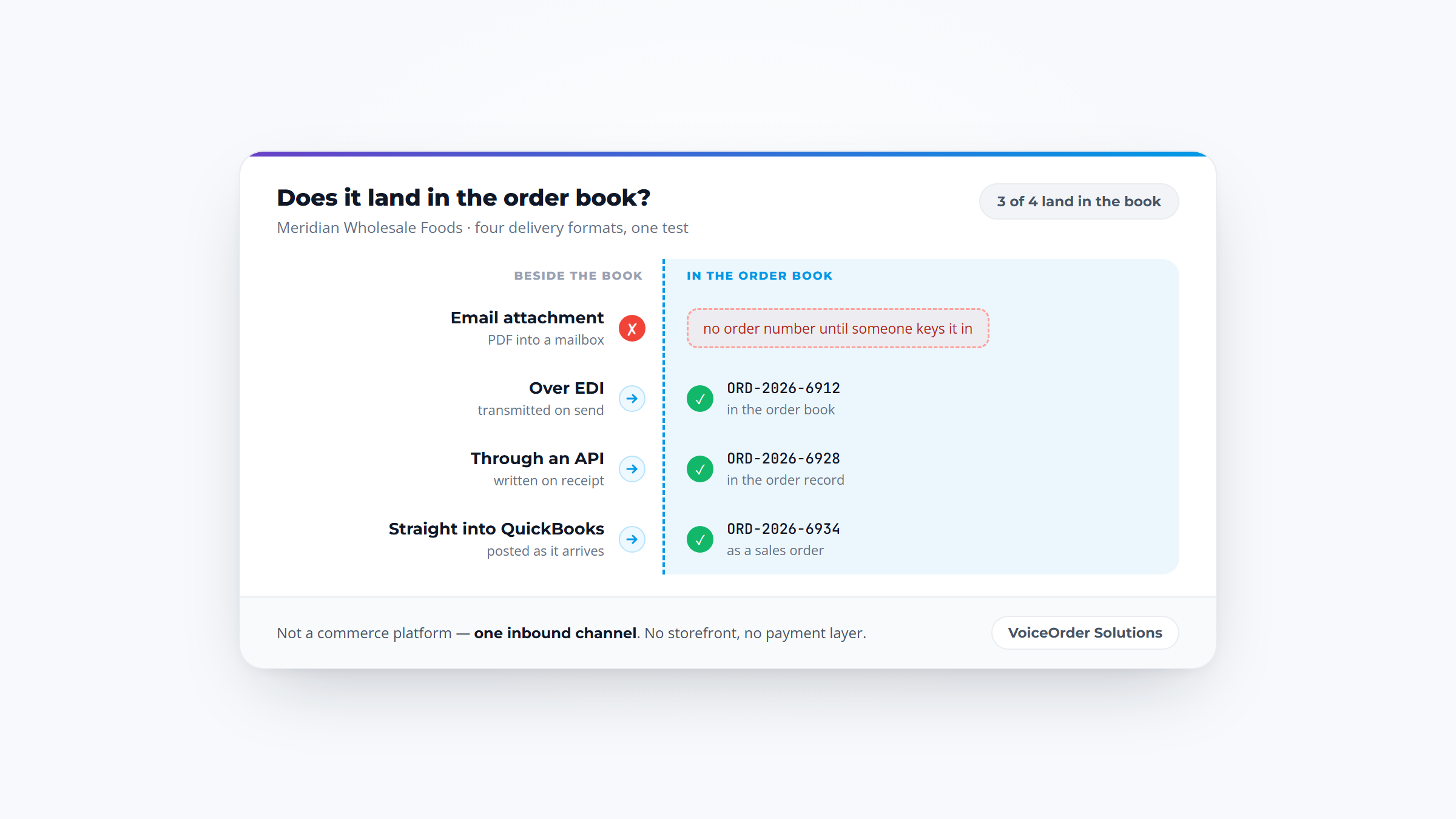
Most distributors end up with both, and the trouble starts when nobody has written down which items sit on which mechanism. Order intake is where that difference shows up first, and tools built around it work on the event-driven side: VoiceOrder Solutions creates the order record the moment an account places it rather than when somebody gets round to typing it up, a flow set out on its how it works page.
Drift is the normal condition, not a sign of a broken operation, and the evidence for how normal is unusually good. In a study published in Management Science, DeHoratius and Raman examined nearly 370,000 inventory records across 37 stores of a single retailer and found 65% of them inaccurate.
Their analysis also showed that 26.4% of the variation sat between product categories and only 2.7% between stores. For a distributor that is the useful half: the problem tends to follow the product, not the building.
The mechanisms are mundane. A case gets picked and the scan fails. A driver takes a short from the wrong pallet. A return comes back and gets put away without a transaction. A catchweight item is received at its nominal weight rather than its actual one. A unit-of-measure mismatch turns a case into an each somewhere between two systems, and the record is now wrong by a factor of twelve.
Phantom inventory is the version that hurts most, because the system shows stock that cannot be found. The order is accepted, the picker cannot locate it, and the shortage surfaces at the last possible moment, on the truck, with a customer already expecting delivery.
On r/logistics, an operations team described the fix that worked for them, and it was not software. They introduced a barcode-based checkout so nobody could pull material from the warehouse without a scan, and accuracy went from around 60% to 95%.
Another commenter in the same thread made the sharper point: visibility follows from making every movement traceable, with barcoded locations and mandatory scans, rather than from adding a reporting layer on top of untraceable movement. Both are single-operation anecdotes rather than benchmarks, and they point at the same cause.
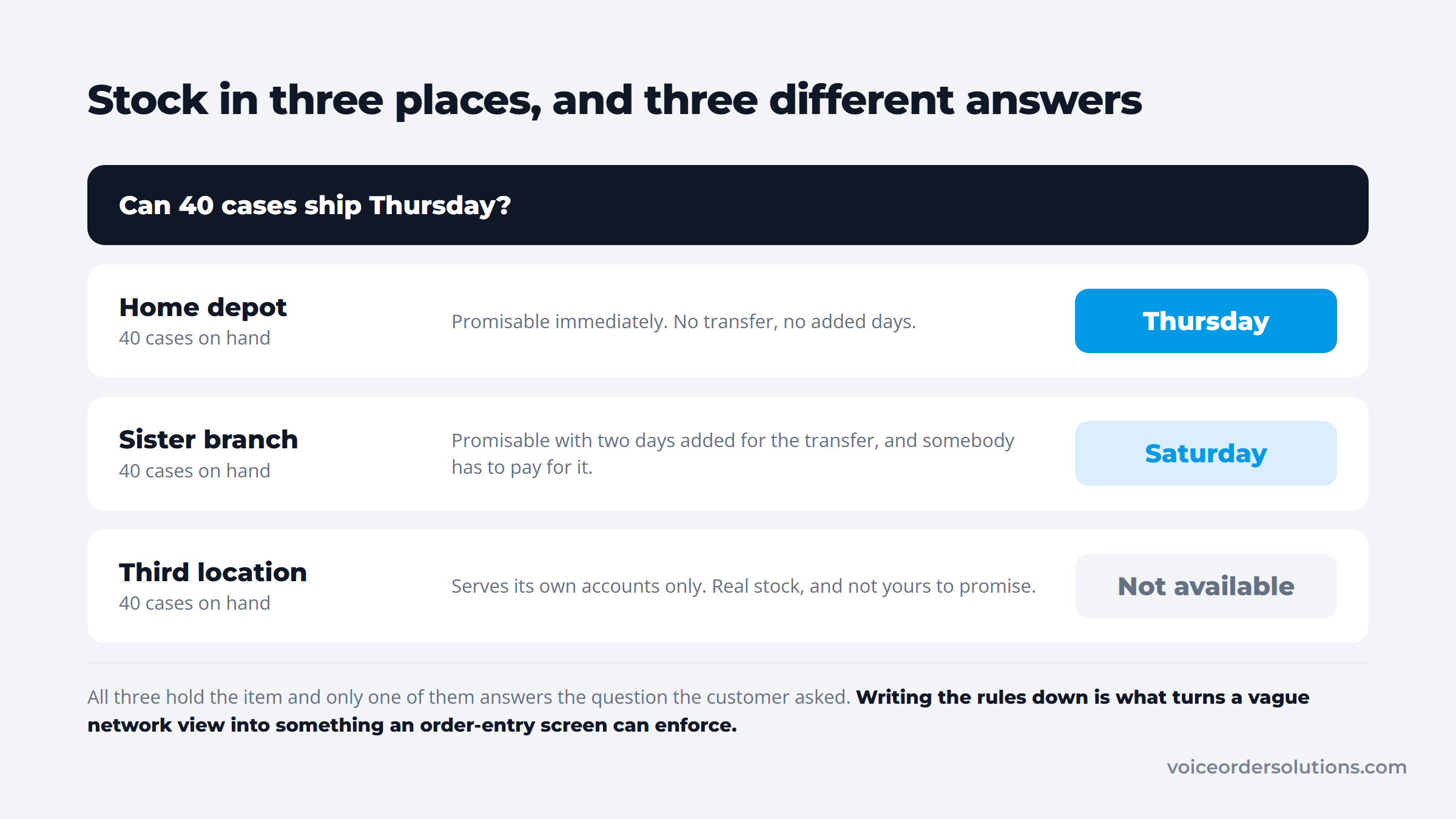
Multi-location inventory visibility introduces a second question on top of "how much," which is "where, and can I use it." Stock in a branch three hours away is real, but whether it counts as available depends on whether you will move it, who pays for the transfer, and whether the promise date survives the journey.
Distributors usually settle this with rules rather than with a single network number. An item might be promisable from the home depot immediately, from a sister branch with two days added to the date, and not at all from a location that only serves its own accounts. Writing those rules down converts a vague network view into something an order-entry screen can actually enforce.
The same forty cases in three places produce three different promises.
Cross-channel inventory visibility is the same problem with more claimants. When the same pool of stock serves a field sales team, an online ordering portal, an EDI feed and a phone desk, the risk is that two channels commit the same case.
Soft reservations are the standard answer. The moment a channel starts an order, the quantity is held provisionally so no other channel can promise it, and the hold is released if the order is abandoned.
Microsoft describes exactly this behavior in the Inventory Visibility add-in for Dynamics 365 Supply Chain Management, which offers soft reservations to prevent overselling across order channels, an immediate available-to-promise response, and the ability to preallocate stock to particular channels or customers.
Whether or not you run that stack, it is a fair specification of what a visibility layer should do. Distributors comparing platforms on this capability will find the field surveyed in warehouse distribution software.
Most inventory visibility challenges are not exotic. They repeat across operations of very different sizes, and they are worth checking in order, because the cheap ones are usually the ones causing the damage.
Working down that list is unglamorous and it moves the number. The item master in particular repays attention out of all proportion to the effort, because every downstream report inherits its errors, and a disciplined inventory list is the artifact that keeps it honest.
Everything above concerns stock you already have. Inventory visibility in the supply chain sense extends the question backwards, to what your suppliers have told you about product that has not arrived.
The academic picture here is less settled than vendors imply. In the Journal of Operations Management, Barratt and Oke noted that visibility had become a popular term while remaining an ill-defined and poorly understood concept.
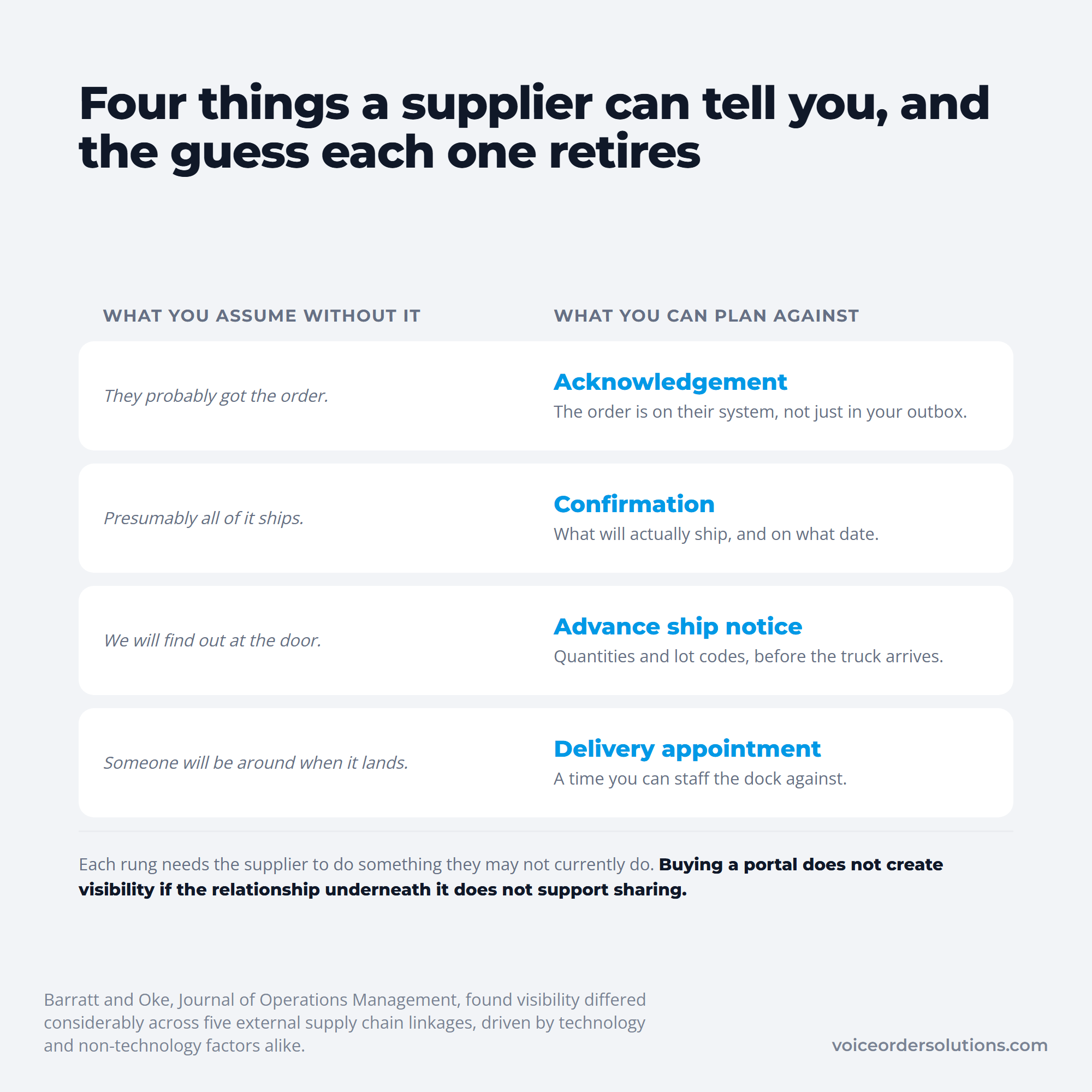
Their study of five external supply chain linkages found that the level of visibility differed considerably across them, driven by a mix of technology and non-technology factors. The practical reading is that buying a portal does not create visibility if the relationship underneath it does not support sharing.
What you can realistically obtain from a supplier falls into a short sequence: an acknowledgement that the order was received, a confirmation of what will actually ship and when, an advance ship notice with quantities and lot codes, and a delivery appointment. Each of those turns an assumption into a date you can plan against, and each requires the supplier to do something they may not currently do.
Each step in that sequence retires a specific guess.
Lot-level detail is worth pushing for beyond planning value, because it is the same data a recall depends on. Distributors handling anything on the Food and Drug Administration's Food Traceability List are already building that record for compliance reasons.
The list reaches further than most people assume: leafy greens, melons, tomatoes, peppers, cucumbers, fresh herbs, sprouts, soft cheeses, shell eggs, nut butters and several seafood categories, so a broadline distributor almost certainly carries something on it. The systems that hold the record are covered in food traceability software.
Projects to improve inventory visibility fail when they start with a dashboard. The order below starts with the data instead, because a reporting layer over inconsistent data produces confident wrong answers faster than a spreadsheet does.
The first five steps make sure two systems mean the same thing when they name an item, and none of them requires a purchase.
Once identity is stable, the work is about latency. Move receiving from an end-of-shift batch to a scan at the dock. Post picks as they happen rather than at order completion. Put returns into the system before the product goes back on a shelf. Each of these removes a window during which the record and the shelf disagree by design.
Only then is it worth choosing where numbers surface. A branch manager needs different figures from a buyer, and the fastest way to lose the room is to give everyone the same screen. Distributors sizing up platforms for this stage often start with inventory tracking software and its neighbors, which is a reasonable place to compare capability against the states you actually need.
For a distributor, inventory visibility has a second audience, and it is the one that generates the phone calls. Your restaurant and store accounts want to know whether the item they order every Tuesday will be on the truck, and if it will not, they want to know before the truck arrives.
Very few distributors expose live on-hand figures to customers, and there are good reasons not to. What customers genuinely need is narrower: confirmation that their order was received, a record of what was accepted, and early warning on anything short. That is an order-status problem more than an inventory problem, and it is usually solvable without opening the warehouse to anyone.
The gap between the two is where most complaints live. A customer who calls to check an order and gets "let me look into that" has just experienced your internal visibility problem as a service failure. Practical detail on this side of the operation sits in wholesale inventory management software, which covers how distributors structure the same data for outward-facing use.
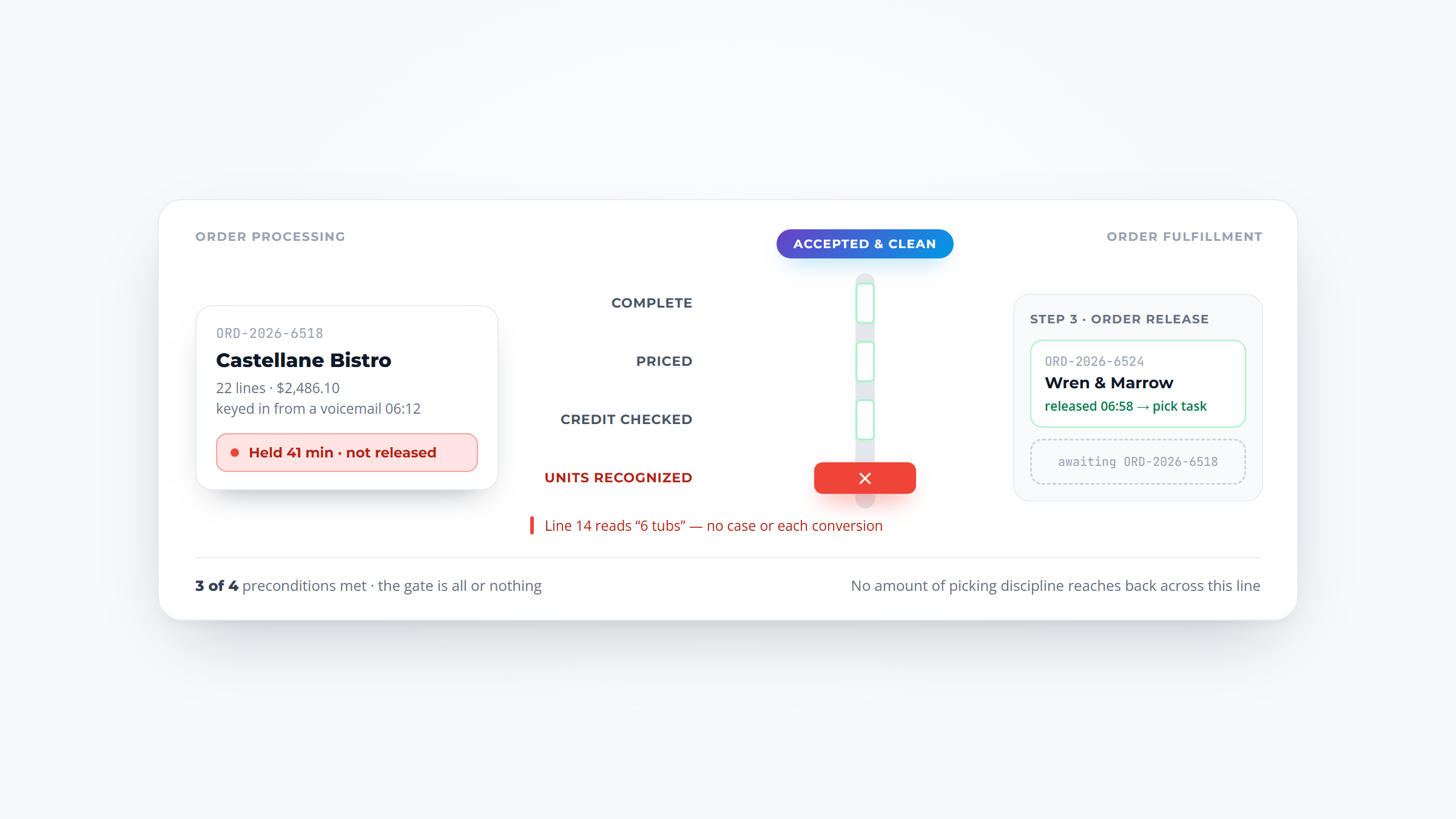
One input to all of this is worth separating out, because it changes how early a demand signal becomes visible. An order that arrives as a voicemail at 5:40 p.m. is invisible to every system in the company until somebody transcribes it the next morning.
The stock that order will consume still reads as available overnight. Anyone quoting against the item in the meantime is quoting against a number that is already wrong.
That 5:40 p.m. voicemail is the gap VoiceOrder Solutions is built to close, and it closes it from the distributor's side. The order desk receives a priced order against that account's own agreed terms, rather than a message somebody has to play back and key in by hand.
An order arrives digitized, confirmed, numbered and timestamped, and passes into the distributor's system without anyone rekeying it, so the demand is visible from the moment it is placed. That holds after hours as well: the record lands at 5:40 p.m. and queues for the next working day, rather than waiting unheard in a mailbox.
The boundary is worth stating exactly. VoiceOrder Solutions does not count stock, does not hold bin or pallet locations, does not calculate available to promise, and does not replace a warehouse management system.
Its own inventory visibility page draws the same line, stating plainly that it is not a warehouse management system and does not manage bins or pick routes, read barcodes, run cycle counts or follow stock moving between sites. What it contributes is visibility of order activity as it lands, which is one input to the picture this article describes rather than the picture itself.
Inventory visibility projects are unusually prone to declaring victory, because a new screen feels like progress. These are the figures that move only if something real changed.
| Measure | How to read it |
|---|---|
| Record-to-shelf match rate | Cycle-count agreement by item class, not a single site-wide average |
| Data latency | Median minutes between a physical event and its appearance in the system |
| Promise reliability | Share of orders shipped complete on the date first promised |
| Phantom stock incidents | Picks failed because the item could not be found where the record said |
| Manual lookups | Times per week a rep has to phone the warehouse to answer a stock question |
The last one is the least technical and the most honest. If your people have stopped calling the warehouse to check, the visibility is real, and if they have not, something on the screen is not trusted yet. Track it for a month before and a month after any change, and compare the counts rather than the impressions. Broader context on structuring this data sits in inventory management.
Pick the twenty items that generate the most short-ship complaints and follow each one through every system that claims to know its quantity. You will find the same three or four causes repeating: a unit-of-measure mismatch, a batch sync, an unowned item master field, a stock state that does not exist.
Fix those causes for those twenty items before buying anything. The exercise takes a week and it tells you whether you have a data problem, a latency problem or a process problem, which are three different budgets.
Should the earliest gap turn out to be order intake, where demand exists in the world but not yet in any system, that one step is separable from everything else here. Wholesalers who want to watch it run against their own catalog can ask for the twenty-minute walkthrough the company offers. Pricing is available on request.
Request a VoiceOrder Solutions demo
It is a vendor label for inventory visibility that updates as transactions happen rather than on a fixed schedule, so a receipt or a pick changes the figure immediately. Underneath the term, the substance is which stock states exist, who can reach them, how many systems have to agree, and how current the number is.
Visibility of any kind is a separate question from whether the number is correct, which is inventory accuracy, and from whether movements are recorded, which is tracking.
Tracking records movement: a scan at receipt, a scan at pick, a transaction on a transfer. Visibility is about reach and freshness, meaning whether that record is available to someone in another building or another department and how old it is when they read it. You need tracking to have anything worth seeing, but good tracking with no visibility just means the information exists somewhere nobody can get to.
Because it is bought with integration work and transaction volume rather than with a dashboard. Every system that touches stock has to agree on item identity and unit of measure, and every physical event has to generate a message when it happens rather than at the end of a shift.
Most operations end up with a mix of event-driven and scheduled updates. That is a reasonable answer as long as somebody has written down which items sit on which, and what lag it implies.
A record shows stock that cannot be found. The common causes are a failed or skipped scan, product put away in an unrecorded location, returns handled on paper, damage or expiry that was never posted, and unit-of-measure mismatches between systems.
DeHoratius and Raman found 65% of nearly 370,000 records at one retailer to be inaccurate, which argues for treating drift as the default condition and building counting and receiving routines around that assumption.
Start with identity rather than software. Name one system as the master for item, pack size and unit of measure, reconcile the others against it, and barcode every location including staging and quarantine.
Then confirm each stock state exists as a real field everywhere it is reported, and attack latency by moving receiving and returns to the point of the physical event. Most of the gain in that sequence comes before anybody buys anything.