.webp)
Key takeaways:
Restaurant operations is the work guests never see and feel immediately when it goes wrong. The table that waits twenty minutes for food, the special that runs out at seven, the delivery that arrives short on a Saturday morning all trace back to something operational rather than something culinary.
Managing it well is mostly about removing ambiguity. Every step that depends on someone remembering, interpreting, or relaying information by hand is a step where the operation can quietly break.
This guide covers what restaurant operations actually includes, where errors originate, and how changing the way orders are captured removes an entire category of them.
Restaurant operations is the day-to-day management of everything required to serve guests consistently and profitably. It spans front of house and back of house, but the phrase usually refers to the systems and routines behind service rather than service itself.
Six areas make up most of it. Food and beverage production handles prep, line execution, and quality, while inventory and purchasing covers counting stock and reordering it. Labor takes in scheduling, time tracking, and training, and compliance covers food safety, temperature logs, and licensing. The remaining two are facilities, meaning equipment and maintenance, and financial operations, meaning costing, invoices, and reporting.
The distinction worth holding onto is between operations and management. Management sets targets and makes decisions; operations is the repeatable machinery that delivers them the same way on a Tuesday as on a Saturday.
Most of restaurant operations happens on a daily cycle that barely changes, which is precisely why it can be documented and delegated.
| Phase | Core tasks | Where it usually fails |
|---|---|---|
| Opening | Temperature checks, prep lists, stock walk, staff briefing | Prep quantities guessed rather than forecast |
| Pre-service | Line setup, specials briefing, reservation review | Specials communicated verbally and forgotten |
| Service | Order flow, ticket times, expediting, guest recovery | No visibility of ticket times until complaints |
| Post-service | Waste recording, cash reconciliation, deep clean | Waste never recorded, so food cost is unexplained |
| Ordering | Counting shortfalls, placing supplier orders | Orders phoned in from a noisy kitchen, unrecorded |
| Closing | Temperature logs, security, next-day prep notes | Logs completed from memory at the end of a shift |
Two rows in that table produce most of the pain. The ordering row generates the delivery errors that surface days later, and the post-service row generates the missing data that makes food cost impossible to explain at month end.
Both fail for the same reason: they happen when everyone is tired, and neither has a system that captures information at the moment it exists.
A restaurant operations manager is responsible for the consistency of all of the above, usually across more than one location or across shifts a general manager cannot personally cover.
The role divides into three responsibilities. The first is standards, meaning defining how things should be done and verifying that they are. The second is cost control, meaning labor and food cost held within target without damaging the guest experience. The third is problem removal, meaning identifying the recurring failures that eat shifts and eliminating their cause rather than firefighting each instance.
The third is where good operations managers separate themselves. A manager who personally fixes a wrong delivery every week is working hard; one who changes how orders are placed so the deliveries stop being wrong has actually done the job.
The measurable part of the role is heavily weighted toward labor, because that is the largest controllable line. The National Restaurant Association reported that salaries and wages including benefits reached a median of 36.5% of sales for full-service operators in 2024, well above the roughly 33% average of prior editions, which leaves less room for scheduling error than most operators are used to.
An operations manual is the highest-return document a restaurant can produce, and most restaurants either lack one or have one nobody has opened since it was written.
Its purpose is not compliance theater. It is to move knowledge out of one person's head and into a form a new hire can follow, which is what makes a restaurant survivable when the shift leader calls in sick.
Keep it practical and build it in this order:
Write it in the language your team actually uses rather than formal prose, and keep each procedure to a single page. A manual that reads like a legal document gets ignored no matter how accurate it is.
When the page and the kitchen disagree, it is usually the page that needs changing.
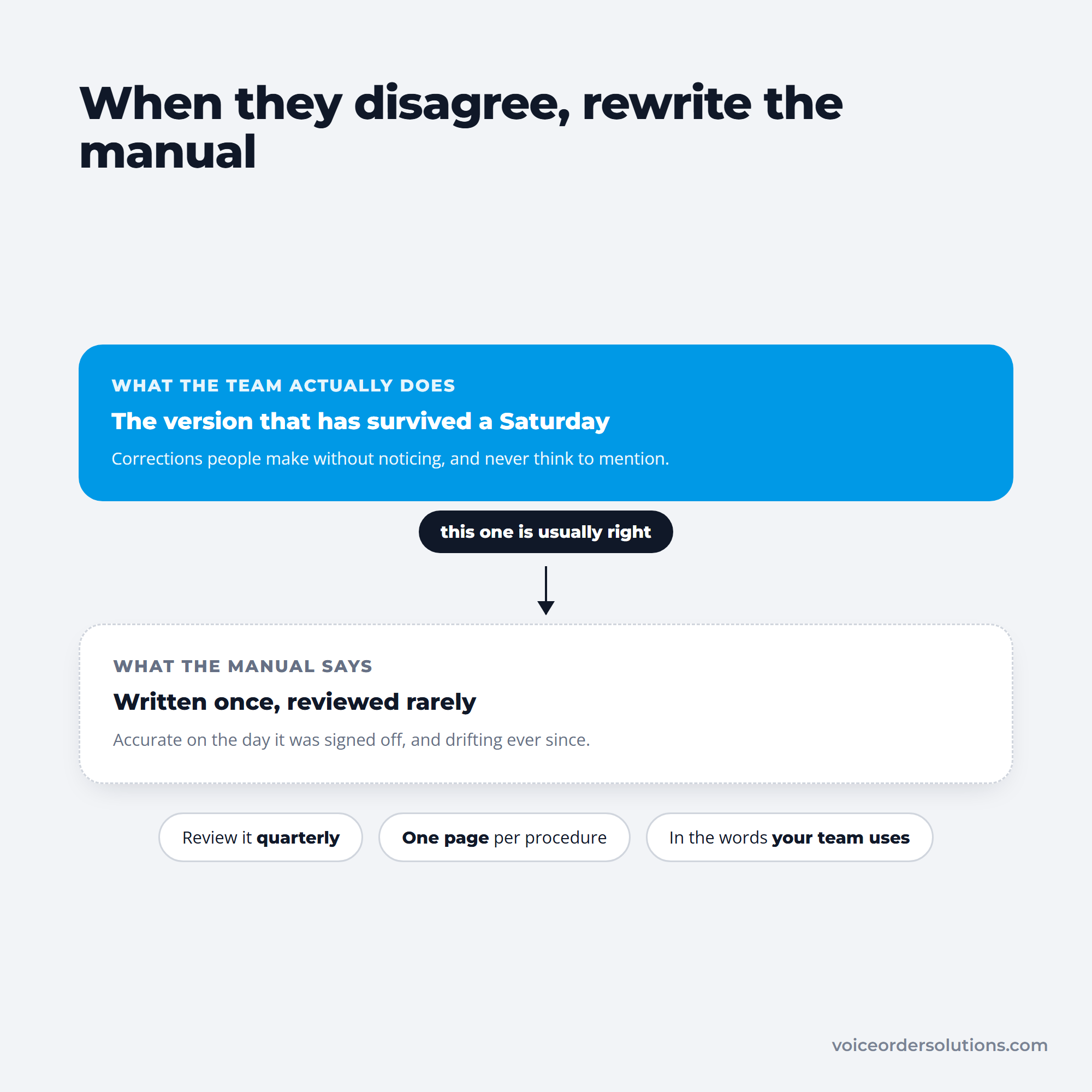
Review it quarterly against what people actually do. Where practice has drifted from the manual, the practice is usually right and the document is out of date.
Kitchen operations is where most of the cost and most of the variability sits. Three things determine whether it runs well: prep accuracy, station discipline, and communication with the rest of the building.
Prep accuracy depends on forecasting. A kitchen prepping from instinct either runs out during service or throws food away at close, and over a year those two errors cost more than most equipment purchases. Tying prep quantities to a forecast, even a rough one built from last year's same-weekday covers, removes most of that swing.
Station discipline is about setup and mise en place being identical every day, so a cook moving between stations does not have to relearn where things are. This is unglamorous and it is the single biggest determinant of ticket times.
Communication is where kitchens most often break down, particularly around what is running low. A cook who notices the walk-in is short on an item at 6pm has information the person placing tomorrow's order needs, and in most restaurants that information travels by shouting it at someone who is busy. Structured kitchen management routines exist largely to catch that class of loss.
It is tempting to attribute operational errors to carelessness. Look closely at the recurring ones and they are almost always structural: information passing through a channel that degrades it.
Supplier ordering is the clearest example. In most restaurants the order is assembled by someone walking the storeroom, then relayed to a distributor by phone or voicemail, often from a kitchen during or just after service. The person receiving it, often on a restaurant phone system shared with reservations, writes it down and types it into their system later.
That path degrades information at every step, and there is measurable evidence for how badly. Research published in Frontiers in Signal Processing found a speech recognition model trained on clean audio saw its word error rate rise from 19% on clean speech to 79% once realistic background noise and network distortion such as packet loss, jitter, and codec loss were combined.
The noise corpus used in that work included restaurant ambience among its real-world noise types.
That study is about automated recognition rather than human listening, and the important detail is what it combined: kitchen-level background noise plus telephone-network degradation. A spoken order relayed through a phone line from a busy kitchen passes through both. Anyone who has re-read a voicemail order and guessed at a case count has experienced the human version.
The second structural error is timing. An order left as a voicemail after close is not processed until someone plays it, which can be the following afternoon, by which point it has missed its picking window.
Voice ordering addresses the degradation problem by removing the relay rather than trying to improve it. Instead of a person describing an order to another person over a phone line, the order is captured as structured data at the moment it is spoken.
This is what VoiceOrder Solutions does for supplier ordering, and the distributor is the one who buys it. Independent food distributors issue each restaurant account an app keyed to its own negotiated catalog.
The person ordering then talks the list through hands free while walking the storeroom. What reaches the distributor is a structured, confirmed, timestamped record rather than a message somebody has to interpret.
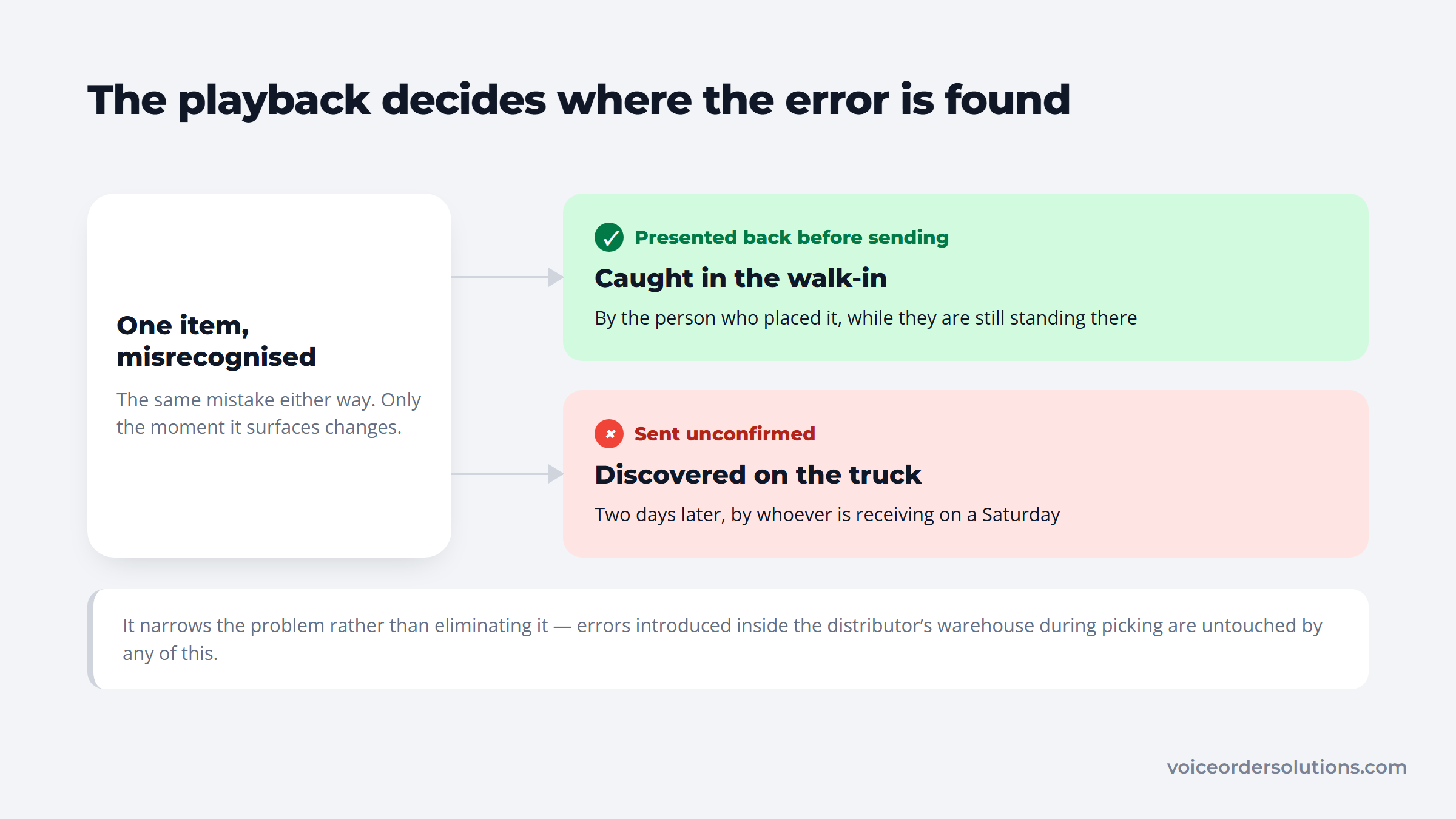
The confirmation step is the part that matters operationally. Because the order is presented back and confirmed before it is sent, a misrecognized item is caught by the person who placed it rather than discovered on the delivery truck. Each order carries a unique number, date, and timestamp, which gives the restaurant a record to point at when a delivery arrives short.
The same mistake either way. Only the moment it surfaces changes.
Two other properties address the timing failure. Orders placed outside business hours are captured and queued rather than sitting in a voicemail box, and an interrupted order auto-saves and resumes from the same point, which matters when the person ordering gets pulled onto the line mid-count.
VoiceOrder Solutions reports the ordering step itself takes 20 to 30 minutes less per order, and that time comes back to both sides: the kitchen stops waiting on hold, and the distributor's reps stop transcribing. It handles the procurement ordering step specifically; it is not a POS, an inventory system, or a kitchen display, and it runs alongside whatever the restaurant and the distributor already use for those.
Restaurant operations management software is broad enough as a category to be unhelpful as a shopping term, so it is worth separating by the job each product does.
| Software type | What it handles | Typical fit |
|---|---|---|
| POS | Orders, payments, sales reporting | Every restaurant, chosen first |
| Scheduling and labor | Rotas, availability, labor cost | Any site with more than a handful of staff |
| Inventory and food cost | Counts, recipe costing, variance | Once food cost stops being explainable |
| Task and compliance | Checklists, temperature logs, audits | Multi-site or food-safety-heavy operations |
| Invoice processing | Supplier invoices into line-item data | Once invoice volume justifies it |
| Supplier ordering | Getting the order to the distributor | Where ordering errors or delays recur |
Most restaurants buy the first three and assume the others are covered. In practice supplier ordering is the row most often left manual, because POS and inventory tools stop at generating a purchase order rather than delivering and confirming it. On the distributor's side, distribution automation software closes the same gap by taking the hand-work out of how those orders arrive.
Laid out as a stack, the gap is at the bottom rather than anywhere anyone is looking.

Sequence purchases against your actual failures rather than the category list. A restaurant losing money to inconsistent portioning needs recipe costing; one losing it to short deliveries needs something else entirely, and buying restaurant automation tools in the wrong order is how operators end up with several subscriptions and the same problems.
A handful of practices show up consistently in restaurants that run smoothly, and none of them require capital.
The first is the underlying principle behind the rest. Nearly every operational data problem in a restaurant comes from someone trying to remember something hours after it happened, whether that is a temperature, a waste figure, or a case count.
The fifth is the one you cannot do alone. Ask your distributors what order taking software they offer their accounts, because a confirmation they generate carries more weight in a dispute than a note you wrote yourself.
Operations improves when a small number of things are measured consistently, and gets worse when everything is measured occasionally.
Four numbers carry most of the signal. Labor as a percentage of sales, tracked by shift rather than by week, shows whether scheduling matches demand. Food cost percentage, compared against theoretical cost from recipes, exposes portioning and waste. Ticket times by daypart show where the kitchen is under-resourced. Order accuracy from suppliers, measured as short or wrong lines per delivery, shows whether your inventory and ordering process is working.
That last one is rarely tracked at all, which is why ordering problems persist for years. Counting wrong lines per delivery for a month usually produces a number that surprises the operator and justifies fixing the process.
Review them weekly with the managers responsible, and resist adding a fifth until the four are reliable.
If you are working out how to improve restaurant operations and the subject feels too broad, pick the failure that costs you the most shifts and trace it backward to its cause rather than its symptom.
For most independents that trail leads to one of two places: prep quantities decided by instinct, or supplier orders relayed by phone and never recorded. Both are fixable in weeks rather than quarters, and both are cheaper to fix than to keep absorbing. For the second, supplier management software built around ordering puts every supplier in one app and keeps a dated record of what was sent.
Write the opening and closing checklists this month, start recording waste daily, and count how many lines arrive wrong per delivery. Those three actions cost nothing and will tell you where the real problem is.
Where that failure is the supplier order, the fix belongs to the distributor rather than the kitchen. VoiceOrder Solutions lets a distributor hand its food service accounts a way to place and confirm orders before they are sent, and it slots into the order management system that distributor already runs. Contact the team to try it against a real order guide.
Restaurant operations covers six areas: food and beverage production, inventory and purchasing, labor and scheduling, compliance and food safety, facilities and equipment, and financial operations such as costing and invoices. Front-of-house service delivery sits alongside them. The term generally refers to the repeatable systems behind service rather than the service itself, which is why it can be documented and delegated.
Start by identifying which recurring failure costs you the most time, then fix its cause rather than its symptoms. The highest-return actions for most independents are writing opening and closing checklists, tying prep quantities to a forecast rather than instinct, recording waste daily, and removing manual relays from supplier ordering. Buying software before diagnosing the failure usually produces subscriptions rather than improvement.
At minimum it should cover opening and closing checklists, station prep lists with quantities, recipe specs with weights and yields, the supplier ordering procedure, food safety routines with specific temperatures and intervals, guest recovery policy, and equipment maintenance schedules.
Keep each procedure to roughly a page, write it in the language your team uses, and review it quarterly, since drift between the manual and actual practice usually means the manual is out of date.
It reduces a specific class of error: the ones introduced when an order is relayed verbally and re-typed by someone else. Capturing the order as structured data at the moment it is spoken, and confirming it back before transmission, means a misheard item is caught by the person ordering rather than discovered at delivery.
It does not affect errors that happen inside the distributor's warehouse during picking, so it narrows the problem rather than eliminating it.
Restaurant operations is the work itself: the routines, systems, and daily execution that deliver consistent service. Restaurant operations management is the discipline of overseeing that work, setting the standards, monitoring cost and quality, and removing recurring problems, often across several shifts or locations. In smaller restaurants the same person does both, which is why the terms are frequently used interchangeably.