Key takeaways:
Sell a pallet of romaine and you have taken on obligations the produce ERP software market rarely puts on a feature page. The lot has to stay traceable through whatever repacking happens next, the invoice has to carry specific statutory wording if you want a trust claim on the money, and the price you quoted this morning may not survive the afternoon.
A general distribution ERP handles none of that well, because it was built for products with stable prices, fixed pack sizes and no spoilage clock. That gap is why fresh produce ERP software is a category rather than a configuration.
The nine produce distribution software systems below were checked against what their vendors publish, in October 2026. Only one carries a price, which is unremarkable in a market where every deployment is scoped individually, and the comparison that matters here is capability rather than cost.
Four requirements separate the two, and all four are specific enough to demo.
The first is lot traceability through transformation. Receiving a lot is easy. The hard part is what happens when you break it down, mix it with another grower's product and send it out under a new pack, and a produce system creates child lots that keep the link in both directions.
The second is repack and packout costing. A repack consumes labor, packaging and yield, and if the system cannot allocate those to the output, your margin on the repacked item is a guess.
The third is prices that move daily. Produce is quoted by commodity, origin, variety, size, pack and grade, and a single price field cannot hold that.
The fourth is PACA records. Trust protection depends on invoice wording, payment terms and lot-level identification of each grower's product, which makes it a recordkeeping requirement before it is a legal one.
Shelf life sits behind all four. Managing fresh produce shelf life with ERP means the system has to know an item's remaining life at the moment it is allocated, not just its quantity, which is what separates produce distribution software from a warehouse count.
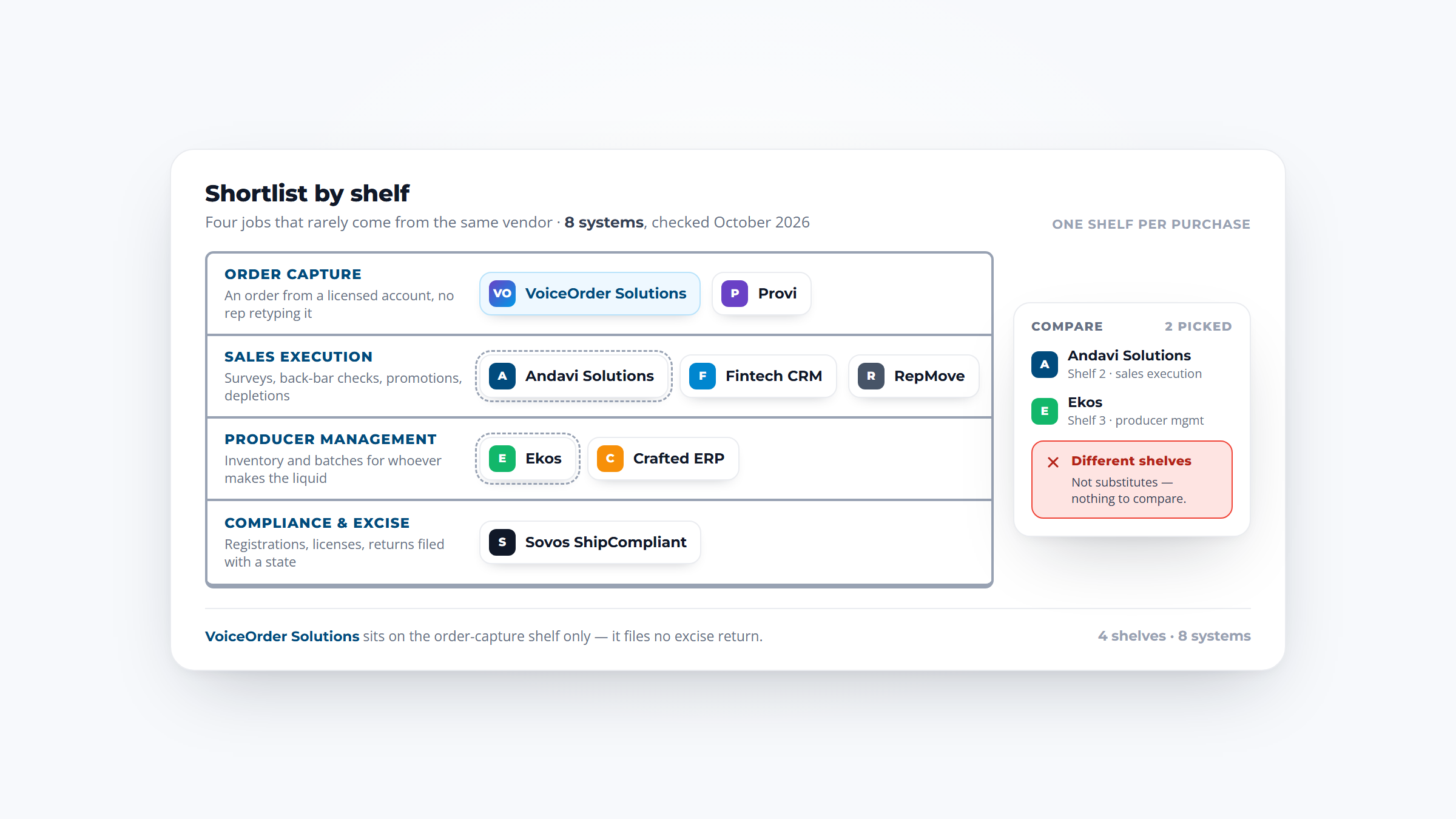
None of the nine decides how the order reaches you in the first place. That stays with the distributor's own channel, whether that is a portal, a rep, or an ordering app such as VoiceOrder Solutions.
One more consideration cuts across all of this: most produce distributors also run a straightforward wholesale operation alongside the complicated part. Keeping the inventory tracking side simple while the traceability side gets sophisticated is the real design problem.
The table scores the five capabilities that separate these systems. Silent means the vendor does not name the capability anywhere on its own site that we could reach, not that it refuses to do it. No vendor here explicitly denies any of the five, which is worth saying plainly before anyone reads a blank cell as a no.
| System | Lot traceability | Repack and grading | PACA trust | Daily price lists | EDI | Pricing (from) |
|---|---|---|---|---|---|---|
| Reserva ERP | Yes, across repacks and transformations | Yes, child lots with labor and yield allocated | Named PACA trust component | Yes, a USDA market price feed | Built in | $299/month, 3 users |
| Famous Software | Yes, with a published FSMA 204 data-element list | Yes, work orders with recipes, BOM and yield | Silent | Contract and on-ad pricing | Yes, direct or via a network | Not published |
| FreshByte | Yes, one-up one-down, through repacking | Yes, with yield and cost allocation | Names PACA compliance | Partial, contract schedules and cost layers | Add-on | Not published |
| Prophet ERP | Yes, pallet tracking and full traceability | Yes, plus production scheduling and QC | Silent | Partial, contract price management | Not named | Not published |
| PICS by WaudWare | Yes, lot, pallet and case, PTI | Yes, as a paid add-on module | Silent as a feature | Yes, broadcast price lists in an add-on | Not named | Not published |
| Visual Produce | Yes, as an add-on | Yes, as two add-on modules | Silent | Silent | Add-on | Not published |
| Produce Magic | Yes, one-button forward and backward recalls | Repacking yes, grading not named | Silent | Partial, automatic pricing | Yes, plus named trading networks | Not published |
| Silo | Yes, at module level only | Silent | Silent | Silent | Yes | Not published |
| Fusionware | Implied by its FSMA content, not a named module | Silent | Silent | Silent | Yes | Not published |
Eight of the nine quote rather than publish, and none of them should be marked down for it. Read the PACA and repack columns first, because those two separate a produce system from a food system with a produce brochure.

Overview: Reserva is a cloud produce ERP aimed at distributors, wholesalers, packers, growers and importers, with cross-border trade between the US and Mexico as a named focus. It operates out of Syracuse, New York.
Reserva is the only system here that publishes a price, and the only one carrying a named PACA trust component.
Key features:
Pricing: Standard is $299 a month for up to three business users, Professional $399 a month or $3,990 a year for five, and Enterprise $699 a month or $6,990 a year for six to ten. Above ten users is not published.
Pros: Publishes real prices, the strongest daily-pricing story here, repack costing done properly, no per-module charges.
Cons: User caps are low and hard, repacking and grading start at the $399 tier rather than the entry one, and every tier describes its inventory tracking as limited in the vendor's own words.
Why it earns a place here: It is the only system whose own pages connect lot traceability, repack costing, a market price feed and PACA into one product rather than treating them as separate concerns.
Final verdict: The most complete produce-native offering on this list at a published price, with the caveat that the entry tier is not the tier that does the packout work. It is built on Odoo rather than from scratch, which is worth knowing before you compare it with a purpose-built codebase.

Overview: Famous is the long-standing category leader, built on Oracle technology and run out of Fresno. It began five decades ago as a grower accounting system, which still shows in how it handles settlements and pooling.
Its FSMA work is the most concrete of any vendor here, down to a published list of the exact data elements it captures.
Key features:
Pricing: Not published. Demo and quote only.
Pros: Deepest traceability detail published by anyone here, genuine value-added production costing, long track record at scale.
Cons: No published price, and PACA is absent from its site entirely.
Where it fits: Larger grower-shippers and packer-distributors whose traceability obligations are already a board-level topic.
Final verdict: The safe institutional choice, and the one whose published FSMA detail you can actually check against your own requirement before a demo.

Overview: FreshByte is a Houston-based ERP for fresh food wholesale distribution, covering produce alongside meat, seafood, floral and specialty food. It positions itself as purpose-built for wholesalers rather than for growers.
FreshByte is one of only two systems here that mention PACA at all.
Key features:
Pricing: Not published. In place of a price it publishes a support commitment: unlimited live support at no extra charge, a two-hour response guarantee and training included.
Pros: Strong post-sale cost handling, PACA named, support terms unusually specific.
Cons: EDI, cloud hosting, warehouse mobility and multi-currency are all add-ons rather than core, and its PACA claim carries no detail about trust notices or invoice wording.
Its real strength: Adjusting cost after the sale, which is the normal case in produce and an awkward one in most accounting systems.
Final verdict: A credible wholesaler-first choice, and worth asking exactly what its PACA compliance covers, because the site does not say.

Overview: Prophet has been building produce and floral ERP for more than 35 years, with offices on three continents and a North American arm formed by acquiring a US competitor in the 2010s.
Its feature set leans further toward production and planning than most of this list.
Key features:
Pricing: Not published. Demo only.
Pros: Deep planning and production functionality, floral as well as produce, long international track record.
Cons: EDI is not named anywhere on its US pages, PACA is absent, and its North American presence is the newest of its three regions.
Why buyers shortlist it: The production scheduling and quality control modules go further than most produce systems attempt.
Final verdict: The strongest fit where packing and production planning is the bottleneck rather than trading, and a system to question closely about US-specific requirements.

Overview: The Produce Inventory Control System combines inventory and traceability in one package, and it publishes a role-by-role breakdown for wholesalers, jobbers, brokers, growers, shippers, packers and cold storage. WaudWare is based in Ontario.
Its licensing structure is unusually transparent even though its prices are not.
Key features:
Pricing: Not published, though the module structure is. The core license covers traceability, buying, selling, inventory and accounting, and pack or repack work orders require the separately sold production module.
Pros: Honest about what costs extra, cloud deployment available in under a day through a hosting partner, strong role-specific detail.
Cons: Repack is a paid add-on, EDI is not evidenced anywhere on its site, and it is a Canadian vendor, which matters on a PACA-centric purchase.
Where it fits: Mid-size wholesalers who want traceability in the core system rather than bolted alongside it.
Final verdict: Good value conceptually, and a vendor to ask directly about PACA, since its only PACA content is 2015 advocacy for a Canadian equivalent rather than a US feature.

Overview: Visual Produce is the product; Silver Creek Software of Boise, Idaho is the company, and the site carries the vendor's branding rather than the product's. It runs on Microsoft SQL Server rather than a proprietary database, which the vendor treats as the main selling point.
Its module split is the most explicit here about what is core and what is extra.
Key features:
Pricing: Not published. Call-back request only.
Pros: Open database, heavy customization is the stated model, named customers with specific operational claims.
Cons: Traceability, EDI, repack and grower settlements are all add-ons, so the core license is essentially an accounting and inventory system.
What it is genuinely good at: Fitting into a stack that already exists, rather than asking you to replace it.
Final verdict: Worth pricing carefully, because the capabilities that make it a produce system are the ones sold separately. Ask for a current module list in writing.

Overview: Produce Magic is the trading name of Advanced Technology Marketing, incorporated in 1986 and shipping produce software since the DOS era. It operates from Arizona and California and is family run.
Its published capability list is broad, covering wholesalers through to fresh-cut processors.
Key features:
Pricing: Not published. Free live online demo only.
Pros: Long operating history, genuinely broad feature list, costing flexibility down to the line item.
Cons: The public evidence base is the thinnest here by a distance, so almost everything needs confirming in the demo.
Why it made this list: Forty years of continuous trading in a niche category is itself a signal, and the costing model is more granular than several better-presented systems.
Final verdict: A real option that you will have to evaluate by demo rather than by research, because the website will not do the work for you.

Overview: Silo is a cloud ERP for produce shippers, distributors, packers and growers, run from California under a chief executive who came from the produce industry rather than from software.
Silo acquired Pet Tiger, a labor and field-cost tracking specialist, in late 2025, and labor management is now one of its named modules.
Key features:
Pricing: Not published. Demo only.
Pros: Active development and recent acquisition, genuine labor-cost capability that most produce ERPs lack, industry-experienced leadership.
Cons: The public site is thin, with one-sentence module descriptions, no pricing and no detail on repack, grading or daily pricing.
Where it beats the alternatives: Labor and field cost, which is a real produce margin problem and is absent from most of this list.
Final verdict: Promising and genuinely active, and the one here where you will learn the most from the demo because the site tells you the least. Its own FSMA page states the regulatory position more accurately than any other vendor we read.

Overview: Fusionware of Idaho Falls describes itself as a cloud digital operations platform for the produce supply chain, aimed at pack sheds, growers, shippers and sales teams.
Whether it is a full ERP or an operations layer is genuinely ambiguous from its own copy, which calls it both.
Key features:
Pricing: Not published. Demo only.
Pros: Clearly growing, with a joint integration launched with a supply-chain partner and repeated hiring announcements through 2026.
Cons: Grower and shipper first rather than distributor first, with repack, grading, PACA and daily pricing all absent from its public pages.
Where it fits: Pack sheds and shippers wanting operational visibility by role rather than a full financial system.
Final verdict: The least conventional entry here, and the one whose scope you should pin down in writing before treating it as an ERP replacement.
Every capability above was read on the vendor's own site, and a blank cell means we could not find the claim rather than that we found a denial.
Two candidates were cut on relevance rather than quality. One is a trading network rather than an ERP, closer to the food-ordering platforms covered in our roundup of Choco alternatives than to the systems here, and its own competitors describe integrating with it rather than replacing it. Another turned out to share a parent company with a system already covered under a different brand.
A third was dropped once its name led to the wrong company entirely, which is worth knowing if you are searching: two widely cited produce names resolve to unrelated businesses.
Where a vendor's homepage shows a dashboard full of figures, those figures were ignored, because two of the nine display invented sample data in their hero images.
This is the clearest gap between what produce distributors need and what produce software advertises.
The Perishable Agricultural Commodities Act creates a statutory trust over produce, the products derived from it, and the money it earns. The trust is what gets an unpaid seller to the front of the queue when a buyer fails, and it is forfeited by paperwork rather than by bad luck.
USDA's PACA trust rules set out how to preserve a claim. A licensee can print specific statutory language on the face of the invoice, stating that the commodities are sold subject to the trust and that the seller retains a claim over them, their derived products and the receivables. The wording has to appear exactly as published.
Anyone not using the invoice method has to send a separate written notice of intent to preserve trust benefits, within 30 days of the day payment was due, or of learning that a payment was dishonored.
Two conditions catch people out. Payment terms cannot exceed 30 days from acceptance if you want trust protection at all, and any terms other than PACA prompt payment, usually 10 days, must be agreed in writing before the transaction rather than settled afterwards.
| Transaction type | Prompt payment deadline |
|---|---|
| Purchases | 10 days from date of acceptance |
| Consignment or joint account net proceeds | 10 days from final sale, or 20 days from receipt at destination |
| Buying brokers | 10 days after the broker's invoice is received |
| Agents authorized to collect and remit | 5 days after receiving payment |
| Growers' agents | 30 days after receipt, or 5 days after payment, whichever is first |
| Other contract terms | 20 days from acceptance |
The software consequence is specific. PACA's own training material states that each grower's product must be identified from harvest or delivery through packing, shipping and selling, and that lot numbers are necessary to distinguish one grower's product from another.
That is a legal recordkeeping requirement satisfied by a lot engine, which is why a produce ERP's traceability module is not only a food safety feature. It is also why only two vendors here naming PACA at all is a genuinely surprising finding, and why the question belongs in every demo you book.
Most vendor pages state the FSMA 204 position incorrectly, so start with the regulation.
The compliance date for the Food Traceability Rule was January 20, 2026. FDA proposed extending it by 30 months to July 20, 2028, and that proposal was never finalized. Congress then barred enforcement before that date in its own right, and the agency has said it will follow that direction.
So the rule is unchanged and enforcement is deferred, which is a different thing from a new deadline. Operationally it matters, because first-mile data cannot be reconstructed later.
The requirement itself is to keep records of key data elements tied to critical tracking events, and to provide them to FDA within 24 hours or another agreed timeframe. What surprises distributors is which produce is covered.
| On the Food Traceability List | Excluded, despite appearances |
|---|---|
| Leafy greens, fresh and fresh-cut | Whole head cabbage, green, red and savoy |
| Tropical tree fruits, fresh | Bananas, pineapple, dates, pomegranate, coconut |
| Fresh-cut fruits and vegetables | Avocado, classed as a pit fruit |
| Cucumbers, peppers, tomatoes, melons, sprouts | All citrus, including oranges, lemons and grapefruit |
| Fresh herbs such as parsley, cilantro, basil | Dill and other exempt herbs, plus figs |
A mixed pallet can therefore be half covered and half not, which is the practical reason traceability has to work at lot level rather than at order level. Whatever food traceability software you already run should be checked against the list item by item, because partial coverage is the normal case rather than the exception.
The produce weighting on that list is not arbitrary. A peer-reviewed analysis by CDC researchers attributed 46% of foodborne illnesses to produce commodities against 22% for meat and poultry, with leafy vegetables alone accounting for 2.2 million illnesses a year, more than any other single commodity. That study used outbreak data from 1998 to 2008 and was published in 2013, so treat it as the reasoning behind the list rather than as current incidence.
One published price exists in this category, and it is worth examining because it shows how these systems are shaped.
Reserva ERP runs $299 a month for three users, $399 for five, and $699 for six to ten, with the middle tier being the first that includes repacking, grading, warehouse management and route planning. The entry price buys the trading and accounting core, not the produce-specific production work.
Everyone else quotes, and the variables are consistent: user count, modules, and whether traceability, EDI and repack are core or add-ons. ERP implementation for fresh produce growers is usually scoped and priced on its own, separately from the license itself. Visual Produce sells traceability, EDI, repack and grower settlements separately. PICS sells its production module separately. FreshByte sells EDI, cloud, warehouse mobility and multi-currency separately.
The honest comparison is a written quote for the same module set, user count and implementation scope. Ask whether repack and traceability are included, because that question moves the number more than anything else.
Smaller operations should price the alternative too. A distributor running a handful of commodities with simple packs may find that small business inventory management plus a good accounting system covers the job, and that a produce ERP solves a problem they do not yet have.
Produce distributors carry a particular ordering burden, because the catalog changes under them. A commodity goes short, a grade drops, a price moves, and the standing order a restaurant placed last Tuesday no longer matches what is on the floor.
Most distributors handle that with a phone call, which is why produce order desks stay busy in a way that dry-goods desks do not. A standing order is a replenishment commitment the catalog keeps breaking. Each substitution becomes a conversation, and each conversation becomes a line somebody retypes.
The systems above manage the stock and the lot. What they generally do not manage is how the order arrives in the first place, and that is a separate decision. A distributor can route it through a portal, a rep, or a dedicated ordering channel it runs for its own accounts.
VoiceOrder Solutions is one option for that last route, and the distributor buys it rather than the restaurant. Accounts order by voice in a mobile app, working from the guide and pricing their distributor maintains, while the distributor runs those guides, the order history and each account's setup from a single admin platform. A commodity change is therefore one central edit instead of a morning of calls.
What reaches the order desk is already structured and stamped with an order number and a time, so the ERP above receives a record rather than somebody's notes.
Book a VoiceOrder Solutions demo
The shortlist narrows quickly once you are honest about your operation.
If you repack, that is the first filter. Reserva, Famous, FreshByte, Prophet and Produce Magic include it, though Produce Magic does not name grading; PICS and Visual Produce sell it as an add-on; Silo and Fusionware do not name it at all. Ask to see a repack that creates a child lot and allocates yield loss, not a slide about it.
If PACA trust is live in your business, and a supplier of fresh or frozen produce becomes eligible the moment it sells, ask every vendor how their system preserves a claim. Only two carry it as a named feature, and neither publishes the detail, so the answer will come from a person rather than a page.
The 2,000 pounds a day people quote is a separate test. That is the threshold for holding a PACA license, not a measure of whether the trust reaches you.
If your prices move daily, Reserva's USDA market feed is the only published answer here, and everyone else expects you to maintain contract pricing yourself. If labor cost is the margin problem, Silo is the one that has invested in it. If planning and production scheduling dominate, Prophet goes deepest.
Whatever lands, run one test across the finalists. Receive a lot, repack it into two grades, sell one grade to a customer on 21-day terms and the other on prompt payment, then ask the system to show the trust-eligible receivables and trace both outputs back to the grower.
That exercise answers more than a feature grid, because it forces the system to reconcile traceability and payment terms at once, and that pairing is what a written procurement strategy has to settle before the contract is signed.
No single produce ERP software package wins outright, because the answer depends on what you do to the product. Reserva ERP is the most complete produce-native option at a published price and the only one with a named PACA trust component.
Famous Software is the institutional choice for larger grower-shippers and publishes the most detailed traceability data. FreshByte suits wholesalers who adjust cost after the sale. If you mainly buy and sell without repacking, several of these are more system than you need.
Far fewer than you would expect. Two of the nine list it among their features, and neither goes on to explain how a claim is actually preserved. The other seven leave it off their feature lists, so read a blank as an unanswered question, not a refusal. Since preserving a claim depends on exact invoice wording, a 30-day notice deadline and payment terms within 30 days of acceptance, treat it as a demo question for every vendor.
Two ways, and only one of them is automated. Reserva pulls USDA market data straight into the system, filtered down to the commodity, market and grade you care about. The rest leave you maintaining contract or customer prices by hand, which is fine when your numbers are negotiated and painful when they follow the market.
USDA publishes daily terminal market reports for 12 cities free of charge, so the feed is a convenience rather than exclusive data. Predicting where those prices go next is a different problem again, closer to forecasting software than to anything an ERP ships with.
Three things. It has to create a child lot linked both ways to the parent, so a recall traces in either direction. It has to allocate the labor, packaging and yield loss consumed by the repack to the output item, or your margin on repacked product is fiction. And it has to carry catch weights through, since what you repack rarely weighs what the system assumed.
January 20, 2026, and that has never formally moved. A 30-month extension to July 20, 2028 was proposed and never finalized as a rule. Congress separately directed FDA not to enforce the rule before July 20, 2028, and FDA has said it intends to comply. The practical position is that the requirement stands and enforcement is deferred, which matters because first-mile records cannot be created retrospectively.
A produce ERP takes over once the order exists. Getting it there, on a commodity whose grade and price move overnight, is a separate piece of the problem and usually the one a distributor feels first.