Key takeaways:
Your largest customer emails on a Tuesday asking for a current certificate of insurance, a third-party audit report and an allergen statement for every item on one supplier's list. Half of those files sit in someone's inbox, one expired in March, and the supplier's contact left last year.
Most food compliance problems look like that. Compliance rarely fails all at once. It piles up as paperwork nobody owns.
Food compliance software is meant to keep that file current. It's a confusing market, though, because the phrase covers supplier portals, regulatory databases, nutrition label builders and packaging declaration tools, and they share almost no features.
This guide, written for manufacturers, importers and distributors, sorts eight compliance tools by the document job they do. A ninth entry, VoiceOrder Solutions, appears last. It's the publisher's own product, an ordering tool for food distributors rather than a compliance platform, and its entry explains the one narrow reason it's here.
Food compliance software keeps the documents and rule checks that show your food meets the law and your customers' standards. In practice, that means supplier approvals, certificates, specifications, label statements, regulatory change alerts and declarations.
Temperature logs, line checks and HACCP monitoring are operational, and they usually sit in a different product. Food safety compliance software covers the paperwork layer behind those checks: who you buy from, what they promised, and what the rules say about it.
That paperwork starts on day one of a supplier relationship. A thorough vendor onboarding process decides which documents you collect, and the software's job is to keep them from expiring quietly afterward.
Before you compare vendors, work out which of these jobs is actually hurting you. The table lists each job and the entries that center on it, and some entries appear twice. VoiceOrder Solutions sits in none of them.
| Job | What it answers | Entries that center on it |
|---|---|---|
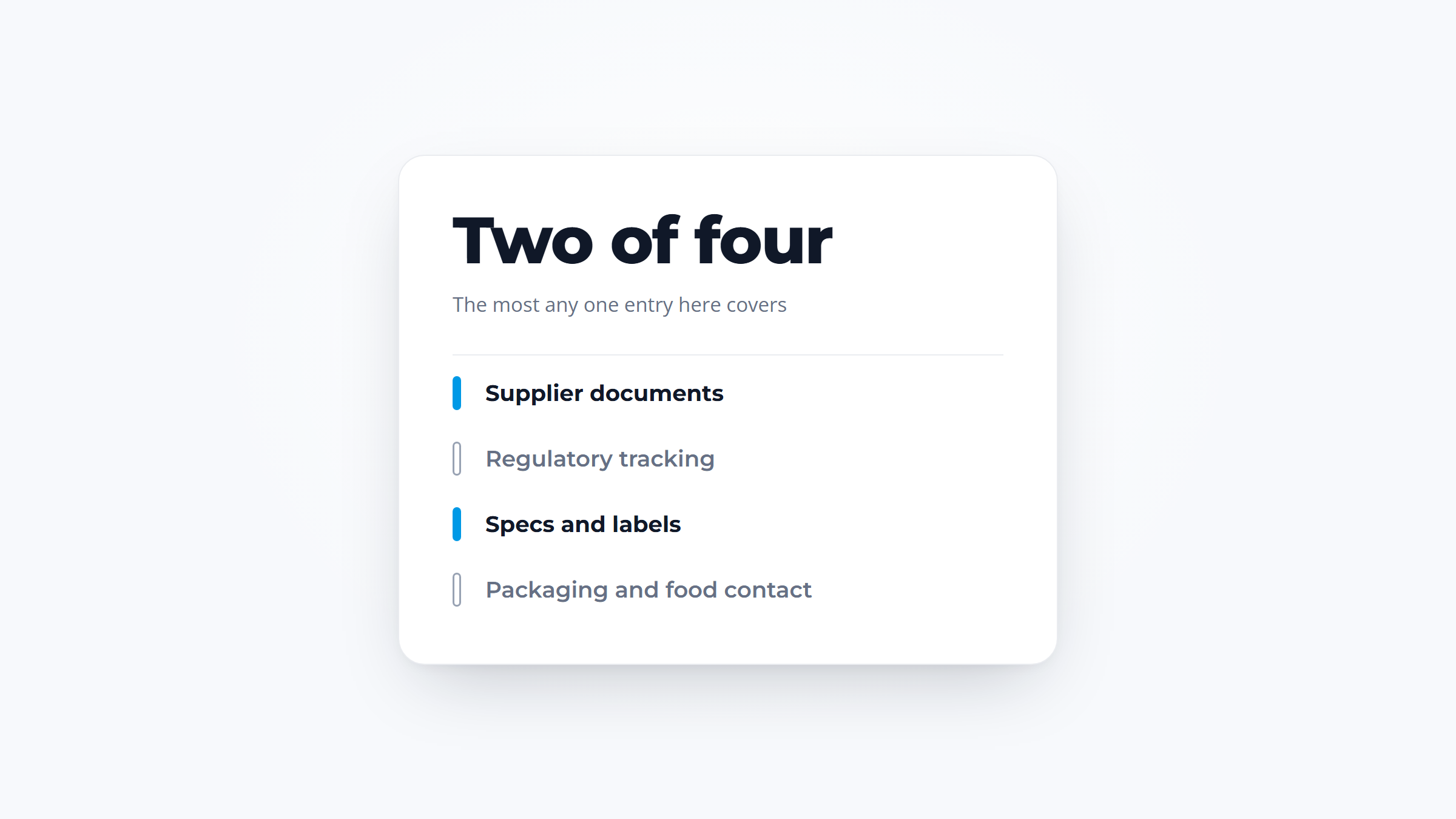
| Supplier documents | Is this supplier approved, and is its file current? | ReposiTrak, Registrar Corp ComplyHub, TraceGains, Trustwell |
| Regulatory tracking | What does the law allow in this market? | SGS FoodNexus, FoodChain ID, Trace One |
| Specs and labels | Does the label match the approved recipe? | Trustwell, Specright, Trace One, TraceGains |
| Packaging and food contact | Can this material touch this food here? | FoodChain ID |
Most companies feel one of these far more than the others. A distributor usually has a supplier-document problem, which is supplier management work by another name. A brand launching in Europe has a regulatory one, and a growing manufacturer with 300 labels has a spec one.
The list follows those jobs: supplier documents first, then regulatory and packaging, then specs, labels and PLM. VoiceOrder Solutions closes it because it does none of them. The third column names the document or decision each one is built around, which is the fastest way to find your match.
| Software | Best for | Built around | Main limitation | Supplier documents |
|---|---|---|---|---|
| ReposiTrak | Wholesalers and retailers chasing suppliers | Supplier documents, FSMA 204 records | No spec or label tools | OCR-read and reviewed, expiry alerts, staff chase suppliers |
| Registrar Corp ComplyHub | US food importers | FSVP files, supplier monitoring | Import-only | FSVP templates, document reminders |
| TraceGains | Brands managing ingredient suppliers | COAs, supplier and spec data | Brand and manufacturer focus | Collected, expiry alerts, COA data checked |
| SGS FoodNexus | Teams watching rules and recalls by market | Regulatory and risk intelligence | Inspection findings start at Monitor Plus | None |
| FoodChain ID | Packaging and multi-country rules | Declarations, regulatory library | Services-heavy | Packaging supplier data, auto-filled declarations |
| Trustwell | Manufacturers writing their own labels | Nutrition, labels, specs, suppliers | Modules sold separately | FoodLogiQ collection, expiry tracking, COA review |
| Specright | Brands with complex specs | Specification data | Foundations is packaging only | Portal with certificates, expiry alerts |
| Trace One | Manufacturers selling across borders | Regulatory compliance, PLM | Heavy PLM implementation | PLM supplier portal, pre-expiry alerts |
| VoiceOrder Solutions | Distributors' order guides and history | Customer orders | Not a compliance tool | None |
If the Tuesday email from the introduction sounds familiar, read the last column first: SGS FoodNexus and VoiceOrder Solutions hold no supplier documents. Published prices are in the cost section below.

Best for: Wholesalers and retailers chasing supplier documents
Overview: ReposiTrak, formerly Park City Group, is the entry that most directly serves wholesalers. Its Compliance Management product collects supplier documents, reads them with OCR, reviews them automatically and warns before they expire.
The unusual part is human. A Customer Success Team chases suppliers for missing paperwork on your behalf, which removes a task that usually falls on compliance staff. Modules cover FSVP, certificates of analysis, Prop 65 and item-level compliance.
Key features:
Pricing: ReposiTrak publishes no rate for Compliance Management. The Traceability Network is free to retailers and wholesalers, while suppliers start at $59 a month with no set-up fee and a minimum of 3 customer connections.
Pros: Free traceability tier for wholesalers, people who chase suppliers, documents accepted in any format.
Cons: No spec, label or nutrition tools, no regulatory-change alerts, and a connection minimum on the supplier fee.
Why it's a good food compliance software pick: It treats document collection as work to be done for you instead of a dashboard to watch.
Final verdict: The first call for a distributor buried in supplier paperwork.

Best for: US food importers
Overview: Registrar Corp, based in Hampton, Virginia, sells ComplyHub to US food importers. It's built around the Foreign Supplier Verification Program: templates, reminders and a watch over each supplier's shipment history.
The monitoring is what sets it apart. ComplyHub checks suppliers against more than 100 million US shipment records and alerts you to FDA violations, so a supplier's FDA problem can surface before its next shipment reaches you.
Key features:
Pricing: Registrar Corp lists no price for ComplyHub or its managed FSVP packages, though its self-paced FSVP course costs $799.
Pros: Deep FSVP focus, FDA violation alerts, managed help available.
Cons: Import-only, nothing for domestic supplier approval or FSMA 204 lot records, labeling sold as a separate Registrar product.
Where it fits: An importer acting as the FSVP importer of record for overseas suppliers.
Final verdict: Close to the default if imports are your compliance exposure, and irrelevant if they aren't.

Best for: Brands managing many ingredient suppliers
Overview: TraceGains, part of Veralto since October 2024, connects supplier documents with the specs and artwork that depend on them. Its Document Intelligence pulls data from a certificate of analysis instead of just storing the PDF, so a value can be checked against the spec.
When a spec changes, the change can reach artwork approvals through Esko WebCenter Go. For a brand that has been burned by a label lagging behind a formula change, that link is the main reason to look here.
Key features:
Pricing: A free TraceGains Gather plan collects up to 100 supplier documents. Paid tiers carry no published price, and suppliers join free, which helps when you ask them to upload.
Pros: Data pulled from documents, spec-to-artwork chain, free plan for 100 supplier documents.
Cons: Brand and manufacturer focus, regulatory data comes through a partner, wider suite overlaps quality tools you may already own.
Why buyers shortlist it: It treats a supplier document as data your systems can check.
Final verdict: A strong choice for a brand with many ingredient suppliers and frequent spec changes.

Best for: Teams watching rules and recalls by market
Overview: SGS FoodNexus combines Digicomply and Foodakai under the testing group SGS, a merger announced in March 2026. It's food regulatory compliance software in the intelligence sense: it tells you the rules and the risks, and it doesn't hold your documents.
Its paid plans cover incident, recall and border-rejection alerts, regulation publication alerts and search across regulations. The wider platform adds more than 250 regulatory guides, substance limits by product and market, plain-language questions and an API, so confirm which tier carries the features you need.
Key features:
Pricing: Nexus Freemium is free for 1 user, 1 ingredient, 1 supplier and 1 country. Nexus Monitor is €50 a year for 1 user, Monitor Plus €500 a year for 3 users, and Enterprise is custom.
Pros: Lowest paid software price here, real free tier, broad market coverage.
Cons: Intelligence feed only, inspection findings start at Monitor Plus, and the unified platform SGS announced in March 2026 only went live in November.
What it's genuinely good at: Watching recalls and rule changes at a price anyone can approve.
Final verdict: Start here if your first need is knowing what's changing.

Best for: Packaging and multi-country rules
Overview: FoodChain ID, which absorbed Decernis, is the entry for food contact material compliance software. Its Packaging Compliance tool collects data from suppliers, applies intended-use rules, auto-fills Declarations of Compliance and models migration before you pay for lab tests.
Migration modeling is rare among food-side vendors. It also has PPWR and EPR modules, which make it the closest match here for packaging rules in Europe.
Key features:
Pricing: Software quotes come through sales. Its online shop sells regulation translations per document, priced from $49 to $699.
Pros: Packaging and food in one vendor, strong for Europe, per-document translations available.
Cons: Built for packaging makers and brand teams, services-heavy, more than a small distributor needs.
Where it earns its place: Packaging decisions that otherwise wait on a lab or a consultant.
Final verdict: The clear pick for food contact work, and overbuilt for a small domestic distributor.

Best for: Manufacturers writing their own labels
Overview: Trustwell came from the merger of ESHA Research and FoodLogiQ, and it pairs Genesis Foods label work with FoodLogiQ supplier and spec data. A spec can pull allergens and nutrition straight from the approved recipe, so a label and its spec are harder to let drift apart.
Genesis Foods has a 90,000-item ingredient database and builds labels for 33 countries. FoodLogiQ Compliance covers supplier documents, expiry tracking and COA review, and its Product Management adds more than 100 built-in attribute fields with approval routing down to the facility.
Key features:
Pricing: AskReg costs $25 a month, billed $299 annually, for 10 chats a month. AskReg Pro is $42 a month, billed $499 annually, and unlimited. Genesis Foods and FoodLogiQ are quoted separately.
Pros: Recipe, spec and label stay linked, supplier documents in the same family, low-cost AskReg entry.
Cons: Modules sold separately, Genesis sits on the R&D side, built for manufacturers more than distributors.
Its real strength: One source for what a product is and what its label says.
Final verdict: The natural fit for a manufacturer that writes its own labels.

Best for: Brands with complex specs
Overview: Specright is a specification platform built around the idea that one spec can touch many products, and one product many specs. Its patented SpecGraph model is what lets you ask a practical question, such as which of your products contain gluten, and get an answer across the catalog.
Allergens carry from ingredient to label for the US, Canada, the EU and the UK. A supplier portal collects the underlying data, and Specright connects with Genesis and 1WorldSync.
Key features:
Pricing: Foundations, Plus and Enterprise are all quote-only, and implementation is scoped in a discovery phase.
Pros: Fast answers across the catalog, strong supplier data, packaging and product in one model.
Cons: Manufacturer and brand side, Foundations covers packaging data only, a discovery phase comes before scope.
Why it earns a place here: An allergen question that needs a spreadsheet hunt elsewhere becomes a single query.
Final verdict: A strong option for a brand with a complex catalog, and more than a mid-size distributor needs.

Best for: Manufacturers selling across borders
Overview: Trace One bought Selerant in March 2022, and the Selerant product is now Trace One Devex PLM. Its Regulatory Compliance tool is web-based software for food manufacturers, drawing on more than 37,000 statutes and more than 20,000 restricted substances.
Trace One is strongest where formula decisions meet market rules. REGDATA covers additive rules, and Smart Alerts flag a change that touches something you make.
Key features:
Pricing: No rate is published. Trace One offers a complimentary pilot and trial, and pricing depends on licenses and term.
Pros: Deep regulatory data, PLM in one vendor, pilot available.
Cons: Manufacturer focus, PLM rollout runs through blueprint, validation and go-live phases, not built for distribution compliance.
Why it's a good food compliance software option: It checks a formula against a market's rules while the formula can still change.
Final verdict: A serious option for manufacturers selling across borders, and heavier than most small teams need.

Best for: Keeping order guides current across accounts
Overview: VoiceOrder Solutions is last here because it isn't compliance software. It stores no supplier documents, tracks no regulations and writes no labels. Independent and DSD food distributors set it up so their accounts can order by voice, and you'd still need one of the eight above for the compliance work itself.
There's one practical overlap. A supplier approval decision doesn't end in your compliance file, because someone still has to change what your accounts can order.
In VoiceOrder Solutions, your accounts order by voice against an order guide you maintain for them, and your team edits those guides from one admin platform, alongside account management.
Order history sits there too, so a question about who ordered what starts from a record. That covers orders placed in the app, not phone orders.
Key features:
Pricing: Distributors request a quote instead of reading a rate card, and the vendor says most finish setup in 24 to 48 hours.
Pros: 20 to 30 minutes off each phone order shifted to the app, per VoiceOrder Solutions, guides edited from one admin platform, a dated record for every app order, fast setup.
Cons: No rate card for distributors, no supplier document, regulatory, label or traceability functions, and order history covers app orders only.
How to start using it:
Where it fits: After your approved-supplier decisions, at the point where accounts place orders.
Final verdict: Not a compliance purchase. Consider it only once your supplier file is in order and the order guide is what's lagging.
Book a VoiceOrder Solutions demo
The eight compliance tools each had to do regulatory or document work on their own terms, while daily temperature and checklist tools were left to a separate food safety list.
Each candidate's own site was read in November 2026 for features and pricing, and each one's ownership was checked, since Trustwell, FoodChain ID and SGS FoodNexus all sit on top of earlier brands. The ninth, VoiceOrder Solutions, comes from the publisher and covers the order guide side that follows a supplier decision.
ETQ Reliance, renamed Octave Reliance, didn't make it: it's a general quality system with food as one sector among many, and food-specific depth counted for more than name recognition.
Software won't decide what applies to you, so start with the rule. Two rules cover much of what US food businesses are asked for, with a third for importers, and each is worth reading directly.
The first is traceability. FDA's FSMA 204 page gives January 20, 2026 as the original compliance date. FDA has since proposed a 30-month move to July 20, 2028, and Congress has told the agency not to enforce the rule before then. Covered businesses must be able to provide records within 24 hours or a reasonable time FDA agrees to.
That rule has particular weight for produce and seafood, because many of those items sit on FDA's Food Traceability List. The records usually get built in a daily system, so traceability belongs high on a produce ERP software shortlist.
The second is supplier verification. Under 21 CFR Part 117, a manufacturing or processing facility that relies on its supplier to control a hazard must approve that supplier and document the approval before receiving the ingredient. For serious hazards, an onsite audit generally comes before first use and at least annually after, unless a written determination supports other checks, and you can't accept an audit the supplier ran on itself.
Distributors should check one carve-out with counsel. Section 117.7 exempts a facility solely engaged in storing unexposed packaged food from these supplier rules and from subpart C, though refrigerated packaged food still carries modified temperature requirements. Many distributors hold supplier files anyway, because their customers demand them.
Importers carry a further duty: under FDA's Foreign Supplier Verification Program, the evaluation of each foreign supplier must be redone at least every three years, or sooner when new hazard information comes to light.
Most demos show an upload, a green check mark and a dashboard. Ask harder questions, and use your own messiest supplier as the test case.
A supplier portal only works if suppliers use it, so ask for the vendor's real completion rates. A good vendor management habit makes the chasing easier, because a supplier who knows the rules from onboarding rarely needs reminding. Also ask how the software retires a supplier you've stopped using.
Most of this category is built for manufacturers, and a distributor's questions are different. You don't write formulas. You collect paperwork from hundreds of suppliers, answer customer requests and keep a catalog honest.
ReposiTrak names wholesalers directly, and Registrar Corp covers importers. Trustwell has a distributor page, though it names no distributor customer. Beyond that, the fit is partial, and most distributors will want one document tool rather than a full spec platform.
Item data is the often-forgotten half. A customer's question about allergens or country of origin usually lands on your order desk first, so it helps if a clean product catalog holds the answer.
Published prices are limited, and where they exist they usually cover a single product. These are the main figures vendors publish themselves.
| Software | Published price | What it covers |
|---|---|---|
| SGS FoodNexus | Free, €50 or €500 a year | Regulatory and risk intelligence, 1 to 3 users |
| Trustwell AskReg | $25 a month billed $299, or $42 a month billed $499 | AI regulatory assistant only |
| ReposiTrak | Free to wholesalers, suppliers from $59 a month | Traceability Network only |
| TraceGains Gather | Free up to 100 supplier documents | Document collection, paid tiers quoted |
| FoodChain ID | $49 to $699 per document | Regulation translations, not software |
| Registrar Corp | $799 | FSVP training course, not software |
The rest quote by scope, including ReposiTrak's and Trustwell's core platforms. For a quote you can compare, give each vendor the same numbers: suppliers, sites, products and countries sold into. Then ask who does the initial supplier outreach, since that labor is easy to leave out of a budget.
Few vendors publish a timeline, and the real variable is your suppliers, not the software. A document platform goes live quickly and then waits on suppliers to respond. A PLM rollout runs on its own project plan, with blueprint, validation and go-live phases at Trace One.
Roll out in tiers. Start with your highest-risk suppliers, finish those files completely and then widen. Seafood suppliers make a sensible first tier, and their records already sit near the top of a seafood ERP software checklist. A complete file on the suppliers that matter most is easier to defend than a half-complete file on everyone.
Start with the question you most often can't answer. If it's "where's that certificate?", look at ReposiTrak, TraceGains or Trustwell. If it's "is this allowed there?", look at SGS FoodNexus, Trace One or FoodChain ID. If it's "does the label match the recipe?", look at Trustwell or Specright.
Whichever you pick, keep the operational link in view: a compliance decision only counts once it reaches what your team sells. For distributors, that often means tidying the catalog management side at the same time.
It's software that manages the documents and rule checks behind food safety and labeling, including supplier approvals, certificates, specifications, regulatory tracking and declarations. It differs from food safety software, which runs daily logs and temperature checks.
January 20, 2026 was the first date. FDA wants to push that back 30 months to July 20, 2028, and a Congressional directive blocks enforcement until then. Check FDA's page for updates, because a draft enforcement discretion policy for certain smaller retail food establishments and restaurants is also in progress.
No rule requires software, and what applies depends on what you do. If you hold foods on FDA's Food Traceability List, though, FSMA 204 means that during a foodborne outbreak, a recall or another public-health risk, FDA can ask for your traceability records as a sortable electronic spreadsheet and expect it inside 24 hours. Only the smallest businesses can answer in another format, and a spreadsheet like that is hard to build from paper files.
Many distributors also buy food safety compliance software because customers demand supplier documents and manual files don't scale. ReposiTrak is the closest fit here.
ReposiTrak's Traceability Network is free for wholesalers, SGS FoodNexus has a free tier and a €50-a-year plan, and TraceGains Gather collects up to 100 supplier documents free. Trustwell's AskReg works out at $25 a month, paid as $299 a year. Only the TraceGains plan is a supplier document system.
It checks whether packaging and other materials are allowed to touch food in a given market. FoodChain ID's Packaging Compliance tool is the example here, with auto-filled Declarations of Compliance and migration modeling, and its PPWR and EPR modules matter most to companies selling into Europe.
Once your supplier file is sound and your traceability records are on track, the last step for a distributor is making sure what accounts can order matches what you've approved. A 20-minute demo shows how order guides handle that side.