.webp)
Key takeaways:
A wholesale bakery runs two businesses that happen to share a building. One of them turns flour into product on a schedule set the night before. The other takes orders from cafes, restaurants, grocery chains and institutional accounts, then gets those orders onto trucks before the product goes stale.
Generic manufacturing software handles the first business badly and the second one barely at all. ERP software for bakery production has to do both. Shelf life is measured in days, a dough batch does not scale linearly, allergen declarations change when a supplier substitutes an ingredient, and half the order book is a standing order that repeats until somebody changes it.
Bakery ERP software exists to handle those specifics. The eight systems below were all checked on their own sites in October 2026, which is also where every price in this article came from. Several of them do not publish one at all, and that is normal in this category rather than something to hold against a vendor.
What follows is what each system is genuinely built for, what it costs where that is public, and where the line sits between a bakery ERP and the simpler tools a retail bakery can live on.
A bakery ERP connects the formula to the finished invoice. At the center sits a recipe that carries ingredients, quantities, yields and allergens, and everything else hangs off it: a production schedule built from tomorrow's orders, a purchase order raised when semolina runs short, a label printed with the correct declarations, and a costed invoice that reflects what the ingredients actually cost this month rather than last quarter.
The part that separates bakery systems from general food manufacturing software is how they treat time. A batch of dough has a proof window. A finished loaf has a shelf life of days. A frozen par-baked product has a different one. The schedule has to respect all three at once, and the order cut-off has to sit early enough that the bake sheet can still be changed.
The second difference is the order book. Most wholesale bakery revenue arrives as standing orders that repeat on a weekly pattern, with daily amendments layered on top. Systems built for this hold the standing order as a living record rather than a template somebody re-keys each week.
Allergen and label control is the third. More on that below, because it is the single capability most likely to be the reason a bakery replaces its system.
Bakeries that also sell through retail counters or run their own delivery fleet end up comparing these against broader food and beverage platforms, which cover more ground per system but less depth per bakery-specific problem.
The market is smaller and more concentrated than the number of bakeries suggests, and the Bureau of Labor Statistics splits it cleanly. Its Quarterly Census of Employment and Wages counted 9,543 retail bakeries employing 104,988 people in March 2025, against 4,195 commercial bakeries employing 151,191.
Commercial bakeries are less than half as numerous and employ 44 percent more people, at an average weekly wage of $1,106 against $568 on the retail side. The average commercial bakery runs 36 staff; the average retail bakery runs 11.
That gap is the whole buying argument. A retail bakery of eleven people can hold the day in one head. A commercial bakery of thirty-six runs shifts, which means the person who takes the order is not the person who mixes, and the handoff between them has to exist somewhere other than in conversation.
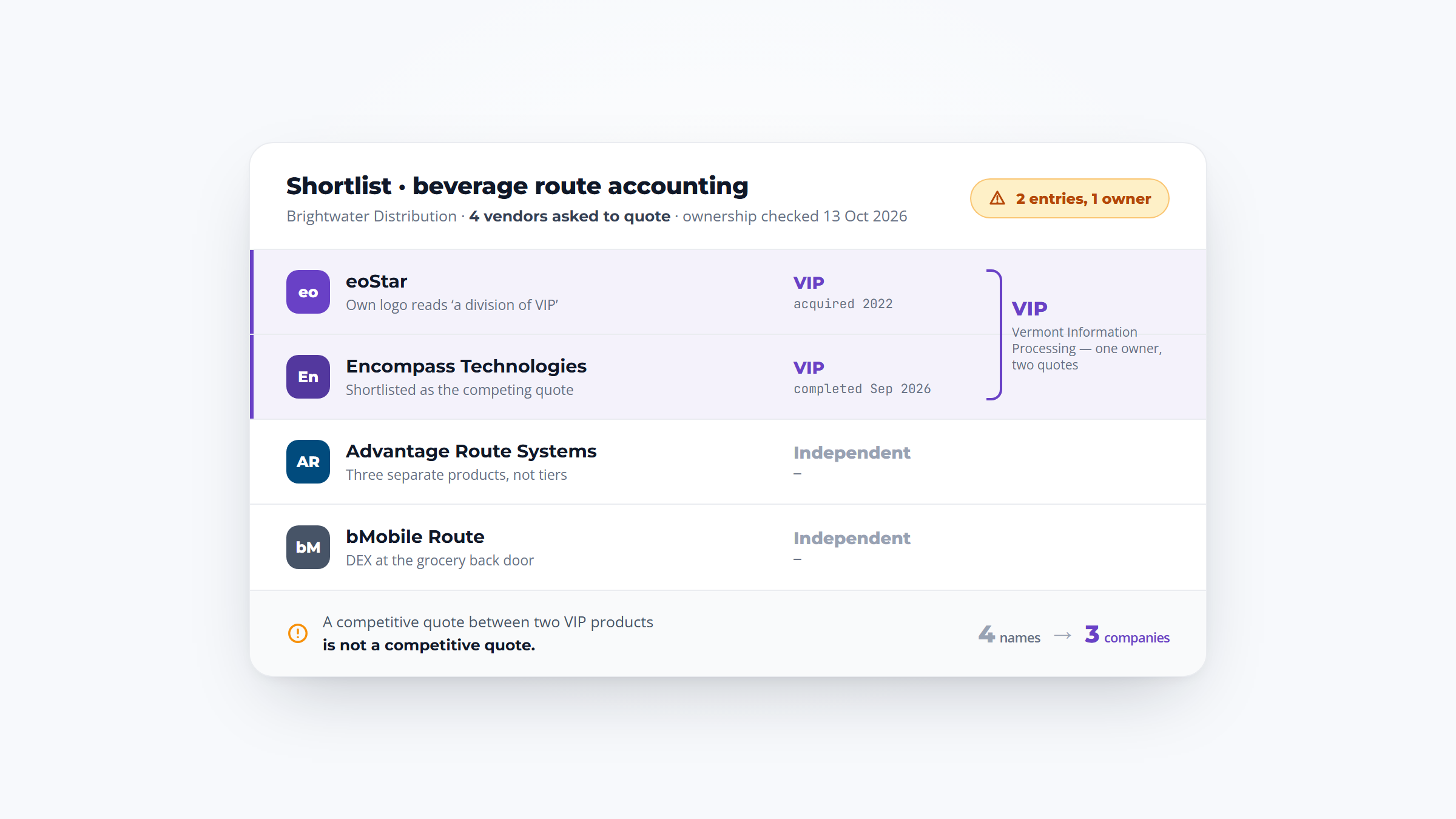
Software splits along the same seam, with order capture tools such as VoiceOrder Solutions on one side of that handoff and the systems in this list on the other.
The same gap explains why so few of these vendors publish a price. Roughly four thousand plants in the country are the real addressable market for a full bakery ERP, and at that scale every deal is scoped rather than sold off a shelf.
Bakeries running multiple sites face a second problem the production module does not touch, which is deciding how much of each SKU each location should carry, and that is closer to distribution resource planning than to baking.
The table below compares what each system is built on, how it handles allergens and labels, whether it covers wholesale ordering natively, and what it costs. The price column names the unit each vendor bills on, because four of them bill on four genuinely different units and a single "from" figure would hide that.
| System | Best for | Built on | Allergen and label control | Wholesale ordering | Price (and the unit it bills) |
|---|---|---|---|---|---|
| Cybake | Bakeries selling wholesale and retail | Proprietary, integrates Sage, QuickBooks, Xero | Dedicated food information module | Standing orders, online ordering, EDI invoicing | Not published |
| Streamline ERP | Wholesale-only bakeries | Proprietary | Recipe costing and lot tracking | Customer catalogs, online ordering, proof of delivery | From $499 setup, then 50 cents per order, $299.50 monthly minimum |
| FlexiBake | Growing food and bakery manufacturers | Proprietary | Nutritional analysis and expiry tracking | One dashboard for orders however they arrive | From $125 a month, plus per-user fees above that tier |
| Aptean Bakery ERP | Mid-sized and large bakeries | Microsoft Dynamics 365 Business Central | Allergen tracking across complex recipes | Through Business Central | Not published |
| BatchMaster ERP | Private-label and co-packing bakeries | SAP Business One | FDA Nutrition Facts labels and claim tracking | Through SAP Business One | Not published |
| Wherefour | Multi-site bakeries needing audit records | Proprietary | FDA, SQF and HACCP record-keeping | Customer self-service B2B portal | Configured per account, not tiered |
| BakeSmart | Bakeries with retail and wholesale sides | Proprietary | Production records | Wholesale portal and ecommerce | From $99 per month per location, plus $499 setup |
| Stocksmith | Small-batch producers leaving spreadsheets | Proprietary | Batch and lot traceability reports | Sales channel integrations | $41 to $291 a month on annual billing |
Five of the eight do not publish a rate card. That is the normal posture for production software sold by implementation rather than by signup, and the three that do publish are the three you can cost without booking a call. Read the entries below for what each one is actually good at.

Overview: Cybake is a bakery-specific ERP covering production, wholesale, retail and in-store bakery under one system. It is sold in the United States, Canada, the United Kingdom, Ireland, Australia and New Zealand, with a separate support line for each region.
Its wholesale module is the most developed part for a bakery selling to trade accounts, and it handles the awkward billing patterns that come with daily delivery.
Key features:
Pricing: Cybake does not publish a rate card. Note that the page at its `/pricing` address is about pricing your own products, not about what the software costs.
Pros: Genuinely bakery-native rather than adapted, strong wholesale invoicing, integrates with Sage, QuickBooks and Xero, covers retail and in-store alongside wholesale.
Cons: No published price, breadth means a longer configuration, in-store modules are wasted on a wholesale-only bakery.
Why it earns a place here: Of the eight, Cybake covers the widest span of a bakery's operation without leaving the bakery category.
Final verdict: The strongest fit for a bakery that sells both wholesale and through its own counters.

Overview: Streamline is built around the wholesale bakery workflow specifically, and Mountain Stream has been selling it since 2012. It connects customer ordering, production planning, recipe costing, inventory, lot tracking, delivery and invoicing in one pass.
Its pricing model is the most unusual in this list and the most useful to a seasonal business.
Key features:
Pricing: A one-time setup and training fee from $499 covers data migration, reports configuration and team training. After that it is 50 cents per order processed against a $299.50 monthly minimum, which is what 599 orders at 50 cents comes to. Below roughly 600 orders a month you pay that floor whatever your volume, and above it you simply pay 50 cents on every order. No contracts, and data export is always included.
Pros: Charges scale with volume rather than headcount, no lock-in, wholesale-first rather than retail-first, published pricing.
Cons: Below about 600 orders a month you pay the $299.50 floor whatever your volume, setup cost varies with data size, less suited to a retail counter.
Where it fits: A wholesale bakery whose order volume swings hard between seasons pays in proportion to what it ships.
Final verdict: The clearest pricing in the category, and the model rewards bakeries with uneven volume.
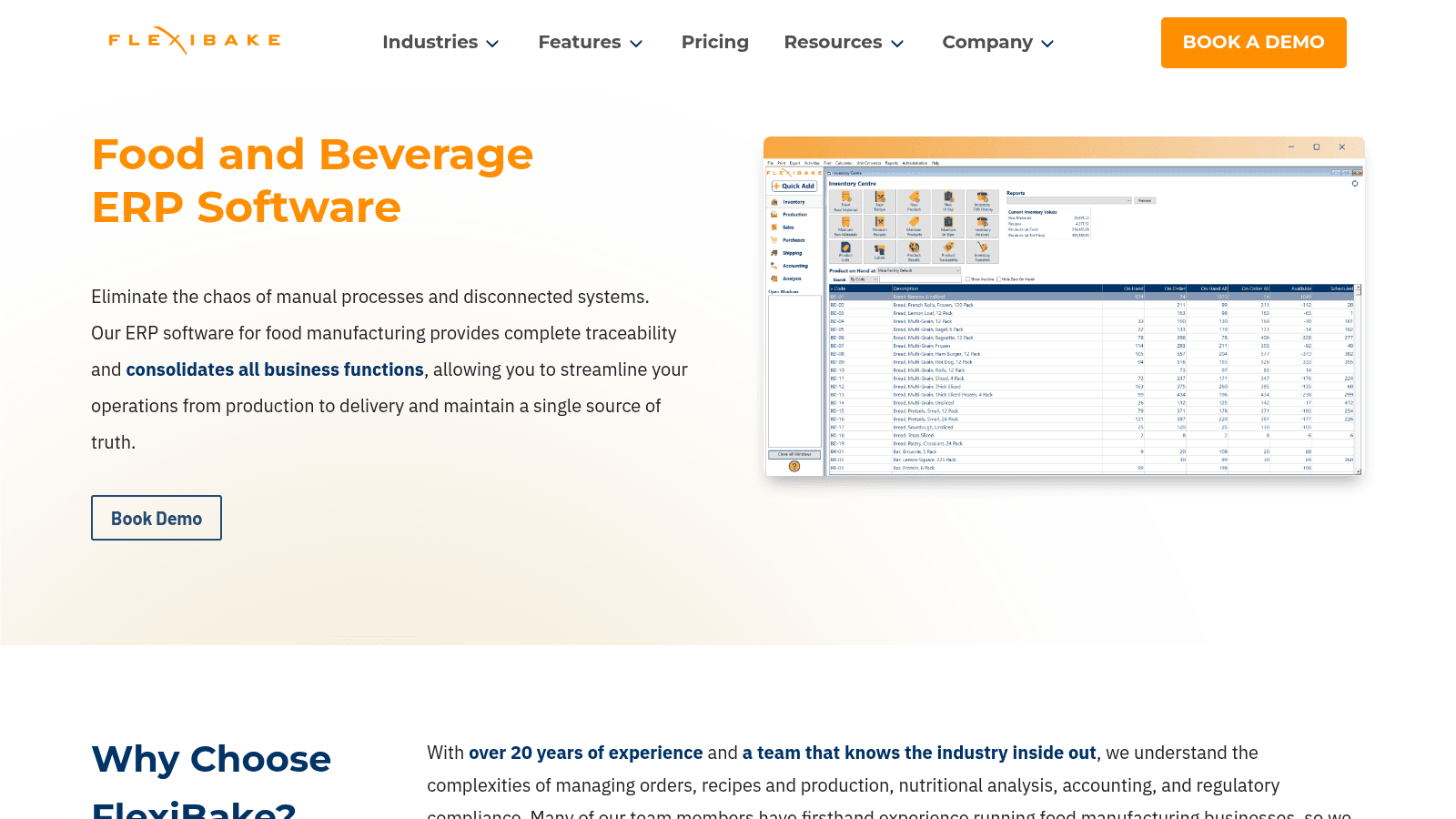
Overview: FlexiBake is a food and beverage ERP with bakery roots and more than twenty years behind it. Its own site describes helping businesses scaling from $1 million to $5 million in annual revenue up to $20 million to $30 million operations, which is a statement about customer size rather than about price.
FlexiBake is built for recipe-driven production, where the SKU count per day is the constraint.
Key features:
Pricing: Four published monthly tiers in US dollars: Nutritional at $125, Base at $295, Professional at $375 and Corporate at $495. Extra users add $145, $165 and $175 a month on the three tiers above the entry one. Enterprise is quote-only, and the online ordering portal and DSD driver app are billed separately.
Pros: Long track record in bakery specifically, published tier pricing, multi-facility inventory, organizes orders from channels bakeries actually use, nutritional analysis built in.
Cons: Extra users add $145 to $175 a month above the entry tier, the ordering portal and driver app are billed separately, and its own product screenshots show a Windows desktop application rather than a browser interface.
Why buyers shortlist it: It is one of the few systems in this list that names the revenue band it serves instead of claiming to fit everyone.
Final verdict: A solid middle option for a bakery past the spreadsheet stage and heading toward multi-site.

Overview: Aptean's bakery product is cloud-native and built on Microsoft Dynamics 365 Business Central, which means the financials, purchasing and reporting are Microsoft's and the bakery-specific functionality is Aptean's layer on top.
Aptean aims it explicitly at mid-sized and large bakeries rather than at small producers.
Key features:
Pricing: Not published. Aptean sells through a quote process, as do most Business Central vertical products.
Pros: Standard platform underneath, deep allergen handling, familiar to any team already on Microsoft, strong labeling.
Cons: No published price, Business Central licensing sits on top of the Aptean layer, oversized for a single-site bakery.
Its real strength: Pairing a bakery-specific layer with a platform Microsoft lists as in support under its Modern Lifecycle Policy, which commits to at least 12 months' notice before support ends.
Final verdict: The safe institutional choice once a bakery has more than one plant and a finance team to match.

Overview: BatchMaster sells bakery manufacturing ERP software and approaches a bakery as a process manufacturer, which suits operations that private-label, co-pack or produce their own line of bread, snacks and pastries. It runs alongside SAP Business One for the financial side.
Its formula handling goes deeper into the chemistry than anything else here.
Key features:
Pricing: Not published. BatchMaster quotes per deployment and the SAP Business One licensing is separate.
Pros: The deepest formula control in this list, electronic batch records, strong labeling, built for contract manufacturing.
Cons: No published price, a second platform to license, more manufacturing depth than a delivery-route bakery needs.
Why it made this list: A co-packer running other brands' formulas needs batch-level control that order-first systems do not attempt.
Final verdict: The right answer for private-label and contract bakeries, and overkill for anyone else.

Overview: Wherefour is a traceability-first food ERP with a dedicated bakery configuration. Its center of gravity is the audit record: what came in, what it became, where it went, and whether you can prove it quickly.
Wherefour pairs that record with a customer-facing portal, which is unusual for a system in this bracket.
Key features:
Pricing: Configured per account rather than sold in tiers. Wherefour states plainly that pricing depends on what you need rather than on a generic plan, and offers a short call to scope it.
Pros: Strongest compliance record-keeping here, customer portal included, syncs with Sage Intacct, QuickBooks, Xero and Microsoft Dynamics, multi-location inventory.
Cons: No published price, no retail-counter functionality, production planning is lighter than BatchMaster's.
Where it beats the alternatives: When the buying trigger is an audit or a customer requirement rather than a production bottleneck.
Final verdict: Choose it when traceability paperwork is the thing costing you time and accounts.

Overview: BakeSmart runs a bakery's commercial side from one platform, with separate modules for wholesale, ecommerce and custom-cake work. Its wholesale portal gives trade customers a branded place to order.
BakeSmart publishes its base price, which most full platforms in this bracket do not.
Key features:
Pricing: From $99 per month per location, with 24/7 US-based support included. Implementation starts at $499 as a one-time fee. Add-ons are priced separately, including time cards at $3 per user per month.
Pros: Published per-location pricing, strong custom-order handling, modular so you pay for what you use, US-based support included.
Cons: Lighter on manufacturing depth than the ERPs here, per-location billing adds up across sites, implementation is a separate cost.
What it is genuinely good at: Bakeries where custom and wholesale orders arrive through the same door and both need accurate quotes.
Final verdict: The better choice when the counter came first and wholesale is the newer half, where Cybake suits a production-led bakery that later added counters.

Overview: Stocksmith is inventory and manufacturing software for small-batch producers, and it is the entry point on this list rather than a full bakery ERP. The product is mid-rebrand from Craftybase, with signup now running through its Stocksmith domain.
Stocksmith is the only system here with self-serve signup, so a bakery can start the same afternoon.
Key features:
Pricing: Four tiers in its plan table, quoted here on annual billing. Studio is $41 a month, Indie $83 a month or $990 a year, Business $166 a month or $1,990 a year, and Growth $291 a month or $3,490 a year. Paying monthly costs about 20 percent more, at $49, $99, $199 and $349. Its FAQ names a fifth plan below those, Pro from $20 a month for a single sales channel, which does not appear in the plan table. Every plan includes a 14-day free trial with no card required.
Pros: Fully published pricing, no implementation fee, unlimited users from the Indie tier, genuine lot traceability at entry level.
Cons: No wholesale ordering portal, no delivery or route functionality, order-line caps bite as volume grows.
Why it belongs on a bakery list: A bakery still costing recipes in a spreadsheet gets real traceability for less than the setup fee of anything else here.
Final verdict: The right first system, and one you will outgrow deliberately rather than painfully.
Every system here was checked on the vendor's own website in October 2026, and every price above came off the vendor's own pricing page rather than a software directory. Directory listings proved unreliable on exactly this point: they carry stale tiers, superseded brand names and ranges that no longer match what the vendor publishes.
Four tests decided the list.
The first was bakery specificity. A system had to publish a bakery page describing bakery problems, not a food-manufacturing page with bakery in a list of verticals. That removed several capable general ERPs.
The second was wholesale capability, since the article is about bakeries selling to trade accounts. A system with no standing orders, no customer catalogs and no delivery handling did not qualify however good its production module was.
The third was verifiability. Where a vendor publishes a price, this article states it and names the unit. Where a vendor does not, this article says so rather than inventing a range.
The fourth was reachability. Two otherwise plausible candidates were cut here: one whose bakery page returns a not-found message inside an otherwise working site, and one that publishes no readable pricing information. A system you cannot evaluate is not a system you can buy. Bakeries comparing these against adjacent categories will find the same tests useful when assessing inventory planning software at the same time.
The feature lists across these eight systems overlap heavily. The differences that matter are narrower than the marketing suggests, and they cluster in three places.
This is the capability most likely to justify the project. Under the Food Allergen Labeling and Consumer Protection Act of 2004, eight foods were named major allergens, and the FDA notes that at the time the law passed those eight accounted for 90 percent of food allergies and serious allergic reactions in the United States. The FASTER Act, signed on April 23, 2021, added sesame as the ninth, effective January 1, 2023.
Why this lands hardest on bakeries is specific. Reporting undeclared allergens through its Reportable Food Registry between September 2009 and September 2014, the FDA named bakery products among the five food types most often involved in food allergen recalls, alongside snack foods, candy, dairy products and dressings.
A system earns its keep here by making the declaration a consequence of the formula rather than a separate document. Working through a label change tells you quickly whether a system does that:
A system that passes all five removes a whole category of recall risk. A system that passes the first three and fails the last two still leaves somebody managing it by hand, which is where mistakes live.
Bakery scheduling is constrained by time in a way most manufacturing is not. The useful test is whether the system schedules backward from the delivery window or forward from the mixer. Backward scheduling respects the proof time, the bake time, the cooling time and the cut-off, and tells you what can still be changed. Forward scheduling produces a plan and leaves staff to work out whether it is achievable.
Ask any vendor to show you a day where a large account amends its order after the cut-off, because that is the day the scheduling model shows its real shape.
Recipe costing is only useful if the ingredient prices behind it are current. The systems here differ sharply in whether purchasing feeds costing automatically, which decides whether your margin report is a measurement or an estimate. Bakeries that already run tight inventory control will recognize the gap between a theoretical cost and what the last delivery actually invoiced.
Four of the eight publish a price and four do not, and the four that publish are the ones you can price without a sales conversation. That pattern is consistent across food manufacturing software and is not evidence that the quiet vendors are expensive.
| Tier of bakery | Typical systems | What you pay for | Published price range |
|---|---|---|---|
| Small-batch producer | Stocksmith | A subscription, by order-line volume | $41 to $291 a month on annual billing, or $20 for a single sales channel |
| Single-site wholesale bakery | Streamline, BakeSmart | Setup plus usage, or per location | $99 per month per location, or 50 cents per order with a $299.50 minimum |
| Multi-site bakery | Cybake, FlexiBake, Wherefour | Published tiers at FlexiBake, a scoped implementation elsewhere | FlexiBake $125 to $495 a month; Cybake and Wherefour quote |
| Manufacturer or co-packer | Aptean, BatchMaster | Platform licensing plus the bakery layer | Not published |
Two things about this table are worth stating plainly. The first is that the units genuinely differ, so a bakery shipping 4,000 orders a month pays Streamline roughly $2,000 while a two-location bakery pays BakeSmart $198 for the platform before its separately priced wholesale module, and neither figure tells you anything about the other product's value.
The second is that implementation is a separate line almost everywhere: $499 at the published end, and a scoped number at the quoted end.
Budget for the data migration too. Recipes, customers, standing orders and price lists all have to move, and the setup fees above exist because that work is real. A bakery that has already tidied its order management records will spend less of it.
Not every bakery needs a production ERP at all, and the honest dividing line is not revenue. It is whether production decisions and order decisions are made by the same person.
In a small bakery they usually are. One person sees the order book, knows what is in the freezer and sets the bake list, and the cost of a wrong decision is an afternoon. Software that tracks recipes, costs and stock is enough, which is the bracket Stocksmith sits in and where most management tools stop.
The threshold is crossed when those decisions split across people and shifts. The person taking orders no longer knows what production can absorb, the person setting the schedule no longer sees which accounts amended at 4pm, and the gap between them starts producing shortfalls and overbakes. That is the point where the standing order needs to be a record the system holds rather than knowledge someone carries.
The second threshold is regulatory. A bakery supplying a grocery chain or an institutional account will be asked for traceability records on a timeline, and reconstructing them from paperwork does not survive contact with a real deadline.
Bakeries approaching either threshold often find that their stock control breaks first, because stock is where production and ordering actually meet.
None of the systems above solves the problem of orders that never arrive in digital form in the first place. A wholesale bakery's trade accounts still call, leave voicemails and send texts, and somebody at the bakery types those into whichever system runs the bake sheet. The ERP sees a clean order, and the work of creating that order happens upstream of it.
This is the gap VoiceOrder Solutions is built for. The product is sold to food distributors rather than to the restaurants and cafes that order from them, and a wholesale bakery running its own delivery routes sits in the same shape: a supplier with repeat accounts, a daily cut-off and an order desk absorbing calls.
Each account gets a voice ordering app built on that account's own order guide, carrying the bakery's SKUs and that customer's agreed pricing. The order then reaches the bakery's back office already structured, numbered and timestamped, instead of as a message somebody has to interpret.
VoiceOrder Solutions is not production software and does not replace anything in the table above. It holds no recipes, schedules no batches and prints no labels, and it is not the system of record for stock. What it changes is the shape of the order before the ERP ever sees it, which is also where most order errors originate. VoiceOrder Solutions is quote-based and publishes no rate card.
The best bakery manufacturing ERP software is the one that removes your worst constraint, so start there rather than with a feature list. These systems are not close substitutes.
If it is paperwork, Wherefour. If it is formulas and contract work, BatchMaster. If it is scale and a finance function, Aptean. If it is the wholesale order book, Cybake or Streamline, with Streamline ahead on price transparency and Cybake ahead on breadth. If you run a counter as well, BakeSmart. If you are still in spreadsheets, Stocksmith costs less than most implementation fees and will tell you within a quarter whether you need more.
With that settled, put the same two questions to every shortlisted vendor: show me a label change propagating through a sub-recipe, and show me an account amending an order after cut-off. Those two demonstrations separate these eight systems faster than any feature comparison, including this one, and they are also the two moments where a clean handoff into production matters most, which is the case for treating order process automation as part of the same project.
Book a VoiceOrder Solutions demo
Most wholesale bakeries run ERP for bakery work specifically, such as Cybake, FlexiBake, Streamline or Aptean, which hold recipes, production schedules, standing orders and labeling in one system. Larger manufacturers and co-packers often run BatchMaster alongside SAP Business One instead, because contract production needs batch-level control. Smaller producers typically start with inventory and recipe software like Stocksmith and move up when order volume outgrows it.
No credible bakery ERP is free. The closest thing is a trial: Stocksmith offers 14 days on any tier with no card required, which is enough to cost your recipes and see whether the batch tracking fits. Free general inventory tools exist, but they are not built for allergen declarations, shelf-life scheduling or standing orders, which are the three reasons bakeries buy this category in the first place.
Published prices in this list run from $20 a month for single-channel inventory software to $495 a month for FlexiBake's top tier, with BakeSmart at $99 per month per location and Streamline charging 50 cents per order against a $299.50 monthly minimum. The four that publish nothing quote per deployment instead. Implementation is almost always separate and starts around $499 at the transparent end.
Bakery management software handles the commercial side: orders, customers, invoices and sometimes a retail counter. Bakery ERP adds the manufacturing side, meaning formulas, batch records, production scheduling, purchasing and compliance records, and ties them to the financials. The practical test is whether the system can tell you what tomorrow's orders require you to mix tonight, and most management tools cannot.
Every manufacturing system here holds lot-level records, which is what both regimes are built on. BakeSmart is the commercial platform in this list rather than a production system, so confirm its traceability depth against your own requirement.
Allergen handling varies more than the feature lists suggest, because the question is whether a formula change updates every downstream product and label automatically. Ask for that demonstration specifically, and ask how the system treats stock already produced under the previous declaration, since that is where recalls begin.