.webp)
Key takeaways:
Food is the hardest version of this problem. Your catalog changes weekly, half your lines are priced per account, some sell by variable weight, and the order has to be in by a cut-off that differs between Tuesday and Friday deliveries.
Most B2B ecommerce software is built for a catalog that holds still and a price list everybody shares. That is why a platform can demo beautifully and still fail on a Friday order, and why the useful comparison is not which one looks best but which ones model food at all.
Twelve B2B ecommerce software platforms are compared below, split into the ones built for food and the ones built for B2B generally, with pricing exactly as each vendor publishes it.
Four requirements separate a usable platform from an attractive one. The food-native vendors treat the first two as standard while the general platforms charge for them, and almost nobody publishes the fourth.
Per-account pricing. Not tiers, not customer groups, but a negotiated price list per account. This is where the general platforms charge the most, and it is the one thing a distributor cannot operate without.
Order guides rather than catalogs. Your customer buys 40 of your 9,000 lines. Showing them the catalog is a worse experience than the phone call they are replacing.
Unit of measure that holds up. Case, split case, each, pound, and a price that is right in all of them.
Order cut-off times. Tuesday's 4pm cut-off is a different thing from Friday's, and missing it changes the delivery date rather than the shipping speed.
Of the twelve systems here, exactly one publishes an order cut-off feature: Pepperi, which goes as far as supporting different cut-off times across multiple time zones. Nobody else mentions cut-offs, catch weight, substitutions on a short ship, or credits on spoiled product anywhere in their marketing.
That gap is why distributor catalogs so often get rebuilt rather than connected, a problem we work through in catalog management.
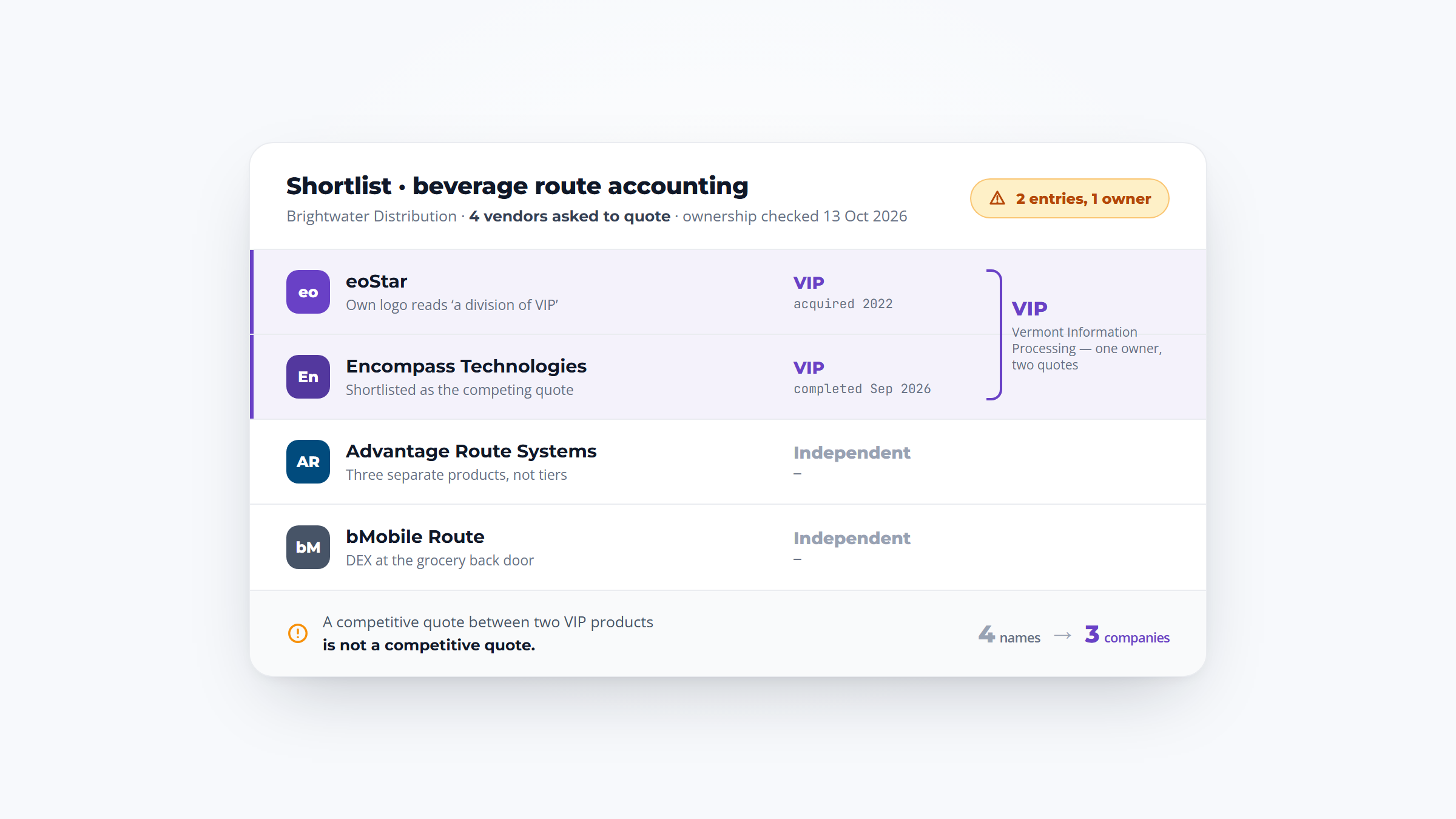
Vendors use those three words interchangeably in B2B ecommerce software marketing, and the difference between them decides who owns your customer.
The cleanest definition is a federal one. The Census Bureau's industry classification separates merchant wholesalers, who "take title to the goods that they sell," from agents and brokers who "use the Internet or other electronic means to bring together buyers and sellers" and who "do not take title to the goods being sold but rather receive a commission or fee."
So a marketplace does not own the product and earns a commission. Listing your catalog on one rents someone else's customer relationship, which can be the right trade when you want reach you do not have.
A customer portal is a login-only ordering screen for accounts you already have. Every price in it is a contract price and nothing is public, because there is no acquisition to do.
A platform does the portal job and adds merchandising, promotions, multiple storefronts and a public face. That is the B2B ecommerce solution most vendors are selling when they use the word.
One federal detail cuts across all three and explains a statistic you will see quoted carelessly. The Census Bureau counts a sale as e-commerce when the order was placed "over an Internet, mobile device, extranet, Electronic Data Interchange (EDI) network, electronic mail, or other comparable online system." An emailed order counts. So does a closed EDI feed.
That is why the headline number is misleading. On the Census Bureau's revised wholesale figures, grocery and related product merchant wholesalers took $408.4 billion of their $1,146.3 billion in 2021 sales electronically, which works out at roughly 35.6% by our own arithmetic from those two published figures.
Most of that is EDI with chain accounts. The independent restaurants are still calling, and what happens to those calls is the subject of phone ordering AI rather than of any storefront.
All twelve at a glance. The column that separates the field is customer-specific pricing, because that is the feature general platforms charge the most for and food-native ones include by default.
| Tool | Food-specific? | Customer-specific pricing | ERP integration | Mobile ordering | Starting price |
|---|---|---|---|---|---|
| VoiceOrder Solutions | Yes | Per-account order guides and pricing | Email, EDI, API, QuickBooks | iOS and Android app | Pricing on request |
| Cut+Dry | Yes, food-native | Yes, synced from your ERP | Middleware, no ERPs named | Operator ordering app | Pricing on request |
| Pepper | Yes, food-native | Yes, order guides with PAR levels | 70+ ERP systems | Operator app | Pricing on request |
| Choco | Yes, food-native | Yes | 200+ ERPs, built per ERP | Branded mobile and web storefront | Pricing on request |
| BlueCart | Yes, food-native | Yes, within its marketplace | None named | Yes | Pricing on request |
| Pepperi | General, with a real food vertical | Yes, account contracts and assortments | 60+ ERP, CRM and accounting systems | Native iOS and Android, offline, white-label | Pricing on request |
| B2B Wave | General, with food customers | Yes, 20 price lists on Pro | None named | Native rep app | $350/month (Pro) |
| Zoey | General, with a food page | Yes, segmented catalogs | NetSuite, QuickBooks Online, Salesforce | Mobile app or storefront on Starter | $600/month plus setup |
| Sana Commerce | General | Yes, customer assortments and segments | SAP and Microsoft Dynamics only | No native app | Pricing on request |
| OroCommerce | General | Yes, custom pricebooks | None prebuilt, API-first | Field sales app, works offline | Quote, based on your sales volume |
| Shopify | General | Plus only, 3 catalogs below it | None native, apps only | Responsive storefront | $39/month billed monthly, $2,300 for per-account pricing |
| Adobe Commerce | General, enterprise | Yes, customer price books | None named, API-first | Responsive only | Pricing on request |
Nine of the twelve publish no price at all, which is ordinary among wholesale ecommerce vendors and is recorded here without comment.
Best for: The accounts a storefront never converts
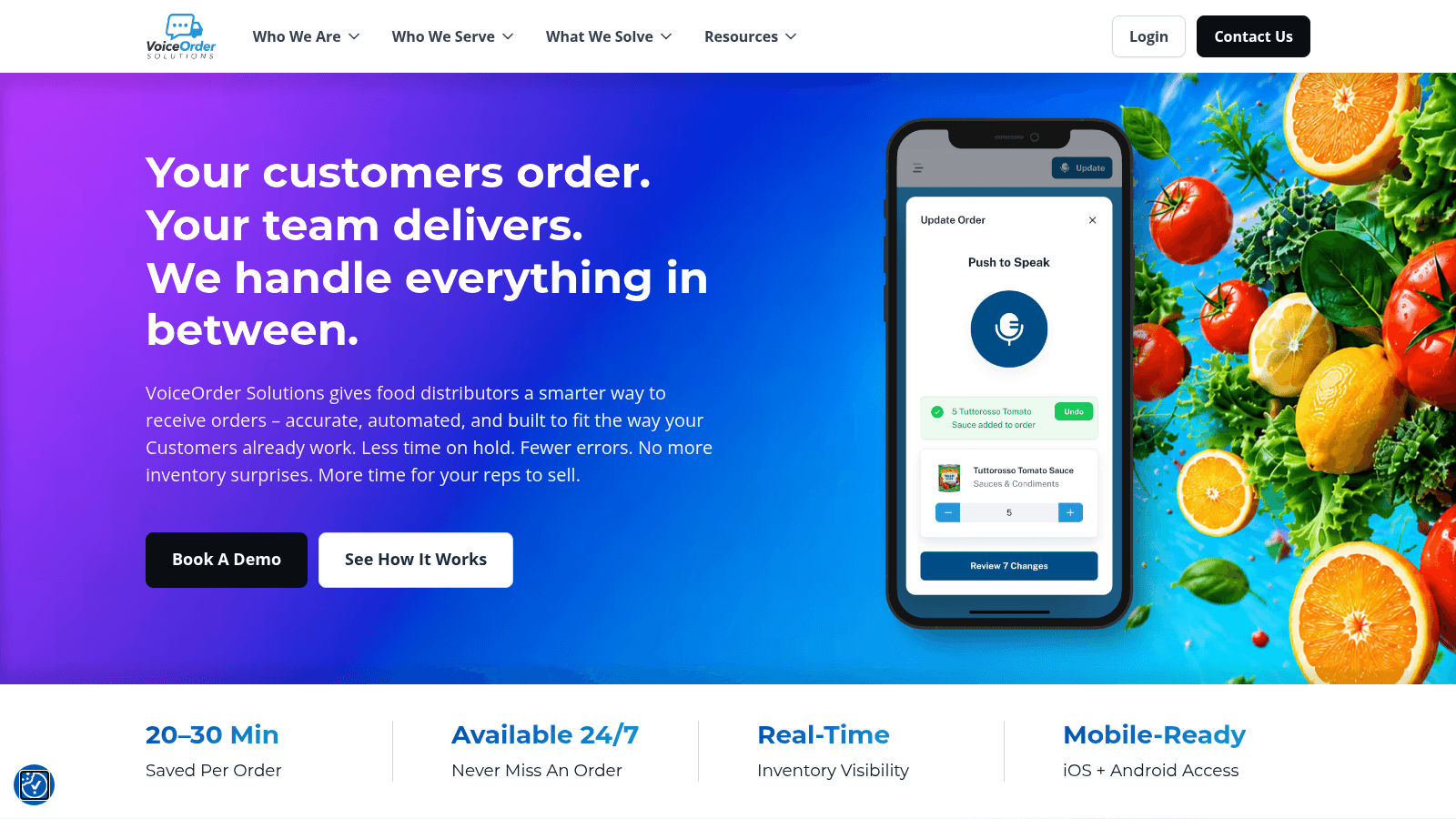
Overview: VoiceOrder Solutions is not a B2B ecommerce platform and makes no claim to be. There is no storefront, no public catalog and no checkout. It leads this list because it answers the question every platform rollout eventually runs into, which is what to do about the accounts that never log in.
Adoption is the unspoken problem with this category. Part of your account book takes to a portal immediately. The rest keep phoning and texting, and a rep keys those in by hand regardless of what you spent.
What VoiceOrder Solutions offers that tail is not a website. It is an app that already knows what the account buys and what they pay, takes the order by voice, and hands the distributor a structured record at the other end.
Key features:
Pricing: Quoted rather than published, which is the posture of eight other entries in this comparison. Rollout is the number worth noting: most distributors go live inside 24 to 48 hours, against the two weeks Choco publishes as its fastest onboarding and the 45 to 100 days Cut+Dry does.
Pros: Reaches accounts a storefront never converts, the fastest rollout in this comparison, no keying on EDI, API or QuickBooks delivery, leaves your platform choice untouched
Cons: No public rate card, and it is a channel rather than a platform, so there is no storefront, no payment processing and no merchandising
How to start using it:
Why it leads this list: Three entries here also take orders that arrive as a call or a voicemail, but they do it by parsing whatever the customer already sent. This is the one that hands the customer an app of their own, working from that account's agreed guide and prices, and it goes live in days beside whatever platform you decide to keep.
Final verdict: Not a replacement for a storefront, and the right companion to one. If this is your first and only ordering channel, buy a platform below and come back to it later.
How VoiceOrder Solutions captures orders

Overview: Cut+Dry is a foodservice-native storefront and sales platform, built around rich product data and an order desk that absorbs whatever channel a customer already uses.
Key features:
Pricing: Available on request. Its pricing page publishes no figure but does commit to a flat SaaS model with no percentage-based order fees and no per-user fees, and states that launch takes 45 to 100 days.
Pros: Genuinely food-built, no order or per-user fees, strong catalog tooling
Cons: No published price, the slowest stated launch window here, and no named ERP connectors, so integration scope emerges during the sales cycle
Where it fits: Mid-market to large foodservice and broadline distributors wanting a branded storefront rather than a marketplace listing.
Final verdict: A strong food-native platform whose commercial terms are clearer than its price.

Overview: Pepper sells an AI-first platform to independent distributors, combining a storefront with an order agent that ingests orders in whatever form they arrive.
Key features:
Pricing: Available on request. The pricing page is a demo funnel with no figures.
Pros: Order intake across every channel, mature order-guide and PAR tooling, broad module set
Cons: No published price, and the module set spans sales, marketing, finance and price management, which is a lot to roll out at once
Why buyers shortlist it: It is the most complete attempt here at being both the storefront and the catch-all for orders that arrive some other way.
Final verdict: A serious option for an independent distributor, with more product than most will adopt at once.

Overview: Choco is the best-funded of the food-native vendors here, with over $328 million raised, and the quickest platform to deploy, with a branded customer app and an order agent covering voicemail, messaging, email and photos.
Key features:
Pricing: Available on request, described on its own page only as a monthly fee based on usage. Choco publishes onboarding in as little as two weeks, with a first order possible inside two days.
Pros: Fastest platform deployment here, broadest ERP coverage, Endless Aisle expands the catalog without holding stock
Cons: Usage-based pricing plus an undisclosed implementation fee makes total cost hard to pin down, its manufacturer ad network sits inside your own ordering flow, and Endless Aisle ties catalog expansion to a single supplier
Where it beats the alternatives: On time to launch. Two weeks against Cut+Dry's 45 to 100 days is a different kind of project.
Final verdict: The quickest route to a branded ordering app, if you are comfortable with usage-based billing.

Overview: BlueCart is the clearest illustration of the distinction this article opened with, because it is a storefront and a marketplace at the same time, describing itself as the largest wholesale marketplace in food and beverage.
Key features:
Pricing: Available on request. Its pricing URL redirects to a demo booking form, so there is not even a tier structure published.
Pros: Genuine buyer network alongside the software, useful competitive pricing data, food-specific throughout
Cons: No published pricing of any kind, and the marketplace model means sharing a buyer network rather than owning the relationship outright
Why it made this list: It is the one entry where reach is the product, which is a real option for a distributor trying to open a new metro.
Final verdict: Worth a conversation if you want customers you do not have, and the wrong shape if you only want to serve the ones you do.

Overview: Pepperi is a general B2B commerce and field-sales suite with the most substantive food and beverage product page of any general platform here. It has been part of Advantive since July 2024.
Key features:
Pricing: Available on request. Pepperi runs no pricing page, so no tier structure is published.
Pros: The only platform here whose own pages model order cut-offs, integration plugins across more than 60 systems, native offline app available white-labeled
Cons: No pricing page at all, the breadth is its own cost since it bundles commerce, field sales, retail execution and DSD, and it now sits inside a software group rather than operating independently
Its real strength: It is the only general platform whose food page reads as though someone asked a distributor what breaks.
Final verdict: The strongest general-purpose option for food, and priced entirely by conversation.

Overview: B2B Wave is a straightforward wholesale storefront with published pricing, aimed at smaller distributors who want a branded ordering site without a project.
Key features:
Pricing: Pro is $350 a month for US customers, currently $175 for the first three months, with Scale at $612 and Enterprise quoted. There is a 14-day trial and no platform transaction fees. Prices shown follow the visitor's country, so a figure in another currency is a localization rather than a different plan.
Pros: Real published pricing, no transaction fees, genuinely quick to stand up
Cons: The Pro plan caps you at 20,000 products and 10 users, which a broadline distributor will exceed, and it names no ERP integrations at all
Where it fits: Smaller distributors and specialty suppliers with a few thousand lines and a manageable account book.
Final verdict: Good value and clearly priced, with a product ceiling you should check against your catalog first.

Overview: Zoey is a general B2B platform with a real food and beverage practice, covering breweries, caterers, bakeries and wholesale deli distributors, and it publishes both subscription and implementation costs.
Key features:
Pricing: Starter is $600 a month, Plus $1,400 and Pro $2,200, with Enterprise quoted and 6% off for annual prepayment. Implementation is published separately, from $2,500 for guided setup and $4,000 for full service. It states plainly that there are no revenue-based fees.
Pros: One of very few here publishing implementation cost, genuine packaging-unit handling, no percentage of revenue taken
Cons: Starter includes only 50 B2B accounts and caps at 100, so a distributor with a normal account book starts at $1,400, and seats are capped at three on Starter and ten on Plus
Why it earns a place here: Publishing the implementation fee alongside the subscription is rare enough to be worth rewarding, and the packaging-unit support is real.
Final verdict: Honest pricing and a sensible product, with an account ceiling that moves most distributors up a tier immediately.

Overview: Sana Commerce builds its entire proposition on native ERP integration, which makes it excellent or irrelevant depending on one answer: which ERP you run.
Key features:
Pricing: Available on request. All three tiers show a request-pricing button and no figures.
Pros: The deepest ERP integration of any general platform here, live stock at checkout, mature B2B account structures
Cons: It runs only on SAP Business One, SAP ECC, SAP Cloud ERP and Microsoft Dynamics 365 Business Central, NAV, AX and F&SCM, so a distributor on entrée, Prophet 21 or Blue Link cannot buy it, and there is no native mobile app
Where it fits: Mid-market and enterprise distributors already committed to SAP or Microsoft.
Final verdict: Check the ERP list before anything else. If yours is on it, this is a serious contender; if not, the conversation ends there.

Overview: OroCommerce was built by the original Magento team as a B2B-first platform, and its pricing engine is the most capable in this comparison.
Key features:
Pricing: Quote-based, and the vendor states what drives it: deployment type, your gross merchandise value, and admin users beyond the first 25. There is also a free open-source Community edition.
Pros: The strongest order-minimum and pricing logic here, open-source option, no charge for API calls or transactions
Cons: The quote scales with your sales volume, there are no prebuilt ERP connectors so integration is a build, and a real implementation partner is effectively required
Why it is in this comparison: Its pricing engine handles the awkward B2B cases that make distributors give up on general platforms.
Final verdict: Powerful and genuinely B2B-native, and the heaviest lift of the mid-market options.

Overview: Shopify is the most familiar name here and the one most often described incorrectly. B2B is no longer restricted to Plus, but the feature a distributor needs still is.
Key features:
Pricing: Basic is $39 a month, Grow $105, Advanced $399 and Plus starts at $2,300. B2B runs on all four, but direct company catalogs, meaning a price list assigned to a specific account, are Plus only. Below Plus you get three B2B catalogs for your entire account book.
Pros: Enormous app ecosystem, excellent checkout, genuine B2B features at the entry price
Cons: Per-account pricing costs $2,300 a month, there is no native ERP connector, and nothing in it understands catch weight, lot codes or delivery-day calendars
Where it fits: A food brand selling wholesale alongside direct-to-consumer, far more than a broadline distributor.
Final verdict: Three catalogs will not cover a distributor's account book, so price this at the Plus tier or not at all.

Overview: Adobe Commerce, still widely called Magento, is the enterprise end of this list. Its B2B functionality is included rather than sold as an add-on, and its implementation is the heaviest here.
Key features:
Pricing: Available on request. Its pricing page carries no dollar figure anywhere and reads as a tier and feature matrix, with Magento Open Source remaining free and self-hosted.
Pros: Handles millions of SKUs, the most sophisticated account hierarchy and approval workflows here, B2B included in the tiers
Cons: No published price and a systems integrator is effectively mandatory, several things a distributor needs including order management and payments are separately priced add-ons, and nothing in it is food-shaped
Where it fits: Large distributors with an IT function and a multi-year platform budget.
Final verdict: Capable of anything and realistically out of reach for most of the companies reading this.
Each figure in the table came from the vendor itself, checked on October 5, 2026. Directories and competitor comparisons were deliberately ignored, because both are badly out of date on B2B ecommerce software pricing.
Three checks shaped the list:
That last check mattered. BigCommerce has renamed every plan and now gates per-SKU price lists behind a Performance tier starting at $1,499 a month billed annually, while charging its self-serve plans 0.6% to 2.0% of order value on orders not run through an embedded payment provider.
Two candidates were checked and dropped. SparkLayer has the best named food customer list of anything considered, and its published plans cap B2B orders at 150 a month on its highest standard tier, which a working distributor clears in days. Unilog and Spryker have no food vertical at all.
The money question in this category is not the subscription. It is what you pay to give each customer their own prices, and keeping that catalog management accurate afterward is its own running cost.
| Platform | Entry price | Price for per-account pricing |
|---|---|---|
| Shopify | $39/month | $2,300/month (Plus) |
| BigCommerce | $39/month | From $1,499/month (Performance) |
| B2B Wave | $350/month | Included, 20 price lists on Pro |
| Zoey | $600/month | Included, plus setup from $2,500 |
| Cut+Dry, Pepper, Choco, Pepperi, BlueCart | Quoted | Included by default |
A distributor needing a negotiated price list per account is looking at $2,300 a month on Shopify, or an unquoted figure from a food-native vendor that treats it as table stakes. That is the clearest argument for buying inside the vertical.
Watch the billing model too. BigCommerce takes a percentage of order value in some configurations and OroCommerce quotes against your sales volume, while Cut+Dry advertises no order fees and Zoey states outright that it charges no revenue-based fees. On a wholesale business running thin margins, a percentage of gross is a very different commitment from a subscription.
The useful question is not which platform is best but which of your orders you are trying to move.
If your volume is concentrated in chain accounts, most of it is probably already arriving by EDI, and a storefront changes little. If it is spread across hundreds of independents, a storefront helps the half who will adopt it and does nothing for the half who will not.
Buying decisions also rarely sit with one person. Forrester's research on business buying found an average of 13 people inside the buying organization involved in the decision, with 89% of purchases involving two or more departments, so the ordering surface has to work for a buyer, a chef and a controller at once.
| Your account book | What to buy | Why |
|---|---|---|
| Mostly chains, EDI-heavy | Sana Commerce or Adobe Commerce | Integration depth matters more than acquisition |
| Hundreds of independents | Cut+Dry, Pepper or Choco | Order guides and multi-channel intake are standard |
| A few hundred accounts, simple catalog | B2B Wave or Zoey | Published pricing, fast to launch |
| Looking for new customers | BlueCart | Reach is the product |
| A long tail that still phones | A platform plus a voice channel | A storefront alone will not convert them |
Most distributors land in the last row whether they planned to or not, and the response is usually to keep a rep on the phone, which is where automated order processing starts earning its keep.
Start with per-account pricing, because it eliminates half of these wholesale ecommerce options on price alone. Then check the ERP question, which eliminates another chunk: Sana runs on SAP and Dynamics only, Oro has no prebuilt connectors, and Shopify and Adobe name none.
What is left is a choice between a food-native vendor who will not publish a price and a general platform that will, and the honest answer is that the food-native ones are built for the business you actually run. The order guide, the units, the cut-offs and the substitutions are the whole job, not a configuration exercise.
Plan for the accounts that will not adopt whatever you pick. Every distributor who has rolled out a portal has the same long tail still calling, and the options there are a rep on the phone or a channel that structures the order without asking the customer to learn a website. Running both at once is what omnichannel order management means in practice, and no B2B ecommerce software does it alone.
Book a VoiceOrder Solutions demo
It depends on your account book rather than your size. For hundreds of independent restaurant accounts, the food-native platforms, Cut+Dry, Pepper and Choco, include order guides and per-account pricing as standard, where a general platform charges four figures a month for the same thing.
For a distributor already on SAP or Microsoft Dynamics, Sana Commerce integrates more deeply than anything else here. The wider category of wholesale food distribution software covers the back office these platforms sit in front of.
B2B ecommerce is selling to other businesses through an online channel rather than to consumers, and a B2B ecommerce system is the software behind it. That channel can be a web storefront, a login-only portal or a B2B ecommerce app on the buyer's phone.
The federal definition is broader than most people assume: the Census Bureau counts an order as e-commerce if it was placed over the internet, a mobile device, an extranet, an EDI network or by email. A closed EDI feed to a chain account counts in the statistics, which is why reported adoption looks higher than what distributors see on their own storefronts.
Partly. B2B on Shopify runs from the $39 Basic plan and includes company accounts, quantity rules and net terms, which covers more than most roundups claim. The catch is that assigning a catalog directly to one company is a Plus feature, and the cheaper plans share three catalogs across your whole account book. A distributor pricing per account therefore needs Plus at $2,300 a month, and still gets no catch weight or delivery-day logic.
Published B2B ecommerce software prices here run from $39 a month on Shopify to $2,200 on Zoey's Pro plan, and nine of the twelve publish nothing. The figure that matters more is what per-account pricing adds: nothing at all on the food-native vendors, $1,499 a month on BigCommerce and $2,300 on Shopify. Check the billing model too, since some vendors take a percentage of order value.
They answer different questions. A marketplace brings buyers you do not have, and the Census classification is a useful way to think about it: the operator of a marketplace does not take title to the goods and earns a commission for introducing buyer and seller. Your own storefront or portal keeps the relationship entirely yours but reaches only the accounts you already serve. Distributors opening a new metro often run both.