.webp)
Key takeaways:
Two people can run the same product with the same demand and the same supplier, and one of them will be short every third week while the other never is. Usually neither of them is calculating anything differently. The difference is that one has an honest lead time in the system and the other has the number someone typed in when the item was created.
Inventory replenishment is the set of decisions that turn a stock position into a purchase order: when to trigger, how much to bring in, from where, and what to do when the answer the system produces is obviously wrong.
That work sits between forecasting, which predicts what you will sell, and ordering, which transmits the request. Those two neighbors get most of the attention, and the middle step is where the money leaks.
This guide is about that middle step, for food businesses where lead times are short, shelf life is finite, and a stockout takes an item off a menu rather than delaying a shipment. Everything here assumes inventory replenishment is a decision somebody owns, not an output somebody accepts.
Three activities get bundled together and they answer different questions. Forecasting asks what demand will be. Replenishment asks what to do about it. Ordering asks how the request reaches the supplier, which is the narrow step products like VoiceOrder Solutions are built for and the one this guide is not about.
Confusing forecasting with inventory replenishment is the common error, and it produces a specific symptom: a business that invests in better forecasting and sees no improvement in availability, because the forecast was never the binding constraint. If your lead times are wrong or your supplier ships on fixed days regardless of what you ask for, a more accurate demand curve changes nothing about when you run out.
The replenishment process itself is short. Something observes the stock position, compares it against a threshold or a target, proposes a quantity, a human accepts or amends it, and the order goes out. Every replenishment model in use is a variation on which of those five steps is automated and how often the observation happens.
Where the demand signal itself is the weak link, that belongs to inventory forecasting rather than here.
Before any method, inventory replenishment needs one structural choice: are you watching the stock position all the time, or looking at it on a schedule?
| Continuous review | Periodic review | |
|---|---|---|
| When it triggers | The moment stock crosses a threshold | At a fixed interval, whatever the position |
| What it needs | A live stock position you trust | A reliable calendar and a target level |
| Order timing | Irregular | Predictable |
| Order quantity | Usually fixed | Variable, up to the target |
| Suits | High-value, fast-moving, or costly to stock out | Suppliers with fixed delivery days, or many items ordered together |
Food distribution pushes most inventory replenishment toward periodic review whether anyone chose it or not, because suppliers deliver on set days. If produce arrives Tuesday and Friday, a continuous trigger firing on Wednesday afternoon has nowhere useful to go, and the effective review cycle is the delivery schedule regardless of what the system is configured to do.
That is worth checking explicitly, because a mismatch here makes every downstream setting misleading. A system configured for continuous review against a supplier who ships twice a week is producing suggestions on days when no order can be placed, and the buyer learns to ignore it.
Vendors name inventory replenishment methods differently, and four patterns cover almost everything in use.
| Method | How it decides | Best fit |
|---|---|---|
| Reorder point | Order a fixed quantity when stock falls to a set level | Stable demand, reliable lead time, continuous visibility |
| Min/max | Order up to the max when stock hits the min | Items where order size should flex with how far below you have fallen |
| Top-off to par | Order back up to a set level on fixed days | Kitchens and sites with scheduled deliveries |
| Demand-driven | Order against actual consumption or a short-horizon signal | High-turn perishables, promotional volume, anything seasonal |
Min/max and reorder point are frequently described as the same thing and are not. A reorder point triggers a standing order quantity; min/max triggers an order sized to reach the maximum, which means the quantity varies with how far the position has dropped. That distinction matters when consumption is lumpy, because a fixed quantity leaves you short after an unusually heavy week.
Top-off to par is the dominant pattern in food service because it fits how kitchens work: order days are fixed, so the useful question is not when but how much to bring back to standard. The arithmetic behind reorder points, par levels and order quantities is a separate topic in its own right, and it is covered under inventory control rather than repeated here.
Choose per item class rather than per business. Nothing prevents running par levels on produce, min/max on dry goods and demand-driven ordering on promotional lines in the same operation, and most well-run operations do exactly that.
Every inventory replenishment method above contains a lead time assumption, and it is almost always stale. The item was created, somebody typed three days, the supplier's performance changed, and nobody went back.
Picture a team that inherits an inventory system after its specialists leave and asks whether running both min/max and safety stock is redundant. The formula detail matters less than one precondition: neither setting means anything if the system does not hold correct and current lead times.
The two settings also overlap. A min is normally set to cover demand over the lead time plus a buffer, so in most configurations it already contains the safety stock, and adding a separate safety stock on top without checking produces a buffer on top of a buffer.
The lead-time precondition is testable in your own data this week. Pull the last twenty receipts for a supplier, compare the actual gap between order and delivery against the lead time in your system, and look at the spread as well as the average.
Variability matters more than the mean. A supplier averaging three days with a range of two to nine needs a different buffer from one that delivers on day three every time.
Set a review cadence and put it on someone's calendar. Quarterly is enough for most food categories, monthly for anything where the supply market is moving.
Safety stock gets described as a buffer, which makes it sound like a quantity somebody estimates. It is better understood as the price of a service-level promise: how often are you willing to be short, and what will you hold to make that true?
The academic literature on this is deeper than the practitioner conversation suggests. A systematic review by Gonçalves, Sameiro Carvalho and Cortez, published in Operations Research Perspectives in 2020, screened 813 papers and analyzed 95 published between 1977 and 2019 on operations research approaches to determining safety stock.
Their summary of what drives the answer is the useful part for a practitioner: safety stocks are affected by six factors, being service level, lead time, demand volatility, order policy, component commonality and holding costs.
Notice how many of those six are decisions rather than observations. Service level, order policy, component commonality and, through where you store things, holding cost are all choices your business makes. Only two, demand volatility and lead time, are handed to you, and even lead time is partly negotiable with the supplier.
Sorted that way, the six split four to two.

Treating safety stock as a number calculated once, rather than as the output of four choices and two measurements, is why it so often ends up as a round figure nobody can defend.
For perishables the calculation carries an extra constraint the general literature does not: a buffer you cannot sell before its date is not protection, it is waste with a different name. Set safety stock in days of supply rather than units on anything short-dated, and cap it below the remaining shelf life on receipt. Restaurant-side handling of this sits in restaurant inventory management.
An inventory replenishment system proposes 140 cases. The supplier ships in pallets of 48 and will not split. The answer is 144 or 96, and the model had no opinion about which.
To scale, the two available answers sit either side of a quantity nobody can ship.
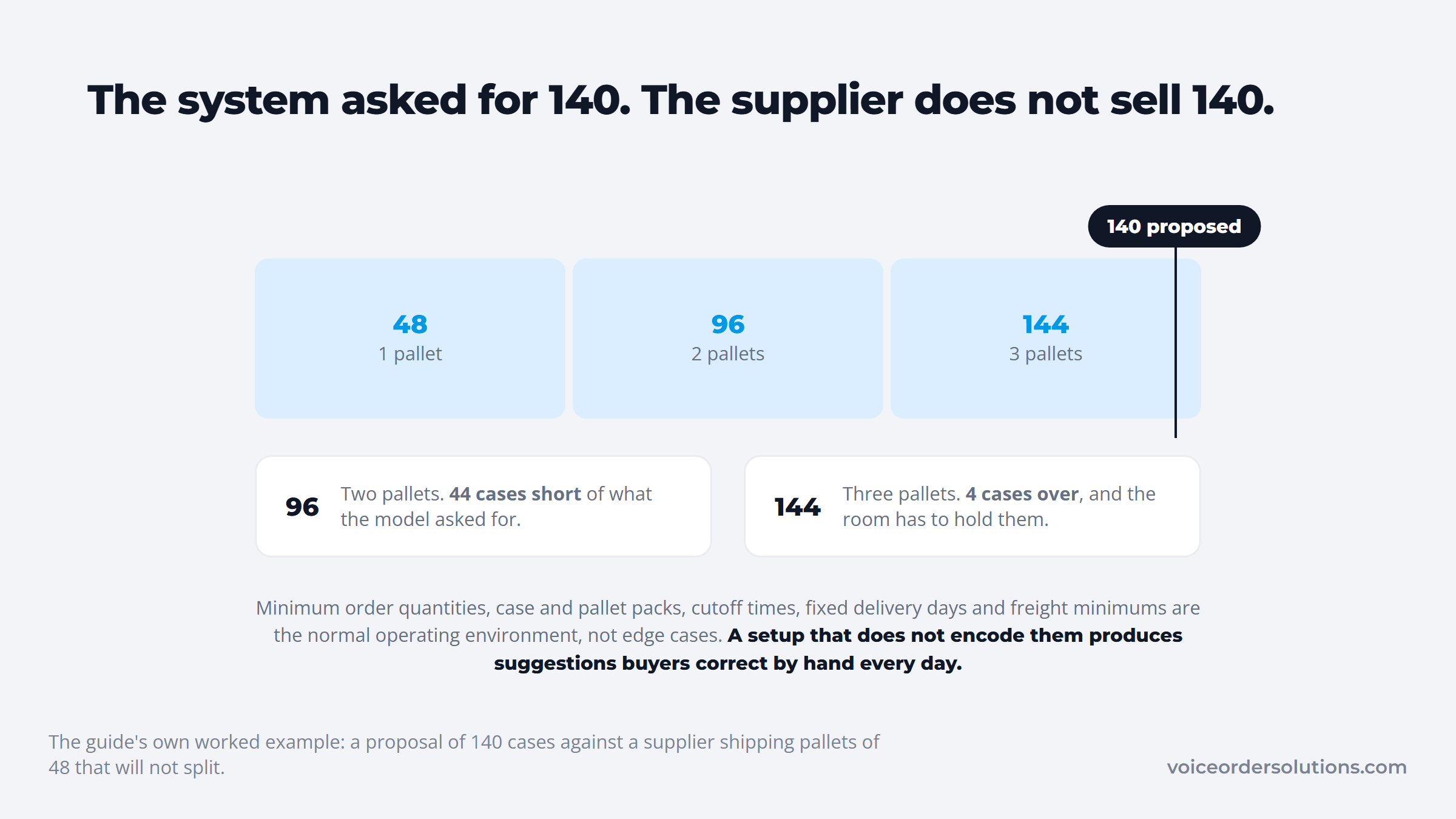
Constraints like these are not edge cases, they are the normal operating environment, and a replenishment setup that does not encode them produces suggestions buyers correct by hand every day.
Minimum order quantities set a floor below which ordering is not worth doing, and case and pallet packs quantize everything above it. Order cutoff times mean an order placed at 4:10 p.m. ships two days later, not one, and fixed delivery days limit when stock can arrive at all. Freight minimums make a small order disproportionately expensive, which is why buyers consolidate across items and why single-item optimization misleads.
Encode what you can and document the rest. The test is whether a new buyer, given the system's suggestion, would place the same order an experienced one would. Where the answer is no, the difference between those two orders is knowledge sitting in somebody's head, and it will leave with them.
Vendor-managed arrangements move this problem to the supplier, who takes on both the visibility and the decision. That is a genuine option for stable, high-volume categories, with its own trade-offs covered in vendor managed inventory.
Automatic inventory replenishment means the system proposes or places orders without a human initiating each one. It works well for a large middle band of items and badly at both ends, which is the part vendors underplay.
Automation handles stable, predictable, well-parameterized items better than a person will, because it never forgets and never gets busy. It fails on new items with no history, on items whose demand pattern just changed, on anything affected by a promotion the system does not know about, and on any item whose supplier constraints were never encoded.
The failure mode that causes real damage is quieter than a wrong order. Picture an item that has been silently over-ordering for months because its lead time is wrong, sitting inside a suggestion list a buyer approves in bulk every morning. Nothing alerts, because nothing failed.
Even with good sales data, reordering often stays an educated guess. Automation applied to that situation does not remove the guess, it stops anyone examining it.
Three controls make automation safe. Cap the value any single suggestion can reach before it needs approval, and review the parameter set on a schedule rather than only when something goes wrong.
The third is the exception rate. If buyers are amending more than a small share of suggestions, the parameters are wrong and the automation is generating work rather than removing it, a symptom that shows up first in the site-level counting routines behind stock management.
With one warehouse, inventory replenishment has one question. With a depot serving branches or a distributor serving customers, it has two: what the network needs, and who decides. Working out what the network needs is the job of distribution resource planning software, and its plan is only as current as the orders it has been given.
The structural choice is push against pull. In a push model the central site allocates stock outward on its own judgment, so downstream inventory is an extension of central operations. In a pull model the downstream sites order what they want, which makes them customers with their own demand signal.
That distinction has a concrete consequence for one common planning question: should a central warehouse's reorder point include the stock sitting in the stores it supplies?
The answer depends on the model. If the distribution center is pushing, downstream inventory is a function of its own operations and should be counted; if the stores are pulling, they should be treated as customers and their stock excluded. Getting this backwards produces a central site that is either chronically over-stocked or chronically surprised.
The same network answers the question two different ways depending on which model is running.
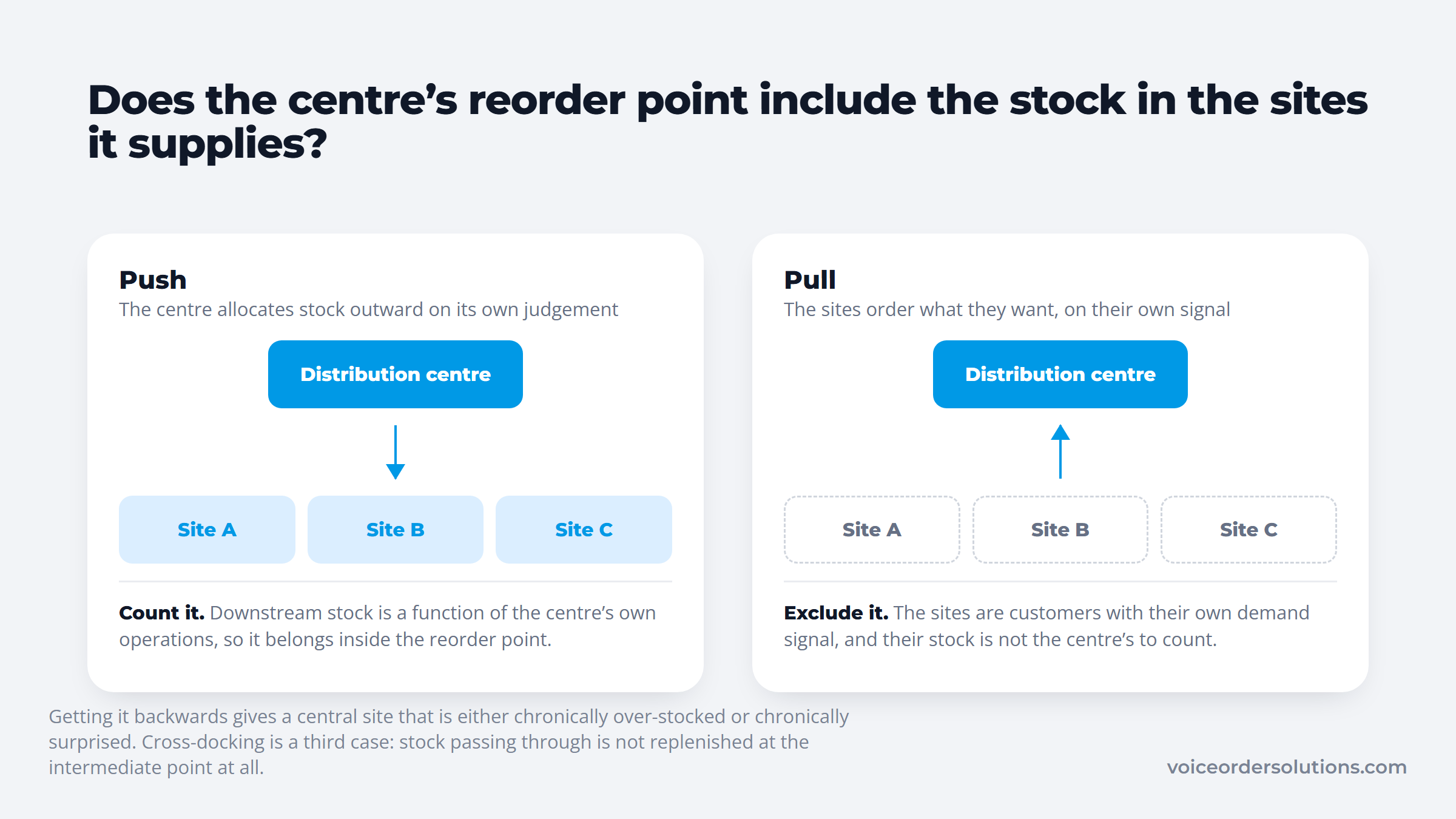
Cross-docking changes it again, since stock passing through is not really being replenished at the intermediate point at all. Whichever model you run, write it down, because the reorder logic and the reporting both depend on the answer.
Inventory replenishment decisions do not stay local. Each layer's ordering pattern becomes the next layer's demand signal, and the distortion compounds.
The classic account of this remains the clearest. Writing in MIT Sloan Management Review, Lee, Padmanabhan and Whang described logistics executives at Procter and Gamble examining order patterns for Pampers: retail sales fluctuated modestly, distributor orders varied more, and P&G's own orders to suppliers such as 3M varied more still, even though babies consume diapers at a steady rate.
Hewlett-Packard found the same shape in printers, where reseller orders swung more than reseller sales and the printer division's orders to its integrated circuit division swung more again. P&G named it the bullwhip effect.
Stacked up, each layer is the one below it with the swings made larger.
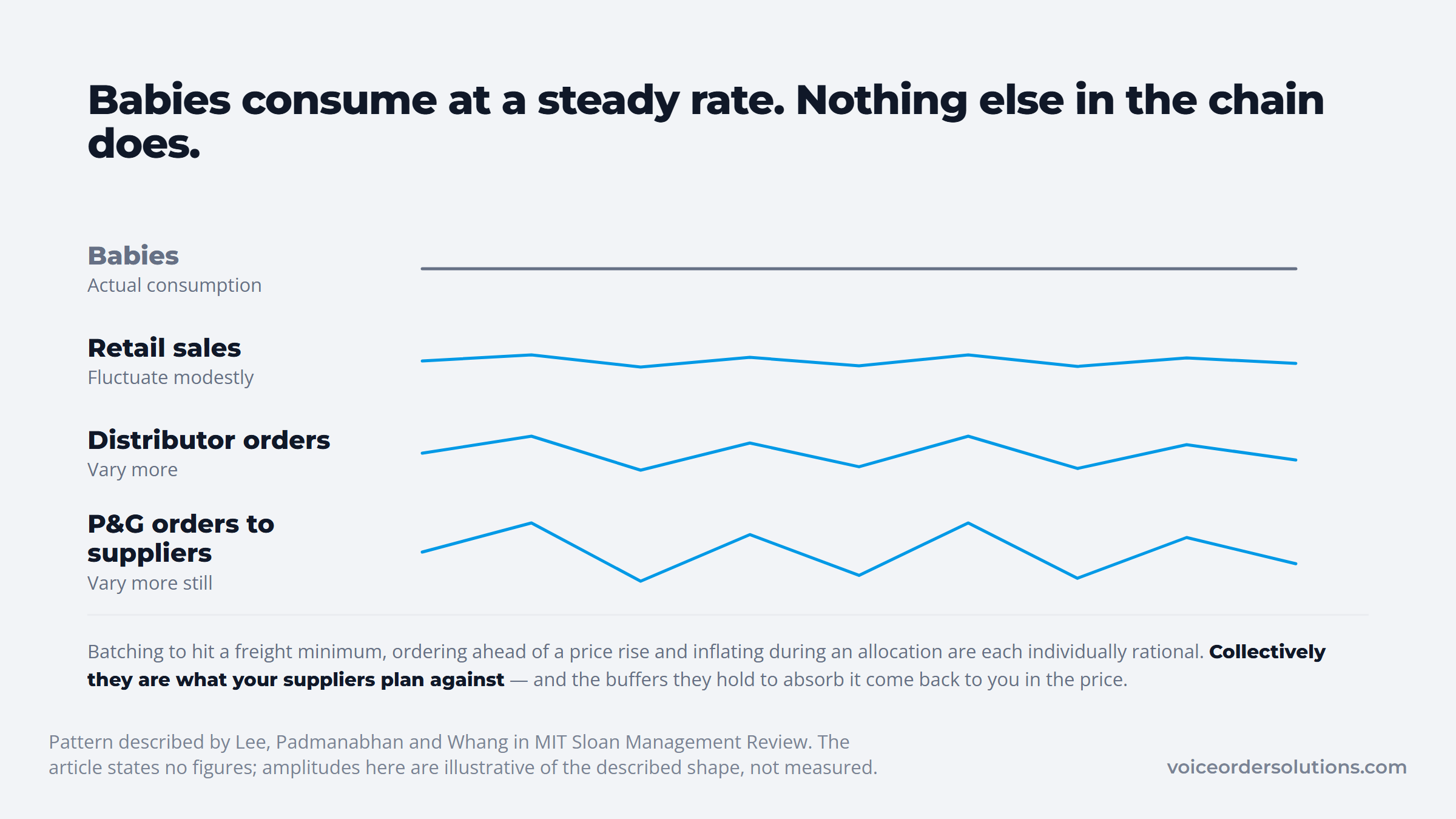
The practical lesson for a distributor is about your own contribution to it. Batching orders to hit a freight minimum, ordering ahead of an expected price rise, and inflating orders during an allocation all make your demand signal less like your actual consumption. Each is individually rational and collectively expensive, because your suppliers plan against the distorted signal and hold buffers to absorb it, which you pay for in price.
Sharing genuine consumption data upstream is the standard mitigation, and it is easier to talk about than to do. The smaller and more achievable version is to stop amplifying: order to a rhythm rather than in reaction, and tell suppliers when a spike is a promotion rather than letting them infer a trend. Smaller operations working through the same problem will find the ground-level version in small business inventory management.
Inventory replenishment planning fails as a project and works as a habit. The sequence below is what a functioning weekly inventory replenishment routine looks like, and it takes less time than the firefighting it replaces.
Five checks, in this order, because each one narrows what the next has to look at.
Once a quarter, step back from the items and look at the parameters. Which items are still on the method they were assigned when the system went live, and does that method still fit their demand pattern? Which lead times have not been touched since the item was created? Which supplier constraints have changed?
This is also the point to review the item classification itself, because items migrate. A line that was a slow mover last year may now justify continuous review, and a former fast mover may be quietly generating waste. Tools that support this parameter work are compared under inventory planning software.
Once inventory replenishment is automated, the job changes shape. Nobody is deciding hundreds of orders any more; somebody is deciding the twenty the system could not resolve, and that queue is where the value now sits.
A healthy queue is short and varied. An unhealthy one is long and repetitive, with the same items appearing week after week, which means the exception is not an exception at all but a parameter that has never been corrected. The fastest diagnostic available is to sort the queue by how often each item has appeared in it over the last quarter and look at the top ten.
Give the queue an owner and a target size. Without both, it grows until buyers start clearing it by approving everything, which converts an exception process into a rubber stamp and removes the only remaining control over the automation.
Forecast-driven versions of this work, where the queue is fed by a demand model rather than a threshold, are compared in restaurant forecasting software.
Every decision above ends in the same physical act: somebody transmits a request to a supplier. That step is treated as trivial in most replenishment writing and it is where a surprising share of the errors enter, because the transmission is frequently a phone call, a voicemail or a text message that a human then retypes. On the distributor's end, that retyping also decides how early inventory replenishment software can show which items are running low.
VoiceOrder Solutions works on that transmission step, from the supplier side of the relationship. The software is bought by food distributors, which set up each restaurant or store account with its own product list at its own negotiated rates.
For the distributor, the change shows up at the order desk. Accounts order by voice in the app instead of calling or leaving a voicemail, so a customer service rep receives a structured record, numbered and time-stamped, rather than a message to rekey. Orders that come in after hours wait in the queue for the morning, and an order a customer started and set aside resumes from where it stopped.
The limits matter here more than in most contexts, because the vocabulary overlaps. VoiceOrder Solutions does not calculate a reorder point, does not hold par levels, does not propose a quantity, does not forecast demand and does not decide anything about replenishment.
What it carries is an order a person has already decided to place. The planning belongs to the systems above, and the buying side of that relationship is described under food service operators.
Take the ten items that went short most often last quarter and check three things about how each is replenished: what the system holds as the lead time, what the last twenty receipts actually took, and which of the four methods that item is running on.
You will usually find one of two patterns. Either the lead time is optimistic and everything downstream inherits the error, or the method does not fit the item, most often a fixed reorder quantity on something with lumpy consumption. Both are settings changes rather than projects, and both can be corrected in an afternoon.
If the shortfall traces instead to the order itself, to items rekeyed wrongly or orders that never reached the supplier, that is a transmission problem. Distributors whose inbound orders still arrive by voicemail can ask VoiceOrder Solutions for a walkthrough against a real order guide, and pricing is provided on request rather than published.
It is the middle link between predicting demand and sending a supplier a request: deciding the trigger, the quantity, the source, and what to do when the system's suggestion is obviously wrong. Businesses that treat it as a forecasting problem tend to buy better demand prediction and see no change in availability, because the binding constraint was a stale lead time or a fixed delivery day.
Four cover almost everything in use: reorder point, which triggers a fixed quantity at a set level; min/max, which orders up to a maximum when stock hits a minimum; top-off to par, which restores a standard level on fixed days; and demand-driven replenishment, which orders against actual consumption. Most operations should run different methods for different item classes rather than standardizing on one.
For stable, well-parameterized items with reliable lead times, yes, since software is not distracted at month end. It performs badly on new lines with no history, on anything whose demand pattern has just shifted, and on items whose pack sizes, cutoffs and delivery days were never entered. The main risk is not a visibly wrong order but a quietly wrong parameter that produces slightly wrong orders for months without alerting anyone.
Review lead times quarterly for most food categories and monthly where the supply market is moving, since lead time is the input every method depends on and the one most likely to be stale. Review the method assignment and item classification quarterly as well, because items migrate between demand patterns and rarely get reassigned.
It is the tendency for order variability to grow at each step up a supply chain, documented at Procter and Gamble and Hewlett-Packard by Lee, Padmanabhan and Whang.
It applies directly to a distributor, and mostly through your own habits rather than anyone else's. Consolidating to hit a freight minimum, pre-buying against a rumored increase and padding requests when a product is short all blur the difference between what you sold and what you asked for. Suppliers then carry inventory to absorb the noise, and that carrying cost returns to you in the price.