.webp)
Key takeaways:
If your team spends hours every week counting stock, guessing reorder points, and cutting purchase orders, vendor managed inventory offers a different deal: let the supplier do it. In a VMI arrangement, your supplier sees your real usage and stock levels and takes responsibility for keeping you supplied, so your staff stop chasing reorders and start managing exceptions instead.
That is the promise. The reality depends on getting the setup right, sharing accurate data, agreeing on clear rules, and knowing when VMI is the wrong fit. This guide walks through what vendor managed inventory is, how it works, real examples, the benefits and the genuine risks, and a step-by-step way to roll it out in 2026 without losing control of your shelves.
Vendor managed inventory is a replenishment model where the supplier, not the buyer, decides how much stock to send and when. The buyer shares real-time sales and inventory data, and the supplier uses it to keep stock between agreed minimum and maximum levels. Sometimes written vendor-managed inventory, it is also called supplier-managed inventory or continuous replenishment.
The vendor managed inventory definition that matters is the shift in decision-making. In a traditional setup, you watch your own stock, forecast demand, and place orders. In VMI, you hand the supplier a live view of your data and the authority to reorder against agreed rules. You still hold the stock on your premises in most cases; the supplier just decides what arrives.
The contrast with a traditional setup is stark:
| Dimension | Traditional replenishment | Vendor managed inventory |
|---|---|---|
| Who decides orders | You | Your supplier |
| Who forecasts demand | You | Your supplier, from shared data |
| Who holds the stock | You | You, in most models |
| Purchasing workload | High, order by order | Low, exceptions only |
| Data shared | Minimal | Live sales and inventory |
That single change ripples through your operation. Purchasing time drops, stockouts shrink when the supplier forecasts well, and the relationship shifts from transactional to collaborative. It also means trusting a partner with both your data and a core operational decision, which is why the setup and the safeguards matter as much as the concept.
At its core, a vendor managed inventory system runs on four repeating steps. Adobe and NetSuite both describe roughly the same loop, and it holds across industries.
First, you and the supplier agree on the rules: minimum and maximum stock levels per item, target in-stock rates, and who owns the inventory at each stage. Second, you connect data, usually by EDI or API, so the supplier sees live sales and on-hand figures.
Third, the supplier monitors that data and decides when and how much to replenish. Fourth, the supplier ships and, in most models, invoices on delivery or after the stock sells.
NetSuite gives a clean worked example. A beverage supplier and a supermarket agree on a 1,000 to 1,500 unit range with a 98% in-stock target. The POS-to-vendor feed runs daily. When the supplier's system spots a weekend heatwave driving cola demand, it ships 200 extra cases without waiting for a purchase order, then a quarterly review raises the diet-soda maximum after observed stockouts.
None of this works if the shared data is wrong. If your on-hand counts or order records are inaccurate, the supplier reorders against bad numbers and the model breaks. This is where accurate order capture earns its keep: tools like VoiceOrder Solutions digitize and timestamp every order at the point it is placed, so the data feeding a replenishment relationship reflects what was actually ordered, not a mis-keyed voicemail.
One detail trips up most first-time VMI setups: who owns the stock, and when do you pay for it? There are two main variants, and the difference changes your working capital directly.
The answer shows up directly in how long your cash sits on the shelf.
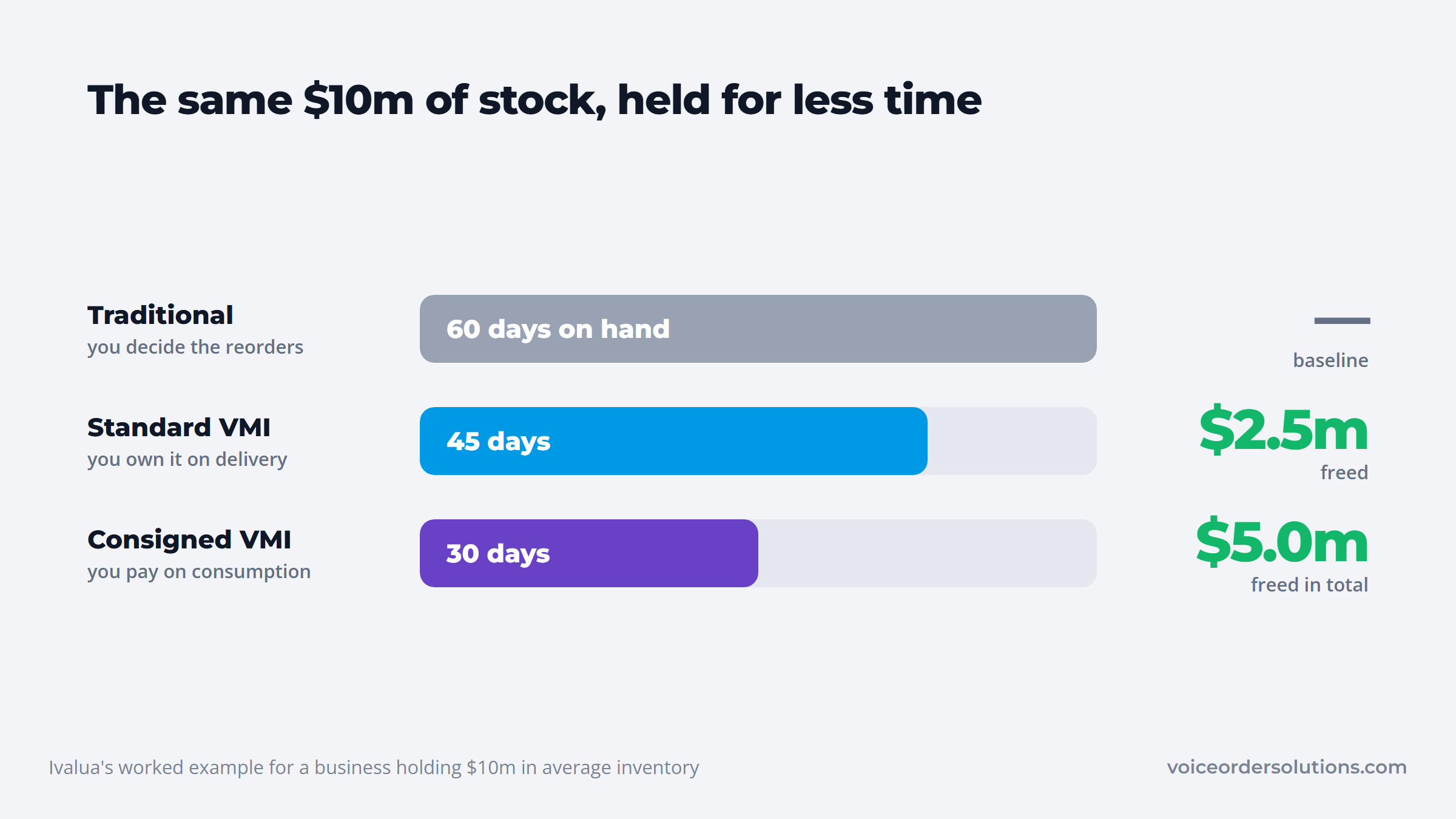
In standard VMI, ownership usually transfers to you on delivery, and you pay on normal terms even though the supplier decided the order. In consigned VMI, the supplier keeps ownership until you actually use or sell the item, so you only pay on consumption. Ivalua frames the impact through the cash conversion cycle: consigned VMI delays the moment your cash is tied up in stock, which frees working capital.
| Factor | Standard VMI | Consigned VMI |
|---|---|---|
| Who decides orders | Supplier | Supplier |
| Where stock sits | Your premises | Your premises |
| Who owns the stock | You, on delivery | Supplier, until consumption |
| When you pay | On delivery / normal terms | When you use or sell it |
| Working-capital effect | Moderate improvement | Larger improvement |
Ivalua's worked numbers show the scale: a business holding $10 million in average inventory at 60 days on hand frees about $2.5 million by cutting to 45 days under standard VMI, and roughly $2.5 million more moving to 30 days under consignment. Pick the variant that matches how much control and payment flexibility you and your supplier can each accept.
The clearest vendor managed inventory example is the one that made the model famous. In the 1980s, Walmart began sharing point-of-sale and inventory data with manufacturers like Procter & Gamble, letting P&G manage replenishment of its own products on Walmart shelves. SPS Commerce dates this partnership as the pioneer of modern retail VMI, and Walmart still runs real-time replenishment systems built on the same logic today.
The model spread well beyond retail. Home Depot uses VMI with larger manufactured-goods suppliers, and oil companies manage fuel inventory at service stations the same way. In manufacturing, automotive plants rely on suppliers to keep fasteners and components stocked at the assembly line, and aerospace makers use it for spare parts. The stakes there are large: McKinsey estimates the aerospace and defense sector risks burning through an extra $60 billion in cash without better inventory and replenishment coordination, the exact problem collaborative replenishment targets.
VMI shows up in consumer life too. A printer maker's auto-replenishing ink subscription is the same idea scaled down: the vendor watches your usage and ships before you run out. Across all of these, the common thread is shared data plus a supplier who owns the reorder decision, whether the item is a pallet of soda or a cartridge of ink.
The vendor managed inventory benefits that show up most consistently across sources are lower carrying costs, fewer stockouts, better forecasting, and a stronger supplier relationship. They reinforce each other: shared data improves the supplier's forecast, which cuts both stockouts and the excess safety stock that drains carrying costs.
The hard numbers back this up. A peer-reviewed study in Results in Engineering modeled a small healthcare supply chain and found that adding VMI with a consignment-stock policy cut total supply-chain cost by 14.8% compared with the scenario without them. Excess safety stock alone can quietly drain 20 to 30% of inventory value each year in carrying costs, so trimming it matters.
Before trimming, it helps to see how much buffer your own demand swings and lead times actually justify, and how much just spoils before it moves.
Work out how much buffer stock you need to stop running out, without tying up cash in product that spoils.
Demand for this SKU
Your supplier
The buffer figure that comes out is exactly what a vendor managed inventory arrangement is meant to shrink. Compare what your own demand swings and lead times justify against what you actually hold today, because the difference is carrying cost sitting in your cooler. That gap is where most of the benefits below come from:
The time savings are the quiet win. When the supplier owns replenishment, the hours your staff spent counting, forecasting, and ordering go back into the business. That only holds, though, if the data the model runs on is accurate, which is where the risks start.
VMI asks you to give up control, and that is a real trade-off, not a footnote. The three risks that appear in nearly every serious source are loss of control, data-security exposure from sharing sensitive sales data, and switching-cost lock-in to a single supplier.
The deciding factor is rarely the model itself. It is the conditions you run it in.
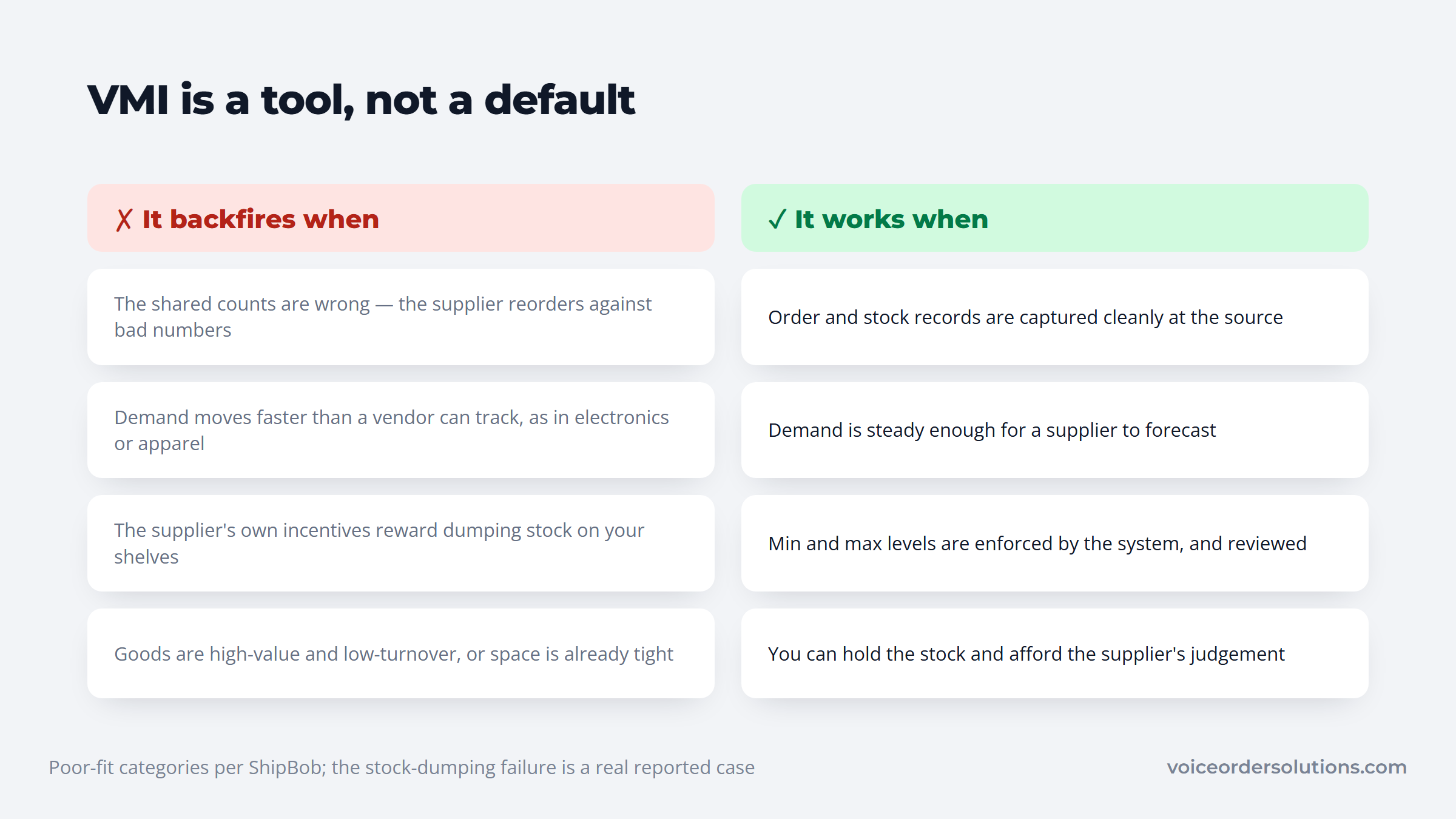
The lock-in cuts both ways. CIPS frames long-term supplier ties as a stability benefit; ShipBob and practitioners frame the same mechanic as lost leverage.
One supply-chain professional put it bluntly on Reddit: they would rather keep their own people in control than trust a supplier's grasp of the supply chain when things go wrong. During a disruption, a VMI relationship is only as good as the supplier's judgment.
VMI also backfires when the supplier games the setup. A procurement professional described a Fastenal VMI program on Reddit that started well, then overstocked nearly every item: the local hub, facing its own inventory count, dumped stock onto the buyer's shelves to avoid taking the hit on its books. The agreed min and max levels meant nothing once the incentive tilted.
It is also a poor fit for some inventory. ShipBob names high-value, low-turnover goods, businesses short on warehouse space, and fast-changing markets like electronics and apparel, where demand shifts faster than a vendor can track.
An NC State case study even found a large electronics manufacturer saw more material shortages after adopting VMI, because reduced demand visibility hurt forecasting. VMI is a tool, not a default; use it where shared data and stable demand make the supplier's job possible.
Whether you build the data-sharing yourself or buy a dedicated vendor managed inventory system, a few capabilities separate a workable setup from a fragile one. SAP's own checklist and the operators who run VMI well agree on the core list.
Prioritize real-time inventory visibility and clean ERP integration, since the supplier can only reorder well against live, accurate data. Look for shared forecasting so both sides work from the same demand picture rather than two conflicting ones. Cloud access and solid analytics help you spot when the minimum and maximum levels need adjusting, and scalability matters if you plan to add suppliers after the pilot.
Above all, the system has to enforce the rules you agreed on: item scope, order limits, and clear ownership. A tool that quietly lets a supplier exceed the maximum is worse than a spreadsheet, because it hides the exact behavior the Fastenal example warned about. Test those guardrails before you trust them with live stock.
You do not flip vendor managed inventory on across every supplier at once. The operators who succeed start small, define the rules tightly, and measure against a baseline. Here is a practical sequence.
Get your own house in order before any data flows to the supplier.
Accurate records are the foundation. If your order intake still runs on phone calls and voicemail, digitize it first; VoiceOrder Solutions captures spoken orders and timestamps them so the numbers you share with a supplier are right at the source.
With clean data ready, pin down the agreement and the integration.
Getting these rules explicit up front is what prevents the overstocking and boundary disputes that sink weak VMI programs.
Go live in a controlled way rather than switching everything on at once.
This staged approach, which Ivalua recommends as a 90-day pilot, keeps a bad fit from spreading across your whole supply base before you have evidence it works.
The time savings from VMI come from removing a whole category of recurring work: the daily cycle of counting, forecasting, and cutting purchase orders. When the supplier owns replenishment for the items in scope, your team shifts from placing every order to reviewing exceptions, which is far less work per week.
But VMI is not the only way to reclaim that time, and it is not right for every supplier relationship. For the orders you still place yourself, especially procurement orders to food and beverage distributors, the bottleneck is usually the manual intake step: someone phones in the order, a rep transcribes it, and errors creep in.
That is the gap VoiceOrder Solutions closes for operators not ready for full vendor-managed replenishment. Staff speak a reorder into the app while walking the storeroom, and the order is digitized, confirmed, timestamped, and sent to the distributor automatically, saving 20 to 30 minutes per order and capturing after-hours orders that would otherwise be missed.
It is a companion to a collaborative replenishment relationship, not a replacement for VMI: accurate, structured order data is exactly what any VMI setup needs. Operators can contact VoiceOrder Solutions to see how voice ordering fits their reorder workflow.
Vendor managed inventory is one of the most valuable changes a distributor or operator can make, but only where the conditions fit: stable demand, accurate shared data, and a supplier you trust with a core decision. Start with a 90-day pilot on one or two suppliers, agree on clear rules and the right ownership model, and measure against a real baseline before you expand.
Where VMI is not the right fit, the same principle still applies: the cleaner and more automated your order data, the less time your team wastes and the fewer errors reach your shelves. Whether a supplier reorders for you or your staff place the order, accurate capture is what keeps the whole system honest.
Vendor managed inventory is a replenishment model where the supplier decides how much stock to send and when, based on real-time sales and inventory data you share. You typically still hold the stock on your premises, but the supplier owns the reorder decision against agreed minimum and maximum levels. It is also called supplier-managed inventory or continuous replenishment.
The classic example is Walmart and Procter & Gamble in the 1980s: Walmart shared point-of-sale data and let P&G manage replenishment of its products on Walmart shelves. Other examples include Home Depot with large suppliers, automotive plants keeping fasteners stocked at the line, and even auto-replenishing printer-ink subscriptions, which apply the same VMI logic to consumers.
The main vendor managed inventory benefits are lower carrying costs, fewer stockouts, better forecasting from shared data, less purchasing labor, and stronger supplier relationships. A peer-reviewed study found a VMI-plus-consignment model cut total supply-chain cost by 14.8%. The time savings come from your team no longer cutting routine purchase orders.
In standard VMI, you take ownership of the stock on delivery and pay on normal terms. In consigned VMI, the supplier keeps ownership until you use or sell the item, so you pay only on consumption. Consigned VMI frees more working capital because your cash is not tied up in stock sitting on your shelves.
VMI is a poor fit for high-value, low-turnover goods, businesses short on warehouse space, and fast-changing markets like electronics or apparel where demand shifts faster than a supplier can track. It also fails when shared data is inaccurate or when a supplier games the min and max levels, so verify the supplier's incentives and your data quality before handing over control.