.webp)
Key takeaways:
Somebody walks the line at four in the afternoon and finds the third pan of diced onion empty. There are two cases of it eighteen feet away on an overhead rack. Nobody ordered wrong, nobody counted wrong, and the station is still short.
That gap between owning the product and having the product where it gets used is what stock replenishment is. Not the decision about how much to buy, which happens upstream in a planning system, but the physical work of closing the distance.
Most writing on this subject skips it. Search the term and you get reorder point formulas, forecasting theory and a software demo, because the planning half is the half that vendors sell. The run itself gets a clause.
This guide is about the clause. It covers who does the run, how long it takes, what the case pack does to it, how the shortage you find gets back to your distributor, and the specific ways the whole cycle quietly stops happening.
Stock replenishment is the movement of product from wherever you are holding it to wherever it gets sold or used. Backroom to shelf, walk-in to line, dry store to prep station, reserve rack to pick face. The direction is always toward the point of consumption.
That is a different activity from deciding what to buy. The decision about quantity, timing and supplier belongs to a planning routine and gets covered under inventory forecasting. The stock replenishment process described here starts once the product is already yours.
Both jobs get called replenishment, which is why operations end up investing in better forecasting and seeing no change in availability. The forecast was never the binding constraint. Somebody stopped working the overhead rack down.
Two failure states look identical to a customer standing at an empty shelf. In one, you never bought the item. In the other, you bought it, received it, and it is sitting forty feet away in a case nobody opened.
The most useful measurement of this comes from a 2002 study for the Grocery Manufacturers of America, which pooled 40 separate out-of-stock studies worldwide and remains the standard reference on the question. Its headline number is an average out-of-stock rate of 8.3%, with individual study highs averaging 12.3%.
The breakdown underneath that number is the part worth acting on. The researchers split every out-of-stock by where it originated.
| Where the out-of-stock came from | Share |
|---|---|
| Store ordering and forecasting | 47% |
| In the store, but not on the shelf | 25% |
| Everything upstream of the store | 28% |
Read the middle row again. In a quarter of cases the product was in the building. The study attributes that category to shelf space that cannot hold enough, no signal reaching anyone that the shelf had emptied, and back-room handling that makes it hard to get product out to the front.
The same study measured how long gaps stayed open, and the answer is longer than most operators assume. Only 20% were closed within eight hours, 25% took between eight hours and a day, 36% ran one to three days, and 19% lasted three days or more.
An item missing for three days is not waiting on a delivery. It is waiting on somebody to walk to the back and get it, which is a scheduling problem you can fix this week without changing a single order.
Put another way, the replenishment of stock you have already paid for and already received is the cheapest availability any operation will ever buy.
A run is a bounded task: one person, one zone, one pass. Treating it as something that happens continuously in the background is how it stops happening at all. The sequence below is what a good one looks like in a restaurant, a store or a small distribution site.
At warehouse scale the same seven steps get formalized into documented put-away and pick-face rules, which is the territory of the wider warehouse management process.
The order of these steps matters more than the steps themselves, because each one prevents rework in the one after it.
Step 6 is the one that gets dropped, and it is the one that makes the rest of it worth doing. A run that closes the gaps it can and says nothing about the gaps it cannot leaves the buyer working from a stock number that looks healthy. Distributors hit the same blind spot one step up, since inventory replenishment software for distributors can only flag a low item once the orders drawing it down have arrived.
The last step is where replenishment of stock stops being an internal chore and becomes an order. Everything the run discovered has to survive the trip from the aisle to whoever talks to the supplier.
That trip is short, and it is where most of the detail leaks. Products such as VoiceOrder Solutions exist for that handoff alone, which is covered further down.
Grocery has a name for this work, top stock, and enough people do it daily that the practical numbers are public. On Reddit, an employee asked whether a full eight-hour shift was a normal time to run it. The answers put it at three to four hours in a smaller store and a multi-person job in a larger one, with the variable being store size and how full the overhead racks already are.
That range is worth taking seriously as a planning input. If your working assumption is that somebody will fit the run into the gaps in their day, and the honest number is half a shift, the run will lose every time it competes with a customer.
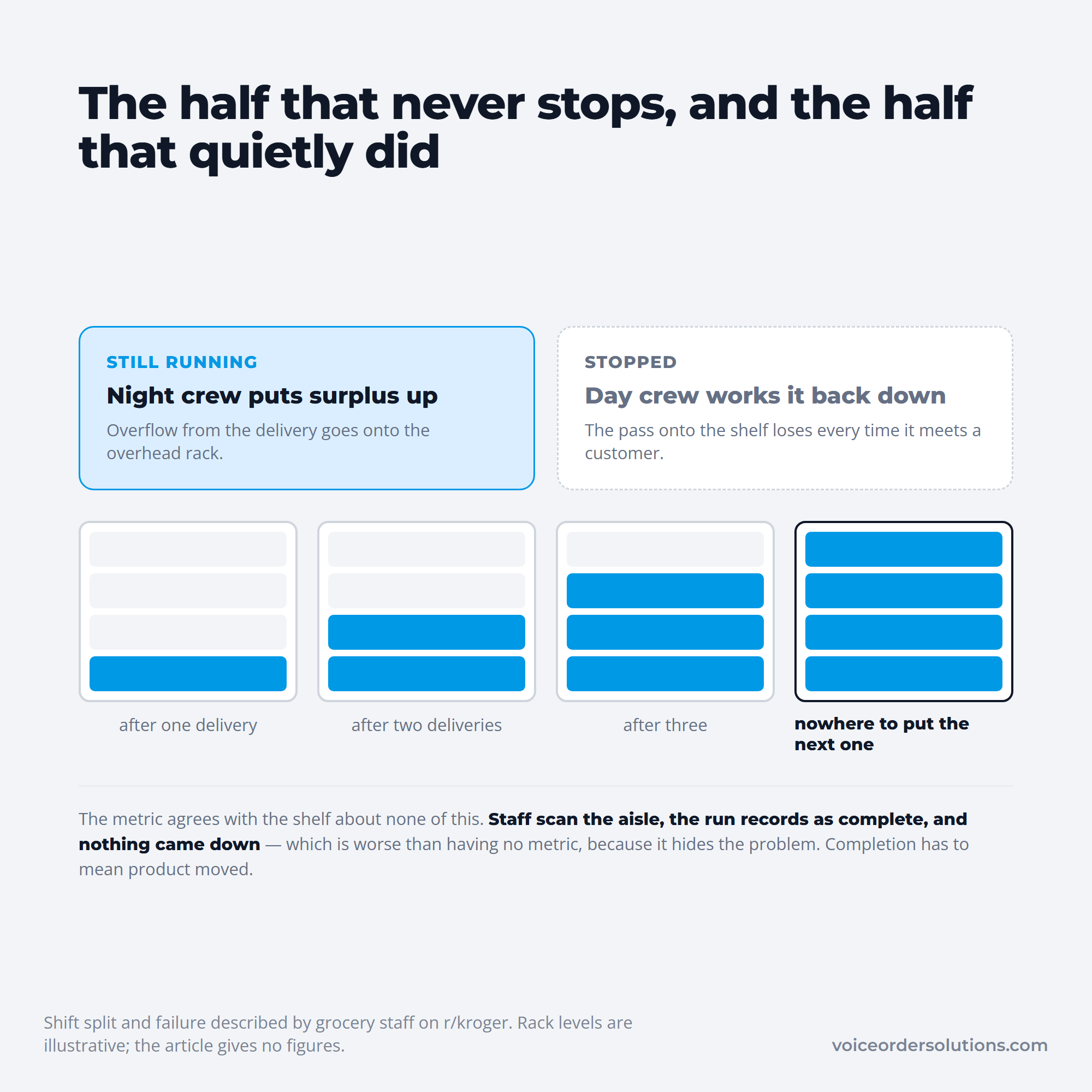
The second thing those threads make clear is that the job splits across shifts and the split is where it breaks. One Reddit thread describes the standard arrangement: the night crew puts surplus stock up on the overhead rack, and the day crew is supposed to work it back down onto the shelf. When the second half stops happening, the first half keeps going, and the racks fill until there is nowhere to put the next delivery.
The commenter's description of how it fails is precise. Staff scan the aisle so the completion metric looks right, without pulling anything down. The system records a finished run and the shelf is unchanged, which is worse than no metric at all because it hides the problem.
Only one half of the split has any reason to stop, and the rack is where the difference collects.
Give the run one named owner per shift, a defined zone, and a completion definition that means product moved rather than a scanner fired. Anything less and you are measuring attendance.
The owner is not always yours. On direct store delivery routes the supplier's own driver works the shelf, an arrangement covered under vendor managed inventory, and the failure mode inverts: the run happens on the supplier's schedule rather than yours, so a Tuesday gap waits for a Thursday route.
Every extra foot between the reserve location and the point of use gets paid on every single refill for as long as the item is stocked. That compounds far faster than it looks on a floor plan.
Slot for movement rather than for tidiness. The items you refill daily belong at waist height on the nearest rack to the door, and the once-a-month items can go up high at the back where retrieving them costs a ladder.
Swapping two racks changes the walk without changing anything else in the room.
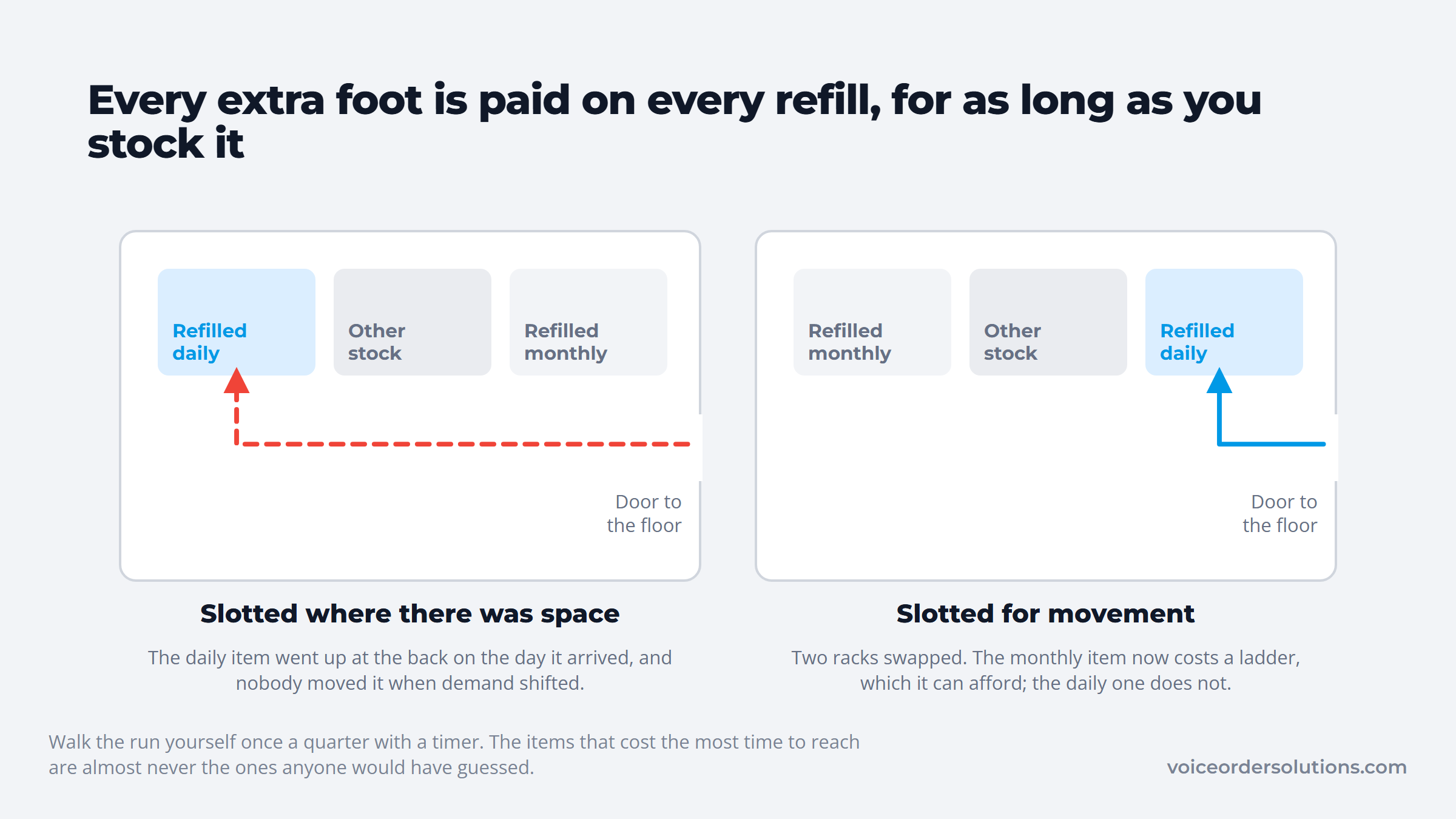
That is a different question from being able to find things, which belongs to your stock control routine. Here the question is narrower: how many seconds and how many touches does one refill take?
Two habits do most of the damage. Product gets put away wherever there was space on the day it arrived, and nobody re-slots when demand shifts, so last summer's fast mover keeps its prime position through the winter.
Walk the run yourself once a quarter with a timer. The items that cost the most time to reach are almost never the ones anyone would have guessed.
The arithmetic says you need eleven units. The case holds twenty-four. What goes on the shelf is a case, and the other thirteen units go back into the room the run is meant to be emptying.
The thirteen that go back are the whole of the problem, drawn to size.
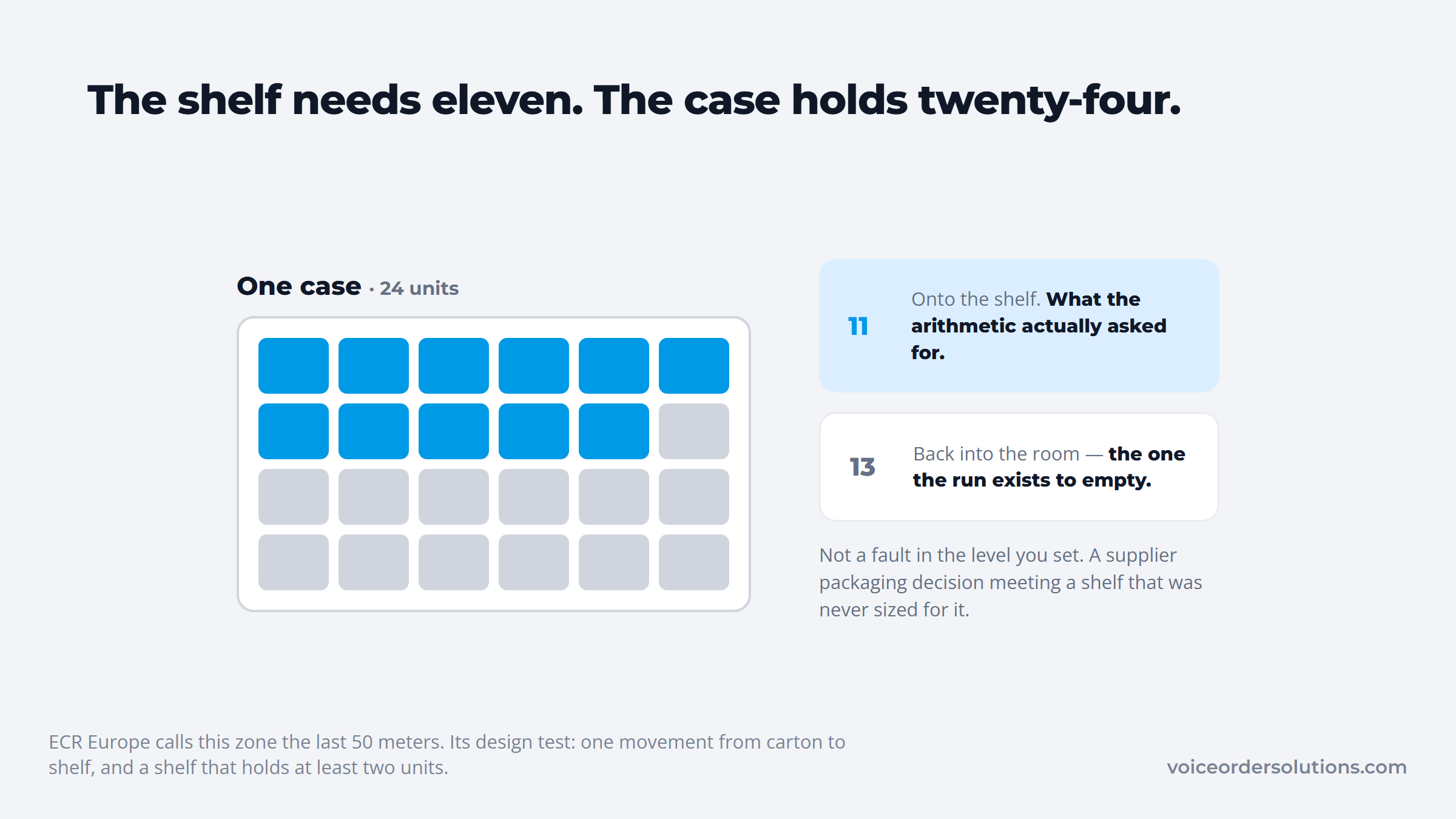
That rounding is the single most common reason a well-planned par level produces a full backroom. It is not a fault in the stock replenishment methods you use to set the level, it is a supplier packaging decision colliding with a shelf that was never sized for it.
ECR Europe, the retail and manufacturer standards body, calls this zone the last 50 meters, and its guide to shelf-ready packaging is the most useful published work on it. The report is blunt about why the distance is hard: staff have to identify the product at the back of the store, carry it without damaging it, open the outer case quickly, and refill efficiently, and each of those steps can defeat the one before.
Its design test is worth applying to anything you buy in volume. A case should allow replenishment in one movement, going from carton to shelf without a person handling individual units, and the shelf should hold at least two of those units so the gap does not open the moment one empties.
ECR also puts a number on the stake, though it is careful to frame it as an assumption the industry accepts rather than a measured finding: an improvement in on-shelf availability of 1% is generally taken to produce a 0.3% revenue uplift. Treat it as a rough sense of scale when building a case, not a promise.
Both the ECR guide and the out-of-stock study behind the table above are field research from the 2000s, and they have held up because the physical constraints they describe have not moved.
Rotation done as a separate task is rotation that does not happen. It belongs inside the refill motion, at the moment the new case is already in your hands and the old stock is already exposed.
ECR's guidance is specific here and matches what works in a kitchen: put the units with the shortest date at the front, and rotate by outer case rather than by individual unit wherever the packaging allows it. Handling cases rather than units is what makes correct rotation faster than incorrect rotation, which is the only way it survives a busy afternoon.
The failure mode is quiet. Someone in a hurry puts the fresh case in front because the shelf is easier to load that way, and the older stock migrates to the back where it ages out unseen. Nothing shows up in a count, because the total is right.
That is why the run and the date check belong to the same person on the same pass. Splitting them guarantees one of them slips.
The shortage discovered on a run has a short useful life. It is exact at the shelf and approximate by the time somebody reaches a desk, which is why the note so often becomes "we need more onions" instead of two cases of a specific pack size.
This is where an ordering layer earns its place, and it is a narrow job rather than a broad one. VoiceOrder Solutions is a tool for the food distributor: the distributor sets up each restaurant or store it supplies with its own order guide at its own agreed prices, and those accounts place orders by voice in the app.
What the distributor receives is a structured order with a number and a timestamp on it, not a voicemail a customer service rep has to play back and retype. Orders that come in after the office closes wait in the queue for the morning team instead of on a callback list.
The boundaries here matter, because the vocabulary overlaps with everything else in this article. It does not hold your par levels, does not know what is on your shelf, does not count anything, and does not decide that you are short. A person on the floor decides that.
What it protects is the handoff, and the handoff is where a run's findings usually get lost. The buying side of that relationship is described for food service operators directly.
The same handful of failures account for most of the empty shelves in operations that are otherwise well run. None of them is a planning error, and none is visible in an inventory report.
| What you see | What is actually happening | The fix |
|---|---|---|
| Shelf empty, stock in the back | The second half of the shift split stopped happening | One named owner per shift, completion means product moved |
| Backroom full after every delivery | Case packs exceed shelf capacity on repeat items | Re-size the shelf, or negotiate a smaller pack |
| Older stock aging out at the back | Rotation is a separate task instead of part of the refill | Rotate by outer case during the fill, not after |
| Run marked complete, gaps still open | The metric measures scanning rather than movement | Count filled facings, not aisles visited |
| Same item short every week | The gap is closed but never reported to the buyer | Shortage note goes out the same day it is found |
Every fix in that right-hand column is a scheduling or reporting change rather than a purchase. That is the useful thing about treating replenishment as execution: most of the repairs are free.
Once a delivery has been checked in, and that check is its own discipline covered under restaurant inventory management, the next decision is where the case goes. There are only two answers and one of them is much cheaper.
If the shelf or station has room now, the case should go straight there. Putting it away first and retrieving it later means handling the same case twice, and the second handling is the one that gets skipped.
Time the delivery against the run rather than against the office. A drop that lands during the shift when somebody is already walking the zone can be cross-docked to the shelf in the same pass. A drop that lands at the busiest hour will be stacked wherever there is floor space and dealt with later, which usually means tomorrow.
Vendor stock replenishment changes who carries the case but not the sequence. Where the supplier's rep does the put-away, the same double-handling question applies to them, and a rep working to a route schedule has even less incentive to make the second trip than your own staff do.
Automated stock replenishment usually gets sold as a buying feature, meaning the system places the order without a human. That is the planning half. On the execution side, automation does something narrower and more useful, which is telling a person exactly what to work and in what order.
| What automates well | What still needs a person |
|---|---|
| Building the run list from sales and receipts | Opening the case and putting the product on the shelf |
| Sequencing the zone so the route is efficient | Judging that a facing looks wrong even though the count agrees |
| Flagging items that emptied since the last pass | Deciding an item is damaged rather than merely short |
| Recording what was filled and what was not | Reading the date on a case and pulling what is old |
| Sending the unfilled list to the buyer automatically | Noticing the same item fails every week |
The right-hand column is why automatic stock replenishment on the floor never reaches zero labor. The system knows what it was told and nothing else, so a case moved without a scan, a mislabeled outer, or a shelf tag that no longer matches the product all stay invisible to it.
Start with the run list and the unfilled report, since those two changes alone convert an informal habit into a task with evidence attached. Fuller stock management tooling is worth adding once the routine itself is real.
Most operations measure stock and not the work that moves it, which is why the run is invisible until a customer complains. Four numbers cover it, and none needs new software to start.
On-shelf availability is the outcome measure: walk a fixed sample of items at a fixed time and record how many are actually present at the point of use. Build that sample from the same items your restaurant inventory list already tracks, so the two numbers can be read against each other.
Do it at the same hour each day, because availability at nine in the morning tells you nothing about availability at seven in the evening.
Run completion is the effort measure, defined as facings filled against facings that needed filling. Time per zone tells you whether your staffing assumption is real, and backstock volume tells you whether the run is keeping up with what arrives.
Watch backstock hardest. It is the only one of the four that moves before the customer notices anything, so a rack that has been creeping upward for a fortnight is the earliest warning you will get.
Pick one zone, walk it at the busiest hour, and write down every gap along with whether the product was in the building. That single list usually settles the argument about whether you have a buying problem or a labor problem, and in most operations it is the second one.
The next step is to give the run a name, an owner and a slot, and to define completion as product moved. Better inventory planning is worth doing, but it cannot fill a shelf.
If the weak point turns out to be the handoff between the person who finds the shortage and the distributor who fills it, contact VoiceOrder Solutions for a demo of how that step works.
Stock replenishment is the movement of product from storage to the point where it is sold or used: backroom to shelf, walk-in to line, reserve rack to pick face. It is distinct from the buying decision that determines quantity and timing.
Both get called replenishment, which causes real confusion. This article covers the physical half, the work of closing the distance between stock you already own and the place it is needed.
Read the shelf and note the shortages, fetch the product, fill in one movement per case where packaging allows, rotate the shortest dates to the front, face the shelf, then record and send whatever you could not fill.
The final step is the one most often skipped and the one that makes the run useful to the buyer. A run that fixes what it can and reports nothing leaves the ordering side working blind.
The methods that decide how much to bring in, such as reorder points, min/max and top-off to par, are planning choices and belong to a replenishment planning routine rather than to the run itself.
On the execution side the meaningful choice is narrower: fill continuously through the day, or work fixed runs at set times. Fixed runs win in most operations, because a task with a slot survives a busy service and a continuous habit does not.
No. It builds the run list, sequences the route, flags what emptied and reports what went unfilled, which is genuinely valuable and changes how the work is scheduled.
It cannot open a case, read a date, or notice that a facing looks wrong. Anything moved without being scanned stays invisible to the system, so the physical pass is still the thing that closes the gap.
Operators doing this daily in grocery report roughly three to four hours for one person in a smaller store, rising to a multi-person job in a large one, with overhead rack fullness as the main variable.
Time your own once rather than assuming. If the honest figure is half a shift and it is currently unassigned, the run is losing to every other demand on that person's day.