Key takeaways:
A food distributor shopping for wholesale ecommerce software is usually solving one problem: orders arrive across phone calls, texts and emailed spreadsheets, and every channel lands in a different shape that has to be reconciled before anything can be picked.
The category promises to fix that with a storefront. What it does not tell you is that wholesale ecommerce solutions come in at least three shapes with three different price tags, and that the feature a food distributor needs most, a per-account price list with a cut-off time attached, is the one most often metered or missing.
This list is eight options read off their vendors' own pages in October 2026. Every price came from the company that charges it, with the billing basis stated, because four of these vendors display an annual rate where a monthly rate belongs.
The word "platform" hides the only decision that matters early, which is how much of the thing you are building yourself.
A turnkey storefront is a hosted product you configure. You upload a catalog, set price lists, and your accounts log in to a site the vendor runs. This is what most buyers picture when they hear wholesale ecommerce platform. Local Line, Freshline and Candid Wholesale sit here, and so does most of what ranks for wholesale ecommerce solutions.
An ordering layer does not try to be your website. It bolts a buyer-facing portal onto the system that already holds your inventory and pricing, and its whole value is the sync. Now Commerce does this for QuickBooks and OrderEase does it across several ERPs.
A composable stack gives you an engine and an API and expects you to build the experience on top, usually with an implementation partner. None of the three is an inventory system, so the stock behind the catalog stays wherever it lives today, a split worth settling early if you also run wholesale inventory management in a separate tool. Virto Commerce is the example here, and it is a different kind of commitment from the other two.
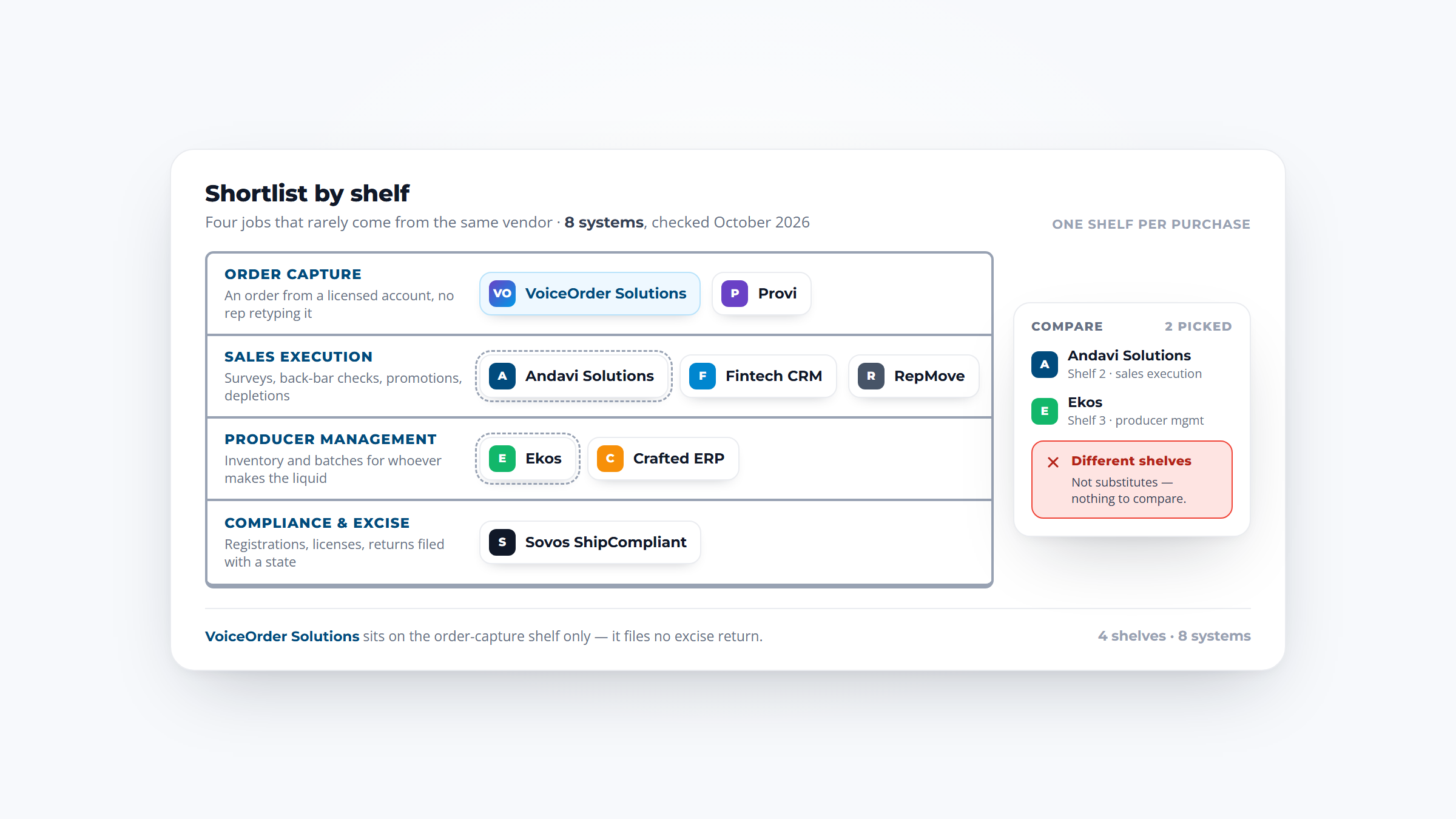
There is a fourth answer that is not a storefront at all, which is to add an ordering channel to what you already have. That is where VoiceOrder Solutions sits, and it is covered last because it does not compete with the platforms above it.
The shape decides everything downstream. A turnkey wholesale ecommerce platform is live in weeks and limits you to the vendor's model of a price list. A composable stack does whatever you want and bills you for the privilege, both in license and in the partner who builds it.
The table compares the shape, the two order settings a food catalog genuinely turns on, how the system reaches your ERP, and what it costs with the basis it bills on.
| Platform | Shape | Best for | Cut-offs and minimums | ERP connection | Price (and the basis it bills on) |
|---|---|---|---|---|---|
| Freshline | Turnkey, food-native | Distributors who need catch weight | Both, on all three tiers | Add-on above the entry tier | Pricing available on request |
| Local Line | Turnkey, food-native | Food hubs and multi-vendor sellers | Both, per price list | QuickBooks, plus API and EDI | $109/month billed monthly |
| Candid Wholesale | Turnkey or embedded | Brands selling into foodservice | Minimums only | Top contract tier only | $219/month billed monthly |
| WizCommerce | Storefront plus rep app | Rep-led wholesale with a catalog | Minimums and case packs | Named as part of the platform | Pricing available on request |
| Now Commerce | Portal layer on QuickBooks | QuickBooks distributors | Minimums and quantity multiples | QuickBooks only | $280/month stand-alone |
| OrderEase | Order orchestration hub | Multi-channel order capture | Not published | NetSuite, Dynamics 365, QuickBooks | From $500/month, plus setup |
| Virto Commerce | Composable stack | Enterprise beverage and FMCG | Not published | Built by your integrator | From 0.5% of GMV, or $2 per order |
| VoiceOrder Solutions | Ordering channel, no storefront | Adding ordering without a rollout | Not published | Email, EDI, API, QuickBooks | Pricing available on request |
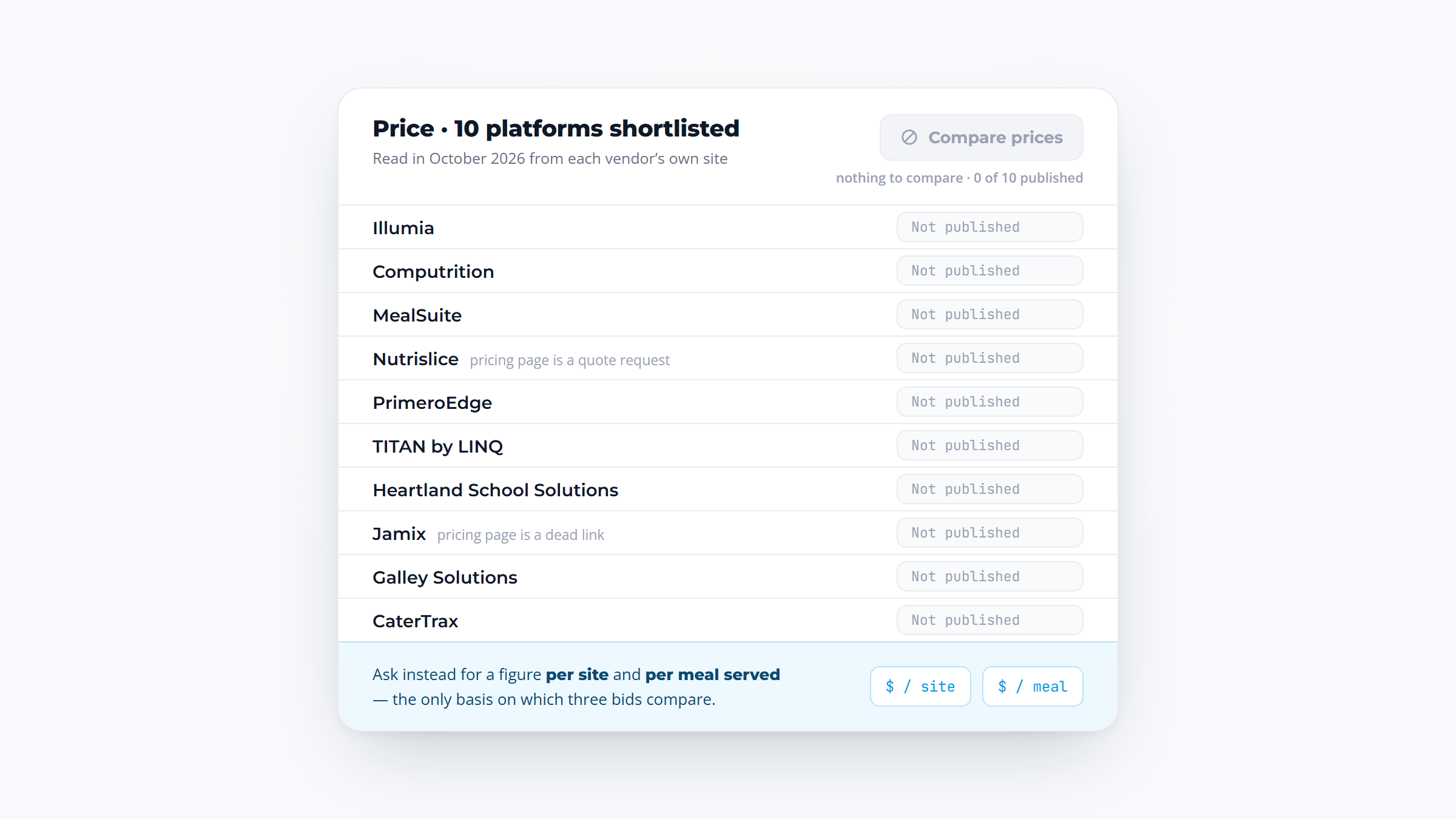
Three of the eight publish no rate card, VoiceOrder Solutions among them, which is simply how this category sells when every deployment is scoped individually. Read down the entries for the shape first, because the price only means something once you know what you are buying.

Overview: Freshline is a white-label ordering and fulfillment platform built specifically for food distributors, running on the distributor's own subdomain. It came out of Coastline Market, a B2B seafood marketplace the founders rebuilt after 2020.
Freshline is the most food-native product here, and its feature matrix shows it: order cut-off hours, order minimums and variable-weight adjustments all sit on every tier, including the entry one.
Key features:
Pricing: No published price. Three tiers, Standard, Advanced and Enterprise, each priced on request.
Pros: Genuinely food-native, catch weight on every tier, cut-offs and minimums included at entry.
Cons: ERP integration is an add-on at every tier and unavailable at entry, the sales rep app is Enterprise only, and it names no specific ERP systems.
Where it beats the alternatives: It is the only platform here that treats variable weight as standard rather than as a custom field, which is the difference between an invoice that reconciles and one a rep fixes by hand.
Final verdict: The strongest fit for a distributor selling meat, seafood or produce by weight, provided the ERP add-on is priced before you sign.

Overview: Local Line is a farm-to-fork commerce platform aimed at farms, food hubs and multi-vendor aggregators selling into restaurants, grocers and distributors. Its own framing is that it layers into existing procurement operations rather than replacing them.
Its distinguishing mechanic is the price list. Each one behaves as a separate storefront over shared inventory, with its own products, prices, order window and minimum.
Key features:
Pricing: $109 a month billed monthly, or $87 billed annually, on the Core plan. Premium is $199 and Ultimate $399, both monthly.
Pros: Publishes a real price, cut-off times and minimums at every tier, no commission on sales, and a usable wholesale ecommerce app on mobile.
Cons: Price lists are metered at two on Core, vendors are capped too, and card fees sit on top of the subscription.
Why buyers shortlist it: It is the cheapest honest entry point here for a seller that needs genuinely separate wholesale and retail catalogs.
Final verdict: Built for food hubs and producers rather than broadline distribution, and priced accordingly.

Overview: Candid Wholesale sells a branded wholesale storefront that can either be hosted or embedded into a site you already run, alongside a collaborative order form, invoicing and reporting.
Its published food proof is a food hub rather than a distributor. Its case study with the Worcester Regional Food Hub describes hundreds of foodservice orders a month across more than a hundred institutional buyers.
Key features:
Pricing: $219 a month billed monthly on PRO, or $179 billed annually. COMPLETE is $719 monthly or $599 annually.
Pros: Price lists and minimums at entry, an embeddable storefront, transparent card and ACH rates.
Cons: Order volume is capped by revenue band at $1.5 million a year on PRO, ERP connectors are reserved for the top contract tier, and its named customers are ceramics and apparel brands.
Its real strength: The embedded option, which lets a distributor keep its own site and still take structured wholesale orders inside it.
Final verdict: A good fit for a food brand or hub selling into the trade, and a poor one for any distributor whose order volume is already past the revenue caps.

Overview: WizCommerce bundles a B2B storefront, a sales rep app, a CRM and payments into one suite aimed at rep-led wholesale. Food and beverage is one of only four industries it names.
Its food page is more specific than most. It describes trade promotions with scheduled hierarchies and channel-level control, and multi-warehouse inventory that shows an account only its nearest or assigned warehouse.
Key features:
Pricing: No published platform price.
Pros: Case packs handled natively, a named food and beverage product, rep app and storefront from one vendor.
Cons: No platform price, no published cut-off times, and its named customers are furniture, gift and toy brands rather than food.
What it is genuinely good at: Rep-led selling where the same catalog has to work for a rep in the field and an account ordering on its own.
Final verdict: Worth a demo if your reps write a meaningful share of orders, and worth asking directly whether catch weight is supported, because the food page does not say.

Overview: Now Commerce has sold QuickBooks-focused B2B ecommerce since 2003, and it is the most literal ordering layer here. Orders placed in the portal are created in QuickBooks automatically, in both directions.
Its description of the buyer experience is the clearest statement of order guides anywhere in this list: customers order from personalized, customer-specific guides carrying the right product numbers, real-time inventory and their own pricing.
Key features:
Pricing: $280 a month for the B2B Customer Portal stand-alone. The Sales Rep Portal starts at $150 a month, and the vendor states a $100 monthly discount for bundling.
Pros: Order guides done properly, genuine two-way QuickBooks sync, unlimited customers on the portal.
Cons: QuickBooks only with no other ERP named, and three modules priced separately.
Where it fits: Distributors running QuickBooks as the system of record who want a portal rather than a platform.
Final verdict: The obvious choice on QuickBooks and a non-starter anywhere else, which is the same constraint that rules out several general platforms for food.

Overview: OrderEase is less a storefront than a hub that collects orders from every channel you already sell through, standardizes them, and pushes them into your ERP. Its own summary is to take orders everywhere and rekey nothing.
OrderEase is the most integration-led option here, and the only one naming several ERPs rather than one.
Key features:
Pricing: From $500 a month for core order automation, plus a setup fee that depends on configuration. Advanced EDI and ERP work is quoted as a separate fixed-price implementation.
Pros: Unlimited users on the base plan, several named ERPs, split-case and pack-size handling built in.
Cons: No food vertical anywhere on its site, no free trial, and the integrations a distributor actually wants are priced as implementation.
Why it earns a place here: Linked inventory is the cleanest answer on this list to selling the same product as a case, a split case and an each.
Final verdict: The strongest choice where orders already arrive through four channels and the problem is consolidation rather than a shopfront.

Overview: Virto Commerce is a composable, API-first platform on .NET, sold as an engine you build on rather than a product you configure. Its food work is real and it is enterprise: Heineken, Lavazza and the beverage distributor De Klok Dranken.
Its FMCG page describes the distributor case directly, giving every account its own catalog and pricing with real-time ERP sync behind it.
Key features:
Pricing: A published model rather than a rate card: from 0.5% of GMV, or $2 per order, at 10,000 SKUs. Implementation and third-party software sit on top.
Pros: Publishes its pricing basis openly, proven at beverage scale, no ceiling on how the experience is built.
Cons: Percentage-of-GMV pricing scales with your sales, an integrator is effectively required, and its reference customers are far larger than an independent distributor.
Why it made this list: It is the honest representative of the composable option, and seeing its pricing basis next to a $109 subscription makes the shape decision concrete.
Final verdict: Right for a distributor with an IT function and a multi-year roadmap, and wrong for anyone who needs to be taking orders this quarter.

Best for: Adding ordering without a rollout
Overview: Every other option on this list is a platform you configure or integrate. You are setting up a storefront, bolting a portal to your ERP, or hiring an integrator to assemble a stack, and all three are measured in weeks at best.
VoiceOrder Solutions is the entry that is none of those. It is an ordering channel a food distributor switches on over an existing order guide, which is why it closes a list of platforms it does not compete with. Nothing is published, nothing is browsable, and there is no checkout.
Setup starts from paperwork that already exists. Whatever guide a distributor keeps for an account becomes that account's catalog, and what comes back is a structured order rather than a message somebody has to interpret.
The channel itself is voice. An account orders by voice from the catalog its distributor set up, confirms each line on screen, and sends it without logging into a portal.
Key features:
Pricing: No public rate card, the same posture as Freshline and WizCommerce on this list. The number VoiceOrder Solutions does publish is a timeline rather than a price: most distributors go live within 24 to 48 hours.
Pros: No site to design or maintain, reaches accounts a portal rollout never converted, runs off order guides that already exist, central control of every account's catalog.
Cons: No public rate card, and it is not a storefront, so you get no public catalog, no merchandising and no checkout.
How to start using it:
Where it fits: It covers the ordering channel while a storefront covers the catalog, so a distributor running both is not buying the same thing twice.
Final verdict: Not wholesale ecommerce software, and it closes this list because it answers the shape question rather than the vendor one. Distributors who want orders arriving clean without committing to a platform rollout can stop here.
Every price here was read off the vendor's own pricing page in October 2026, and recorded with the basis it bills on. That discipline earned its keep here: one vendor routes its pricing link to an entirely different product, and several price a card annually while the buyer reads it as monthly.
Directory listings were deliberately not used as a price source. They carry superseded tiers under former brand names, and in this market the brand names move: two candidates we checked had shut down or rebranded since their last directory entry.
Farm and food-hub platforms were kept in deliberately, because the wholesale side of that market is the larger one. USDA's National Agricultural Statistics Service reported that US farms selling food locally earned $9.0 billion in 2020, of which $4.1 billion came from sales to institutions and intermediate buyers and $1.9 billion from sales straight to retailers.
That is two thirds of the total going through trade channels rather than farmers markets, on our own arithmetic from those published figures, and it is why a platform built for a food hub belongs in a distributor's shortlist.
The data describes 2020 and was published in 2022, so read it as the shape of the channel rather than as this year's number.
A candidate also had to be a storefront or ordering system the distributor owns and controls. Marketplaces were excluded on purpose, because listing a catalog on someone else's network is a different decision with different economics, and two otherwise strong products were cut on that test alone. The food-ordering networks a distributor is likeliest to weigh against a storefront, among them Cut+Dry and its rivals, sit outside this list for the same reason.
Every platform here that publishes a price meters something, and the unit varies enough that comparing monthly fees alone will mislead you.
| Platform | What gets metered | At the entry price | What lifts the cap |
|---|---|---|---|
| Local Line | Price lists and vendors | 2 price lists, 5 vendors at $109 | Premium at $199 for 5 lists, Ultimate at $399 for 10 |
| Candid Wholesale | Annual order volume | Up to $1.5M a year at $219 | COMPLETE at $719 for $5M, then contract pricing |
| Now Commerce | Modules | Portal only at $280 | Rep portal at $150, less a $100 bundle discount |
| OrderEase | Channels, volume and features | Core automation from $500 a month | EDI and ERP priced as implementation |
| Virto Commerce | What you sell | 0.5% of GMV, or $2 per order | Nothing, it scales with revenue |
A distributor with four customer tiers is already over Local Line's entry plan, and one doing $3 million of order volume is past Candid Wholesale's PRO band.
A volume cap is really a ceiling on how much of your order fulfillment process the platform is allowed to carry before the price changes. Those are the numbers that move the real cost, not the headline subscription, and they are worth working out against your own account book before you book a demo.
On subscription alone the field spans less than you would guess, and the gap only opens once the separately billed items go in.
Card processing is the first. Local Line charges 2.9% plus $0.30 at its entry tier, falling to 2.5% at the top, with ACH from 1.0% down to 0.6%. Candid Wholesale sits at the same 2.9% plus 30 cents and charges nothing on cash and checks. On wholesale margins that percentage usually outweighs the subscription within a few months.
Implementation is the second. OrderEase prices advanced EDI and ERP work as a separate fixed-price package, and Virto Commerce says plainly that implementation sits on top of its subscription, whether you use your own team or a partner.
The quote-based group behaves differently again. Freshline, WizCommerce and VoiceOrder Solutions publish nothing, which is ordinary for software sold by implementation, and it means the only way to compare them against a $109 subscription is to get both numbers in writing for the same scope.
A general B2B platform can be cheaper on paper and more expensive in practice, because per-account pricing is frequently the upgrade the rest of it sits behind. A distributor comparing these figures against a broader B2B ecommerce platform shortlist should check which tier the per-account pricing actually lands on.
Gartner's March 2026 sales survey of 646 B2B buyers found that 67% of B2B buyers prefer a rep-free experience. That is the case for building a storefront, and it is also the case for not assuming the storefront finishes the job, because the remaining third is a real share of most account books.
In food that tail is bigger than the average, and it is concentrated in exactly the accounts a distributor least wants to annoy. A chef ordering at closing time, an independent operator with one laptop in a back office, a customer who has phoned the same rep for nine years.
Two things follow for a rollout. The first is to measure which accounts actually moved, by account rather than by order count, four weeks after launch. The second is to decide deliberately what happens to the ones that did not, because the default is that a rep keeps keying their orders in by hand and the platform never pays back.
The honest options for that tail are a rep-assisted order entry screen, a standing order you confirm by exception, or an order-taking channel that does not require them to log in to anything. Which one fits depends on whether the barrier is the device, the habit or the hour.
What does not work is waiting. An account that keeps phoning for six months after launch has decided, and the ordering process around that decision needs to be deliberate rather than accidental.
A storefront is only as good as the catalog behind it, and the catalog is where most rollouts quietly degrade.
Three failures recur. Prices drift out of sync with the agreement because the price list lives in two systems. Items stay visible after they stop being available, so an account orders something that will not ship. Pack sizes get duplicated as separate items until nobody can tell a case from a split case.
Each has a straightforward owner. The price list needs one system of record and a sync, which is the argument for an ordering layer over a standalone storefront. Availability needs to be driven by stock rather than by a flag somebody remembers to set, which is what makes catalog management a continuing job rather than a launch task. Pack sizes need the linked-inventory treatment OrderEase describes, where one physical stock pool serves several sellable units.
Set a cadence for reviewing all three before launch, because none of them announces itself. They show up as credits, redeliveries and a rep quietly going back to the phone.
Work down in this order and the shortlist builds itself.
Start with how you sell by weight. If a meaningful share of your catalog ships at variable weight, Freshline is the only platform here with catch weight on every tier, and that one question removes most of the field before price enters it.
The system of record comes next. On QuickBooks, Now Commerce is the direct answer. Across several ERPs, OrderEase is the one naming them. On a stack you intend to own, Virto Commerce. Everything else is a storefront that will need a connector built.
Price lists and order volume come last. Count both against the metering table above, because that is where a $109 plan quietly becomes a $399 one.
Whatever lands, ask every shortlisted vendor to demonstrate one order from an account with its own negotiated prices, a next-day cut-off, a variable-weight item and a split case. That single order separates these products faster than any feature grid, and it is the order your accounts place every day.
The distributors who make online ordering stick are the ones who also plan for the accounts that never log in. If a share of yours still call the desk every morning, the phone ordering route is the part worth solving first, because no storefront fixes an order it never received.
Book a VoiceOrder Solutions demo
There is no single answer, because wholesale ecommerce solutions split into three shapes and the right one depends on what you already run. A distributor on QuickBooks is best served by Now Commerce, one selling by weight by Freshline, one consolidating four order channels by OrderEase, and one with an in-house development team by Virto Commerce. Decide the shape first and the vendor list narrows to two or three.
Local Line at $109 a month billed monthly is the lowest published entry point here that still gives you separate wholesale and retail catalogs with their own cut-off times. Watch the metering: that plan carries two price lists, so a distributor with several customer tiers moves to the $199 plan quickly. Freshline is the alternative where catch weight matters more than price.
Mostly not. Of the eight here, only Freshline publishes variable-weight adjustment, and it includes it on all three tiers. WizCommerce mentions catch weight in its blog but not on its food and beverage product page, which is a difference worth pinning down in a demo. If you sell meat, seafood or produce by the pound, treat this as a disqualifying question rather than a nice-to-have.
Local Line is the cheapest published start at $109 a month and OrderEase the dearest at $500, with Now Commerce at $280 for a portal on its own and Virto Commerce taking 0.5% of what you sell. Add card processing of roughly 2.9% plus $0.30 where the platform handles payments, and a separate implementation fee for any real ERP work. Freshline, WizCommerce and VoiceOrder Solutions quote instead of publishing.
Not entirely, and planning as though it will is the common rollout mistake. Gartner's 2026 survey put the share of B2B buyers preferring a rep-free experience at 67%, which leaves a substantial minority who will keep calling, and in food that minority skews toward long-standing independent accounts. Budget for how those orders get captured rather than assuming the storefront absorbs them.
That tail is the part a storefront project tends to leave for later, and it is the part that decides whether the rollout pays back.