Key takeaways:
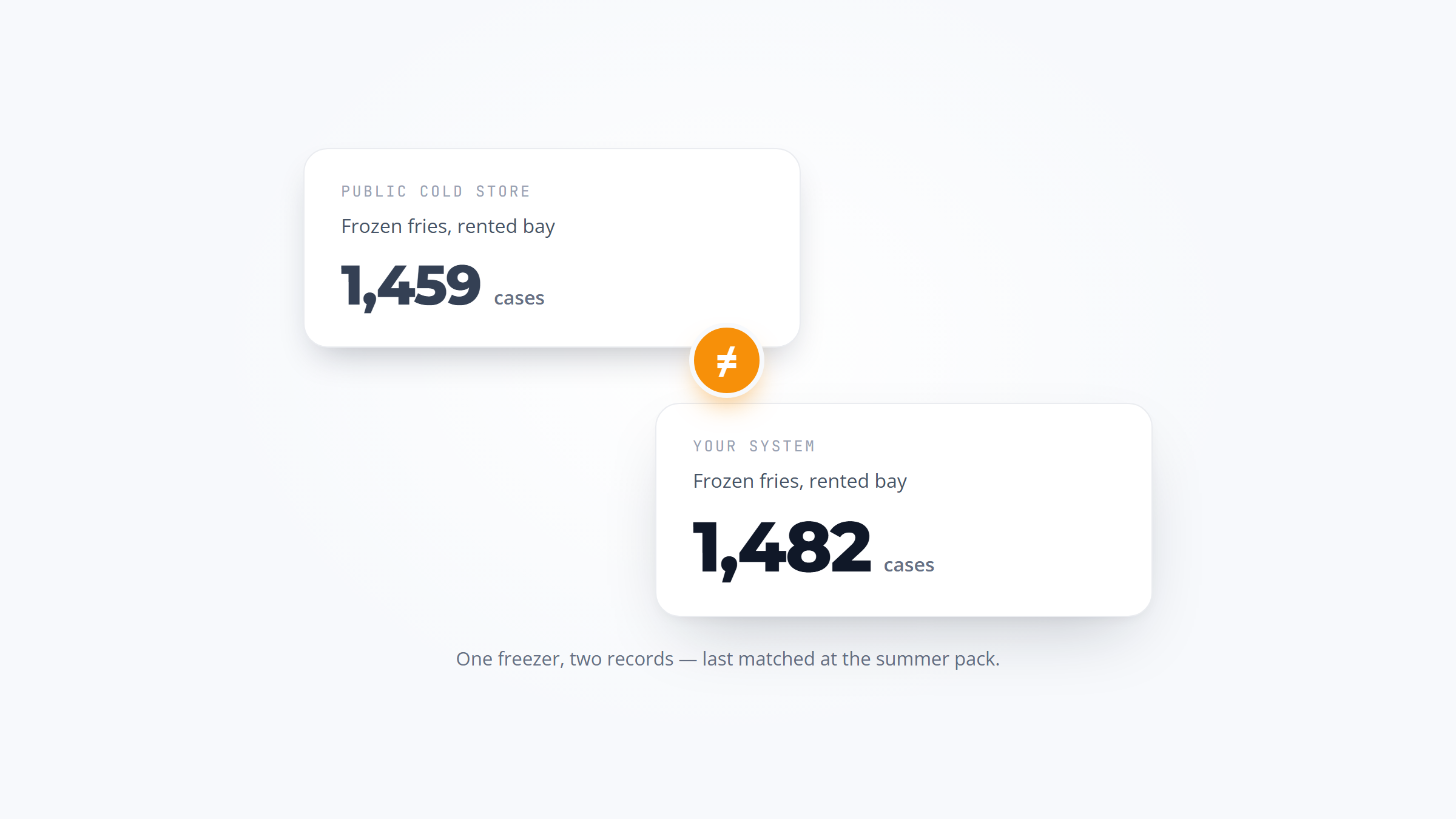
A frozen case can sit in a freezer for a year and still be safe to eat, so the trouble with frozen inventory comes from elsewhere: a grocery buyer who rejects a pallet with too little code date left, a glazed shrimp case invoiced at its gross weight, or a third-party logistics (3PL) freezer count that hasn't matched yours since the summer pack.
Frozen food ERP software is built for those problems. It follows lots and dates through freezing, storage and shipping, sells product on its actual weight, and keeps your records in step with the freezers you rent. The hard part: a pallet with nine months left can fail one customer's receiving rule and pass another's.
VoiceOrder Solutions, the publisher's own product, closes the list below as an ordering app food distributors hand to their restaurant and store accounts, so repeat orders the accounts used to call in arrive at the distributor's office as app orders, and the account can check each line first.
Frozen product breaks a few assumptions general systems make about dates and weights. Test each in a demo with your own items, not the vendor's sample data.
Shelf-life minimums are where frozen systems get tested hardest. FEFO ships the earliest-expiring lot first, which is right for rotation and wrong for a retailer that wants, say, at least half the code date left on arrival. The rule has to sit on the customer, so the same lot can go to a foodservice account and stay away from the grocery chain that would refuse it.
Glaze matters most in seafood, where a fillet or shrimp case carries a coat of ice the invoice shouldn't charge for. A frozen seafood processor also needs the species, catch and import records that seafood ERP software keeps, on top of the list above.
Your frozen stock may not sit in a building you run. The USDA NASS 2025 summary of refrigerated warehouse capacity shows how the warehouses split between those that store food for others and those food companies run for themselves.
| Measure | 2025 figure |
|---|---|
| Gross refrigerated storage capacity, October 1, 2025 | 3.99 billion cubic feet |
| Usable freezer space, as a share of usable refrigerated space | 79 percent |
| Refrigerated warehouses | 931 |
| Public warehouses | 476 |
| Private and semiprivate warehouses | 455 |
NASS defines public refrigerated storage as facilities "maintained for storing food for others at specified rates per unit." Just over half the warehouses it counted fall in that group, and the report's highlights credit them with 62 percent of gross refrigerated space, coolers and freezers together. The 79 percent freezer share in the table above also comes from those highlights.
For freezers alone the public share is higher. The report's page 6 table of refrigerated storage by type of warehouse puts public usable freezer space at 1.65 billion of 2.56 billion cubic feet, about 64 percent, so renting pallet positions in someone else's building is an ordinary way to run a frozen business.
That changes what you ask of an ERP. Your system holds one count and the 3PL holds another, and the two drift every time a receipt is keyed late or a pallet is pulled for a sample.
Receiving, put-away and cycle counts in a warehouse management process are where that drift starts, so look for a system that checks itself against the 3PL's records on a schedule, not once a year.
The seven systems below run roughly from the smallest buyer to the largest, as the Best for column shows, and VoiceOrder Solutions sits last because it handles the customer order, not the frozen work.
| System | Best for | Frozen-relevant controls on its pages | Main limitation | Dating rule on its pages |
|---|---|---|---|---|
| Cin7 Core | Small brands selling finished frozen cases | Batch tracking, inventory and orders in one system | Built for many product types, not frozen | FEFO, only with Advanced Warehouse Management |
| Sutton | Small makers wanting published tiers | Bins and locations, lots on production and purchase orders, 10-level recipes | Lots start at Growth; catch weight not named | FIFO on frozen page; FEFO and expired-lot block on food page |
| Acctivate | QuickBooks-based makers selling to retailers | Variable yields, two-way trace, seasonal forecasting | Accounting stays in QuickBooks | Lot expiry dates; no FEFO rule on its frozen page |
| DOSS | Brands using co-packers and 3PLs | Lot expiry and QC, daily 3PL reconciliation | Not a plant ERP | FEFO on food page, FIFO on inventory page |
| inecta | Seafood and protein processors | First Thaw Date, tare gross-to-net, 3PL forms | Usually $150,000+ budgets | FEFO against ship date, plus per-customer rules |
| VAI S2K Enterprise for Food | Processors and distributors with own trucks | Catch weight at three points, 3PL billing, route tools | Glaze handling not named | FIFO or FEFO |
| Oracle Fusion Cloud SCM | Multi-plant producers with IT staff | Dual units per lot, batch records, co-products | No food or frozen page | Expired lots blocked from production; no customer rule described |
| VoiceOrder Solutions | Frozen distributors taking repeat orders | None: it handles customer orders | Not an ERP | None: it takes the order, not the lot |
Sutton, Acctivate, inecta and VAI write frozen food pages; Cin7, DOSS and Oracle are pitched more broadly, so prove their frozen fit in a demo. Then read the dating column against your strictest customer: only inecta's cell names a per-customer rule.

Overview: Cin7 Core is inventory and order management software sold on three published tiers, with user counts that suit a small frozen brand: 5 on Standard, 10 on Pro and 15 on Advanced.
For frozen stock, the catch is that Cin7 enforces FEFO picking only in Advanced Warehouse Management, which Standard doesn't offer, Pro sells as an add-on and Advanced includes, so check your tier before you count on it to stop a picker taking a newer case.
Key features:
Pricing: Cin7's pricing page lists Standard at $349 a month, Pro at $599 and Advanced at $1,199, as its rates for new customers.
Pros: Published prices, team sizes that suit a small brand, FEFO enforcement available.
Cons: No FEFO enforcement on Standard, built for many product types rather than frozen alone, catch weight and glaze to prove in a demo.
Where it fits: A small frozen brand selling finished cases, with no production floor to schedule.
Final verdict: A low-cost start for a small brand, as long as you budget for the Advanced Warehouse Management its FEFO rule depends on.

Overview: Sutton is the new name of Digit Software, founded in 2021 and renamed in September 2026, so older reviews may still say Digit. Its frozen food page covers bins and multiple locations, lots on manufacturing and purchase orders, and recipes up to 10 levels deep, and its inventory page adds nested pallets and containers.
Two limits shape the decision. Lot and batch tracking, traceability, bins and multi-level bills of materials start at the Growth tier, so Starter won't carry a frozen operation.
The frozen page's capability list names FIFO and keeps best-before dates in custom fields, while its food and beverage page describes FEFO and blocks expired lots from picking, so ask which your tier runs. It doesn't name catch weight anywhere on its pages.
Key features:
Pricing: Starter is $320 a month billed annually or $400 billed monthly, Growth is $600 annually or $750 monthly, and Professional is $1,040 annually or $1,300 monthly, for 5, 10 and 15 users.
Pros: Clear published pricing, nested pallets on its inventory page, a choice of four EDI providers.
Cons: Lots only from Growth, best-before dates held in custom fields, catch weight not named on its pages.
Why buyers shortlist it: You can price the tier a frozen operation needs before you speak to sales.
Final verdict: A practical pick for a small frozen maker that sells by the case, once you've seen how it handles expiry rules beyond FIFO.

Overview: Acctivate sells inventory and operations software that runs with QuickBooks, and its frozen food page aims at producers that make their own product and ship to retailers. Batch processing allows variable recipes and yields, which suits a pack line whose output depends on that week's raw material.
Distribution sets it apart at this size. The frozen page lists two-way traceability through to the retailer, multiple warehouses and units of measure, landed cost, EDI and trucks tracked as mobile warehouses, plus seasonal forecasting for packing ahead of demand. Lots carry expiration dates that print on invoices, though the frozen page names no FEFO rule.
Key features:
Pricing: Acctivate prices each package on request, though its pricing page publishes onboarding at $1,000 for each month until go-live, typically about 90 days, and says the package price is a one-time license fee plus an annual subscription.
Pros: Trucks tracked as mobile warehouses, retailer EDI, seasonal forecasting.
Cons: Depends on QuickBooks for accounting, no published package price, EDI and mobile warehouse tools come with Enterprise or as add-ons.
Its real strength: Following a frozen lot from the batch to the retailer and back without leaving a QuickBooks setup.
Final verdict: A good fit for a QuickBooks-based frozen producer that sells into retail and runs its own trucks.

Overview: DOSS is an operations platform for brands that posts to your existing accounting system, whether that's QuickBooks Online, Xero or NetSuite, instead of replacing it. It isn't a plant ERP, so it suits a frozen brand that uses a co-packer and a 3PL more than a processor running its own lines.
For that kind of brand, lots carry expiry dates and QC status, its food page says picking follows FEFO (its inventory page says FIFO, so confirm which applies), trace runs both ways, and AI reads the documents your co-packer sends. Retail EDI includes pallet-level advance ship notices, and DOSS reconciles against 3PL stock daily. It raised a $55 million Series B in March 2026.
Key features:
Pricing: DOSS doesn't publish a price, so plan on a quote.
Pros: Built for co-packed and 3PL-stored product, daily 3PL reconciliation, AI-read co-packer documents.
Cons: Not a plant ERP, no published price, accounting stays in a separate system.
Who it suits: A frozen brand that owns the recipe and the customer but not the freezer or the line.
Final verdict: The strongest pick here for an asset-light frozen brand, and the wrong one if you run your own plant.

Overview: inecta, which spells its name in lowercase, goes deep into frozen-specific detail on its frozen food page. Each lot can carry a "First Thaw Date" attribute, which records when frozen stock was first thawed, and its FEFO logic blocks lots that would expire before the ship date.
Catch weight runs on dual units of measure, with tare deducted at the scale to turn gross weight into net. Shelf-life rules can be set per SKU and per customer, the hardest frozen test above. 3PL forms cover receipts, picks and releases, items on FDA's Food Traceability List carry a flag, and EDI covers the 850, 855, 856 and 810 documents retailers send and expect.
Key features:
Pricing: inecta doesn't list a rate, but it says it usually works with companies budgeting at least $150,000.
Pros: Per-customer shelf-life rules, FEFO tied to ship dates, tare gross-to-net catch weight.
Cons: Usually a $150,000+ budget, a bigger project than the tools above, glaze deduction to confirm in a demo.
Why it's a good frozen food ERP software choice: It names per-customer shelf-life rules and 3PL receipts and releases, two problems this guide opened with.
Final verdict: The deepest frozen fit on the list for a seafood or protein processor with the budget for a full ERP project.

Overview: S2K Enterprise for Food is VAI's food edition, and its frozen page pairs inventory controls with delivery tools. Lots and dates run under FIFO or FEFO, and catch weight is captured at receiving, in production and at shipping, so you invoice the weight of the case that left.
Delivery planning is where it goes beyond the entries above. VAI lists route optimization, a Truck Builder tool and automated 3PL billing, so ask which side of the 3PL relationship that billing covers.
Key features:
Pricing: VAI doesn't publish a price for S2K, so expect a scoped quote.
Pros: Catch weight at three points, delivery tools built in, automated 3PL billing.
Cons: No published price, glaze handling to confirm in a demo.
What it does best: Keeping weights right from the receiving dock to the truck for a company that delivers its own product.
Final verdict: A strong option for a frozen distributor or processor with its own fleet, once a demo shows how it handles glaze.

Overview: Oracle Fusion Cloud SCM is Oracle's enterprise supply chain suite, a different product from NetSuite, which Oracle also sells. It has no food or frozen page, but its February 10, 2026 announcement of 26A process manufacturing features lists what a large frozen producer needs: lot-specific dual units of measure, shelf life, expired-lot blocking, formula and batch records, and co- and by-products.
That makes it a build rather than a ready fit. A multi-plant processor with an IT team should plan for setup work, including any customer shelf-life rule at shipping, which Oracle's pages don't describe.
Key features:
Pricing: Oracle's global price list, dated November 5, 2026, puts Supply Chain Execution at $350 per hosted named user a month, with a 10-user minimum and a 3-year standard term. Its service description lists Manufacturing, Maintenance and Inventory Management as included. The minimum comes to $3,500 a month, or $126,000 over the term.
Pros: Published per-user price, multi-site scale, expired-lot blocking built in.
Cons: No food or frozen page, a 10-user minimum on a 3-year term, setup work before frozen rules run.
Why it made this list: It's the published-price route for a frozen producer that has outgrown mid-market ERP and runs several plants.
Final verdict: Worth scoping for a large multi-site processor, and far more system than a single frozen plant needs.

Best for: Frozen food distributors whose accounts call in repeat orders
Overview: VoiceOrder Solutions isn't frozen food ERP software, and it replaces nothing above. It keeps no lots, weights, freezer counts or ledger.
It's on the list for a problem frozen distributors know well: accounts that call in the same order every week. Picture a weekly call keyed as 6 cases of breaded shrimp where the account asked for 4. The ERP picks, ships and invoices 6, and the error surfaces only as a credit days later.
With VoiceOrder Solutions, your team moves those accounts onto an app where orders come in by voice against the order guide you keep for each one. The account can check each line before sending, so the case count reaching your office is the one the account entered, not one keyed from a call.
Each app order arrives numbered and timestamped, as an emailed PDF, Excel or Word file, over EDI or an API, or inside QuickBooks.
Key features:
Pricing: There's no rate card for distributors, so pricing comes by quote. The demo takes 20 minutes, and the company reports that most distributors finish setup within 24 to 48 hours.
Pros: Lines the account can check before sending, 20 to 30 minutes saved per order by the vendor's estimate, runs alongside your ERP, order guides tied to your own SKUs and pricing, orders captured around the clock.
Cons: Does nothing in frozen ERP work such as lots, catch weight or freezer stock, no help for orders that already arrive by EDI.
How to start using it:
Where it fits beside frozen food ERP: Ahead of the sales order, at the step where a repeat order reaches your team.
Final verdict: Leave it out if you sell only through brokers or retail EDI, and book a demo if your team still takes repeat orders from restaurants and stores by phone.
Book a VoiceOrder Solutions demo
To make the list, each of the seven systems had to show frozen-relevant controls on its own pages: lots and dates at a minimum, then extras such as catch weight or 3PL reconciliation. Prices and features come from each vendor's own site as of November 2026, with the billing basis wherever the vendor states one.
Spread came next, because a frozen dumpling brand with eight staff and a 3PL contract needs a different system from a seafood processor running glazing lines.
Broad food ERP suites compared in the food and beverage industry software roundup aren't repeated here, so check that list if none of these seven fits.
Freezing changes what a date means. USDA's freezing guidance is plain about it: "Food stored constantly at 0 °F will always be safe. Only the quality suffers with lengthy freezer storage."
So a best-before date on a frozen case marks a quality limit, not a safety one, and your customers build their own receiving rules around it.
FSMA 204 brings the second date to watch. Finfish and crustaceans, fresh or frozen, are on FDA's Food Traceability List under FSMA 204, so a frozen seafood processor will have to keep key data for those items at each critical tracking event once the rule applies, unless an exemption covers it.
FDA proposed a later compliance date of July 20, 2028, and the 2026 appropriations act directed FDA not to enforce the rule before then.
Vendor pages don't always keep up, so take the date from the Compliance Date section of FDA's rule page, which still carries an older January 20, 2026 line further down, and ask each vendor to show its Food Traceability List flag on a real item, the way inecta marks those products.
You may not need separate frozen food shipping software at all, because several systems here carry the shipping pieces. inecta, DOSS, Sutton and Acctivate all list EDI, Sutton also offers parcel and LTL connectors, and VAI routes your own trucks while Acctivate tracks stock on them.
Retail EDI is the shipping piece to test most carefully. A grocery chain sends an 850 purchase order, expects an 855 acknowledgment, wants an 856 ship notice before the truck arrives, and gets billed on an 810. If your ship notice lists a pallet the 3PL never loaded, the chargeback lands on you.
So ask each vendor to run that sequence end to end with a 3PL release in the middle. Map that sequence against your own order fulfillment process first, so you know which step each system must cover.
Three of the seven frozen systems publish a subscription price, and the table lists each one with its billing basis.
| System and tiers | Published price | Billing basis |
|---|---|---|
| Sutton Starter, Growth, Professional | $320, $600 or $1,040 a month | Billed annually, 5, 10 or 15 users |
| Sutton, same tiers | $400, $750 or $1,300 a month | Billed monthly |
| Cin7 Core Standard, Pro, Advanced | $349, $599 or $1,199 a month | Per month for new customers; billing term not stated |
| Oracle Supply Chain Execution | $350 per hosted named user a month | 10-user minimum, 3-year standard term |
Headline prices can understate the frozen cost. Sutton's lot tracking starts at Growth, so a frozen operation really starts at $600 a month billed annually, and Cin7 Core enforces FEFO only with Advanced Warehouse Management, an add-on to the $599 Pro tier and included in the $1,199 Advanced tier.
The rest work from a quote. inecta says it usually works with budgets of at least $150,000 rather than naming a rate, Acctivate quotes beyond a published $1,000-a-month onboarding fee, and DOSS and VAI price on request. VoiceOrder Solutions has no rate card for distributors.
For the quoted systems, ask for license, implementation, lot and date migration, EDI setup per trading partner, and 3PL integration as separate lines, so two proposals can sit side by side.
Business type narrows this list faster than any feature, so the table starts there.
| Your business | Start with | Why |
|---|---|---|
| Small brand or maker with 5 to 15 users | Cin7 Core, Sutton | Published tiers for 5 to 15 users |
| QuickBooks-based maker selling to retail | Acctivate | Variable yields, retailer trace, EDI |
| Brand using a co-packer and a 3PL freezer | DOSS | Daily 3PL reconciliation, co-packer documents |
| Seafood or protein processor with glazed product | inecta | Per-customer shelf life, tare gross-to-net, First Thaw Date |
| Processor or distributor running its own trucks | VAI S2K Enterprise for Food | Catch weight at three points, route tools |
| Multi-plant producer with an IT team | Oracle Fusion Cloud SCM | Dual units, expired lots blocked in production |
| Distributor taking repeat orders by phone | VoiceOrder Solutions, beside your ERP | Orders the account can check line by line |
This is an editorial match drawn from each vendor's own pages, so ask for a reference customer in frozen food before you rely on it.
Whichever row you land in, test the seasonal side. A vegetable or berry packer can freeze months of stock in a few weeks, and the inventory replenishment rules you use the rest of the year won't hold while the freezer fills.
Frozen distributors that supply restaurants and stores run on repeat business, and many accounts still send the same weekly order of fries, wings and breaded fish as a phone call or voicemail someone on your team keys into the ERP.
That's where a small error grows. Each called-in order is keyed fresh, so every week is another chance to get a count wrong, and the order fulfillment software your warehouse runs will ship the wrong count accurately every time. With VoiceOrder Solutions, those accounts order in an app instead, so the account can check each line ahead of sending.
Start with the record that costs you most today, whether that's net weight on glazed product, short-dated pallets bounced at a dock or a 3PL count that never matches. Then find your row in the matching table, shortlist two systems, and make each one run your own worst week, ideally the middle of the pack season.
Ask for one screen in every demo: stock by lot and date across your own freezers, the 3PL and anything in transit. The point of inventory visibility software is that this view stays current without hand reconciling, so a system that can't show it sends you back to spreadsheets.
The right frozen food ERP software enforces your customers' dating rules and invoices your real weights without a workaround. Prove that on one product family, then move the rest across.
It's software that runs a frozen manufacturer's, processor's or distributor's lots and dates, catch weight, freezer and 3PL stock, and production. Cin7 Core and Sutton sit at the small end of this list, and Oracle Fusion Cloud SCM at the large end.
Not on its own. FEFO ships the earliest-expiring lot first, while a customer requirement asks whether a lot has enough life left for that account. inecta blocks lots that expire before the ship date and says it keeps shelf-life rules per SKU and per customer. Test any system you shortlist on a customer-specific minimum with your own items.
The scale weighs product, ice glaze and packaging together. Catch weight software should record the actual weight of each case, then take off glaze and tare to reach the net weight you invoice. No entry here states that it deducts glaze: inecta lists tare gross-to-net and notes that glazing is standard on frozen seafood, and VAI captures catch weight at three points, so test glaze on your own cases.
Sutton starts at $320 a month billed annually, though lots begin at Growth, at $600 a month billed annually. Cin7 Core starts at $349 a month for new customers, and FEFO enforcement needs Pro with an add-on, or Advanced. Oracle charges $350 per named user a month with a 10-user minimum, inecta usually works with budgets of $150,000 or more, and the rest quote.
Often not. inecta, DOSS, Sutton and Acctivate list EDI, Sutton adds parcel and LTL carriers, and VAI adds route optimization for your own trucks. Customer orders still have to come in cleanly first, and VoiceOrder Solutions gives distributors a voice ordering app for accounts that call in orders.
If repeat orders still reach your desk as voicemails, a 20-minute demo shows them arriving as app orders the account could check line by line.