Key takeaways:
A buyer at a regional food distributor orders 60 cases of a fresh salsa with an 18-day shelf life, because that's what sold during last month's promotion. This month the promotion runs at a different chain, sales halve, and 30 cases age out in the cooler. Nobody was careless. The buying plan simply didn't know about the promotion calendar or how many days the salsa had left.
Food supply chain management software exists to close that gap. It forecasts demand by item and location, plans replenishment around expiry dates and supplier lead times, adjusts for promotions and, at the logistics end, plans freight and reefer capacity as well. A case of yogurt loses value every day it waits, so a food plan has to count sellable days, while a general inventory tool only counts cases.
This guide covers planning, supplier collaboration, logistics and visibility for food companies and food distributors. Traceability systems and cold-chain sensors are left out, because they answer different questions. The entries run from planning tools that sit on top of your ERP, through enterprise planning suites, to the logistics layer.
Every one of those tools reads its demand from order history, and for many distributors part of that history still starts as called-in orders someone types up hours later. So the list closes with the publisher's own product, VoiceOrder Solutions, an ordering app built for food distributors. It plans nothing, and it's there for the order step the plans depend on.
Four jobs sit under the label, with visibility across them in the larger suites: forecasting demand, planning supply, working with suppliers on lead times and shared stock, and moving product. A system doesn't have to do all four, but it has to handle the food version of whichever ones it does. Run these tests in a demo with your own item data, not the vendor's sample set:
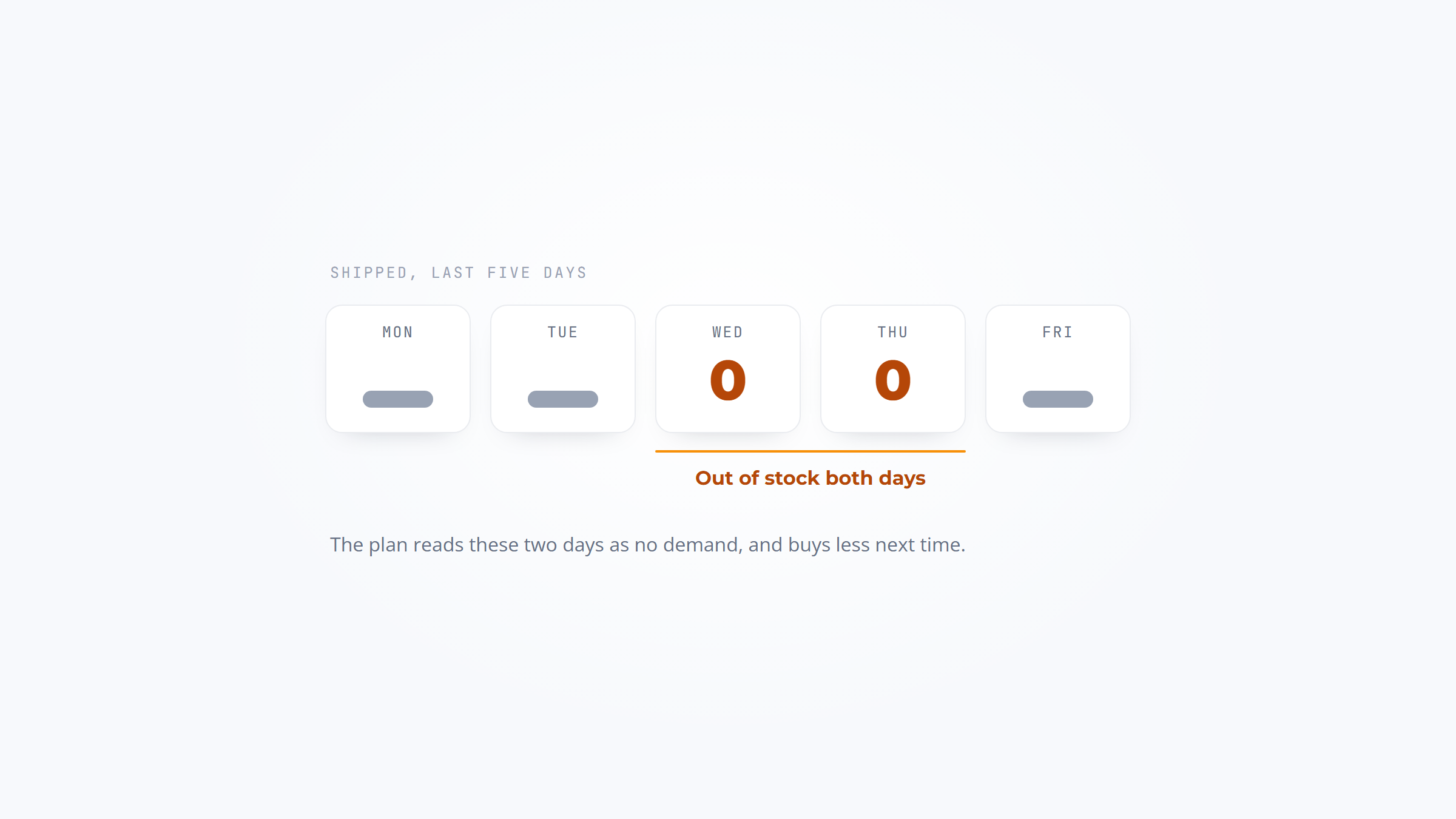
The out-of-stock question matters more than it looks. A forecast built only on shipments learns that nobody wanted a product on the days you had none to sell, and it orders less next time. Blue Ridge names lost sales on its food page, and it's worth asking every other vendor how they handle the same days. The basics of inventory forecasting apply to all eight systems, and what differs is how much food logic sits on top.
Expiry is the other big test. Planning with first-expired, first-out (FEFO) logic assumes the stock expiring soonest ships first and counts only sellable days when it decides how much to buy. John Galt's Atlas and Netstock both list expiry handling, and Arkieva heads a section of its food page "Planning Designed for Perishables".
The eight food supply chain solutions on this list fall into three groups, and the group says more about fit than any feature list. Planning tools sit on top of the ERP you already run. Planning suites take over planning across a large network, and logistics platforms plan the freight.
| Layer | Question it answers | Entries here | Where it usually fits |
|---|---|---|---|
| Planning and replenishment tools | How much should I buy, and when? | Netstock, Blue Ridge, John Galt Solutions, Arkieva | Netstock for small-to-mid distributors; the rest for mid-sized and larger firms |
| Enterprise planning suites | How do I plan demand and supply across many sites? | ToolsGroup, RELEX, o9 Solutions | Large producers, grocers and wholesalers |
| Logistics and transport | How do I get it there on time, in the right truck? | E2open | Shippers running their own freight programs |
| Order intake | What did the customer actually ask for? | VoiceOrder Solutions | Distributors taking account orders |
The last column is an editorial grouping drawn from each vendor's positioning. Order intake sits outside the three groups, and small distributors usually start with the first row. Questions such as where a second warehouse should go or which accounts a hub should serve belong to supply chain network optimization, a separate exercise from the weekly buying plan.
The order below puts the four planning tools first, then the enterprise suites, then the logistics layer. VoiceOrder Solutions sits last because it's the publisher's own product and because it isn't a supply chain system at all. It handles the ordering step in front of one.
| System | Best for | Food planning depth on its pages | Main limitation | Jobs it covers |
|---|---|---|---|---|
| Netstock | Small-to-mid distributors on a mid-market ERP | Expiry, lots, promotions, supplier lead times | A planning layer, annual commitment | Demand, replenishment, supplier lead times |
| Blue Ridge | Food and beverage distributors | Lost sales, promotions, shelf-life constraints | Fees payable annually in advance | Demand, replenishment |
| John Galt Solutions | Shelf-life-heavy planning with VMI | FEFO logic, expiry in planning, S&OP | More platform than a small team uses | Demand, supply, S&OP, VMI, freight |
| Arkieva | Producers planning promotions and lines | Promotion-aware forecasts, shelf life, scheduling | Scheduling depth a distributor won't use | Demand, production scheduling |
| ToolsGroup | Producers with big promotion swings | Perishability-aware inventory optimization | Enterprise scoping | Demand and promotions, inventory optimization |
| RELEX | Larger grocery and foodservice wholesalers | Wholesale page covering fresh goods, plus producer pages | Large suite to scope | Demand, inventory, automated purchasing |
| o9 Solutions | Multi-site producers | Shelf-life and quality management, AI forecasting | Less food detail than John Galt | Demand, shelf-life and quality planning, visibility |
| E2open | Shippers paying OTIF penalties | Reefer capacity, transport, demand sensing | Sized for large shipping programs | Freight, demand sensing |
| VoiceOrder Solutions | Distributors taking account orders | None: it handles customer orders | Not a planning or logistics tool | None of the four: customer order intake |
The jobs and depth columns reflect each vendor's own pages, not a feature audit, so use the demo tests above to check what sits behind them.

Overview: Netstock is an inventory planning tool that runs on top of your ERP, and it's the only ERP-connected planning layer here with a published price. Its food and beverage page covers expiry and batch or lot tracking, supplier lead times, seasonal and promotional demand planning, and replenishment.
That mix suits a small-to-mid distributor that already runs NetSuite, Sage, Acumatica, MYOB or Cin7 Core and still plans its buying in spreadsheets.
Key features:
Pricing: Netstock says pricing starts at $900 a month, sold on annual subscriptions. Ask which items, locations and users the starting tier covers before you set it beside a quote.
Pros: Published starting price, links to common mid-market ERPs, a food page that covers expiry and lots.
Cons: Annual commitment, a planning layer rather than a system of record, transport planning isn't part of its food pitch.
Where it fits: A distributor on one of those ERPs, running one or two warehouses, that wants a better buying plan without replacing it.
Final verdict: The simplest planning layer here to budget for, and a sensible first step for a small-to-mid distributor.

Overview: Blue Ridge is a cloud planning platform from an Atlanta company dating to 2007, and its food page is written for food and beverage distribution rather than for a plant. Its forecasts account for lost sales and promotions, two ways a distributor's demand history misleads a buyer, and plan within shelf-life constraints.
That lost-sales logic is the part to probe in a demo, using the out-of-stock question from the first section.
Key features:
Pricing: Blue Ridge publishes no price. Its terms say fees are payable annually in advance, so plan for one yearly invoice rather than monthly billing.
Pros: Built around distribution, lost-sales logic in the forecast, cloud SaaS.
Cons: No published price, a year paid up front, no transport or freight tools on its food page.
Why buyers shortlist it: It starts from the distributor's buying problem rather than a plant's production plan.
Final verdict: A first call for a mid-sized food distributor whose buyers have stopped trusting the forecast.

Overview: John Galt Solutions is a private company founded in 1996, and its Atlas platform reaches past replenishment. Atlas plans with FEFO logic, builds expiry into planning, and adds demand sensing, sales and operations planning (S&OP) and vendor-managed inventory (VMI).
The VMI piece matters if you manage stock at a customer's site or let a supplier manage yours. A separate Atlas Deliver application plans freight around truck load capacity and routes. John Galt also sells ForecastX, an Excel add-in priced separately from Atlas.
Key features:
Pricing: Atlas is quote-only. The published prices belong to the ForecastX Excel add-in: Lite at $59 a month or the full version at $99 a month, on an annual subscription, plus a one-time $500 per user. That puts year one at $1,208 per user for Lite and $1,688 per user for the full add-in.
Pros: FEFO logic in the plan, VMI and S&OP included, a low-cost Excel option for one planner.
Cons: No published price for Atlas, more platform than a small team may use.
Its real strength: Expiry dates shape the plan itself, from the forecast through to replenishment.
Final verdict: Shortlist Atlas for shelf-life-heavy planning, and treat ForecastX as a separate, cheaper tool for a planner who works in Excel.

Overview: Arkieva's food page has a section headed "Planning Designed for Perishables" and covers promotion-aware forecasting, shelf-life tracking and capacity-aware scheduling. The scheduling piece suits a producer with production lines more than a distributor that only buys and resells.
On the business side, Banneker Partners made a growth investment in Arkieva in April 2025. The results Arkieva quotes on its site are percentages it reports itself, so test them with a reference customer before you count on them.
Key features:
Pricing: Arkieva lists no price, so expect a quote once the scope is set.
Pros: A page written for perishables, demand tied to production capacity, promotion handling.
Cons: No published price, vendor-reported results only, scheduling depth a pure distributor won't use.
What stands out: It ties the demand plan to what the plant can produce in a given week.
Final verdict: Best suited to a food producer that plans production and promotions together.

Overview: ToolsGroup, a Boston company dating to 1993 and backed by Accel-KKR, describes its food offer as "perishability-aware inventory optimization". In plain terms, its stock targets take account of how long each product stays sellable, which makes it food supply chain optimization software in the literal sense.
Promotions are its other focus. Its food and beverage page describes promotional peaks of up to 30 times baseline demand as the problem its planning is built for, which matters for a producer selling into grocery, where a feature week can dwarf an ordinary one.
Key features:
Pricing: ToolsGroup publishes no price; ask for a quote once scope is set.
Pros: Shelf life built into stock optimization, heavy promotion handling, three decades in business.
Cons: No published price, enterprise scoping, more than a small distributor needs.
Why it made this list: It puts perishability and large promotions at the center of its food pitch.
Final verdict: A strong option for a food producer whose volume swings with retail promotions.

Overview: RELEX runs one page written for grocery and foodservice wholesalers, plus separate pages for food producers in fresh food, dairy, meat, baked goods and beverages. The wholesale page covers demand visibility across accounts, automated inventory planning and automated ordering.
The backing behind it is strong: Blackstone Growth and TCV increased their investment in RELEX in December 2024, buying out early investor Summit Partners.
Key features:
Pricing: RELEX publishes no price, so expect a quote.
Pros: A wholesale-specific page that covers fresh goods, producer pages by category, strong investor backing.
Cons: No published price, an enterprise-scale project, likely more than a single-warehouse distributor needs.
Where it beats the alternatives: Among the suites, it's the one with a page written for foodservice wholesale.
Final verdict: The suite to call if you're a larger wholesaler supplying both grocery and foodservice.

Overview: o9 Solutions is a private planning company, and its food and beverage page lists six capabilities, among them shelf-life and quality management, end-to-end visibility and AI-driven demand forecasting. The page gives quality management one sentence, so ask in the demo whether a lot on hold, or one near the end of its life, changes the plan.
Key features:
Pricing: o9 Solutions publishes no price, so expect an enterprise quote.
Pros: Shelf life and quality in one planning view, AI forecasting, enterprise breadth.
Cons: No published price, an enterprise implementation, less food detail on its page than some rivals.
Why it's on the list: It puts quality management on the same page as shelf life and forecasting.
Final verdict: Worth a demo for a multi-site producer that wants shelf life and quality in the same plan.

Overview: E2open is the logistics layer on this list, and WiseTech Global completed its acquisition of the company in August 2025 at a $2.1 billion enterprise value. Its food page goes where the other food pages here stop: on-time-in-full (OTIF) penalties, reefer capacity and transportation management, alongside demand planning and sensing.
That makes it the closest thing here to food delivery logistics software for a large shipper. A load that can't find a refrigerated truck ships late, and a late load against a retailer's window becomes an OTIF fine.
Key features:
Pricing: E2open publishes annual fees only for carriers joining its Carrier Marketplace, from $549 to $42,000 by load volume, and no shipper price, so expect a quote.
Pros: Freight and planning in one place, a food focus on OTIF and reefers, demand sensing.
Cons: No shipper price, an ownership change in 2025 to ask about, sized for large shipping programs.
Why it's a good food supply chain management software choice: It's the only entry whose food page names transportation management and reefer capacity.
Final verdict: The pick for a food shipper whose biggest losses are retailer penalties and missed reefer capacity.

Best for: Distributors fielding called-in orders
Overview: VoiceOrder Solutions replaces nothing above, because it isn't food supply chain management software. It's on this list because each of the eight systems above plans from demand, and the demand a distributor records is its orders.
Called-in orders are the weak point in that record. An order left on voicemail at 9 p.m. gets typed up the next morning, sometimes with a wrong case count and sometimes not at all, and the sales history your planning tool reads carries the error forward.
The fix is to move the accounts that call in onto the VoiceOrder Solutions app, where voice ordering runs on a guide your team curates for each of them. The account can check each line before sending, and each order sent through the app arrives at your office numbered and timestamped. Orders placed after hours sit in a queue for your team to pick up in the morning.
Key features:
Pricing: VoiceOrder Solutions works without a rate card for distributors, prices by quote and offers a 20-minute demo. Setup takes most distributors 24 to 48 hours, according to the company.
Pros: A line check the account can run before sending, after-hours orders waiting in a queue, a timestamped record for each app order, a company-stated 20 to 30 minutes saved per order, quick to get running.
Cons: No forecasting, planning or logistics features, no use unless customer accounts order from you directly.
How to start using it:
Where it fits beside supply chain software: Ahead of the sales order in your ERP, so the app orders your planning tool reads begin with what the account itself sent.
Final verdict: Skip it if every account already orders through EDI, and look closer if your team still replays voicemails each morning.
Each of the eight systems had to show food-specific planning or logistics on its own pages: shelf life or expiry in the plan, promotions, perishables, or food freight problems such as reefer capacity and OTIF penalties. Every price and feature here matches what the vendor's site showed in November 2026.
The four planning tools come first, led by Netstock's published price, since a small-to-mid distributor has the least time for enterprise discovery calls.
Traceability systems and cold-chain monitoring stay out because they record where a lot went and what temperature it saw, while the eight systems here decide how much to buy, make or ship. VoiceOrder Solutions takes the ninth slot for distributors whose demand data starts as customer orders.
Most of what you pay for food goes to activities after the farm. USDA's Economic Research Service, in its Food Dollar summary findings, reports that the farm share was 12.6 cents per dollar spent by U.S. consumers on domestically produced food in 2025.
ERS describes the rest this way: "The marketing share, which captures the share of value added by post-farm activities that transform farm commodities into finished food products, was 87.4 cents. This includes transporting, processing, storing, wholesaling, and retailing food."
Every entry in this list works inside that 87.4 cents, though not all of it: the same page credits 35.5 cents of value added in 2025 to the food services industry group, meaning restaurants and other eating places, which this software doesn't plan. Most planning tools here cover storing and wholesaling, Arkieva and ToolsGroup add the producer's side, and E2open and John Galt's Atlas Deliver plan the freight.
Loss is the other side of it. The ERS loss-adjusted food availability documentation estimates that "133 billion pounds (31 percent of the available food supply at the retail and consumer levels) went uneaten in 2010", worth $161.6 billion. The figures are 16 years old, so read them as scale rather than as today's number.
The estimate covers only retail and consumer levels, so it leaves out cases that age out in a distributor's cooler. A shelf-life-aware buying plan works on exactly that excluded stretch.
Just two of the eight systems publish a price a food buyer can budget with, shown here with each billing basis and year-one cost.
| System | Published price | Billing basis | Year one |
|---|---|---|---|
| Netstock | From $900 a month | Annual subscription | $10,800 at the starting price |
| John Galt ForecastX Lite | $59 a month per user | Annual subscription, plus a one-time $500 per user | $1,208 per user |
| John Galt ForecastX (full) | $99 a month per user | Annual subscription, plus a one-time $500 per user | $1,688 per user |
The two published prices don't describe the same kind of product. ForecastX is an Excel add-in priced per user, while Netstock is a planning layer connected to your ERP, so the gap between $1,688 and $10,800 mostly buys scope.
The other six food supply chain systems quote after a conversation. There's no rate card for distributors from VoiceOrder Solutions either.
As the quotes come in, have each vendor split the subscription, implementation, ERP integration, data cleanup and training, and state the items, locations and users the price assumes. That's how you compare two enterprise quotes and see what the inventory planning work costs beyond the license.
Your type of business narrows this list faster than features do, so find your row first.
| Your business | Start with | Why |
|---|---|---|
| Small-to-mid distributor on NetSuite, Sage or Acumatica | Netstock | Published price, ERP links, expiry and promotions |
| Food and beverage distributor fighting forecast errors | Blue Ridge | Lost sales, promotions and shelf life in the forecast |
| One planner working in Excel | John Galt ForecastX | Low first-year cost per user |
| Producer planning shelf life and production | John Galt Atlas, Arkieva | Atlas for FEFO and VMI, Arkieva for scheduling |
| Producer selling into heavy retail promotions | ToolsGroup | Perishability and promotion spikes |
| Larger grocery or foodservice wholesaler | RELEX | Wholesale page covering fresh goods |
| Multi-site producer with quality holds | o9 Solutions | Shelf life and quality in one plan |
| Shipper paying OTIF penalties | E2open | Reefer capacity, transport management |
That table is an editorial match built from each vendor's positioning, so confirm it with a reference from your own food category before you buy.
Your network shape matters too. If you run a hub-and-spoke distribution model, plan the hub first and let the spokes pull from it, because a planning tool that buys separately for every branch will carry the same short-dated stock in every branch.
For a food distributor, the chain has two ends most planning tools here don't cover: the truck and the order. For large shippers, E2open covers the truck. A smaller distributor usually handles routes in its ERP or a separate routing tool, and food delivery logistics software at that size is a different purchase from a buying plan.
The order end is where VoiceOrder Solutions fits. It gives your team an app to put its call-in accounts on, so orders placed through it reach your office numbered and timestamped, which is the input your distribution workflow software works from.
Start with the loss you can name. If short-dated stock is going to waste, test expiry handling first. If promotions leave you over or short, test the promotion lift, and if retailers are fining you for late loads, measure your ETA accuracy on each route and call E2open.
Your size comes next. A distributor with one or two warehouses rarely needs an enterprise suite, while a producer with several plants usually outgrows a single-planner add-on. Run the five demo tests from the first section, and pilot one category before you roll the system out across the catalog.
Whichever vendor you choose, clean item data, honest supplier lead times and a weekly review your buyers keep will decide the result. If buyers still override most suggestions after the pilot, fix the item data before blaming the system.
It's software that plans how food moves from suppliers to customers: demand forecasts, replenishment around expiry dates and lead times, promotions, supplier programs such as vendor-managed inventory, and in some cases freight. Netstock and Blue Ridge sit at the planning-tool end, while ToolsGroup, RELEX and o9 Solutions are enterprise suites and E2open adds transport.
No. Traceability software records where each lot came from and where it went, which you need for a recall. Supply chain software decides how much to buy, make and ship, and when. This list covers only the planning and logistics side.
Netstock's entry price is $900 a month, sold as an annual subscription. For one planner in Excel, ForecastX runs $1,208 per user for Lite or $1,688 per user for the full version in its first year, including a one-time $500 fee per user. The other six vendors, and John Galt's Atlas platform, quote after a conversation.
Netstock suits that buyer best: it publishes a price and links to mid-market ERPs. Blue Ridge writes its food page for distribution but names $100M to $5B in revenue as its main market, so it fits a mid-sized distributor better. If one planner works alone in Excel, John Galt's ForecastX is the cheapest way to start.
No. They read order history from your ERP and plan from it. If accounts still call in orders, your team keys them in first. VoiceOrder Solutions works on the call-in part of that step: food distributors move those accounts onto its app, where they order by voice against the guide the distributor keeps, and orders reach the office by email, EDI, API or QuickBooks.
A buying plan can only be as accurate as the orders behind it, so a distributor whose overnight orders still arrive as voicemail may want to fix that input before signing a planning contract.