Key takeaways:
Direct store delivery is a business where the paperwork is the product. A driver leaves with a truck full of inventory, sells some of it, delivers the rest against orders taken last week, takes back damages and out-of-code stock, collects payment at some stops and extends credit at others, and comes back with a vehicle that has to reconcile to the penny against what it left with.
Route accounting software exists to close that loop. It is not route optimization, which decides the order of stops, and it is not an ERP, though several of the systems here sit next to one. It is the ledger of the route.
How punishing that ledger gets depends on the network behind it, because a hub-and-spoke distribution model puts a transfer step between depot and truck that direct delivery from one depot never has to reconcile.
All eight options below were read off their vendors' own pages in October 2026, and every price quoted here came from the company that charges it. They are ordered from the most complete route accounting systems down to adjacent tools that handle one part of the job well, and VoiceOrder Solutions appears last because it covers the step before the route rather than the route itself.
A route accounting system holds four records and keeps them consistent with each other: truck inventory, the transaction at each stop, the money, and the settlement when the truck comes back.
Truck inventory is the record that causes the most trouble. The vehicle is a moving warehouse with its own stock record, and every sale, delivery, return, damage and sample has to move quantity out of it. A system that cannot do this makes the warehouse count wrong rather than the truck count wrong, which is harder to find.
The stop transaction is where presell and van sales diverge. On a presell route the driver is delivering against an order already in the system. On a van sales route the driver is creating the order at the shelf, pricing it, and printing or emailing the invoice before leaving.
Settlement is the end-of-day reconciliation: cash collected, checks, credit terms extended, returns accepted, inventory remaining. Settlement is the feature that separates genuine route accounting from field sales software with a delivery module bolted on.
The fourth piece is what the back office receives. Most distributors running direct store delivery want all of it landing in the general ledger without anyone re-keying it, which is why the integration list matters as much as the mobile app.
The table below compares operating model, whether the system invoices at the stop, whether it works without a signal, and what it costs. Offline capability is not a nicety: a basement stockroom with no bars is where a route day stops.
| System | Best for | Presell or van sales | Invoices at the stop | Works offline | Price (and the unit it bills) |
|---|---|---|---|---|---|
| eoStar | Beverage distributors in the three-tier system | Both | Yes | Yes | Not published |
| Advantage Route Systems | Route sales and equipment service businesses | Both | Yes | Yes | Not published |
| bMobile Route | Food and beverage DSD with DEX requirements | Both | Yes | Yes | Not published |
| LaceUp Solutions | Distributors on Microsoft Dynamics | Both | Yes | Yes | Not published |
| inSitu Sales | Distributors wanting published pricing | Both | Yes | Yes | $200 to $429 a month for 3 users |
| SimplyDepo | Field sales teams adding route work | Presell-led | Yes | Yes | $69 per rep a month, billed annually |
| The Full Truck | Independent drivers and owner-operators | Van sales | Yes | Not stated | $12.99 to $99.99 a month by tier |
| VoiceOrder Solutions | Capturing orders before the route | Order capture only | No | Not applicable | Pricing on request |
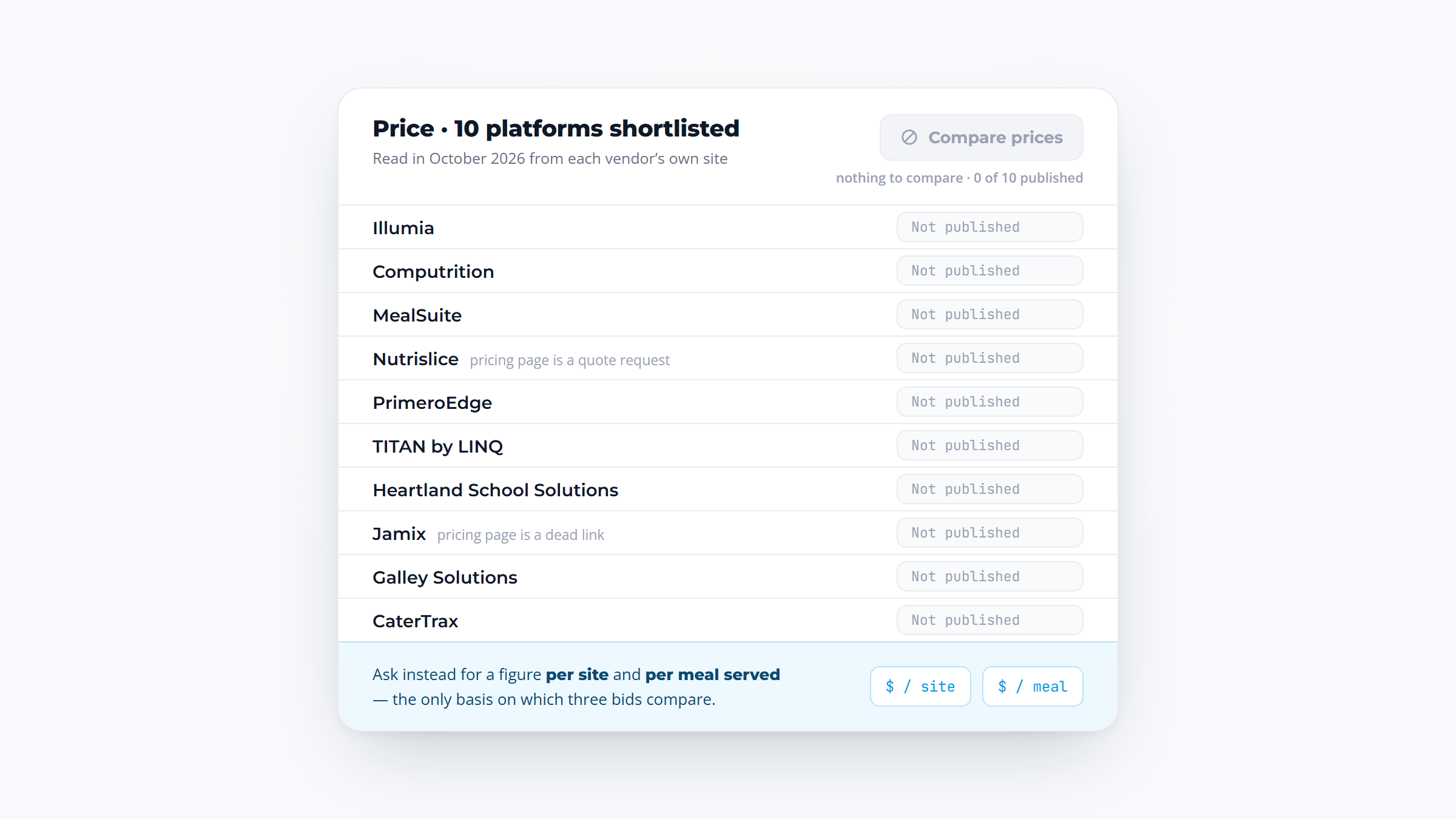
Five of the eight, VoiceOrder Solutions among them, publish nothing on price. Quote-based pricing is the normal posture for software sold by implementation in this category, and the three systems that do publish are the three sold by self-service signup. Read down the entries to find your operating model first.

Overview: eoStar is the route accounting platform most often found in regulated beverage distribution, built for the three-tier system where compliance obligations sit alongside the commercial ones. It runs as an ecosystem rather than a single product, with warehouse management, voice picking, palletization and mobile modules available alongside the core.
eoStar operates as a division of VIP and says more than 14,000 distribution professionals use the platform.
Key features:
Pricing: Not published. eoStar scopes each deployment and sells through its own team from Holland, Michigan.
Pros: The deepest beverage and compliance functionality here, mature warehouse modules, large installed base, modular rather than all-or-nothing.
Cons: No published price, sized for established distributors rather than small ones, implementation runs long, breadth means a longer configuration.
Why buyers shortlist it: Regulated beverage distribution has reporting obligations that general DSD software simply does not carry.
Final verdict: The default choice for a beer, wine or spirits wholesaler of any scale.

Overview: Advantage Route Systems sells three separate route accounting products rather than one with tiers, which is unusual and useful. Advantage is the streamlined, ready-to-go option, RMA is the feature-rich platform with desktop software and mobile apps, and Prism ServQuest is the customizable one with a full accounting system or connectors.
Advantage Route Systems serves route sales, DSD and equipment service businesses, which is a wider net than most here cast.
Key features:
Pricing: Not published. The route to a number is a walkthrough with its team.
Pros: Genuine product choice rather than tiers, covers equipment service alongside delivery, established in water and beverage delivery, flexible accounting approach.
Cons: No published price, and three products makes the first conversation longer.
Where it fits: Businesses that deliver and service equipment on the same route, which few systems handle together.
Final verdict: Worth a conversation precisely because the smallest product is a real product.

Overview: bMobile Route is aimed squarely at food and beverage DSD, with named configurations for bread and bakery, snack food, tortilla, and beverage and dairy. It covers route management, warehouse management and third-party logistics operations from one platform.
Its integration list is the most practical detail about it.
Key features:
Pricing: Not published.
Pros: DEX support is rare and specific, named configurations per food category, works with mainstream accounting systems, hardware guidance included.
Cons: No published price, broken pricing page makes evaluation slower, 3PL breadth is irrelevant to most DSD operators.
Its real strength: DEX, which is a hard requirement for anyone delivering into major grocery.
Final verdict: The strongest fit for a food DSD operator delivering into chain grocery.

Overview: LaceUp sells DSD route accounting software designed to attach to an ERP rather than replace one, and it publishes its integration targets prominently: Microsoft Dynamics 365 Business Central, Dynamics 365 Finance and Operations, and Fishbowl Inventory.
That makes it the natural shortlist entry for a distributor already committed to Microsoft.
Key features:
Pricing: Not published.
Pros: Built to sit beside a real ERP, clear integration story, bilingual support, focused product rather than a suite.
Cons: No published price, broken pricing page, less useful if you are not on Dynamics or Fishbowl, thinner compliance functionality than eoStar.
Where it beats the alternatives: When the ERP decision is already made and the route layer has to fit it.
Final verdict: The obvious candidate for a Dynamics distributor, and a weaker one for anybody else.

Overview: inSitu Sales covers the sell-and-deliver workflow as one customer-stop transaction, letting route teams sell, deliver, invoice, collect payment and update truck inventory at the stop, including when they are offline.
inSitu Sales is also the only system here that publishes example monthly totals at three, five and ten users.
Key features:
Pricing: Four published monthly plans, each including three users. Starter App is $200 and Starter B2B Ecommerce is $200, Pro is $329 and Enterprise is $429. Additional app users are $34.99 each per month, a 14-day trial runs without a credit card, and NetSuite or SAP Business One setup is a $500 one-time fee.
Pros: Fully published pricing including per-user costs, offline capability, genuine settlement, real ERP integrations, free trial.
Cons: Per-user pricing adds up on a large route team, three users is a small base allowance, lighter on compliance than beverage-specific systems.
What it is genuinely good at: Letting a distributor cost the whole thing before booking a single call.
Final verdict: The easiest system here to evaluate, and a capable one once you do.

Overview: SimplyDepo comes at DSD from the field sales direction, combining visit tracking, retail execution, route management and B2B ordering in one platform. Route work is one capability among several rather than the whole product.
Its pricing is public, per rep, and tiered by team size.
Key features:
Pricing: $69 per rep per month for one to five reps billed annually, $59 for six to fifteen, and $49 for sixteen to forty-nine, with tailored pricing above fifty. Monthly billing is $89 per rep. The SimplyAI assistant is a $19 per rep add-on, there are no setup fees, and there is a 30-day free trial.
Pros: Transparent per-rep pricing with volume breaks, strong retail execution, B2B ordering included, fast onboarding.
Cons: Retail execution emphasis means lighter settlement than dedicated route accounting, per-rep cost grows with headcount, less suited to pure van sales.
Why it made this list: Many DSD operations are really field sales operations with deliveries attached, and this is built for that shape.
Final verdict: Choose it when merchandising and selling matter as much as delivering.

Overview: The Full Truck is built for independent distributors and route drivers rather than for companies with ERP systems and IT departments. It covers the end-to-end route workflow from product catalog through orders, deliveries, payments and profit and loss reporting.
The Full Truck is the only option here that names the owner-operator as its intended user.
Key features:
Pricing: Three published tiers with no user minimums and no annual contract. Starter is $12.99 a month for manual order entry, CRM, expenses and profit and loss reports; Professional is $49.99 and adds the AI invoice scanning and SMS order links; Business is $99.99 and adds up to five team members and QuickBooks Online sync. Every plan carries a 14-day trial with no card required.
Pros: By far the lowest entry price here, no contract or user minimum, genuine P&L reporting for an owner-operator, built for the actual user.
Cons: Not built for multi-route operations, no enterprise integrations, offline behavior is not stated on its site, limited compliance functionality.
Where it fits: The owner-operator who currently runs the route from a notebook and a phone.
Final verdict: The right tool for one to a handful of trucks, and deliberately not more.

Best for: Capturing orders before routing
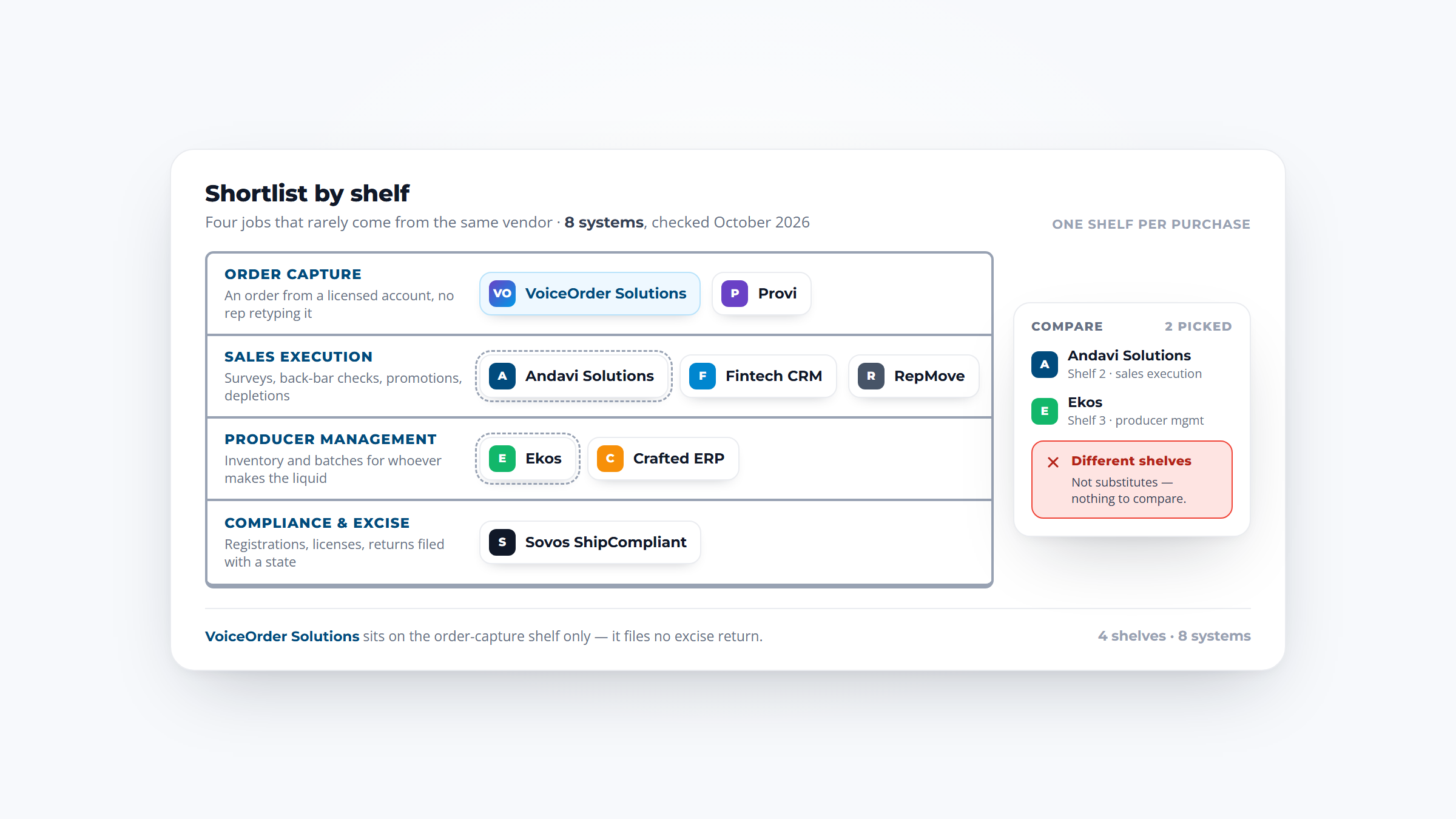
Overview: VoiceOrder Solutions is listed last here because it is not route accounting software and does not claim to be. It is an order capture layer that food distributors deploy for their own accounts, and it solves the step that happens before any system above has anything to work with.
On a presell operation, tomorrow's route is built from today's order file. The more of that file that arrives already confirmed by the account, the less tomorrow depends on anyone reconstructing it afterwards, and redeliveries and credits are where that difference shows up in the ledger.
Setup runs from the order guide the distributor already maintains for each account. Once that is loaded, the account orders by voice against exactly the catalog and pricing the distributor set for it.
Orders then reach the distributor's order desk digitized and confirmed, with every order placed in the app carrying a unique order number, date and timestamp before anyone touches it.
Key features:
Pricing: Quote-based, with no published rate card. VoiceOrder Solutions scopes pricing per deployment, and most distributors are live in 24 to 48 hours.
Pros: Removes the transcription step that creates redeliveries, works for accounts that will never log into a portal, fast to deploy, order history in one admin platform, built for distributors rather than for their customers.
Cons: No public rate card, no routing, delivery tracking or settlement, and no invoicing at the stop.
How to start using it:
Where it fits in a route operation: It sits upstream of everything else on this list, turning the order file that drives tomorrow's route into a clean record. It replaces no part of a route accounting system and removes a chunk of the work that precedes one.
Final verdict: Not a route accounting system, and the place a confirmed order record pays off before anything downstream does. Distributors running a capable route system and still losing time at the order desk are the clearest fit.
Book a VoiceOrder Solutions demo
Each of these systems was evaluated in October 2026 against what its own vendor publishes, prices included. Nothing came from a software directory, which in this category means nothing came from a source that lists superseded tiers under former brand names.
A candidate had to do route accounting rather than something adjacent to it. That is a stricter test than it sounds, and it removed two otherwise plausible names: one sells beverage retail execution and asset tracking with no invoicing or settlement, and the other sells a wholesale distribution ERP with no route product at all. Both would have padded the list and misled anyone shopping by it.
A candidate also had to be a separate company, which is less obvious than it looks in this market. The section below explains why.
Published prices appear here with the unit they bill on, because per-rep, per-user and flat monthly pricing produce wildly different totals at the same headcount. Distributors sizing this against their wider stack usually find the same question arises with order taking software, where the billing unit decides the bill.
Shopping this category turns up two names more than any others, eoStar and Encompass, and a buyer could easily shortlist both believing they are comparing competitors. They are not. They are the same company.
VIP, Vermont Information Processing, acquired eoStar in 2022 along with BizStride Logistics and Backbar, and records it on its own company timeline. eoStar's own logo reads "a division of VIP". In September 2026 VIP announced it had completed its acquisition of Encompass Technologies, joining two of the largest beverage technology platforms under one owner.
This is not a reason to avoid either product. It is a reason to put the same two questions to both: whose roadmap each one sits on now, and who supports it once the integration settles.
If you want a wider comparison set in regulated beverage, Advantage Route Systems and bMobile Route are the nearest independent options, though neither sets out three-tier compliance in the detail those two do. After that you are into general DSD software with compliance handled elsewhere.
Consolidation also moves slowly through product lines, so ask directly which roadmap your deployment sits on and what the support model looks like in two years. Record both answers against the account rather than the conversation, because a supplier that has just been acquired is the case vendor management reviews exist for.
This is the decision that determines which systems can even be considered, and plenty of distributors run both on different routes.
On a presell route, a rep or an ordering system captures the order a day or more ahead, the warehouse picks against it, and the truck leaves with a load nobody has to guess at. Returns stay low and loading stays accurate, and the whole model depends on orders arriving in time for the pick. The constraint is the cut-off.
On a van sales route, the driver carries stock on speculation, sells at the shelf, prices and invoices on the spot, and returns with whatever did not move. The model suits small accounts, cash customers and categories where the buyer decides on sight. The constraint is truck inventory accuracy, because every stop changes it.
Settlement is where the two models diverge most sharply. Presell settlement reconciles deliveries against orders. Van sales settlement reconciles stock out against stock back plus sales plus returns plus cash, and getting that wrong by one case per truck per day is a real number by the end of a month.
The five systems marked for both in the table above do handle both, though not equally well, and asking a vendor to demonstrate a van sales settlement is the fastest way to find out which. Distributors moving from van sales toward presell usually have to rewrite their replenishment rules at the same time, because stock that used to ride on the truck now has to be committed a day earlier.
Three of the eight publish a price. The spread between them is wide, and it is explained almost entirely by who they are built for.
| Scale of operation | Options | What you pay | Published figure |
|---|---|---|---|
| One to a few trucks | The Full Truck | Flat monthly by tier, no contract | $12.99, $49.99 or $99.99 a month |
| A small route team | inSitu Sales | Monthly plan plus per-user | $200 to $429 a month for 3 users, then $34.99 per extra user |
| A growing field team | SimplyDepo | Per rep, tiered by team size | $69, $59 or $49 per rep a month on annual billing |
| An established distributor | eoStar, Advantage, bMobile, LaceUp | Licensing plus scoped implementation | Not published |
Run the arithmetic for your own headcount before drawing conclusions, because the per-unit prices are not comparable. A ten-person route team pays SimplyDepo $590 a month on annual billing against $444.93 for inSitu Sales on the Starter App plan, and at three it is $207 against $200.
inSitu Sales is therefore the cheaper of the two from three users upward, because its plan carries three before the $34.99 additions begin. SimplyDepo only comes out ahead at one or two reps.
The published prices also exclude what established distributors spend most on. Implementation, data migration and integration work are where a quoted deployment's money goes, and none of the four systems in that bottom row will size it without understanding your route count, your accounting system and whether you need DEX. The labor side is the other half of the number, and it is worth costing alongside your delivery accuracy targets.
Software is a small line next to the route itself, which is worth holding in mind when a quote looks expensive.
The Bureau of Labor Statistics puts the median annual wage for driver/sales workers at $38,770 as of May 2025, within a wider occupation of 1,511,400 jobs that it projects growing 7 percent through 2035, much faster than average, with about 152,700 openings a year.
Against that, a SimplyDepo seat at $49 to $89 a month is between 1.5 and 2.8 percent of one driver's wage. The question is not whether the software is affordable but whether it recovers an hour a day of someone's time, and the usual answer sits in settlement and in redeliveries rather than in the driving.
The office cost is the larger half. An account that cannot see where its order is will call, and those calls land on the same desk that takes the orders, which is why order tracking and order capture tend to get bought together.
The demand side is growing too. The Census Bureau's Monthly Wholesale Trade Report put July 2026 sales by merchant wholesalers at $801.3 billion, up 0.8 percent on June and up 13.0 percent on July 2025, which is the kind of growth that exposes manual settlement rather than absorbing it.
Route accounting solutions sort themselves quickly once you fix the operating model, then the ledger, then the price.
If you distribute regulated beverage, eoStar first, with Advantage Route Systems and bMobile Route as the nearest independent options rather than Encompass, bearing in mind that neither publishes three-tier compliance in the same detail.
If you deliver into chain grocery, bMobile Route for DEX. If you run Dynamics, LaceUp. If you want to know the cost before a sales call, inSitu Sales or SimplyDepo depending on whether you think in users or reps. If you own one truck, The Full Truck.
Whichever way that lands, ask every shortlisted vendor to run a van sales settlement with a short-paying customer, a damaged return and two cases that never left the truck. That one demonstration will separate the list faster than any feature comparison.
And if your presell orders still arrive by voicemail, a confirmed order record is worth putting in place alongside whichever system you pick, because none of these can improve on the order it was handed, a point worth weighing against how you handle phone ordering today.
Route accounting software manages the full financial and inventory loop of a delivery route: what stock left on the truck, what was sold or delivered at each stop, what came back as returns or damages, what money was collected, and how the day reconciles. It differs from route optimization, which sequences stops, and from an ERP, which runs the business the routes belong to. Settlement is the capability that defines the category.
Published prices in this list start at $12.99 a month for an owner-operator on The Full Truck's entry tier, run $200 to $429 a month for three users with inSitu Sales, and $49 to $89 per rep per month with SimplyDepo depending on team size and billing frequency. The four systems built for established distributors quote per deployment and publish nothing, which is normal for software sold with an implementation attached.
Presell captures the order ahead of delivery, picks against it in the warehouse, and sends the truck out with a known load. Van sales sends the driver out with stock to sell at the shelf and invoice on the spot. Presell reduces returns and depends on an accurate order cut-off; van sales suits small and cash accounts but makes truck inventory accuracy the daily constraint. Most systems here support both, though rarely equally well.
The established systems do, and offline capability should be treated as a requirement rather than a feature. Drivers routinely work in basements, coolers and back rooms with no usable connection, and a system that stalls there turns a two-minute stop into a ten-minute one. inSitu Sales and SimplyDepo both state offline operation with automatic sync on reconnection; The Full Truck does not address it on its site, which is worth asking about directly.
Most do, and the specific targets vary enough to matter. bMobile Route publishes integrations with NetSuite, QuickBooks and Denali; LaceUp with two Microsoft Dynamics products and Fishbowl Inventory; inSitu Sales offers NetSuite and SAP Business One on its Enterprise plan for a $500 one-time setup fee. Confirm the direction of the sync as well as its existence, since reading customers out is not the same as posting invoices back.
Every system above inherits the order file rather than creating it, so the quality of that file sets the ceiling on what the ledger can tell you.