.webp)
Key takeaways:
Every restaurant loses money it never sees. A few cases of produce spoil in the walk-in, a vendor quietly raises a price, portions drift over spec, and by month end the food cost is three points higher with no obvious culprit.
Multiply that across the industry and the numbers get serious. U.S. restaurants and foodservice generated about 12.5 million tons of surplus food in 2024, and the sector spends roughly $162 billion a year on waste-related costs, according to ReFED. Globally, the FAO estimates a third of all food produced is lost or wasted.
Food inventory software is how modern kitchens fight back. It replaces the clipboard and spreadsheet with live counts, recipe costing, and vendor tracking, so you catch the leaks before they hit the profit and loss statement. This guide reviews the 10 best food inventory software tools for 2026, with verified pricing, screenshots, and honest pros and cons, plus how to choose the right one for your operation.
Food inventory software tracks the ingredients a restaurant buys, stores, and uses, and turns that into food-cost control. Instead of keeping a restaurant inventory list on paper and typing it into a spreadsheet, staff count on a phone, and the system does the math.
Good food inventory management software usually covers a few core jobs. It records live stock counts and flags what is running low. It prices recipes so you know the margin on every menu item. It reads vendor invoices to catch price changes, tracks waste and transfers, and reports your actual food cost against what it theoretically should be.
Many tools also connect to your point-of-sale and accounting systems, so sales draw down stock automatically and the books stay current. What most inventory tools do not do is actually place your restock orders with suppliers. That last step, the reorder, is where a companion tool like VoiceOrder Solutions fits, and it is covered later in this guide.
The table below is the shortlist at a glance. Detailed reviews, with screenshots and verified pricing, follow underneath.
| Tool | Best for | Key features | Main limitation | Pricing (from) | Rating |
|---|---|---|---|---|---|
| MarketMan | Multi-unit food-cost control | Recipe costing, invoice scanning, purchase orders | Add-ons inflate the real cost | $199/month | ★★★★★ |
| MarginEdge | Hands-off invoice automation | Daily invoice processing, live food cost, bill pay | No true self-serve tier | $350/location/month | ★★★★½ |
| Restaurant365 | All-in-one accounting + inventory | Inventory, restaurant accounting, AP automation | Complex, quote-only | Custom | ★★★★½ |
| Craftable | Restaurant + bar margin control | Inventory, recipe costing, AP automation, AI insights | No public pricing | Custom | ★★★★ |
| xtraCHEF by Toast | Existing Toast POS restaurants | Invoice automation, mobile counts, POS-tied COGS | Best value only on Toast | Custom (add-on) | ★★★★ |
| Lightspeed Restaurant | POS plus built-in inventory | Ingredient stock, recipe cost, auto supplier orders | Inventory is a higher-tier add-on | Custom | ★★★★ |
| Apicbase | Scaling multi-outlet groups | Recipe management, procurement, forecasting | Entry tier targets 5+ outlets | Custom | ★★★★ |
| Yellow Dog | Hospitality and venue inventory | Mobile counts, AI invoices, 400+ integrations | Quote-only, broad focus | Custom | ★★★★ |
| WISK | Bar and beverage programs | Pour tracking, variance, Bluetooth scale counts | Beverage-first, food costs extra | $189/month | ★★★★ |
| Sortly | Simple supply and asset tracking | Photo items, QR labels, mobile counts | Not food-specific | Free / $49/month | ★★★½ |
Prices were verified live in 2026. Restaurant tools change pricing and packaging often, so confirm current numbers before you buy.
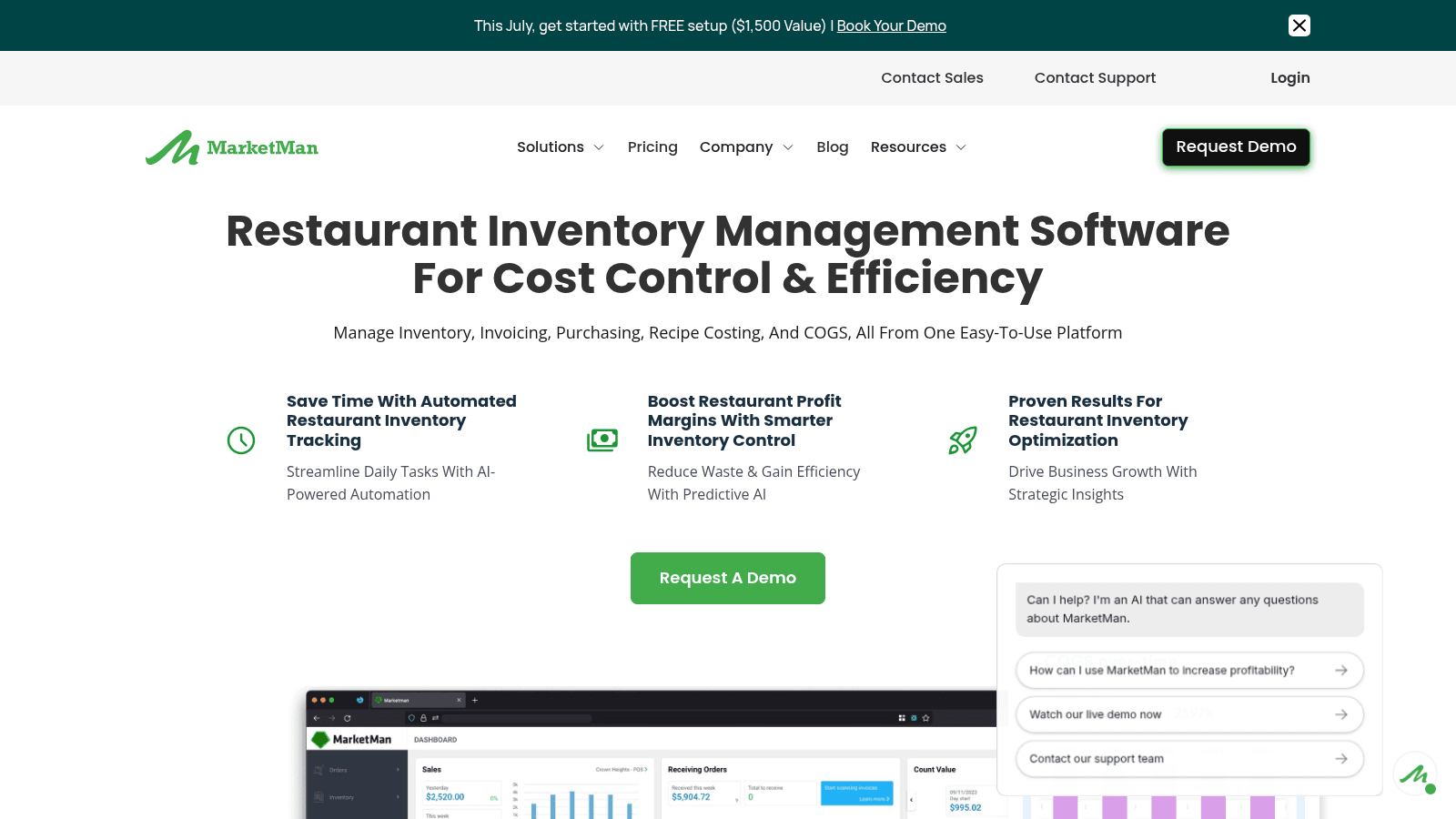
MarketMan is a dedicated restaurant inventory platform rather than a POS with inventory attached, and one of the few here that publishes its pricing. It handles counts, purchasing, recipe costing, and vendor management well, a clean all-round pick for food-cost control at any size.
Key features:
Pricing: Starter is $199 per month and Growth is $249 per month, with Enterprise priced custom. There is no free trial, only a demo, and some features like vendor integrations are paid add-ons.
Pros: Transparent public pricing, strong recipe costing and COGS automation, easy multi-unit rollout.
Cons: Add-on fees can raise the real cost, and it needs a separate POS and accounting system.
Why it's a good food inventory software choice: It combines dedicated inventory depth with transparent pricing, which is rare, and scales cleanly from a single kitchen to a group.
Final verdict: The best all-round food inventory software for restaurants that want serious food-cost control without buying a whole POS.
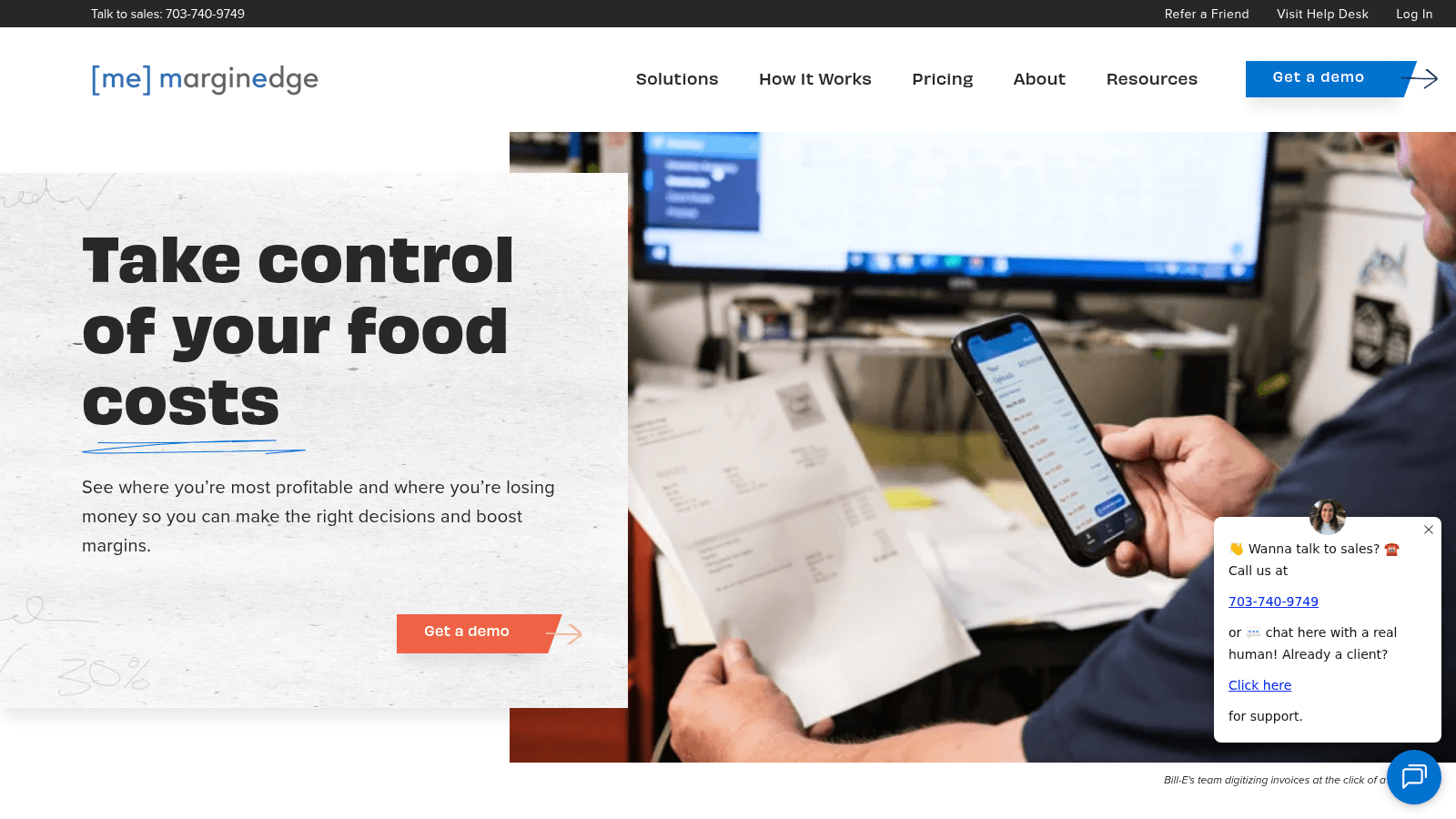
MarginEdge pairs inventory with hands-off invoice automation and one of the clearest pricing models in the category: a flat, all-inclusive fee with no contracts. You photograph invoices, and the system does the line-item entry, updates food cost daily, and can even pay the bills.
Key features:
Pricing: $350 per location per month, flat and all-inclusive, with no contract (10% off if billed annually). Toast users pay an extra Toast integration fee, and a bar add-on (Freepour) is $150 per location per month.
Pros: Flat all-inclusive pricing, excellent invoice automation, no contract lock-in.
Cons: Per-location cost adds up for large groups, and there is no self-serve free tier.
Why it's a good food inventory tool: The flat pricing and daily invoice automation make food cost effortless to keep current.
Final verdict: The best pick for operators who want food-cost visibility without the manual bookkeeping.
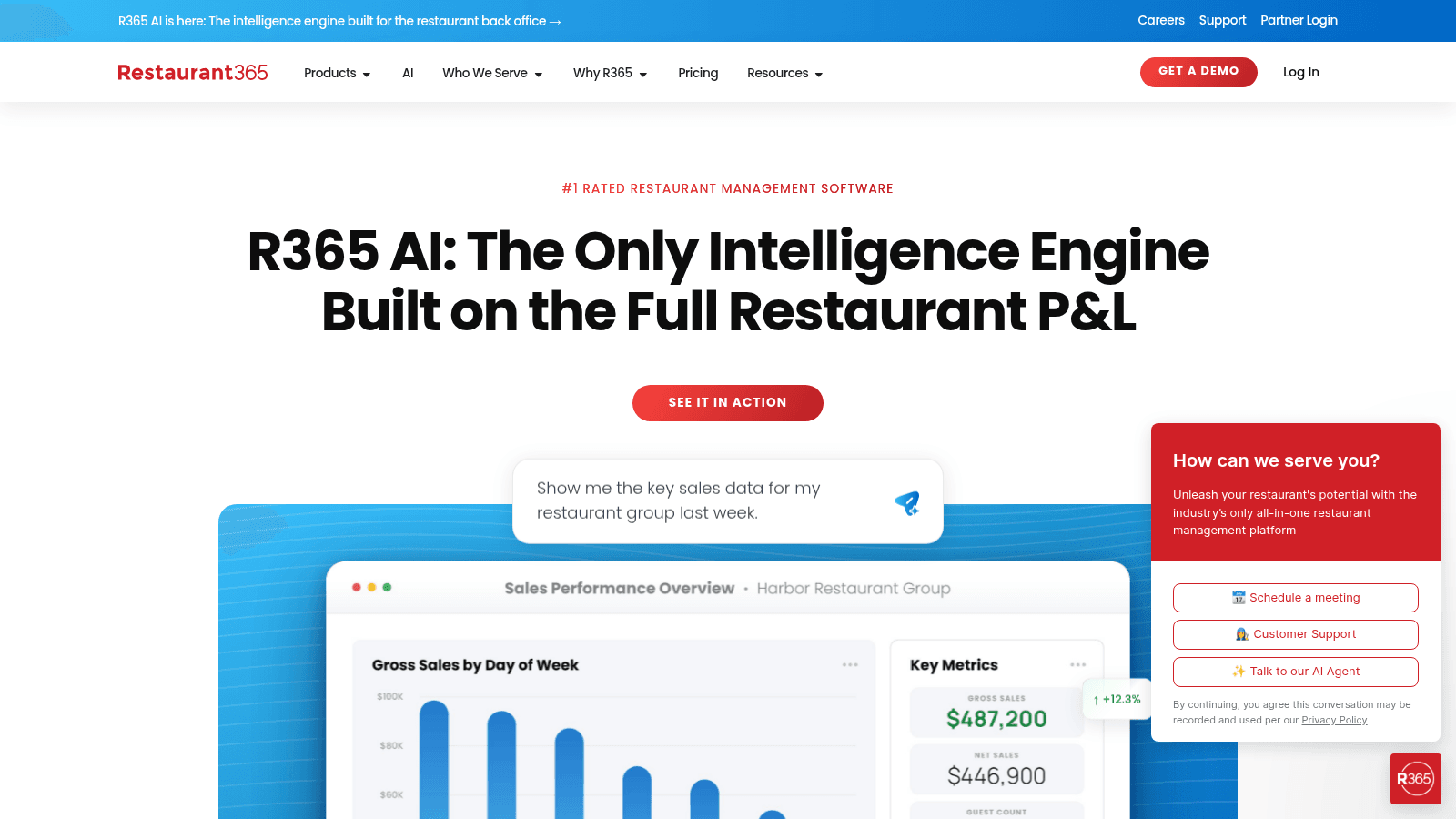
Restaurant365 is an all-in-one platform where inventory sits alongside true restaurant accounting, payroll, and workforce tools. If you want inventory and the general ledger in one system, it is the deepest option here.
Key features:
Pricing: Custom, quote-based, and modular (accounting, inventory and purchasing, workforce, payroll). Demo only, no free trial.
Pros: Deep all-in-one with genuine restaurant accounting, scales to large groups, strong reporting.
Cons: Opaque pricing, the most complex tool here, and overkill for a single independent.
Why it's a good food service inventory management software choice: It unifies inventory with accounting, which multi-location finance teams value.
Final verdict: The right food inventory management software for multi-unit operators who want one system for costs and books.
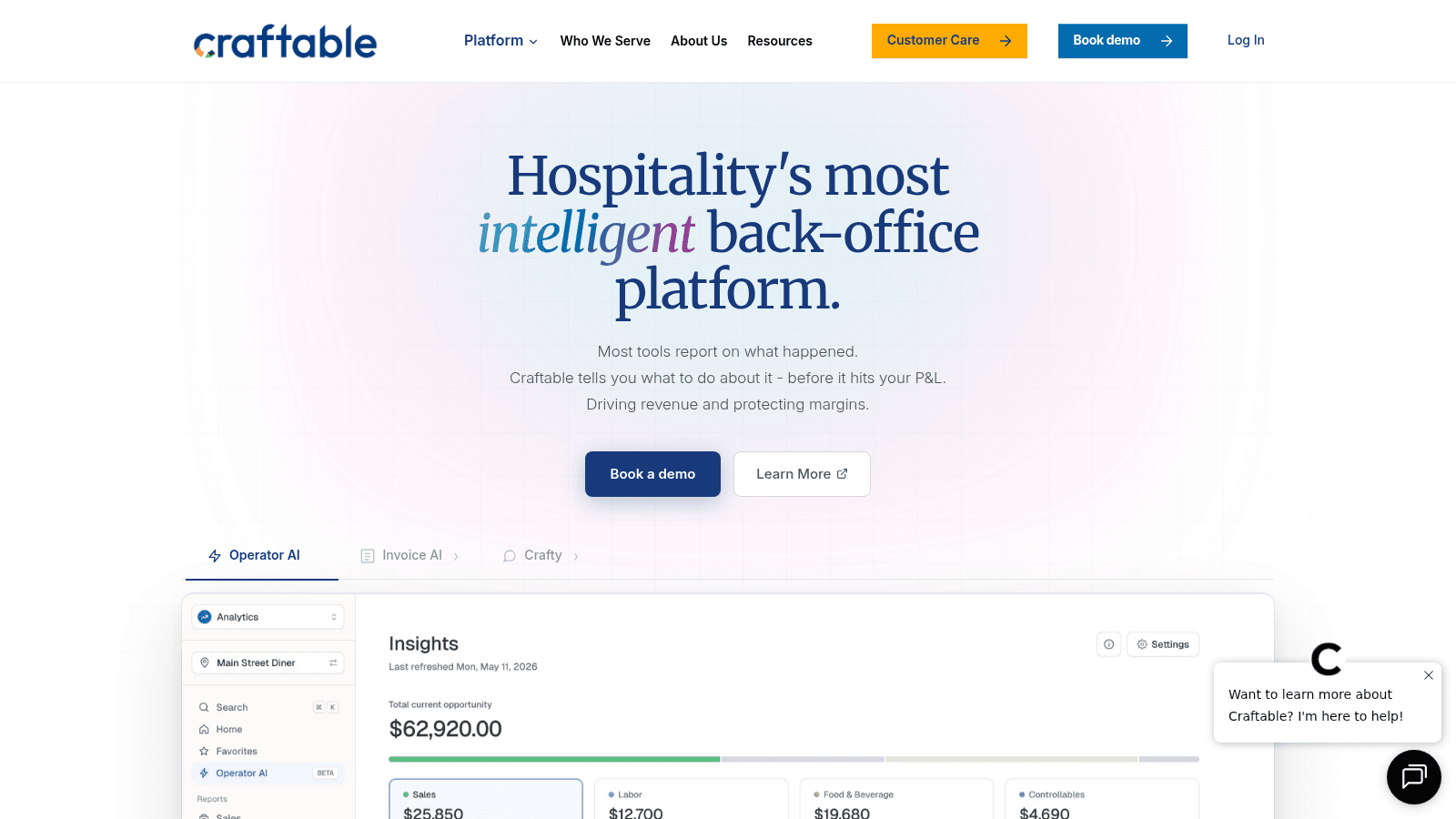
Craftable is a hospitality back-office platform strong on both food and beverage, combining inventory, recipe costing, and AP automation with AI-driven ordering insights. It is a favorite of higher-end restaurant and bar groups.
Key features:
Pricing: Custom, quote-based (no public pricing page). Demo only.
Pros: Strong for food and beverage programs, deep AP automation, useful AI insights.
Cons: No public pricing, enterprise orientation, and module breadth adds onboarding time.
Why it's a good food costing and inventory software choice: Its bar and beverage depth makes it a fit for venues where drinks drive margin.
Final verdict: A polished choice for restaurant and bar groups that want food and beverage cost control in one back office.
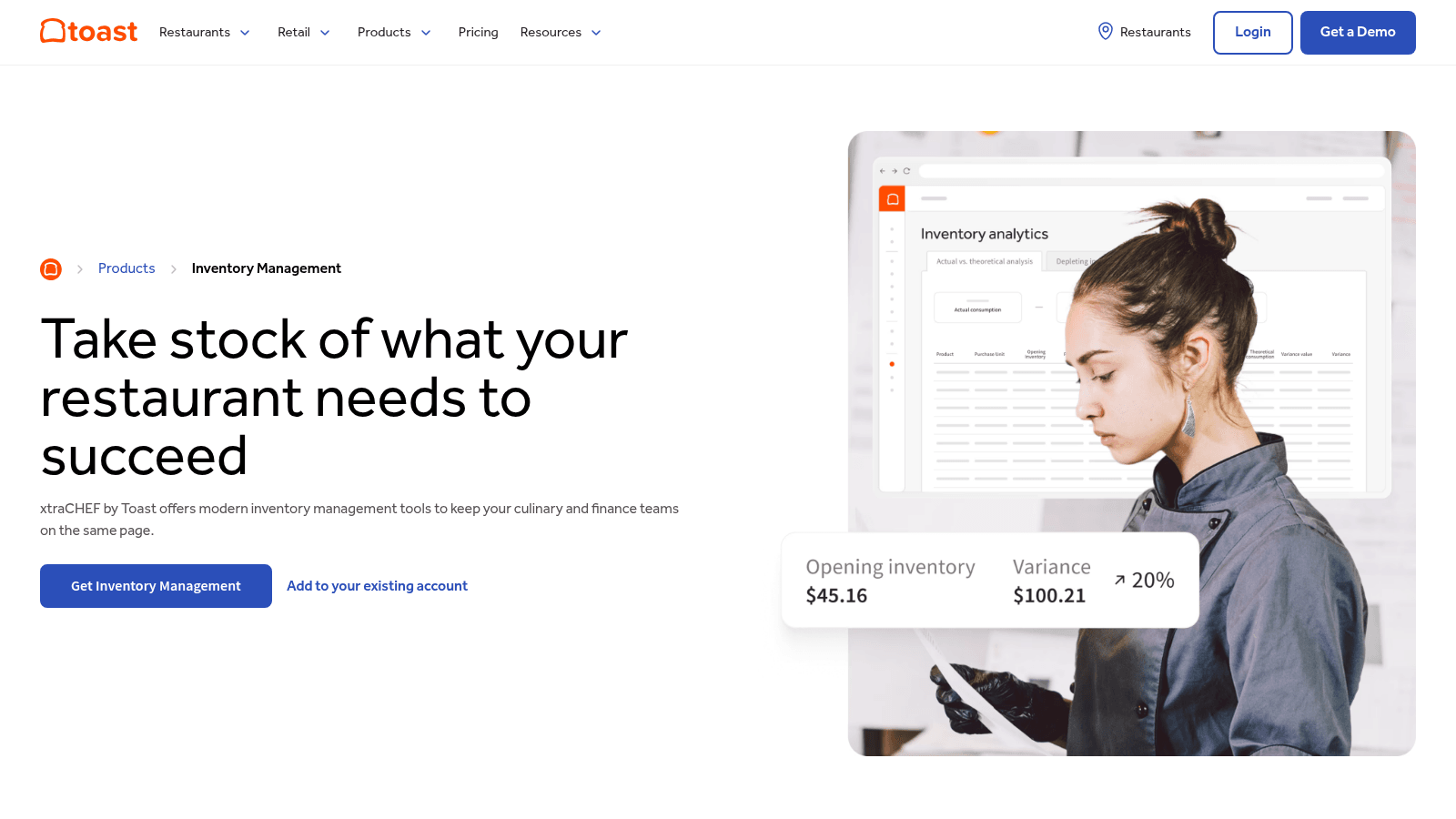
xtraCHEF is Toast's inventory and invoice-automation layer, built to blend recipe costing with live Toast POS sales data. If you already run Toast, it is the most natural inventory add-on you can pick.
Key features:
Pricing: Custom, sold as an add-on within Toast POS packages (Toast POS starts at $69 per month). Demo only.
Pros: Tight native Toast integration, strong invoice automation and recipe costing, mobile offline counts.
Cons: Best value only if you already use Toast, inventory sits behind a higher tier, and pricing is not transparent.
Why it's a good food inventory software choice: For Toast restaurants, sales-to-stock data flows automatically with no extra integration.
Final verdict: The obvious food inventory software pick if Toast is already your POS, and less compelling if it is not.
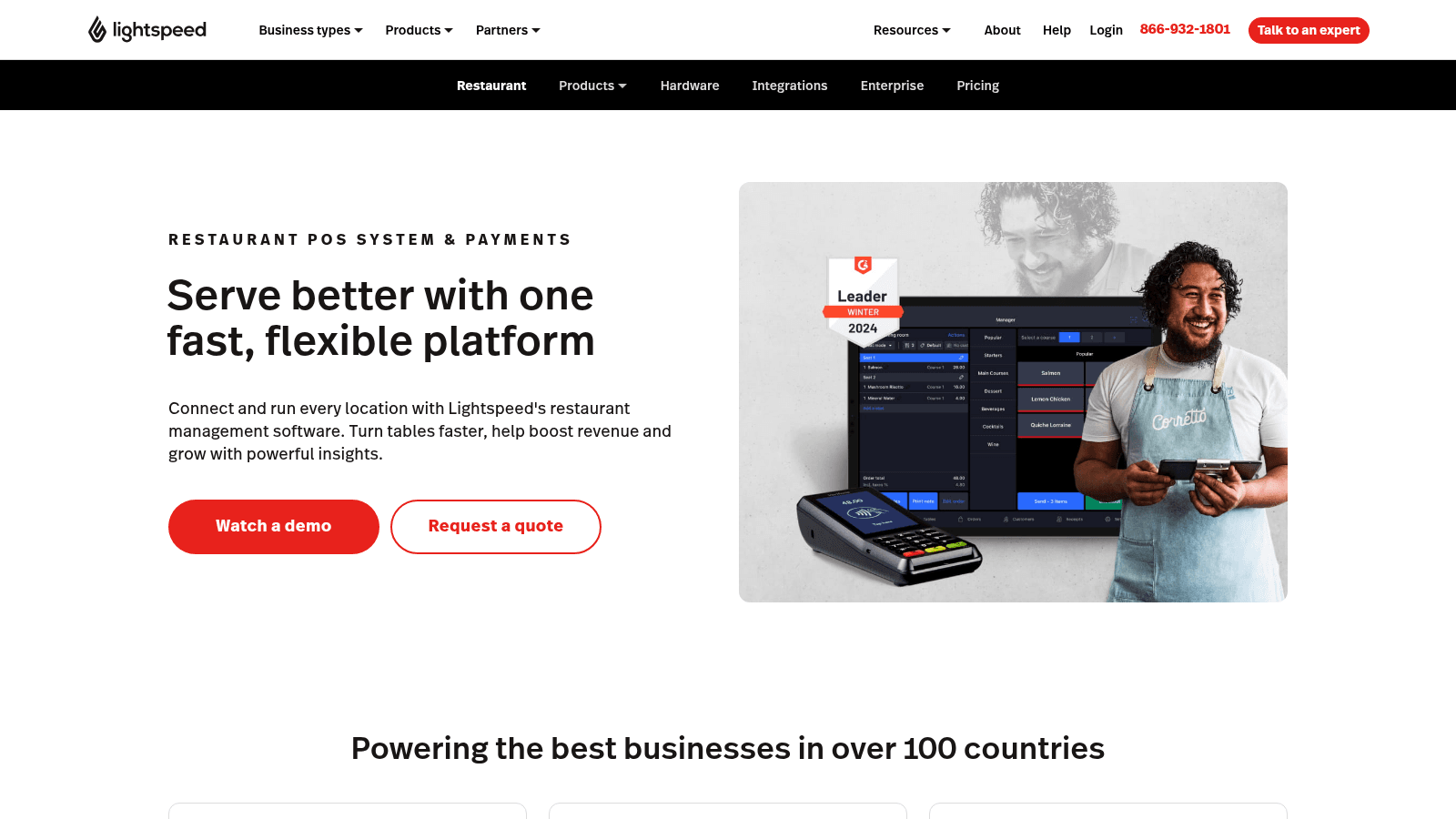
Lightspeed Restaurant is a cloud POS with a real inventory module, tracking ingredients, recipe costs, and low-stock alerts inside the same system that rings up sales. It suits operators who want one platform for front and back of house.
Key features:
Pricing: Custom, with plans shown as "Custom" and inventory available as an add-on on lower tiers. A kitchen display system is $30 per screen per month. Demo only.
Pros: Inventory built into the POS, live sales-to-stock link, scales to multi-location.
Cons: Inventory is a higher-tier add-on, pricing is opaque, and you are buying a whole POS.
Why it's a good food inventory software choice: It removes the POS-to-inventory integration problem by putting both in one system.
Final verdict: A strong food inventory software option for teams ready to run their POS and inventory on one platform.
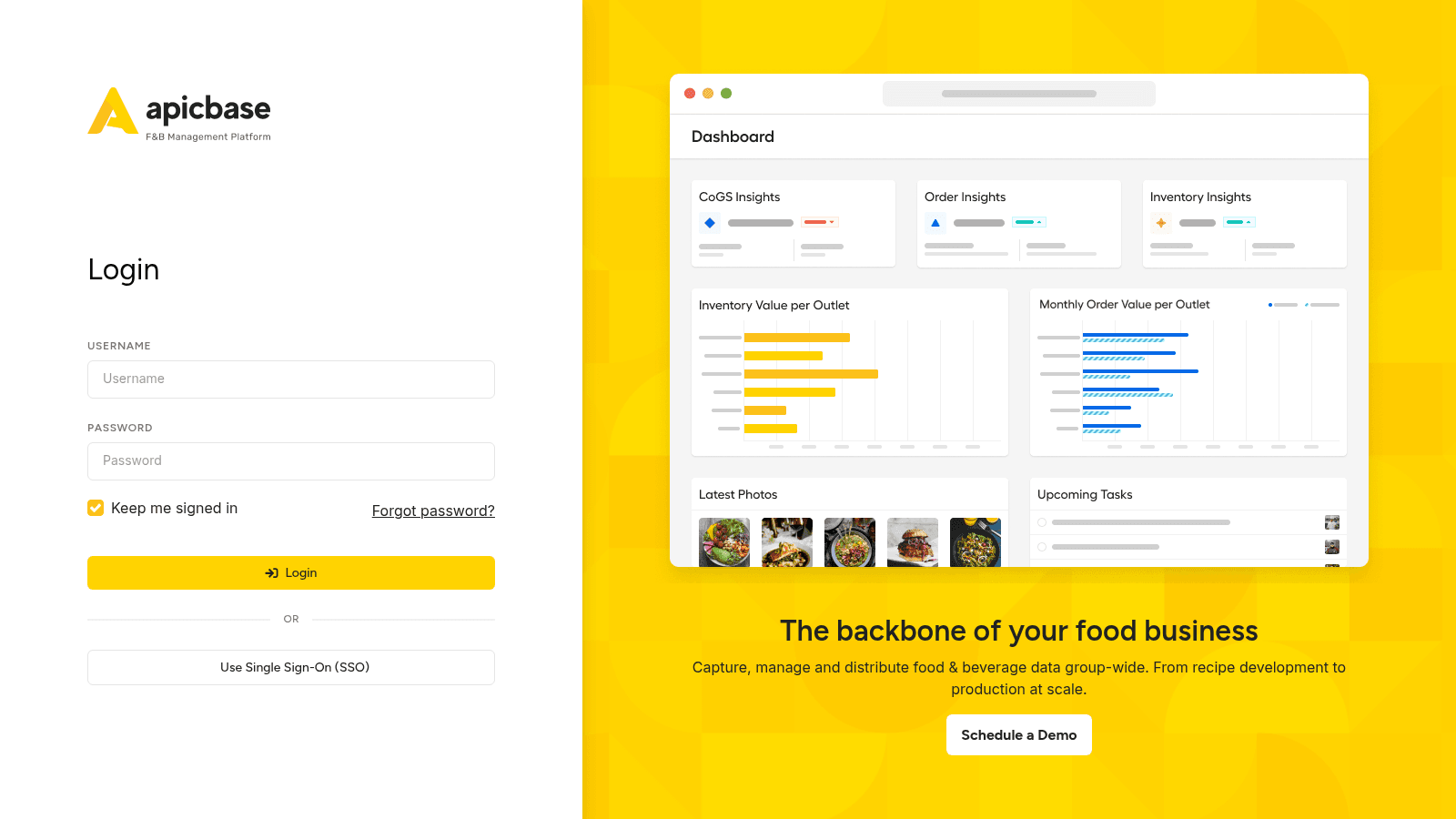
Apicbase is a cloud food and beverage management platform built for multi-outlet groups, connecting recipes, procurement, inventory, and analytics. Its strength is menu engineering and scale.
Key features:
Pricing: Custom, priced by number of outlets, with the entry tier aimed at five or more locations. Demo only, plus paid add-on modules.
Pros: Deep end-to-end back office, built for multi-outlet scale, extensive add-on modules.
Cons: No public pricing, entry tier suits 5-plus outlets, and breadth means a learning curve.
Why it's a good food inventory software choice: It is designed for groups that need recipe, procurement, and inventory control across many sites.
Final verdict: The food inventory management software to shortlist if you run a growing multi-outlet group.
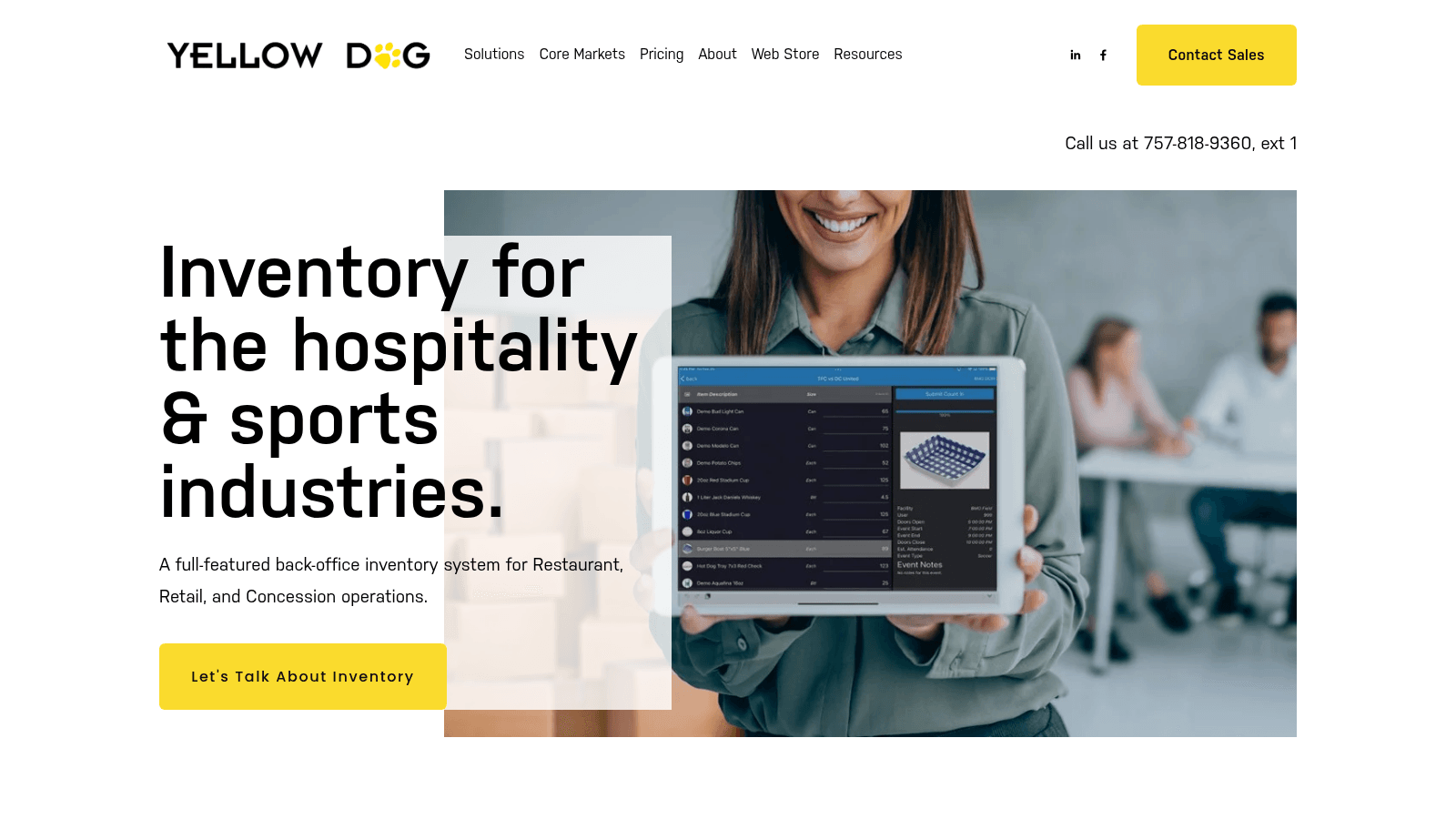
Yellow Dog is a full-featured back-office inventory system for hospitality, concessions, and retail, with unusually broad integrations. It is common in resorts, hotels, and stadiums where inventory spans many outlets.
Key features:
Pricing: Custom, quoted per store by outlets and item count, with monthly-subscription or one-time-license options. Unlimited users and free mobile apps. Demo only.
Pros: Deep hospitality focus, 400-plus integrations, flexible pricing models, built-in waste tracking.
Cons: No public pricing, some POS partners require buying through their marketplace, and the retail breadth can be more than a small restaurant needs.
Why it's a good food service inventory software choice: Few tools handle multi-outlet venue inventory as thoroughly.
Final verdict: The strongest food inventory software for hotels, resorts, and venues with complex inventory.
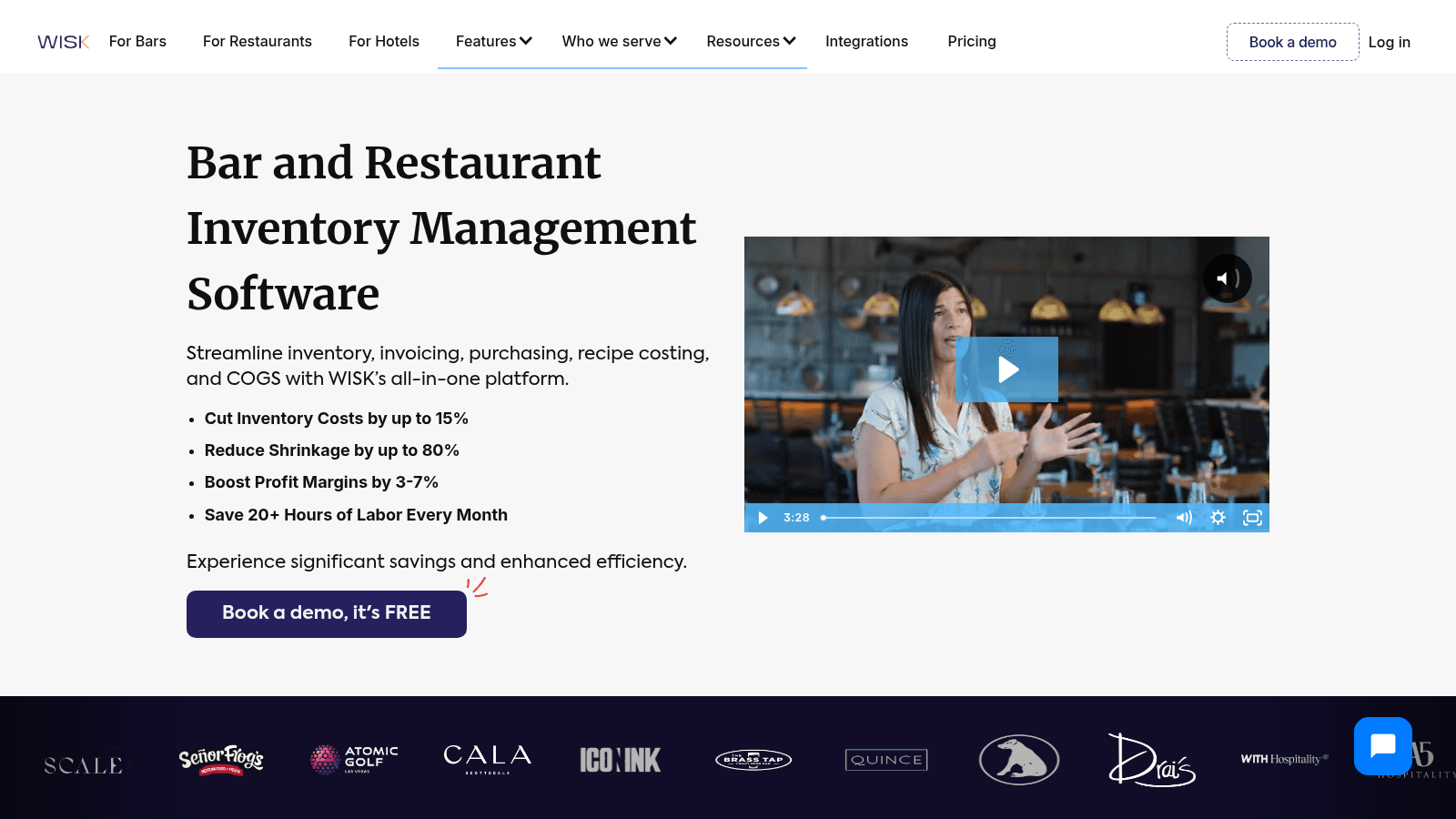
WISK is a per-location beverage and bar inventory platform that tracks pours, variance, and invoices, with food inventory available as a paid add-on. For bar-driven venues, its variance tracking is excellent.
Key features:
Pricing: Essentials is $189 per month per location (billed annually), rising to $249 and $499 for higher tiers, plus setup fees. Food inventory is a $99 to $199 per month add-on. Demo only.
Pros: Best-in-class bar variance tracking, large bottle database and Bluetooth scale, strong POS integrations.
Cons: Beverage-first, so full food inventory costs extra, SKU caps on lower tiers, and setup fees on every plan.
Why it's a good food inventory software choice: For venues where the bar drives margin, its beverage depth is hard to match.
Final verdict: The pick for bar-heavy operations, with food inventory as an add-on rather than the main event.
Sortly is a simple, visual, general-purpose inventory app rather than a dedicated food tool. It has no recipe costing or COGS, but its free tier and photo-based counts make it a fair starting point for tracking supplies.
Key features:
Pricing: A genuine free tier ($0, 100 items), then Advanced at $49 per month, Ultra at $149, and Premium at $299, with a 14-day trial.
Pros: Real free tier and trial, very easy photo-based interface, transparent pricing.
Cons: No food-specific features like recipe costing or COGS, hard item caps per tier, and no restaurant POS integration.
Why it's a good food inventory software choice: It is the cheapest way to start tracking stock and supplies before graduating to a food-specific tool.
Final verdict: A budget, general-purpose option best for small operations that only need simple counts.
We prioritized food inventory management systems built for food and beverage operations, then judged them on the fundamentals that decide food cost: recipe and menu costing, invoice and vendor management, real-time counts, waste tracking, and reporting that compares actual to theoretical usage. Those are the fundamentals any inventory control software has to cover before the extras start to matter.
We also weighed integrations (POS and accounting), ease of counting on mobile, and pricing transparency. Every price and feature here was verified on the vendor's live site in 2026. Tools that could not be verified were left out, and general-purpose or beverage-first tools are flagged as such so you can judge the fit. Operations that produce as well as serve outgrow this list quickly, and food and beverage industry software is the wider category covering both.
Not every kitchen needs every feature. These are the ones that matter most for food inventory control:
One practical note from restaurant operators: your POS often dictates your options. As one owner researching food inventory tracking software put it on Reddit, the shortlist comes down to what integrates with the POS you already run, and plenty of kitchens are still escaping spreadsheets to get there.
Several tools above, including xtraCHEF, WISK and Craftable, report actual-versus-theoretical food cost, and the number only helps if you know what goes into it. The math is simple enough to run by hand once, which is the fastest way to understand what the software automates.
Actual food cost is what you used: beginning inventory, plus purchases, minus ending inventory. Theoretical food cost is what you should have used: the recipe cost of each menu item multiplied by how many you sold, added up across the menu. The gap between the two is your variance.
Here is one month at a restaurant with $50,000 in food sales:
| Line | Amount |
|---|---|
| Beginning inventory | $9,000 |
| Plus purchases | $15,300 |
| Minus ending inventory | $8,550 |
| Actual food cost | $15,750 (31.5% of sales) |
| Theoretical food cost, from recipes and the sales mix | $14,500 (29.0% of sales) |
| Variance | $1,250 (2.5 points) |
That $1,250 is food you paid for and can't account for: waste nobody logged, portions over spec, comps and staff meals rung up wrong, theft, or recipe cards that no longer match the plate. Over a year at the same rate, it is $15,000 from one location.
Food inventory management software runs this calculation every time you count instead of once a month by hand, and it can break the variance down by item. That breakdown is what you can't do by hand at scale: seeing that most of the gap comes from three proteins, or from one location, tells you where to look first.
Two habits keep the number honest. Count the same items the same way each period, and log waste and transfers as they happen, or they resurface later as unexplained variance.
Pricing splits into two camps: a few tools publish flat rates, while most restaurant platforms are quote-based and sized to your locations and item count. This table shows what each one charges.
| Tool | Starting price | Model | Free option |
|---|---|---|---|
| Sortly | Free / $49/month | Per plan, tiered by items | Free tier + 14-day trial |
| WISK | $189/month per location | Per location, annual | Demo only |
| MarketMan | $199/month | Per account, tiered | Demo only |
| MarginEdge | $350/month per location | Flat, all-inclusive | Demo only |
| Restaurant365 | Custom | Quote, modular | Demo only |
| Craftable | Custom | Quote | Demo only |
| xtraCHEF by Toast | Custom | Add-on to Toast POS | Demo only |
| Lightspeed Restaurant | Custom | Quote, add-on | Demo only |
| Apicbase | Custom | Quote, by outlets | Demo only |
| Yellow Dog | Custom | Quote, by store | Demo only |
Watch the add-ons. Vendor integrations, AI ordering, extra invoice scans, and bar modules can lift the real monthly cost well above the headline price, so price your actual feature list before you commit. None of it substitutes for the weekly routine of stock control, which is what makes the numbers in any of these tools worth reading.
Here is the gap most buyers miss. Food inventory software is excellent at telling you what you are low on, but with most tools you still place the restock order yourself, often by phone or a rushed voicemail to a distributor. That handoff is where errors creep back in: wrong quantities, missed items, and orders that never get logged.
Some inventory tools include ordering (MarketMan, Restaurant365, and Lightspeed can generate purchase orders), which helps. The other option is to pair your inventory system with a dedicated ordering tool that closes the loop, a small step toward restaurant automation that pays off at the reorder.
VoiceOrder Solutions is a voice-powered ordering companion for that last step. Restaurant staff place a procurement order to their distributor by speaking it into an app, and the order is digitized, confirmed, and timestamped, then transmitted automatically, with a unique order number and an auto-save if a count gets interrupted.
It is not an inventory platform and does not replace the tools above. It layers on top of them, turning a low-stock signal into a clean, accurate order to the supplier without a phone call or a hand-typed email. For operators whose reorder step is still manual, it removes the errors that inventory counts alone cannot fix.
Match the tool to your operation rather than the highest rating:
Two common mistakes are worth avoiding. The first is overbuying: as one manager noted on Reddit, a heavy platform like Restaurant365 is powerful but pricier because it bundles accounting, so if you only need inventory, a focused tool costs less.
The second is ignoring the reorder step, which leaves a manual gap even after you have great counts. If you are comparing the best POS systems for food inventory management, remember the POS is only half the job; the ordering workflow is the other half.
The tools above are built for kitchens that buy ingredients and sell plates. That model strains once you start producing in batches: a commissary making sauces and doughs for five locations, or a restaurant bottling its dressing for grocery shelves. At that point you need food production inventory management software, which tracks what goes into each batch and where each batch goes.
The differences show up in four places:
Most restaurant tools on this list cost recipes for plates rather than tracing which finished jars contain a particular ingredient lot. Inventory management software for food industry producers fills that gap at several sizes.
Craftybase is built for small-batch makers and gives every batch a lot number. Katana adds batch numbers, expiry dates and shelf-life management to its manufacturing platform. BatchMaster, a food ERP aimed at private-label, co-packing and prepared-food producers, supports FEFO, FIFO and LIFO lot issue and bidirectional lot tracing.
If you're weighing food manufacturing inventory management software against a restaurant tool, the deciding moment is usually your first sale to another business, because from then on a buyer can ask which batch they received. Keep the restaurant tool for the dining rooms, run production in the second system, and price transfers between them at batch cost so each location's food cost still reflects what it received.
For most restaurants, MarketMan is the best food inventory software: dedicated, capable, and transparently priced. Choose MarginEdge if you want flat pricing and hands-off invoicing, Restaurant365 if you need accounting and inventory together, and xtraCHEF if you already run Toast.
Whichever you pick, remember that counting stock is only worth it if the savings survive the reorder. Get the inventory system that fits your operation, then close the loop on ordering so the food cost you worked to control does not leak back out at the last step. Contact VoiceOrder Solutions if automating that supplier-ordering step is where you want to start.
For most restaurants, MarketMan is the best food inventory software, with strong recipe costing, invoice scanning, and transparent $199-per-month pricing. MarginEdge is the best for flat, hands-off invoice automation, and Restaurant365 is the best food service inventory management software for multi-location operators who want accounting built in.
Sortly offers a genuine free tier for simple item tracking, and some distributors provide free tools to their customers. Most dedicated food inventory control software is paid, though, because recipe costing, invoice automation, and POS integration carry real costs. Free tiers work best for very small operations.
Look for recipe and menu costing, invoice and vendor price tracking, real-time mobile counts, waste and variance reporting, and POS and accounting integration. Together these turn raw counts into food-cost control. Supplier ordering is a valuable extra, since it closes the gap between knowing you are low and actually restocking.
Published prices start around $189 to $350 a month (WISK, MarketMan, MarginEdge), while most restaurant platforms such as Restaurant365, Craftable, Lightspeed, and Apicbase are quote-based and sized to your locations and item count. Add-ons for integrations and AI ordering can raise the real cost, so price your full feature list first.
Some can. MarketMan, Restaurant365, and Lightspeed generate purchase orders, and dedicated ordering companions like VoiceOrder Solutions capture the restock order by voice and send it to the distributor cleanly. Many teams still place orders manually by phone or email, which is where reordering errors tend to happen.