.webp)
Key takeaways:
Search for distribution management software and you get three directories, four vendor pages dressed as category pages, and explainers that use the term interchangeably with ERP. Two page-one results are not even the same product: they are Indian FMCG distributor management systems, built for manufacturers tracking claims through a sales channel, which is a different job from running a foodservice wholesaler's back office.
None of it is written for someone who moves perishable product. That is the gap this list is for.
Nine systems are compared below, plus the order-capture layer that sits in front of them. Pricing appears as each vendor publishes it, which for seven of the nine means no public figure at all. That is ordinary here and recorded as a fact rather than a failing.
The honest starting point is that nobody official defines it. Gartner publishes a market definition for warehouse management and a topic page defining ERP, and has no equivalent for this term. It is a market label, sold interchangeably as a distribution management solution and as distribution inventory management software, and vendors mean roughly the same thing by it.
The two anchors on either side are defined, which is enough to place the middle. Gartner's warehouse management definition covers software that helps "manage and intelligently execute the operations of a warehouse, distribution center (DC) or fulfillment center (FC)," with core capabilities that "receive, put away, store, count and pick, pack and ship goods."
Its ERP topic page is far broader: applications that "automate and support multiple administrative and operational business processes, including line-of-business, customer-facing, administrative and the asset management aspects of an enterprise."
So a WMS answers where something is and who picks it, inside one building. An ERP answers what the business did, across finance, people and assets. Distribution management software is the piece between: order guides and contract pricing, purchasing and replenishment, stock across branches, delivery, and the invoice.
Every product sold under the label is one of two shapes: a distribution edition of a general ERP, which is what Acumatica, Sage X3 and NetSuite sell, or a vertical ERP written only for distributors, which is what entrée, Produce Pro, Encompass and Prophet 21 are.
Which shape you buy decides whether food-specific behavior is built in or configured later at your expense, so it matters more than the feature grid. A warehouse system is a component either shape contains or connects to, a boundary we map in warehouse distribution software.
One neighboring category is worth ruling out. Distributed order management software routes orders across fulfillment locations for retail and ecommerce, so it ranks for these searches without belonging here.
A general distribution ERP handles inventory, orders and warehousing well. What it misses is a short list of things that are routine in food and rare everywhere else, and the cost of missing them is unusually high.
The International Foodservice Distributors Association puts the median foodservice distribution business at a 1.8% net profit margin for 2025, on industry sales of $426 billion and 12.8 billion cases a year. At that margin one mis-keyed line can wipe out the profit on several correct ones.
Four gaps account for most of it.
Catch weight. A case of ribeye is ordered as a case and sold by the pound, and the two numbers are not fixed to each other. Software without it forces a workaround on every variable-weight line, and the workaround is where margin leaks.
Order cut-off times. A foodservice day is built backward from a cut-off, because tonight's order book is tomorrow's pick list and tomorrow's route. Software treating an order as something that can arrive at any moment is not modeling the business.
Standing orders and substitutions. Most accounts buy close to the same thing every week, and those who do not usually want a substitute rather than a dropped line. Both are default behavior in food and custom development elsewhere.
Lot traceability to a date code. The FDA's Food Traceability Rule attaches record-keeping obligations to specific foods, and a lot has to survive receiving, repacking and shipping rather than appearing only on the invoice.
Catch weight is the one you can check in about a minute, because vendors sort themselves on it. entrée, inecta and Sage X3 name variable or catch weight on their own pages, and five of the nine say nothing either way.
Blue Link ERP puts the answer in bold on its own food page: its software "does not include catch weight functionality for managing food items with variable weights." That is a vendor voluntarily ruling itself out of meat, seafood, deli and produce, and it is worth more than any analyst grid.
The rows below cover the nine distribution management systems here. VoiceOrder Solutions is excluded, being an order-capture layer rather than a system of record.
| What food needs | Named on the vendor's own site | Not mentioned |
|---|---|---|
| Catch weight / variable weight | entrée, inecta, Sage X3 | Acumatica, Epicor, NetSuite, Encompass, Produce Pro (Blue Link rules it out in writing) |
| Lot traceability to a date code | entrée, Produce Pro, inecta, Blue Link, Sage X3, Acumatica | Encompass, Epicor (NetSuite claims it without naming a mechanism) |
| Order cut-off times | nobody | all nine |
| Standing orders / order guides | entrée, Encompass | the other seven |
| A food vertical at all | entrée, Produce Pro, inecta, Encompass, NetSuite, Sage X3, Blue Link | Acumatica, Epicor |
The third row is the interesting one. Order cut-off times are the spine of a foodservice day and no vendor here publishes a feature for them. Most explanations of distribution management make the same assumption, starting from an order that already exists as data.
The nine systems and the capture layer in front of them, at a glance. Rates appear as each vendor publishes them, and "pricing on request" is recorded without comment, because that is normal here.
| Tool | Best for | Key features | Main limitation | Pricing (from) |
|---|---|---|---|---|
| VoiceOrder Solutions | Replacing phone and voicemail order intake | Voice ordering on each account's own guide, orders numbered and timestamped, delivery by email, EDI, API or QuickBooks | Order capture only, not a system of record | Pricing on request |
| entrée by NECS | Independent broadline foodservice distributors | Catch weight, standard orders and order guides, five cost fields with automatic repricing | Windows client/server, cloud is hosting rather than architecture | Pricing on request |
| Produce Pro Software | Fresh produce wholesalers and repackers | Lot traceability built in from day one, any unit of measure, pick by voice or scan | Server-based, and scoped to produce and perishables | Pricing on request |
| inecta | Food businesses on the Microsoft stack | Catch weight, shelf life, lot traceability, built on Dynamics 365 Business Central | Publishes a $150,000 budget floor | Pricing on request |
| Acumatica Distribution Edition | Growing multi-warehouse distributors | Available-to-promise, distribution requirements planning, warehouse operations in the ERP | No food vertical, and no catch weight named | APEX for Distribution under $1,495/month |
| Sage X3 | Multi-site businesses that make and move product | Variable-weight selling, farm-to-fork lot tracking, multi-entity and multi-country | Its food vertical is written for manufacturers | Pricing on request |
| Oracle NetSuite | Multi-channel distributors wanting one platform | Orders across web, call center, portal and marketplace, multi-location inventory, financials and CRM in one | Thin food page, no catch weight or EDI named on it | Pricing on request |
| Blue Link ERP | Dry, frozen and canned goods importers | Lot tracking for recalls, landed cost, price matrix with contract pricing | States on its own site that it has no catch weight | Pricing on request |
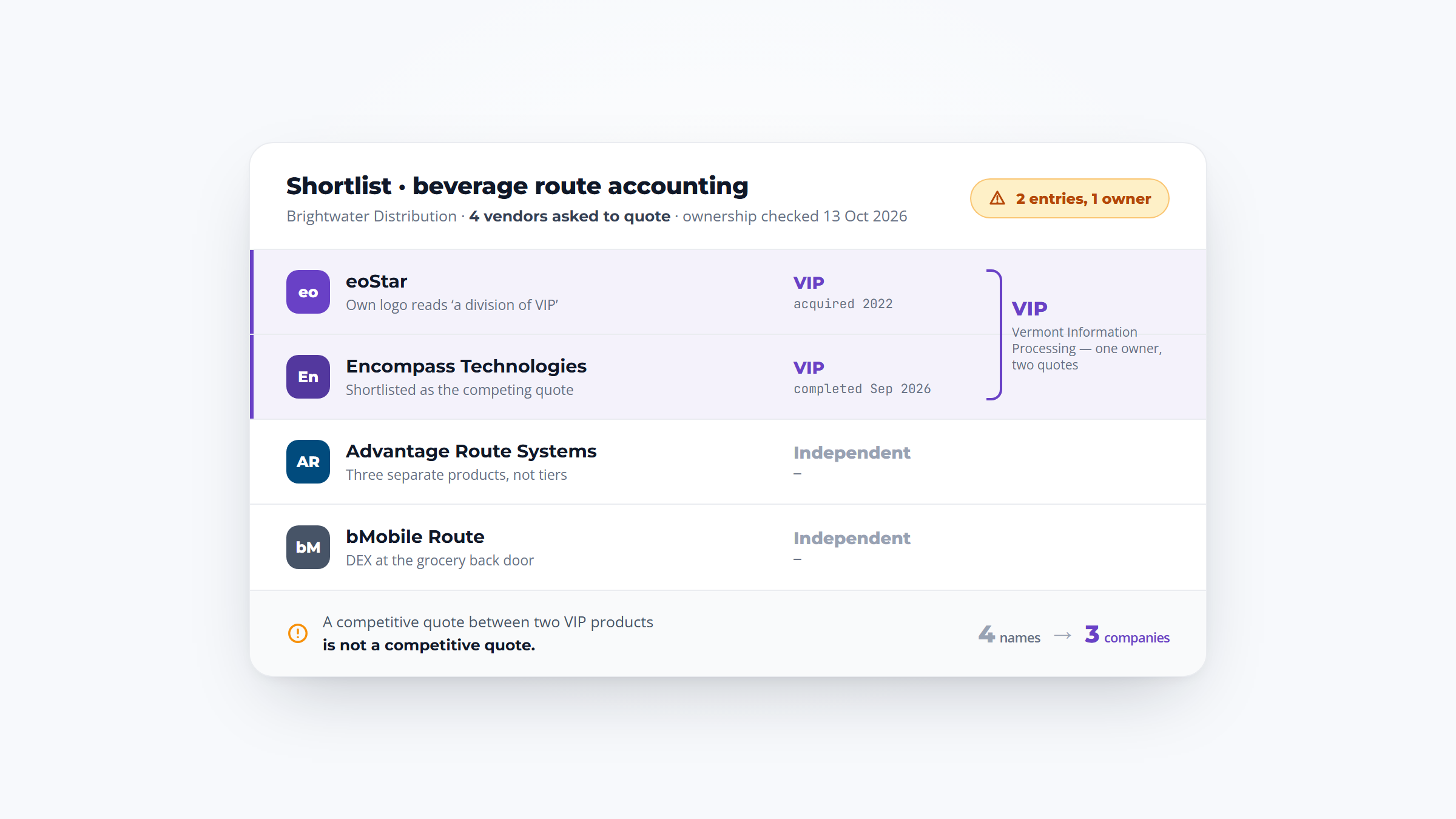
| Encompass Technologies | Beverage wholesalers and DSD operators | Route accounting, retailer self-service ordering, TTB and state reporting | Beverage only, and ownership changed in September 2026 | Pricing on request |
| Epicor Prophet 21 | Industrial and MRO distribution | Machine-learning demand forecasting, deep EDI product family, WMS across warehouse and yard | Lists twelve industries it serves and food is not one | Pricing on request |
Two of those rows are in the list for opposite reasons, and the entries below make clear which is which.

Best for: Replacing phone and voicemail order intake
Overview: VoiceOrder Solutions sits at the front of this category rather than inside it. It is not a distribution management system, holds no inventory and is not a system of record. It handles the step before all of that: turning an order that arrives as speech into a record your existing software can act on.
The distributor runs the setup. You share an account's order guide, it is loaded into the admin platform and the account is provisioned, and that account begins ordering against its own items at its own agreed prices.
What matters for this list is where the order lands. It reaches the order desk digitized and confirmed, carrying a unique order number, date and timestamp, in the format the back office already uses: email as PDF, Excel or Word, or a direct connection by EDI, API or QuickBooks. On those last three, nobody retypes anything.
That shape suits a DSD or route-based operation as readily as a broadline one. Those accounts reorder on a fixed rhythm, and the order still reaches the desk as a call somebody keys in before the route can be built, which is the step this removes.
Field capture is the other route into the same order book. Platforms such as SimplyDepo put a rep on a tablet in front of the account, where VoiceOrder Solutions puts the ordering app with the account itself. They are two different entry points, and a distributor running routes may well have accounts suited to each.
Key features:
Pricing: Available on request, the same posture as eight other entries here. Most distributors are live in 24 to 48 hours with account setup included, and the company publishes a 20-minute demo rather than a rate card.
Pros: Removes the keying step outright on EDI, API and QuickBooks delivery, captures orders at any hour, timestamps every order placed in the app, short setup, leaves existing systems in place
Cons: No public rate card, and it is deliberately a capture layer rather than a distribution management system, so it carries no inventory, purchasing, routing or financials
How to start using it:
Why it leads this list: It is the only entry targeting order intake specifically, and it changes nothing else about how the business runs.
Final verdict: The right first move if your order desk spends its mornings on the phone, and no substitute for a distribution management system if what you need is inventory and financials.
See how VoiceOrder Solutions works

Overview: entrée is the most food-native product here. NECS has sold it since 1987 from Branford, Connecticut, and says more than 1,500 food distributors run on it.
Its design assumptions are a foodservice distributor's: catch weight, order guides and a call list telling the order desk who to ring today.
Key features:
Pricing: Available on request. There is no pricing page, and a customer testimonial calling it affordable is a testimonial rather than a figure.
Pros: Deepest food functionality in the list, long track record, very large installed base for a vendor this size
Cons: Windows client/server rather than cloud-native, two generations shipping in parallel, no published price
Why it earns a place here: Its Order Taker Call List schedules the day's outbound order calls, a workflow nobody else here models.
Final verdict: The strongest fit for an independent broadline distributor wanting food behavior out of the box.

Overview: Produce Pro has served fresh produce companies since 1990 and was acquired by Aptean in 2022. It reports 200 customers and 7,000 end users.
Everything about it assumes perishables that get repacked, reprocessed and sold in whatever unit the buyer wants.
Key features:
Pricing: Available on request. No figure appears on its site or on Aptean's product page.
Pros: Genuine produce-trade depth including price-after-sale and consignment terms, strong recall capability, real WMS included
Cons: Server-based, with disaster recovery sold as an add-on, narrow to produce, small installed base
Where it fits: Produce wholesalers, repackers and terminal-market houses needing traceability and repack costing more than breadth.
Final verdict: Excellent inside its vertical and the wrong tool a step outside it.

Overview: inecta is food ERP built on Microsoft Dynamics 365 Business Central and hosted on Azure. It names lot traceability, catch weight, shelf life and recipe scaling as the things generic ERPs cannot do, which is this article's argument in a vendor's own words.
Its licensing runs in four levels, and distribution without manufacturing sits in levels one and two.
Key features:
Pricing: Available on request, but inecta publishes a floor most vendors will not: it says it usually works with companies that have "a budget of at least $150,000," and that cost rises with users and devices. A paid requirements workshop comes before any proposal.
Pros: Sits on a mainstream Microsoft platform, names its food functionality precisely, published budget guidance is unusually honest
Cons: That $150,000 floor rules out the small independent, device licenses are extra, and you are locked to one tenant tier
Why buyers shortlist it: The clearest answer for a food business already on the Microsoft stack, and the published floor tells you early whether the conversation is worth having.
Final verdict: A strong mid-market choice, and openly not aimed at anyone running five trucks.

Overview: Acumatica is a cloud ERP whose distribution edition covers sales orders, purchasing, inventory and warehouse operations under one license, priced on resource consumption rather than per seat. It is also the only entry here publishing a number you can plan against.
Key features:
Pricing: The main pricing page carries no figure, but its packaged SMB offer does: APEX for Distribution starts "under USD 1,495 monthly," and that bundle includes implementation and support rather than software alone. The general edition remains quote-based.
Pros: Unlimited users rather than per-seat pricing, genuine DRP, one published starting price in a category with almost none
Cons: No food vertical in its industry list and no catch weight named anywhere on the distribution page, mostly implemented through resellers so quality varies
Where it beats the alternatives: On breadth per dollar for a growing multi-warehouse distributor whose product does not move by variable weight.
Final verdict: The best general-purpose option here, provided your catalog is countable in cases rather than pounds.

Overview: Sage X3 is a mid-market ERP sold for manufacturing and distribution together, operating across more than 80 countries with multi-entity consolidation built in. Its food and beverage pages name the two things that matter most here.
Key features:
Pricing: Available on request. Sage publishes no rate for X3, and every call to action is a gated product tour.
Pros: Names variable-weight selling outright, genuinely strong for multi-branch and cross-border operations, mainstream vendor with partner depth
Cons: Its food vertical is written for manufacturers, not distributors, no published price, heavy for a small independent
Why it made this list: The one general ERP here stating a variable-weight capability on its own pages instead of leaving you to ask.
Final verdict: Right for a business that both makes and moves product across sites, and oversized for one that only moves it.

Overview: NetSuite is the broadest cloud platform here, putting financials, CRM, inventory and commerce on one system, and it maintains a page aimed at food and beverage wholesale distributors.
That page is also the briefest food evidence in this list, which is worth reading before you shortlist on brand.
Key features:
Pricing: Available on request. NetSuite publishes no figure, and licensing is an annual number built from platform, modules and user count plus a one-time implementation fee.
Pros: Widest channel coverage of any entry, genuine single-platform consolidation, very large installed base
Cons: Its food page was published in 2023, names no catch weight, lot tracking or EDI, and describes customers "throughout the food and beverage manufacturing space" on a page about distribution
Where it fits: Multi-entity, multi-channel distributors big enough to absorb a full ERP program and staff it.
Final verdict: A credible platform whose food-specific case is argued less convincingly than several smaller vendors here manage.

Overview: Blue Link has been built since 1992 by a company founded by a chartered accountant, and it shows: accounting sits at the center rather than bolted alongside, with inventory, order entry and warehouse management around it. It is also the most forthcoming vendor here about what it cannot do.
Key features:
Pricing: Available on request. Blue Link publishes no rate, and the only call to action is contacting sales.
Pros: Accounting and landed cost in the same system, honest published boundaries, suits importers particularly well
Cons: States plainly that it has no catch weight, serves North America and the Caribbean only, small vendor with no analyst coverage
Its real strength: Telling you in bold on its own website that it is wrong for variable-weight product, which saves a buyer a sales cycle.
Final verdict: A good fit for dry, frozen, confectionery and canned goods, and explicitly not for meat, seafood or produce.

Overview: Encompass sells a cloud ERP for beverage distributors covering sales, warehouse, delivery, financials and field operations, built around three-tier and DSD realities rather than food generally.
Its retailer ordering product is the closest thing here to order capture, letting accounts see catalog, pricing and inventory directly.
Key features:
Pricing: Available on request. Encompass publishes no rate, and the only routes forward are a contact form or a demo.
Pros: Genuinely deep in beverage, payments and regulatory reporting included, large distributor network on the platform
Cons: Beverage only, so a broadline foodservice distributor is not its buyer, and its ownership changed in September 2026 when VIP completed its acquisition
Where it fits: Beer, wine, spirits and non-alcoholic wholesalers, mid-market and up.
Final verdict: An obvious shortlist entry if you distribute beverages and an odd one if you do not.

Overview: Prophet 21 is the default mid-market distribution ERP in the United States, described by Epicor as designed by distributors for distributors, with machine-learning forecasting and warehouse management covering yard as well as floor. Epicor positions it for distribution broadly rather than for food specifically, and that distinction is what matters on this list.
Key features:
Pricing: Available on request. There is no pricing page and the only paths are a demo, a product tour or a sales form.
Pros: Very strong inventory, EDI and warehouse functionality, a self-reported three-year run as a Gartner Magic Quadrant Leader for cloud ERP, deep partner ecosystem
Cons: Epicor publishes the twelve industries Prophet 21 excels in and none is food, its distribution page never uses the word, and food behavior would arrive through customization
Why it is in this comparison: It will reach your shortlist regardless, and the fastest way to evaluate it is Epicor's own industry list.
Final verdict: An excellent distribution ERP for industrial and MRO wholesale, and a long customization project for anyone selling food.
Every figure above was read off the vendor's own website on October 5, 2026. Nothing came from a software directory, because a listing is evidence a vendor exists and not evidence of its price or its capabilities.
Three checks did the work:
That third check mattered for two entries here. Encompass changed hands in September 2026, and Produce Pro has been Aptean's since 2022, which is not what either vendor's directory listing tells you.
Each remaining entry had to be food distribution software a distributor could run order-to-cash on, which rules out pure warehouse systems and accounting packages.
Most advice here is written for a distributor far larger than the one reading it. The Census Bureau's business statistics make the mismatch concrete: of 27,458 US grocery and related product merchant wholesalers, about two-thirds report annual receipts under $5 million, while the 4.5% at $100 million or more take 85% of the sector's receipts.
The loudest buyers here are a tiny minority of the companies, and the marketing follows the money.
| Your size | What actually constrains you | Where to look first |
|---|---|---|
| Under 5 trucks, one warehouse | Budget and the fact that nobody has time to run an implementation | entrée, Blue Link ERP, or an order-capture layer on what you already have |
| 5 to 25 trucks, one or two sites | Catch weight and order guides, and whether the desk can stop retyping | entrée, Produce Pro if you are in produce, Acumatica APEX |
| 25 to 100 trucks, multi-branch | Branch inventory, EDI with chain accounts, consolidated reporting | Acumatica, Sage X3, inecta, Prophet 21 if you are not in food |
| Multi-entity or cross-border | Intercompany, multiple legislations, audit | Sage X3, Oracle NetSuite |
The smallest band is where the honest answer is often not a distribution management system at all. If your stock sits in one building and your inventory control already holds up, the expensive problem is order intake rather than the back office, and that is far cheaper to fix than a platform migration.
Seven of the nine systems publish nothing, and VoiceOrder Solutions is quote-based as well. That is the shape of enterprise software sold with implementation attached rather than evasiveness, and it means a shortlist cannot be costed from websites alone.
Two vendors give you something to plan against, at opposite ends. Acumatica's APEX for Distribution package starts under $1,495 a month with implementation and support inside that figure. inecta states it usually works with companies carrying a budget of at least $150,000, after a paid requirements workshop.
Treat that spread as the real range. Between them sit implementation fees, device licenses, module charges and a partner's day rate, none of which appear on a pricing page.
Ask every vendor for the same three numbers: first-year total including implementation, the annual figure from year two, and what a new warehouse or legal entity adds. Comparing subscription lines alone will mislead you, because the implementation fee is usually the larger number in year one and sits outside the quote, a pattern that holds across wholesalers ERP software generally.
Nobody here publishes a timeline, which is worth remembering when a salesperson offers one.
The spread tracks shape rather than vendor. A vertical product whose defaults match your business configures faster than a general ERP you have to teach about catch weight, and one warehouse goes faster than four branches with intercompany transfers.
Sequencing matters more than the estimate. Order intake can be fixed independently of a platform migration and on a far shorter timeline. Nothing in the order management process waits on a data migration, which is what makes it the part that pays back first.
The fastest way through this category is to stop comparing feature grids and start with what moves through your warehouse. If it moves by variable weight, the list shortens to three vendors and one disqualifies itself in writing. If it is beverage, one entry is built for your regulatory reporting; if produce, one is built for repacks and the rest get configured toward it.
One honest caveat. None of the nine publishes a feature for order cut-off times, and none of them captures an order arriving as a phone call.
A distribution management system starts work once an order exists as data. Getting it there is a separate job, and on a 1.8% median margin it is the cheaper of the two to fix. VoiceOrder Solutions covers that step for independent food distributors without touching the systems behind it.
Book a VoiceOrder Solutions demo
It is software that runs a wholesaler's order-to-cash cycle, from the account's priced order guide through replenishment, branch stock and delivery to the invoice. No standards body defines the term, so what you are shown is always one of two things: a general ERP with its distribution modules forward, or a vertical system built for distributors alone. Establishing which beats comparing feature lists.
An ERP is the wider system, covering finance, people, assets and customers across an enterprise. Distribution management software is the distribution-shaped part of that: the order, the stock and the delivery. Most products sold under the label are ERPs with the distribution modules foregrounded, which is why the terms blur in vendor marketing.
Usually yes, which is why food distribution software exists as a category at all, and catch weight is the clearest test. If you sell by variable weight, software without native catch weight forces a workaround on every affected line. Lot traceability to a date code, standing orders and substitutions are the other three behaviors that are default in vertical products and custom work in general ones.
Seven of the nine systems here publish no price at all, which is normal for software sold with implementation attached. The two published reference points sit far apart: Acumatica's APEX for Distribution starts under $1,495 a month including implementation and support, while inecta sets a floor of $150,000 on the budgets it works with. Ask every vendor for first-year total, year-two annual, and the cost of a new site.
No. These systems begin work once an order exists as structured data, and none of the nine systems of record here publishes a feature for capturing an order placed by phone or left on voicemail. entrée comes closest, with a call list that tells the order desk who to ring today, but a rep still keys in whatever the customer says.
That step is handled separately, by order-capture tools delivering a finished order into the distribution system by email, EDI, API or a direct accounting connection. Order capture and wholesale order management software are two different purchases, and most buyers learn that after signing for one.