Key takeaways:
A cooler alarm at 2 a.m. only helps if somebody hears it. Plenty of food safety failures don't start with a dramatic mistake. They start with a door left ajar, a line check skipped during a rush, or a temperature log filled in at the end of a shift from memory.
Good software closes those gaps by making the check harder to skip and the record more accurate. The difficulty is that the category covers a kitchen tablet, a wireless cooler sensor and a plant-wide quality system, and vendors describe all three the same way.
The CDC estimates that 48 million people get sick from a foodborne illness each year in the US, and that 128,000 are hospitalized and 3,000 die.
This guide compares nine food safety systems by the setting they're built for, from restaurant chains through plants to cold storage, for operators, plant managers and the distributors who store and move food. A tenth entry, VoiceOrder Solutions, closes the list. It's the publisher's own product, it isn't a safety system, and its entry says plainly how little of this job it does.
A digital food safety tool replaces paper logs with records that are timed, assigned and hard to back-fill. At minimum, it tells someone what to check, captures the result, and flags the failure. Better systems also force a corrective action and keep that record for the inspector.
A real food safety system goes further than a checklist app. Under HACCP, you identify hazards, set critical control points and limits, monitor them, act on deviations and keep records. Food safety management software should hold that whole chain, and several products here handle only the monitoring step.
So a tablet with a temperature form may be useful without counting as food safety management system software. If an inspector asks why a cooling step has the time limit it does, the record of the reading won't answer. Your plan will. Software that also tracks a product by lot is a separate category, covered in the food traceability software comparison.
Three jobs hide under the same label, and most products here are built around one of them. The table below sets out which entries handle which, so you can drop most of the list before reading a single entry.
| Entry | Digital checklists | Sensor data | HACCP plan building | Audits |
|---|---|---|---|---|
| ComplianceMate | Yes | Yes | Not shown | Separate Ladle product |
| Squadle | Yes | Yes | Not shown | Crunchtime Ops Execution |
| Zip HACCP | Yes | Spot probes | Not shown | Checklists |
| FreshCheq | Yes | Spot probes | Not shown | Self-audits |
| GoAudits | Yes | Not shown | Not shown | Yes |
| Safefood 360 | Prerequisite programs | IoT integration | Yes | Yes |
| SafetyChain | No-code forms | Machine and sensor data | Monitoring against your plan | Yes |
| SmartSense | Yes | Yes | Logging against your plan | Yes |
| testo Saveris Food | Yes | Yes | Quality manual sold as a service | Not shown |
| VoiceOrder Solutions | No | No | No | No |
"Not shown" means the vendor's pages didn't list it, so ask before you rule a product out. The pattern still holds: the restaurant tools cover checks, with ComplianceMate and Squadle adding sensors, the sensor makers cover equipment, and only Safefood 360, which has no warehouse positioning, builds the plan itself. That leaves independent food distributors assembling their own mix.
Most food safety tools are pitched at restaurants and plants, so a distributor ends up reading lists written for someone else. Yet a distributor holds food for days, moves it between temperature zones and hands it to drivers.
SmartSense speaks most directly to warehouses and trucks, testo pitches Saveris Food at distribution centers for incoming goods, and ComplianceMate's continuous monitoring also covers transport and delivery. For checks and inspections, food safety audit software such as GoAudits can cover a warehouse, though its food page leads with plants and restaurants.
Start with receiving, because that's where a temperature problem passes from your supplier to you. Take a reading, record it, and decide who can reject a load. Good warehouse operations make that check part of the dock routine, so the software records a habit that already exists.
The list runs by setting: restaurants first, then cross-setting audit tools, then plants, then warehouse and cold chain. VoiceOrder Solutions sits last because it doesn't do this job at all.
| Software | Best for | Setting | Main limitation | Hardware needed |
|---|---|---|---|---|
| ComplianceMate | Multi-unit sensors plus checklists | Restaurant, grocery, convenience | Audits sold separately | Wireless sensors, installed |
| Squadle | Multi-unit franchise groups | Restaurant | No HACCP plan authoring shown | Its monitors, for remote alerts |
| Zip HACCP | Restaurants wanting simple digital logs | Restaurant | Spot checks, no fixed sensors | Optional: its probe or any Bluetooth thermometer |
| FreshCheq | Restaurants and cafeterias | Restaurant, cafeteria, theater | Price unit not stated | None required; syncs a Bluetooth probe |
| GoAudits | Inspections across several sites | Plant, restaurant, supplier | No sensor features shown | None beyond a phone |
| Safefood 360 | Plants needing plan management | Manufacturing | Broader than daily operations need | None of its own; reads connected IoT |
| SafetyChain | Plant floor quality programs | Manufacturing | Plants only | Your own devices; streams machine data |
| SmartSense | Warehouses and truck fleets | Warehouse, grocery, restaurant | Cost scales per asset | Sensors and cellular, included per asset |
| testo Saveris Food | Sites wanting measurement hardware | Restaurant, retail, distribution center | Setup heavier than an app | testo loggers, gateway and Control Unit |
| VoiceOrder Solutions | Distributors' order records | Order intake | Not a food safety tool | None; accounts order in an app |
Prices sit in each entry, and the hardware column shows which bills will carry equipment. Use it with the setting column to pick your two or three, then read those entries first.

Best for: Multi-unit operators wanting sensors plus checklists
Overview: ComplianceMate combines wireless sensors with digital HACCP checklists for multi-unit restaurants, convenience stores, grocers and foodservice operators. It's now a product of Ladle, which also sells store audit and traceability tools under other names.
The sensors are the main draw. They sit on coolers, freezers and prep areas, and Ladle says they work through stainless steel, insulation and concrete, which matters in a walk-in.
Key features:
Pricing: Ladle publishes no rate for ComplianceMate. Expect a quote based on locations and sensors.
Pros: Sensors and checks in one system, strong multi-unit view, automatic records.
Cons: Sensor install required, audits sit in a separate MeazureUp product, no plant use shown.
Why it's a good food safety software pick: It removes the human step from the riskiest reading, which is a temperature nobody thought to take.
Final verdict: A strong fit for chains that want cooler coverage and checklists from one vendor.

Best for: Multi-unit franchise groups
Overview: Squadle is restaurant food safety software built for multi-unit franchise groups, now sold by Crunchtime. Its best-known idea is ZeroTouch, patented technology that automates temperature logging on the checklist.
Automation matters on a line during a rush, because the reading gets recorded accurately even when nobody has a free hand to take it. Remote temperature monitors cover the equipment side, with alerts running around the clock.
Key features:
Pricing: No published rate. Crunchtime's request form asks for your location count, which tells you how the quote is built.
Pros: Automatic logging, corrective actions tied to alerts, part of Crunchtime's wider suite, where Ops Execution handles audits.
Cons: Built for chains, no HACCP plan authoring on the page, remote monitoring needs its monitors installed.
Where it fits: A franchise group already on Crunchtime, or one that wants readings no one keys in by hand.
Final verdict: Well matched to multi-unit brands, while a single independent would use only a fraction of it.

Best for: Restaurants wanting simple digital logs
Overview: Zip HACCP, published by Altametrics, is a straightforward digital log for restaurants. It separates critical from non-critical tasks, tracks follow-ups and escalations, and syncs across devices in real time, so a missed cooler check reaches a manager during the shift.
Temperature capture is handheld. You can buy its probe or pair any third-party Bluetooth thermometer, so there's no fixed sensor network to install.
Key features:
Pricing: Standard costs $59.99 per location a month, and the Zip HACCP Probe is a one-time $200.00. Enterprise goes through a demo.
Pros: Clear published price, hardware optional, simple for line staff.
Cons: Handheld spot checks only, one published tier, restaurant positioning only.
Why buyers shortlist it: You can price a rollout across every location before speaking to anyone.
Final verdict: A solid first step away from paper for a restaurant group.

Best for: Restaurants and cafeterias moving off paper
Overview: FreshCheq was founded by people who say they've owned restaurants for 29 years, and it's written for restaurants, cafeterias, movie theaters and fitness centers. Staff sync readings from a Bluetooth probe, snap a photo of a failed item and follow a countdown on cooling logs.
FreshCheq also uses streaks and leaderboards to keep staff on task, which is unusual here. Readings taken offline upload when WiFi returns, so a dead spot doesn't stop a check.
Key features:
Pricing: FreshCheq lists $60 monthly or $629 for one year, with no set-up fee, and special pricing on 10 or more locations. The pricing page doesn't say what the $60 covers, though its FAQ describes unlimited users per location, so confirm the unit before you budget.
Pros: No hardware needed, inexpensive, works offline, set up for you.
Cons: No fixed-sensor monitoring listed, no HACCP plan builder listed, price unit not stated on its pricing page.
What it's genuinely good at: Getting a busy crew to actually complete the log.
Final verdict: A practical pick for a small operator that wants digital checks this month.

Best for: Inspections across several kinds of site
Overview: GoAudits is food safety audit software that works across settings, and it's the pick here for inspection-led buyers. Plants use it for GMP, BRC, SQF, IFS and FSSC audits, restaurants for hygiene checks, and buyers for supplier audits.
Auditors work offline on a phone, annotate photos and raise action plans with unlimited assignees. Mock EHO and FDA inspections let you rehearse before the real one.
Key features:
Pricing: On the US page, Starter is $10 per user a month billed annually, or $12 monthly. Enterprise is $30 billed annually, or $35 monthly. There's a 14-day trial.
Pros: Priced on both billing options, works in plants and restaurants, runs offline.
Cons: No sensor or plan-building features on the food page; Starter caps at 25 locations and 10 templates; roles, scheduling and advanced analytics are Enterprise only.
Its real strength: One audit tool for a group that owns several kinds of site.
Final verdict: The clear choice if you want food safety inspection software, not monitoring.

Best for: Plants that need full plan management
Overview: Safefood 360 is food safety quality management software for manufacturers working to GFSI-recognized standards, and it's now part of Ideagen. Of all the entries, it's the closest to a full plan system, with risk models, decision trees and a hazard database behind your HACCP and preventive control plans.
Its 35-plus modules cover CAPA, deviations, recalls and prerequisite programs such as cleaning, pest control, training, and glass and plastic control.
Key features:
Pricing: The site lists no figure, so expect a conversation with sales. It runs in the cloud on Azure.
Pros: Real plan authoring, wide module set, built around certification.
Cons: Far broader than a daily-operations tool, no sensors of its own, no restaurant or warehouse positioning.
Where it earns its place: A plant that has to defend its plan to a certification body.
Final verdict: Right for a plant's quality team, and overkill for a kitchen.

Best for: Plant-floor quality programs
Overview: SafetyChain digitizes plant floor programs for food and beverage producers: pre-op hygiene, master sanitation, GMP, facility audits, receiving inspections, HACCP monitoring and CAPA. Where Safefood 360 starts from the plan, SafetyChain starts from the people running it on shift.
No-code forms let your own team change a check, and the Advanced tier adds real-time equipment data for HACCP and process monitoring.
Key features:
Pricing: Essential and Advanced are both request-only, with unlimited users and unlimited data. Its pricing FAQ describes an annual subscription per facility plus a one-time set-up fee based on plant count.
Pros: Unlimited users, plant-floor focus, published pricing basis.
Cons: Manufacturing only, no restaurant or distribution use, plan authoring is less central than monitoring.
Where it pays off: Daily sanitation and pre-op checks are the programs it targets most directly.
Final verdict: Worth shortlisting for a mid-size plant ready to retire its clipboards.

Best for: Warehouses and truck fleets
Overview: SmartSense, a business unit of Digi International, is the entry most directly aimed at the cold chain. It monitors warehouse temperature and humidity, tracks moving assets through its Voyage product, and serves grocery, restaurants, K-12 and truck fleets.
Since January 2026 it has sold the combined SmartSense ONE platform, with Operate for checklists, Guard for food safety monitoring and Assure for audits and inspections.
Key features:
Pricing: SmartSense uses per-asset pricing with no published figure. That includes unlimited users, monitoring equipment, cellular networking, free equipment replacement for the term and NIST-certified recalibration.
Pros: Warehouse and truck coverage, equipment included, recalibration included.
Cons: Cost scales with every cooler, truck and room, equipment ownership depends on the order, a large platform for a single site.
Where it beats the alternatives: Monitoring product after it leaves the building.
Final verdict: The strongest starting point here for a distributor's cold storage and fleet.

Best for: Sites that want measurement hardware
Overview: Testo is a measurement company, so Saveris Food starts with the instrument and adds software around it, pitched at restaurants, food retail and distribution centers. On-site staff use a Control Unit for checklists with corrective-action prompts, while wireless loggers send temperature and door data through a gateway.
A single gateway takes up to 30 sensors, and sensor batteries run up to 10 years. Testo also lists temperature mapping and a quality manual as services, so you can buy help as well as hardware.
Key features:
Pricing: Testo publishes no rate, and its setups are modular. Its cloud terms say digital functions generally need a separate subscription or license, so ask for hardware and software as separate lines.
Pros: Measurement pedigree, long sensor battery life, mapping services.
Cons: Needs testo hardware, cost set per offer, setup is heavier than an app.
Why it made this list: It's the only entry whose page lists temperature mapping as a service.
Final verdict: A strong option when measurement accuracy is what your auditor questions.

Best for: Distributors needing clean order records
Overview: VoiceOrder Solutions is listed last because it isn't food safety software. It takes no temperatures, holds no HACCP plan, runs no checklists and traces no lots. It's a voice ordering tool that independent and DSD food distributors give their accounts.
It's here for a narrower reason. A distributor keeps an order file beside its safety file, and when a customer questions what they ordered, the order file is the one that settles it.
With this tool, accounts order by voice in an app, and every order placed that way reaches your team carrying its own number, date and timestamp. That gives a dispute a record to check rather than a recollection to argue over.
It's a commercial record, not a trace record. It won't replace lot tracking or any entry above, and orders that still come in by phone get no number or timestamp.
Key features:
Pricing: Distributors get a quote rather than a rate card, after a 20-minute demo, and the company puts most go-lives at 24 to 48 hours.
Pros: The company's figure of 20 to 30 minutes saved when a phone order shifts to the app, dated record for orders placed in the app, quick setup, runs beside your current ERP, built for distributors.
Cons: No rate card for distributors, no temperature, HACCP, audit or traceability functions, and phone orders get no numbers or timestamps.
How to start using it:
Where it fits: Beside your safety system, on the commercial side of the file.
Final verdict: Buy one of the nine above for food safety, and look here only if your order records are the weak spot.
Book a VoiceOrder Solutions demo
The nine safety systems each had to show real operational food safety work on their own sites, read directly in November 2026 for features and pricing. General sensor makers with no food workflow were ruled out, and supplier-document platforms were left out. The tenth entry is the exception: VoiceOrder Solutions publishes this blog, and it's included for order management records rather than safety, which the jobs table near the top marks "No" for every job.
Ownership got its own check, since three of these names have changed hands: ComplianceMate now sits under Ladle, Squadle under Crunchtime and Safefood 360 under Ideagen. SmartSense is a business unit of Digi International. Support and roadmaps can shift after a deal, so ask those three what changed.
Sensors or an app is the decision that moves the bill most, because sensors bring hardware with them. An app relies on a person taking a reading. A sensor doesn't, which matters for the hours nobody is on site.
USDA's Food Safety and Inspection Service says bacteria grow most rapidly between 40 °F and 140 °F, doubling in as little as 20 minutes. Run that across a long weekend and a failed compressor is a stock loss before anyone opens the door.
Sensors earn their cost where three things are true: the product is expensive, the room is unattended, and a failure can run for hours. Think walk-ins, blast chillers, warehouses and trucks. For a single kitchen staffed 14 hours a day, a Bluetooth probe and a good habit may cover most of the risk, with the checks sitting inside your wider kitchen management software routine.
Skip the feature grid and test the moments that fail in real life, because food safety solutions all look alike in a slide deck. Bring a real scenario from your last inspection to each demo.
The third test matters most, because a log you can back-fill is only slightly better than paper. Inventory accuracy suffers from the same problem as safety logs: a number written down after the fact looks exactly like a real one.
Two vendors publish enough to work out a bill, and a third publishes a price without saying what it covers. The table runs all three against the same group of five locations and ten staff.
| Software | Published rate | Five locations, ten staff |
|---|---|---|
| Zip HACCP | $59.99 per location a month | $299.95 a month, plus any probes at $200 each |
| GoAudits Starter | $10 per user a month billed annually, or $12 monthly | $100 a month billed annually, or $120 monthly |
| FreshCheq | $60 monthly or $629 for a year | Can't be worked out until FreshCheq confirms the unit |
For the six other safety systems, ask for three numbers: hardware, recurring software, and installation. On sensor systems, also ask who owns the equipment when the contract ends, since SmartSense's terms let an order supply it either way.
An app-only rollout is a matter of building your forms and training a shift. FreshCheq handles setup for each location, and Zip HACCP takes readings from a handheld probe, so there's nothing to mount.
Sensors take longer, because someone has to place them, test coverage and set alert rules. Plant systems take longest: SafetyChain's homepage says rollouts often take 8 to 12 weeks, while its pricing FAQ promises live data within 6 weeks. Whichever you pick, start with your two riskiest checks, prove them for a month, then add the rest.
Set alert routing before go-live. An alarm that reaches a phone nobody watches is worse than no alarm, because the record will show the alert was sent.
Match the tool to your setting and your weakest control. A restaurant group with solid managers and unreliable logs should look at Zip HACCP, FreshCheq or Squadle. A plant facing certification should look at Safefood 360 or SafetyChain. A distributor with cooler and truck exposure should start with SmartSense, and testo is worth a look if receiving checks are the gap.
Check your records beyond the safety file too. A short or wrong delivery can turn into a disputed credit, and cutting order errors settles that dispute before any temperature log comes into it. The right system is whichever one your people will still be using a year from now, so test it on the night shift before you sign.
It's software that schedules food safety checks, records results and flags failures, replacing paper logs. Depending on the product, it can also run temperature sensors, manage HACCP plans or support audits, so it's worth asking which of those a vendor really does.
On price, Zip HACCP is the simplest place to start, at $59.99 per location a month. FreshCheq lists $60 a month but doesn't state the unit, so confirm it. Multi-unit groups wanting sensors should compare ComplianceMate and Squadle, which both quote on request.
Not always. An app with a Bluetooth probe suits a staffed kitchen, but it can't watch a cooler overnight. Sensors from SmartSense, testo or ComplianceMate make sense where expensive product sits unattended, as it does in a walk-in, warehouse or truck.
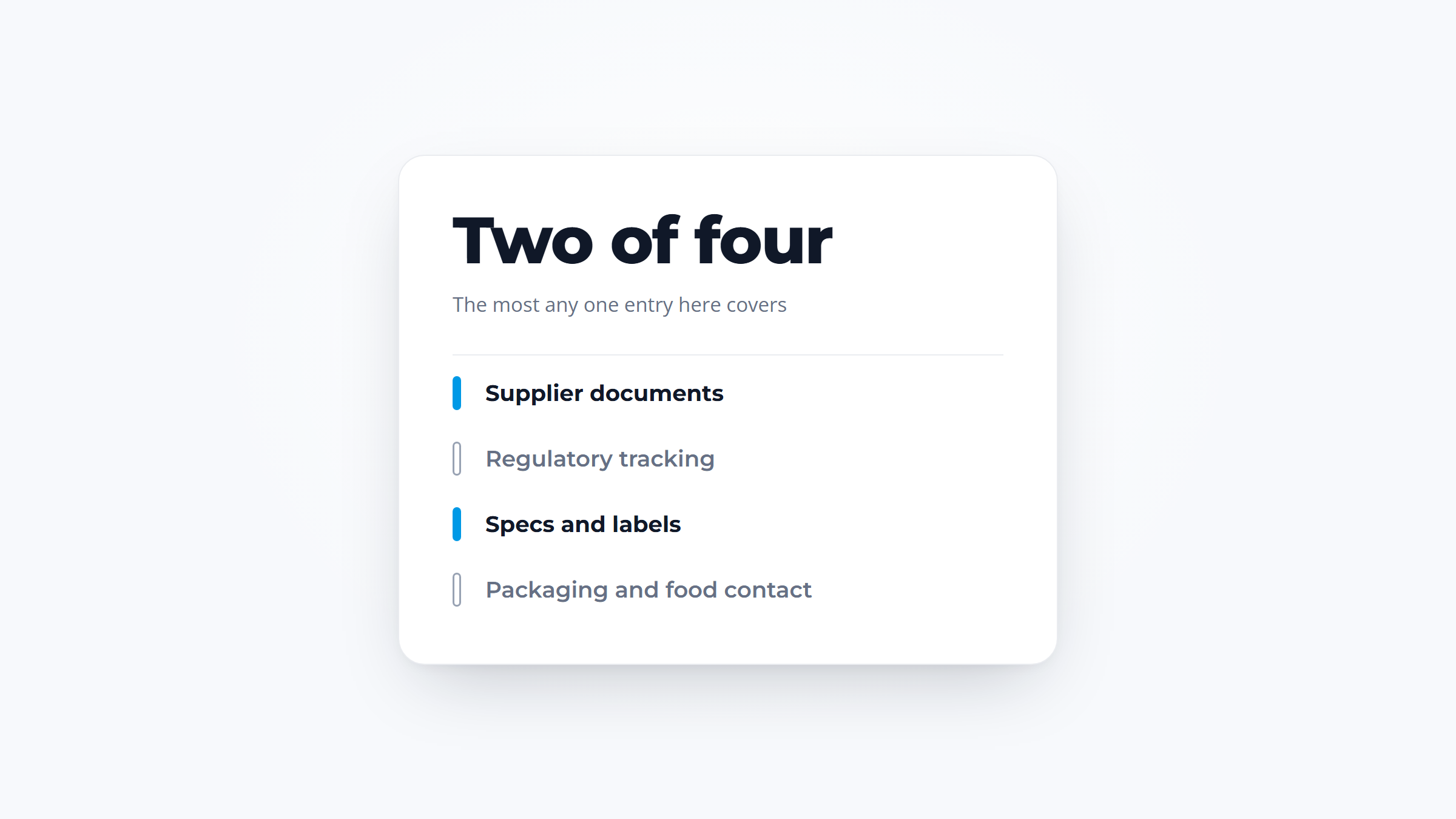
The first runs daily operations such as logs, temperatures, checks and audits. The second handles the documents behind them, such as supplier approvals, specifications and regulatory tracking. Some plant systems, Safefood 360 among them, do a little of both.
No US rule requires software, but rules such as HACCP and FSMA preventive controls require plans and records where they apply. A food safety system makes those records easier to keep complete and accurate. Ask your inspector or auditor what format they expect.
Traceability is the exception that comes closest. Under FDA's Food Traceability Rule (FSMA 204), businesses handling foods on its Food Traceability List must be able to hand the agency a sortable electronic spreadsheet inside 24 hours when it's investigating a foodborne outbreak, running a recall or facing another threat to public health. Only the smallest businesses may answer in another format, and the proposed compliance date is now mid-2028.
Whichever safety system you choose, the order desk keeps a separate record. If your safety file is solid but orders still arrive by phone and voicemail, a 20-minute demo shows what the order side could look like.