For Food Distributors

Distributor Analytics Software Runs On Clean Orders.

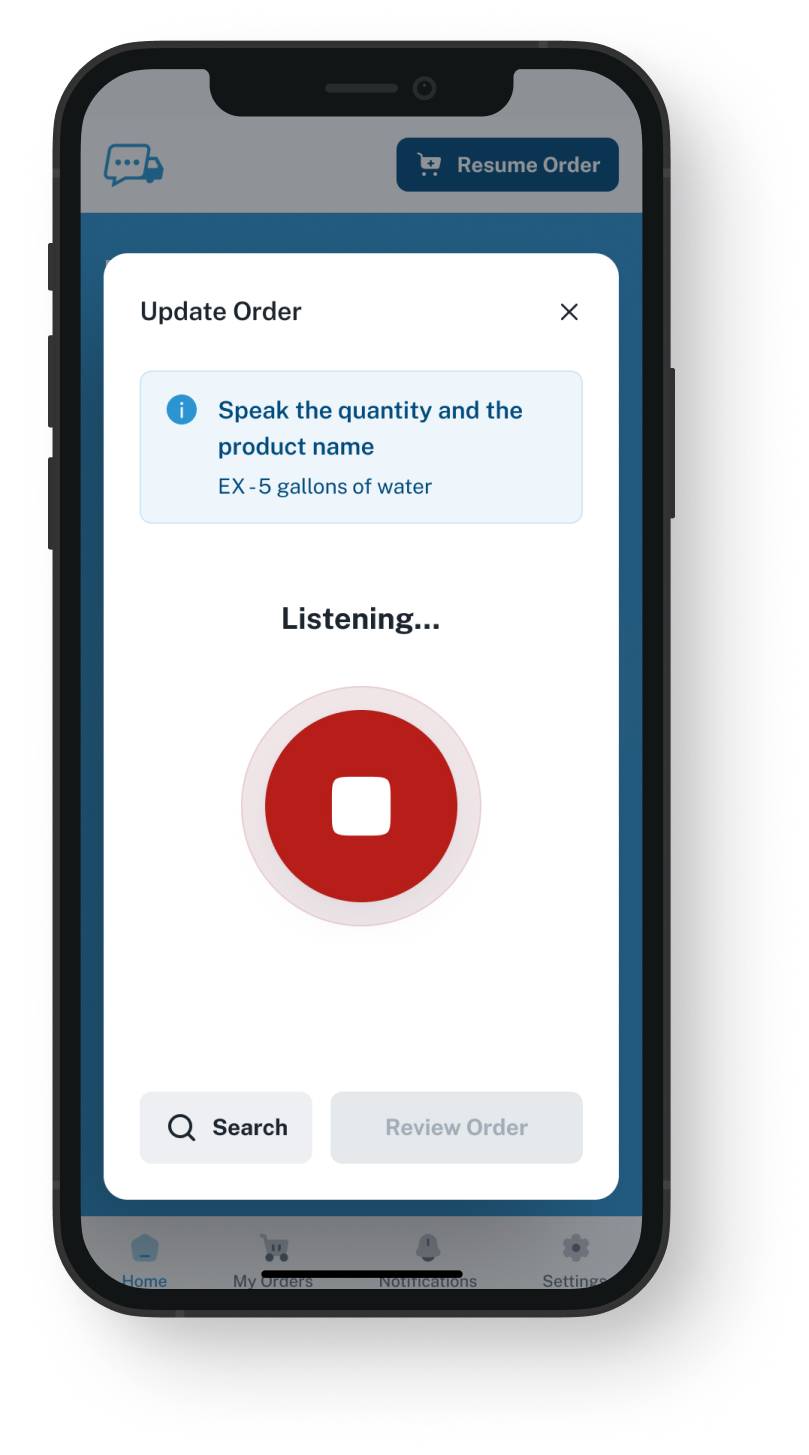
VOS does not draw you a dashboard. It fixes what the dashboard is drawn from: your customers say what they need into the app, and each order arrives itemized, dated and tied to an account.
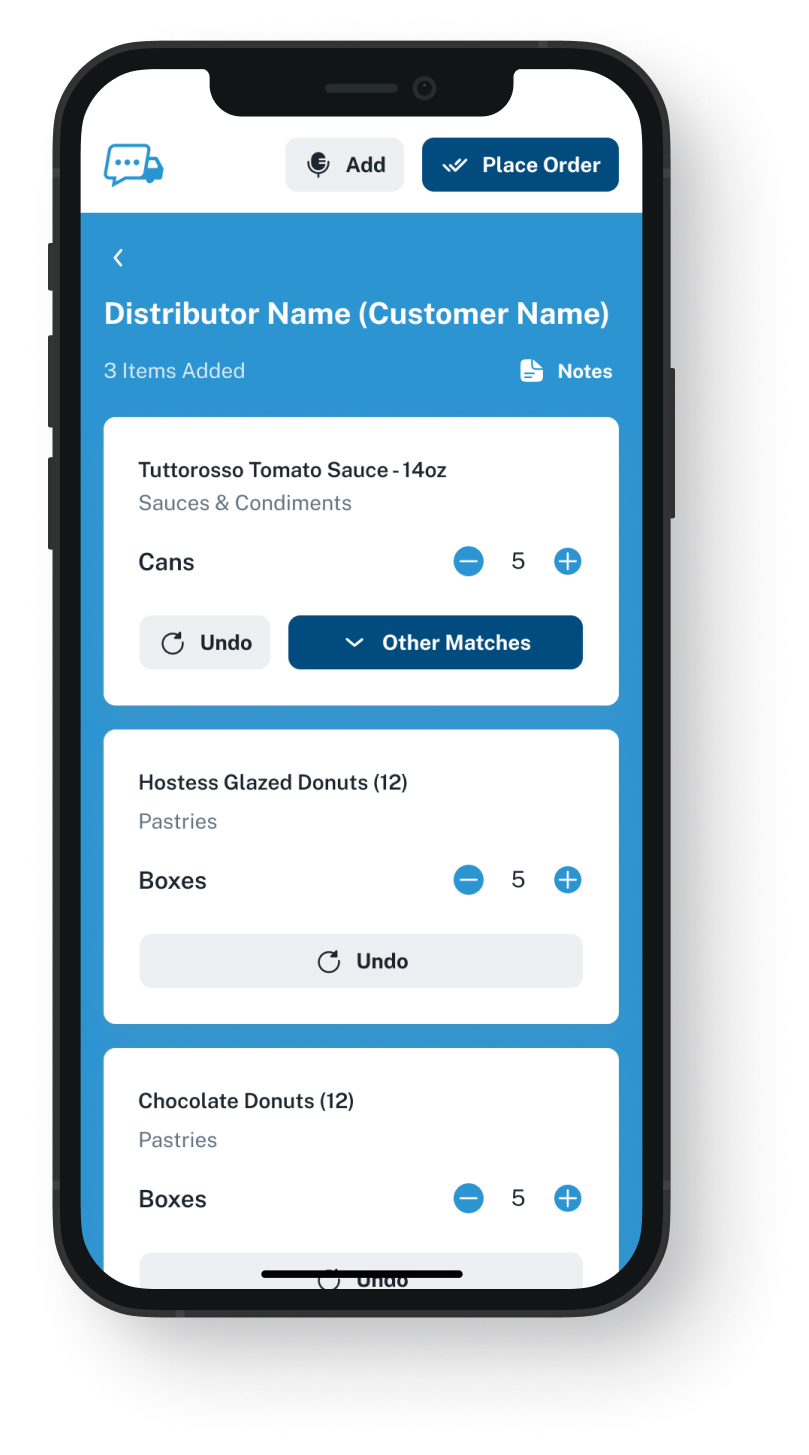
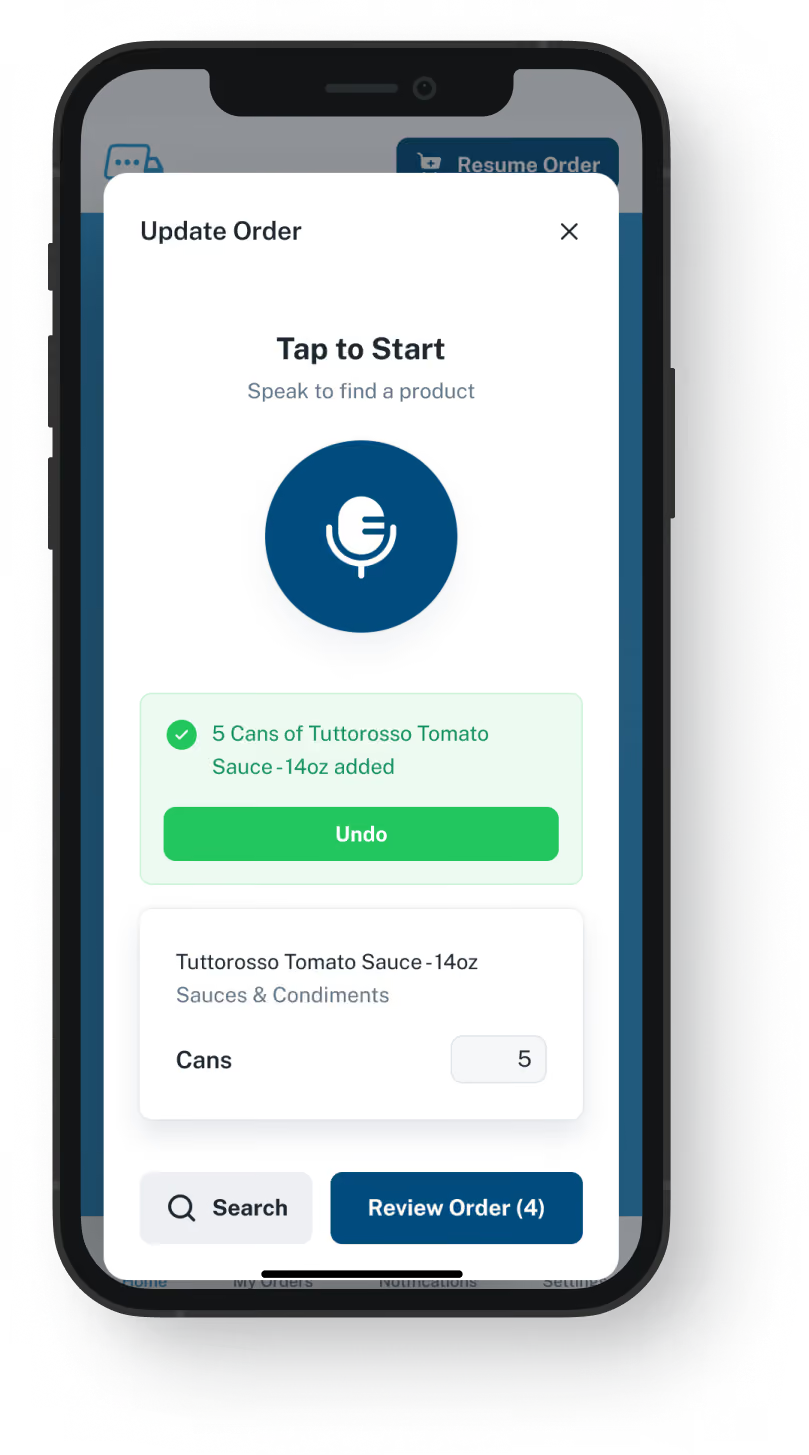
VoiceOrder app ordering screen
24/7

capture, so late orders still leave a record

24-48 Hrs

is what switching VOS on takes for most firms

20-30 Min

of handling gone from an order taken by voice

Sound Familiar?

Nobody argues with the chart. They argue with the numbers in it.

A report built on handwritten notes and voicemail is a guess with gridlines. Three reasons the numbers do not hold up:
Integration icon

"Half the orders left no trace"

A call has no record, no stamp and no line items until somebody types one up. What was never captured cannot be measured.
Integration icon

"The same item, three spellings"

Typed in by three people over two years, so a report splits one product into three and the totals mean nothing.
Integration icon

"We know the week, not the hour"

Without a timestamp you cannot tell an early order from a panic one, and that difference is the whole story.
Fix The Input First

What distributor analytics software cannot fix on its own

Dashboard mockup
Captured, Not Transcribed

Orders become data at the moment they are spoken.

A customer talks through the guide you loaded for them, so each line already arrives under the code you use. Nothing passes through a notepad on the way in, which is where meaning usually leaks out.
Each line lands on a code from your catalog
Each quantity sits on one of your own SKUs
The buyer confirms the lines, so errors get caught at source
One spelling per product, because there is no typing
A Record Per Order

What distributor reporting & analytics needs: a dated trail.

An order out of the app brings its own number and the time it was sent, filed under that account. Feed that into whatever distributor analytics software you use and the output stops being a best guess about last quarter.
Its own number on anything sent from the app
The hour it was placed, not just the day
Who placed it, held against their account
Earlier orders, still there to read
Dashboard mockup
Dashboard mockup
Out To Your Tools

Goes where your reporting already lives.

Applying distributor analytics is easier in a tool your team already trusts, so we pass the records to it as well as holding them on your own VOS screen. Pick the route once: a file in an inbox, a QuickBooks entry, EDI, or a direct link to your ERP.
Nothing new for your analyst to learn
With EDI, the API or QuickBooks nothing is keyed twice
Your ERP stays the system of record
No export project to schedule
Stock In The Picture

What you had, beside what they asked for.

Order records on their own tell you what was wanted. VOS also shows live stock that shifts with the ordering, fed by your own inventory system, so demand and availability sit next to each other rather than in two different meetings.
Stock view across the whole catalog, not just today's lines
The catalog on your side updates as stock levels change
Works beside whatever you count stock in today
The demo walks through how your levels would connect
Dashboard mockup
Also Built In

The rest of what comes with it.

Useful next to the records, and not a reporting feature in sight.
Integration icon

Prices As You Agreed Them

Each guide carries the figures you agreed with that customer, so an order shows the prices it was placed at.
Integration icon

Reps Freed From Order Taking

When customers order themselves, your reps spend the week selling instead of writing lists down.
Integration icon

Additive By Design

Built to connect, so it extends the platform you run rather than asking you to leave it.

See the record one app order leaves behind

Ask for the 20-minute demo and see the shape an order arrives in.
Simple Setup

Records that start out clean

No data warehouse, no migration, no build phase. Three steps and your order trail starts filling up on its own.
1

Give us the item lists

A list for each account, carrying your codes. That is what makes the orders comparable later.
2

We provision each account

Most firms are switched on in 24 to 48 hours, with nothing asked of your IT people.
3

Records build as people order

The trail fills up on its own. Most buyers are ordering the day they are set up.

"I used to spend hours every week ordering food. Now it's simple, super easy, and I have free time to spend on other aspects of my restaurant."

Tony Luna | Owner-Chef, Prairie Moon
Delivery Formats

Orders go out in the formats distributors already use

Each order leaves VOS as an email with a PDF, Excel or Word file, an EDI or API feed, or a QuickBooks entry. No one has to switch software to receive it.
Integration icon

Email

Integration icon

PDF, Excel, Word

Integration icon

QuickBooks

Integration icon

EDI

Integration icon

API Direct

Integration icon

iOS App

Integration icon

Android App

Integration icon

Web Admin

Integration icon

Distributor Platforms

Why VoiceOrder Solutions

We are the source.
Not the chart.

Worth saying plainly: distributor analytics software draws the charts, and VOS draws none of them. No dashboard, no KPI and no chart anywhere in it. Here is what each side actually does.

Feature

VoiceOrder Solutions

BI or Analytics Tool

Phone + Email Orders

Captures the order in the first place
On paper first
Each line sits on your own product code
Whatever it is fed
Typed in later
A reference, plus a timestamp
Whatever it is fed
Email carries a time
Dashboards, KPIs and charts
Fill rate and margin reporting
Demand prediction
Varies
Hands records to your ERP by EDI or API
Reads from it
Manual
Captures orders outside office hours
Voicemail takes it
Time before it is useful
A day or two for most
After a build
Already running
FAQ

Reporting questions, answered without spin

Is VOS distributor analytics software?
No, and it is better to say so on the way in. VOS builds no dashboards, calculates no KPIs and draws no charts. It is the layer underneath: your customers' spoken orders captured as structured records, numbered, timed and matched to your own codes, then handed to whatever you report with.
So what do we actually get to look at?
On the web you get the orders each account sent from the app, the items on them, its own number and when it was sent, along with the guide it orders from. It is a record you can read back through, not a reporting suite, and nobody here will pretend otherwise.
People ask how analytics improve distributor profitability. What is realistic?
Honest answer: analytics change nothing by themselves, and we publish no figures claiming otherwise. What a reliable order trail lets you do is spot an account whose ordering slipped, or a product nobody reorders. Acting on those is where any gain comes from.
Can we get the records into our own warehouse or BI tool?
Yes, through the delivery route you pick at onboarding: by email as a PDF, Excel or Word file, through EDI, into QuickBooks, or straight into your ERP over the API. From there your own pipeline takes over. An order emailed as a file may still be keyed in by your office. Distributor analytics software downstream sees orders that never passed through a notepad.
Does it forecast anything?
No. VOS runs no forecasting model and predicts nothing about next month. It records what was ordered and when. If a forecast is what you are after, the tool that produces one reads these records rather than retyped phone notes.
What about the orders that still come by phone?
They stay as they are, and they bring no reference or stamp from us, so they will not show up in anything built on VOS records. That gap is worth knowing about: the more of your customers switch, the more of the picture is real.
Do we need an analyst to make this worth it?
No. You do not need somebody with that job title. The records are useful on their own when a customer queries a delivery or a rep wants to know what a kitchen has stopped buying, long before anyone builds a report.
How long until there is enough history to be useful?
The trail starts from the first order, so a few weeks in you have patterns per account. We do not backfill your old phone orders, because we were not there for them.

Want numbers you would defend?

Start with how an order reaches you. See a spoken order land as a record.