Follow a case from your cost to the shelf, and check that your wholesale price still leaves the retailer the margin they need to stock you.
Your side of the case
$
Your landed cost before your own markup.
%
What you add on top to reach your wholesale price.
units
How many sellable units the retailer breaks a case into.
%
Grocery keystone is roughly a 40% margin, a 50% markup on cost.
Retail shelf price per unit
$3.97
Priced to leave a 40% retailer margin
Your wholesale price per case
$28.60
Your cost plus 30% markup
Your gross profit per case
$6.60
A 23.1% margin for you
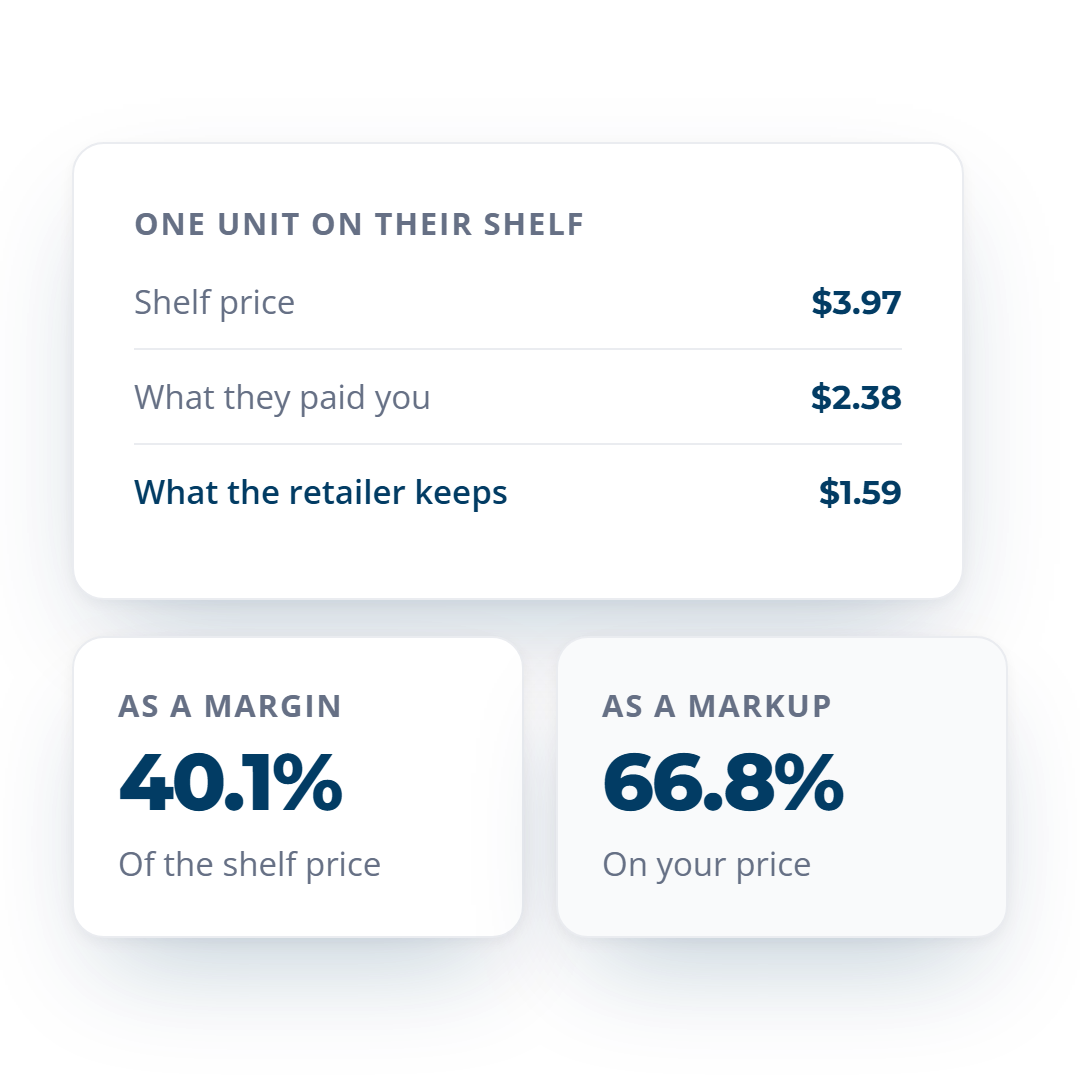
Retailer margin per unit
$1.59
40.1% of the $3.97 shelf price
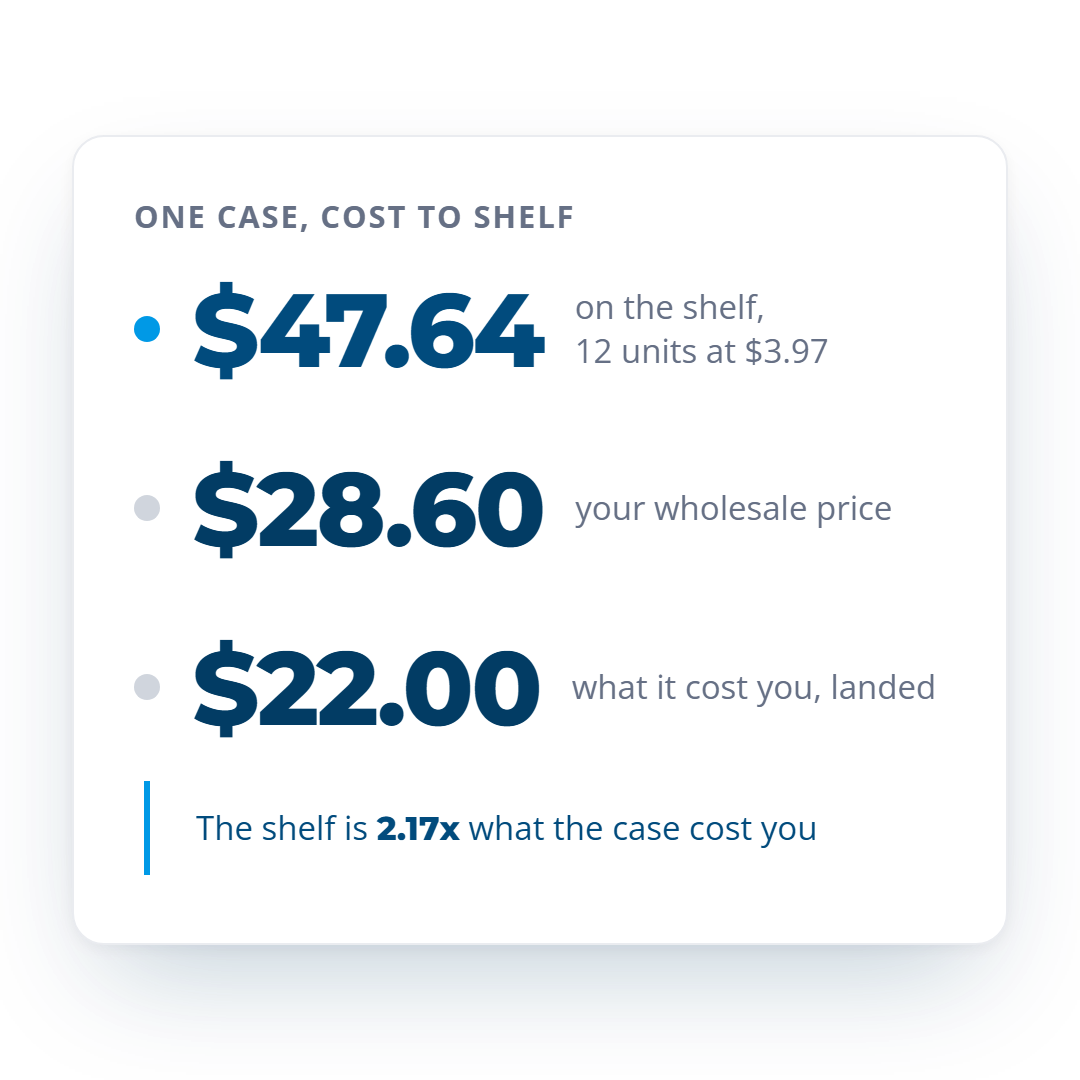
Retail price per case
$47.64
12 units at $3.97
Retailer cost per unit
$2.38
Your wholesale, split per unit
At a 30% markup your case sells for $28.60, a 23.1% margin for you. Split across 12 units the retailer pays $2.38 each and has to shelf it at $3.97 to keep a 40% margin. If that is above the competition, they will not stock you, so watch the shelf price your wholesale creates.
Estimates only. Retail margins and shelf prices vary by channel, so confirm with your buyer before you set terms.
Where does everyone's margin come from?
Six quick questions. At the end you get the whole chain, from what the case costs you to what it has to shelve at for your customer to make their number.
Step 1 of 6
The situation
What put this on your desk?
Pick the closest one.
Pick one to carry on.
Your end of it
What does the case cost you, and what do you add?
Landed cost, and the markup you put on it to get your wholesale price.
$
Landed, with freight in.
%
Added on top of your cost to get the price you bill.
Enter a cost above zero.
Their end of it
How does it break down, and what do they need to make?
The retailer margin is the number that decides the shelf price, not your price.
units
How many sellable units come out of one case.
%
What your customer needs to keep on each unit. 35 to 40 percent is common.
Enter units per case above zero.
How much you can see
Do your retail customers tell you what they shelf it at?
You cannot defend a wholesale price without knowing what it has to become.
Pick one to carry on.
How the reorders come
How do their reorders reach you?
Last one before your numbers.
Pick one to carry on.
Your breakdown is ready
Retail shelf price per unit
--
The headline number. The rest are below.
Want to see your results?
You have given us enough to work this out. Fill this in and the full breakdown opens up.
Loading the form.
The form did not load.Your browser or your network is most likely blocking it. That should not cost you the numbers you just worked out.
Your details go straight to our team, who will follow up about these numbers.
Your result
Working it out.
Here is your breakdown.
Retail shelf price per unit
--
Your wholesale price per case
--
Your gross profit per case
--
Retailer cost per unit
--
Your case price divided across the units
Retailer margin per unit
--
Retail price per case
--
Your price has to work on the shelf, not just on your invoice.
VoiceOrder Solutions keeps your price lists and order guides straight, so the number the retailer sees is the one you meant to quote.
Estimates only. Confirm the retailer margin expectation before quoting against it.
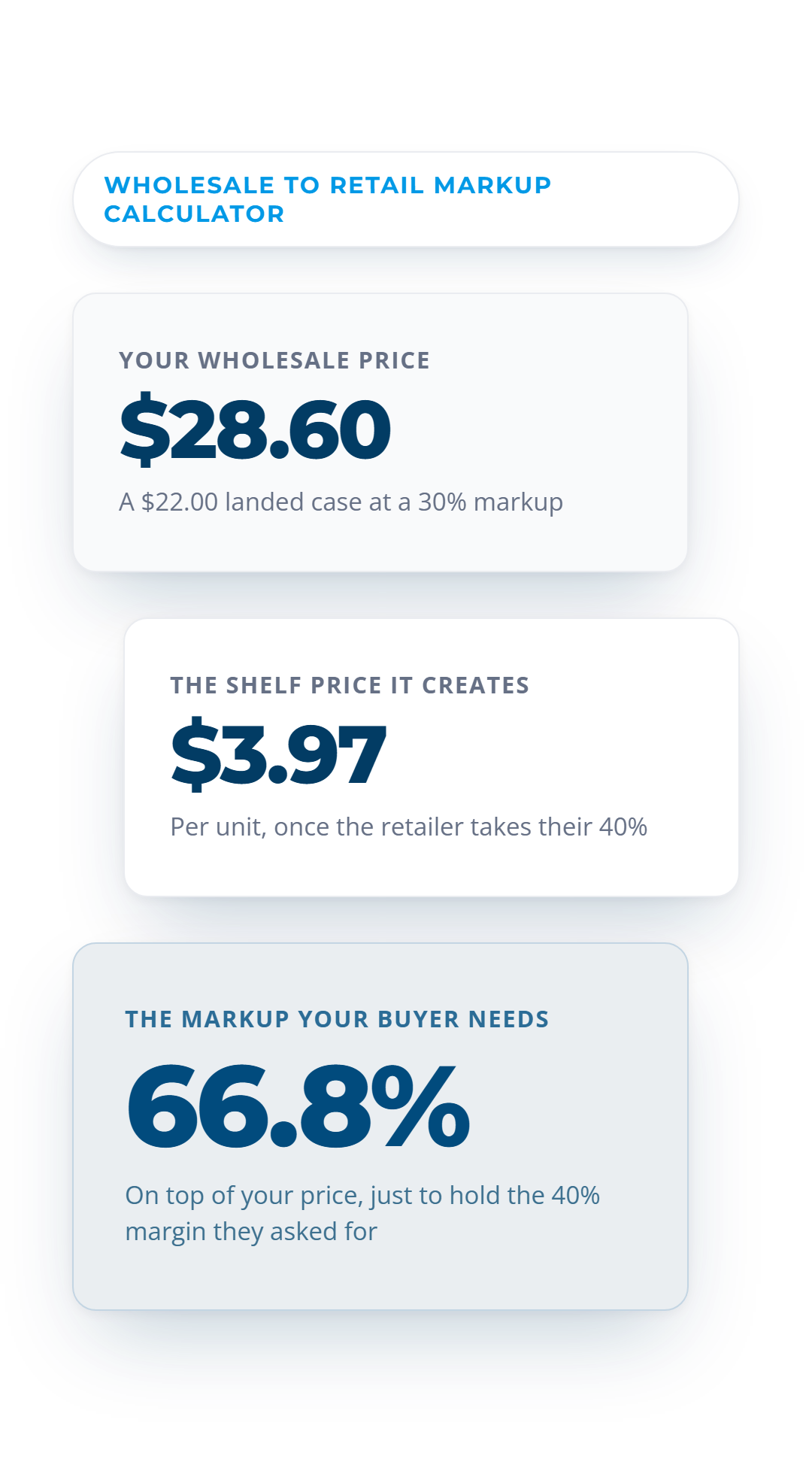
$28.60
Your wholesale price on a $22.00 case
$3.97
Shelf price per unit at a 40% retail margin
66.8%
The markup your buyer needs to get there
The Basics
What is a wholesale to retail markup?
A wholesale to retail markup is what a store adds to your wholesale price to set its shelf price. It is stated as a share of the store's cost. For a distributor it is the second of two steps: your markup sets the case price, then the store's markup sets the shelf.
Two markups that multiply
Your markup and the store's stack on top of each other. They multiply rather than add: your 30% and the store's 66.8% take a $22.00 case to 2.17 times its cost on the shelf.
What the store's share pays for
The $1.59 a unit the store keeps is gross margin. Shelf labor, rent, spoilage and promotions all come out of it before any of it is profit.
Which accounts it fits
The chain fits accounts that resell your case one unit at a time, such as grocers, markets and convenience stores. A restaurant turns a case into plates and prices on food cost instead.
Who It's For
Who uses a wholesale to retail markup calculator
Selling into grocery and specialty retail means pricing a case the store will mark up again. Sales staff and owners who set that case price should check the shelf it leads to.
Owners setting case prices
Sales managers splitting the margin
Brokers pitching a new item
DSD reps pricing store routes
Controllers checking gross profit
Category managers reviewing lines
Teams setting suggested retail prices
Reps answering shelf price pushback
Managers comparing retail and foodservice
How It Works
How to use the wholesale to retail markup calculator
Work the chain in the order the money actually moves. Your cost, then your price, then the shelf.
1
Start from your landed cost
Freight and handling belong inside the case before you mark it up. The default here is a $22.00 landed case.
2
Set your markup
30% on $22.00 gives a $28.60 case and $6.60 of gross profit, which is a 23.1% margin for you.
3
Add the pack and the retail margin
Twelve units a case puts your buyer in at $2.38. A 40% target margin puts the shelf at $3.97.
What You See
What the calculator shows you
Your wholesale price
What your markup produces, and what it leaves you
A 30% markup on a $22.00 landed case gives $28.60 and $6.60 of gross profit. That is a 23.1% margin, not 30%.
The math in both steps is fixed. Real accounts break it at the inputs, most often in one of these three places.
1
Units the store actually prices
Count the units the store puts a price on, not the items packed inside. If the items come in twin packs, the store prices half as many units at twice the cost.
2
The case price after deals
If the case carries an off-invoice deal, the store's real cost sits below your list case price. Enter what the buyer actually pays, or the shelf comes out too high.
3
The price ending the store uses
The calculator sets the shelf on the target margin, to the cent. Stores round to their own price endings, so ask how this one rounds before you defend a case price.
Sound Familiar?
Your 30% markup is not the number your buyer is looking at
You price a case. Your buyer prices a shelf. The same dollar gets described two different ways, and the gap between them is where quotes fall apart.
We give them a fair 30% markup.
That 30% markup is a 23.1% margin for you, 6.9 points thinner than it sounds. Your buyer then needs 66.8% on top of your price to hold 40%.
They said the shelf price does not work.
At $28.60 a case and 12 units, their cost is $2.38 and the shelf lands at $3.97. If $3.97 is wrong for that store, your case price is what has to move.
We quote cases, they buy shelves.
One $22.00 landed case shelves at $47.64, which is 2.17 times what it cost you. Quote without knowing that number and you are negotiating blind.
The Comparison
Three ways to price a case, and which one survives the buyer
Same $22.00 landed case, same 12 units, same buyer who needs 40%. These are the three numbers people quote from.
VOS does not calculate markups or shelf prices. It takes the routine order off your reps. Stores order by voice in the VOS app, from their own guide at your case prices.
Frees sales reps to sell instead of taking orders
20-30 minutes saved on each order versus a phone call
Orders arrive confirmed after the customer checks each line
There is no single standard, and anyone quoting one is averaging across categories that behave nothing alike. Work it from your own landed cost instead. A 30% markup on a $22.00 case gives $28.60 and keeps $6.60, which is a 23.1% margin. Judge the margin, because the markup always sounds bigger than what you keep.
What is keystone pricing?
Keystone means the retailer doubles their cost. On a $2.38 unit that puts the shelf at $4.76 and leaves them a 50% margin. Grocery rarely keystones. At a 40% target the same unit shelves at $3.97, which is why the pack size and the target margin matter more than any rule of thumb.
How do you work out the retail price from a wholesale price?
Divide the case price by the units, then divide that by one minus the retail margin. A $28.60 case over 12 units is $2.38, and $2.38 divided by 0.60 is $3.97. Do not multiply by 1.40 instead, because that gives $3.33 and a 28.5% margin, not 40%.
Why is the retailer's markup so much bigger than mine?
You are each measuring against a different number. Your 30% is measured on your cost. Their 66.8% is what it takes, on top of your price, to leave 40% of the shelf price. Markup is always measured on cost, margin on the selling price.
What margin does a grocery retailer need?
It varies by category and by store format, so ask rather than assume. 40% is a common target on center store, and the calculator takes any figure you put in. Change it to 35% and the same case shelves at $3.67 instead of $3.97.
Should I quote a case price or a unit price?
Quote the case, but know the unit. Your buyer decides on the shelf price, and the shelf price comes from your case divided by the pack. Walking in with $28.60 and no idea it means $3.97 leaves you arguing about the wrong number.
What happens to the shelf price when my cost goes up?
It moves by more than your cost does. Every dollar you add to a case adds about $1.67 across the retail case, because the retailer takes their margin as a share of the shelf. A small freight increase you absorb is cheaper than one the shelf has to carry.
Price the whole chain, not just your end of it
VoiceOrder Solutions sends every order through your own SKUs and pricing, so the price a rep quoted is the price that gets ordered.