Work out how much buffer stock you need to stop running out, without tying up cash in product that spoils.
Demand for this SKU
cases/day
Total cases shipped, divided by the days you ship.
cases/day
Roughly how far a normal busy day runs above average. Weekend or holiday spikes go here.
Your supplier
days
Order placed to product on your dock.
days
How many days late a typical late delivery runs. Enter 0 if they never miss.
How often you are willing to run out before the next delivery lands.
$
Landed cost, so we can show the cash this buffer ties up.
days
Days from receiving to the date it is no longer sellable. Enter a high number for dry or frozen goods.
Safety stock to hold
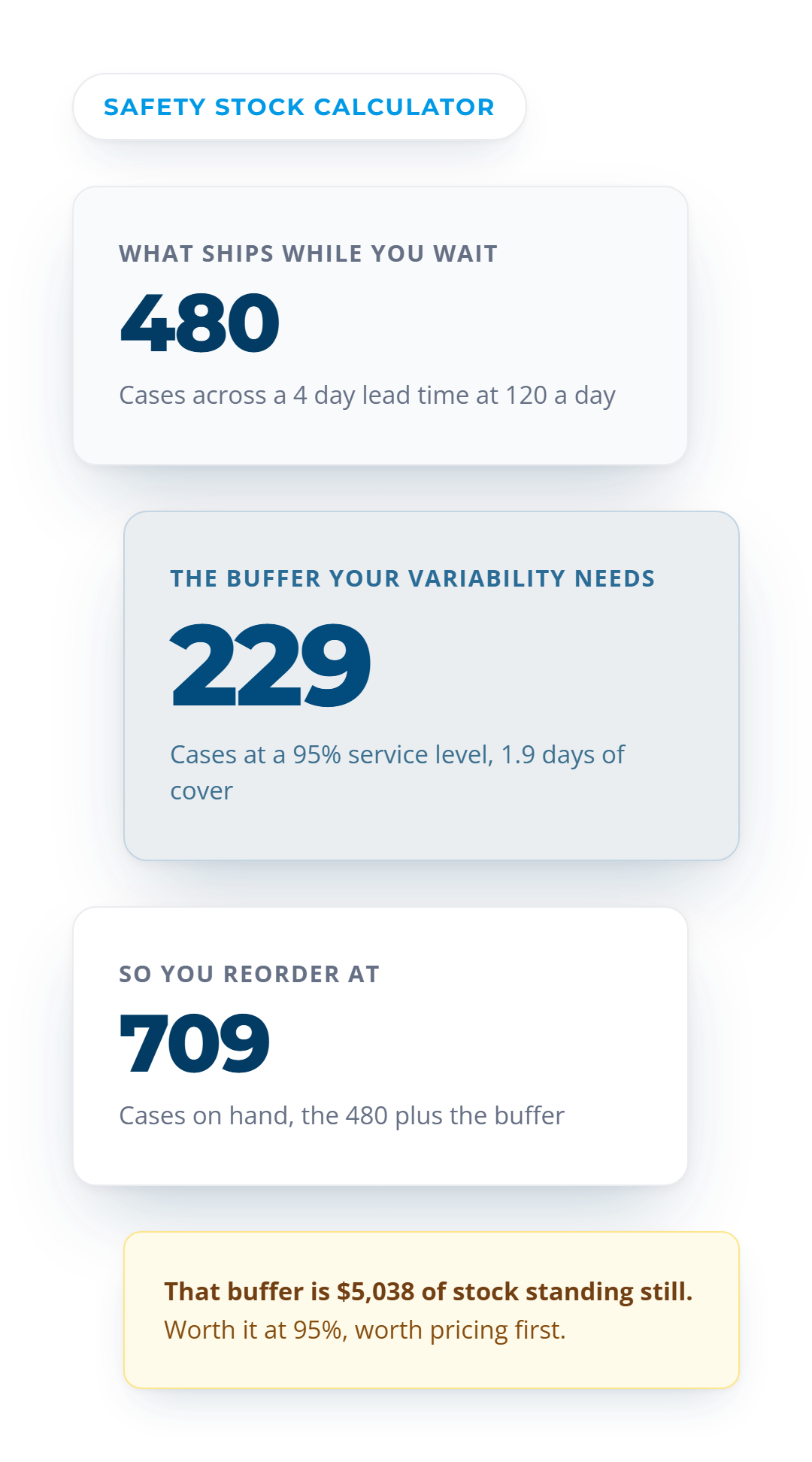
229 cases
Buffer on top of what you expect to sell
Reorder point
709 cases
Place the order when stock drops to here
Cash tied up in the buffer
$5,038
Sitting on your shelf, not in your bank
Extra days of cover it buys
1.9 days
How long the buffer alone lasts at average demand
Expected demand during lead time
480 cases
What normally sells while you wait
Stockout risk per cycle
5.0%
Cycles where you run short before delivery
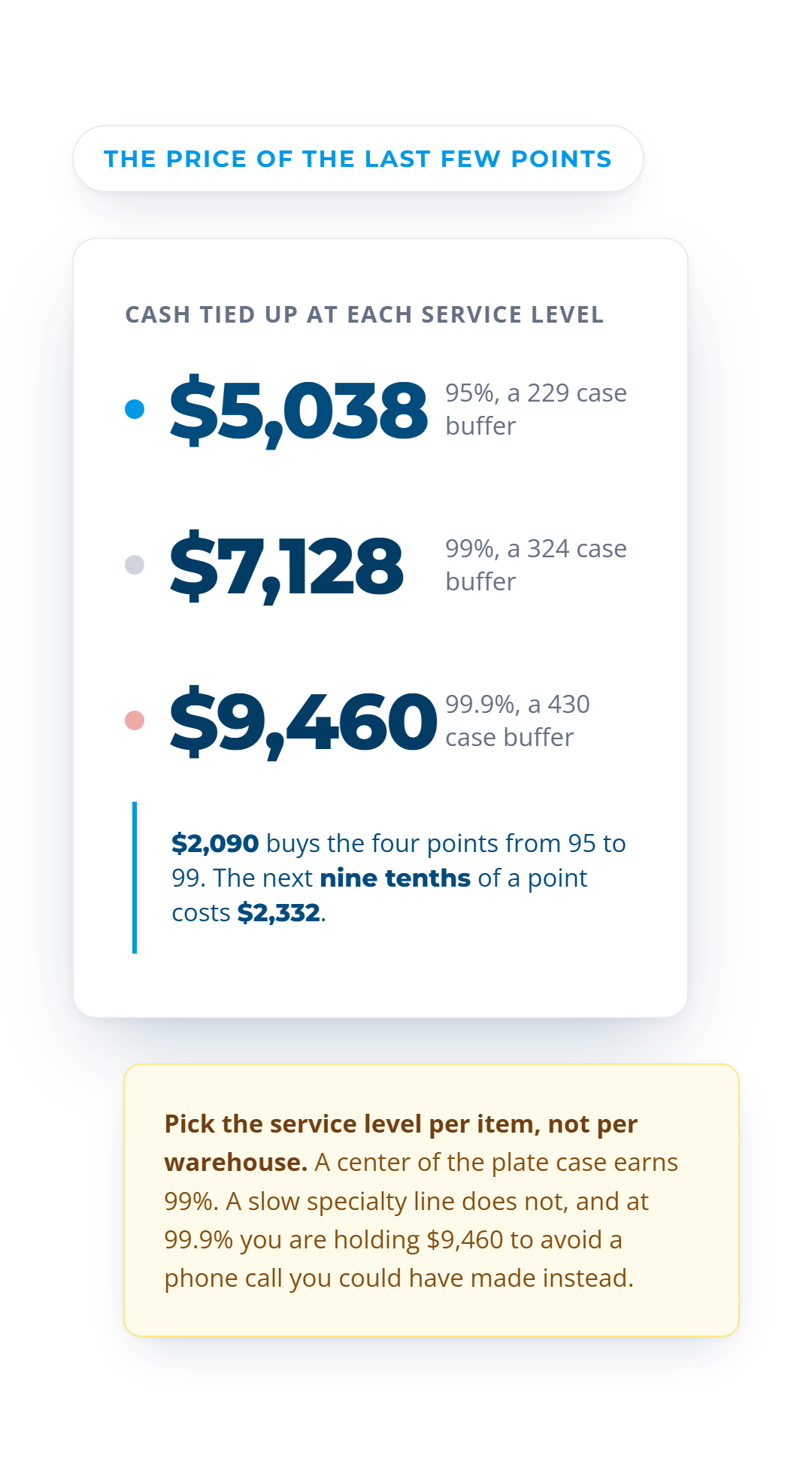
At a 95% service level you still run short on about 1 order cycle in 20. Pushing to 99% takes your buffer to 324 cases and ties up $7,128, so the last few points of service are the expensive ones.
Safety stock math only works if your stock counts are right.
VoiceOrder Solutions keeps inventory updating in real time as orders come in, and flags low stock before it costs you an account.
Estimates only. Assumes demand and lead time vary in a roughly normal pattern. Check the numbers against your own history before you change a reorder point.
229
Cases of buffer at a 95% service level
709
Cases on hand when you reorder
$2,332
What the last 0.9 points of service costs
Sound Familiar?
A bigger buffer is not a better buffer
Every stockout argument ends with order more next time. That is a decision about cash and shelf life, not about caring more.
Just keep more on hand.
229 cases at $22 is $5,038 parked. Going from 95% to 99% adds 95 cases and $2,090, and you still run short one cycle in a hundred.
We want 99.9% on everything.
That is 430 cases and $9,460. The jump from 99% costs $2,332 for 0.9 points, more than the 4 points before it cost.
Half the lead time demand is close enough.
That rule says 240 cases against a real 229, which looks fine until something changes. With steady demand and a reliable supplier the right buffer is zero, and the rule still says 240.
How It Works
How to use the safety stock calculator
Four numbers and a service level. The two swings do most of the work, not the averages.
1
Enter demand and its swing
120 cases a day with a 35 case swing on a busy day. The swing drives the buffer, not the average.
2
Enter lead time and its swing
4 days, give or take a day when a supplier runs late. Both swings feed the same buffer.
3
Pick a service level
95% gives 229 cases. Check the days of cover against shelf life before you commit to it.
What You See
What the calculator shows you
Safety stock
The buffer your variability actually needs
120 cases a day, a 35 case swing and a 4 day lead time give 229 cases at 95%. That is 1.9 days of cover.
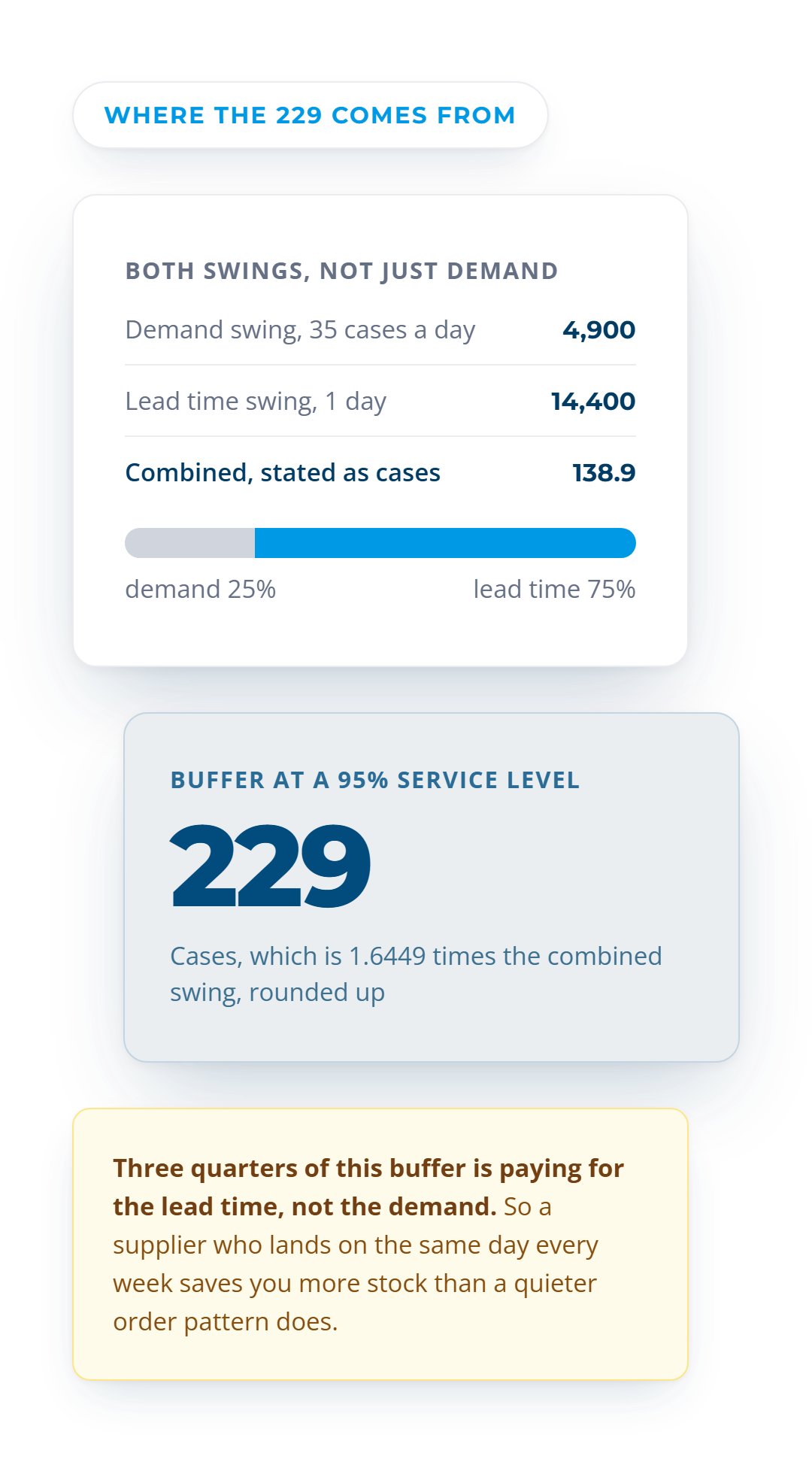
Take the square root of the lead time times the demand swing squared, plus the demand squared times the lead time swing squared. That gives a combined swing of 138.92 cases here. Multiply it by the factor for your service level, 1.65 at 95%, and you get 229 cases.
Is safety stock the same as a reorder point?
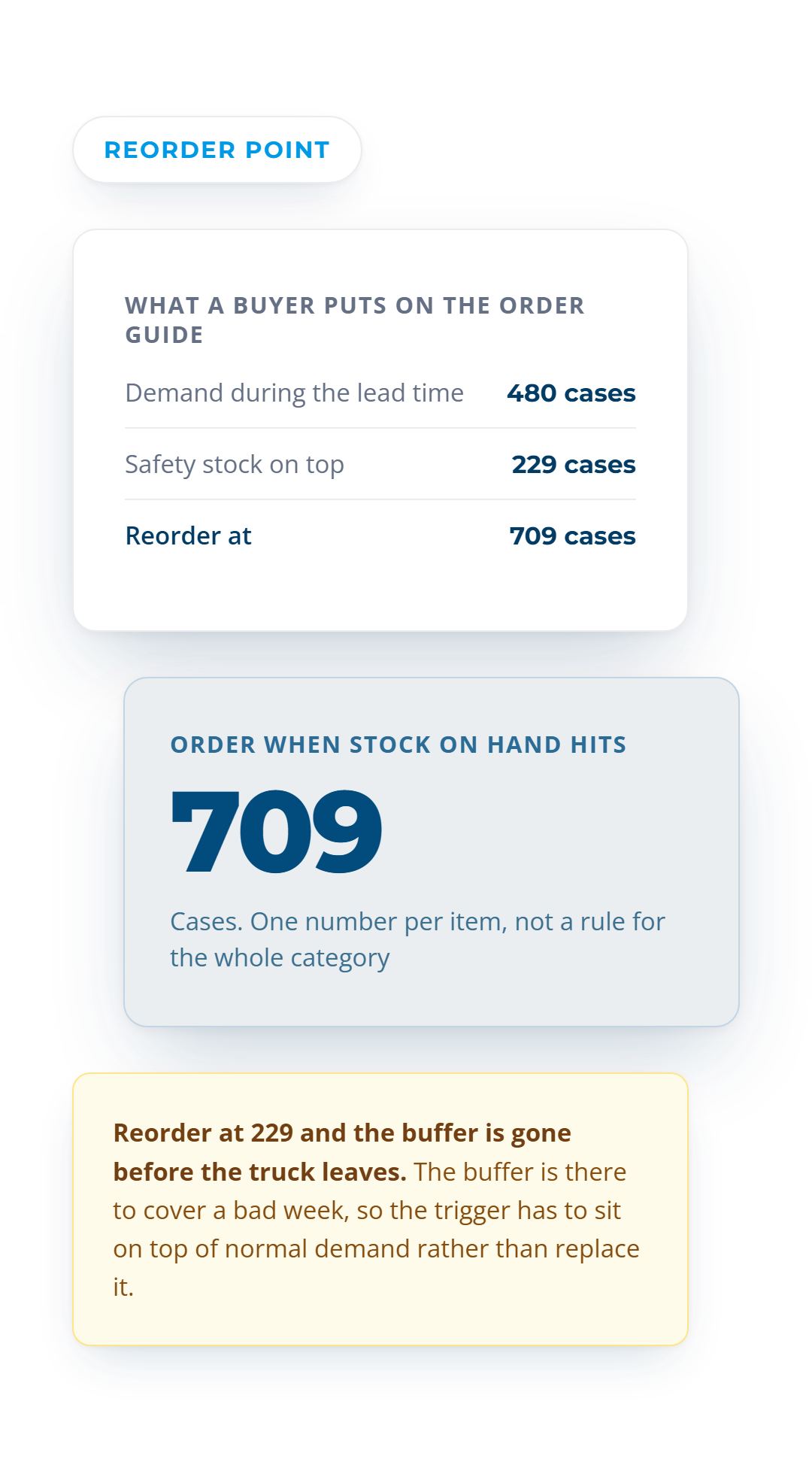
No. Safety stock is the buffer itself, 229 cases here, sized from how much your demand and lead time vary. The reorder point is the level that triggers the order, 709 cases here, because it also counts the demand you will sell while you wait. This tool sizes the buffer, and a reorder point calculator tells you when to order.
What is the 50% rule for safety stock?
It sets the buffer at half the demand during lead time, which is 240 cases here against a real answer of 229. The agreement is luck. The rule never looks at how much your demand or your lead time varies, so when a supplier becomes reliable it still tells you to hold 240 cases.
What service level should a food distributor use?
95% is a sensible starting point, and the last points get expensive quickly. Going from 95% to 99% adds 95 cases and $2,090. Going from 99% to 99.9% adds another 106 cases and $2,332, which is more money for about a fifth of the gain.
Why does shelf life limit safety stock?
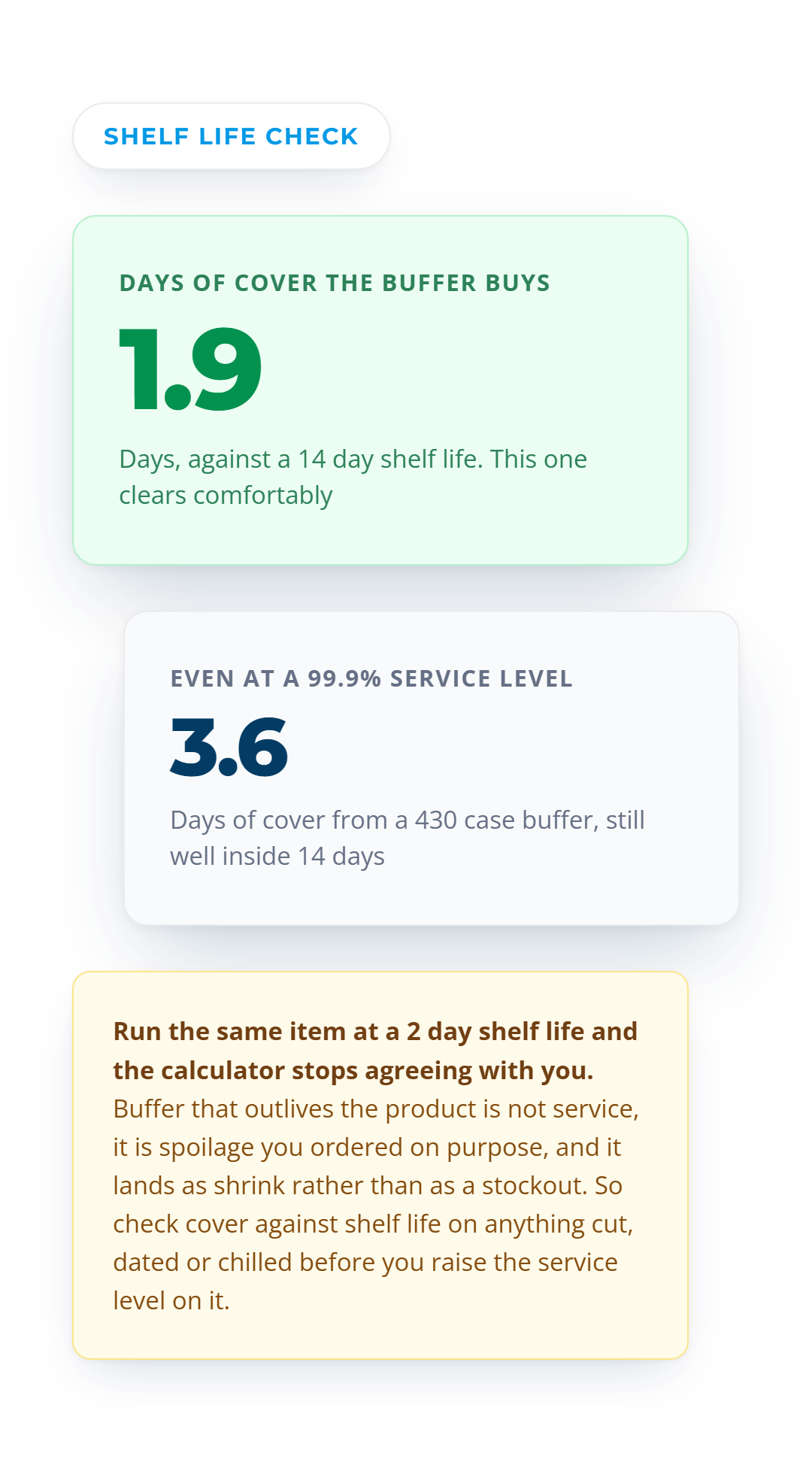
Because buffer you cannot sell in time is spoilage. 229 cases is 1.9 days of cover against a 14 day shelf life, so it clears comfortably. Raise the service level far enough on a short life item and the buffer starts outliving the product.
Does a bigger buffer always mean better service?
No, and past a point it mostly means parked cash. A flat week of stock here is 840 cases and $18,480, which is $13,442 more than the 95% answer without fixing why you ran short. Fewer stockout surprises come from steadier lead times, not from a larger pile.
What makes safety stock go up?
Four things, and only one of them is demand. A wider demand swing, a longer lead time, a less reliable supplier and a higher service level all raise it. Supplier reliability is usually the cheapest of the four to fix.
Steadier orders need a smaller buffer
VoiceOrder Solutions lets each account order against a guide built from your own SKUs and pricing, so orders arrive complete and the swing you buffer against gets smaller.
.webp)